
19
0Activity Feed
Website Updates – Part 2
 ELEvgenii Lepikhin
### Website Update: Enhanced Features for Users * Mirror site for Russian users * Invitation-free registration * Internal link support for streamlined navigation
And a few more important news about the site
Mirror for Russians [beta]
Since many people have problems accessing the site from Russia, it was decided to set up a mirror that should partially or completely solve the problem: https://ru.summitx.info/ru. Everything is the same, but without circumvention tools. You probably saw a pop-up message about this mirror when you visited the site. To make it easier to remember the address, a link has been added to the Russian version of the site in the footer.
Registration without invite codes
Now you don't need an invite to register on the site! But you can still enter a friend's invite during registration to support their rating.
Internal links
To make it easier to link to routes, peaks, passes, or articles from articles and comments, support for internal links has been added. Simply insert a link to the desired object into the text, so that readers see a well-formatted link with the language already substituted, which is convenient for them. A few examples: https://summitx.info/ru/routes/58783382/about https://summitx.info/ru/objects/ranges/12443833/about https://summitx.info/ru/objects/peaks/12739493/about
Website Updates – Part 1
ELEvgenii Lepikhin
Users of the site can now edit mountaineering routes, add descriptions and draw tracks on the map, as well as create new routes.
Now every user of the site can edit alpine routes and add their own.
- In addition to the impersonal official name "via the right couloir of the S wall", you can add a folk name that is known to everyone.
- You can draw a route thread, and it will be displayed on the map.
- Write a detailed description of the route, with pictures, etc. It is important not to confuse this with reports and articles. This is precisely a general description of the route. An example of a more or less edited route: https://summitx.info/ru/routes/58844991/about
How to edit a route
Click the edit button on the route page:
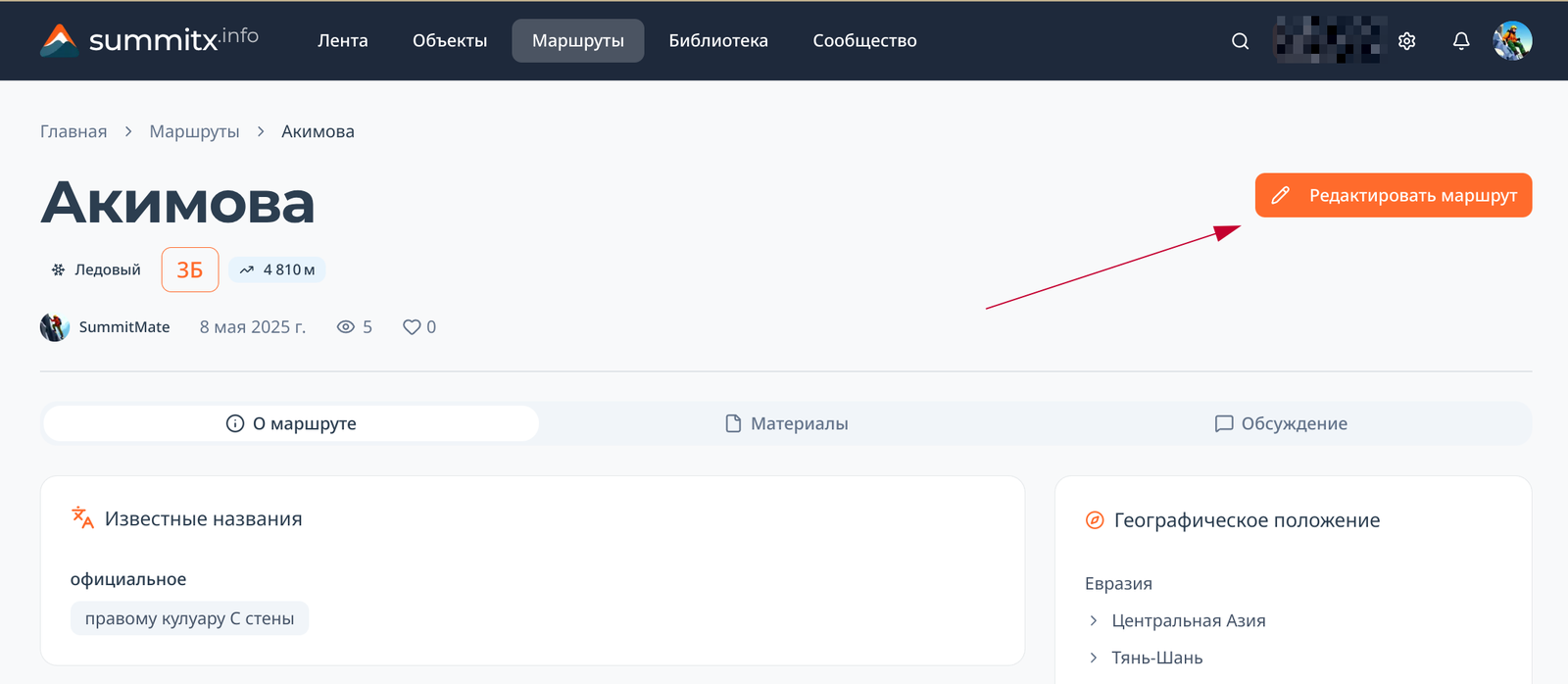 You will be taken to the draft edits page. The draft can be saved and you can return to editing it later using the same button, or from your personal account.
To draw or edit a route line, on the card with the map, you need to click the edit button (1), after which you can simply click on the map to add, delete or move points:
You will be taken to the draft edits page. The draft can be saved and you can return to editing it later using the same button, or from your personal account.
To draw or edit a route line, on the card with the map, you need to click the edit button (1), after which you can simply click on the map to add, delete or move points:
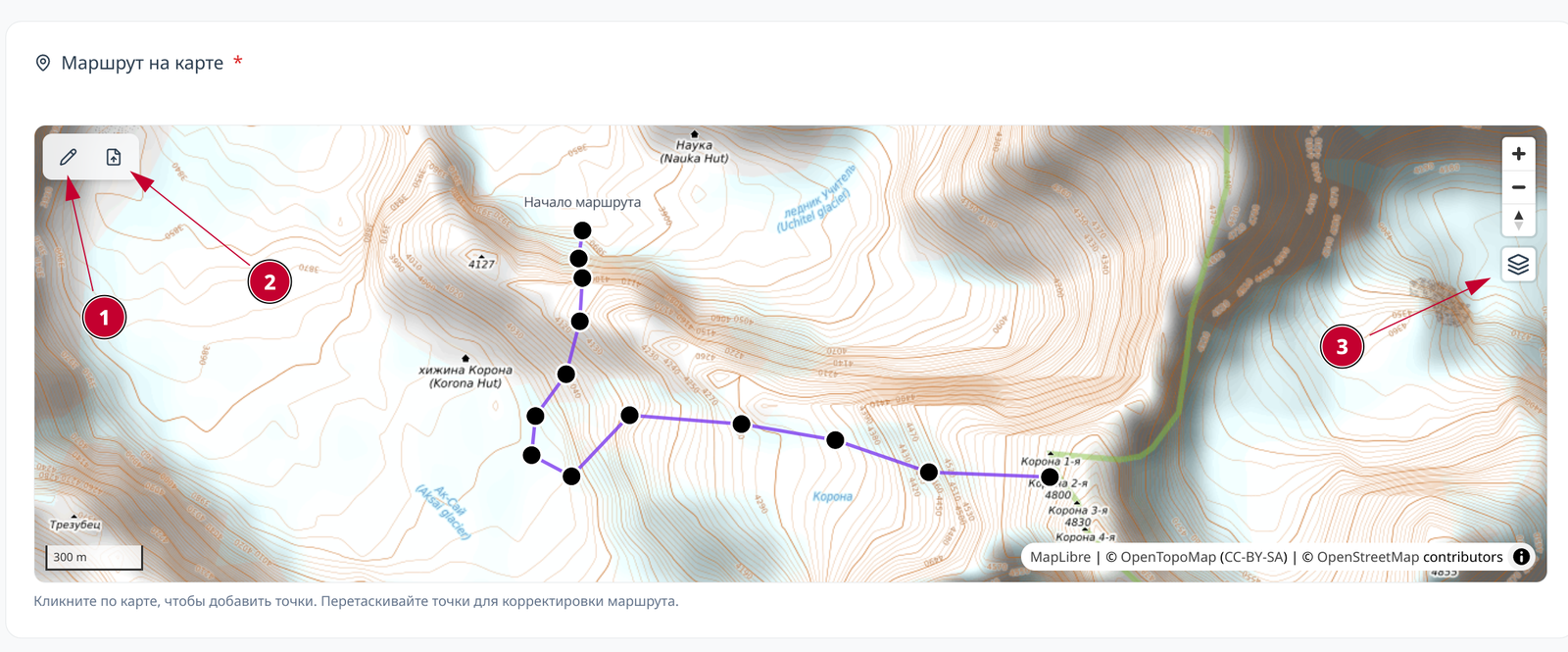 By the way, take a look at the other buttons:
12
1Accidents on Hiking Trips. Part 4. Adding and Subtracting Risks.
 ЛФЛеопард Фил
The equation of risks in alpinism is examined, along with the impact of inherent and generated risks, and the role of experience and equipment.
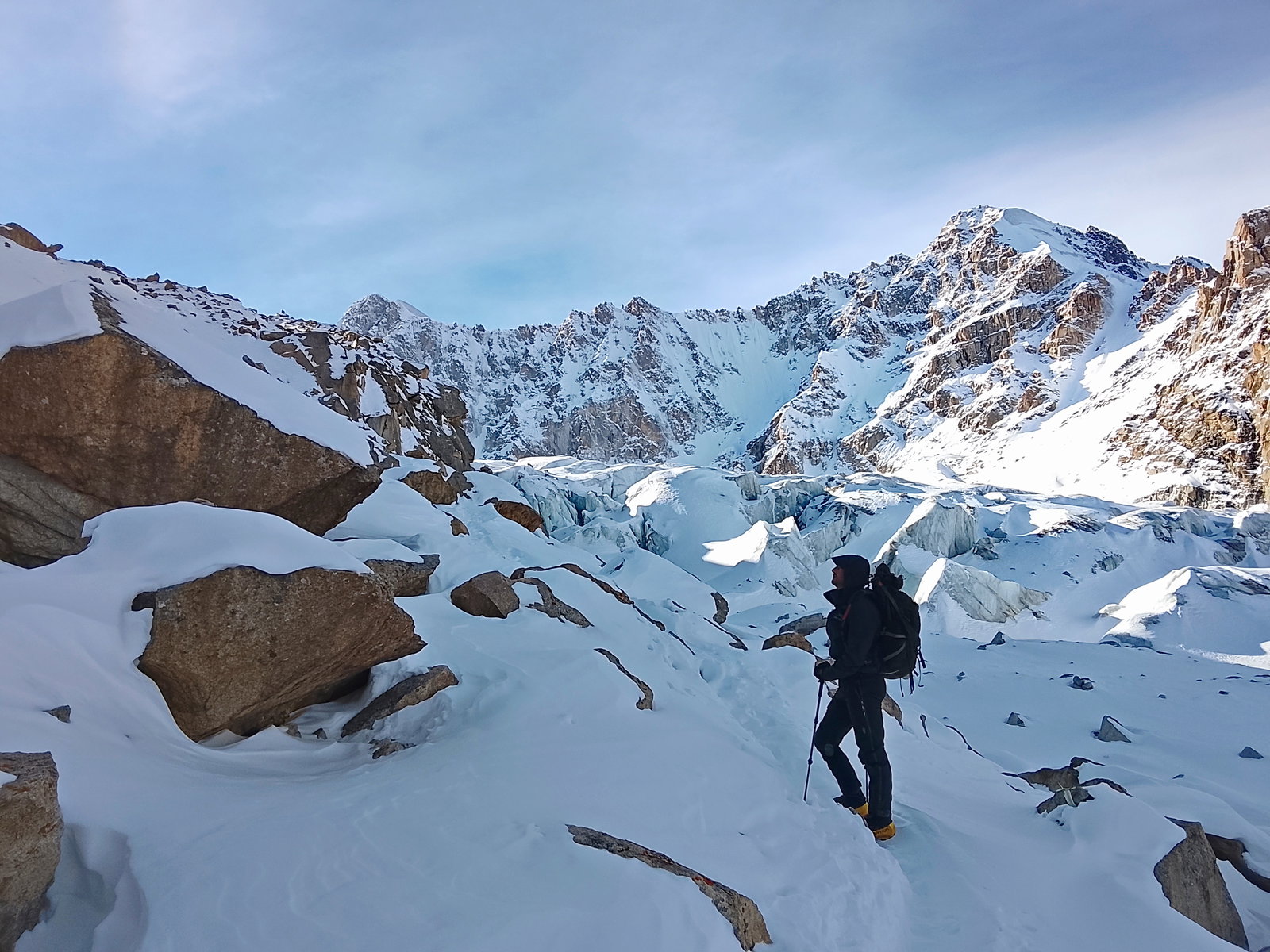 Before we move on to the chapter where we'll examine a more complex risk equation than the classical one, and analyze the role our experience plays in it, let's first clarify the concepts of risk addition and subtraction.
Risk addition poses a specific problem that warrants separate consideration.
We have inherent risks and generated risks. They can lead to events. From the chapter on risks, we've learned the following:
A) Events are inevitable
B) Risks always add up
The fewer the sum of risks, the lower the impact of the event on us. However, the force of the event may initially exceed our capabilities.
Let's start with an example: we're crossing a pass, and a rock falls on our head.
It's known that many tourists have crossed passes without ever being hit by a falling rock. Nevertheless, empirical experience shows that if a tourist hikes passes of category 1B...2A and above every year for 15 years in different regions, it's almost certain that they'll be hit by something falling from above at least once. Maybe a carabiner, ice axe, or a partner's boot. Or even crampons. Very rarely - intentionally )) If someone claims it hasn't happened to them, it means they just don't remember the last time it did. For an experienced tourist, selective memory loss is normal.
The same empirical experience of hiking in the same region over many years shows that there are years when everything is falling apart, even things that previously seemed reliable and stable.
Before we move on to the chapter where we'll examine a more complex risk equation than the classical one, and analyze the role our experience plays in it, let's first clarify the concepts of risk addition and subtraction.
Risk addition poses a specific problem that warrants separate consideration.
We have inherent risks and generated risks. They can lead to events. From the chapter on risks, we've learned the following:
A) Events are inevitable
B) Risks always add up
The fewer the sum of risks, the lower the impact of the event on us. However, the force of the event may initially exceed our capabilities.
Let's start with an example: we're crossing a pass, and a rock falls on our head.
It's known that many tourists have crossed passes without ever being hit by a falling rock. Nevertheless, empirical experience shows that if a tourist hikes passes of category 1B...2A and above every year for 15 years in different regions, it's almost certain that they'll be hit by something falling from above at least once. Maybe a carabiner, ice axe, or a partner's boot. Or even crampons. Very rarely - intentionally )) If someone claims it hasn't happened to them, it means they just don't remember the last time it did. For an experienced tourist, selective memory loss is normal.
The same empirical experience of hiking in the same region over many years shows that there are years when everything is falling apart, even things that previously seemed reliable and stable.
27
0Accidents on Hiking Trips. Part 3. Events.
ЛФЛеопард Фил
Analysis of events and event loops in alpinism and sports tourism, including classification by discreteness, consequences, and duration of impact.
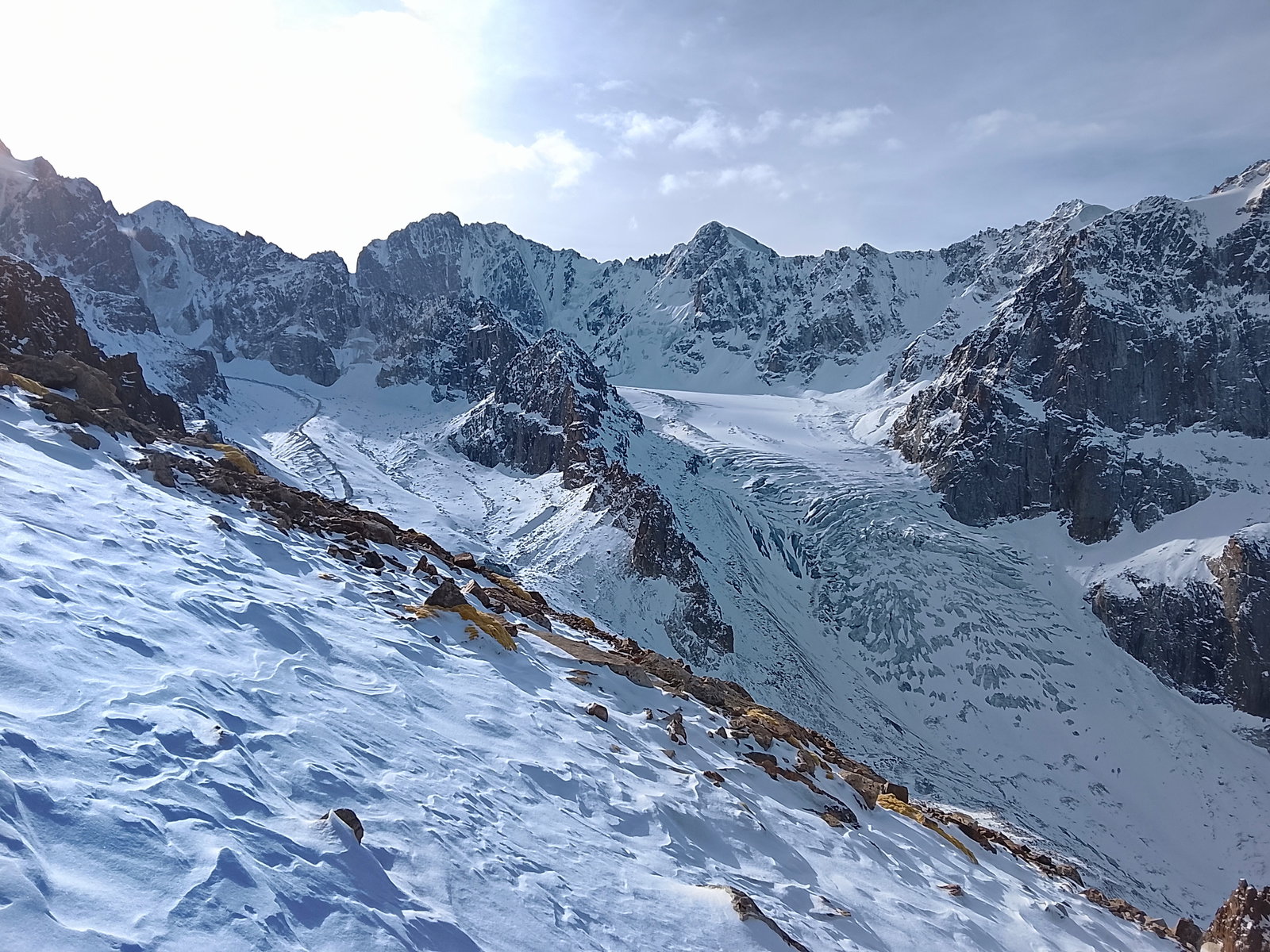 In the previous chapters, we examined the combination of processes that can lead to events on a route.
We found that risks are at the root of everything. Risks represent a condition that, if it occurs, has the potential to negatively impact a group.
Risks are "before the fact." When we work with risks as uncertain conditions, the event has not yet occurred. Our actions and decisions on the route are always accompanied by risks. They either generate them or, conversely, reduce the likelihood of an event by eliminating the conditions for their occurrence.
In most cases, an accident is either caused or accompanied by our actions and decisions - risks. However, our actions and decisions can also prevent an accident or reduce its severity. The nuance is that the negativity of a decision or action is only known after the fact - and often the mistake is not acknowledged; good decisions and actions, on the other hand, mostly go unnoticed because the event did not occur. This contradiction affects the further application of experience. Solely positive experience does not provide an understanding of the boundaries within which decisions and actions are most effective. Nevertheless, negative experience without recognition and analysis of mistakes leads to a similar result. In this regard, the described version of negative experience is much more dangerous than solely positive experience.
Thus, risks create conditions for events to occur. Risks come from both the team itself - generated risks, and from the environment - inherent risks.
An event is a direct negative impact on the group. That is, when a storm tears a tent, an event occurs, resulting from an environmental factor. The death of one of the participants due to hypothermia in a torn tent is another event.
A storm here represents an environmental phenomenon; it becomes an event when it transfers the system to a worse state.
In the previous chapters, we examined the combination of processes that can lead to events on a route.
We found that risks are at the root of everything. Risks represent a condition that, if it occurs, has the potential to negatively impact a group.
Risks are "before the fact." When we work with risks as uncertain conditions, the event has not yet occurred. Our actions and decisions on the route are always accompanied by risks. They either generate them or, conversely, reduce the likelihood of an event by eliminating the conditions for their occurrence.
In most cases, an accident is either caused or accompanied by our actions and decisions - risks. However, our actions and decisions can also prevent an accident or reduce its severity. The nuance is that the negativity of a decision or action is only known after the fact - and often the mistake is not acknowledged; good decisions and actions, on the other hand, mostly go unnoticed because the event did not occur. This contradiction affects the further application of experience. Solely positive experience does not provide an understanding of the boundaries within which decisions and actions are most effective. Nevertheless, negative experience without recognition and analysis of mistakes leads to a similar result. In this regard, the described version of negative experience is much more dangerous than solely positive experience.
Thus, risks create conditions for events to occur. Risks come from both the team itself - generated risks, and from the environment - inherent risks.
An event is a direct negative impact on the group. That is, when a storm tears a tent, an event occurs, resulting from an environmental factor. The death of one of the participants due to hypothermia in a torn tent is another event.
A storm here represents an environmental phenomenon; it becomes an event when it transfers the system to a worse state.
36
0Video Guide to "Mobilnye" Route (5A) on Korona by Dima Pavlenko
ELEvgenii LepikhinVideo guide to the "Мобильных" route (5A) to the first Korona tower by experienced alpinist Dima Pavlenko.
Video guide to the "Мобильных" route (5A) on the first tower of the Crown by Dima Pavlenko.
Loading video...
21
0Pavlenko's Video Guide: 3A to the first tower of the Crown
ELEvgenii LepikhinVideo guide to the 3A route to the first tower of the Crown by experienced alpinist Dima Pavlenko.
Video guide for the 3A route to the first tower of the Crown by Dima Pavlenko.
Loading video...
17
0The New Year on summitx.info started with an update: a notification system has been added, allowing users to subscribe to articles about geographical objects and manage their subscriptions. The article cover system has also been revamped.
The site has undergone a New Year's update. There are many changes, and I'll cover the key ones.
Notification System
The site is gradually acquiring features that will make communication more comfortable. The introduction of notifications (the "bell" in the site header) is a logical continuation of this development. The system is quite complex, so there will likely be more work to eliminate errors. The notifications follow the site's concept - linking physically existing objects on Earth to the virtual space. Therefore, you can subscribe not just to "new articles," but to all articles posted for the peaks/routes of the Caucasus, or subscribe to new articles about a mountain or even a specific route that interests you.
Subscribing to a Mountain Region/Peak/Route
On the geographical object's page, you can subscribe to articles about it and all its child objects. For example, by subscribing to "Central Caucasus," I will receive notifications about stories about Bezengi, descriptions of new routes on Ushba, etc.
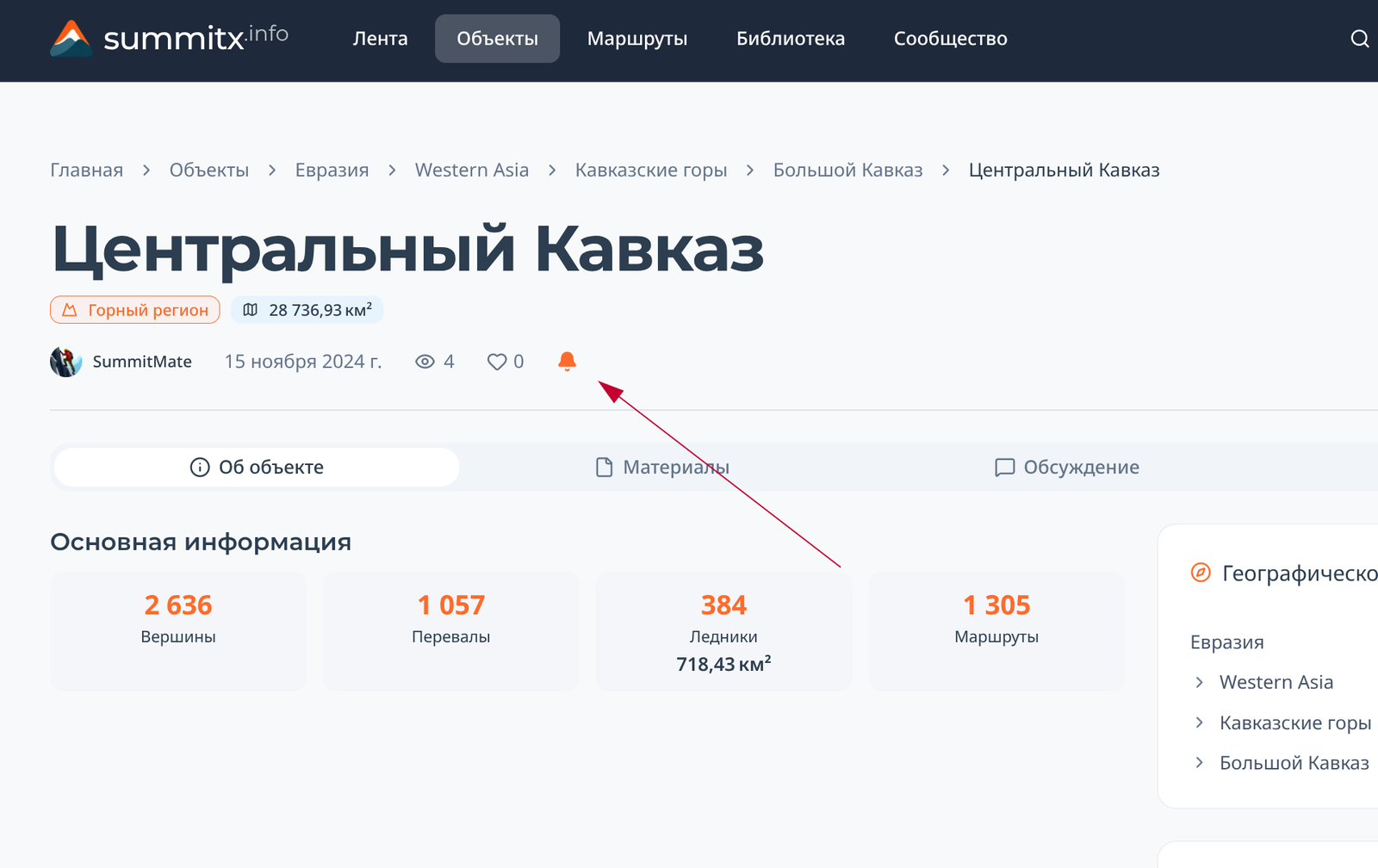
Subscribing to a Library Section
A subscription button for new articles in the library has appeared on the section page:

Subscribing to a Forum Section
16
0Pavlenko's Video Guide: "Rechki" Key, 4B on Mt.Baychechekhey
ELEvgenii LepikhinVideo guide to the "Rechka" route (4B ice climbing grade) on Pik Baychechekhey with a demonstration of climbing the key wall.
Video guide to the "Rechka" route (Ilyushenko, ice 4B) on Peak Baychechekey by Dima Pavlenko. Captured work on the key wall.
Loading video...
39
0Pavlenko's Video Guide: 3A on Ratsek via the Western Ridge
ELEvgenii LepikhinVideo guide to ascending Peak Ratsek via the Western Ridge (Route 3A) by experienced mountaineer Dima Pavlenko.
Video guide to Route 3A via the west ridge to Peak Ratzek by Dima Pavlenko.
Loading video...
27
0Pavlenko's Video Guide: 2B on Ratsek via North Ridge
ELEvgenii LepikhinVideo guide to Route 2Б to Peak Ratzek via the northern ridge by experienced mountaineer Dima Pavlenko.
Video guide for the 2Б route via the north ridge to Razek Peak by Dima Pavlenko.
Loading video...
20
0Showing 21–30 of 7076 results