
5
0Activity Feed
Nepal: Climbing Everest Only After 7,000 Meters
 ELEvgenii Lepikhin
Nepal introduces new rules for climbing Everest: climbers must first ascend a 7,000-meter peak in Nepal to prevent inexperienced climbers from attempting the ascent.
New Everest Climbing Regulations: Climbing a 7,000-meter Peak in Nepal First is Now Mandatory
 Nepal's National Assembly has passed a new tourism bill that requires climbers to first ascend a 7,000-meter peak in Nepal before tackling Everest. This new regulation aims to deter inexperienced or unprepared climbers from attempting the mountain and to develop the expedition business in the country.
Every year, new regulations are proposed for trekking and mountaineering in Nepal, and now they are on the verge of becoming national law. The requirement for climbers to have prior experience ascending a 7,000-meter peak in Nepal before attempting Everest is the most notable innovation.
Nepal's National Assembly has passed a new tourism bill that requires climbers to first ascend a 7,000-meter peak in Nepal before tackling Everest. This new regulation aims to deter inexperienced or unprepared climbers from attempting the mountain and to develop the expedition business in the country.
Every year, new regulations are proposed for trekking and mountaineering in Nepal, and now they are on the verge of becoming national law. The requirement for climbers to have prior experience ascending a 7,000-meter peak in Nepal before attempting Everest is the most notable innovation.
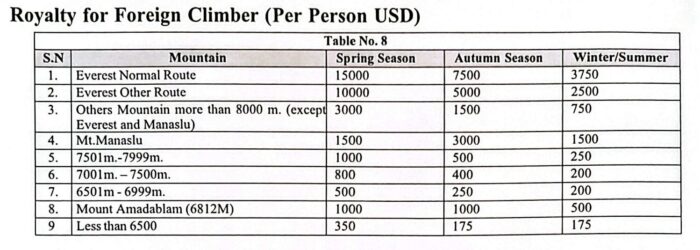
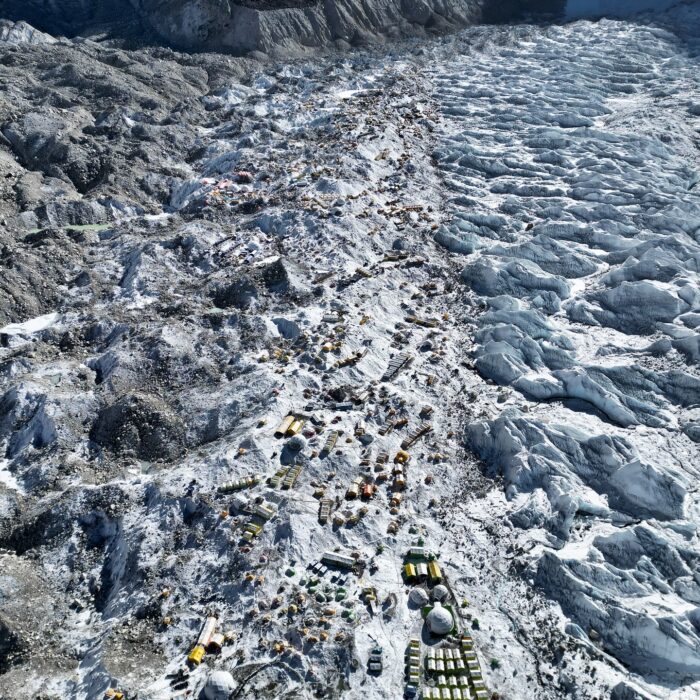 According to officials, this provision is designed to curb the growing number of inexperienced climbers attempting the world's highest peak, which often leads to congestion, accidents, and strain on rescue services. Nepal has 86 peaks between 7,000 and 7,999 meters, and the climbing fee for foreigners ranges from 500to800 during the spring season.
Some of the rules outlined in the bill have also featured in other recent ordinances, such as the requirement to provide a recent medical certificate to obtain a climbing permit. The bill also lays the groundwork for a general environmental fund that will collect money from climbers.
According to officials, this provision is designed to curb the growing number of inexperienced climbers attempting the world's highest peak, which often leads to congestion, accidents, and strain on rescue services. Nepal has 86 peaks between 7,000 and 7,999 meters, and the climbing fee for foreigners ranges from 500to800 during the spring season.
Some of the rules outlined in the bill have also featured in other recent ordinances, such as the requirement to provide a recent medical certificate to obtain a climbing permit. The bill also lays the groundwork for a general environmental fund that will collect money from climbers.
Everest: Statistics and Facts of the 2026 Season
ELEvgenii Lepikhin### Everest Statistics as of December 2025 - **Total Ascents:** 13,737 - **Total Deaths:** 339 - Notable trends include a steady **increase in climbers** and **fatalities** - The role of **supplemental oxygen** and **Sherpa support** is significant.
Overall Statistics (as of December 2025)
As of December 2025, there have been 13,737 summits of Everest, corresponding to a 43% success rate. Of those who reached the summit, 7,563 different people have stood on the top. 339 people have died on all routes. Nepal remains the more popular and more deadly side. 9,887 summits and 229 deaths were recorded on the Nepalese side, corresponding to a death rate of approximately 2.3%. On the Tibetan side, there were 3,850 summits and 110 deaths, a death rate of 2.8%. The use of supplemental oxygen remains one of the strongest predictors of survival. 180 of the 339 deaths occurred among climbers ascending without supplemental oxygen.
Tibet or Nepal?
The Nepalese side remains the most popular route and has recorded the highest absolute number of fatalities. The Tibetan side has recorded a slightly higher percentage of deaths — 2.8%, but a comparable normalized mortality rate — 1.05.
Deaths Rise with the Number of Climbers
Since 2000, Everest has experienced an unprecedented influx of climbers. 15,781 people climbed above Base Camp in Nepal from 2000 to 2025, nearly triple the total number for the previous 80 years. Throughout Everest's history (1921–2025), 339 people have died on the mountain. The average number of deaths increased to approximately seven deaths per year from 2010 to 2025.
Standard Routes — 98% vs. Non-Standard Routes — 2%
5
0UIAA: Respect for Human Dignity and Remembrance of those Lost in the Mountains
ELEvgenii LepikhinThe UIAA declaration calls on mountaineers to respect human dignity and not to publish photos of bodies of the deceased in the mountains in public without necessity.
Recently, an article appeared on the UIAA website with which I couldn't help but agree. Every time someone dies in the mountains, a wave of outrage spreads across social media: people who are not in the know post for the umpteenth time a photo of the "green boot" and discuss how inhumane climbers are for not removing another body from another eight-thousander or some extremely dangerous mountain. Please, take photos of bodies only if it is necessary for the prosecutor's office. Never post these photos publicly. I am posting the news with minimal edits.
UIAA Declaration: Human Dignity and Respect for the Dead
Discovering a body is likely to be disturbing. We must respond to this with sensitivity and common sense. The UIAA Declaration on Hiking, Climbing and Mountaineering, published in 2024, sets out the generally accepted norms of behavior that the UIAA considers optimal. This includes the ethics and style of ascents, as well as environmental and social aspects. The above quote is taken from the section “Balance between Risk, Success and Failure.” Due to climate change, the discovery of bodies on the upper slopes of high mountains is becoming more frequent. Documenting these finds has become easier thanks to smartphones with cameras. In some cases, documentation may be necessary and justified. However, it has also led to an increase in social media content, where videos of dead and dying people have sparked moral debate and raised questions about respect for human dignity. Posting graphic images without filtering or context is abhorrent and shows disrespect to the deceased and their loved ones. The UIAA, which represents member federations from more than 70 countries, recognizes that cultural and religious differences affect attitudes toward the bodies of the dead.
4
0**Beal Sunrise 92 rope recall**: defective product serial numbers and replacement procedure are listed.
The manufacturer reported defects in a batch of climbing ropes. Ropes with serial numbers 004A01235824, 005A01235824, 006A01235824, 007A01235824, 009A01235824, 012A01235824, 014A01235824 on the packaging and label with the rope type must not be used and are subject to exchange. Other ropes manufactured by the company are not affected by the recall.
5
0Mammut: Possible Malfunction in Via Ferrata Set Safety Carabiners
ELEvgenii LepikhinMammut is recalling some Skywalker Pro Via Ferrata Set safety equipment due to a potential carabiner defect that manifests at low temperatures.
If you purchased a bundle including a helmet and Via Ferrata Set, you only need to check the Via Ferrata Set and return it if necessary. All other products can be used safely.
Possible Fault
Two possible faults have been identified in the carabiner of the Skywalker Pro Via Ferrata Set safety equipment. The issues are particularly evident at low temperatures and may affect safety. The cause lies in the carabiner's plastic latches, which can slightly deform inwards due to external factors during production, transportation, or storage. Subsequent exposure to low temperatures may cause the latch to jam, restricting the carabiner's movement and preventing it from closing completely.
Check your Safety Equipment
The check applies to all Skywalker Pro & Pro Turn Via Ferrata carabiners without batch number 07/2021 or 11/2022. To ensure safety, follow these steps:
- Check the batch number on the carabiner. If it is batch number 07/2021 or 11/2022 without an additional "R", you can skip the check and return the products.
- For other batch numbers: Place the safety equipment in a refrigerator at a temperature between 0°C and 10°C.
- Leave the equipment in the refrigerator for at least 1 hour.
- Remove the equipment and immediately check the carabiner by opening and closing it several times.
5
0Defect Found in Simond Probe Ski Touring
ELEvgenii LepikhinDecathlon is recalling Simond Probe Ski Touring 240/280cm probes due to a defect that hinders proper deployment during search for someone buried under snow.
Decathlon has issued a warning about their Simond Probe Ski Touring 240cm and Probe Ski Touring 280cm products due to a detected defect. The defect may prevent the probe from deploying properly, which is critical when searching for a person buried under snow. The risk is assessed as serious. Full details can be found in the warning information sheet.
Additional Information
You can view a complete list of recalls and warnings in the special database. Source: UIAA, Communication
5
0Accidents on Hiking Trips. Part 5. The Danger Equation.
 ЛФЛеопард Фил
### Risk Analysis in Alpinism and Tourism Using an Equation Accounting for Natural and Generated Risks, Concern, and Uncertainty
 In the article continuing the topic of risks, we will examine a more complex danger equation. Based on it, we will evaluate common judgments related to sporting and commercial routes.
The article is more complex than the previous ones and is intended for an audience that does not find all the answers in guidelines and rules. It continues the ideology of the previous articles but provides a more detailed answer to the question of why we still get into accidents, even though we seem to be doing everything correctly and according to official guidelines.
In the previous chapter, we analyzed real examples of event loops - perhaps the most terrifying phenomenon on a route, when a series of unfortunate decisions traps a group in a loop where each subsequent step leads to a depletion of resources, and after a qualitative reduction, the participants perish. In two of the three cases we analyzed, the group's experience significantly exceeded the complexity of the declared route.
As harsh as it may sound, these examples divide the audience into two conditional and polar categories. The first category believes that the events of the loops were obvious from the start and that they can avoid similar situations on their routes. The other half, on the other hand, understands that we are not always able to control the situation, especially in large groups.
The division I mentioned does not depend on the experience of hiking and climbing, in terms of their quantity and quality. In this article, we will examine in detail why this is the case. However, the material is intended specifically for the second category - those who want to travel safely in conditions of high uncertainty and do not indulge in illusions of control.
In the article continuing the topic of risks, we will examine a more complex danger equation. Based on it, we will evaluate common judgments related to sporting and commercial routes.
The article is more complex than the previous ones and is intended for an audience that does not find all the answers in guidelines and rules. It continues the ideology of the previous articles but provides a more detailed answer to the question of why we still get into accidents, even though we seem to be doing everything correctly and according to official guidelines.
In the previous chapter, we analyzed real examples of event loops - perhaps the most terrifying phenomenon on a route, when a series of unfortunate decisions traps a group in a loop where each subsequent step leads to a depletion of resources, and after a qualitative reduction, the participants perish. In two of the three cases we analyzed, the group's experience significantly exceeded the complexity of the declared route.
As harsh as it may sound, these examples divide the audience into two conditional and polar categories. The first category believes that the events of the loops were obvious from the start and that they can avoid similar situations on their routes. The other half, on the other hand, understands that we are not always able to control the situation, especially in large groups.
The division I mentioned does not depend on the experience of hiking and climbing, in terms of their quantity and quality. In this article, we will examine in detail why this is the case. However, the material is intended specifically for the second category - those who want to travel safely in conditions of high uncertainty and do not indulge in illusions of control.
Simplified Risk Equation
12
0Ability to Add Regions
ELEvgenii Lepikhin
Now on summitx.info any user can add a mountain region - a valley or a gorge, which will simplify navigation and planning ascents.
Now any registered user can add valleys and gorges as mountain regions. Examples of added regions:
- https://summitx.info/ru/objects/ranges/64823512/about
- https://summitx.info/ru/objects/ranges/64824755/about
- https://summitx.info/ru/objects/ranges/64824505/about
Why this is valuable to the community
- The added region is automatically integrated into the hierarchy. All its mountains, passes, and routes are automatically linked to it. Those planning ascents, searching for routes, or studying the area will find it much easier to navigate: they can easily look up the 5As in Ak-Sai. They won't have to search for these 5As among all the 5As of the vast Kyrgyz Ala-Too range.
- The gorge gets its own page with the ability to ask questions about it on the forum, post or article specifically about this gorge.
- A visitor can easily see the boundaries of the valley, which can be especially useful for mountain tourists.
How to add a gorge or valley
It's very easy to do. A minimally formatted valley requires literally a few seconds.
15
0Safety Issues that are "Really Painful" for Russian Active Tourism
ЛФЛеопард Фил
The article discusses pressing safety issues in alpinism and tourism, including instructor certification, avalanche awareness, the culture of accident analysis, and physical training of participants.
 1) Certification of guide instructors
Essentially, a new axis of reality for active tourism is being set. As of July 2024, this has become a mandatory framework for commercial accompaniment on complex routes; the authority for certification has been given to all-Russian sports federations, there are schedules for 2025–2026, and many regions are living in "hurry to re-certify by 01.10.2026" mode. Why is this topic hot? It changes responsibility, market, tolerances, and gives rise to a new type of generated risk - "paper competence" and "checkmarks instead of skills".
2) Avalanche literacy as a necessary base, not an elective for enthusiasts
A sore topic that has worn everyone out. Strangely, in tourism, suddenly, more attention is being paid to this than in mountaineering. In mountaineering, avalanche training is traditionally embedded in the training system (initial training, "Rescue in the Mountains" badges), although the quality of this training can, to put it mildly, vary. In tourism (hiking, skiing, and mountaineering), the situation is more heterogeneous. Now, more attention is being paid to it against the backdrop of a general increase in interest in active recreation and new legislative initiatives. In some circles, this has become a topic of even more discussion due to the wider audience coverage and less initial regulation - unlike mountaineering. Although, I confess, the over-regulation of mountaineering has always caused me bewilderment. Unlike many European countries or the USA, where mountaineering is often seen as a personal matter and the responsibility of the individual (with an emphasis on insurance and private guide schools), Russia maintains a centralized sports approach. Again, suddenly, while we envy them, many European mountaineers sometimes envy us, considering our state's approach more structured and understandable. What a weird thing.
15
0New alpine route: Fedorov
ELEvgenii LepikhinDifficulty:4А / D-
Route type:Ice
Maximum elevation:
4810 mPasses through:Korona Peak
Kyrgyzstan → Uchitel glacier and Korona ridge area
One of the most popular routes to the Corona peak crest wall. It starts from the bergschrund, from which there are about 450 meters of even ice to the ridge. On the penultimate rope of the route, there is a small ice ridge, which is a bit more complicated than the main section of the route. The start of the route is 70-100 meters to the right of the https://summitx.info/en/routes/58844837/about route. In the Russian official classification, both these routes are considered variants of the same route.
21
Showing 11–20 of 7076 results