
Passport
I. High-altitude technical category
2. South-Western Pamir
3. Peak “Tajik State University” via the central route on the right part of the E. wall (V.Smirnov's route)
4. Proposed — 6B category of difficulty, second ascent
5. Height difference: 1250 m, length — 1340 m
Length of sections with 5–6 category of difficulty — 1020 m. Average steepness — 73°. 6B category of difficulty — 380 m.
6. Pitons driven:
| Type | New | Previously driven |
|---|---|---|
| Rock | 173 | 52 |
| Bolt | 10 | 10 |
| Chocks | 111 | 42 |
| Ice | 20 | 0 |
| X — use of previously driven pitons |
7. Team's working hours: 79 hours and days — 8
8. Overnights: 1st in a tent, lying; 2–3rd in a tent, lying, platform carved on a snow-ice ridge; 4–5th in a tent, semi-reclining, platform carved on a snow-ice slope; 6th — 5 people in a tent sitting, platform carved in ice, 1 — in a hammock; 7th — 4 people in a tent sitting, 2 — in a hammock.
9. Team Leader: Kolomyitsev Vladimir Georgievich, Master of Sports
Team Members:
- Grebenshchikov Igor Evgenievich, Master of Sports
- Elagin Vasily Igorevich, Master of Sports
- Moskalev Vladimir Borisovich, Candidate for Master of Sports
- Penzov Sergey Konstantinovich, Candidate for Master of Sports
- Petrov Nikolay Evgenievich, Candidate for Master of Sports
10. Coach: Kolomyitsev Vladimir Georgievich, Master of Sports.
11. Departure to the route: July 19, 1984.
Summit: July 26, 1984.
Return: July 27, 1984.
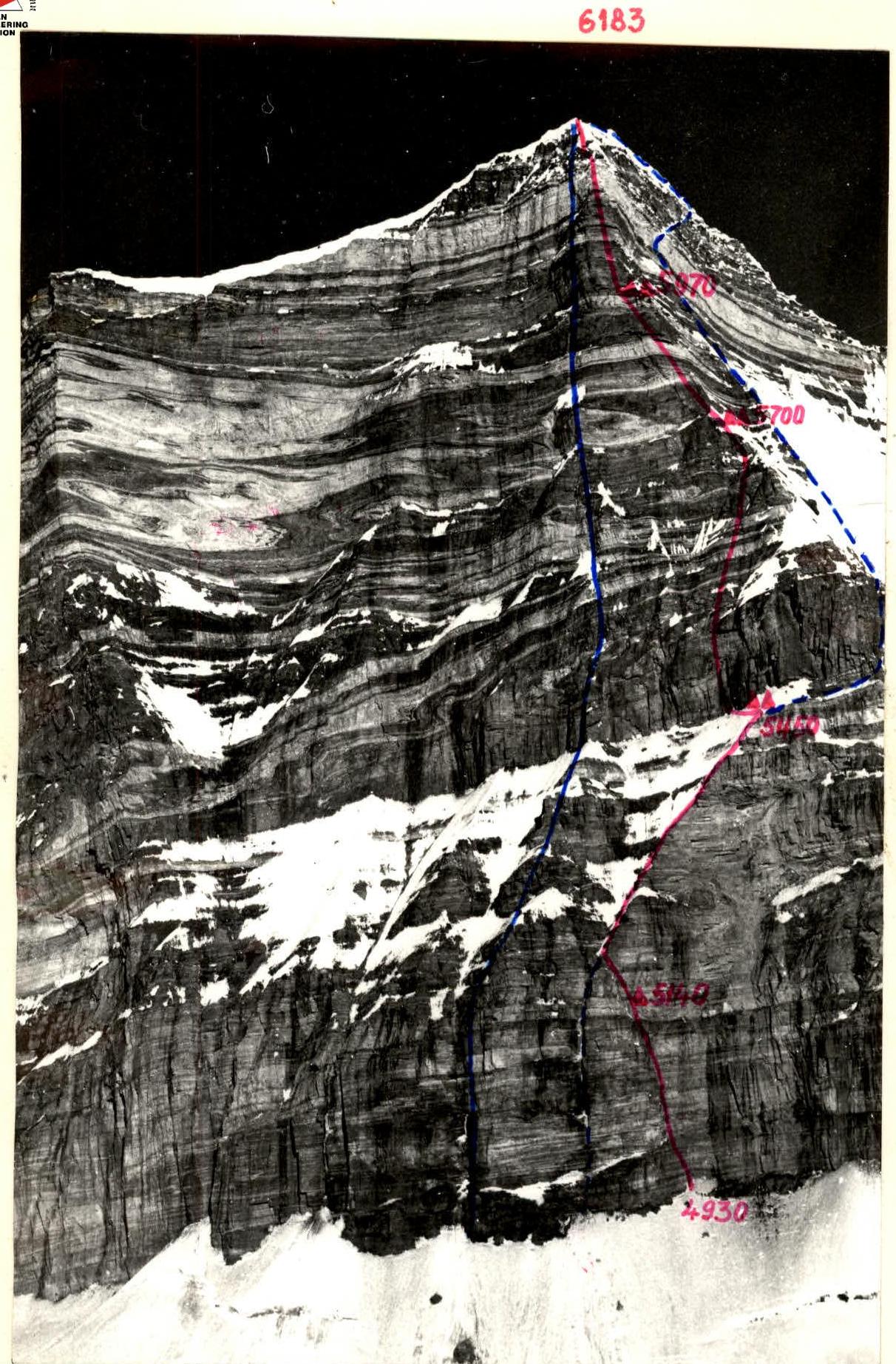
General photo of the summit, Solonnikov's route, Krasnoshchekov's route, Smirnov's route. July 18, 1984, 12:00, 90°, "Iskra" film, S=2 km, H=5200 m, T. No. 1.
The team's actions on the route were determined by the tactical plan of ascent. Almost throughout the entire route, the first climber worked on a double rope “Edelrid”. Practically all three rope teams worked first, taking turns, which allowed for an even distribution of physical and psychological load on each participant.
Since the lower part of V.Smirnov's route is objectively prone to rockfall during the day (as mentioned in the team's report and confirmed by observations of the route), the team passed this part 20–30 m to the left and reached the ridge at approximately the same point as the first ascenders (sections R0–R7). This reduced the route's danger.
As planned, the route was ascended using the tactic of processing the most difficult sections from intermediate camps (sections R14–R16, R21–R24, R30–R32), with processing carried out in generally very bad weather.
Thanks to the team's good cohesion (and, as a result, good mutual understanding), the composition of the rope teams changed during the ascent, allowing for a more even load distribution among all participants and increasing the speed and reliability of passing the most challenging sections. The leaders changed at points: R5, R7, R14, R15, R16, R18, R20, R21, R24, R29, R30, R32, R35.
Perils were set up almost throughout the entire route, enhancing the safety of the ascent. All 6 ropes taken were used for this purpose.
Overnights were organized in pre-planned safe locations under cornices or on snow-ice ridges (points R5, R14, R21, R30).
- The 1st overnight was planned on a rock shelf under an overhang, lying down.
- The 2nd and 3rd — on a snow-ice ridge under large cornices, lying down.
- The 4th and 5th — on a rib, carved on a snow-ice slope, semi-reclining.
- The 6th — carved on an ice ledge, 5 people slept sitting in a tent, 1 — lying in a hammock (see photo 12).
- The 7th — on the same spot, 4 people sitting in a tent, 2 — in a hammock.
A lightweight high-altitude tent was taken on the route, allowing participants to rest well during overnights.
The route has a height difference of 1250 m and consists of three sheer bastions made of monolithic rocks with few holds, with the difficulty and steepness of the rocks increasing with altitude. Numerous cornices are encountered (photos 5, 7, 13). To pass such sections, the entire set of modern technical means and techniques is used. The first climber works on a double rope, often using a belay station. Due to very bad weather, the first climber rarely climbs in crampons. Therefore, IT (Intermediate Technical) equipment is used more frequently than usual, including chocks, regular titanium pitons, and rigid steel pitons for micro-cracks, friends, skyhooks, etc. For artificial holds, ladders and extensions are used. Everyone ascends on jumar-climbed perils with backpacks (photos 4, 9, 10) or "American-style" (photos 3, 14). Extension ropes are rarely used. Unexpectedly, one of the key areas turned out to be the "roof" — about three ropes of snow-ice walls, cornice ridges, and "mushrooms," resembling the Cold Wall. The snow condition is extremely challenging: the snow is loose, with a steepness reaching 90° and more under a thin ice crust, featuring voids and ice bridges. To organize belays or simply move, a large amount of this snow-ice mass has to be scraped or chopped away. The first climber goes in crampons on a double rope with two impact tools. Several cornices have to be chopped away.
The descent from the summit presented no technical difficulties and was made first down an ice slope, then along the Rovny Glacier, and finally through the Nishgar gorge to the eponymous kishlak in the Panj Valley, where a vehicle was waiting. During the ascent, there were no falls, injuries, or illnesses.
Communication with the observation group on the 5200 m pass and with the base camp was carried out using a "Karat-M" radio station 3 times a day at 8:00, 14:00, 20:00 — and was regular and clear.
Observations were made (sometimes there was visibility) using binoculars. The composition of the observation group changed. It included:
- Katys M.,
- Dobriyan T.,
- Kitsis I.,
- Andrianova T.,
- Zhukov S.
The planned tactical plan was almost fully executed despite very bad weather (bad weather for seven out of eight days). A one-day delay was foreseen in the tactical plan.
The success of the plan was achieved due to:
- correctly chosen tactics;
- good sports form of the participants;
- experience of climbing in winter and in bad weather conditions.
Not a single day was lost due to waiting out bad weather on a bivouac. The ascent took 79 hours, i.e., on average, they worked 10 hours a day, covering about 170 m.
| 3 | – 1 | |
|---|---|---|
| 2 | – 3 | |
| 3 | – 2 | |
| 2 | – 2 | |
| 3 | – | |
| 2 | – 1 | |
| 5 | – 2 | |
| 4 | – 3 | 5140 m |
| 5 | – 3 | |
| 5 | – 3 | |
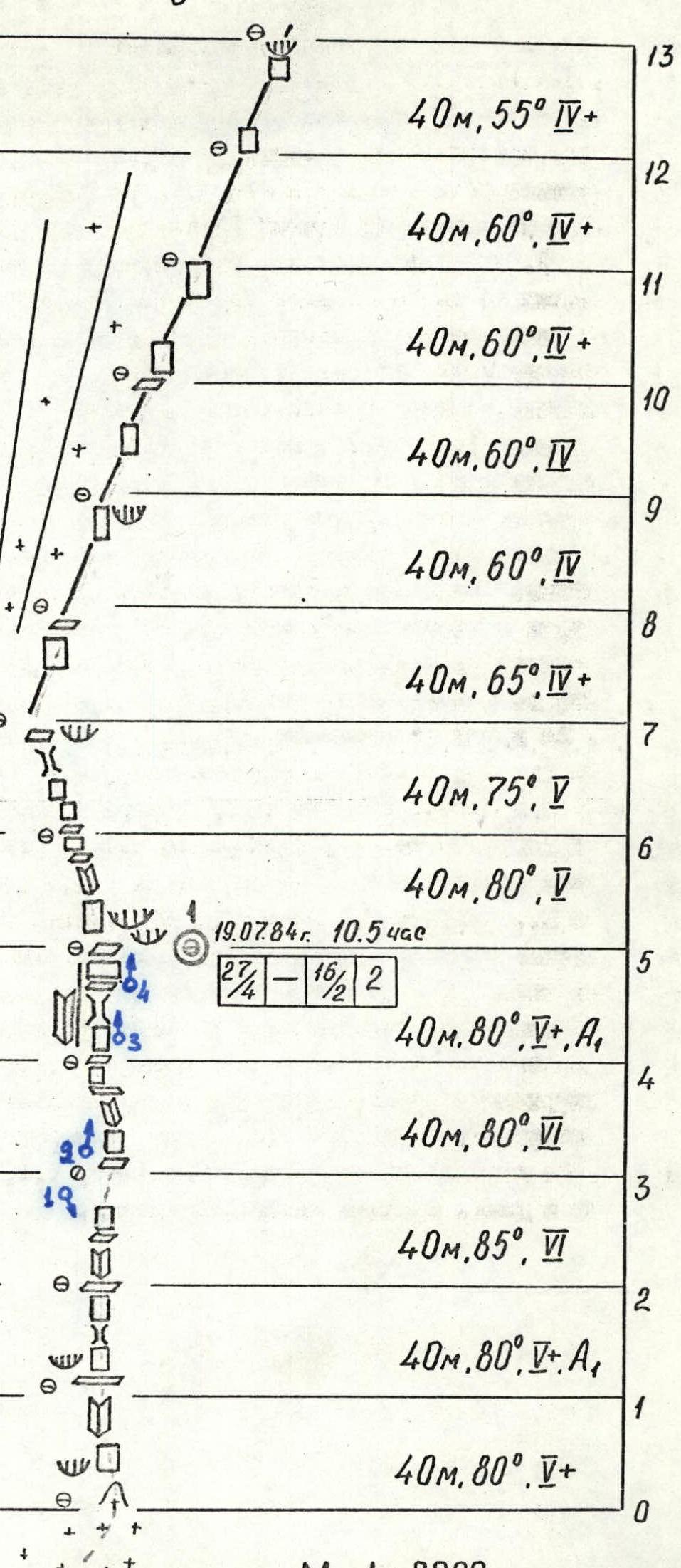 |
Photo 2. Section R3–R4.

TECHNICAL PHOTO OF THE ROUTE. "Iskra" film, July 18, 1984, 10:00, 5 x 2 km, H=5200 m, T. M.
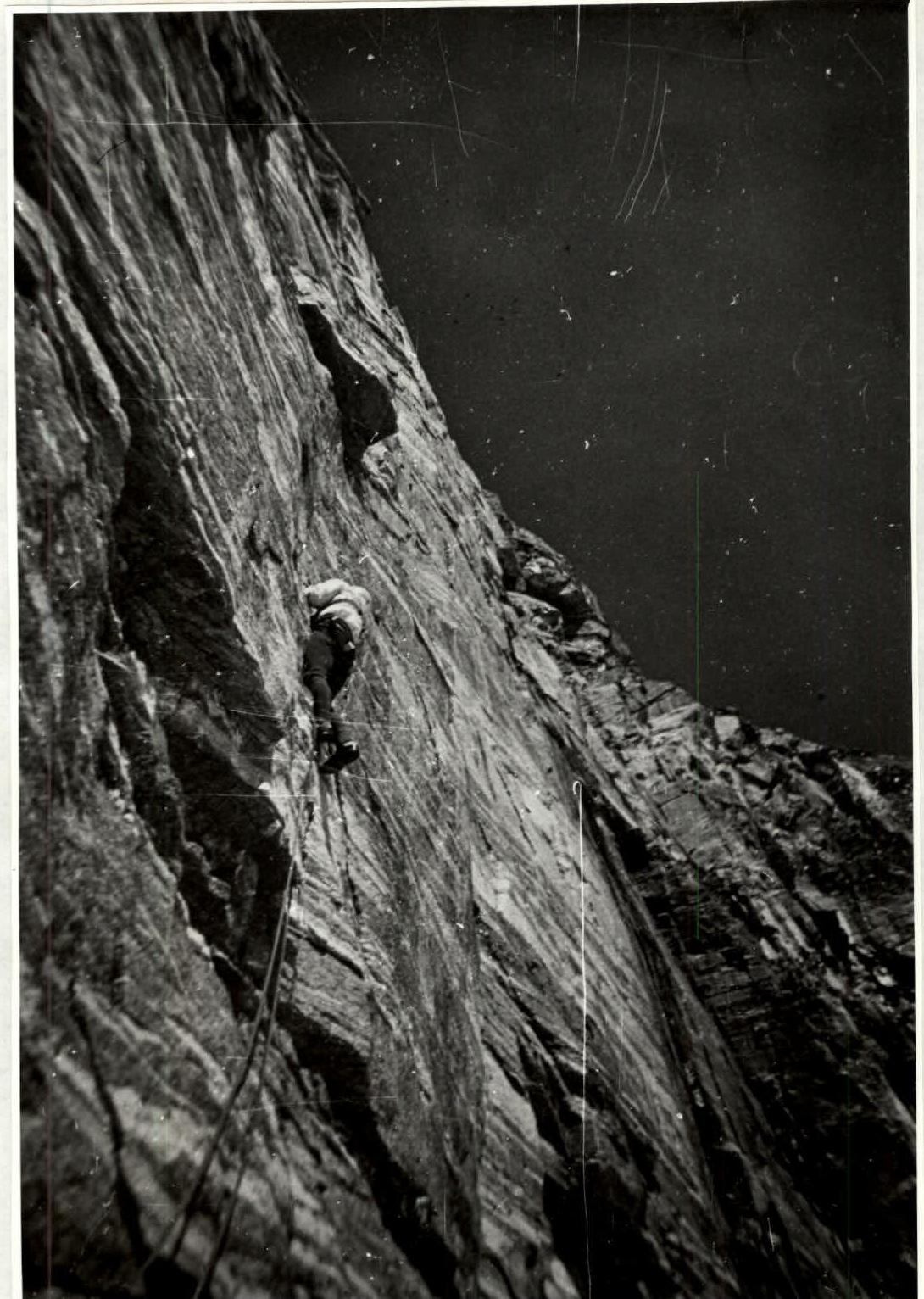
Photo 5. General view of sections R14–R17 from bivouac No. 2. Passage by processors of a cornice.
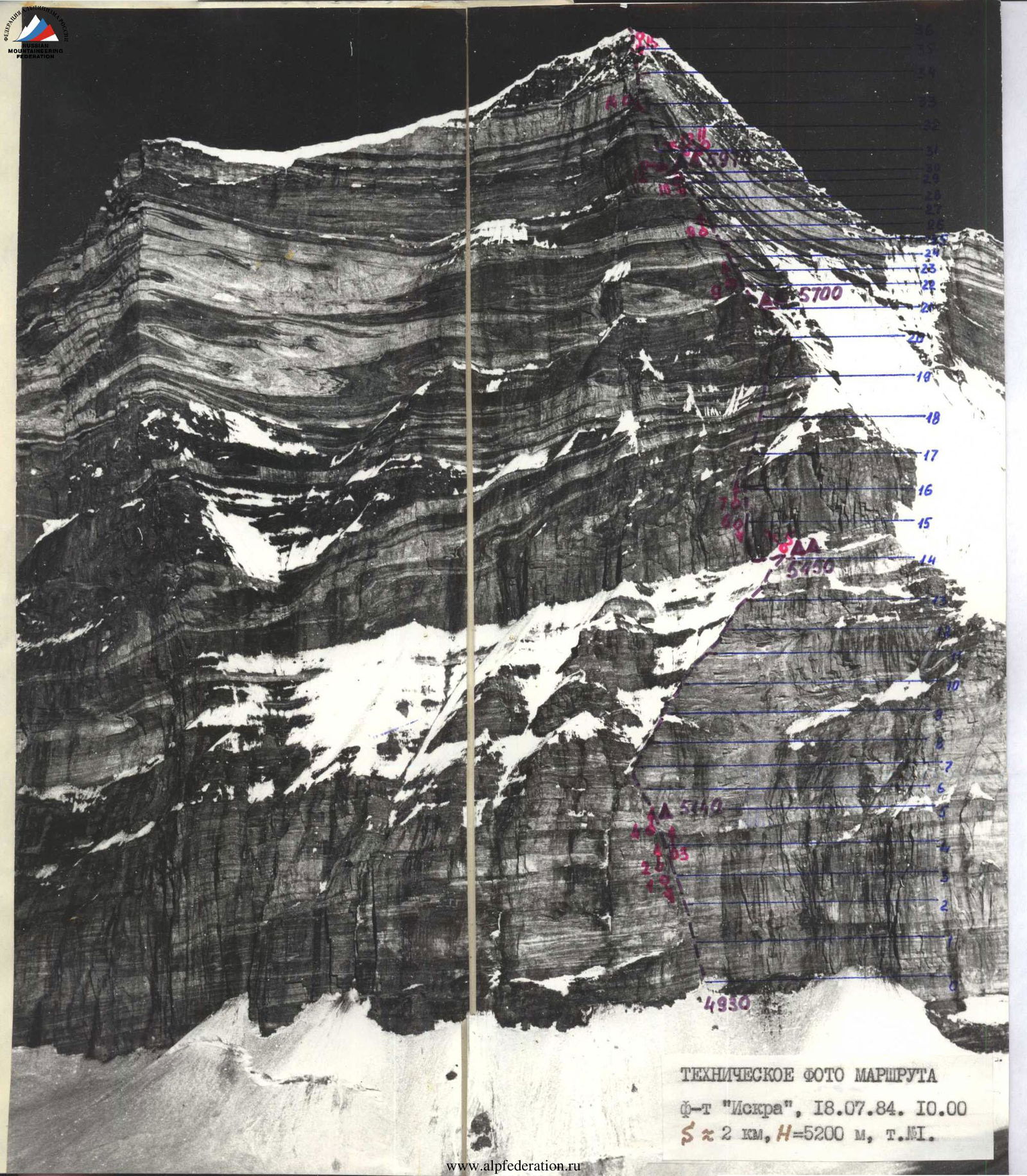
Photo 8. Section R21–R22. Processing.
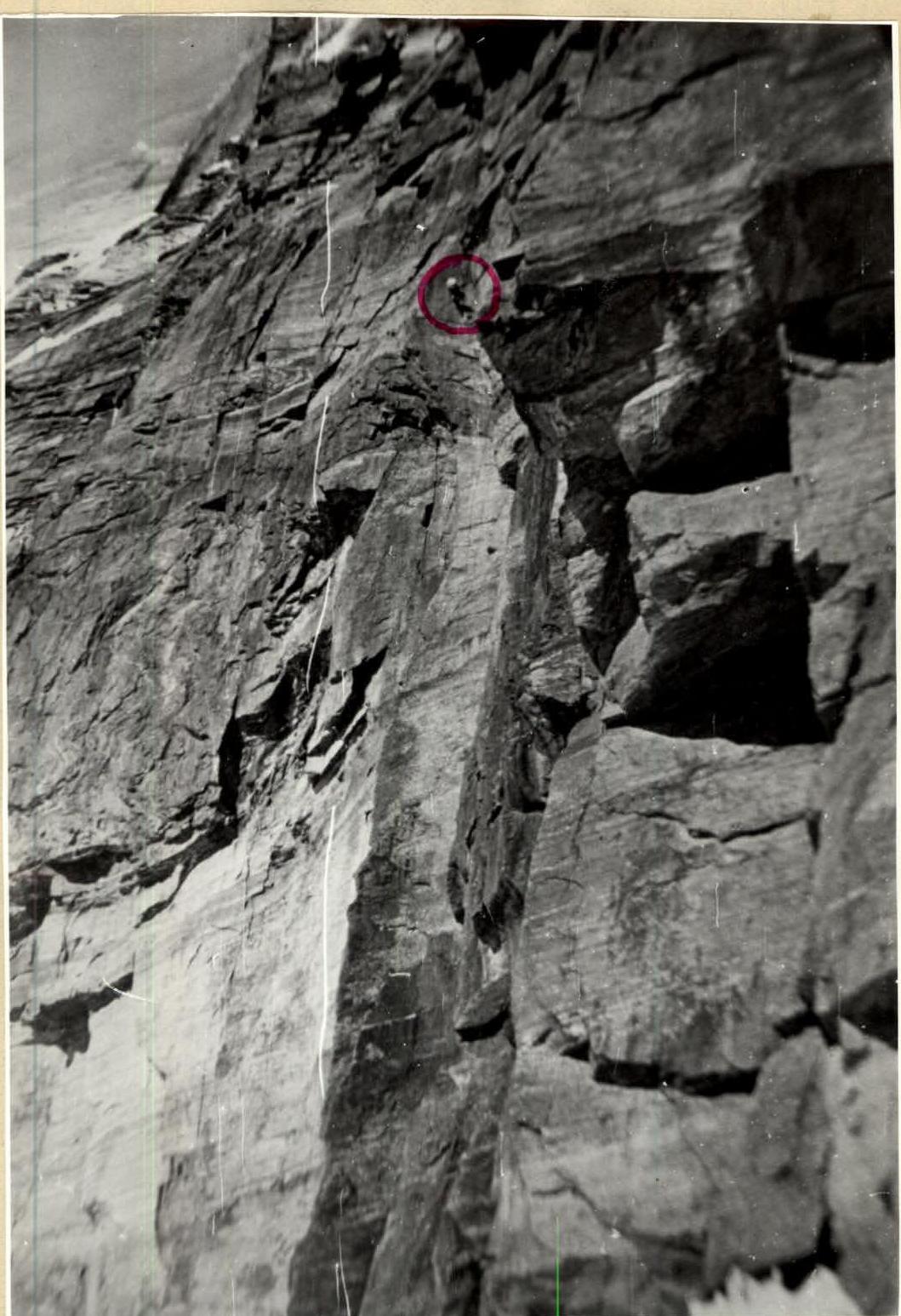
Photo 9. Sections R26–R27.
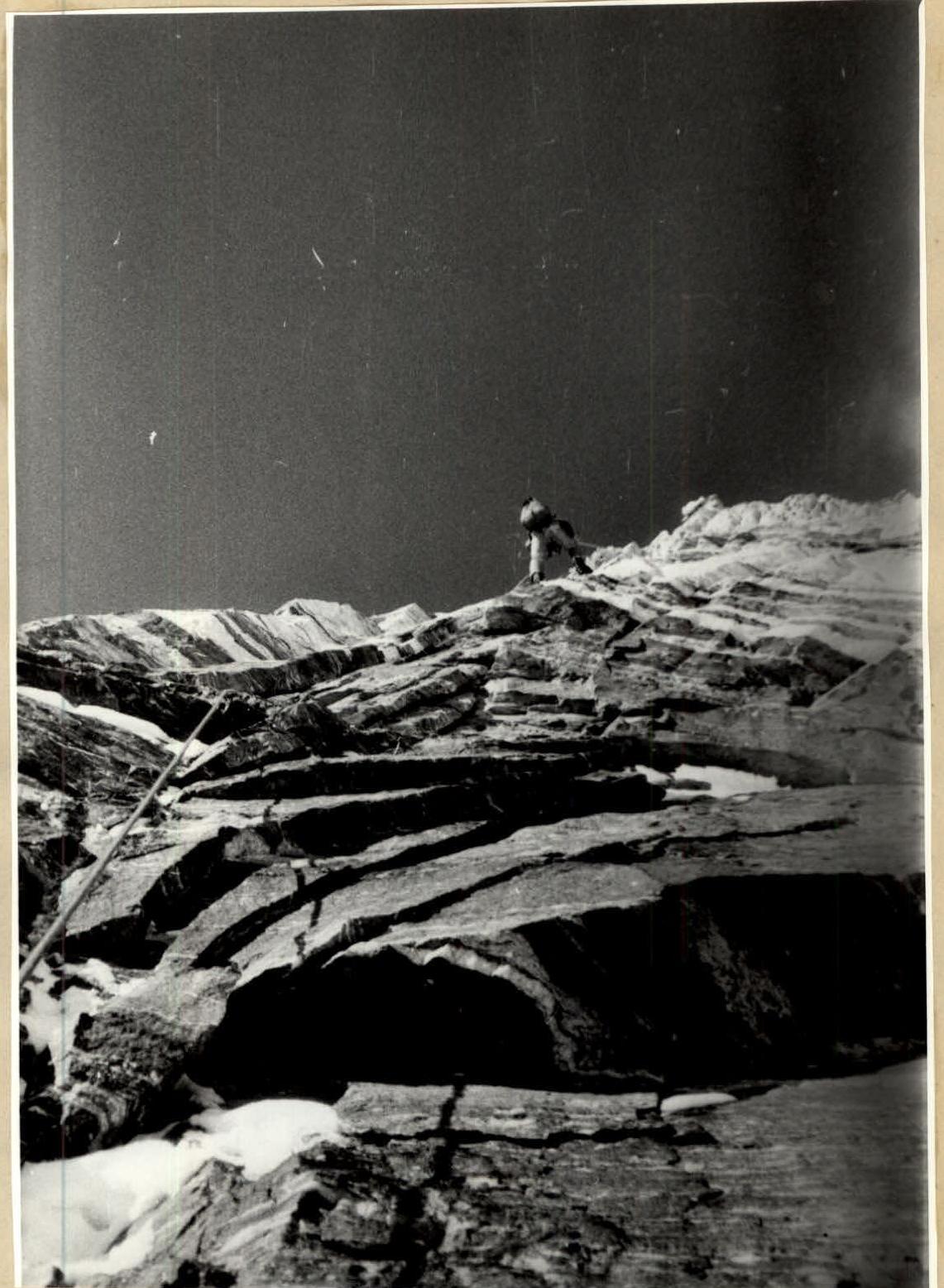
Route description by sections
Section R0–R1. The beginning of the route — a steep monolithic wall. The belay station is convenient, protected by a cornice. To the right of the cornice, up a crack in the wall for 15 m. Then a small traverse left into an internal corner leading to a shelf under a cornice. Holds are small and smooth.
Section R1–R2. The belay station is convenient, protected by a cornice. From the shelf, right up 20 m up the wall into a chimney. Chocks go in well. Then straight up a small wall onto a shelf. IT (Intermediate Technical) equipment is used to pass the walls.
Section R2–R3. From the shelf up into a steep internal corner, which is passed on the right side. Climbing is very difficult, few cracks, monolithic rocks with small holds. The internal corner ends with a small shelf at the base of a large slab with a crack at the top. Passed straight up.
Section R3–R4. Alternating steep walls with very few small holds. Climbing is very difficult and delicate. Belay is reliable on rock pitons and chocks. The belay station is inconvenient, sitting in a harness.
Section R4–R5. Straight up the wall, between a large internal corner on the left and a cornice on the right. The wall leads to a small but very steep chimney with smooth walls. On the left side, there are several cracks. Exit from the chimney onto a narrow shelf. “Live rocks!” Then up a steep wall to under a large cornice on a fairly wide talus shelf. Overnight.
Section R5–R6. From the overnight, left up (bypassing the cornice) a steep slab. The slab is passed via a crack turning into an internal corner. Chocks go in well.
Section R6–R7. The section consists of several steep walls alternating with narrow steep shelves. At the top, a cornice. Bypassing it on the left, we go up to a small shelf. A small traverse left along the shelf leads to a ridge.
Section R7–R14. The ridge is generally not steep, with fairly destroyed and snow-covered rocks alternating with small but steep and icy walls. The ridge leads under a steep rock belt. A convenient overnight spot under the protection of a cornice.
Section R14–R15. From the overnight, traverse left for 40 m to the base of a very steep internal corner with smooth monolithic walls. At the bottom, two overhanging blocks. Exit from the corner right onto a small inclined shelf. Chocks go in well.
Section R15–R16. Under the cornice straight up. The cornice is passed on the right via a crack, and then up an internal corner, bypassing the next cornice on the left. The internal corner ends with a small cornice, which is overcome in the center. Climbing is very difficult, belay — sitting in a harness.
Section R16–R17. Straight up the internal corner. There are two cornices in the section. Climbing is very difficult via a crack and in the internal corner. Chocks and angles are used.
Section R17–R19. Exit from the cornice onto a small shelf. Further sections consist of, in many places, icy rock walls, slabs, and small internal corners alternating with snow-covered shelves convenient for belay.
Section R19–R21. Rocks, heavily destroyed and in ice, gradually turn into a snow-ice ridge. Ice screws and rock pitons are used for belay. The first climber works in crampons. On the ridge, an overnight on a platform carved in ice.
Section R21–R22. From the overnight, right up, a logical path is visible along the concave part of the wall.
Section R22–R23. Passed via an internal corner and then through a small cornice along a white band. Climbing is very difficult, few holds. IT equipment is used.
Section R23–R24. Straight up. We approach under a cornice. Bypass it on the right using IT. Then into an internal corner.
Section R24–R25. The belay station is inconvenient, sitting in a harness. The corner turns into a slab with few holds; at the top of the slab, there are good breaks. A small cornice is bypassed on the right and then right up onto a snow-covered shelf.
Section R25–R26. Along the shelf, right up a monolithic steep slab, few holds. Then up a steep slab into a very steep internal corner, which abuts a large cornice (2 m). Under the cornice, along the slab, traverse left and up into an internal corner. The section is very complex, chocks go in well.
Section R26–R28. The belay station is inconvenient but safe (under a cornice). A steep internal corner leads to a wall under large cornices. The wall is made up like tiles from large slabs. On the wall, there is a small shelf from which we move right up under a cornice.
Section R28–R29. Up, slightly right, along a wall with few small holds. Above the wall, a belt of heavily destroyed, icy, and snow-covered rocks. The first climber works in crampons and is extremely cautious. Due to the difficult condition of the rocks, organizing a reliable belay takes a lot of time and effort.
Section R29–R30. Right up into a chimney with a snow plug, which leads to a narrow snow-ice shelf under a large 2-meter cornice encircling the wall. Overnight sitting.
Section R30–R31. From the overnight spot — traverse along the shelf 15 m left. Control cairn. Under the cornice, a convenient spot for belay. The traverse is passed straight on. Exit from the cornice is very complex, then via a complex internal corner ending with a cornice, which is also passed straight on. To pass this section and belay, the entire arsenal of rock equipment is used.
Section R31–R32. Up a steep wall through a small cornice belt and left up towards the pre-summit ridge (bypassing a large cornice on the left). Climbing is very difficult. Small pitons and chocks go in well.
Section R32–R33. Left up into an internal corner, at the top filled with flowstone ice, and above it along a wall (icy), which leads to the beginning of the pre-summit ridge. In the middle of the section, the first climber puts on crampons.
Section R33–R36. A small chimney filled with snow and ice leads to the pre-summit ridge. The ridge is passed on the left side and is a very complex section. Rock walls in flowstone ice alternate with layered snow-ice vertical walls and ridges. Snow "mushrooms" are encountered. Organizing a reliable belay requires a lot of time and ingenuity. The exit to the summit is through a snow-ice cornice, which is chopped through. Descent: towards the Rovny Glacier is not technically difficult.