

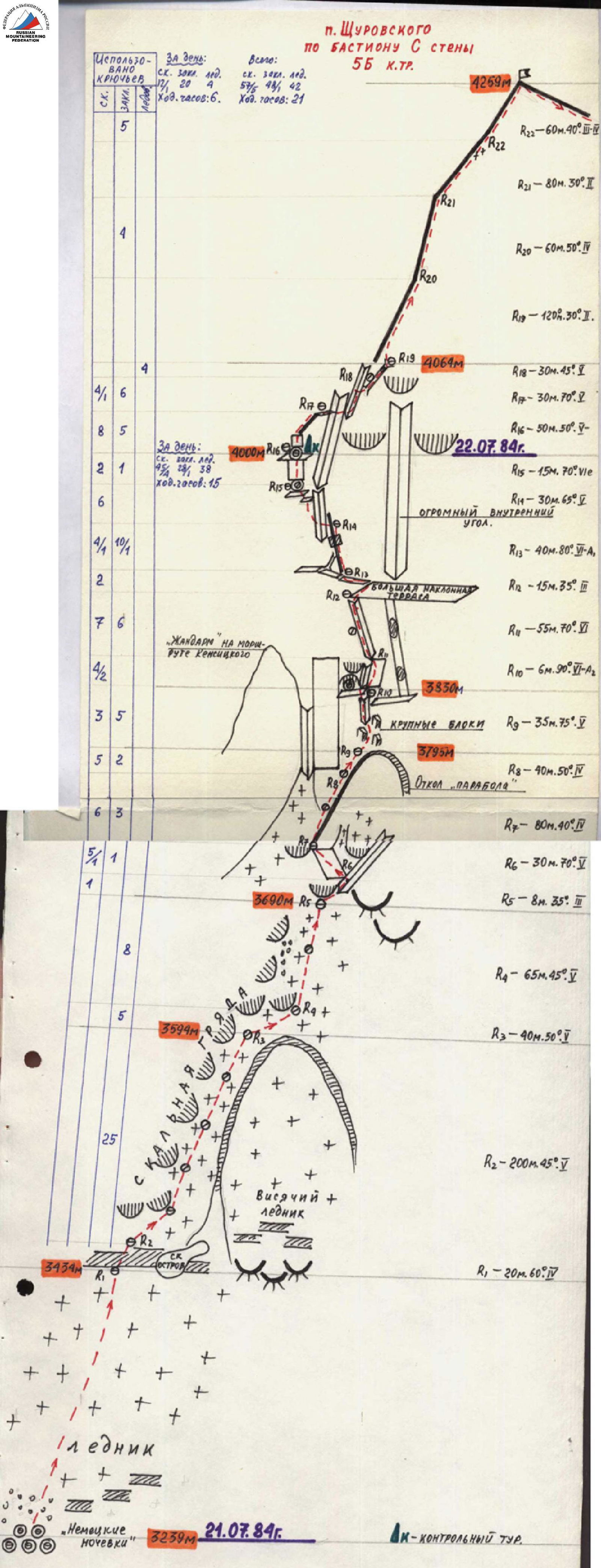
I. Rock class. 2. Central Caucasus. 3. Peak Shchurovsky via the bastion on the north wall. 4. 5B category of difficulty. 5. Elevation gain 825 m, length 1109 m.
Length of sections with 5–6 category of difficulty — 626 m. Average steepness — 49°, of the bastion — 66°, including 116 m of 6th category sections.
-
Pitons hammered in: rock — 57, spare — 5; chocks — 48, spare — 1; ice screws — 42, spare — 0.
-
Team's travel time — 21 hours, days — 2.
-
Overnight stay at the beginning of section R16 on a ledge away from the possible path of falling rocks.
-
Team leader: Timofeev Vladimir Nikolaevich, Master of Sports
Team members:
- Kharianyk Ivan Vasilievich, Candidate Master of Sports
- Moroz Sergey Andreevich, Candidate Master of Sports
- Khitrikov Vladimir Andreevich, Master of Sports
- Titkin Evgeny Georgievich, Master of Sports
- Gurin Nikolai Ivanovich, Candidate Master of Sports
- Coach: Kharianyk Ivan Vasilievich.
- Approach to the route: July 21, 1984.
Summit: July 22, 1984 at 13:15. Return: July 22, 1984.
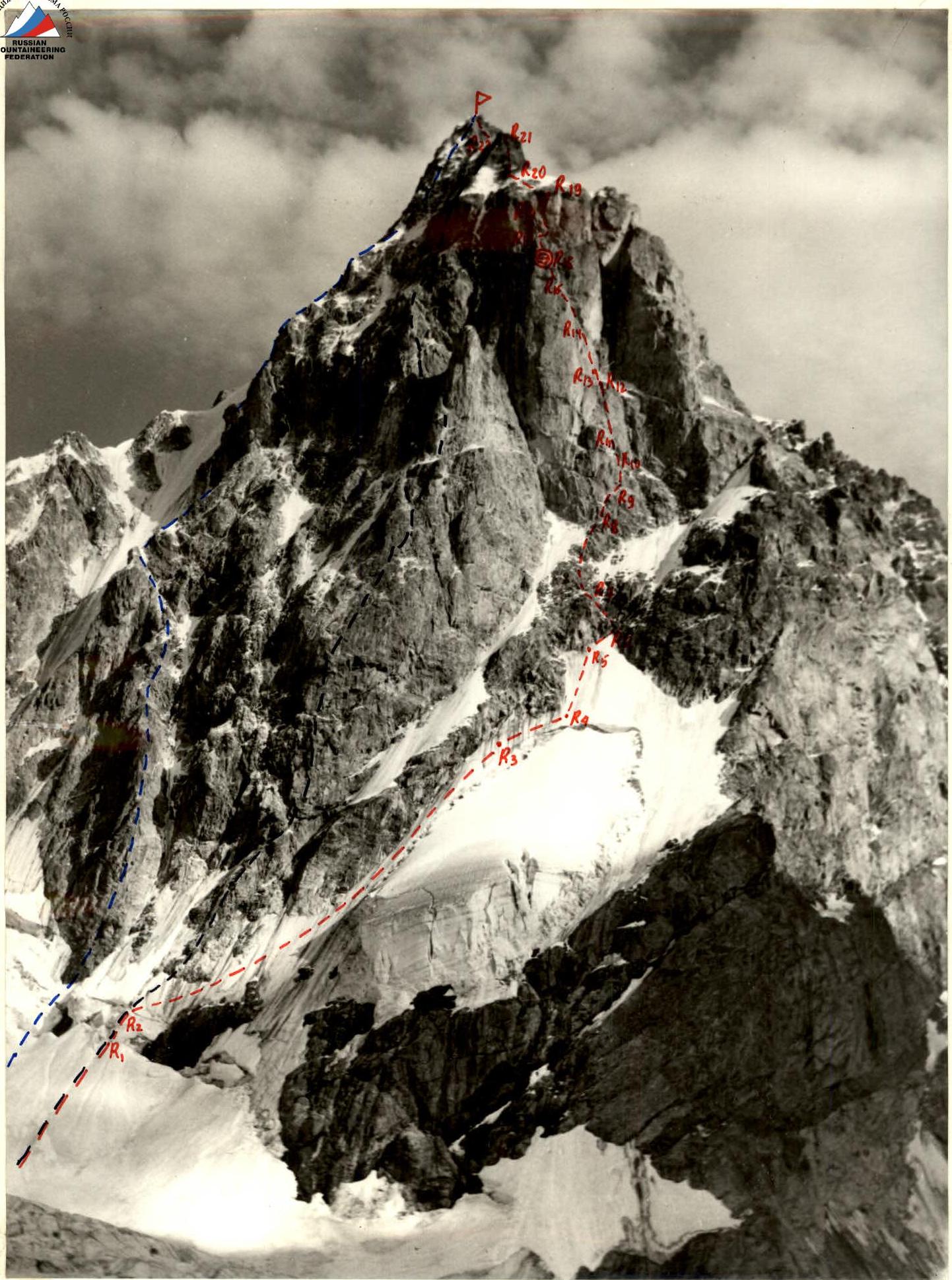
Photo #1. Routes:
- via the bastion on the N wall (M. Khergiani).
- via the N wall (L. Kensitsky).
- via the NE wall (V.A. Abalakov).
Team's Tactical Actions
I. Team composition by rope teams:
- Timofeev V.N. — Kharianyk I.V.
- Moroz S.A. — Gurin N.I.
- Khitrikov V.A. — Titkin E.G.
The composition of the rope teams did not change during the ascent.
II. Actual time breakdown:
July 21, 1984
1:00 — departure from the bivouac at the "German overnight stays". 1:50 — the team reached the bergschrund. 1:50–5:00 — waiting out bad weather under the cover of the bergschrund. 9:00 — exit to the rock belt at point R5. 11:00 — exit to the base of the bastion at point R8. 14:00 — exit to the alternate overnight stay at point R10. 19:00 — exit to the planned overnight stay at point R16. Processing of one rope length of the route above the overnight stay.
July 22, 1984
7:00 — start of work on the route at point R17. 11:00 — exit to the "roof" at point R19. 13:15 — exit to the summit of Peak Shchurovsky. 16:40 — descent to the "German overnight stays".
On July 21, 1984, the rain with snow that started at 1:30 forced the team to stop moving along the route (since the rain increased the likelihood of rockfall onto the route, which passed over ice) and wait out the bad weather, covering themselves with cloaks, under the cover of the upper wall of the bergschrund. At 5:00 the rain stopped and the team resumed moving along the route. Thus, due to bad weather, the movement from the bergschrund was started at 5:00 instead of 2:00, which naturally led to a shift in the planned schedule for July 21, 1984 by about 3 hours.
III. Tactics of movement along the route.
Rope teams worked on sections in the following sequence:
- R1–R5: Moroz — Gurin, Khitrikov — Titkin, Timofeev — Kharianyk;
- R5–R9: Khitrikov — Titkin, Timofeev — Kharianyk, Moroz — Gurin;
- R9–R17: Timofeev — Kharianyk, Moroz — Gurin, Khitrikov — Titkin;
- R17–R19: Khitrikov — Titkin, Timofeev — Kharianyk, Moroz — Gurin.
On the section R5–R9 — the "roof" of the bastion and when moving to the summit along the counterfort and ridge, the rope teams and leaders in the teams swapped places. Belaying was simultaneous through outcrops and bends and alternate — through chocks and outcrops. On the section R1–R5, the rope teams moved in crampons with alternate belaying on the pitons of the first team without organizing fixed ropes, except for traverse sections. The first in the teams went using ice tools. Movement was carried out along the edge of the ice, two to three meters from the rock ridge, in order to be under cover from rocks coming from above.
On the section R1–R8, the group had to move in short transitions with frequent and relatively long stops under the cover of rock walls. Rocks were periodically falling from above, apparently caused by the rain that fell at night and the work of a group on the Kensitsky route above to the left.
On the rocks, water greatly hindered movement on sections R2–R3 and R16–R19. The rain that fell, and in the upper part, snow that melted during the day, caused abundant streams of water, which flowed not only through internal corners and chimneys, but also along almost all the walls of the bastion. Water falling from above the bastion was sprayed on the route in the form of a fine rain even in sunny weather. In addition, there was ice accretion in chimneys and internal corners.
The first in the 1st team:
- moved on a double rope,
- organized fixed ropes,
- received their partner, who moved along the fixed ropes with top belay.
At the same time, the second brought a free rope to organize the movement of the first on a double rope.
The first in the second and third teams:
- moved along the fixed rope on jumar with a prusik knot,
- used bottom belay,
- clipped their team rope into carabiners on intermediate pitons left by the first team.
Then they received their partners on the team, who moved along the fixed rope with top belay.
The following were passed along the rope team:
- pitons,
- quickdraws with carabiners,
- free rope.
Thus, when passing all rock sections of V–VI category of difficulty, each team member moved on a double rope:
- 1st — with bottom belay;
- 3rd, 5th — along fixed ropes with bottom belay;
- 2nd, 4th, 6th — along fixed ropes with top belay.
On the section R9–R19, the first moved in galoshes and without a backpack. The weight of his backpack was redistributed among the other team members. The scheme of interaction between the rope teams given above remained unchanged.
Sections of II–III category of difficulty encountered on the route were passed by the team without organizing fixed ropes with alternate and simultaneous belaying through outcrops and pitons.
The rocks were местами heavily destroyed. At the end of section R15 — a good platform for overnight stay, a control cairn. In the cairn, a note from climbers from 1981 was removed, who in turn removed a note from 1974. At the overnight stay site, it was necessary to cut through a layer of ice covering a platform laid out by previous groups. The team conducted a lying-down overnight stay. From the overnight stay site, one rope length was processed.
On the night of July 21–22, 1984, snow fell, which turned to rain by morning. Movement on July 22 took place during constant snowfall (section R16–R19).
Deviations from the tactical plan:
Due to waiting out bad weather in the bergschrund, movement from here was started at 5:00 instead of 2:00, which led to a shift in the planned schedule for July 21, 1984 by about 3 hours.
Section R18–R19 was not processed, as it was an internal corner with ice, along which water flowed. The rope left overnight after processing could freeze into the ice.
In the existing description from the overnight stay at point R10 to point R16 (planned overnight stay) — three rope lengths. The actual distance turned out to be equal to 4 rope lengths. As a result, the exit to the overnight stay was one hour later than scheduled.
IV. Measures, means, and methods of ensuring safety.
a) Team preparation:
For high-quality preparation for the USSR Championship in mountaineering, as well as to ensure safety, the following measures were taken:
- training camp in Crimea with ascents along routes of 5B category of difficulty (May 1984);
- participation of team members in Republican and All-Union competitions in sport rock climbing;
- participation of two team members in a winter camp for candidates for the USSR national team in mountaineering with an ascent to Shkheldy peak;
- practicing tactics and interaction of rope teams on rocks in the Tyrnyauz area;
- two training ascents of 5B category of difficulty to peaks in the area, which are similar in relief, difficulty, and length to the routes on Peak Shchurovsky and Shkheldy peak.
b) Means and methods of ensuring safety on the route:
- having familiarized themselves with the description and received consultations, the team drew up a real tactical plan. The tempo of movement laid down in the plan provided for maximum safety and was fully implemented;
- all team members moved on a double rope, the first in the first team went on a rope with a UIAA stamp;
- the first in each team went with BPEU system compensators;
- use of extenders with compensators on intermediate pitons;
- blocking of all pitons at belay stations with a separate loop and all fixed ropes with each other;
- fixing fixed ropes on 2–3 intermediate pitons;
- use of 2 self-belay devices for the belayer: in case of a fall of the first, a jerk of varying direction is possible;
- predominant use of chocks on the most destroyed sections of the route.
When climbing, natural relief was also used to ensure safety:
- the entire lower ice part of the route passed under the cover of the rock ridge;
- the steep main bastion covered the team from rocks from the "roof";
- constant observation of the top and those going ahead reduced the possibility of being hit by rocks.
The first in the 1st team on rocks of V–VI category of difficulty worked in galoshes and without a backpack.
V. Radio communication.
Communication with observers was carried out using a "Lastochka" radio station according to the communication schedule of the Shkhhelda alpine camp:
- 7:10
- 11:00
- 14:00
- 19:00
- emergency 12:00
Not a single radio communication session was missed. The radio communication log is attached.
Comments
Sign in to leave a comment