
Passport
- Technical class
- Central Caucasus
- Peak Chatyn Main — 4368 m, "по ромбу" North wall (route by L. Myshlyaev)
- 6B category of difficulty
- Elevation gain — 770 m, length — 880 m Length of sections with 5–6 cat. diff. — 520 m Average steepness of the main part of the route — 83° (3600–4040 m), including 6B cat. diff. — 95° (3825–3860 m; 3935–4030 m)
- Pitons used:
| Rock | Bolts | Nuts | Ice |
|---|---|---|---|
| 90/17 | 1+46°/20° | 107/24 | 28/1+1* |
* — reusing previously driven pitons
- Team's travel time: 51 hours and 9 days (including 3 days of processing)
- Overnights: 1, 2, 3 — in a tent on a suspended platform, 4, 5 — on a ledge carved into the ice slope for 4 people
- Team leader — Moshnikov Anatoliy Ivanovich, MS
Participants:
- Barulin Boris Aleksandrovich, MS
- Kalmykov Sergey Georgievich, MS
- Sazanov Viktor Vasilyevich, CMS
- Coaches:
- Vasiliev Boris Petrovich
- Beilin Yuriy Iosifovich
- Approach to the route — February 18, 1984 (February 7, 16, 17 — processing) Summit — February 23, 1984 Descent — February 23, 1984
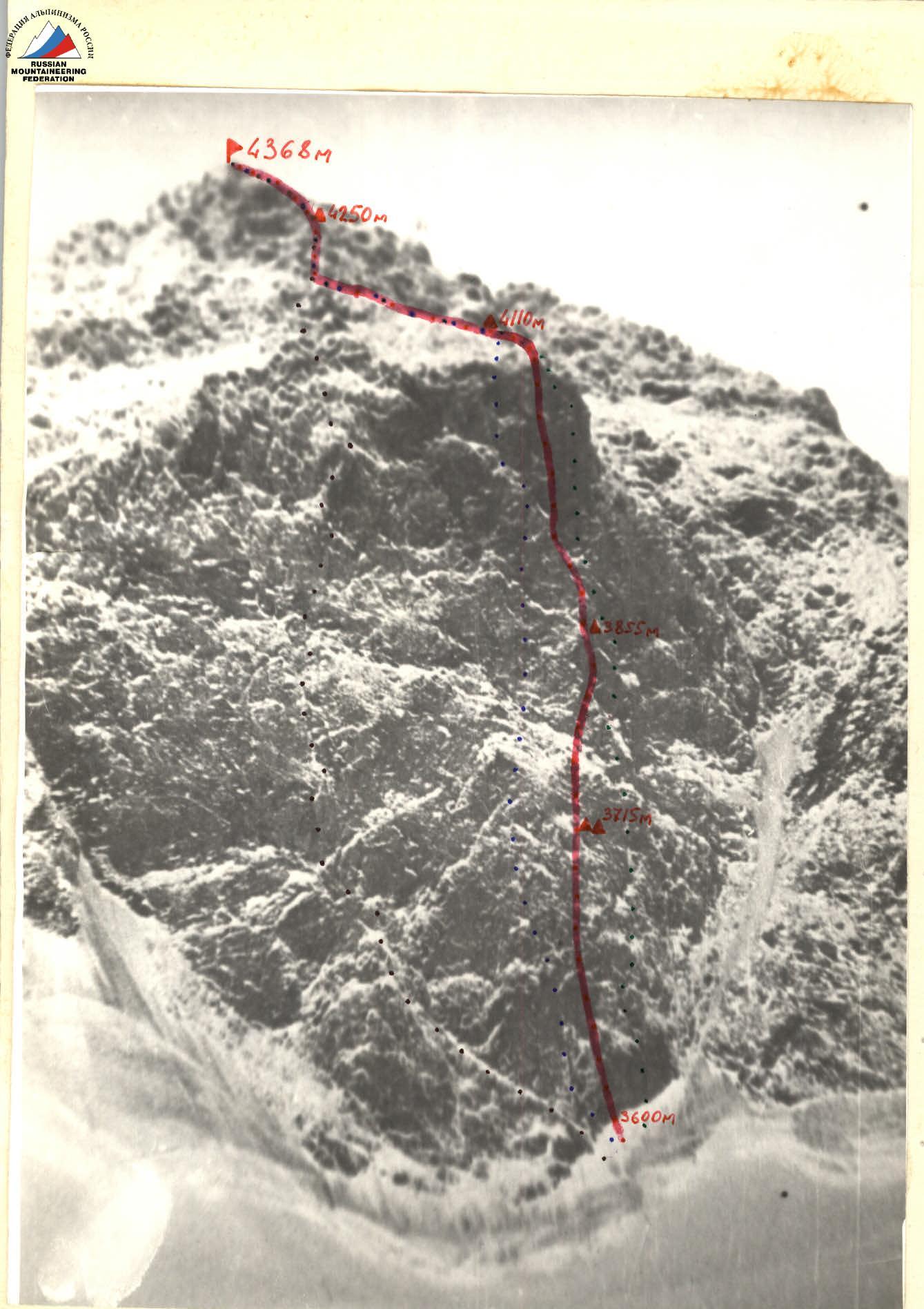 №1. General photo of the summit
- Snesarev's route, 1959
- Chernoslivin's route, 1965
- Team's route (Myshlyaev, 1959)
- Grakovich's route, 1972 Photo taken from the plateau of Chalaat glacier (3400 m) on February 11, 1984 Distance — 1 km Camera "Smena-8N"
Tactical actions of the team
Since the reconnaissance and observations on February 2 and 3 showed that the wall was in excellent condition (after a prolonged period of good weather), it was decided to start climbing without processing, having two reserve days for bad weather. On February 7, in accordance with this decision, the group went to the wall. However, the heavy snowfall that began in the evening of that day made the overnight stay on the route unsafe and forced the group to descend into the cave under the wall. There, they waited out the continuous snowfall until February 10. Having exhausted their time reserve, the group took advantage of a brief cessation of snowfall and descended to the camp on February 11, leaving 80 m of ropes on the wall. The snowfall continued until February 13. During the debriefing, the group's actions were deemed correct, the section of the route covered on February 7 was counted as a one-day processing, and the group was allowed to make a second attempt.
Since the condition of the route had significantly deteriorated by then, it was decided to carry out preliminary processing up to the level of the "Abalakova's shelf". Subsequently, the route was gradually cleared of snow, and the overhanging sections in its upper part were likely always clear, and the pace of passage increased as they ascended.
The tactical plan for the second attempt was carried out with no significant deviations. The change in the condition of the route can be seen from the comparison of photos 2, 1, 4 (listed in chronological order).
During the ascent, the team used the following tactical techniques:
- The leading duo's main task was to "hang the ropes".
- The second duo supplied equipment to the first, cleaned, straightened, and removed the ropes, prepared the bivouac, and carried the load up.
- The pairs changed every 1–2 days.
- The leaders in the pair changed every 0.5–1 day.
- The work was distributed among the sections (the leader is listed first):
| Sections | Leader — second |
|---|---|
| R0–R5 | Moshnikov — Kalmykov |
| R5–R10 | Barulin — Sazanov |
| R10–R11 | Sazanov — Barulin |
| R11–R15 | Moshnikov — Kalmykov |
| R15–R17 | Barulin — Sazanov |
| R17–R26 | Moshnikov — Kalmykov |
| R26–R28 | Sazanov — Barulin |
| R28–R29 | Moshnikov — Barulin |
| R29–R30 | Kalmykov — Moshnikov |
Due to the complexity of the route, ropes were used throughout the ascent to the summit (see, for example, photos 9, 15).
Each day began with passing the section processed the previous day. The first in the pair was always belayed with a double rope (see, for example, photos 8, 12).
After passing the main part of the route and reaching the "roof", the group dropped the platform and excess equipment to the observers.
The following daily routine was maintained on the route:
- 5:15 — wake-up
- 8:00–8:30 — departure
- mid-day — short rest and snack
- end of work at 18:00–18:30
- descent to the bivouac no later than 19:00
- 20:00–21:00 — sleep
On the wall, the bivouac was set up on a special suspended platform (photos 6, 11); on the "roof" — on ledges carved into the ice (photo 14). In the evening, all four used headlamps on the bivouacs. To save time and fuel, a homemade autoclave with thermal insulation made of polyethylene foam was used for cooking.
There were no accidents or injuries.
The group was observed by members of the rescue team: CMS Mikhailov V., 1st class athletes Botov D., Ivanov A., Ivanovski V., and team doctor Tikhonov L. Pairs of observers were stationed on the False Chatyn pass, where they conducted visual observations, radio communication with the group, and relayed their messages to the base camp. Radio communication was carried out twice a day (for example, see photo 11).
Description of the route by sections
The approach to the wall is not difficult. The bergschrund is narrow and partially filled with snow. Its upper edge is a sheer wall 2 m high. Then, about 30 m to the rocks along a relatively even ice slope with a slope of 40–55°. A small platform was carved under the rocks to make it easier to prepare for climbing the rocks.
The beginning of the route is the entrance to the chimney that cuts through the entire lower part of the wall.
Section R0–R1 A crack in the inner corner, filled with snow. Movement along the right overhanging part, mainly using artificial supports.
R1–R2 The crack widens, turning into a chimney, whose walls are iced, and the chimney is filled with snow, making climbing difficult. In the middle, the left wall of the chimney becomes gentler, and the chimney widens to 1.5–2 m.
R2–R3 The chimney narrows and is clogged with snow plugs. At the top, there is a bypass to the left of the overhang, leading to a wide chimney.
R3–R4 A wide chimney is heavily snowed in, requiring snow to be cleared to find cracks. At the end, there is an overhanging stone that is bypassed on the right towards a slab with a small nose-shaped ledge.
R4–R5 Movement along the slab with a ledge to a vaguely defined rib. To the left, the chimney continues, and large nuts work well.
R5–R6 On the rib, there is a snow-covered slab, at the end of which is a small ledge.
R6–R7 From the ledge, along a crack (filled with snow), with smooth slabs on the right and left without cracks, using artificial supports on nuts.
R7–R8 The crack widens into a chimney with snow plugs, and the chimney is covered by an overhang.
R8–R9 The overhang is passed using artificial supports on nuts; then along a vaguely defined inner corner.
R9–R10 Along snow-covered slabs to the left and along a slab to the base of a chimney. To the right, under the overhang, there is a snowdrift. Here, they hung a platform for a bivouac. Its edge closest to the wall rests on the drift.
R10–R11 An icy slab. To the left, a chimney approaches it, from which they emerged 35 m below. The slab leads to a chimney, whose right wall initially overhangs.
R11–R12 A chimney with difficult climbing, partially using artificial supports, and at the end, an overhanging section, bypassed to the right onto slabs.
R12–R13 Icy slabs leading to a diagonal ledge crossing the entire wall.
R13–R14 Along the ledge, 15 m to the right and upwards, towards a red overhanging wall.
R14–R15 Along the icy and snow-covered wall above the ledge to the right and upwards, behind a corner, to the base of an inner corner under the red overhang. To the left and above, there is a small ledge for an overnight stay under a cornice, marking the first control point.
R15–R16 Along the right wall of the inner corner with small holds to the base of an overhanging wall cut by a chimney.
R16–R17 An overhanging chimney filled with snow plugs, partially iced, with good placements for nuts. The chimney leads to a small icy ledge, where the second control point is located.
R17–R18 Along a snow-covered inner corner, straight up to the base of a chimney. The rocks are brittle. A platform for the upper wall bivouac ("3855") was suspended in this corner.
R18–R19 In the lower part, the chimney is filled with snow; in the upper part, it overhangs, but the rocks are clean and solid. Free climbing on jams, with good cracks and holds for hands. The chimney leads to slabs.
R19–R20 Along icy slabs into a couloir. The large upper chimney is clearly visible.
R20–R21 Along an icy couloir with stones frozen into the ice to a slab covered with snow.
R21–R22 Along the slab, relatively gentle but with small holds, to the beginning of the upper chimney. Above the upper end of the slab, there is a cornice with a small ledge and the third control point. From here, there is a possible descent to the left along a ledge onto Chernoslivin's route. After passing the upper chimney, excess equipment was dropped from this ledge. From the point, along an overhanging wall, a pendulum move was made to the right to the entrance of the chimney.
R22–R23 A spiral overhanging chimney with micro-holds, very difficult climbing, partially psychologically tense due to having to turn face away from the wall. Small stoppers work well.
R23–R24 An overhanging chimney, partially narrowing, with clean and dry rocks. There are few holds. Insurance is on nuts, with cracks for pitons.
R24–R25 The chimney ends in a smooth vertical wall with micro-holds, leading to semi-destroyed, snow-covered rocks on the "roof".
R25–R26 Along a rib to the base of an ice "knife". Here, a ledge was carved into the ice for the fourth bivouac.
R26–R27 An ice slope with hard, frosty ice; pitons are difficult to place.
R27–R28 A wall leading into an icy couloir.
R28–R29 Along the couloir, whose steepness gradually increases, upwards and then to the left onto rocks. About 90 m.
- The ice is very hard; pitons are difficult to drive.
- To the left, 10 m from the couloir, under the rocks, a small ice ridge was carved out, and a tent for the fifth bivouac was set up.
- The overnight stay was uncomfortable, in a semi-reclining position.
R29–R30 Snow-covered slabs and ice fields lead to a sharp, jagged northwestern ridge, along which 30 m to the summit.
The descent followed route 3A cat. diff. to West Chatyn and, not reaching the summit by about two rope lengths, along an ice slope to the Uzhbin plateau.
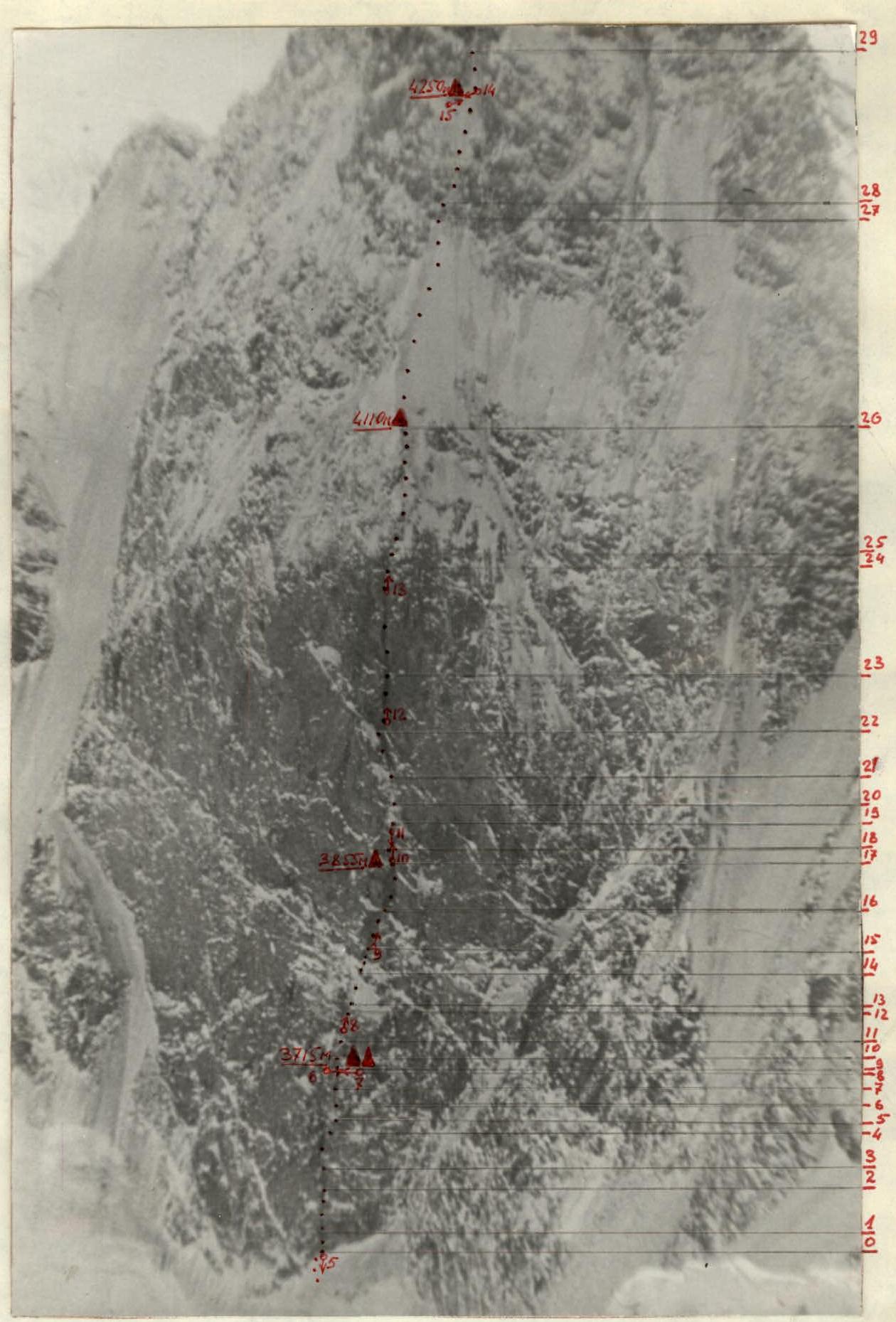 №3. Technical photograph of the route. Taken from the southeastern ridge of Peak Shchurovskogo on February 23, 1984. 3 — photo shooting points.
Description of the ascent
For the first time in the winter season of 1984, we saw the north wall of Chatyn on February 1 from Peak Vulley and the False Chatyn pass. During the preparation of the assault camp — a cave under the wall — we were able to approach it closely. After a month and a half of dry weather, the wall looked excellent: all black, with snow visible only in the depths of cracks and chimneys, and the relief was clear, with no ice. "Better than in summer — no water," said Kalmykov, who participated in 1971 in an unsuccessful attempt to pass Myshlyaev's route.
February 5. The first pair, Moshnikov — Kalmykov, accompanied by observers, left "Shkhelda". As in the previous year, as soon as we started working, the good weather that had been standing since December began to deteriorate — cirrus clouds appeared in the morning. We had lunch at Nemetskie noctovki, and spent the night in a cave on the False Chatyn pass. In the evening, the sky was clear, and we...
February 6. The blue sky. Leaving the observers on the pass, the climbers went to the cave under the wall in pairs. The rest of the day was spent sorting out equipment and preparing for the next day's departure.
February 7. No, you can't escape fate: the sky was covered with a thin veil of altostratus clouds from morning — a warm front was approaching. However, at 7:00, the pair still set out on the route. A rope length was passed along the snow on the bergschrund, another rope length along the ice from the bergschrund to the wall, at 8:00 — morning radio communication, and now, Anatoly Moshnikov hangs the first ladder on the wall, overhanging directly from the ice, and takes the first step onto the rocks.
Looking ahead, we note that the lower 2/3 of the route is quite littered with abandoned pitons, mostly bolts. It was the same in 1971. We recall again that the first ascenders — Myshlyaev — Kosmachov — Simonik — in 1959 did not drive a single bolt. It's good that the upper chimney is too challenging for most enthusiasts of drilling work — we found only 4 old pitons on its 120 m. Our group used about 40 other people's pitons in total.
Work on the first day was not fast. Skills forgotten since summer were restored, and snow plugs in the depths of the chimney hindered progress. Until you clear out a kilogram of 50 dense snow, you can't make the next 8–10 steps. By 15:00, it started snowing. At this time, the second pair appeared on the wall. A little above the end of the first rope, in a local widening of the chimney, they hung a platform for a bivouac. At 17:00, the first pair, having passed 2 rope lengths from the beginning of the wall, finished work, and everyone gathered around the platform with a tent. Saying goodbye, Barulin and Sazanov descended. According to the plan, they were to spend the night in the cave — let them conserve their strength while they could.
February 8, 9, and 10. The decision turned out to be correct: the next three days, it snowed without stopping. Every half hour, a gray curtain — a powder avalanche — descended along the entire front of the wall, swaying. The entrance to the cave was regularly blocked, and we had to dig out, breaking through a one-and-a-half-meter layer of snow. The team entertained themselves as they could. We went to the wall, repaired the slightly damaged platform, straightened the ropes, expanded, and improved the cave.
February 11. In the morning, there were breaks in the clouds, and the snowfall had stopped. We decided to return to the camp — we were already not meeting the deadline. However, we left all our gear — we would return! We waded through the fresh snow up to our chests, anxiously glancing to the left and forward — fearing avalanches from the slopes of the northeastern ridge of Peak Shchurovskogo. Fortunately, everything ended well — at 15:00, we were standing on the pass. We didn't linger in the caves here or on the "Nemetskie noctovki", as it gets dark by 18:00. Up there, there was still a whirlwind, and down in the glacier valley, the moon shone dimly, and some stars were visible. We slowly slid down on skis — romance!
February 12 and 13. The snowfall continued. However, scouts sent on February 13 reported that the front was passing. The sky was blue above Peak Shchurovskogo. The continuous cloud cover was all below.
February 14. The torn clouds had not yet dissipated, but the weather was improving, and it had gotten colder. In "Shkhelda", the temperature was –15…–12° during the next week. The first pair to continue the assault were Barulin and Sazanov, accompanied by observers. However, they were unable to reach the pass that day: the snow was up to their necks under the pass. Only by 1:00, exhausted from fatigue, did the guys return to the cave on Nemetskie noctovki.
February 15. The weather was still not settled, and the summit of Peak Shchurovskogo was in the clouds. Putting on the skis they had left the day before, the group headed to the pass. It was a surprising sight: in crampons, with clamps on the ropes, they climbed the ice slope to the pass, with skis tied to their backs. However, from the pass to the cave under the wall, it took only 50 minutes. The second pair followed their example, and the skis were then carried by our patient observers and helpers.
February 16. Finally, the sky cleared, but it was better not to look at the wall: it was all covered in snow, with only the top 200 m visible. It was surprising, as it wasn't much better at the bottom, with a slope of 80–85°. During the morning communication, it was finally decided to preliminarily process the wall up to the ledge.
Climbing the ropes was agonizing. The ropes below the bergschrund were buried somewhere 2 m deep and needed to be dug out. On the wall, the slightest movement of the rope through the chimney caused a stream of snow to fall on their heads. Only by 13:00 did the pair reach the upper end of the ropes. Barulin worked first, and snow poured down from him continuously. Sazanov, pressed against the rock, patiently endured it.
The second pair caught up, brought a hot lunch. The processors returned to the cave by 19:00 in the dark, with headlamps. Only 30 m had been covered.
February 17. An angry Barulin went to work first again. Moshnikov and Kalmykov carried part of the load from the cave to the upper end of the ropes. The first pair returned down in the dark again. Another 50 m were covered, leaving about 20 m to the lower edge of the ledge. A spot was found for a bivouac under a cornice on a narrow but solid snowdrift attached to a sheer rock face. It was decided to set out on the wall the next day with the whole team.
February 18. The pair Moshnikov — Kalmykov set out onto "Abalakova's ledge". The ledge was 15 m long, with a slope of 60°. As always in winter, a relatively easier and gentler section was covered in hard ice and snow, making it more difficult than the steep rock faces. The route required going along the ledge to the right, around the outer corner, under the red overhanging wall. But for this, they needed to put on crampons. And how to belay themselves? Tolya crossed the ledge straight up along the protruding rocks and moved in a complex climb along the monolithic overhanging wall.
Three long hours passed. Having moved about 20 m along the wall, Moshnikov reached a narrow horizontal ledge. He unsuccessfully tried to find a bypass to the left, then traversed to the right. And then — luck! — a small platform for a sitting bivouac and a control point with last year's note from Senchina's team. It was 17:00, 60 m covered, and the further path was clear. Moshnikov was tired, and Kalmykov on belay was freezing. The pair decided to descend.
Below, the bivouac was already ready. The platform rested on a snowdrift with one edge — it was convenient. The foursome climbed into the tent and began preparing dinner. Barulin was dissatisfied with today's progress: "Tomorrow, Sazants and I will go again. You, Tolya, take a rest. The upper chimney is still ahead".
February 19. At 7:00, Barulin emerged from the tent. Today's section of the route was one of the most challenging: a 30-meter steep inner corner led to a 30-meter chimney. The chimney overhung so much that the rope, fixed at its upper end, was 4 m away from the rocks at the base. Those climbing on the ropes here hung in the air, not touching the wall. At the exit from the chimney, there was the 2nd control point. 20 m above the chimney, Sazanov worked — it was a vaguely defined vertical inner corner. The platform would be moved here tomorrow, but for now, they spent the night in the same place. Moshnikov and Kalmykov carried part of the load to the first control point in the middle of the day.
Today, 70 m were covered. The pace was constantly increasing: first, 30 m were covered in a day, then 50, 60, 70 m. The higher they went, the steeper it got, but the cleaner the route became. This was apparently the main reason for the acceleration. However, it was already the 5th day of the ascent, more than half of the wall was covered, and there was still the "roof" ahead. The captain prepared for the next day's work in the evening, determined to increase the pace.
February 20. At 7:00, having taken 3 ropes, the first pair began to move. Above the upper end of the ropes, there was a slightly overhanging 20-meter chimney. Having overcome a snow plug, Tolya quickly passed it with free climbing — the rocks were dry and clean.
From here, the first pair saw a grandiose panorama of the upper part of the wall: a huge rock mirror overhung, cut by a 100-meter chimney. The next 60 m were relatively easy. Above their heads, there was a cornice with a crack — the beginning of the chimney. But the route led a little higher and to the left of this point. Here, under the overhang, there was a ledge filled with a huge snowdrift and a bunch of bolt pitons. This was usually the bivouac from which they processed the chimney for a day or two. Now, the chimney was surprisingly clean — not a single speck of snow or ice. A narrow, intermittent ledge on the overhanging wall led to the beginning of the chimney. Tolya passed it with a pendulum and entered the chimney. But it overhung and expanded outward — it was not possible to rest here. Having placed a nut, Moshnikov began to move up the chimney. Kalmykov could only hear his tense breathing. The sound of a piton being hammered, the rope stopped moving — rest. "How is it further, Tolya? — The chimney is difficult, but we're managing little by little". The first 30 m of the chimney were "plowed" by 15:00. The pace was so high that the second pair, busy with the heavy work of moving the bivouac to a new location, couldn't keep up with supplying ropes. The first pair descended and joined the setup of the platform, which was entirely hanging in the air here. However, this did not affect the comfort of the bivouac — an advantage of the platform.
February 21. Moshnikov led again. At 12:00, he reached the "roof" — the famous upper chimney of Myshlyaev's route was passed by the first participant in 3.5 hours, almost entirely with free climbing — an excellent result even for summer.
After 2.5 rope lengths, at the base of the ice ridge, they stopped, carved out a platform for a tent. At 16:00, they were finally lit by the setting sun after 6 days. The overnight stay was in a reclining position, but not as comfortable as on the platform.
February 22. After breakfast, Tolya and Vitya descended 5 rope lengths to the base of the chimney — to drop excess equipment and the platform to the observers.
At 14:00, they continued moving upwards. Sazanov led now. 140 m of ice with a slope of 35–50°. As always in winter, they struggled with ice pitons — tubular drills were hard to place in the ice, and it was hard to clear the ice core from them. Titanium "carrots" worked best — or rather, the one "carrot" they had.
The weather began to deteriorate: cloud waves rolled in from the south. They broke against the bastions of Shkhelda, retreated, but each subsequent wave rose higher than the previous one. Finally, the cloud sea overflowed the massif and slowly flowed down into the Shkhelda gorge.
After the ice slope, there was a sheer rock step, then a long, about 100 m, couloir, and again ice. The steepness increased to 60°, and Vitya's crampons broke. Moshnikov led again. The couloir narrowed and became steeper. A tense moment: all ice pitons were used up, the rope was finished, and there were still about 5 m to the nearest rocks. While Sazanov moved along the ropes to Barulin on belay, while the rope was being extended, these long minutes Tolya hung motionless on the hard winter 70-degree ice on the front teeth of his crampons and the pick of his ice axe. Finally, they could move on. Moshnikov fixed the rope, received Barulin on belay, and in the dark, passed another 30 m along the rocks.
Meanwhile, the lower pair, having left the ropes 15 m to the left under the rocks, carved out a snowdrift — prepared a bivouac. It was not possible to set up and stretch the tent properly; it hung from a rock on 3 sides, with little space. At 21:00, the foursome squeezed into it, but the fuss continued until midnight. About 2 hours of semi-sitting, semi-reclining rest were managed. The night hours dragged on, it was cold. Kalmykov, whose head did not fit in the tent and stuck out "outside", occasionally cheered them up: "Stars, guys. The sky is clear".
February 23. Wake-up at 5:00. At 7:00, they began moving along the ropes. It was still clear, but very cold. According to their feeling, it was around –30 °C. Kalmykov finished the route — the last 4 rope lengths. At 11:00, they were on the summit. Fog, wind, snowfall. They dug out snowdrifts, searched for the landmark for a long time, and found a note from Bershov and Turkevich, who had passed the left edge of the north wall before Senchina's team reached the route. Then they learned that this team had joined the rescue efforts on Chernoslivin's route, not reaching the upper chimney.
They were filled with joy from inside — after all, it was the first winter "six" in the USSR, and on the Caucasus, and on Chatyn, and on Myshlyaev's route — and pride in themselves, in their "Burevestnik", in their Leningrad. It was the Day of the Soviet Army, and they unanimously agreed with Bob's proposal to dedicate the ascent to the 40th anniversary of the lifting of the siege of Leningrad. The only thing that spoiled their mood was that Yura Beilin, who had invested a lot of effort and care in preparing the ascent on Chatyn, was not with them, having had to leave for the second team to strengthen it for the winter Cup of Leningrad. They made Peak Shchurovskogo simultaneously with us via the Khergiani route.
At 12:00, radio communication. We congratulated the observers on the holiday, and they congratulated us on the mountain. They advised us to descend carefully, not to rush. And we weren't in a hurry, but there was a trail on the Uzhbin plateau and icefall. Almost all the athletes from Leningrad's sports societies had been to the Shkhelda gorge this winter. At 18:00, we met our guys and the SCA team on Nemetskie noctovki.
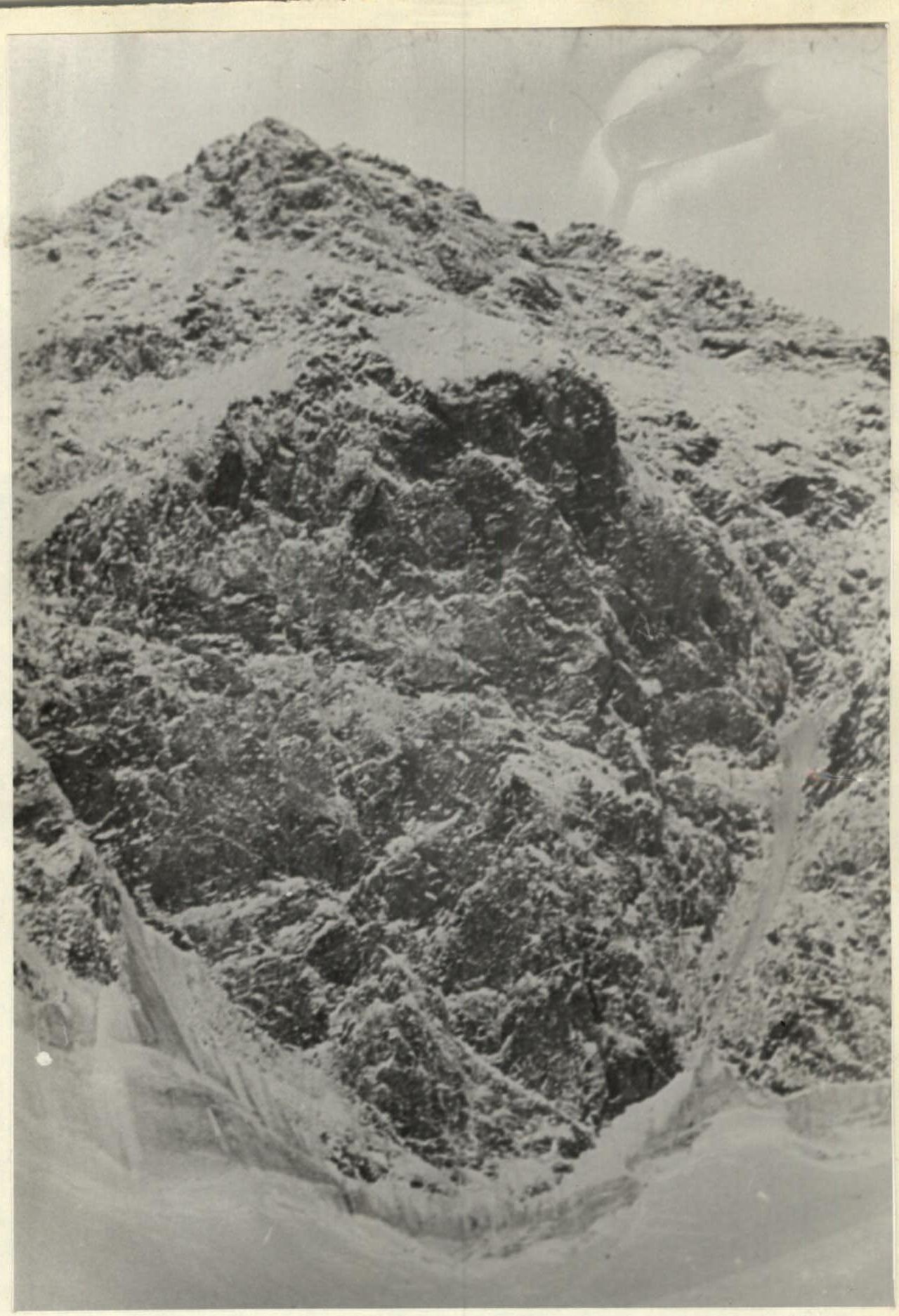 №4. North wall of Chatyn after snowfall. Taken on February 16, 1984, from the False Chatyn pass.
Tactical actions of the team (Second report)
By the decision of the judges' panel, the ascent was scheduled for July 31, 1984, at 4:00. Upon approaching the route at 4:00, all teams began searching for the start of the route, as it was still dark and there was heavy fog. By 6:00, when it started to get light, they approached the route. They started the ascent together with the "Lokomotiv" team via the "Snesarev's ledge". Having passed 3 rope lengths, we turned right along a slab onto Chernoslivin's route.
The leading pair was Turkevich — Bershov. Due to the presence of a lot of snow and water on the route, they climbed in boots. The first person on the route used a double rope of imported production with UIAA quality mark, 12 mm. Most often, one imported rope and one domestic rope were used. The upper belayer was insured through a "Shikhta" carabiner. To facilitate the passage of ropes at the belay points, nylon loops — extensions — were used. All belay points were located under cornices protecting from falling stones. The ropes were typically blocked on 3 pitons.
From the beginning to the highest point reached, the pair Turkevich — Bershov led.
The other participants passed the route along the fixed rope with top-rope belay. From the start of the route to section №9, Turkevich led. From section №9 to section №16, Bershov led.
On July 31, the team was on the route for 9.5 hours. They stopped for the night at 16:00. Due to everyone being wet, they decided not to continue processing the route further. The overnight stay was in a semi-reclining position in a tent. This bivouac location was planned in case of bad weather and poor route conditions.
On the night and during the following day, it snowed. On August 1, 125 m of double ropes were hung. The condition of the route worsened. It was necessary to drive pitons more frequently. On that day, all available free ropes were hung. Due to the use of all available equipment, further processing was stopped at 13:30. On that day, there were 5 travel hours. On the night of August 1-2, it rained with snow. The rocks were covered in snow and ice. In the morning, via radio, the safety judge instructed the team to descend down according to the judges' panel's decision.
At 9:00, Bershov — Belousov — Krasnenko went to remove the ropes hung the day before. Everyone wore crampons. The ropes were very icy, and it was necessary to clear them of ice. The descent from the upper point to the bergschrund was 11 rope lengths of 40 m. All transfer points were under cornices. In adverse weather conditions, the team paid special attention to the safety of the route passage. Deviations from the tactical plan in terms of the route passage time were due to a significant deterioration in the weather and the condition of the route.
UIAA scheme and pitons used
Total travel time — 14 hours 30 minutes. Pitons used: rock — 83, used 29; ice — 5; bolts — 21, used; 17 nuts.
 Route scheme in UIAA symbols
M 1:2000
Route scheme in UIAA symbols
M 1:2000
Description of the route by sections (Second report)
Section №R0 is an ice slope with a slope of 50°. It was passed with piton insurance, in crampons.
Section №R1 ("Snesarev's ledge") was heavily snowed in, making it an additional difficulty for passage.
Section №R2 — a wet slab with a limited number of holds.
Section №R3 — an inner corner with natty ice and snow.
Section №R4 — an inner corner ending in an overhang. Many loose stones. Passed partially using artificial supports. The insurance point was located to the right under an overhang.
Section №R5 — a snow-covered slab. Piton insurance.
Section №R6 — a traverse along an icy ledge.
Section №R7 — snow-covered slabs.
Section №R8 — ascent to the left and upwards along a snow-covered "Abalakova's ledge". Piton insurance. During warm weather, it is prone to rockfall.
Section №R9 — overnight stay under a cornice. After some construction work, a semi-reclining overnight stay in a tent for 5 people was arranged on the ledge.
Section №R10 — a steep snow-covered slab. Passage using artificial supports with frequent piton placement.
Section №R11 — a snow-covered wall with artificial supports.
Section №R12 — an inner corner through which a stream of snow flows during snowfall. Passage using artificial supports.
Section №R13 — an icy slab with icicles. Passage using artificial supports.
Section №R14 — a wall with driven bolt pitons. Passage using artificial supports.
Section №R15–R16 — passage of a cornice using artificial supports with rope fixing.
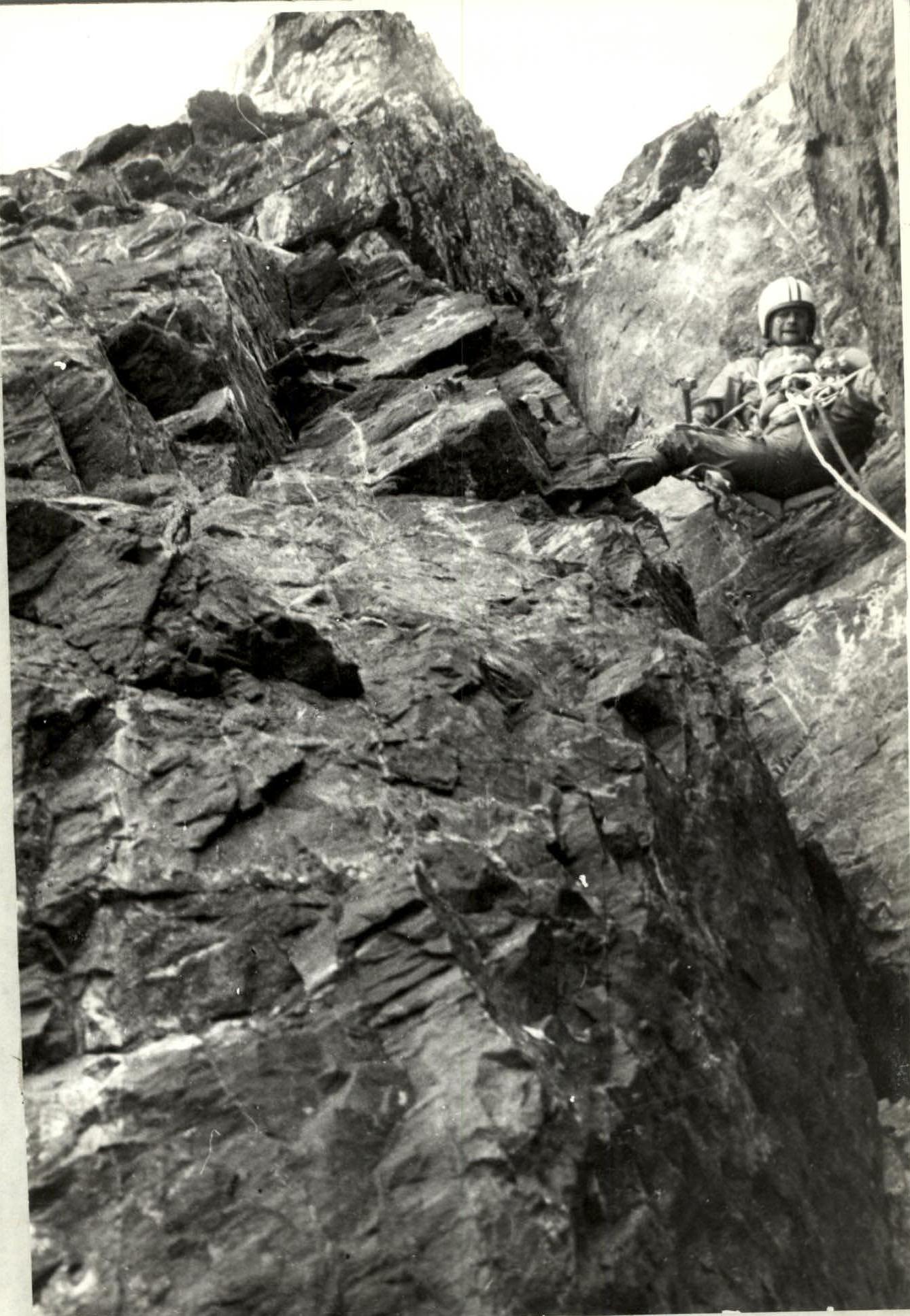
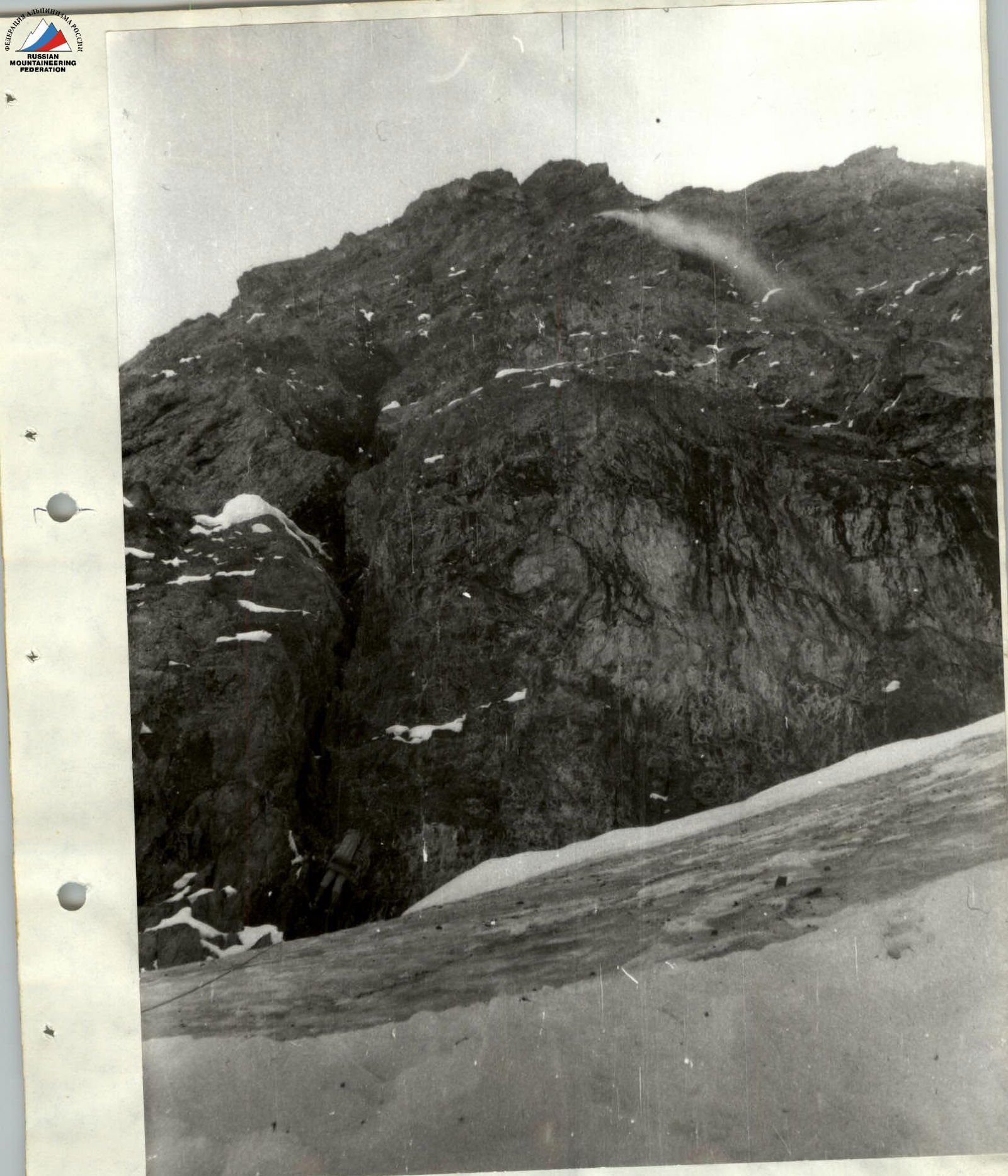 Photo 7. Beginning of the route. Ice slope (section R0–R1) and start of the chimney (section R1–R2).
 Photo 4. Technical photograph of the route. February 17, 1994. Camera "Smena". Focal