
Passport
I. Class of rock climbing ascents.
-
Western Caucasus, Uzunkol gorge, Gvandra region.
-
Pik Kirpich, via the "diamond" on the western wall, Manoilov's route, category 5B difficulty.
-
Sixth ascent.
-
Elevation gain: 670 m; route length 1370 m; sections: R6 — 250 m, R5 — 170 m, R4 — 400 m.
Elevation gain of the "diamond" wall — 240 m, section lengths:
- R6 — 250 m,
- R5 — 90 m,
- R4 — 20 m.
- Pitons hammered:
| rock | bolt | chocks | ice |
|---|---|---|---|
| 90+16 | 6 | 55 |
-
Team's moving hours: 26 hours.
-
On rock ledges in the "splinter".
-
Leader: Vakurin V.V., CMS
Participants:
- Popov F.E., MS
- Kudashkin Yu.V., MS
- Skorokhodov S.N., CMS
- Danichkin A.Sh., CMS
- Tugalev V.G., CMS
- Coach: Popov Fedor Efimovich.
II. Departure to the route: July 1, 1983.
Summit: July 2, 1983.
Return: July 2, 1983.
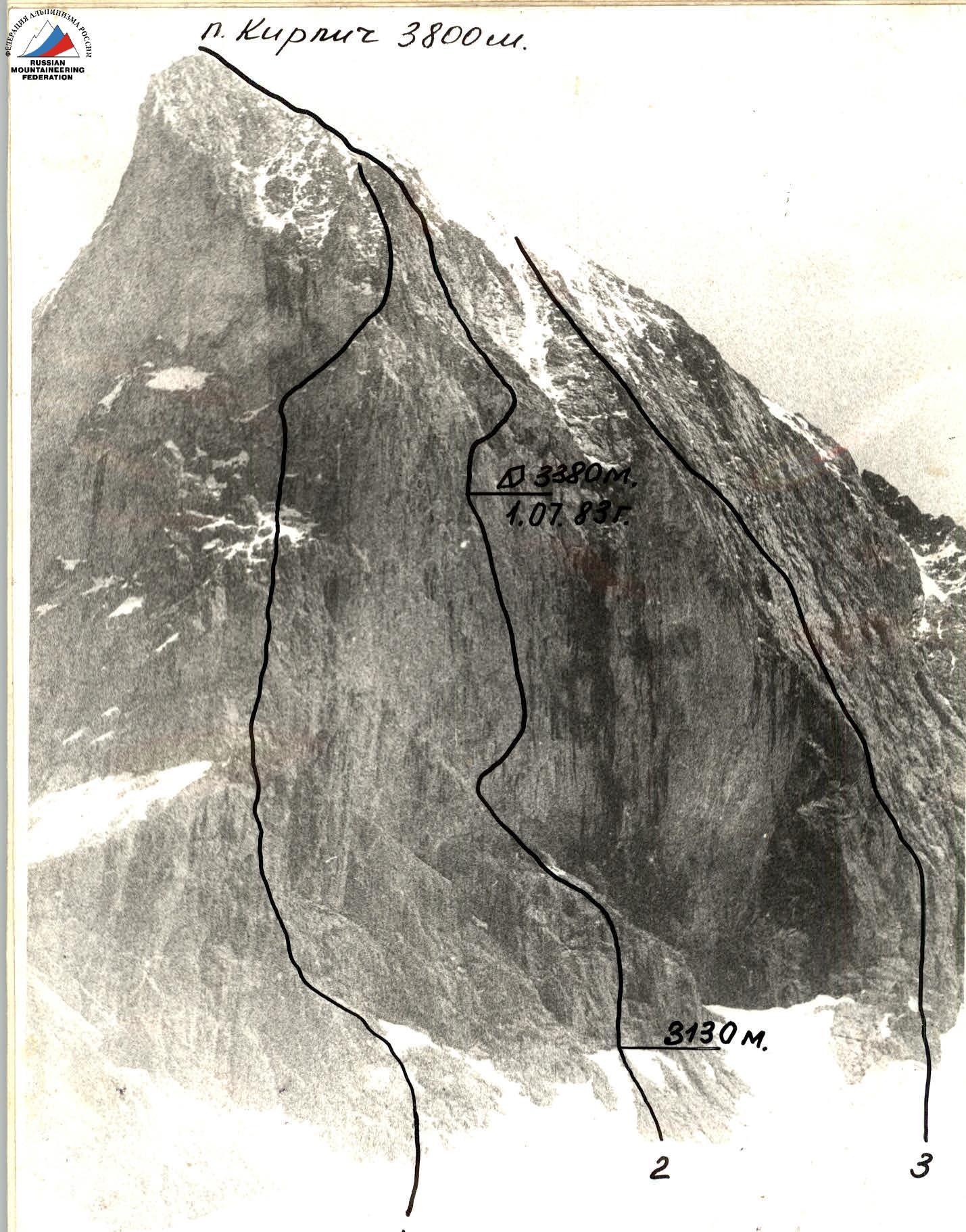
1- Sogrin's route, category 5A difficulty, via the NW wall 2- Manoilov's route, category 5B difficulty, via the diamond on the western wall. 3- Sedov's route, category 4B difficulty, via the 3rd wall along the gutters.
Tactical actions of the team
Before the ascent, two tactical plans for the route passage were developed based on time.
Due to the excellent weather conditions during the ascent, a tactical plan was developed and followed, involving an overnight stay on the wall and reaching the summit the next day:
- overnight stay on the wall
- the next day — summit push
The overnight stay was planned on a rock ledge under the "diamond" — section R6, and then processing the route for approximately 4-5 ropes. The next day, it was planned to move along the fixed ropes and then reach the summit. The route time was taken with a clear margin, considering that the group was on the Caucasus for the first time, not fully familiar with the character of the rocks, meteorological conditions, etc. The route left its mark on the passage time.
The group reached section R6 by 7:00. Then 4 people continued moving, while 2 remained on the site with 5 backpacks. By 13:00, the lead climber was on section R11, and the other three were 40-80 m below. Four ropes of very difficult rock climbing were passed (bolted climbing on a quartz belt and 40 meters of very tense climbing on an inner corner).
At this moment, a decision was made to continue moving as a group along the route and spend the night depending on progress on the rock ledges on the following sections:
- "Splinter" — section R4;
- section R3 — a rock ledge for 6 people sitting;
- bolted ledge — 60 m from the "Splinter" — for 6 people sitting;
- two rock ledges "green", 1 m apart — 3 people sitting each, 20 m from the "Splinter".
By 20:00, the lead climber reached the "Splinter". By 20:30, the entire group had gathered together. The next day, the group reached the summit and descended to the camp. There was a certain advance on the tactical plan in terms of time.
On the route, the group worked according to a previously practiced scheme:
- The first climber goes out on a double rope;
- Organizes fixed ropes and receives the second;
- The entire group moves along the fixed ropes with top-rope climbing.
When passing section R6-R9, two team members were lowered down on fixed ropes from a niche (section R9) directly down 60 m, and their backpacks were pulled up. The two climbers were also pulled up on two "jumars".
From section R9, 160 m of fixed ropes were organized, and all participants were positioned on the ledges of the inner corner at belay stations.
The last climber started moving from the niche only when the first had passed two inner corners (overhanging and swinging left), i.e., a risky descent down the fixed ropes was planned. When removing the fixed ropes, a descent along the ascent path was impossible.
On the first day, a change of lead was planned on section R11, which gave a positive result — faster work. The work of the first and last climbers was very tense — climbing was very difficult, with a lot of climbing using artificial holds. The last climber was constantly in a pendulum, being swung left. No preliminary route processing was planned. There was no inner rope fixing.
Fixed ropes were organized on the following sections: R0, R16.
Rest for participants was planned at belay stations, where there were generally small ledges. The overnight stay in the "Splinter" was semi-reclined on rock outcrops. It was warm. They used raincoats as shelter. There was snow in the crevices, which allowed them to drink, rest, and regain strength.
To ensure the safety of the first climber's work, tape absorbers were used. For emergency descent, fixed ropes were installed, and there were also bolted pitons. Throughout the entire route, there were no falls or injuries. Communication with observers was maintained via RPT-70 radio station every 2 hours until 21:00.

Route diagram in symbols.
 Description of the route by sections.
Section R0-R1. Rocks similar to sheep's foreheads, medium difficulty. Passed by independent teams.
R1-R6
- Monolithic rocks, местами covered with ice.
- Piton belays.
- In difficult places, fixed ropes are organized.
R6-R8
- Solid granites.
- Belays using pitons and chocks.
R8-R9
- Quartz belt, very solid.
- Passed using previously hammered bolted pitons with ladder use.
- Backpack retrieval is organized.
R9-R10
- Steep, complex rocks.
- Passed with free climbing.
- Belays using pitons and chocks.
R10-R12
- Inner corner with individual overhangs.
- Climbing is very difficult.
- Passed using ladders, pitons, and chocks.
R12-R13
- Series of steep, complex walls.
- In the middle part, a ledge with three bolted pitons.
- Passed using ladders.
- Belay spot is inconvenient, narrow ledge.
R13-R14
- In the middle part, a wide ledge suitable for overnight stay.
- Ends with a chimney.
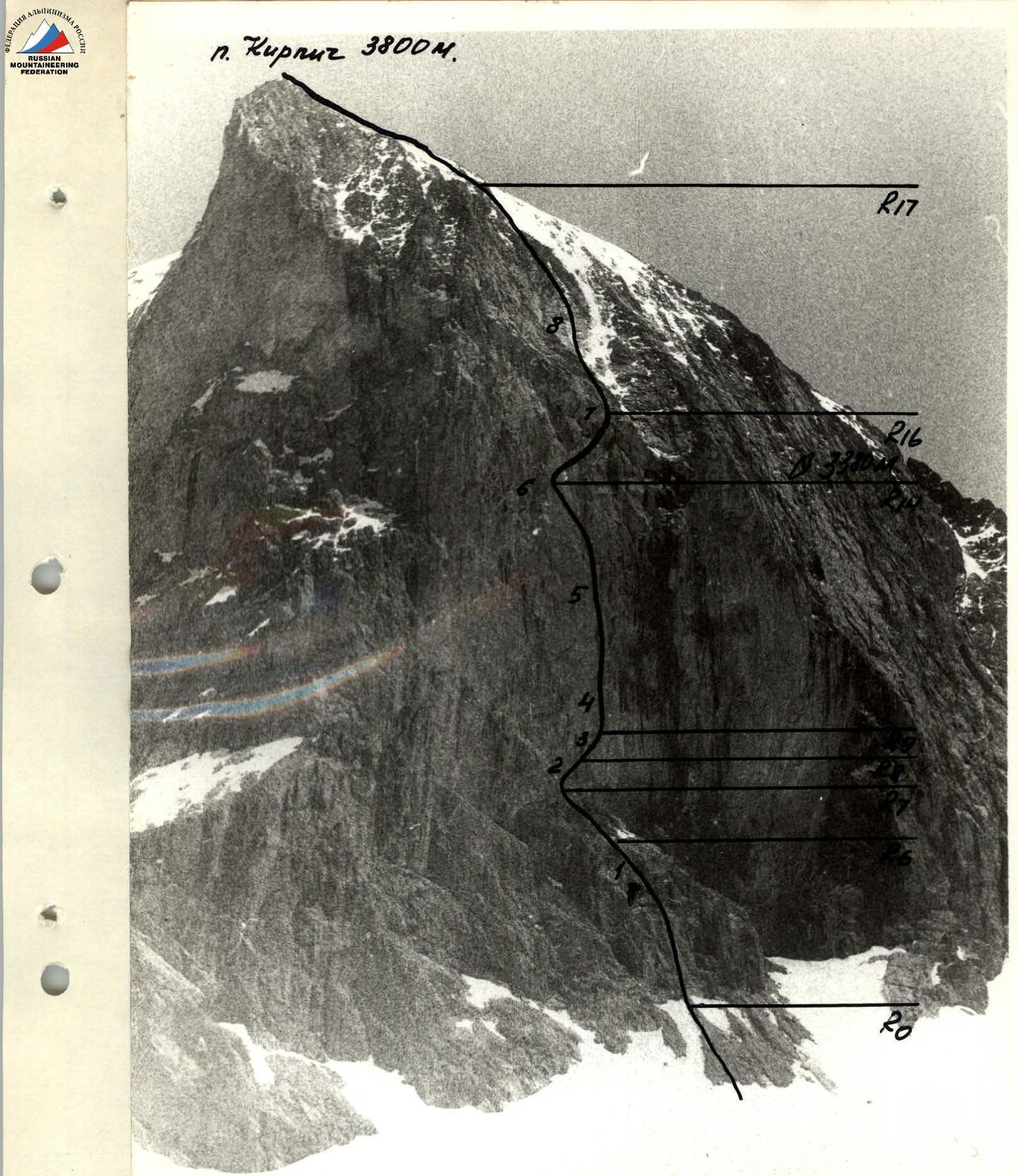
Filmed on June 27. Exposure 44; 50 min. Distance to object 1000-1500 m. Height 2900 m. Point #1. View of the inner corner from section R4-R5. The route line is shown. Lens T-43; 40 mm. Filmed on July 1, 1983, 8:00.

Comments
Sign in to leave a comment