
ASCENT DOCUMENT
-
ASCENT CLASS — technical.
-
ASCENT REGION — Pamir-Alay.
-
PEAK, ITS HEIGHT, ASCENT ROUTE:
Skalnaya Stena, 5112, via the left part of the center of the North face.
-
DIFFICULTY CATEGORY — 5B.
-
ROUTE CHARACTERISTICS:
height difference — 810 m,
length of sections with 6th cat. diff. — 220 m, «––» — 5th cat. diff. — 430 m, «––» — 3–4th cat. diff. — 160 m,
average steepness of the wall — 70°.
-
NUMBER OF PITOONS: for belaying, for creating I.T.O. (Intermediate Technical Objects)
rock pitons — 142, 10 ice screws — 8 bolt pitons — 8
-
NUMBER OF CLIMBING HOURS — 40 hours (excluding approach and descent).
-
NUMBER OF NIGHTS AND THEIR CHARACTERISTICS — 2 bivouacs, lying down.
-
SURNAME, NAME, PATRONYMIC OF THE LEADER, PARTICIPANTS, AND THEIR QUALIFICATION:
STADNIK Vladimir Fedorovich — Master of Sports of the USSR, SAMODED Alexey Anatolyevich — Master of Sports of the USSR, KHOROSHILOV Alexander Afanasyevich — Candidate Master of Sports, GREBENNIKOV Alexander Andreevich — Candidate Master of Sports, KABATSKY Vladimir Ivanovich — Candidate Master of Sports, PASTUKH Viktor Ivanovich — Candidate Master of Sports.
-
TEAM COACH — Stadnik V.F., Master of Sports of the USSR.
-
DEPARTURE DATE — July 13, 1983.
RETURN DATE — July 15, 1983.
* The height is taken from the classification table of routes. The actual height is: 4800–4850 m.
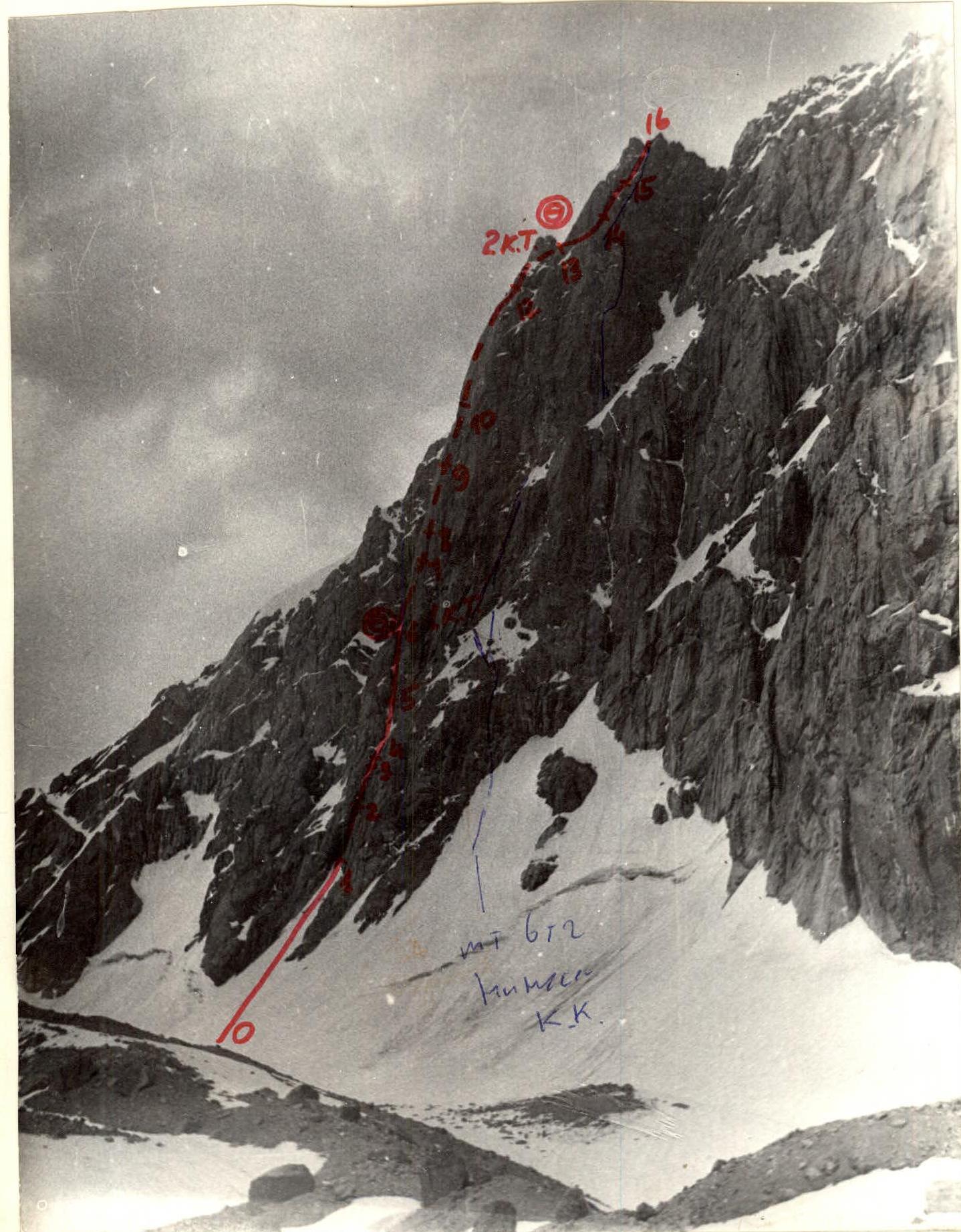
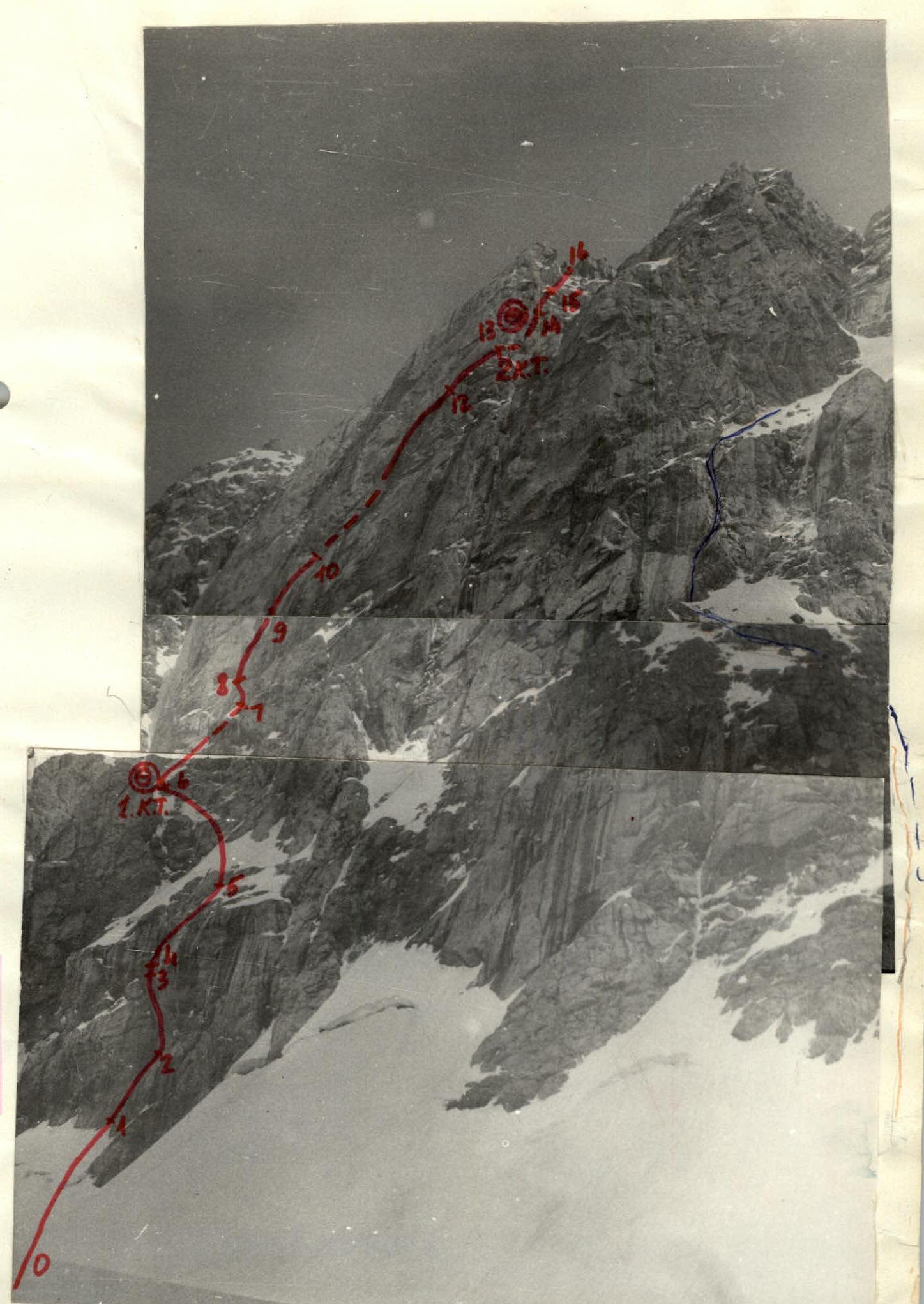
Tactical Ascent Plan
July 2–12: Observing the route. Departure from the base camp under the North face is scheduled for July 13. The route is planned to be completed in three days.
- Day 1 — approach to the wall and passage of the lower bastion (R0–R6)
- Day 2 — passage of the middle belt (R6–R13)
- Day 3 — passage of the upper bastion, reaching the summit, and descent
- Day 4 — reserve day
Considering the rockfall danger when passing the icy section under the wall, the group's departure onto the route is planned before the wall is illuminated by the sun, 2–3 hours before the time required to pass the hazardous area. The first climber works on a double rope without a backpack. To ensure safety in case of a fall, a shock absorber with a breaking force of 400 kgf is used.
The rest of the team climbs using double running belays or top-rope belays. Backpacks are carried by participants on their shoulders or attached to their harnesses via an extender.
Since significant sections of the route are icy, the group brings:
- crampons
- ice axes.
When choosing the amount of main rope, pitons, and carabiners, the possibility of processing the route above bivouacs I and II was taken into account.
Radio communication between the assault team, observation group, and base is carried out using "VITALKA" radios.
In case of worsening weather or an emergency situation, the group descends via the ascent route. For this, they are equipped with the necessary number of rappel slings and pitons.
The adopted tactical plan was implemented and fully justified.
ROUTE PROGRESSION
July 13
The lead pair departed from the base camp under Skalnaya Stena at 5:00. The approach to the bergschrund took 20 minutes. Crossing the bergschrund does not present technical difficulties. After the bergschrund, there is an icy slope (50° steepness, 100 m long). It is traversed using front-point crampons and ice axes (section R0–R1).
After crossing the icy section, there is a 60 m approach to an internal corner (section R1–R2). Climbing up the internal corner (icy "ram's foreheads," 70°) leads to a нависающий внутренний угол (overhanging internal corner) (100°) and a cornice (section R2–R3). Sections are traversed using ladders and I.T.O.
After the overhang, steep "ram's foreheads" (70°–80°), iced up (80 m, section R3–R6), are traversed. Organizing belays and movement is very challenging. Exit onto a snowy ridge. Time: 16:00. A decision is made to organize a bivouac on the snowy ridge and process the icy section further (R6–R7). The first rope team, Samoded–Pastukh, finished work at 20:00.
July 14
At 7:00, the Grebennikov–Stadnik rope team started. They traversed the 60 m icy section processed the day before. The wall is climbed via an oblique chimney, 25 m, filled with snow and ice. The chimney abuts a sheer wall, 10–15 m (90°) (section R7–R8). After the wall, a vertical internal corner with flow ice and huge icicles, 40 m (90°), is traversed using ladders and I.T.O., and ice screws (section R8–R9). Then, a vertical wall (90°), 35 m, with few cracks for piton placement (section R9–R10). This is followed by a series of walls and internal corners heavily iced up, 120 m (70°), and an approach to an overhanging wall, 30 m (100°) (section R12–R13). After passing the wall (ladders, I.T.O.), there is an exit onto a snowy ridge, 5 m. Time: 18:00. A decision is made to organize bivouac II here. The rope team continued processing further. Work was finished at 21:00.
July 15
At 7:00, the Samoded–Pastukh rope team started. After the bivouac, they traversed an internal corner, 40 m (100°), using ladders and chocks. After the internal corner, along a small oblique ledge, they approached an internal corner with a cork. The rocks are iced up and snow-covered, 90 m (70°–80°). This is followed by a series of walls and internal corners, 60 m, and an exit onto the summit ridge, 20 m from the summit. The group reached the summit.
CONCLUSIONS AND RECOMMENDATIONS FOR THE ROUTE
The traversed route to v. Skalnaya Stena via the left part of the center of the North face is classified as a technically complex combined route. Based on the assessment of sections and the condition at the time of passage (heavy icing), the route corresponds to a good 5B cat. diff. This route has the following features:
- Most of the route has a steepness of 70°–80°, and some sections — 90° or more.
- Rocks along the entire route are iced up, with the character of "ram's foreheads."
- Belays on most sections were primarily made using pitons and chocks; bolt pitons were also used.
- Objectively, rockfall-prone areas are sections R0–R1 and R6–R7.
- The route has many sections requiring ice climbing equipment.
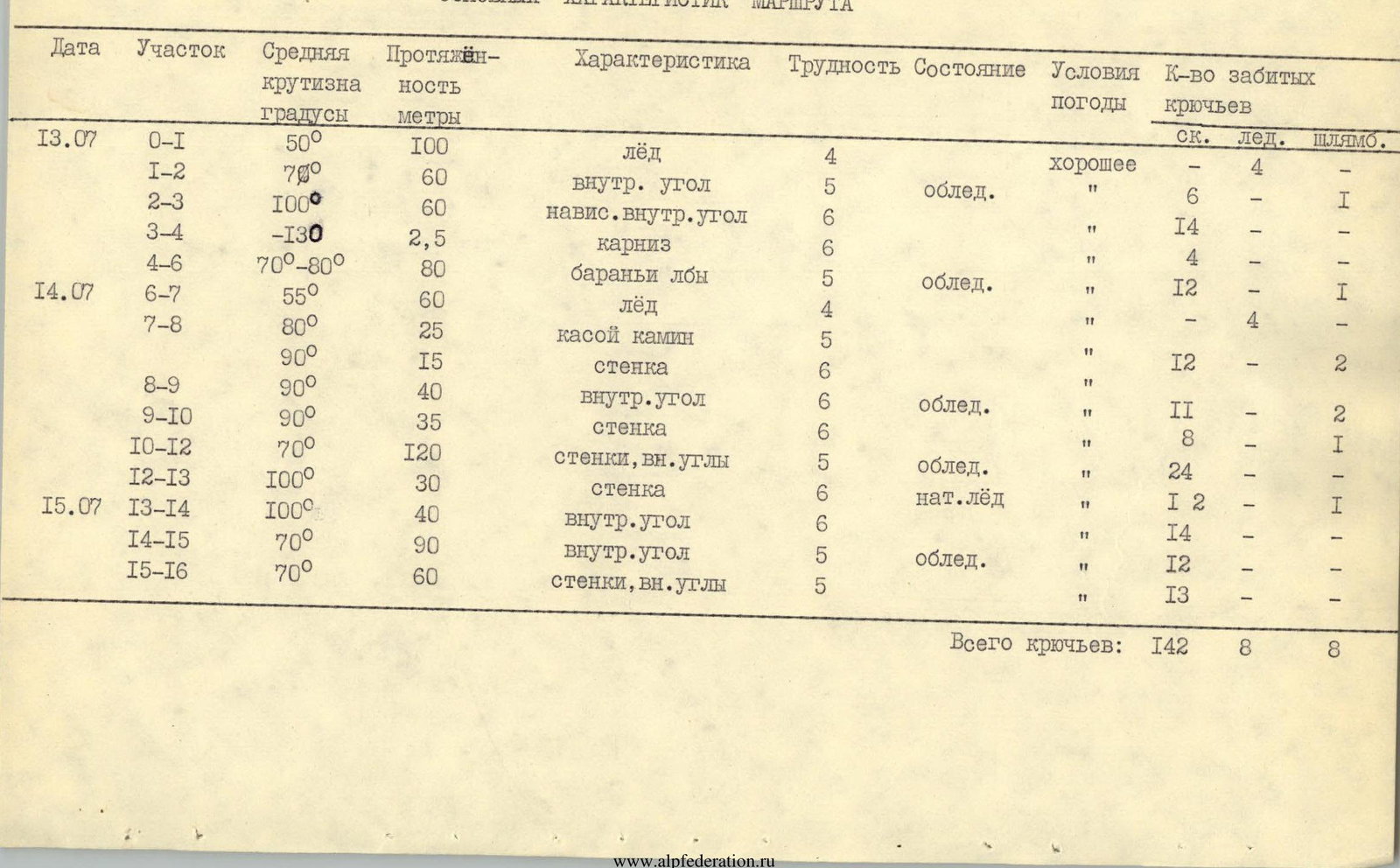
TABLE OF MAIN ROUTE CHARACTERISTICS

Comments
Sign in to leave a comment