
RUSSIAN ALPINISM FEDERATION
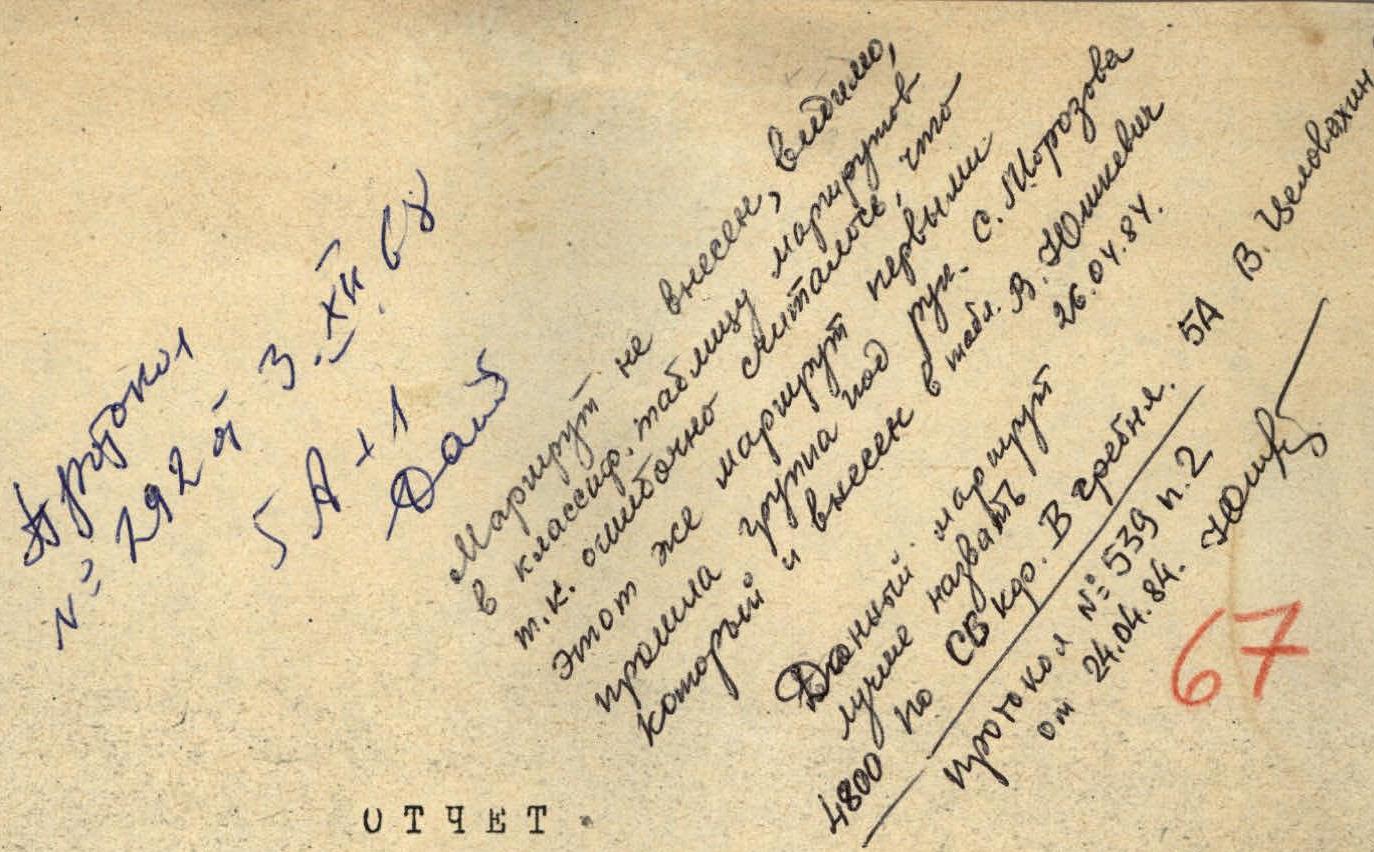
№ 292 dated October 3, 1968 5A+Б
It is given
The route has not been entered, apparently, into the classification table of routes, as it was mistakenly believed that this same route was first passed by a group led by S. Morozov, who is listed in the table. V. Yumikevich April 26, 1984
This route should be named 4800 along the NE edge of the ridge. 5A V. Tselovakhin, 1968 Protocol № 539 p.2 dated April 24, 1984
REPORT ON THE FIRST ASCENT OF THE NORTH FACE OF "SKALNAYA STENA" PEAK BY A GROUP OF ALPINISTS FROM THE KUIBYSHEV REGIONAL COUNCIL OF THE "TRUD" SPORTS SOCIETY July 30 – August 2, 1968
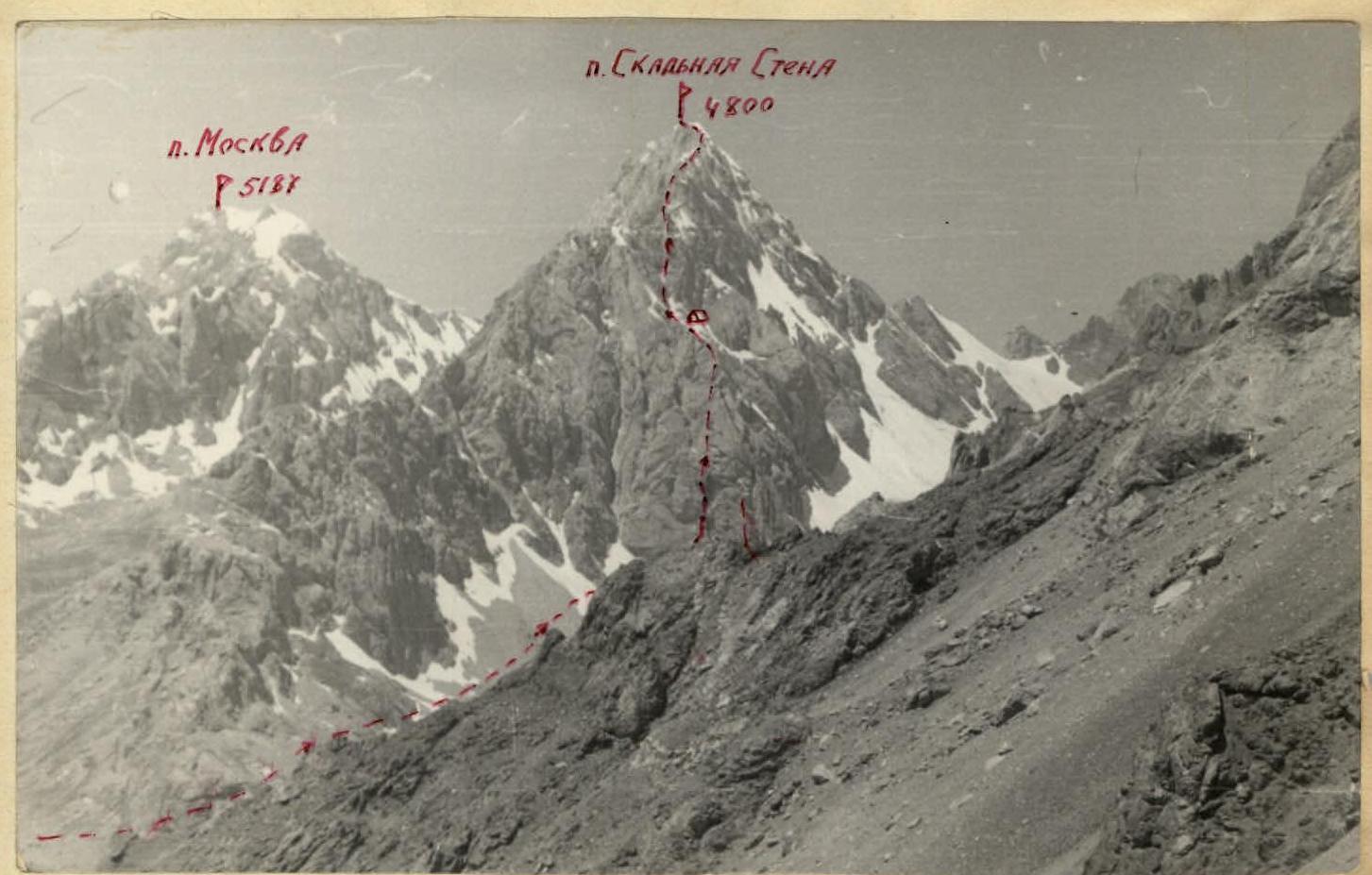
View of Skalnaya Stena peak from Kaznok pass.
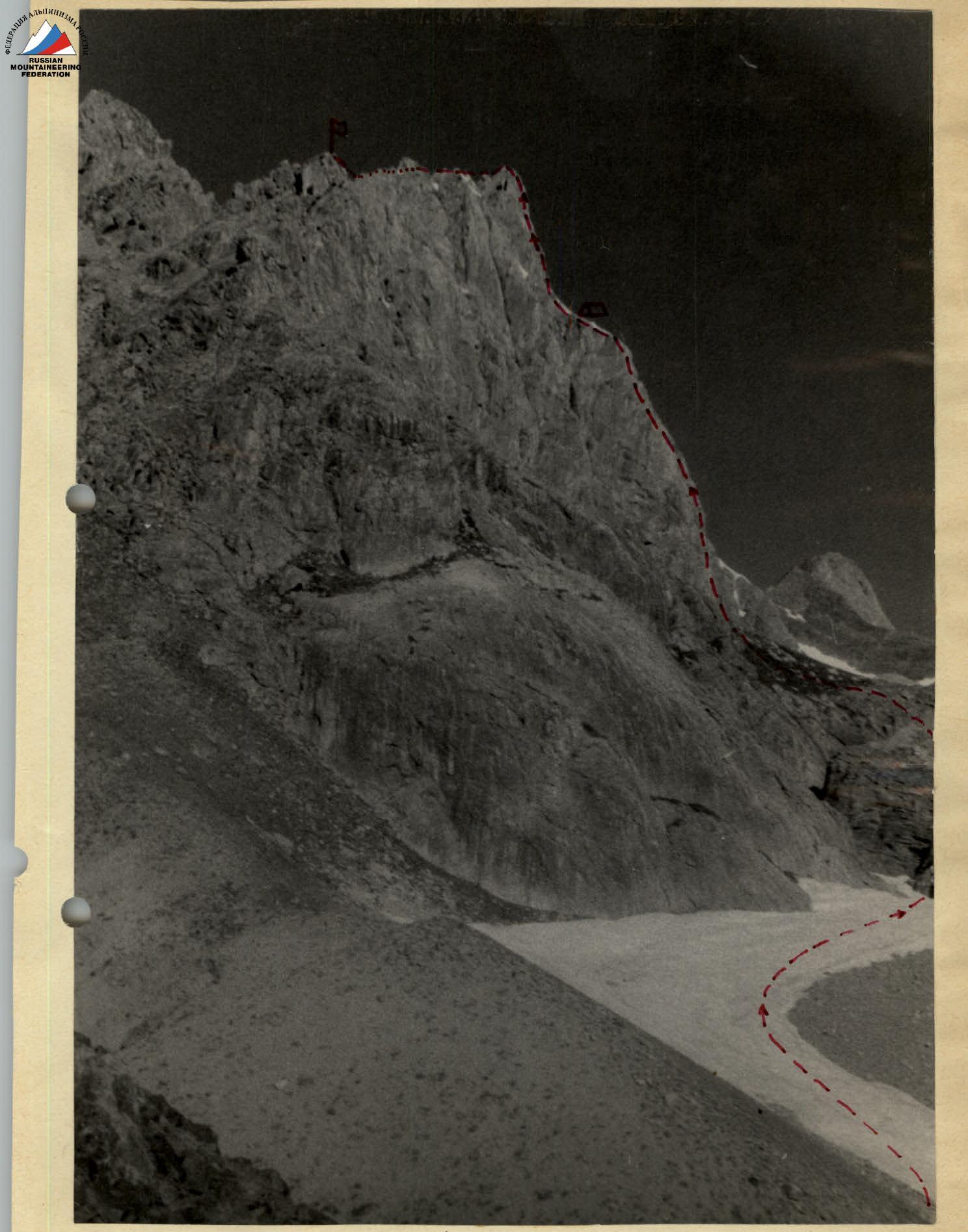
Profile of the wall. View from the assault camp.
II. Information about the sports group
The assault group for the first ascent of the north face of "Skalnaya Stena" peak consisted of four participants from the main alpinist composition. All four were included in the competitive team roster for the USSR championship in 1968.

Until this season, group members Benkin V.S. and Tselovakhin V.V. had completed several climbs together, including the ascent of the northwest wall of Zapadny Dombay with a 5B category difficulty in 1967, climbing in the same rope. Ashanin V.V. and Kazaev Yu.V., also in the same rope, had completed several category 5 climbs in previous years.
III. Preparation for the ascent
I. Before departure to the mountains.
Preparation for this summer season for the group members and the entire alpinist team began immediately after the previous season. Since the Fann Mountains region was chosen back in September 1967, and the main goals for the team were set:
- Ascending the north face of "Skalnaya Stena" peak;
- Traversing
Skalnaya Stena.
On July 30 at 7:00, the group left the assault camp located at the beginning of the eastern ridge of Skalnaya Stena peak in the Kaznok gorge, carrying with them pitons, carabiners, hammers, ladders, helmets, two 45-meter main ropes, and one 95-meter rope, i.e., everything necessary for processing the lower part of the route and organizing rappels for the first day of the assault. The ascent to the start of the route took one hour. After an additional inspection of the wall and a brief discussion of the assault plan, they began the ascent at 9:30.
The ascent onto the wall began at the very bottom part of the wall via a narrow, steep couloir filled with snow (20 m), then via easy, crumbling rocks (40 m) under an almost vertical wall with a tile-like structure. The initial ascent was simultaneous (section 1). The wall is 80° steep and 40 m long. There are small holds and narrow, short ledges (2–4 cm). Climbing is not very difficult. Piton belay - 5 pitons were driven (section 2).
The wall leads to a not very pronounced ridge of the counterfort, rather a rocky slope of the same tile-like structure, with rocks that are less steep - 65–70°.
Movement is of medium difficulty, the length of the section is 50 m in the direction of a pronounced internal angle. Piton belay - 3 pitons were driven (section 3). We move up and to the right along a 30-meter internal angle with a steepness of 75°, driving 3 pitons. Climbing is difficult, only made easier by the absence of a backpack (section 4). A yellow wall looming over the exit from the angle is bypassed on the left along a narrow, inclined ledge going left and up at 60°. This 10-meter ledge is traversed with difficulty, with almost no holds. 3 pitons were driven. From the ledge, there is an ascent up and slightly to the right along a narrow, 25-meter internal angle with a steepness of 85° to a separate large rock. Climbing is very difficult, there are few holds, and movement in tricouni boots is absolutely impossible. 6 pitons were driven in the angle (section 5). Immediately above this, a rocky overhang looms over the rock wedged in the upper part of the angle. It is necessary to move under it along a sheer wall to the left for 6 m to an inclined slab (30° – 10 m). The slab was passed easily ("vibram" soles held well). From the slab, they exited onto a fairly wide ledge that wraps around the wall on the left for 40 m (section 6).
In the middle part, the ledge is interrupted for 8 m. Traversing along the sheer, smooth wall is extremely complex. The rocks have a fine roughness, with a load on the tips of the fingers and friction movement.
Underfoot, at a depth of 250 m:
- snow;
- rocks of the gorge.
A dropped stone falls without touching the rocks of the wall. The section was passed by the first climber with thorough piton belay. The others follow along the taut, horizontal rappel lines. 4 pitons were driven.
Along the second half of the ledge, they approached two large niches where an overnight stay is possible. There is no water.
The ascent from the bottom to the niches took 5 hours with movement without a backpack.
Along the way, ropes were secured on pitons:
- 185 m of rope;
- 40 m of reepschnur in the lower part.
They descend, removing some of the pitons along the way. The ropes are secured on anchors. They quickly rappel down to the assault camp, leaving the gear under the wall. Confidence grows that after processing, they will be able to pass the entire lower wall to the snowy shoulder in a full day.
July 31. They left the assault camp at 6:00, while a group of alpinists led by STATSKY L.N. began their assault on the south wall simultaneously. After 10 minutes of walking, their paths diverged. After an hour, they began their ascent along the suspended ropes with a prusik knot. They tried not to be directly under each other, although there were no loose rocks on the wall. Gradually, they retrieved the ropes from the upper belay of the last climber and removed the pitons.
After 3 hours, they gathered in the niche. Breakfast, tea was hauled up in flasks. Control checkpoint № 1. At 11:00, they continued on to the unprocessed part of the wall. By bypassing the far niche on the left, they ascended 2.5 m along a sheer and smooth wall, then moved up and to the right for 10 m along a 50° slab, which serves as a sort of roof over both niches.
Above the slab, there is a looming yellow wall. The ascent onto it is made at its shortest part - along a 3-meter smooth wall with an overhang (105°). 5 pitons were driven in this section. The wall was passed with the aid of ladders.
Above the wall, movement is up and to the left along an internal angle - 75°, 25 m. The area is prone to rockfall, and 3 pitons were driven.
Above the angle, there is a ledge where the second climber can be received.
From the ledge, there is a traverse to the right and up along a narrow, 5-meter ledge along the sheer wall to a pronounced, narrow internal angle, and then straight up - 80°, 15 m.
The entire 60-meter section is very complex and was passed in 2 hours. The most complex part is the internal angle, where 4 pitons were driven (section 7).
The left edge (section 8) of the angle transitions into a wide, smooth slab at 60° over 15 m. There are no cracks.
The slab was passed on friction without a backpack (2 pitons). Movement in ordinary boots without ladders on bolted pitons was impossible. The right edge of the angle is closed by the slab with an overhanging rocky cornice.
Beyond the slab, there is a 10-meter traverse to the right and up along the base of the overhanging wall, then 5 m up along a narrow crevice filled with rocks. 8 pitons were driven over 15 m - climbing is very difficult without a backpack.
The crevice led to a wide, 20-meter osseous ledge encircling a large yellow belay tower. The walls of the tower are absolutely smooth, with not a single hold even for fingers, but in the center, there is a narrow, deep chimney slightly inclined to the left. The steepness of the chimney is 80°, its length is 20 m.
Passage is complicated, relying on friction. Climbing with a backpack is impossible since the body of the middle participant completely fills the width of the chimney. Piton belay - under and above the chimney (4 pitons).
(Section 9)
Beyond the chimney, they moved along a narrow, 10 cm wide ledge on the left side of the tower for 5 m. 2 pitons were driven. The ledge ends near the outer angle, which is 12 m with a steepness of 75° (2 pitons). Backpacks were hauled up. After the angle, they moved up and to the left along a narrow crack at 60° for 15 m to a ledge (2 pitons) and from it up along an 80° smoothed wall for 60 m (section 10). Climbing is very difficult, the first climber goes without a backpack, with 12 pitons driven for belay. The wall led to a gentle ridge edge with a snow patch. After moving simultaneously for 50 m along it, they organized a convenient bivouac on the scree at 20:00. Control checkpoint № 2.
For the working day and the time spent processing the lower part of the wall, they covered 490 m (440 m in height).
65 rock pitons were driven.
IV. Brief description of the ascent
Section 11
Along easy rocks along the counterfort ridge for 20 m and a steep snow slope for 30 m, they approached a ledge at the junction of the ridge with the wall, which steeply ascends to the main ridge of the peak.
Along the ledge, they moved 20 m to the left. Belay was variable through ledges.
From the end of the ledge, there is an ascent along a 120-meter, almost vertical wall with smooth rocks:
- There are few holds.
- Passage of the wall is possible only on friction in rubber boots and on dry rocks.
- In bad weather, overcoming it is very problematic.
- There are few cracks, and careful organization of belay requires a lot of time.
- A wide range of pitons is necessary.
- 18 pitons were driven.
The first climber goes without a backpack (section 12).
The upper part of the wall is absolutely smooth, with no cracks.
A bypass to the right along a narrow couloir filled with ice is objectively dangerous due to rockfall. A more difficult but safe path was found:
- Movement along a long, narrow chimney running parallel to the wall on the left.
- At the bottom, the chimney is wide, but only the upper 60 m are suitable for climbing.
- Movement is possible using both edges of the chimney.
- Entry into the chimney involves descending to the left along the wall for 6 m on a rope.
They move along the chimney on friction (sometimes bracing with legs and back, or rather, the backpack, and sometimes by ordinary climbing along the right wall of the chimney). Climbing with a backpack in narrow places is very difficult. The steepness is 80° (section 13). 8 pitons were driven. Above the chimney, there is a ledge with loose rocks. Finally, a steep snow slope for 50 m leads them to the main ridge of the peak at 16:00. They covered 310 m in 8 hours, with 240 m of ascent.
26 pitons were driven for belay. The ridge is a highly dissected rocky ridge with many belay towers and snow ridges.
Two large belay towers are particularly pronounced, with height differences of up to 100 m:
- The first, as they move towards the peak, consists of rocks of a reddish-brown color with many loose large rocks.
- The ascent onto it goes along the left (southern) slopes, crossing several couloirs and passing many small walls.
- Movement up seems less complex after passing the wall, but it is necessary to move extremely cautiously due to rockfall.
- There are many ledges.
- Pitons are not driven.
Beyond the brown belay tower, after a 40-meter horizontal snow ridge, there is an ascent onto the second large belay tower about 100 m high:
- The lower 30 m are quite complex, with 3 pitons driven.
- Then climbing is of medium difficulty with alternating belay through ledges.
- The last 15 m are steep rocks with snow, and the group exited onto a horizontal snow ridge.
On the left, between it and the rocks on the scree part of the ridge, they organized a bivouac at 20:00. They spent the night next to LUPASHIN E.'s group from the same alpinist team. The guys had reached the peak 50 minutes earlier, ascending for the first time along the edge from the Double Pass. Their goal was to complete a full traverse of the massif from West to East. There was a mutual consultation. It became clear that the peak was "not far away." They decided to descend directly to the south onto the Khoroshevsky pass along the ascent route of Statsky L.N.'s group - it was interesting to see how this absolutely new route, also climbed by their young but very strong and experienced first-raters, turned out.
September 2 - departure at 8:00. They parted ways with Lupashin's group and quickly moved along the easy snow ridge with small belay towers towards the peak. The ridge is almost horizontal. The ascent to the peak is along a rocky slab for 25 m, and they reached the cairn at 8:30, exchanging notes.
The excellent mood after overcoming a very pleasant and complex wall for climbing was somewhat spoiled by bad news. It turned out that their young companions, who had reached the peak a day earlier, found a cairn with a note from Chelyabinsk alpinists led by Master of Sports of the USSR Sergei Morozov, who had ascended the peak the previous year via the north wall, but not from the Kaznok gorge, as they did, but from the Zindon gorge.
They had been sure that their alpinist team would be the first on this rocky beauty... It's a shame that the Chelyabinsk alpinists didn't register their route, and no one knew about it, including the annual visitors to the Fann Mountains - almaty and tajik alpinists.
After photographing the surrounding peaks, they began their descent at 9:00. 70 m of return along the ridge, and they started descending along the rocks of the South Ridge. 100 m were traversed with alternating belay to a practically sheer wall. Further:
- 40 m of sport descent;
- 45 m "dülfer" into a wide couloir;
- traverse to the right along the route for about 40 m;
- a series of "dülfers" for 40–45 m directly onto the Khoroshevsky pass.
From the pass, they descended into the assault camp in the Kaznok gorge in 1 hour and 20 minutes, arriving at 19:00.
The group completed the ascent in the following rope teams:
- Benkin V.S. - Tselovakhin V.V.
- Ashanin V.V. - Kazaev Yu.V.
The rope teams were alternated on the route. The route, first passed by the group, is very complex. Almost the entire path was traversed by all participants in rubber footwear (two in "vibram" and two in canvas shoes). The two pairs of tricouni boots available in the group were used during the ascent only on snowy sections and on the ridge. Good physical and technical preparation allowed them to pass this very complex route by climbing, without the use of bolted pitons, but with the use of ladders on the negative wall. The maximum lightening of backpacks fully justified itself. The most necessary turned out to be short, wide, combined titanium pitons 3–4 mm thick.
The group required 30 hours and 30 minutes to reach the peak, of which 26 hours were spent on passing the wall (including 5 hours for processing).
94 pitons were driven for belay during the ascent, of which 91 were driven when passing the wall.
In some places, the organization of belay was complicated due to the absence of cracks. There were no wide cracks for wedges.
The group considers the passed route, compared to many 5B category routes previously passed by the participants, to be a very difficult 5B category route.
Table of main characteristics of the ascent route
Ascent route - north wall of Skalnaya Stena peak.
Height difference of the route - 1200 m.
Including the most complex sections - 750 m.
Average steepness of the route:
- 75–80°.
Steepness of the most complex sections:
- 90° and more.
| Section № | Average steepness of the section | Length of the section | Relief description | Technical difficulty | Method of passage and belay | Time | Pitons driven | Notes |
|---|---|---|---|---|---|---|---|---|
| 1 | 60° | 60 m | Rocks are destroyed. In a steep couloir with snow. | Medium difficulty. Rocks are easy. | Simultaneous movement. | |||
| 2 | 80° | 40 m | Rock wall with a tile-like structure. | Not very difficult climbing. | Alternating climbing with piton belay. | 1 | 4 | |
| 3 | 65–70° | 50 m | Slope of rocks of the same type. | Medium difficulty. | Alternating movement with piton belay. | 1 | 2 | |
| 4 | 75° | 30 m | Internal angle. | Difficult climbing. | Movement on friction without a backpack. | 3 |
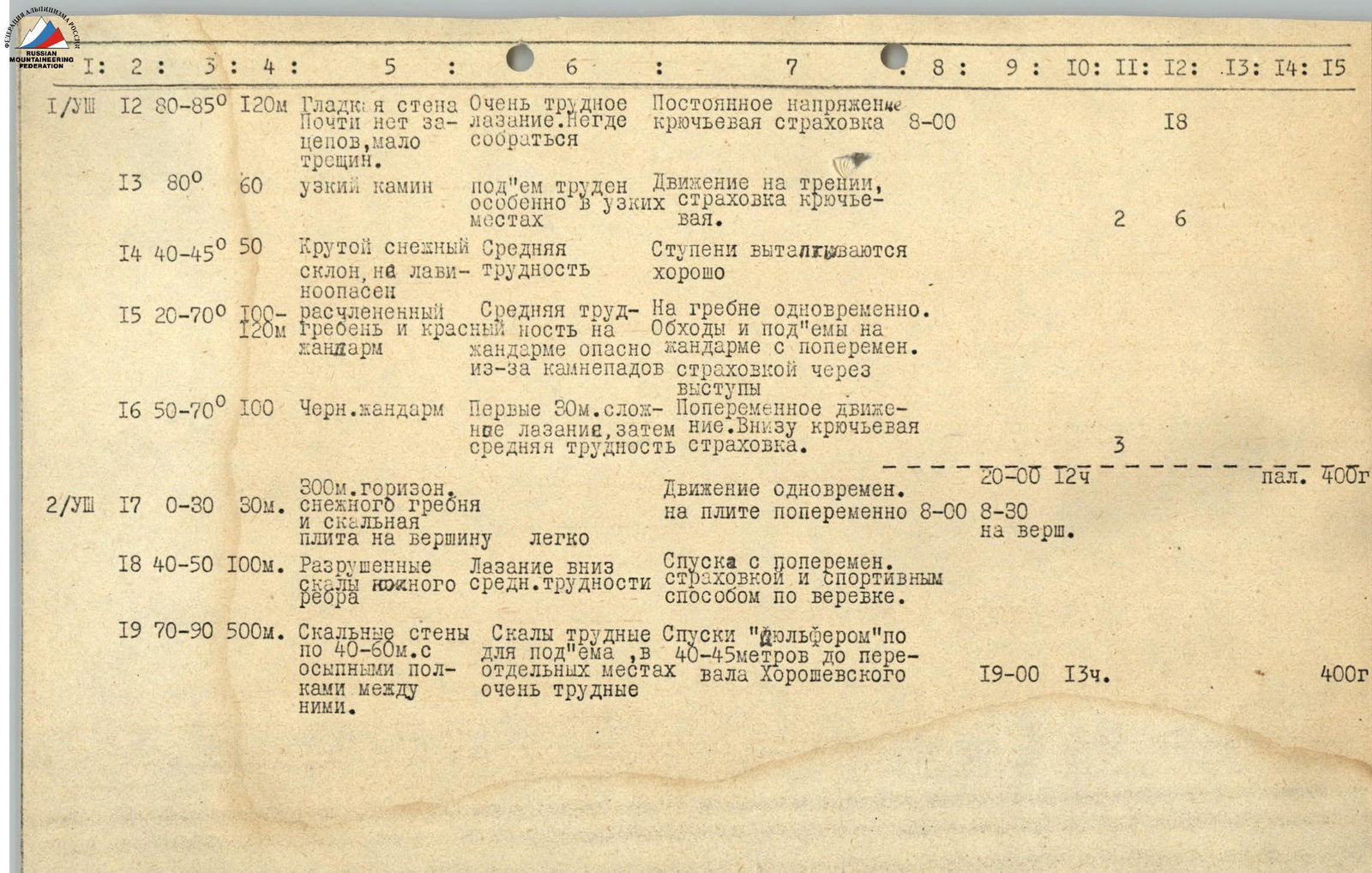
| Section № | Average steepness of the section | Length of the section | Relief description | Technical difficulty | Method of passage and belay | Time | Pitons driven | Notes |
|---|---|---|---|---|---|---|---|---|
| 5 | 85° | 35 m | 10 m steep ledge, 25 m internal angle to a wedged rock. | On the ledge difficult, in the angle very difficult. Holds are absent. | First without a backpack. Piton belay. | 2 | ||
| 6 | 35° | 55 m | Traverse along the wall under the cornice, slab, and ledge with an 8 m traverse along a smooth wall. | The slab was passed easily. Under the cornice difficult. Extremely difficult on the traverse of the wall where the ledge is interrupted. | Alternating movement, on traverse - rappel lines. | 1 | ||
| 7 | 75–105° | 60 m | 2.5 m wall. Traverse of a slab, negative wall 3 m, internal angle 25 m, narrow ledge, and narrow internal angle 15 m. | Very difficult climbing, especially the overhanging wall and the upper angle - almost no holds. | On the wall - ladders, in angles - movement on jamming. Belay only piton. Backpacks were hauled up. | 2 | ||
| 8 | 60–90° | 50 m | Smooth slab, ledge, very complex narrow crevice, then main ledge - 20 m. | Very complex on the slab and in the crevice. On the ledge easy. | Slab passed on friction (only in rubber footwear). In the crevice, movement on jamming. Backpacks were hauled up. | 2 | ||
| 9 | 75–80° | 52 m | Narrow smooth chimney, narrow ledge, outer angle, and narrow crack. | Very complex climbing in the chimney, in the rest of the sections difficult. | Piton belay, in the chimney movement on friction. Backpacks were hauled up separately. | 3 | ||
| 10 | 80° | 60 m | Smooth wall. | Very difficult. | First without a backpack. Ladders were used twice. | 3 | ||
| 11 | 20–50° | 100 m | Easy rocks and snowfields of the counterfort ridge and ledge under the upper wall. | Easy. Movement on the ridge simultaneous, on snow and ledge - alternating belay. | From 20–84. | Made an excellent site on the ridge |
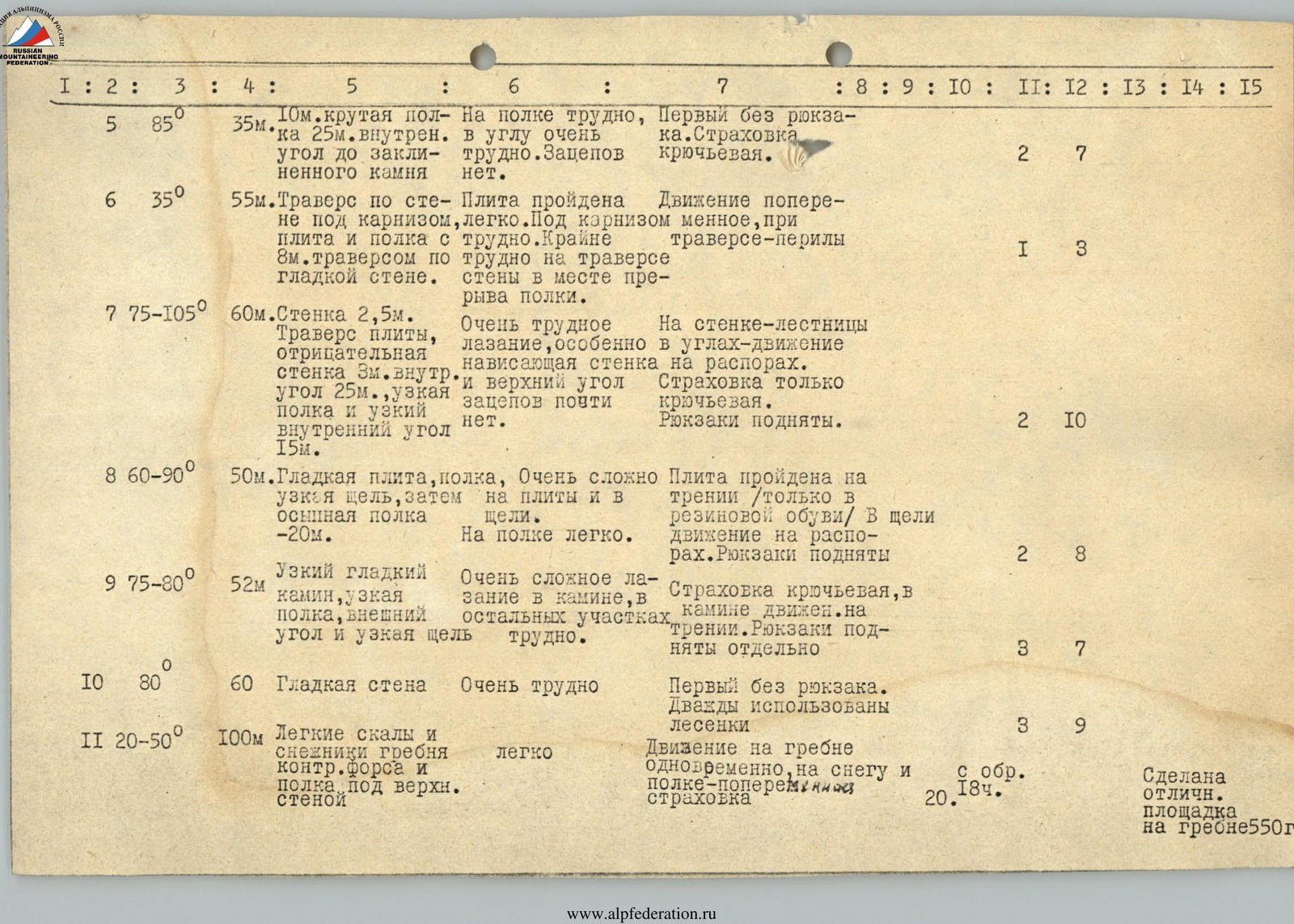
| Date | Section № | Average steepness of the section | Length of the section | Relief description | Technical difficulty | Method of passage and belay | Time (Start) | Time (End) | Duration (h) | Pitons driven | Distance covered (m) | Notes |
|---|---|---|---|---|---|---|---|---|---|---|---|---|
| 1/VIII | 12 | 80–85° | 120 m | Smooth wall. Almost no holds, few cracks. | Very difficult climbing. Nowhere to stand. | Constant tension, piton belay. | 8:00 | 18 | ||||
| 13 | 80° | 60 m | Narrow chimney. | Ascent is difficult, especially in narrow places. | Movement on friction, piton belay. | 2 | 6 | |||||
| 14 | 40–45° | 50 m | Steep snow slope, not avalanche-prone. | Medium difficulty. | Steps are well-trodden. | |||||||
| 15 | 20–70° | 100–120 m | Dissected ridge and red belay tower. | Medium difficulty on the belay tower, dangerous due to rockfall. | On the ridge simultaneous. Bypasses and ascents on the belay tower with alternating belay through ledges. | |||||||
| 16 | 50–70° | 100 m | Black belay tower. | The first 30 m complex climbing, then medium difficulty. | Alternating movement. At the bottom piton belay. | 3 | ||||||
| 20:00 | 12 h | Tents, 400 g | ||||||||||
| 2/VIII | 17 | 0–30 | 30 m | 300 m horizontal snow ridge and rocky slab on the peak. | Easy. | Simultaneous movement on the slab alternating. | 8:00 | 8:30 | On the peak. | |||
| 18 | 40–50 | 100 m | Destroyed rocks of the South Ridge. | Climbing down of medium difficulty. | Descent with alternating belay and sport descent on a rope. | |||||||
| 19 | 70–90 | 500 m | Rocky walls for 40–60 m with scree ledges between them. | Rocks difficult for ascent, in some places very difficult. | "Dülfer" descents for 40–45 m to the Khoroshevsky pass. | |||||||
| 19:00 | 13 h | 400 g |
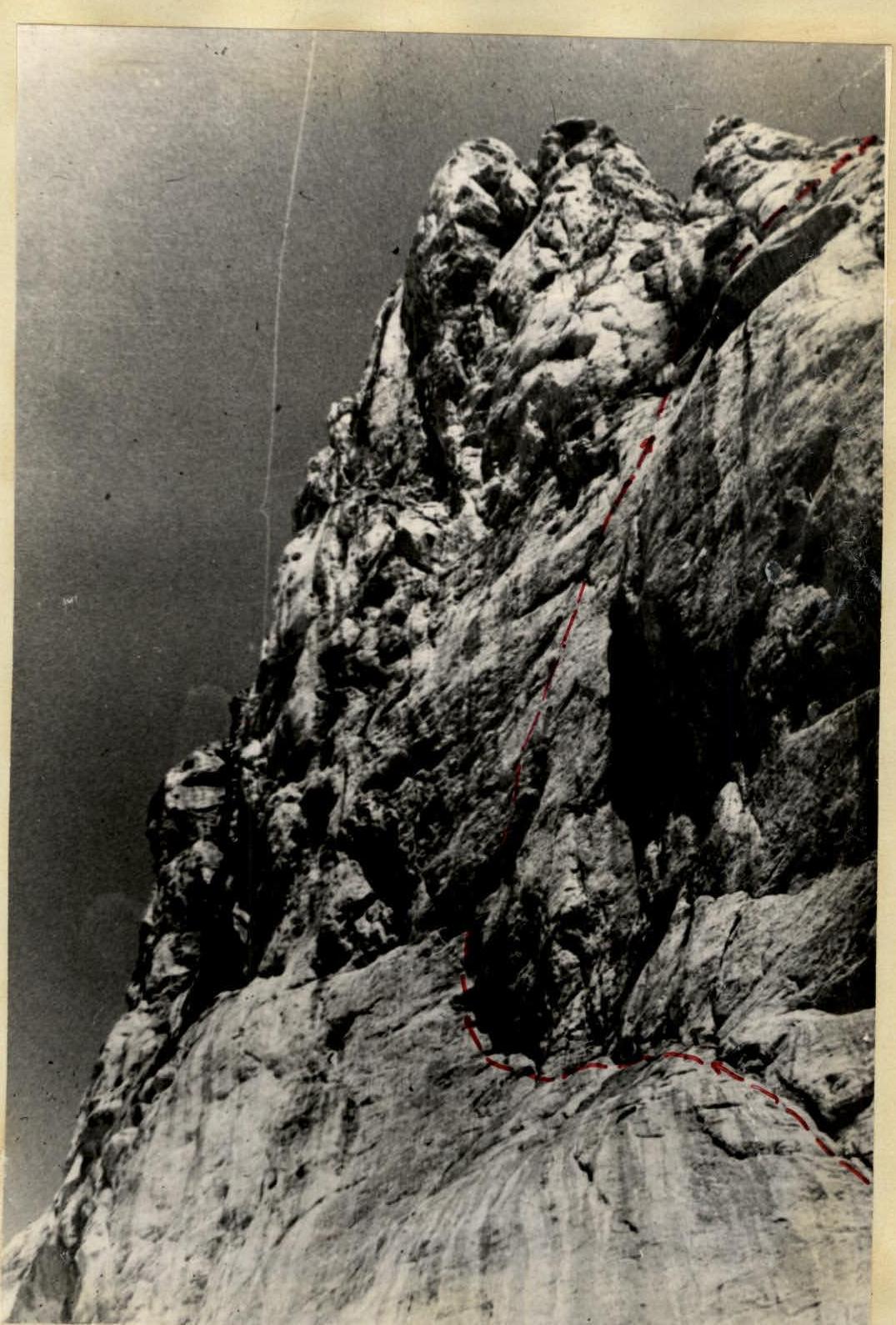
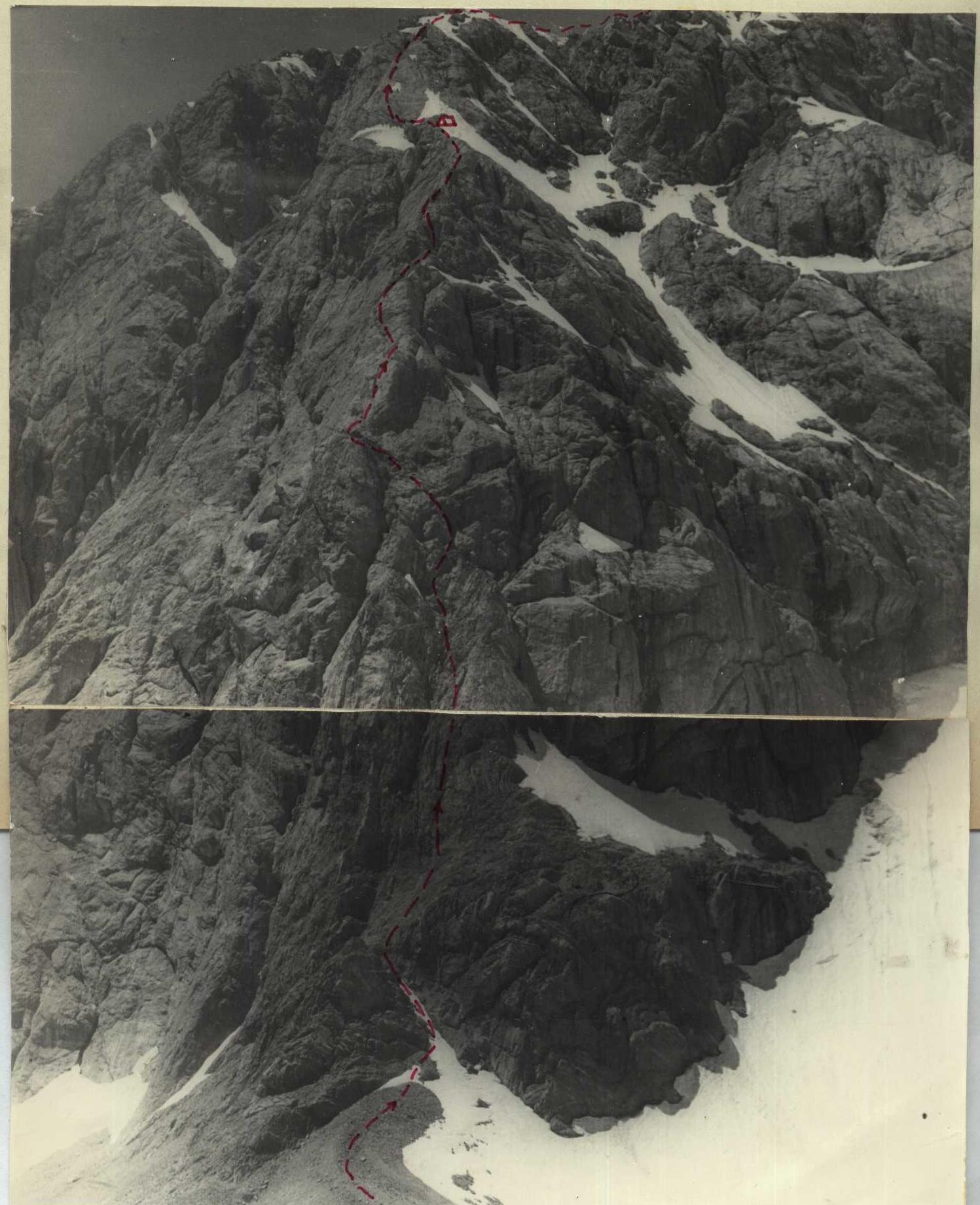
SECTION R2. Ledge and lower part of the wall. Photographed from a snow slope.

Comments
Sign in to leave a comment