
Central Council “Zenit”
Traverse of Dukdon Massif (first ascent)
N 418, October 13, 1970 5B
Team Captain Moiseev Yu. Team Coach Baskin S.
- Simonik A. G.
- Druy M. G.
- Pisarev K. L.
- Solodkov Yu. K.
- Kopenningene L.
Pamir-Alay—Moscow
1970
July 31–August 16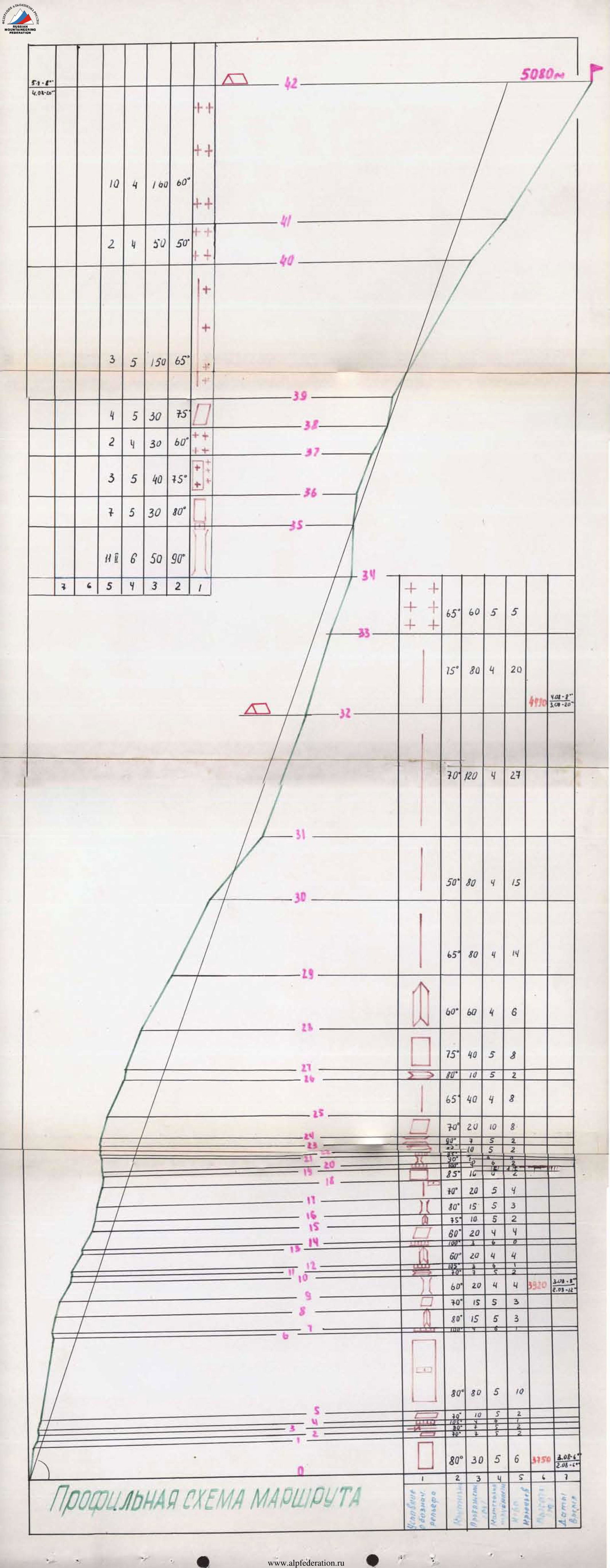
Continued Route Diagram
Map—Diagram of Dukdon Area
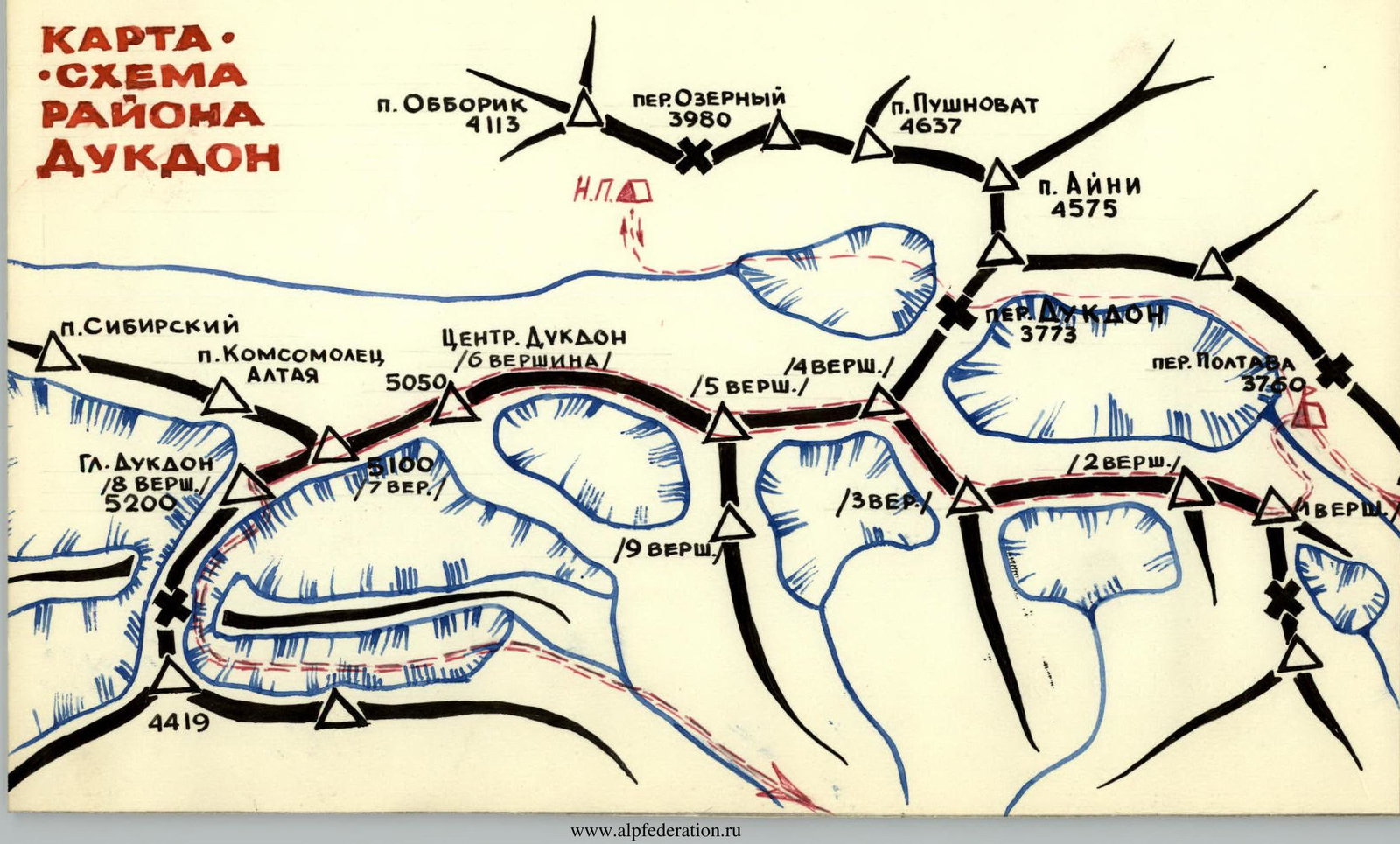
Ascent Description
1st day. August 3, 1970. Fog, overcast.
After a good rest, we leave the base camp at 9:00 and move along the scree into the cirque of a small glacier under the wall of the eastern peak of Dukdon. Then, through the bergschrund, we ascend the snow with increasing steepness up to 40–45° to the base of the ascent on the eastern counterfort of the wall. Along a steep icy slope covered with snow, we reach a wide rocky scree shelf by 14:00. The weather worsens sharply, rain, wet snow. We stop for the night, setting up camp on the shelf. By 16:00, the weather clears somewhat, and a team with two spare ropes goes up to scout and prepare the route for the next day. We move right to a crack. Then, along slabs and destroyed rocks, we climb onto a ridge connecting spur. Difficult climbing with piton protection. Then we traverse 1–1.5 rope lengths to the left along inclined shelves, bypassing the steep ascent of the ridge, and along a crack, we ascend to a depression in the ridge. From here, 20 m straight up a smooth wall (very difficult climbing). Working hours – 8.
2nd day. August 4. Overcast, occasional graupel.
We start at 8:00. We quickly pass the processed part of the route and pull up the backpacks over the last wall. The path continues mainly along the left wall of the counterfort. Initially, the path goes through an internal corner, transitioning into a chimney at the top (we pull up the backpacks). We reach a small platform (can accommodate three to four people) and set up a control cairn. Then, along monolithic large-block rocks with few holds and cracks, alternating with occasionally destroyed ridges, we reach a wide rocky couloir. On this section, the first person climbs in Vibram boots. After two rope lengths through the couloir, we reach a jagged ridge that is closed by a huge rocky triangle.
18:00. We chop ice on the northern part of the ridge and set up a platform. After two hours, the platforms are ready. We build a control cairn under the ascent of the ridge. Working hours – 10.
3rd day. August 5. Overcast, occasional graupel, snow. We start at 9:00. Movement along the ridge of large-block structure, consisting of a series of gendarmes. Climbing is difficult in places.
We approach the base of a rocky chimney with a snow-ice plug. We pull the backpacks through, pushing them ahead. After two rope lengths of moderately difficult rocks, we reach difficult shelves near a rocky wall with a crack.
We ascend the wall of the tower along a spiral path to the left and upwards. We pull the backpacks along the crack.
Then we move into a gentle depression along a rocky edge, with a parallel snowy ridge transitioning into a snowy slope to the right. This slope leads to the summit tower.
In the lower part of the edge, where a vertical rocky couloir descends to the left, we stop for the night at 17:00. Continuing is not feasible as tomorrow will be a challenging part of the ascent – overcoming the summit tower.
A team ascends along the edge for two rope lengths, then moves to the snowy ridge and examines the further path. The snow is soggy. We decide on an earlier start for the next day.
Working hours – 8.
4th day. August 6. Overcast. We start at 7:00. After passing the edge, we reach the ridge and then move left along the ridge, initially on snow, then on ice with increasing steepness up to 45–50°, covering 8 rope lengths to the base of a rocky counterfort. To the left is a steep, rockfall-prone couloir that is constantly "shedding rocks." Along shelves and slabs, and then along a steep groove veering right, we reach under an overhanging wall. We bypass this wall to the right along very difficult rocks, while pulling the backpacks "straight up." The weather worsens sharply, graupel, wet snow; we decide to continue as there are no suitable places for camping. We move right and upwards onto the shoulder of the counterfort – very difficult climbing – the first person goes without a backpack. We climb half a rope length up, bypassing a gendarme on the counterfort. Here is a wall. Smooth, slightly overhanging, without holds. We descend to the right along very difficult rocks with ice to the base of a black groove transitioning into a vertical chimney. To pull up the backpacks, we set up rappelling lines with two "relays." A key point on the route. The chimney is virtually without cracks or holds, wet, and iced over in the upper part. After the chimney, there's an inclined platform under a yellow wall. Here, we can have a semi-reclining bivouac. 20 m above, over the wall, is another small platform. We reach the lower platform at 19:00. We organize protection and attempt to level and enlarge the platform. By 20:00, the sky clears. We set up rappel lines between the platforms. Two people spend the night on the upper platform, and four on the lower one. At 22:30, we get into our sleeping bags. Working hours – 12.
5th day. August 7. Clear. We start at 9:00.
After a challenging day, we decide to rest and dry our tents in the sun. We move past the upper platform to the left towards the counterfort, bypassing the icy section along an internal corner. Along strongly destroyed rocks of moderate difficulty, veering right and upwards, we reach the pre-summit ridge running meridionally from the Kara-Archa pass, and along a simple, destroyed rocky ridge, we reach the first peak of Dukdon at 15:00. The height is about 5000 m. The team proposes to name it Peak L.V. Myshlyaev in memory of the outstanding mountaineer with whom team members Moiseev Yu.N. and Simonik A.G. shared climbing experiences. The total time spent on overcoming the wall was 44 working hours. The most challenging sections were about 450 m. The average steepness of the most challenging sections is about 70°. 106 rock pitons were hammered, 7 wedges, 5 ice pitons, and 2 screw pitons.
Far to the west stretches the jagged ridge of the Dukdon massif, at the end of which, shining in the sunlight, the main peak rises in a snowy-icy trapezoid. We build a cairn, leave a note. From the peak, we descend along the destroyed rocky ridge with short walls, bypassing small gendarmes to the left. The rock structure is notably different – more heavily destroyed with very sharp edges (the surface is like sandpaper). From a steep drop, we descend along a rocky wall with ice using a rappel (one rope) onto a steep snowy-icy slope and then reach a saddle with a small lake at 18:00, bounded on one side by a rocky ridge and on the other by an icy slope. We tramp down and chop the snowy-icy slope, throw rocks onto the platforms, and at 20:00, we climb into our tents. At 21:00, we fire a white flare for the observers – we've completed the first section of the route. Working hours – 9.
6th day. August 8. Clear. We start at 8:00.
We move around a rocky gendarme along shelves and then along a sharp ridge with snow; subsequently, along a snowy-icy ascent with rocky outcrops, we ascend to the second peak of Dukdon, which the team proposes to name in agreement with the Central Council "Tajikistan". We descend from the peak along a sharp ridge for 60 m to a small depression, from where we ascend a ridge along a complex wall and, bypassing a large, sharp stone to the left, we again reach the ridge. Further, to the right, along a steep snowy slope, and down onto an osypnoe plateau. The ascent to the third peak begins along osypnye "ram's foreheads," then we traversing left and upwards across the slope, 30 m below the peak, where we level two platforms for the tents. We have to work hard as there are monoliths everywhere, and a lot of "building material" is needed for a decent bivouac. At 21:00, we fire a white flare – from here, communication with the observers ceases (the main ridge turns southwest and is obscured by another ridge) – a signal to the observers that we're starting the descent to Saritagh. Working hours – 10.
7th day. August 9. Variable cloudiness, strong wind. We start at 8:00. We pass to the left of the peak and descend via a rappel (40 m) to a large stone in the ridge. Further along the ridge to the left towards a steep wall dropping south. We descend along a steep icy groove (sporting descent) onto a rocky ridge of large-block structure. After a small saddle, we overcome a wall. Very difficult, we pull up the backpacks.
Further south, we descend via a rappel. The rappel leads to a shelf from which, along an icy groove ending in a chimney with a plug, we reach under a wall with a crack. One of the difficult sections; we constantly have to pull up the backpacks. Along the crack, we reach a ridge with snowy cornices. Then we traverse left along a snowy-icy slope and subsequently straight up along a groove leading to a sharp snowy ridge, along which we ascend to the peak.
Time 17:00. The weather is bad, strong wind. Down to the south, 20 m, and we can set up platforms for the tents. After three hours of work, the tents are standing, and a team that went to scout has already returned, setting up another rappel. We go to sleep, the wind, although weaker than on the ridge, makes it hard to fall asleep. Working hours – 9.
12th day. August 14. Strong wind, overcast. We start at 9:00.
We descend along the ridge, then along a wall, and reach a snowy slope. Further along a shelf to the left, overcoming a wall with a crack, we reach an icy groove. After the groove, a short wall leads to a snowy-icy slope. Again, a rocky wall with an internal corner, and we reach a peak, which the first ascenders named Peak of Siberian Railway Workers. Then we descend along the scree and a long snowy slope to approach the main peak. From this point, the main peak looks like a giant triangle bounded on the right by a steep icy wall and on the left by an icy wall with embedded stones, transitioning into a rocky ridge at the top. We decide to move to the left. We traverse left along part of the wall and upwards along very destroyed rocks, at the end of which there's a small wall. Further movement is along the ridge to the false summit, descent from it to a saddle where we leave our backpacks, and then we ascend to the main peak. We return to the saddle. Time 18:00. We "repair" the old platform on the saddle and lay out a new one. Working hours – 9.
13th day. August 15. Variable cloudiness, wind. We start at 8:00.
We descend to the south. Initially, along a snowy-icy couloir branching off from the saddle, then along shelves, we traverse left along the path. Further down, two rappels and to the right down along a shelf – sporting descents. Then down along rocks like "ram's foreheads" and along smooth rocky walls, two rappels. After that, we traverse along rappel lines to the left to a snowy-icy section, along which we descend left – sporting descents. We approach a rocky island, pass it to the right and downwards, and in the same direction, we cross a snowy-icy slope. Then we reach a narrow shelf leading to a steep counterfort, and initially, we descend sporting, then via a rappel and land on two small platforms where all six people can fit. Time 20:00. We settle in for the night. Two people on the upper platform, four on the lower one, 3–4 meters apart. Working hours – 12.
14th day. August 16. Clear, cold. We start at 6:00. Almost dawn. Along a shelf and slabs, we traverse right and upwards, bypassing a rocky barrier, and further down along snow with sections of ice onto the Kara-Archa glacier. Along the Kara-Archa valley, then along the Karakul valley to Saritagh. We meet the observers. From Saritagh, at 15:00, we depart on a passing car (incredibly lucky) to the Varzob alpine camp, arriving at 19:30. Working hours – 4.
We traverse a snowy slope, from where we reach osypnye shelves along complex destroyed rocks (one rope length). Time 17:00. 40 m from the peak, we start "building" platforms. At this time, one team with an additional rope goes to scout and sets up a sporting descent from the peak. By 19:00, the platforms are ready. At 21:00, we fire a white flare – the second section of the traverse is completed. Working hours – 9.
Some Summary Data on the Route
| Indicator | Value |
|---|---|
| Total working hours on the route | 130 |
| Total days on the route | 14 |
| Traverse length | about 6.5 km |
| Total route length, including ascent and descent | about 10.5 km |
| Height difference on the wall | 1200 m |
| Total height difference during ascents (including the wall) | 2900 m |
| Total height difference during descents (including descent from the main peak) | 2500 m |
| Total pitons hammered on the route | 282, including: |
| rock pitons | 244 |
| ice pitons | 25 |
| wedges | 11 |
| screw pitons | 2 |
| Pitons hammered during descent | more than 30 pitons |
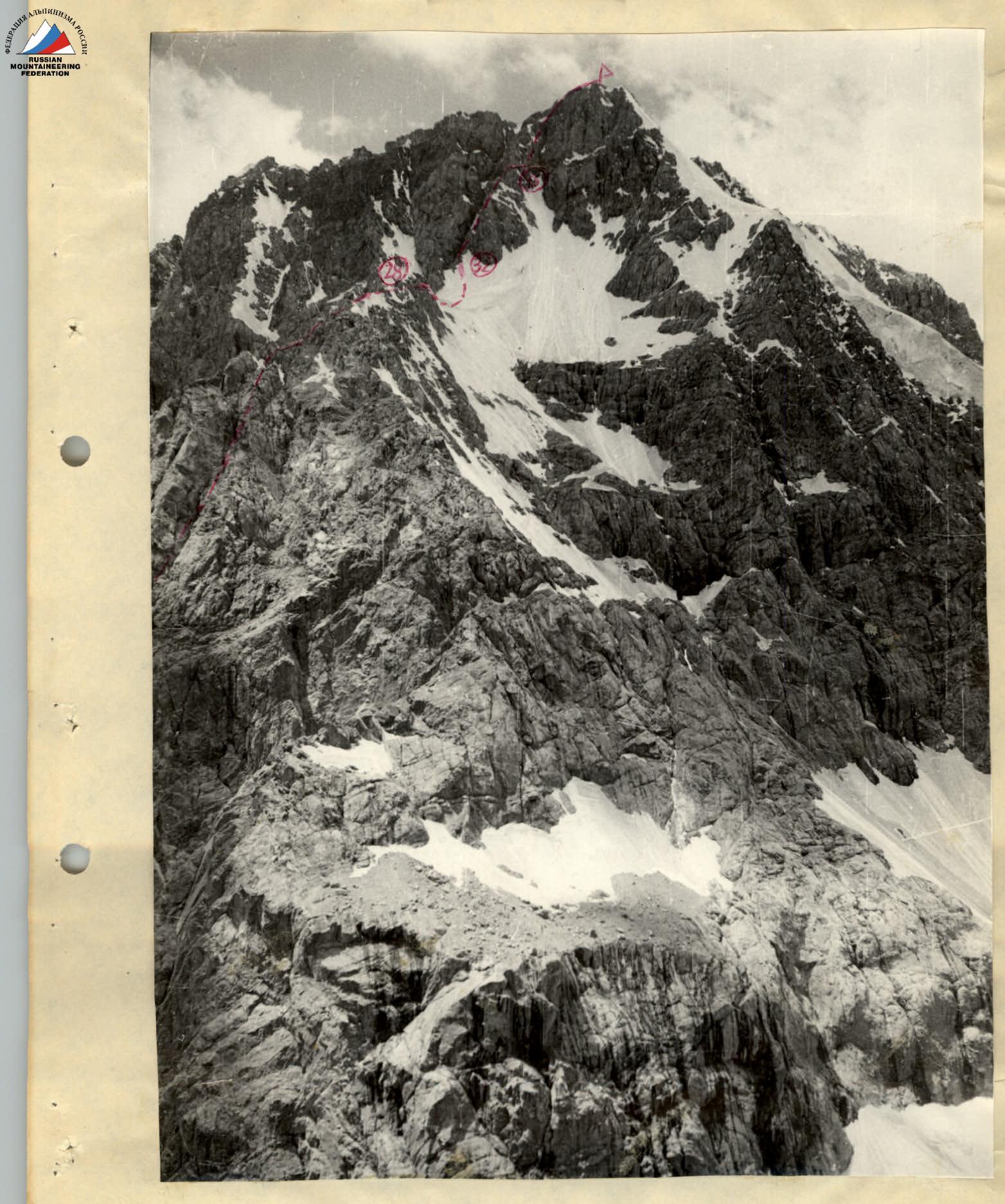
UPPER PART OF THE WALL (from Poltava pass)
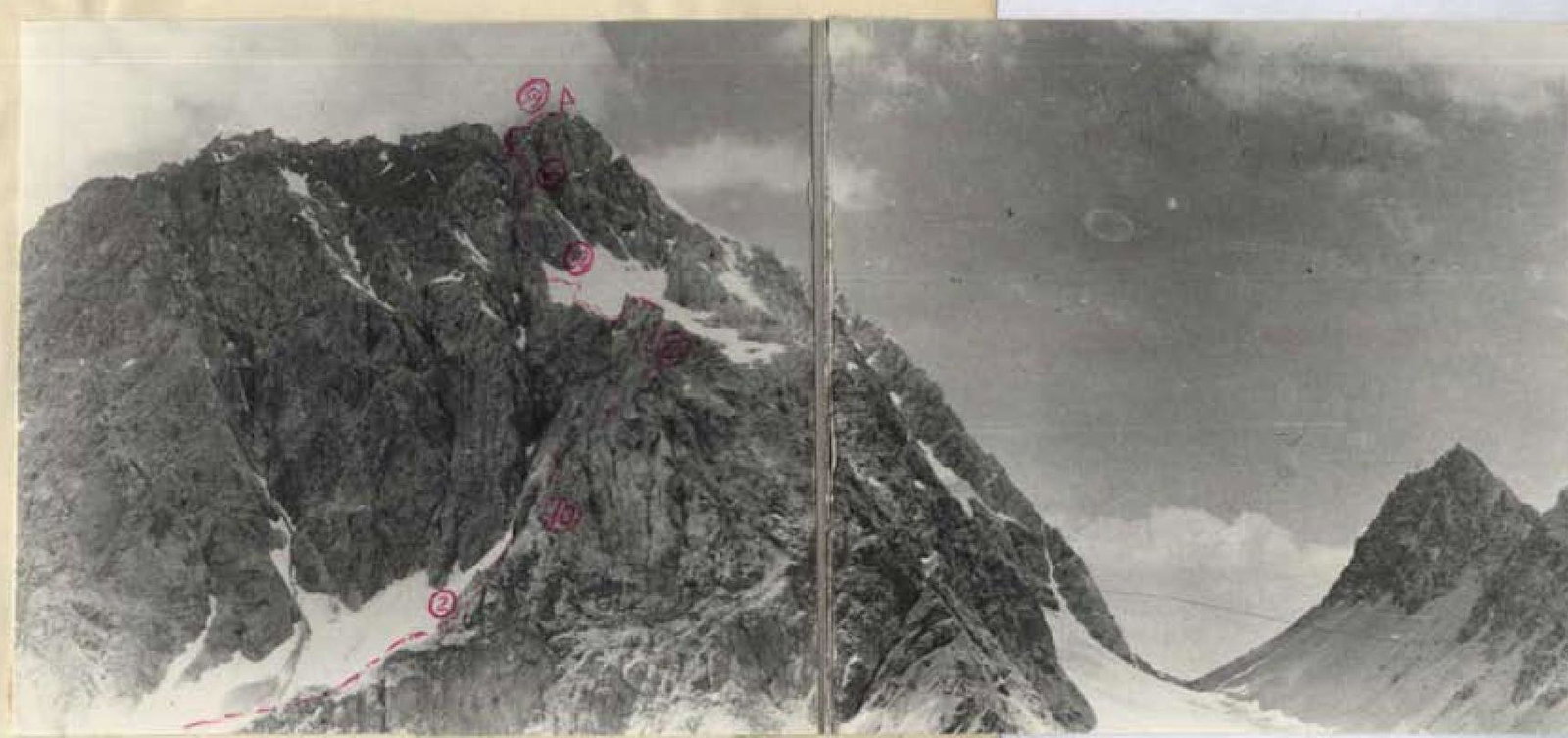
GENERAL VIEW OF THE WALL FROM KARA-ARCHA VALLEY. TO THE RIGHT IS DUKDON PASS.

7TH DAY OF TRAVERSE (sect. R82–R85). ENTERING THE CHIMNEY WITH A PLUG. FURTHER LEFT AND UPWARDS ONTO THE RIDGE.
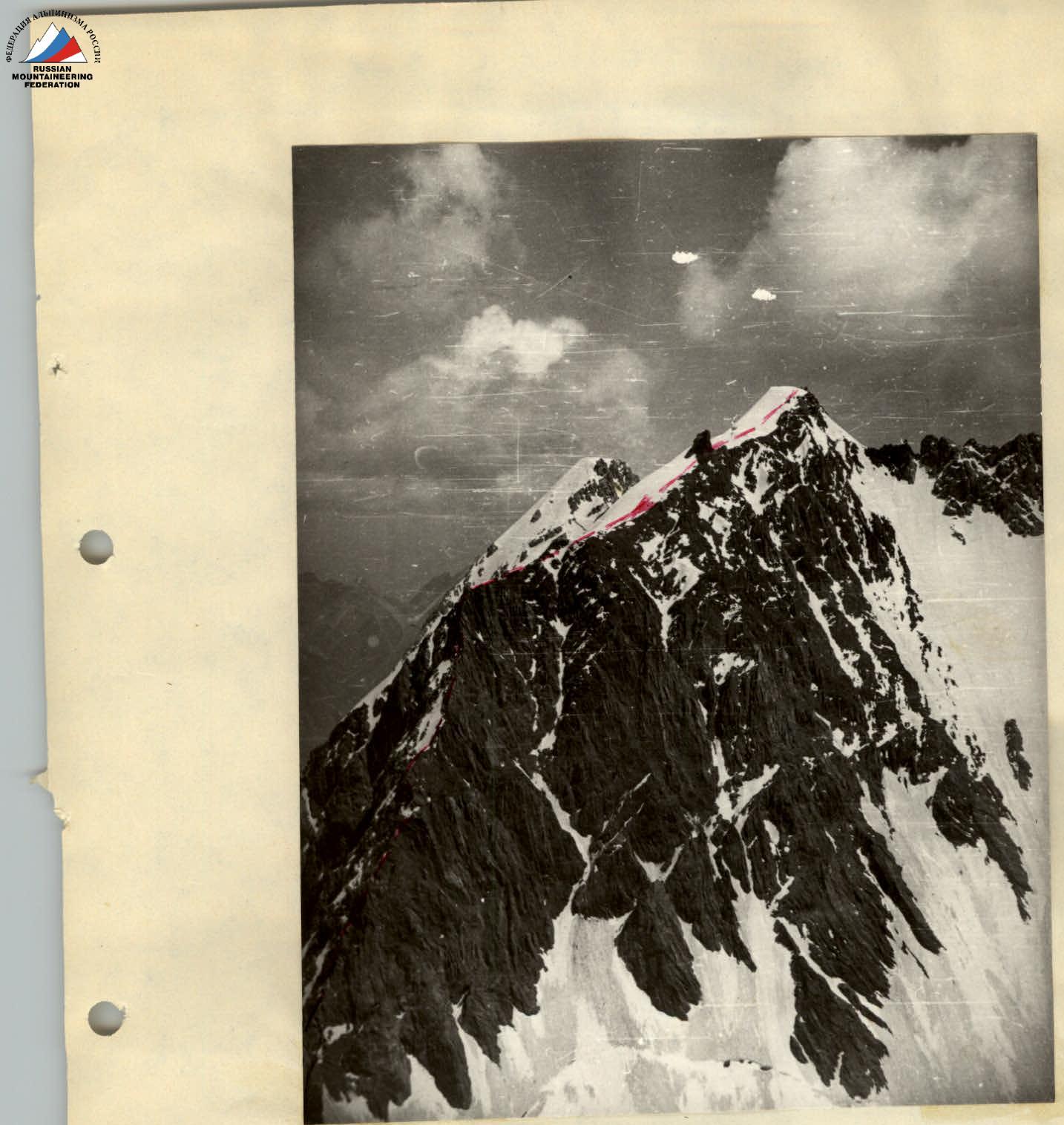
10TH DAY. DESCENT FROM 5TH PEAK OF DUKDON.

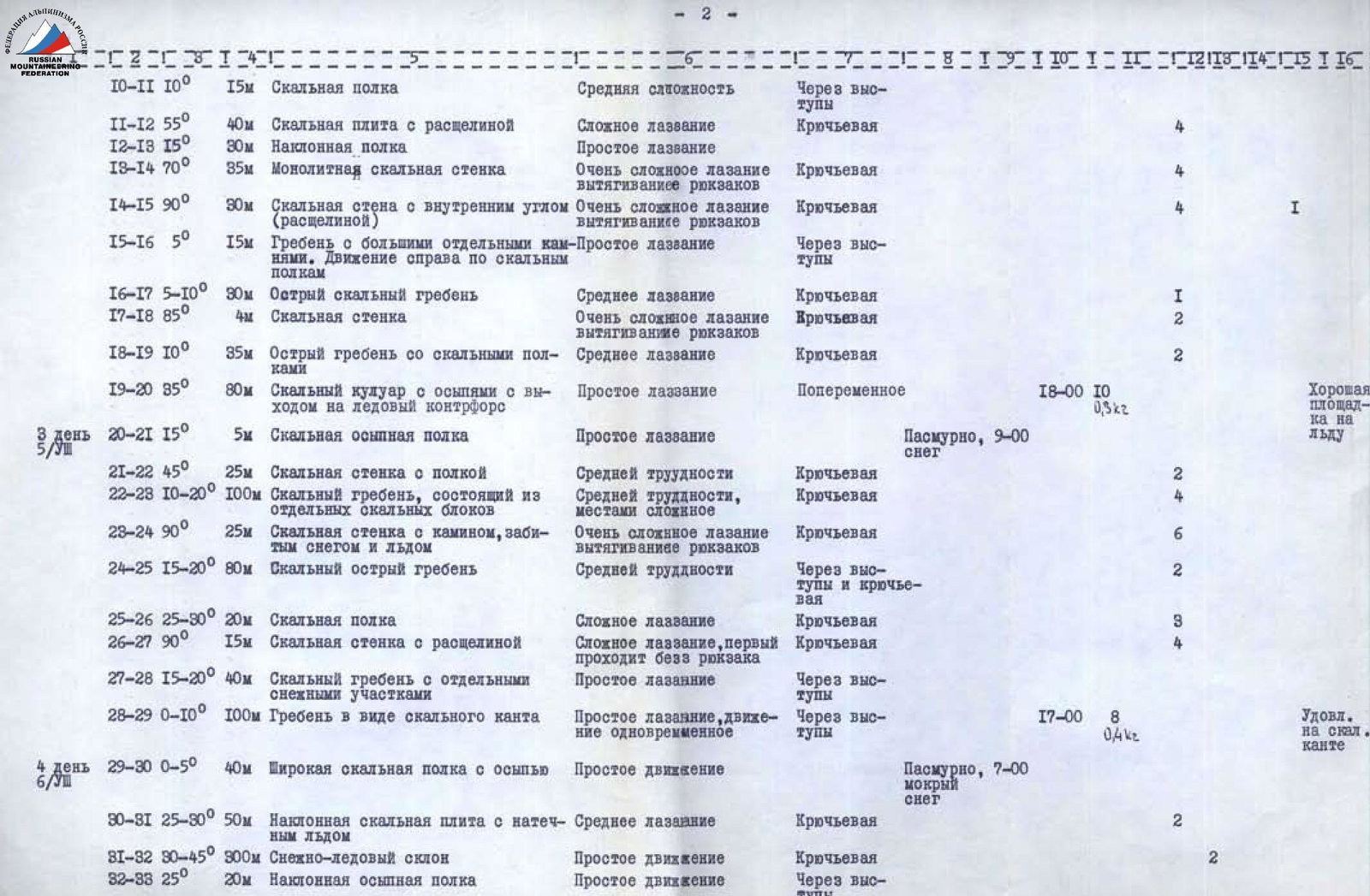
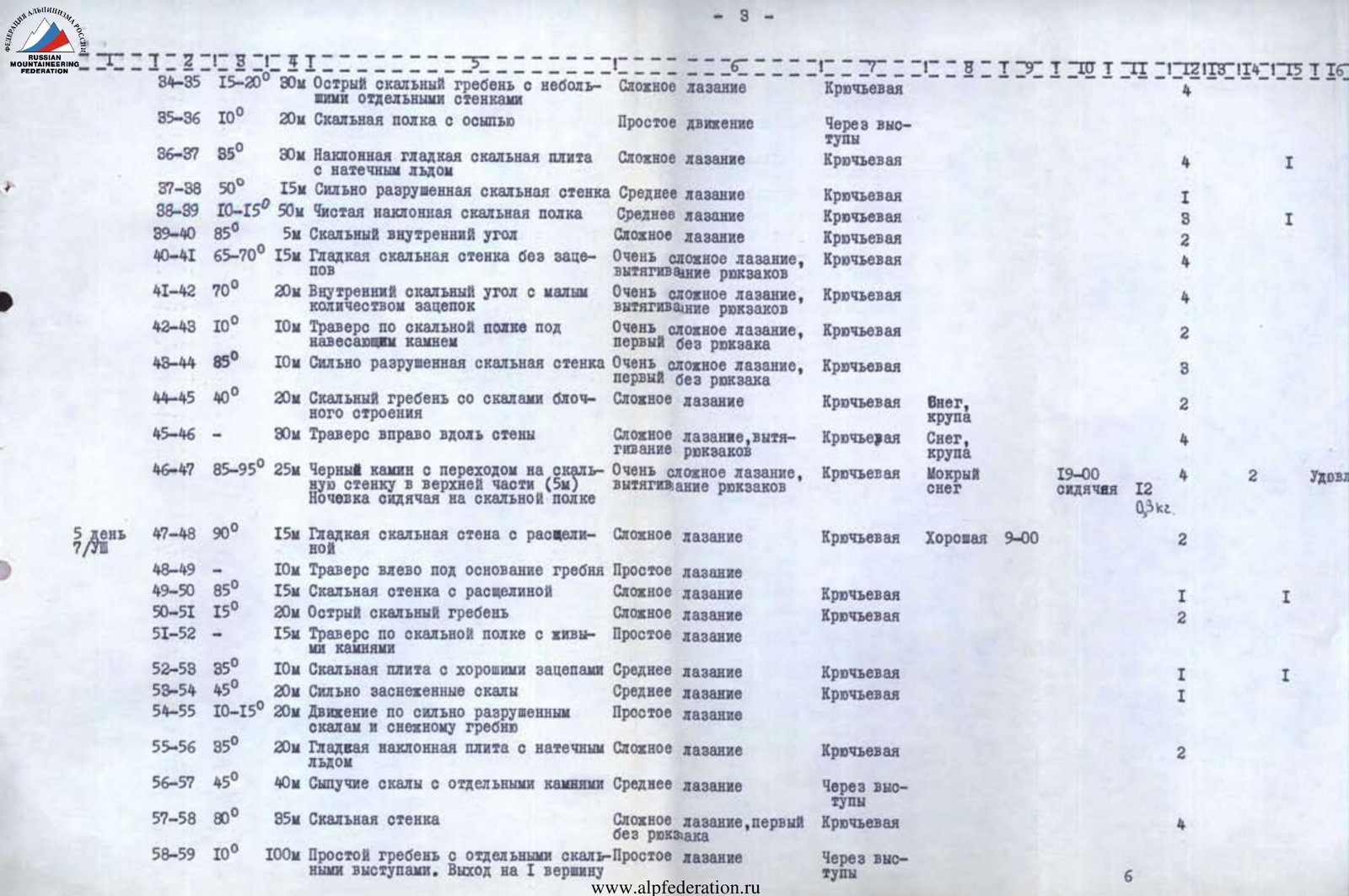
Table of Main Route Characteristics
| Date | Sections | Steepness, ° | Length, m | Relief Characteristics | Technical Difficulties | Protection Means | Weather | Exit Time | Time on Section | Bivouac / Notes | Rock Pitons | Ice Pitons | Wedges | Screw Pitons |
|---|---|---|---|---|---|---|---|---|---|---|---|---|---|---|
| 1st day 3/8 | R0–R1 | Up to 40–45 | 150 | Bergschrund, snow-firn slope | Medium difficulty | Through ice axe | Overcast | 9:00 | — | Satisfactory processing up to sect. R8 | 5 | — | — | — |
| R1–R2 | 45–50 | 60 | Thin layer of snow on ice | First person in crampons | Piton protection | Snow, fog | — | 0.2 hours | 2 | 3 | — | — | — | |
| R2–R3 | 10 | 40 | Wide rocky scree shelf | Medium difficulty. Simultaneous movement | Through ledges | — | 14:00 | — | 8 | — | — | — | — | |
| 2nd day 4/8 | R3–R4 | 75 | 20 | Rocky wall with a crack | Difficult climbing | Piton protection | Satisfactory, overcast | 8:00 | — | 2 | 2 | — | — | — |
| R4–R5 | 55 | 15 | Inclined smooth slabs | Difficult climbing | Piton protection | — | — | — | 2 | 2 | — | — | — | |
| R5–R6 | 60 | 45 | Strongly destroyed rocky wall with live rocks | Difficult climbing (rockfall hazard) | Through ledges and pitons | — | — | — | 1 | 1 | — | — | — | |
| R6–R7 | 35 | 50 | Inclined shelves with slabs | Medium difficulty | Through ledges and pitons | — | — | — | 1 | — | — | — | — | |
| R7–R8 | 90 | 20 | Rocky wall without holds | Very difficult climbing, pulling up backpacks | Piton protection | — | — | — | 4 | 4 | — | — | — | |
| R8–R9 | 75–80 | 50 | Rocky wall | Difficult climbing | Piton protection | — | — | — | 2 | 2 | — | — | — | |
| R9–R10 | 90 | 22 | Rocky wall with an internal corner | Very difficult climbing with pulling up backpacks | Piton protection | — | — | — | 8 | — | — | — | — | |
| R10–R11 | 10 | 15 | Rocky shelf | Medium difficulty | Through ledges | — | — | — | — | — | — | — | — | |
| R11–R12 | 55 | 40 | Rocky slab with a crack | Difficult climbing | Piton protection | — | — | — | 4 | 4 | — | — | — | |
| R12–R13 | 15 | 30 | Inclined shelf | Easy climbing | — | — | — | — | — | — | — | — | — | |
| R13–R14 | 70 | 35 | Monolithic rocky wall | Very difficult climbing, pulling up backpacks | Piton protection | — | — | — | 4 | 4 | — | — | — | |
| R14–R15 | 90 | 30 | Rocky wall with an internal corner (crack) | Very difficult climbing, pulling up backpacks | Piton protection | — | — | — | 4 | 1 | — | — | — | |
| R15–R16 | 50 | 15 | Ridge with large individual rocks. Movement to the right along rocky shelves | Easy climbing | Through ledges | — | — | — | — | — | — | — | — | |
| R16–R17 | 5–10 | 30 | Sharp rocky ridge | Medium climbing | Piton protection | — | — | — | 2 | 2 | — | — | — | |
| R17–R18 | 85 | 4 | Rocky wall with a small number of holds | Very difficult climbing, pulling up backpacks | Piton protection | — | — | — | 8 | — | — | — | 1 | |
| R18–R19 | 10 | 35 | Sharp ridge with rocky shelves | Medium climbing | Piton protection | — | — | — | 2 | 2 | — | — | — | |
| R19–R20 | 35 | 80 | Rocky couloir with scree leading to an icy counterfort | Easy climbing | Alternating | — | — | 18:00 | 10 | — | — | — | — | |
| 3rd day 5/8 | R20–R21 | 15 | 5 | Rocky scree shelf | Easy climbing | — | Overcast, snow | 9:00 | — | — | — | — | — | — |
| R21–R22 | 45 | 25 | Rocky wall with a shelf | Medium difficulty | Piton protection | — | — | — | 2 | 2 | — | — | — | |
| R22–R23 | 10–20 | 100 | Rocky ridge consisting of individual blocks | Medium difficulty, partly difficult | Piton protection | — | — | — | 4 | 4 | — | — | — | |
| R23–R24 | 90 | 25 | Rocky wall with a chimney filled with snow and ice | Very difficult climbing, pulling up backpacks | Piton protection | — | — | — | 6 | — | — | — | — | |
| R24–R25 | 15–20 | 80 | Sharp rocky ridge | Medium difficulty | Through ledges and piton protection | — | — | — | 2 | 2 | — | — | — | |
| R25–R26 | 25–30 | 20 | Rocky shelf | Difficult climbing | Piton protection | — | — | — | 3 | — | — | — | — | |
| R26–R27 | 90 | 15 | Rocky wall with a crack | Difficult climbing, first person without a backpack | Piton protection | — | — | — | 4 | 4 | — | — | — | |
| R27–R28 | 15–20 | 40 | Rocky ridge with individual snowy sections | Easy climbing | Through ledges | — | — | — | 2 | 2 | — | — | — | |
| R28–R29 | 0–10 | 100 | Ridge in the form of a rocky edge | Easy climbing, simultaneous movement | Through ledges | — | 17:00 | — | 8 | — | — | — | — | |
| 4th day 6/8 | R29–R30 | 0–50 | 40 | Wide rocky shelf with scree | Easy movement | — | Overcast, wet snow | 7:00 | — | — | Satisfactory on rocky edge | — | — | — |
| R30–R31 | 25–30 | 50 | Inclined rocky slab with rime ice | Medium climbing | Piton protection | — | — | — | 2 | 2 | — | — | — | |
| R31–R32 | 30–45 | 300 | Snowy-icy slope | Easy movement | Piton protection | — | — | — | — | — | — | — | — | |
| R32–R33 | 25 | 20 | Inclined scree shelf | Easy movement | Through ledges | — | — | — | — | — | — | — | — | |
| R33–R34 | 45–50 | 7 | Slab with an internal corner | Medium climbing | Piton protection | — | — | — | 1 | 1 | — | — | — | |
| R34–R35 | 15–20 | 30 | Sharp rocky ridge with small individual walls | Difficult climbing | Piton protection | — | — | — | 4 | 4 | — | — | — | |
| R35–R36 | 10 | 20 | Rocky shelf with scree | Easy movement | Through ledges | — | — | — | — | — | — | — | — | |
| R36–R37 | 35 | 30 | Inclined smooth rocky slab with rime ice | Difficult climbing | Piton protection | — | — | — | 4 | 1 | — | — | — | |
| R37–R38 | 50 | 15 | Strongly destroyed rocky wall | Medium climbing | Piton protection | — | — | — | 1 | 1 | — | — | — | |
| R38–R39 | 10–15 | 50 | Pure inclined rocky shelf | Medium climbing | Piton protection | — | — | — | 8 | 1 | — | — | — | |
| R39–R40 | 85 | 5 | Rocky internal corner | Difficult climbing | Piton protection | — | — | — | 2 | 2 | — | — | — | |
| R40–R41 | 65–70 | 15 | Smooth rocky wall without holds | Very difficult climbing, pulling up backpacks | Piton protection | — | — | — | 4 | 4 | — | — | — | |
| R41–R42 | 70 | 20 | Internal rocky corner with few holds | Very difficult climbing, pulling up backpacks | Piton protection | — | — | — | 4 | 4 | — | — | — | |
| R42–R43 | 10 | 10 | Traverse along a rocky shelf under an overhanging rock | Very difficult climbing, first person without a backpack | Piton protection | — | — | — | 2 | 2 | — | — | — | |
| R43–R44 | 85 | 10 | Strongly destroyed rocky wall | Very difficult climbing, first person without a backpack | Piton protection | — | — | — | 3 | 3 | — | — | — | |
| R44–R45 | 40 | 20 | Rocky ridge with large-block rocks | Difficult climbing | Piton protection | Snow, graupel | — | — | 2 | 2 | — | — | — | |
| R45–R46 | — | 30 | Traverse right along the wall | Difficult climbing, pulling up backpacks | Piton protection | Snow, graupel | — | — | 4 | 4 | — | — | — | |
| R46–R47 | 85–95 | 25 | Black chimney transitioning into a rocky wall in the upper part (5 m). Nocturnal bivouac on a rocky shelf | Very difficult climbing, pulling up backpacks | Piton protection | Wet snow | — | 19:00 | 12 | 4 | — | — | 2 | |
| 5th day 7/8 | R47–R48 | 90 | 15 | Smooth rocky wall with a crack | Difficult climbing | Piton protection | Good | 9:00 | — | 2 | 2 | — | — | — |
| R48–R49 | — | 10 | Traverse left under the base of the ridge | Easy climbing | — | — | — | — | — | — | — | — | — | |
| R49–R50 | 85 | 15 | Rocky wall with a crack | Difficult climbing | Piton protection | — | — | — | 1 | 1 | — | — | — | |
| R50–R51 | 15 | 20 | Sharp rocky ridge | Difficult climbing | Piton protection | — | — | — | 2 | 2 | — | — | — | |
| R51–R52 | — | 15 | Traverse along a rocky shelf with live rocks | Easy climbing | — | — | — | — | — | — | — | — | — | |
| R52–R53 | 35 | 10 | Rocky slab with good holds | Medium climbing | Piton protection | — | — | — | 1 | 1 | — | — | — | |
| R53–R54 | 45 | 20 | Heavily snow-covered rocks | Medium climbing | Piton protection | — | — | — | 1 | 1 | — | — | — | |
| R54–R55 | 10–15 | 20 | Movement along strongly destroyed rocks and snowy ridge | Easy climbing | — | — | — | — | — | — | — | — | — | |
| R55–R56 | 35 | 20 | Smooth inclined slab with rime ice | Difficult climbing | Piton protection | — | — | — | 2 | 2 | — | — | — | |
| R56–R57 | 45 | 40 | Loose rocks with individual stones | Medium climbing | Through ledges | — | — | — | — | — | — | — | — | |
| R57–R58 | 80 | 35 | Rocky wall | Difficult climbing, first person without a backpack | Piton protection | — | — | — | 4 | 4 | — | — | — | |
| R58–R59 | 10 | 100 | Simple ridge with individual rocky outcrops. Exit to the 1st peak | Easy climbing | Through ledges | — | — | — | 6 | — | — | — | — | |
| 6th day 8/8 | R59–R60 | — | 350 | Descent along the ridge bypassing individual small gendarmes | Easy climbing | Through ledges | — | — | — | — | — | — | — | — |
| R61–R62 | — | 35 | Descent via a rappel along a rocky-icy wall onto a snowy saddle. Nocturnal bivouac | — | Piton protection | — | — | — | 3 | — | — | — | — | |
| R62–R63 | 30 | 250 | Bypassing a rocky gendarme to the left along shelves | Easy climbing | Through ledges | Good | 8:00 | — | — | — | — | — | — | |
| R63–R64 | — | 300 | Sharp ridge with occasional snow | Medium climbing | Piton protection | — | — | — | 1 | 1 | — | — | — | |
| R64–R65 | 40 | 350 | Snowy-icy ridge (ascent) with individual rocky sections filled with snow and ice (exit to the 2nd peak) | Medium climbing | Piton protection | — | — | — | 2 | 2 | — | — | — | |
| R65–R66 | — | 60 | Sharp rocky ridge | Difficult climbing | Piton protection | — | — | — | 2 | 2 | — | — | — | |
| R66–R67 | 90 | 12 | Rocky wall with a small number of holds | Very difficult climbing, pulling up backpacks | Piton protection | — | — | — | 8 | 1 | — | — | — | |
| R67–R68 | 10 | 20 | Rocky-icy ridge | Medium climbing | Piton protection | — | — | — | 1 | 1 | — | — | — | |
| R68–R69 | — | 700 | Descent along firn and snow | Initially alternating, then simultaneous | Through ice axe and simultaneous | — | — | — | — | — | — | — | — | |
| R69–R70 | 25–30 | 600 | Ascent along scree and "ram's foreheads" | Simultaneous movement, rockfall hazard | — | — | — | — | — | — | — | — | — | |
| R70–R71 | 45–50 | 40 | Strongly destroyed rocky wall | Difficult climbing | Piton protection | — | — | — | 2 | 2 | — | — | — | |
| R71–R72 | 45 | 40 | Ascent along a snowy-firn slope | Alternating movement | Through ice axe | — | — | — | — | — | — | — | — | |
| R72–R73 | 30 | 200 | Strongly destroyed rocky counterfort. Exit to the 3rd peak. (Nocturnal bivouac). | Simultaneous movement | — | — | 17:00 | — | 9 | Satisfactory | — | — | — | |
| 7th day 9/8 | R73–R74 | — | 40 | Descent from the peak along a steep snowy-icy slope | Sporting descent | Piton protection | Variable cloudiness, strong wind | 8:00 | — | 1 | 1 | — | — | — |
| R74–R75 | — | 200 | Movement along the ridge to a rocky drop | Alternating | Through ledges | — | — | — | — | — | — | — | — | |
| R75–R76 | — | 10 | Descent traversing left along a rocky wall | Difficult climbing | Piton protection | — | — | — | 2 | 2 | — | — | — | |
| R76–R77 | — | 30 | Descent along a steep icy groove (slope) | Sporting descent | Piton protection | — | — | — | 1 | 1 | — | — | — | |
| R77–R78 | — | 60 | Rocky ridge of large-block structure | Medium climbing | Piton protection | — | — | — | 1 | 1 | — | — | — | |
| R78–R79 | 85 | 40 | Monolithic walls without holds | Very difficult climbing, pulling up backpacks | Piton protection | — | — | — | 3 | 3 | — | — | — | |
| R79–R80 | (~85) | 40 | Descent along a strongly destroyed rocky wall onto a saddle. Rockfall hazard. | Rappel | Piton protection | — | — | — | 1 | 1 | — | — | — | |
| R80–R81 | — | 20 | Traverse along an osypnoye shelf to the left | Easy climbing | — | — | — | — | 2 | 1 | — | — | — | |
| R81–R82 | 60 | 30 | Icy groove | Difficult climbing | Piton protection | — | — | — | 2 | 2 | — | — | — | |
| R82–R83 | 90 | 10 | Chimney with a plug filled with ice | Very difficult climbing, pulling up backpacks | Piton protection | — | — | — | 2 |

Comments
Sign in to leave a comment