USSR Climbing Championship 1988. Rock class.
Report
on the ascent to the summit of Zamin Karor (Western shoulder 4070) via the right part of the NW wall (variant) by the team of the State Sports Committee of the Tajik SSR.
Team leader: Yevgeny V. Prilepa. Team coach: Vyacheslav I. Lavrukhin.
 State Sports Committee of the Tajik SSR
Dushanbe, tel. 22-32-27
Chief coach Almin R.
State Sports Committee of the Tajik SSR
Dushanbe, tel. 22-32-27
Chief coach Almin R.
Lavruhkin V. I. 734060 Dushanbe, Mayakovsky st., 83/3, apt. 59, ph. 33-38-49
Prilepa E. V. 735310 Yavan, Lesnaya st., 98-13, tel. 2-23-21
Ascent details
- Class — rock climbing
- Gissar Ridge
- Western shoulder via the right part of the NW wall of Zamin Karor peak
- Proposed 6B category of difficulty (variant)
- Height difference — 1070 m, length — 1255 m, length of sections with 5–6 difficulty grade — 995 m, average steepness of the main part of the route — 76° (3000–4070), including 6th category — 460 m, 89° (3000–3125), 95° (3180–3195), 80° (3220–3250), 90° (3305–3320), 91° (3510–3790), 85° (3870–3910)
- Pitons used:
| Rock | Bolt | Nuts | Ice |
|---|---|---|---|
| 193 | 17 | 203 | 0 |
| 62 | 10 | 55 |
-
Team's total climbing time — 42 h 30 min; days — 4.
-
Overnights: 1 — comfortable, on a ledge; 2 — sitting; 3 — on the ridge, lying down.
-
Team leader: Prilepa Yevgeny Vladimirovich, Candidate Master of Sports.
Team members:
- Skornyanin Sergey Aleksandrovich, Candidate Master of Sports
- Levitsky Alexander Vladimirovich, Candidate Master of Sports
- Tuktogulov Ishpalty Mutikovich, Candidate Master of Sports
- Ishmukhametov Sazit Mazitovich, Candidate Master of Sports
-
Coach: Lavrukhin Vyacheslav Ivanovich, Master of Sports of the USSR
-
Departure to the route July 14, 1988.
Summit July 17, 1988.
Return July 18, 1988.
-
Organization: State Sports Committee of the Tajik SSR.
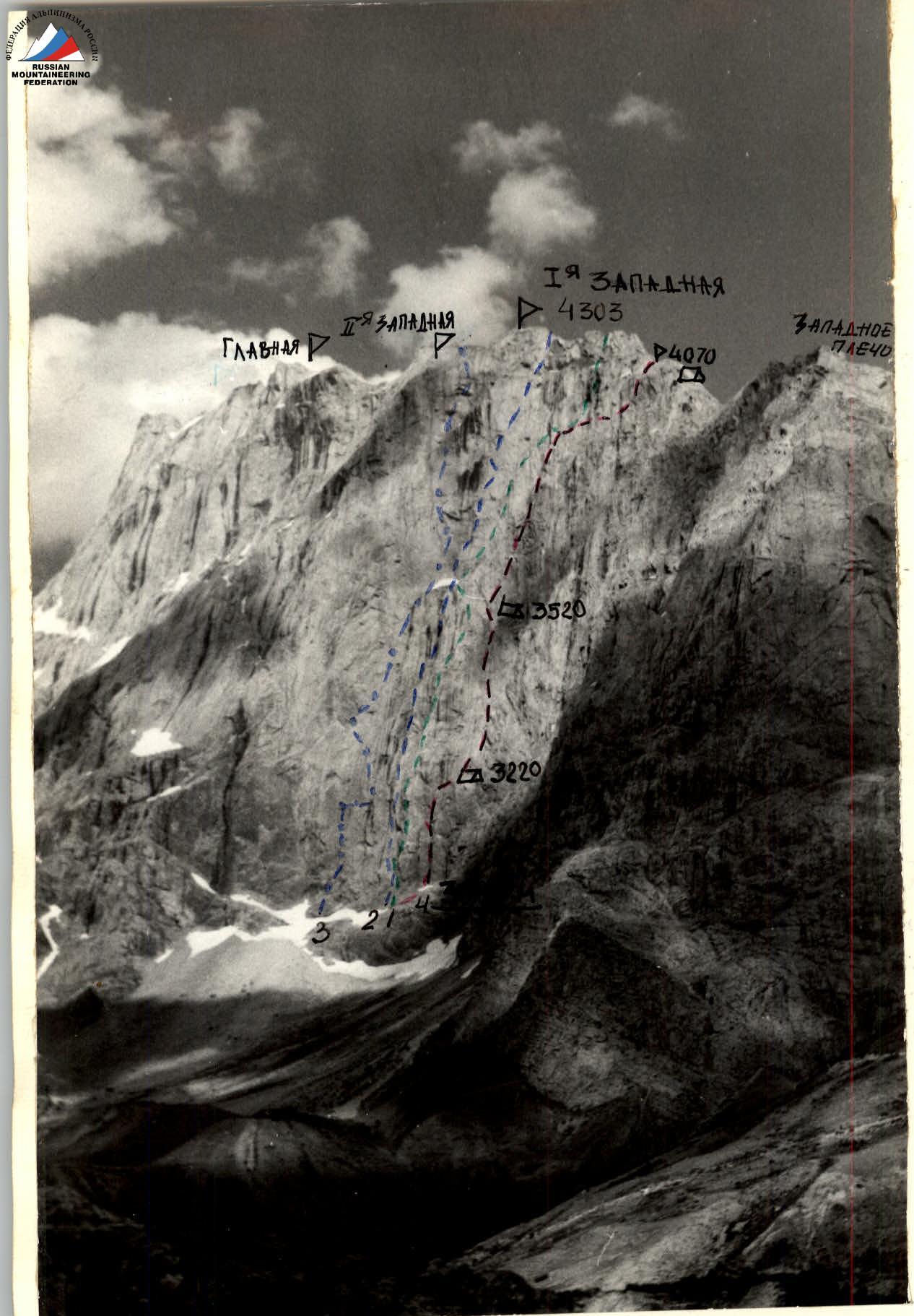
1st route Shramko (1971) 2nd route Yefimova (1979) 3rd route Kapitanov (1974) 4th route Prilepa (1988)
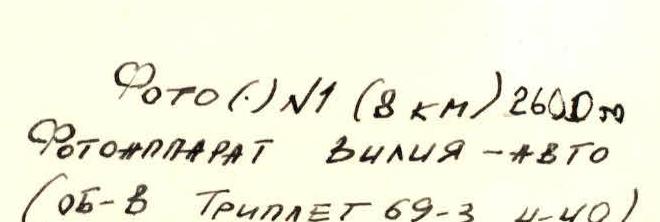
Photo #1 (8 km) 2600 m Vilia-Auto camera (Triplet 69-3 4-40 lens) June 20, 1988 14:30
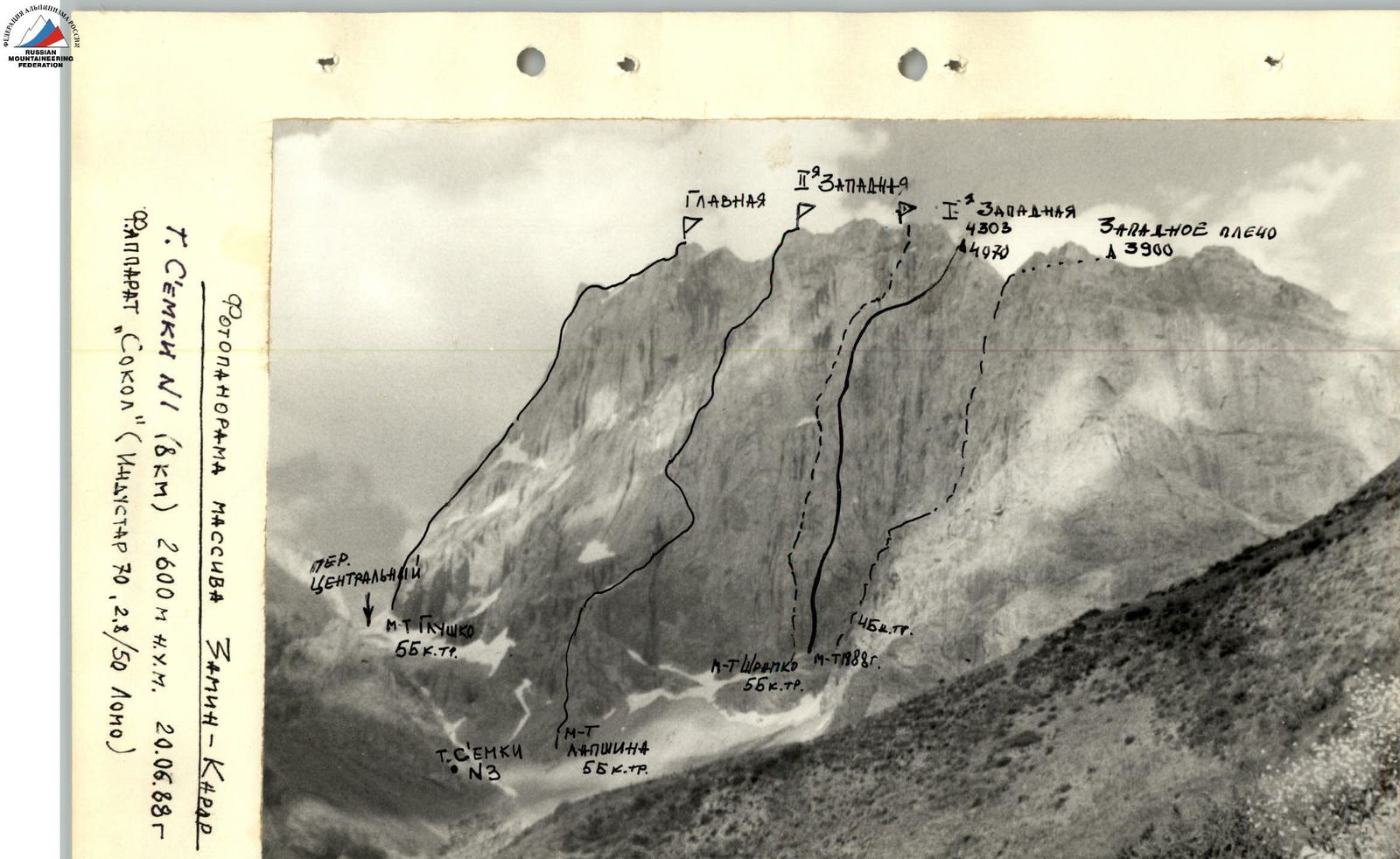
Photopanorama of the Zamin-Karor massif
T. Semki #1 (8 km) 2600 m a.s.l. "Sokol" camera (INDUSTAR 70, 2.8/50 Lomo) June 20, 1988 15:30
Route description by sections
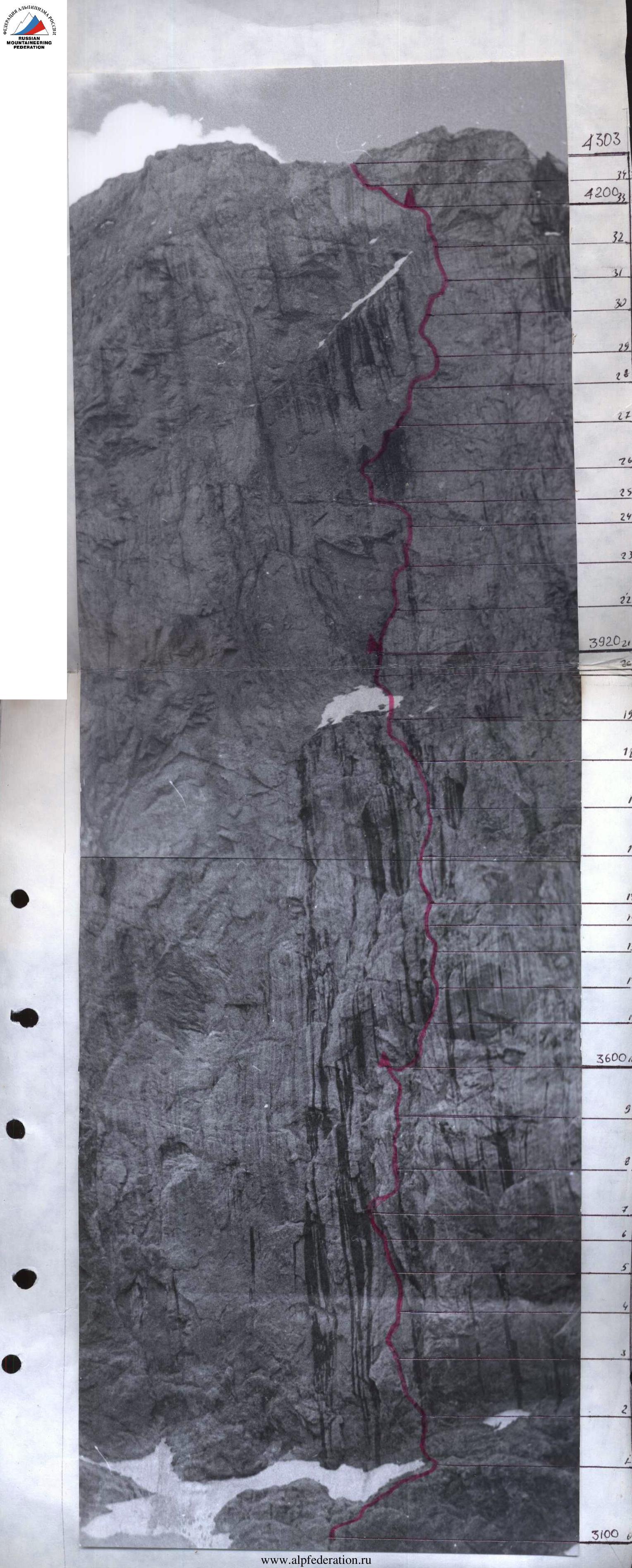
- The route starts directly from the snowfield between two black streaks on a monolithic wall with microrelief. Climbing is extremely difficult, on the verge of a fall. In the middle part, skyhooks are used. Exit into an implicit internal corner that overhangs.
- Passed on skyhooks, with protection via bolt pitons. The wall overhangs.
- The corner leads to a wall, moving slightly to the right, bypassing a series of cornices. Monolithic wet rocks, climbing is extreme, requiring excellent coordination.
- Exit into an implicit groove (corner), direction slightly to the right, leads under a sheer wall. The character of the rocks remains unchanged.
- Direction of movement along a "streak" to the base of a "bird". Climbing is difficult, with a transition from climbing to skyhooks. 6–7. Up the sheer wall, movement is straight up under an overhanging wall.
- The overhanging wall is passed "head-on" via wet rocks and leads to an inclined ledge with archa trees.
- From the archa tree to the right via an internal corner, overhanging initially, exit onto a wide ledge "bird's wing". Overnight stay.
- From the overnight stay via a wall with a cleft into a huge internal corner, which is a wall bounded on the right. Movement is carried out along the wall, periodically pressing against the right edge.
- Continuation of the internal corner. The character of climbing remains the same.
- The right edge of the corner overhangs strongly, the left one is vertical. Protection via medium nuts and bolt pitons.
- Both edges become less steep. From here, the further path is visible.
- A small wall with a cornice, above which is a convenient belay spot. 16–17. The internal corner is passed along the left edge. In the depth of the internal corner, there is a convenient cleft for medium nuts. In some places, the cleft is filled with moss.
- Monolithic wall with small sharp holds.
- Via the wall slightly to the left, bypassing the overhang.
- Steep wall with good holds, leads to an internal corner that rests against a cornice. Under the cornice, there is a niche — a convenient belay spot (two people can stand comfortably).
- From the niche to the left through an overhang (pyramid) onto a wall, which leads to an overnight stay spot. Overnight stay — a narrow inclined ledge under an overhanging rusty wall.
- Steep internal corner, the right edge is cut by vertical clefts/fissures. In the upper part of the corner, a transition to the left edge, as the right edge turns into an overhanging rusty wall.
- Tuktogulov, standing on Prilepa's shoulders, hammers in a bolt piton and, standing in it, a second one. Then, with a pendulum, he moves to a narrow overhanging cleft/split. Climbing is extremely difficult, sometimes requiring the use of ITO. The wall is monolithic.
- Movement along the cleft for 15 m. The cleft ends with a short pendulum and a difficult traverse 4–5 m to the right — a transition to another parallel cleft.
- Further, the cleft is visible along the entire wall. It is along this cleft that further movement is carried out.
- The cleft widens, climbing is extremely difficult, protection via large nuts and bolt pitons.
- The cleft overhangs, the character of climbing remains the same.
- The cleft ends with an exit to a red wall "forehead" (30) with an overhanging upper part.
- An overhanging internal corner leads to a dissected "cucumber". 32–34. The dissected "cucumber" represents a series of internal corners, walls (many "live" stones).
- An implicit internal corner with a cleft, in the upper part a wall with micro-holds leads to a ledge.
- Long, easy ledge — traverse to the right under a powerful monolithic corner filled with water. 37–38. Internal corner with smooth edges in the upper part. Climbing is difficult, on wet rocks. In the upper part, via the right edge, exit onto an oblique ledge. 39–40. Along the ledge to the right into the base of a wet chimney, up the chimney to a saddle (summit).
Note:
It is necessary to consider:
- The character of climbing.
- The nature of the relief.
- Belaying.
- Difficulties of passage, namely: wetness, moss, overhanging, psychological factors.