
Ministry of Sports of Krasnoyarsk Krai
KRASNOYARSK KRAI ALPINISM FEDERATION
Russian Championship in Alpinism
2016
High-Altitude Technical Class
Report
On the first ascent by the Krasnoyarsk Krai team
On Verchina Chernaya, 1915 m, via the center of the N wall, route "Chernaya Drozda"
First ascent, orient. 6Az cat. diff. (First winter ascent in this area on the Taigishon wall)
Krasnoyarsk 2016
Ascent Passport
- Area – Western Sayan, Ergaki ridge, p.6.2
- Peak – Chernaya, 1915 m, via the center of the N wall, route name "Chernaya Drozda"
- Assumed – 6Az cat. diff., first ascent (first winter ascent in the area)
- Route character – combined
5. Route characteristics:
height difference – 565 m, total route length – 725 m, wall section length – 475 m, section lengths:
- 5 cat. diff. – 85 m
- 6 cat. diff. – 390 m, including:
- ITO A3 – 155 m
- A4 – 215 m, average steepness of the entire route – 74°, wall section – 80°.
- Used on the route: anchor pitons – 117/98, left 1 pc., cam hooks – 54/46, about 134 ITO on "fifas", about 78 ITO on skyhooks, 11 bolt hanger pitons were hammered and left, 5 pcs. as belay points and ITO, 6 pcs. for platform installation.
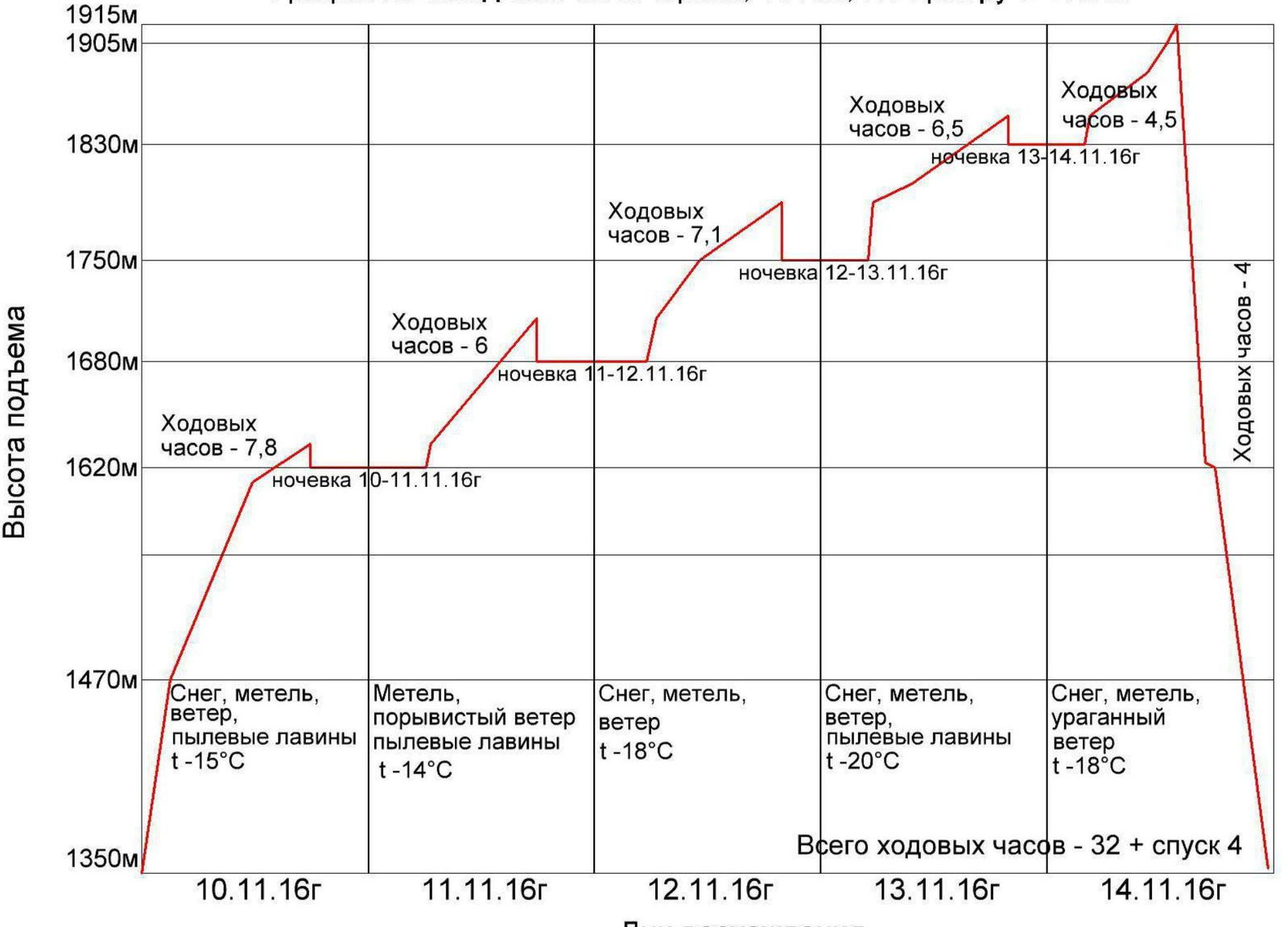
- Number of working hours – 32 h, days – 5. Descent 4 h via the 3rd ridge, rappel from Pereval Tumanny-1.
Overnight stays – 4, all on a platform on the wall.
- Leader: Zhigalov Alexander Vladimirovich MS
Participants:
- Ivanov Timofey Pavlovich 1st sports category
- Timofeev Vyacheslav Mikhailovich 1st sports category
- Team coaches:
Balezin Valery Viktorovich MSMK, ZTR
Zakharov Nikolai Nikolaevich MSMK, ZTR
- Date of departure:
On the route – at 8:10, November 10, 2016
On the summit – at 14:20, November 14, 2016
Return to the base camp under the wall – at 18:20, November 14, 2016
- Responsible for the report: Zhigalov Alexander Vladimirovich, tel. 8-983-574-84-88
Email: 0jog@bk.ru
- Ascent organized by – Ministry of Sports of Krasnoyarsk Krai
2016
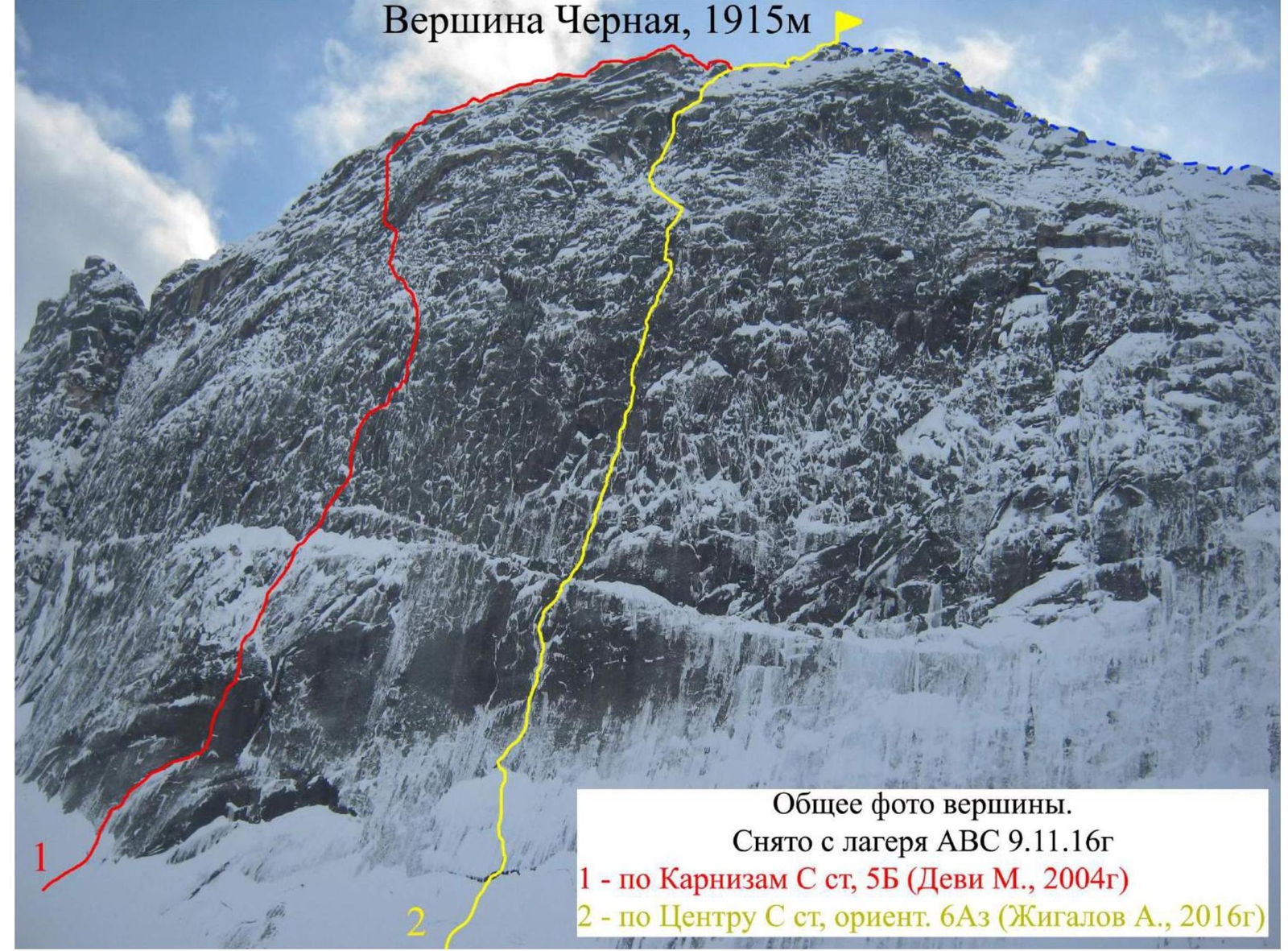
General photo of the summit. Taken from the ABC camp on November 9, 2016.
1 – via the Cornices of the N wall, 5B (Devi M., 2004)
2 – via the Center of the N wall, orient. 6Az (Zhigalov A., 2016)
Verchina Chernaya, 1915 m
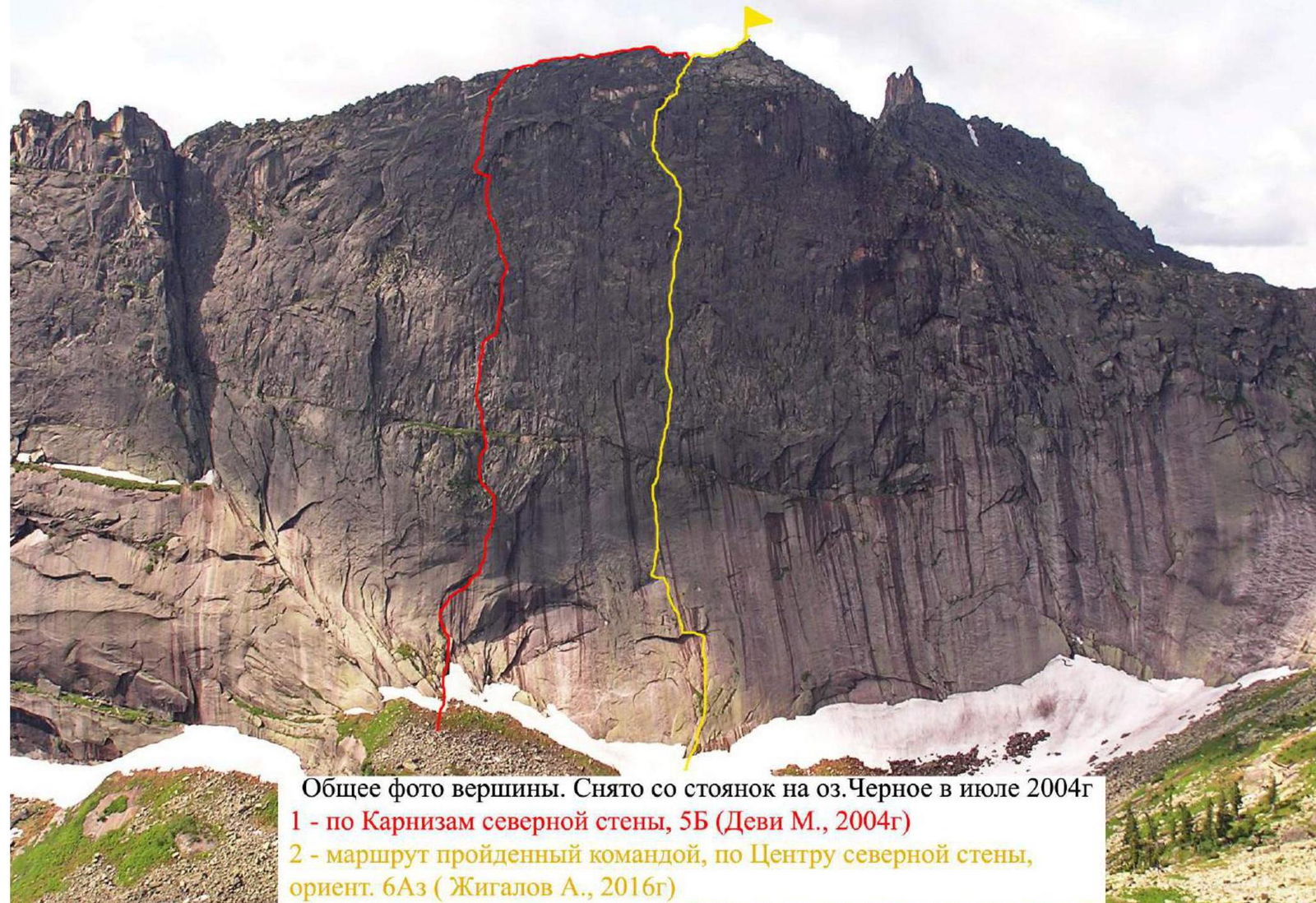 General photo of the summit. Taken from the stands on Lake Chernoye in July 2004.
1 – via the Cornices of the N wall, 5B (Devi M., 2004)
2 – route taken by the team, via the Center of the N wall, orient. 6Az (Zhigalov A., 2016)
General photo of the summit. Taken from the stands on Lake Chernoye in July 2004.
1 – via the Cornices of the N wall, 5B (Devi M., 2004)
2 – route taken by the team, via the Center of the N wall, orient. 6Az (Zhigalov A., 2016)
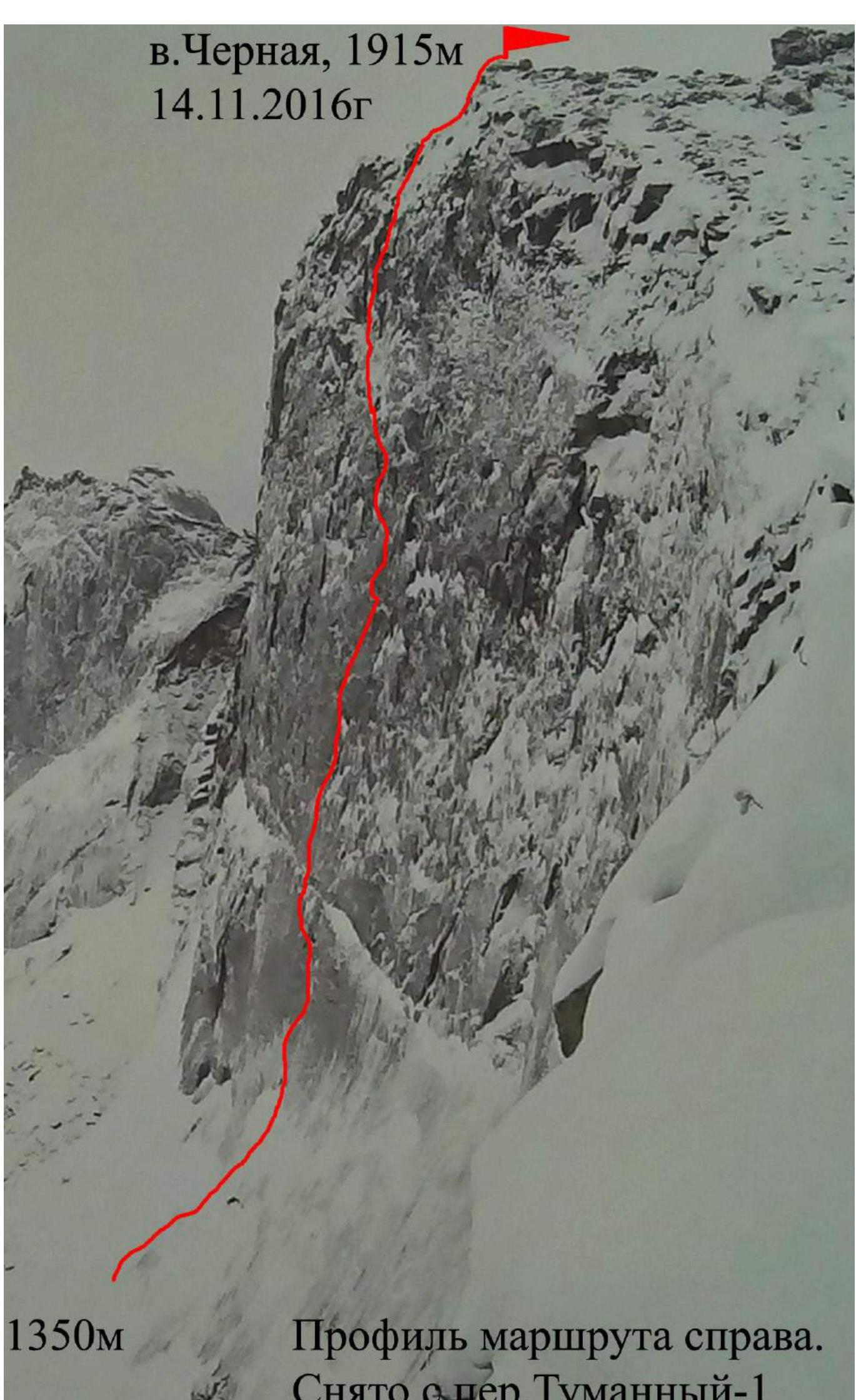 p. Chernaya, 1915 m, November 14, 2016. 1350 m. Route profile on the right. Taken from Pereval Tumanny-1.
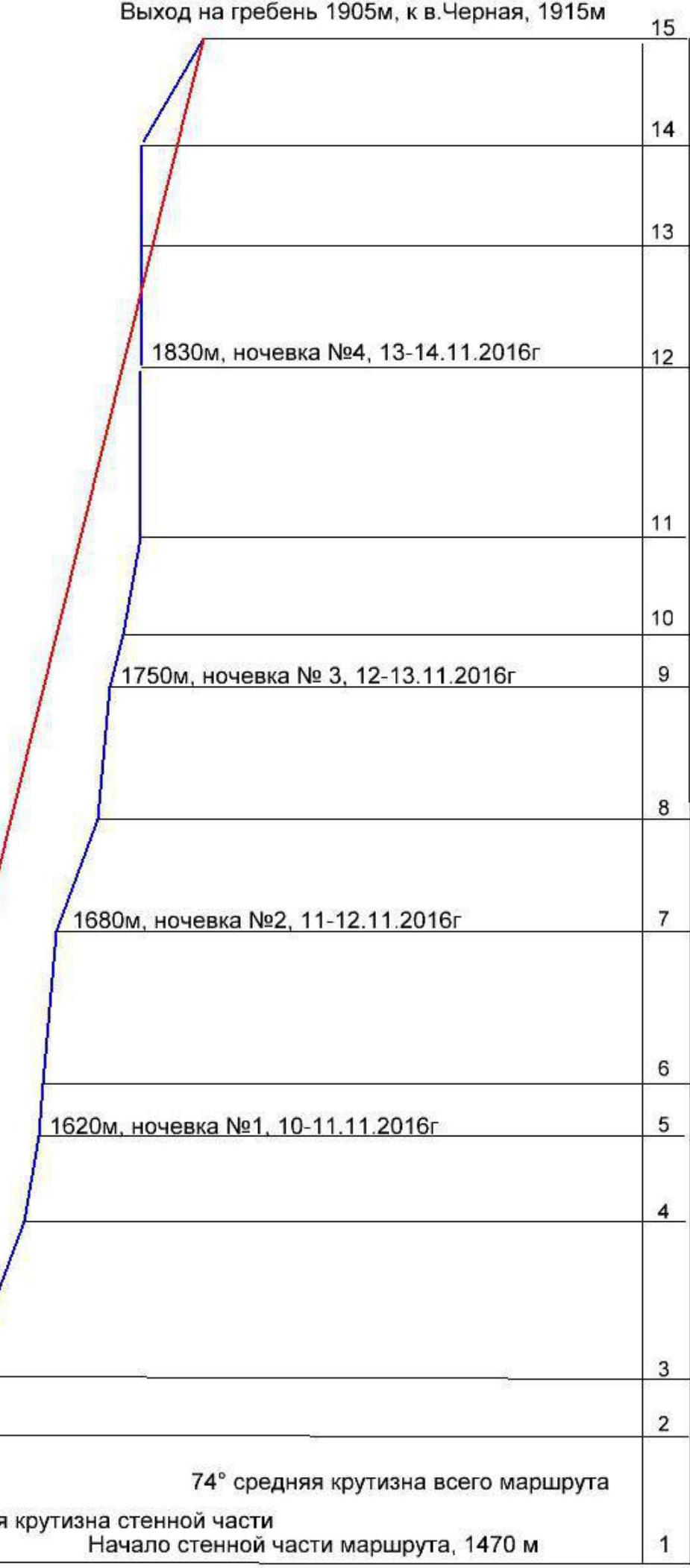 Summit on November 14, 2016 at 14:20. Exit to the 1905 m ridge, to p. Chernaya, 1915 m. Drawn route profile.
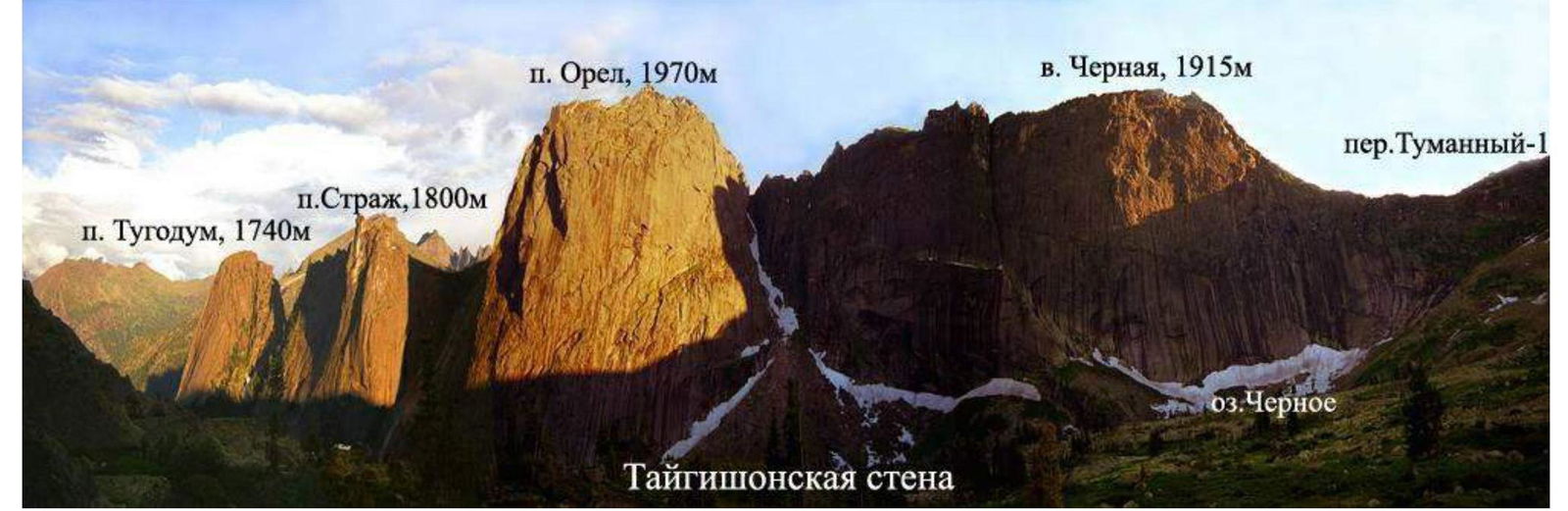
Photopanorama of the area

Photopanorama of the area, taken from Pereval Mezozerný
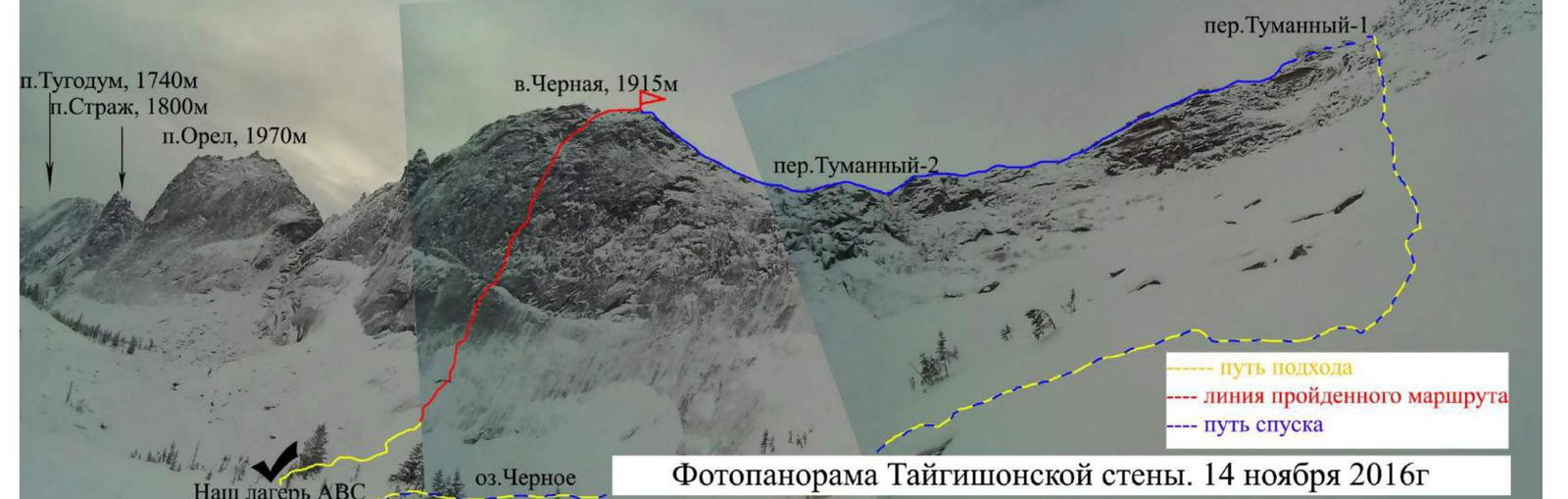
Photopanorama of the Taigishon wall. November 14, 2016
Tactical Actions of the Team
In November 2016, the Krasnoyarsk team, as part of the Russian Championship in Alpinism in the high-altitude technical class, organized an autonomous expedition to the Western Sayan area, Ergaki ridge, Taigishonok river valley, with the goal of making the first ascent of a new route on Verchina Chernaya via the center of the north wall.
Ergaki is characterized by a harsh winter climate. From the beginning of October to the end of April, the area experiences heavy snowfall. The thickness of the snow cover can reach tens of meters, contributing to high avalanche danger and complicating the approach to the peaks.
The air temperature drops to –50 °C, and due to high humidity, these frosts are felt even more severely. The weather is mostly cloudy, with strong, gusty winds that raise snow drifts and cause snowstorms. The daylight hours are short.
Characteristic weather features:
- cloudy weather
- strong, gusty winds
- snow drifts and snowstorms
- short daylight hours
The Taigishonok valley is a remote area of the Ergaki ridge. The main massif is the Taigishon wall, which includes the peaks (from left to right):
- Tugodum
- Straj
- Verblud
- Orёл
- Chernaya
To reach the location, one can take two routes, both involving crossing several tourist passes of 1A–1B cat. diff. (in winter, 2A–2B cat. diff.). The last time an in-person alpinism championship was held in the area was in the summer of 2004, when a route was taken on Verchina Chernaya via the cornices of the N wall by a team from Yekaterinburg led by M. Devi. After that, in the summer of 2009, another alpinism championship was held, where teams again ascended this peak via the existing route. Since then, there has been no information about any ascents in the area. Therefore, we planned to make the first winter ascent on this wall.
On November 5, 2016, the group consisting of Zhigalov Alexander – MS – leader (expedition organizer), Timofeev Vyacheslav – 1st sports category, and Ivanov Timofey departed from Krasnoyarsk to Ergaki. In the evening, they arrived at the "Snezhnaia" ski base and spent the night.
November 6. In the morning, they packed their backpacks and sleds. The total weight of the cargo was about 170 kg for the three of them. This included:
- three backpacks
- two sleds
All movements were made on wide ski, as other technical means were not effective at this time of year. They left the car at the МЧС base. They departed from the Ergaki visitor center, following the Buiba river to Lake Raduzhnoe. They had lunch at Raduzhnoe (under the Visyachiy Kamen), then headed towards the Head of the Sleeping Sayan. They approached the head at 18:00 and spent the night.
November 7. They crossed the avalanche-prone Volosy pass (Head of Sayan), using belays. They rappelled to the other side. They reached Lake Lazurnoye and stopped for lunch. Then they continued, traversed a steep slope where they triggered a snow "board" slide, and stopped for the night under Verchina Mat' Sayan.
November 8. They traversed the plateau and reached Pereval Tumanny-1 by lunchtime. After lunch, they began rappelling down into the Taigishonok valley, about four rappels. They dropped all the cargo. By 18:00, they reached the isolated trees near Lake Chernoye and set up the forward camp ABC. They spent the night.
November 9. In the afternoon, they inspected the wall in detail and finally decided on the route. Then they carried all the equipment and platforms to the base of the wall, having previously marked the approach.
November 10, they approached the wall, and at 8:10, they started working on the route. They traversed the lower part, then reached the серп (a crescent-shaped feature) that ends in a bare wall. They ascended the wall using a drill and skyhooks to reach R4. Then they continued via narrow cracks to R5 and R6.
- The first participant set up a belay station under the cornice at R6.
- The second and third participants began setting up the platform.
The first participant finished moving at 17:00. They spent the night on a suspended platform on the wall under the cornice. The entire day was marked by heavy snowfall. Dust avalanches were constantly falling down the wall.
November 11. Due to the challenging first day, the team was tired and slept until 10:00. They started working on the route at 12:30.
They traversed a very difficult section between R6 and R7, then:
- The second and third participants began setting up the platform at R7.
- The first participant processed the section between R7 and R8.
The first participant finished working upwards at 18:30. They spent the night on a platform on the wall to the right of a large internal angle, on two bolt hangers. On the left, they left the 1st control cairn with a capsule containing a note. The weather was snowy with gusty winds.
November 12. The morning preparation for work took more time. All equipment was frozen, cam hooks worked poorly, ropes were stiff and icy, and jumar devices were slipping. All outerwear was wet and frozen.
The first participant started on the route at 10:20.
They traversed a very difficult section of a steep vertical wall without distinct relief, hammering in two bolt hangers for belays.
The second and third participants then began setting up the platform on a vertical wall at R9. The first participant processed the sections between R9, R10, and R11. At R11, they hammered in a bolt hanger.
The first participant finished working upwards at 17:30.
Throughout the day:
- it was snowing,
- windy,
- overcast,
- temperature was dropping.
To the right, on a bolt hanger, they left the 2nd control cairn with a capsule containing a note.
November 13. The first participant started work at 11:00. They traversed a steep overhanging section with cornices between R11 and R12. Initially, they planned to reach the ridge that day, but the upper part of the route, which appeared to be a "gentle roof," actually consisted of large, destroyed cornices with dense snowdrifts underneath. Often, they had to knock down the snow to clear the relief, which was unpleasant for the participants below and negatively affected their performance. They decided to:
- Set up the platform at R12.
- The first participant processed the labor-intensive section between R12 and R13.
The first participant finished working at 17:30. It was snowing all day. They left the 3rd control cairn on a bolt hanger with a note.
November 14. They started work at 9:50.
They traversed the difficult section between R13 and R14, then:
- reached a more gentle part of the wall,
- ascended a steep snow slope to reach the ridge.
On the ridge, they faced hurricane-force winds that knocked them off their feet. Within minutes, all exposed skin was frostbitten.
Quickly, using their remaining strength:
- they approached the summit pinnacle,
- climbed to the summit via a chimney,
- took several photos and videos.
They found an old, almost rotten note in a torn cellophane bag in the control cairn. They replaced it with their own note in a plastic bag and bottle.
Only in the tent were they able to read fragments of the text:
- July 2007;
- Shabalin – CMS;
- Grachev – 1st sports category;
- ascent to Verchina Chernaya;
- they took the route via the Chimney on the N wall – 5A (officially, such a route does not exist);
- they removed the note from the Yekaterinburg team.
The note is attached to the report.
They descended from the summit to Pereval Tumanny. They left all unnecessary equipment, platforms, and trash on the pass. They also left some food for disposal.
Then:
- They stretched out the three ropes and a rep cord down from the pass.
- Rappel down towards the ABC camp.
- Left the ropes hanging.
- Arrived at the camp.
They spent the night.
November 15. In the morning, they dismantled the camp, collected all trash, and then approached the pass. They jumared up the ropes they had left the previous evening. Intermediate stations were set up at the beginning of the ascent under the wall and had been hanging all this time. On the ascent to the pass, they naturally collected all the iron they had left behind. This was the tactical trick of the event.
They continued to dispose of their gear on skis. They reached Lake Lazurnoye that day and spent the night.
November 16. At night, the temperature dropped to –25 °C. They crossed the Volosy pass, then followed the same route back, arriving at the МЧС base at 17:00, where their car was parked.
They named the route "Chernaya Drozda" because it:
- reflects the character of the route taken,
- corresponds to the type of relief.
The route was taken without prior processing, in alpine style. All overnight stays were on the wall, using a suspended collapsible platform.
The platform was moved to the next overnight location each day.
During the ascent, they partially used a simultaneous movement scheme to keep all participants in constant motion and prevent them from freezing while hanging on the stations.
The entire route was first processed by Zhigalov A.V., second by Timofeev V.M., and third by Ivanov T.P.
It is worth noting that the route turned out to be much more complex and labor-intensive than planned. This is the opinion of all team members: Zhigalov A.V., Timofeev V.M., and Ivanov T.P.
The route features many sections of difficult climbing, both psychologically and physically:
- ITO A4 – 215 m
- ITO A3 – 155 m
Most belay points are unreliable. Anchor pitons were hammered into narrow cracks with the tip or into earth and grass tufts. Skyhooks were often used.
Most of the visible relief was filled with dense snow and covered with a thick layer of ice, which cracked under load. It was necessary to laboriously clear the relief to organize reliable belay points and to traverse it. Cam hooks constantly flew out of frozen, mossy cracks.
The upper part features ITO under collapsing cornices and "humming" slabs. Eleven bolt hanger pitons were hammered on the route.
It took 5 days and 32 working hours to complete this route, considering the short daylight hours in autumn.
Due to the above, we believe the route corresponds to the 6A cat. diff., at least during the winter period.
The route was taken under very poor, harsh Siberian weather conditions. There was not a single clear day during the ascent. Mostly, it was snowing with constant dust avalanches, gusty winds, and a drop in temperature each day.
Ascent graph to Verchina Chernaya, 1915 m, via the Center of the N wall
| Section # | Cam hooks (used/left) | Anchor pitons (used/left) | Fifas | Skyhooks | Bolt hangers (used/left) | Description / Overnight stay | Category, Length, Steepness |
|---|---|---|---|---|---|---|---|
| R0 | II, 150 m, 40° | ||||||
| R1 | 1 | 2 | 2 | 6 | V, A1, 50 m, 50° | ||
| R2 | 2 | 4 | 4 | 8 | VI, A2, 20 m, 60° | ||
| R3 | 3 | 3 | 10 | 20 | 1 | VI, A3+, 50 m, 70° | |
| R4 | 4 | 4 | 7 | 10 | VI, A3, 25 m, 80° | ||
| R5 | 2 | 5 | 2 | 4 | 1 | 1st overnight stay, Nov 10-11, 2016 | VI, A3, 15 m, 85° |
| R6 | 6 | 2 | 12 | 10 | 2nd overnight stay, Nov 11-12, 2016 | VI, A4, 45 m, 85° | |
| R7 | 7 | 4 | 7 | 12 | 2 | VI, A3, 35 m, 70° | |
| R8 | 3 | 2 | 10 | 10 | VI+, A4, 40 m, 85° | ||
| R9 | 9 | 1 | 2 | 11 | 1 | 3rd overnight stay, Nov 12-13, 2016 | VI, A4, 15 m, 75° |
| R10 | 10 | 6 | 8 | 12 | VI, A3+, 30 m, 80° | ||
| R11 | 11 | 5 | 7 | 13 | 1 | VI, A4, 50 m, 90° | |
| R12 | 12 | 12 | 14 | 12 | 4th overnight stay, Nov 13-14, 2016 | VI, A4, 35 m, 90° | |
| R13 | 8 | 4 | 12 | 11 | VI, A4, 30 m, 90° | ||
| R14 | 4 | 3 | 2 | 4 | V, 35 m, 60° | ||
| R15 | II, 100 m, 15° | ||||||
| R16 | Summit Chernaya, 1915 m | ||||||
| Total | 16/54 | 117/46 | 134 | 78 | 11/5 |
Description by Sections
R0–R1. Snowy, avalanche-prone steep slope. 30' 150 m. At the top, under the snow, is a smooth rock mirror. Climbing on friction, without relief.
R1–R2. Smooth wall without relief 50' 50 m. Proceeds on friction, "catushechnoe" climbing. Snow and ice lie in places. Sometimes, under the snow, there is relief for organizing belays. Station under a large cornice "ptitsey" in the form of a checkmark.
R2–R3. Series of internal corners A2 60' 20 m. Transition through a hanging cornice "ptichku" along the relief. Further along a not clearly expressed internal corner upwards on ITO. Exit to a flattening to the right of a serpoobraznogo cornice.
R3–R4. Wall with very poor relief A3+ 70' 50 m. Traverse left along the flattening to the base of the serpoobraznogo cornice. Under the cornice on ITO, the general direction is upwards to the right along a blind crack. Further, the crack ends. Upwards along a smooth steep wall on dyrochnыkh skyhook (talons, d=6 mm) about 6 steps, then a bolt hanger is hammered (50×8 mm), then another about 6 steps on skyhooks, exit to an internal corner with blind cracks. In the corner, a station on its own points.
R4–R5. Internal corners A3 80' 25 m. Along blind cracks inside not clearly expressed internal corners upwards, first to the left, then to the right, through a hanging exit to a wall with a grassy tuft. Station on its own points, to the right of it on the wall, a bolt hanger is hammered for platform installation.
R5–R6. Steep wall with a cornice A3, 85' 15 m. From the station upwards on ITO along frozen grassy tufts under the cornice. Traverse under the cornice to the left on large camolots (2–3 #), which periodically fly out of the iced, mossy crack.
- In the center of the cornice, a tense transition first on an anchor, then on dюбель-huks
- Exit under a smaller cornice
- Hanging station on its own points
R6–R7. Wall with almost no relief A4 85° 45 m. Complex, tense ITO.
Through a small cornice upwards along a drawn crack, further many steps on skyhooks with a general direction upwards to the right. Sometimes, belaying is done with anchors hammered into blind cracks under serpoobraznye cornices. Exit to the base of an internal corner.
Along the corner upwards on frozen grassy tufts. Station inside a large vertical internal corner on its own points – a bolt hanger. On it hangs a capsule with the first control cairn. To the right of the station, another bolt hanger is hammered for platform installation.
R7–R8. Series of internal corners A3 70' 35 m.
- Upwards along a vertical internal corner.
- Exit left onto a small inclined shelf with snow.
- Further to the right upwards along not clearly expressed internal corners on ITO along frozen earth tufts.
- Exit to the base of a serpoobrazny cornice.
- Hanging station on its own points.
R8–R9. Vertical wall without relief. A4 85' 40 m. Transition through a серп, then to the right upwards along a vertical wall on dyrochnыkh skyhooks. For belaying, two bolt hanger pitons are hammered. Exit under a small cornice-brov. Here, a station on its own points. To the right, a bolt hanger piton is hammered with a control cairn #2.
R9–R10. Monolithic wall A4 75' 15 m. Along an absolutely smooth wall upwards on dyrochnыkh skyhooks about 11 steps. Station at the base of an internal corner on anchor pitons driven into the earth.
R10–R11. Series of internal corners A3+ 80' 30 m. Along an internal corner to the right upwards on ITO along frozen grassy tufts. Further along a smooth wall on dyrochnыkh skyhooks to the next internal corner. Along the corner upwards to the right to the base of a serpoobrazny cornice. Along the cornice upwards to the left on ITO to a flattening under a large square cornice. Station on its own points and a bolt hanger.
R11–R12. Vertical internal corner A4 90' 50 m.
- Transition through a cornice into a vertical internal corner.
- Along the corner upwards on large and medium camolots.
- Further along "humming" slabs on anchors and skyhooks upwards, first to the left, then to the right.
- Exit to inclined walls with snow.
- Along the walls upwards to the left onto a shelf under large cornices.
Station on its own points and a bolt hanger. To the right, a bolt hanger is hammered for platform installation. On it is a control cairn #3.
R12–R13. Series of large cornices A4 90' 30 m. From the station to the left upwards along inclined shelves to the base of a large cornice. Under the cornice upwards to the right, tense ITO under hangings. In the upper part – a traverse to the right from the cornice along large "humming" blocks. Further upwards along a blind crack and earth tufts – exit to the beginning of an internal corner. Station on its own points and a bolt hanger.
R13–R14. Series of large cornices A4 90° 30 m. Along the corner upwards to the right to a smooth wall. Along the wall on skyhooks upwards under a large cornice. Throughout, under the cornices hang large dense snowdrifts, which greatly complicate movement and periodically fall down onto the participants.
- Under the cornices, a traverse to the right about 15 m
- All anchors and fifas are driven only into horizontal cracks and work on bending
- Through a large grassy tuft, exit into an internal corner filled with snow
- A more gentle part of the route
- Station on large camolots.
R14–R15. Series of shelves and corners 60' 35 m. From the station, a traverse to the right about 15 m. Further upwards to the right along snow-covered internal corners and shelves:
- Exit to the ridge through a large snowdrift.
Station on a large stone.
R15–R16. Ridge 15' 100 m. To the right, on foot along the ridge. Exit to the summit pinnacle. Further along a short chimney – exit to the summit. Control cairn made of stones, in which they left a bottle with a note in a plastic bag.
Descent along the Western ridge on foot to Pereval Tumanny-1. Further, about 4 ropes down rappel into the Taigishonok valley.
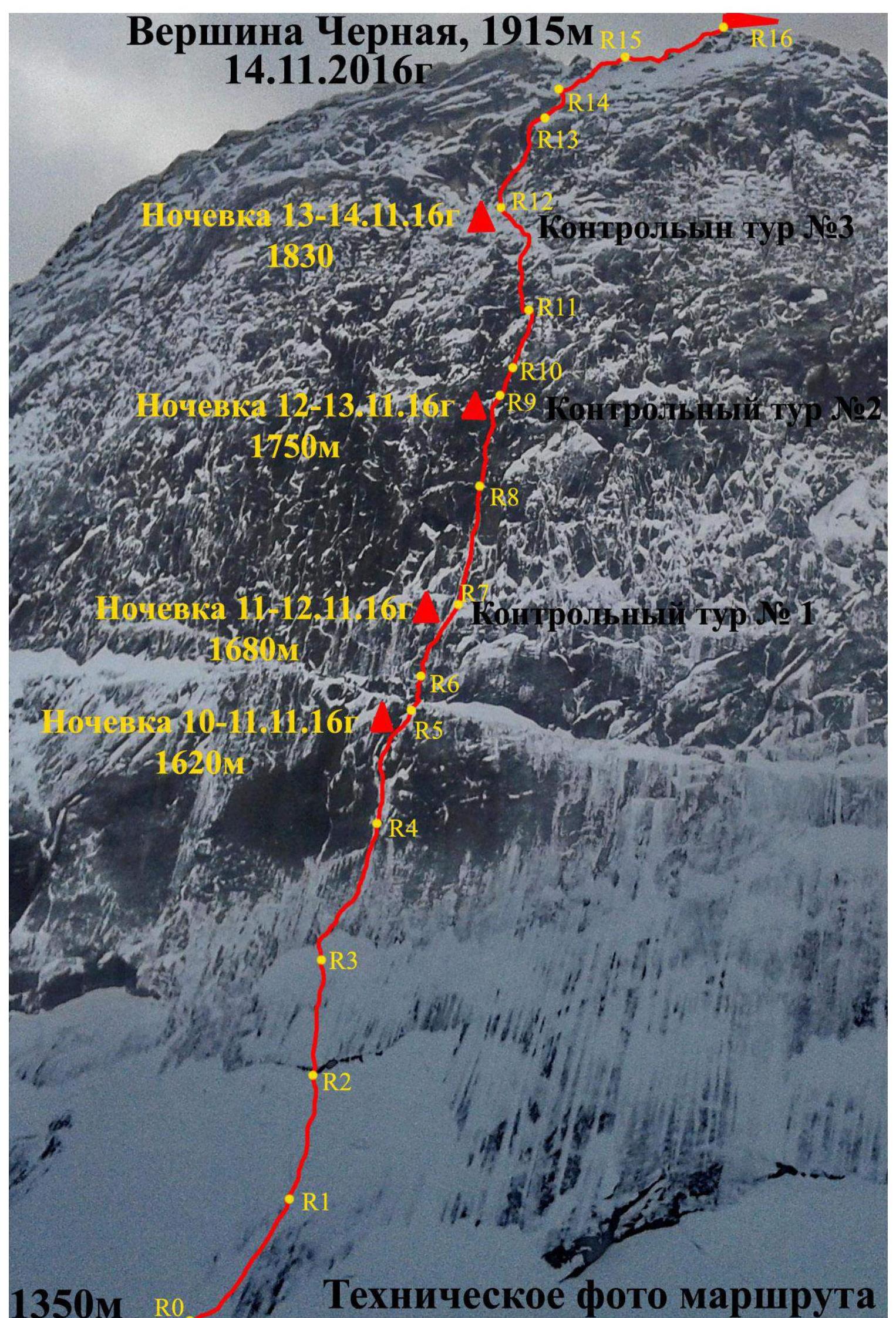 Technical photo of the route. Verchina Chernaya, 1915 m. Overnight stay Nov 10-11, 2016 (1620 m). Overnight stay Nov 11-12, 2016 (1680 m). Control cairn #1. Overnight stay Nov 12-13, 2016 (1750 m). Control cairn #2. Overnight stay Nov 13-14, 2016 (1830 m). Control cairn #3.
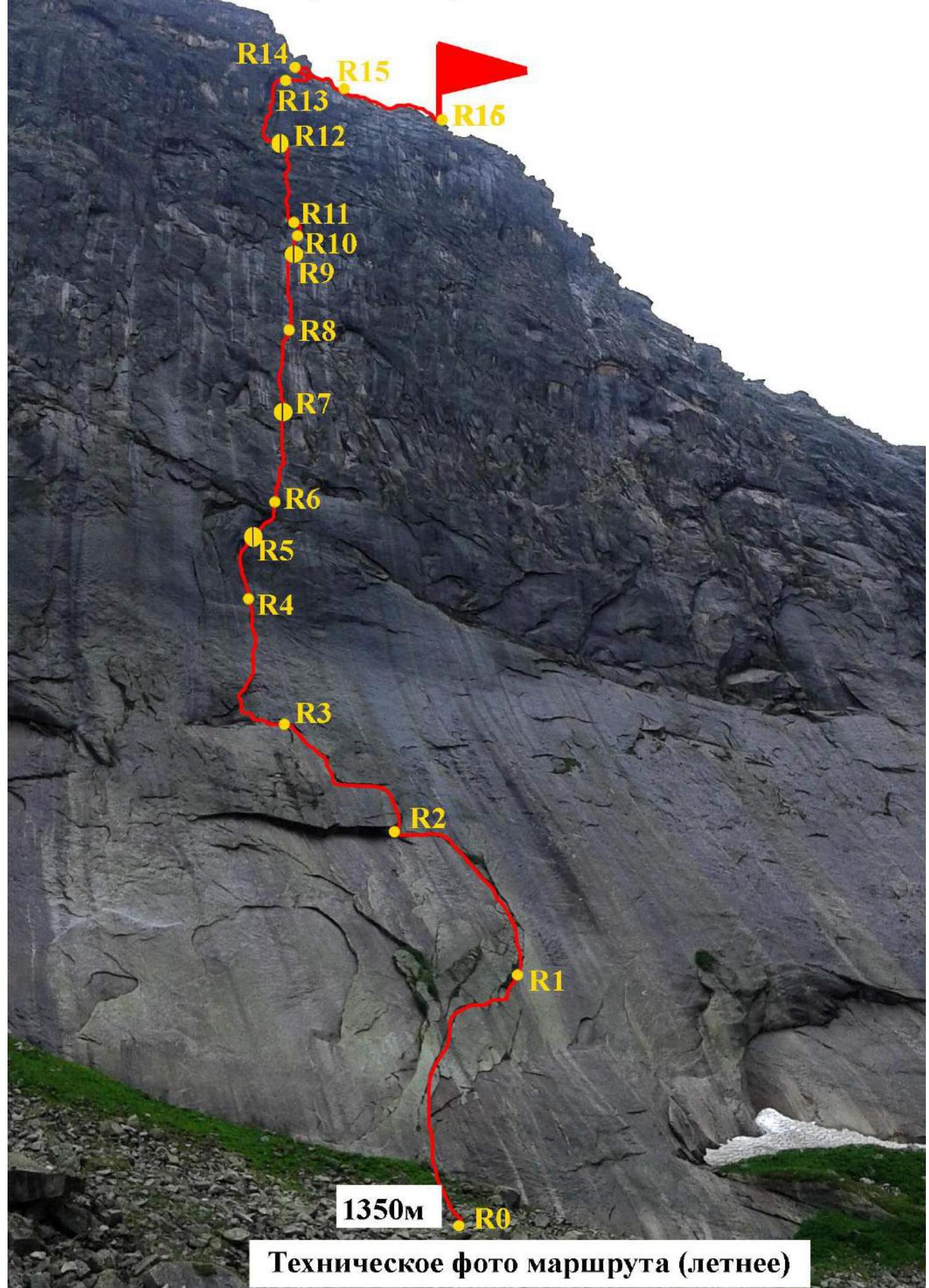 Technical photo of the route (summer). Verchina Chernaya, 1915 m.
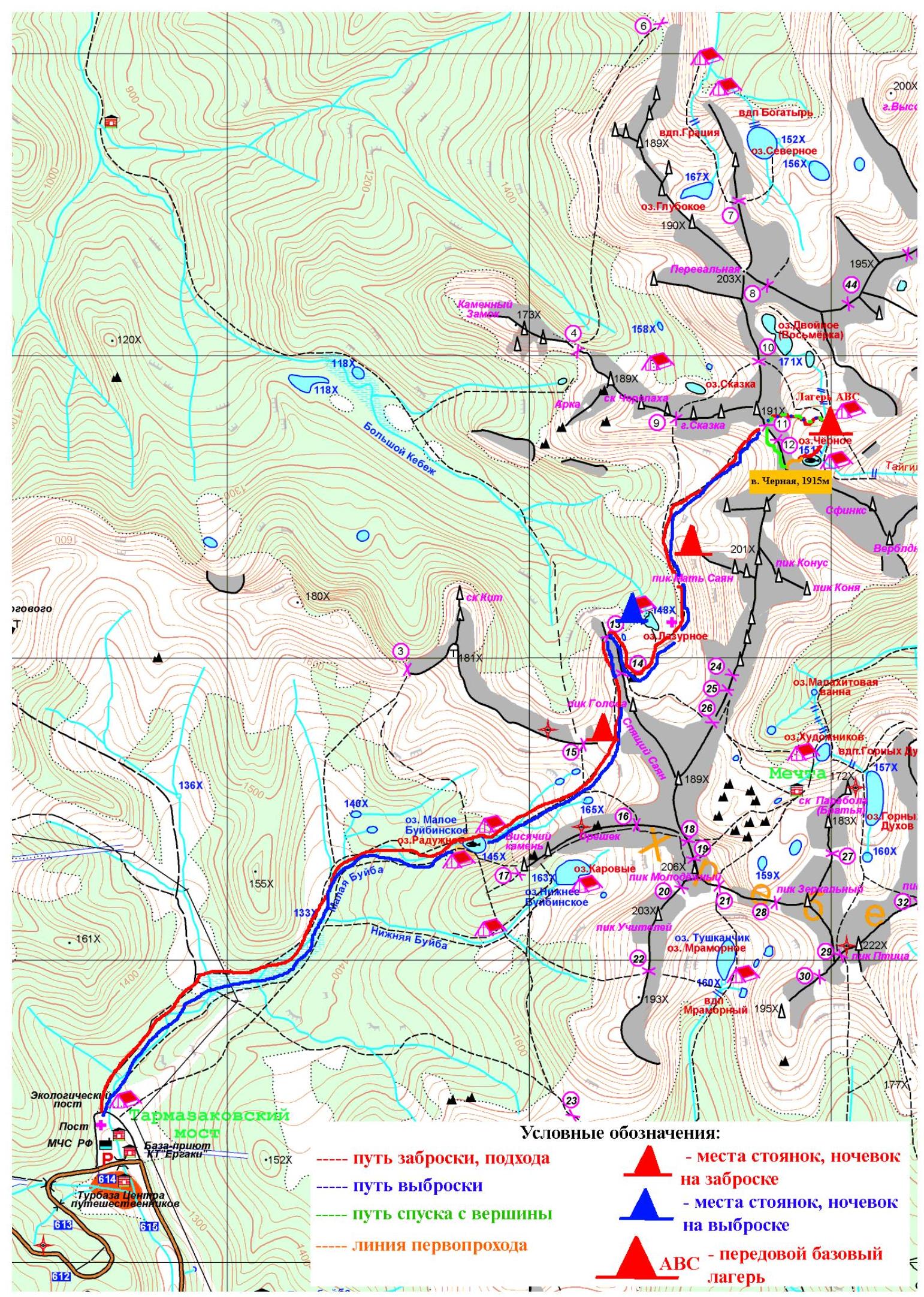
Map-scheme of the area with all designations
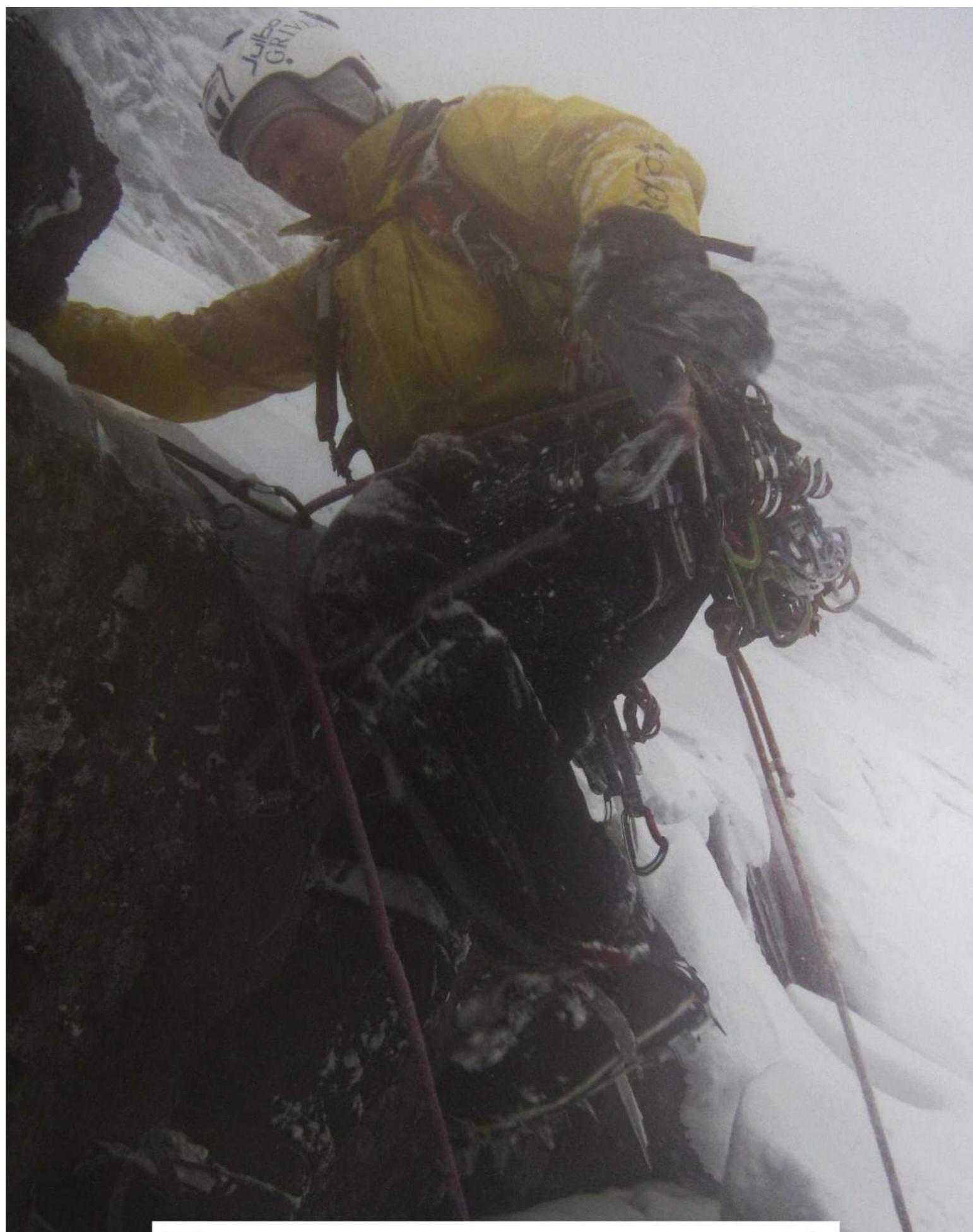
Passage of the cornice R2
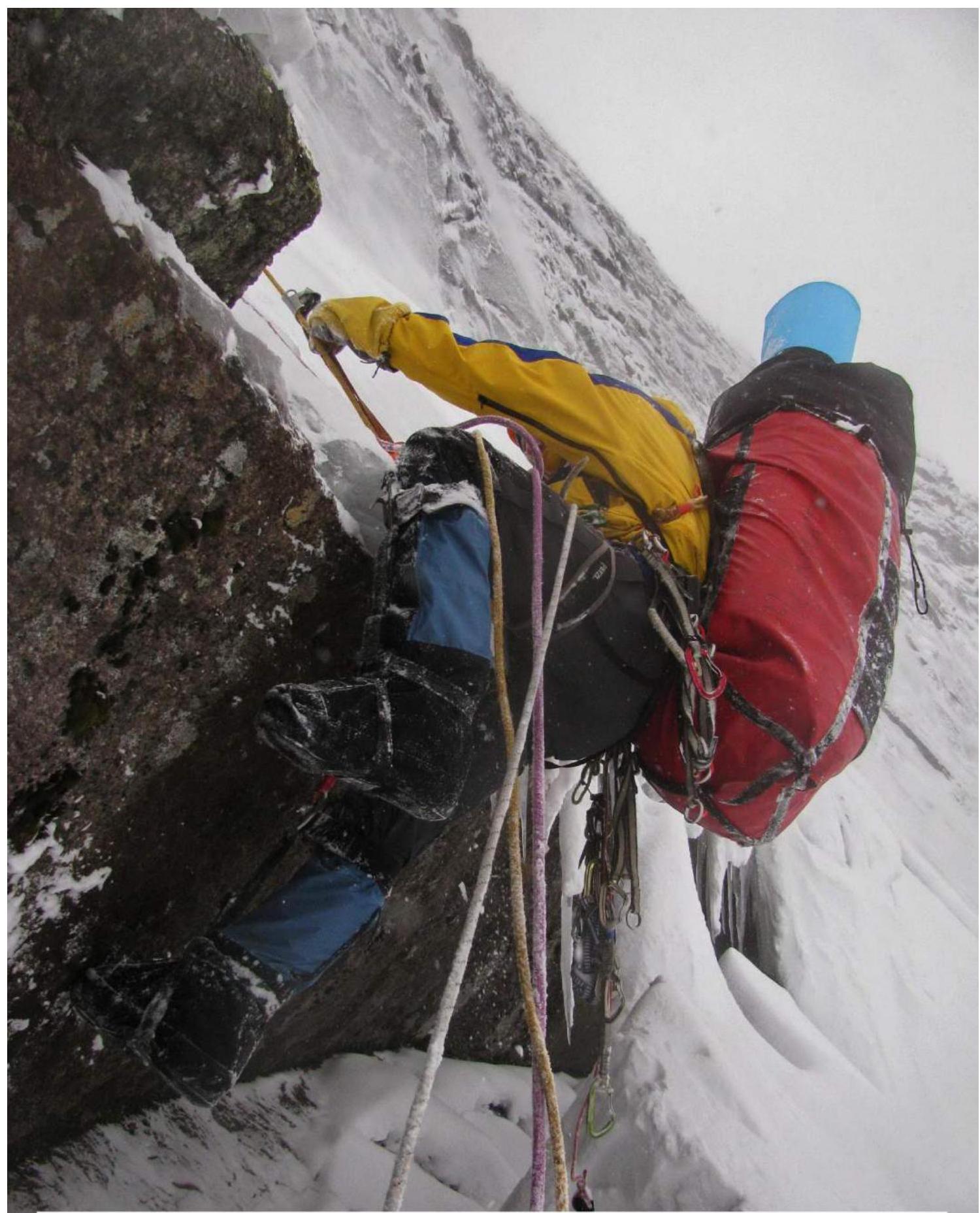
Transition of the second participant through the cornice on section R2
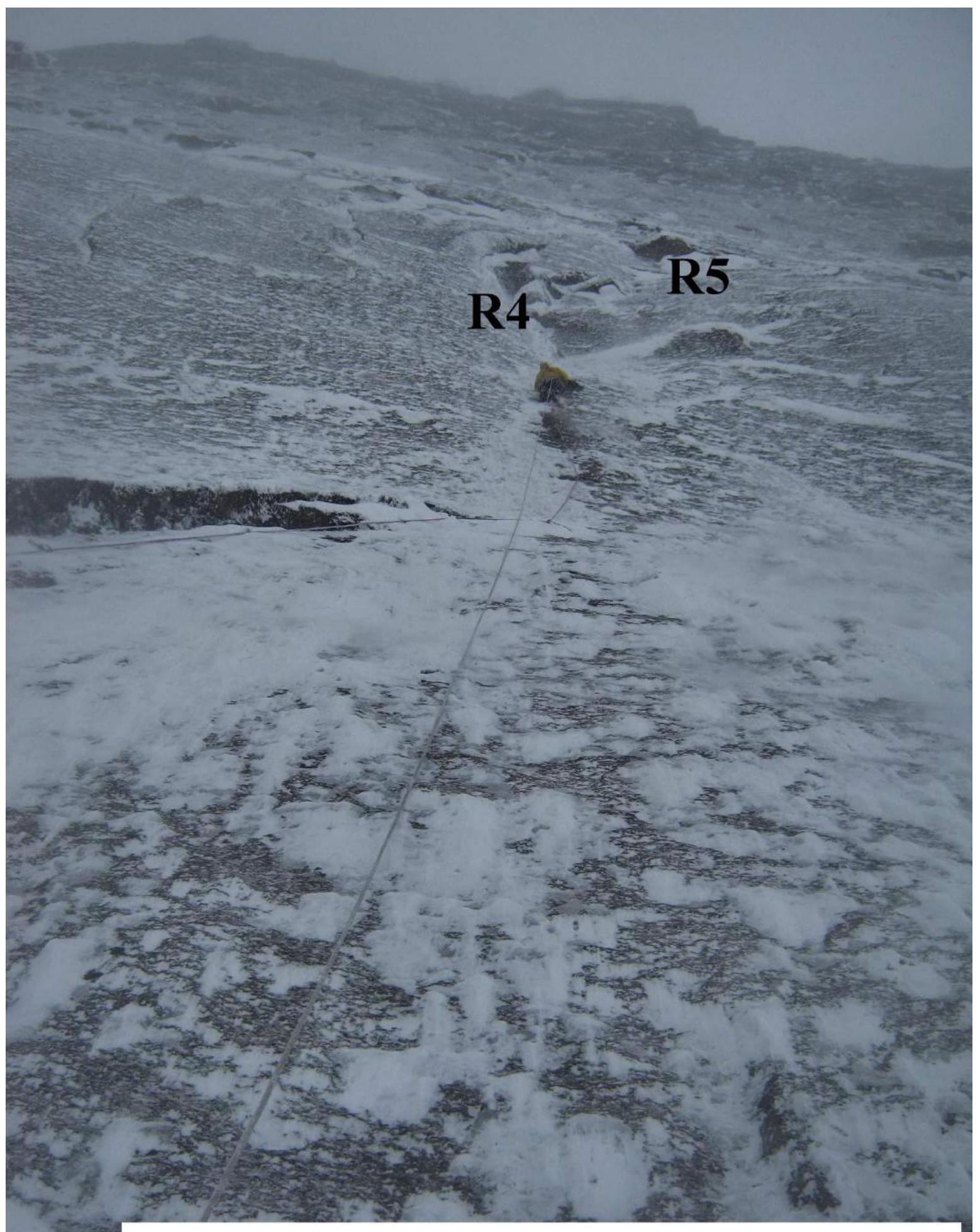
Passage of section R3–R4 on skyhooks
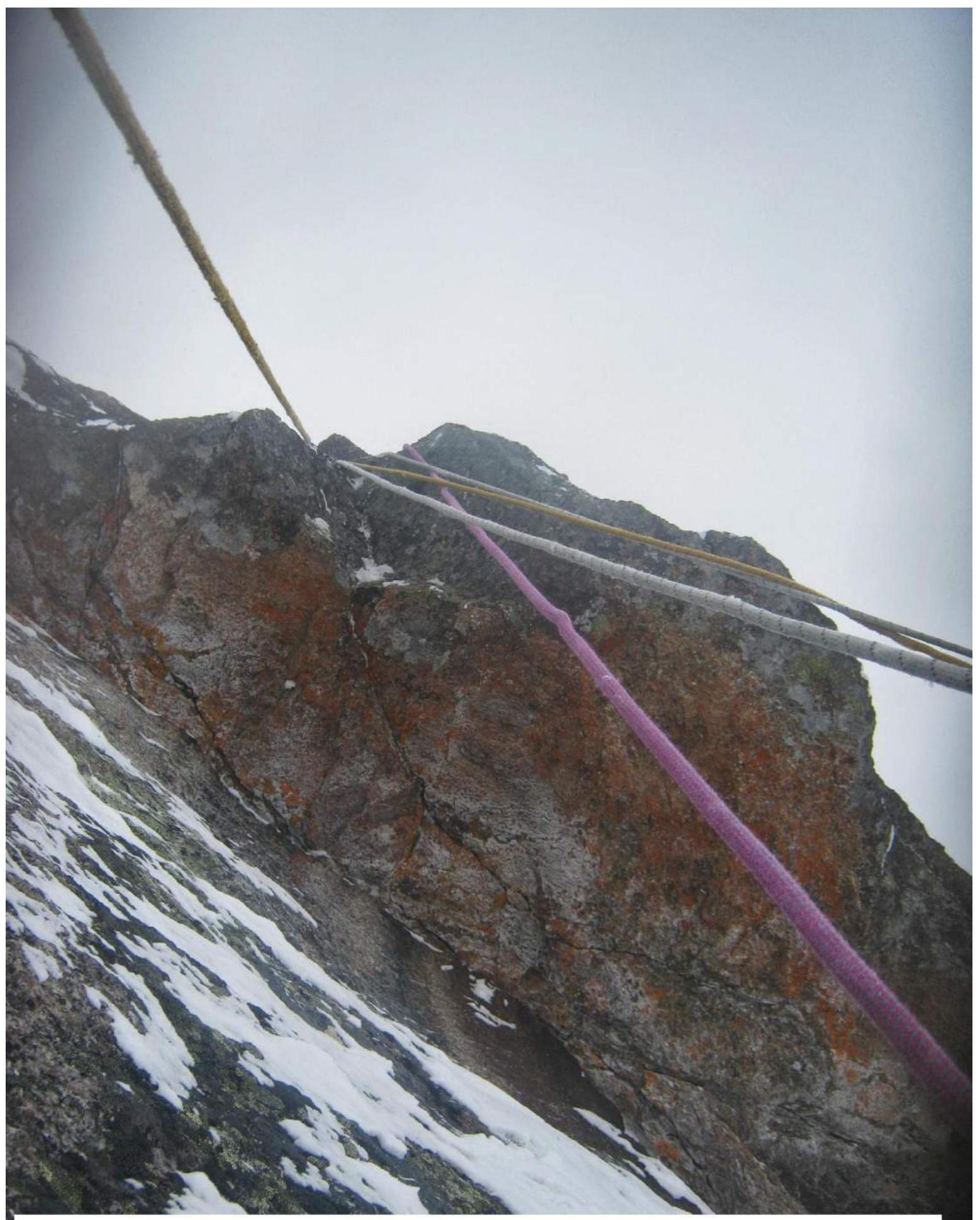
Cornice on section R5–R6. Photo from the 1st overnight stay.
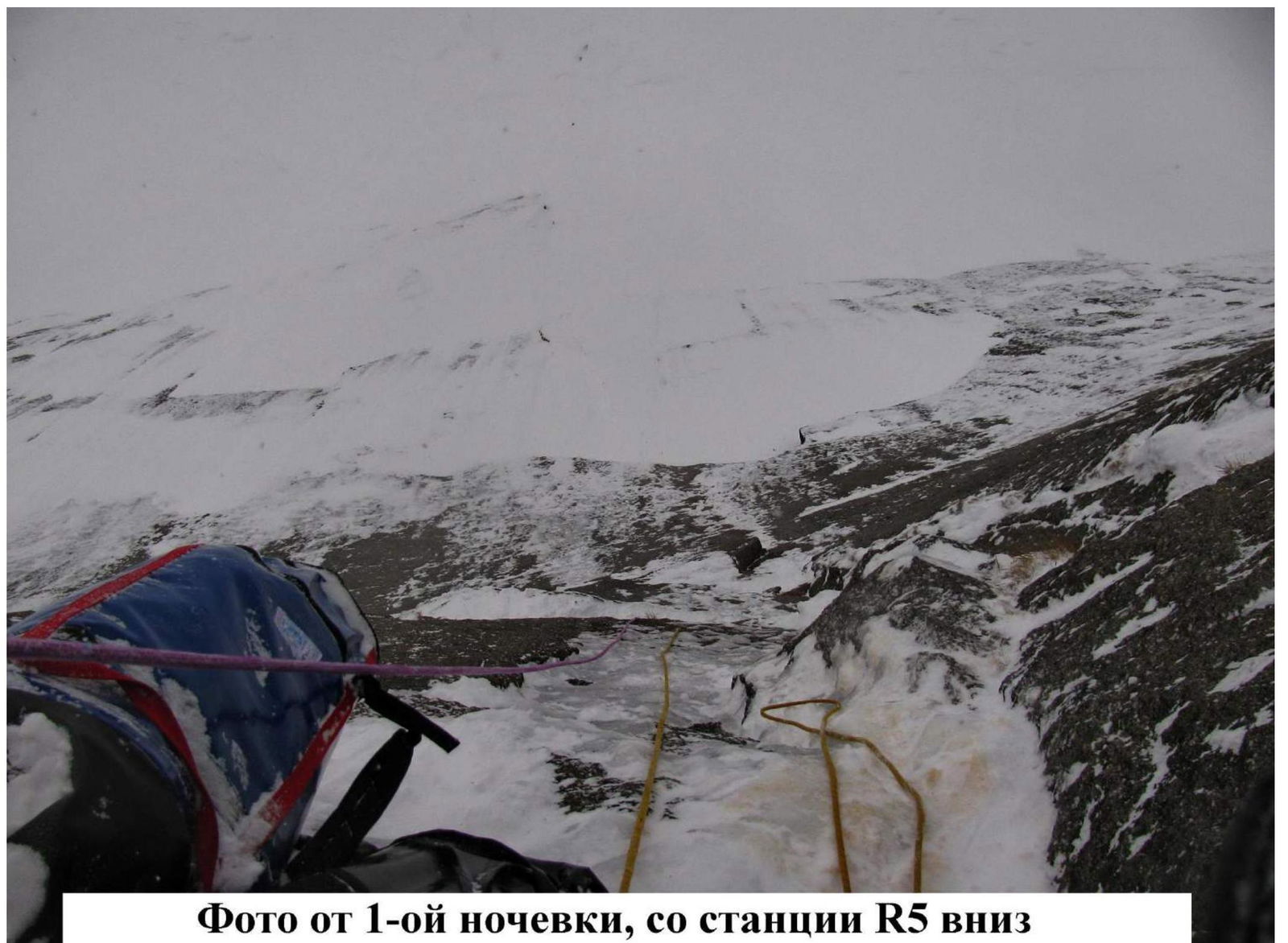
Photo from the 1st overnight stay, from station R5 downwards.
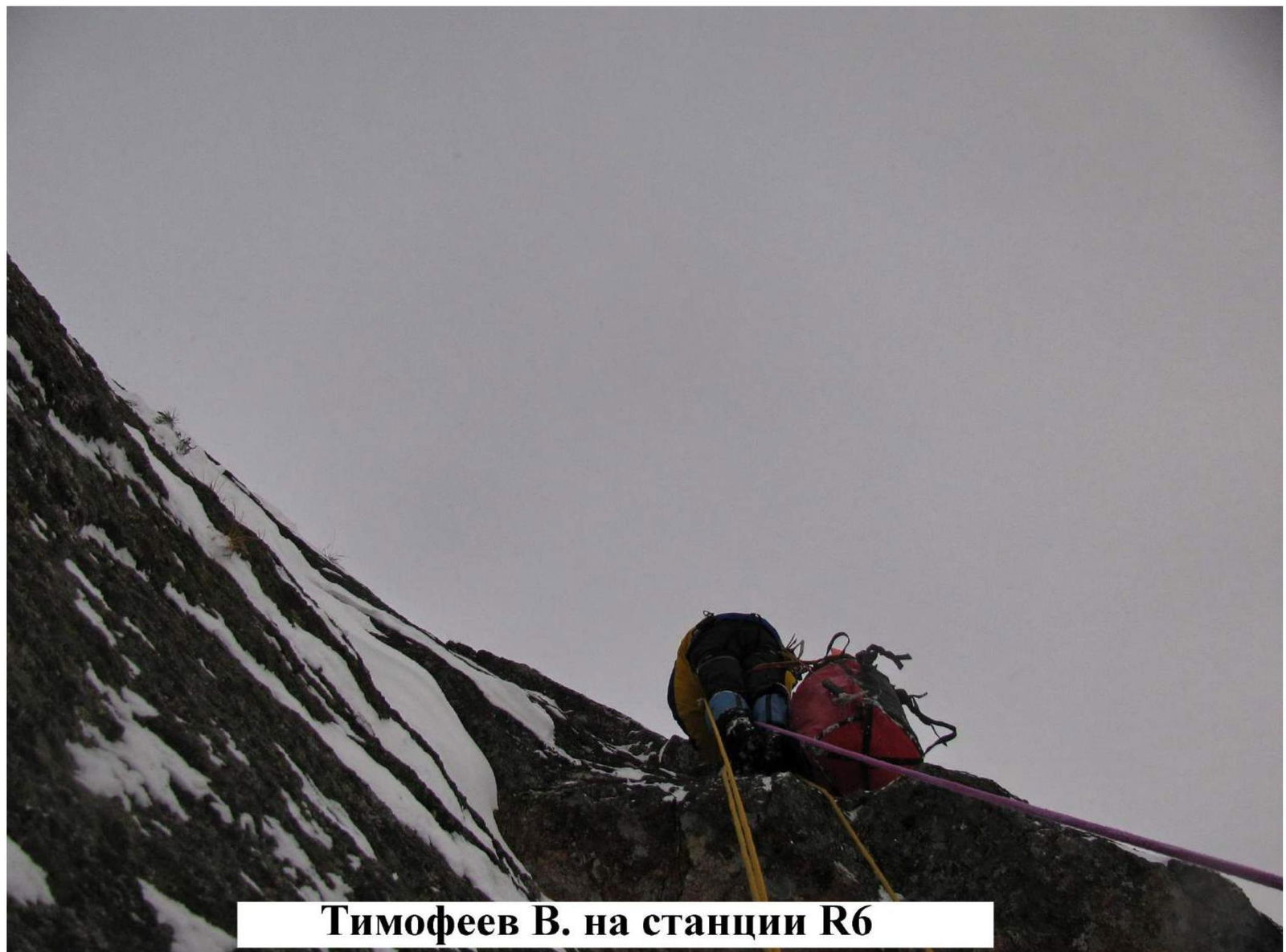
Timofeev V. on station R6.
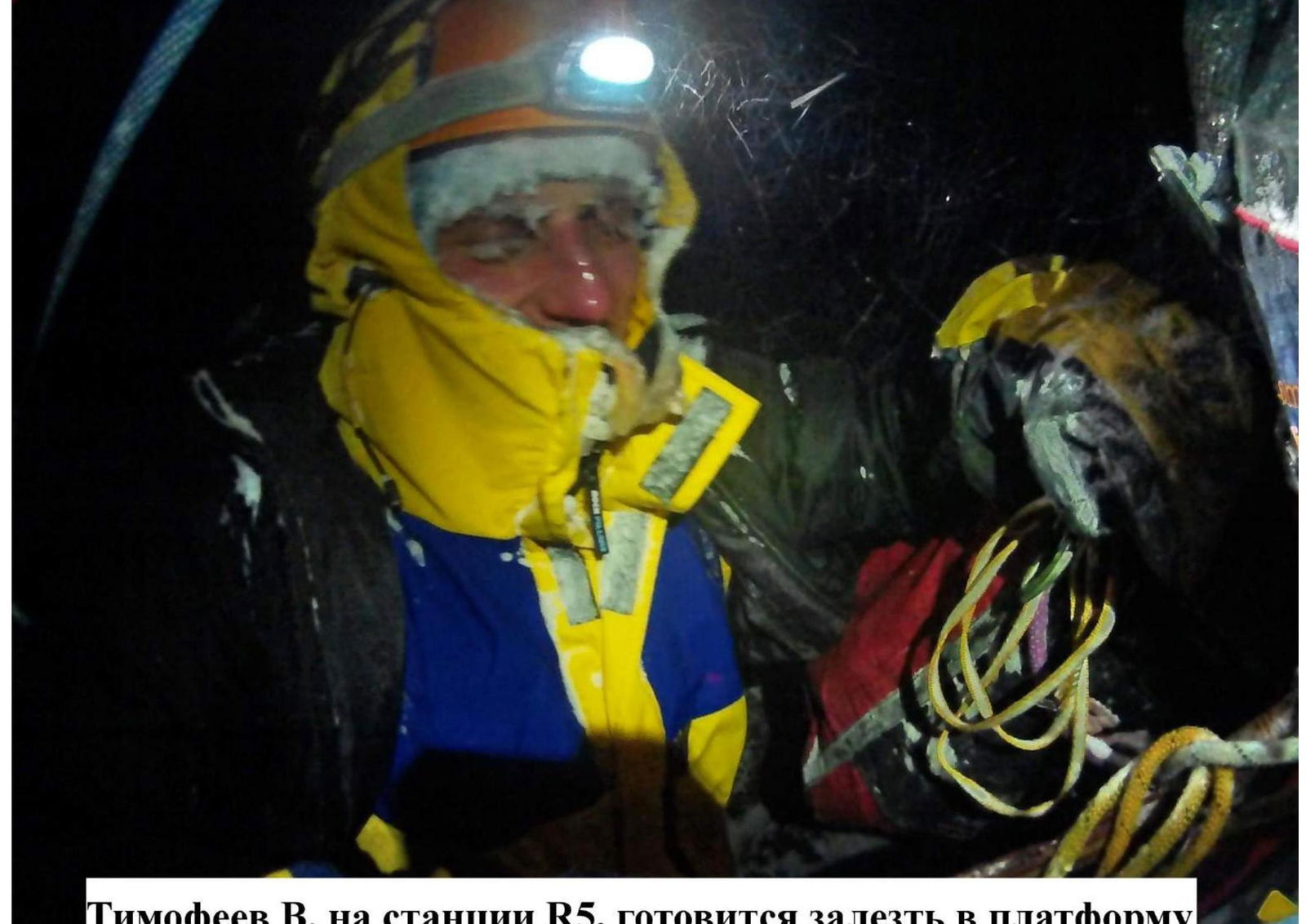
Timofeev V. on station R5, preparing to climb into the platform.
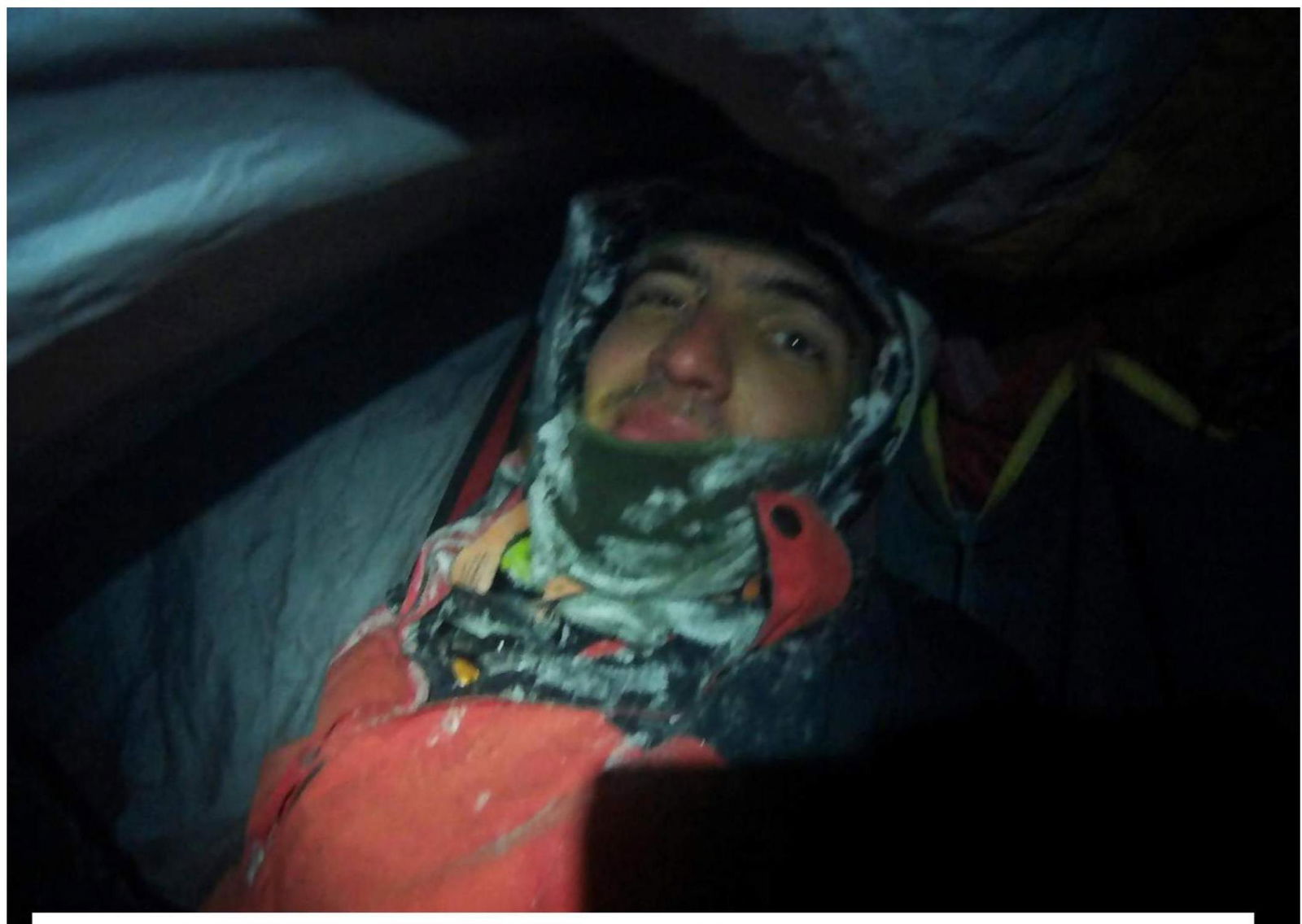
Ivanov T. in the platform, on station R5, preparing for the first overnight stay.
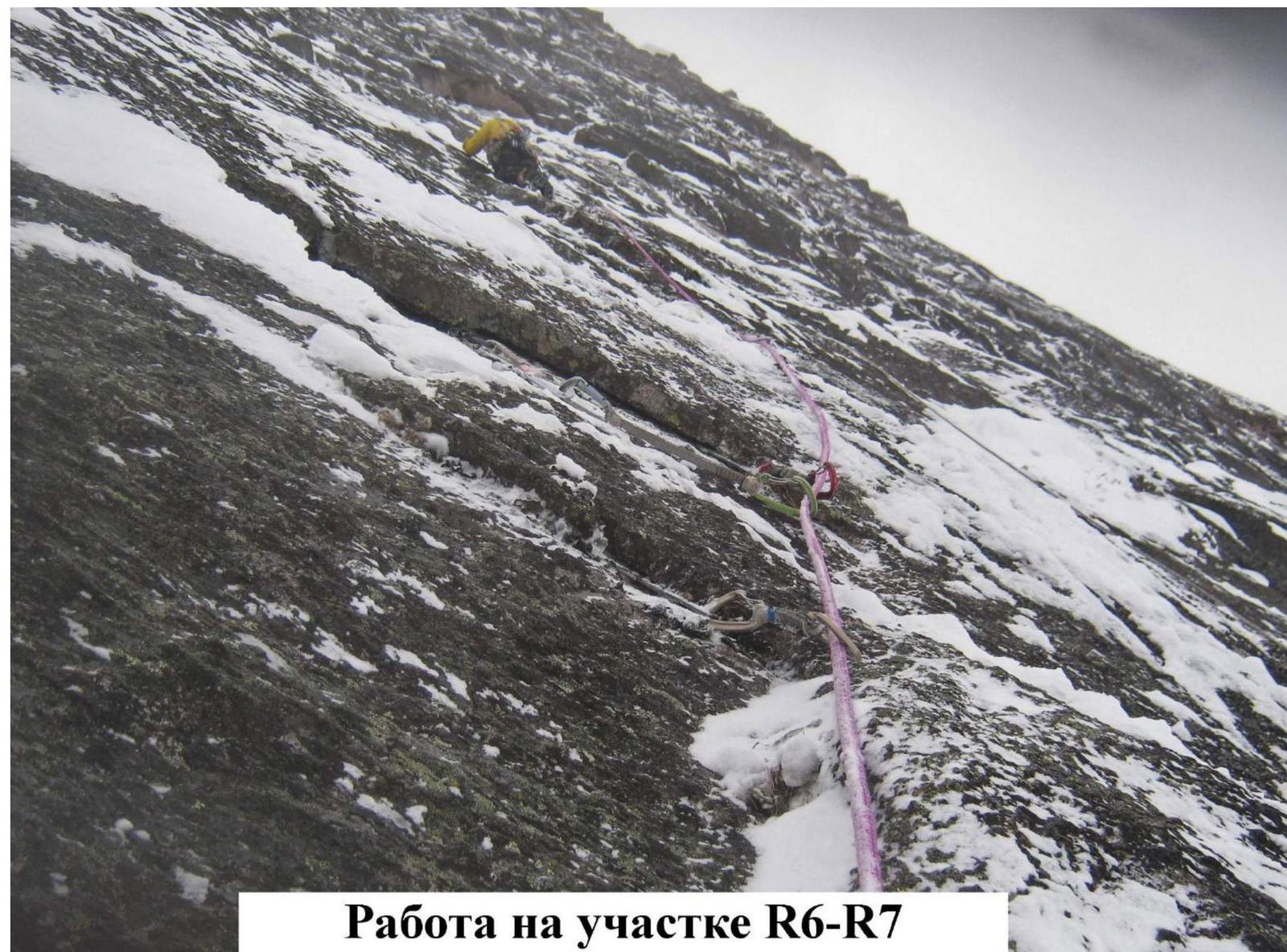
Work on section R6–R7.
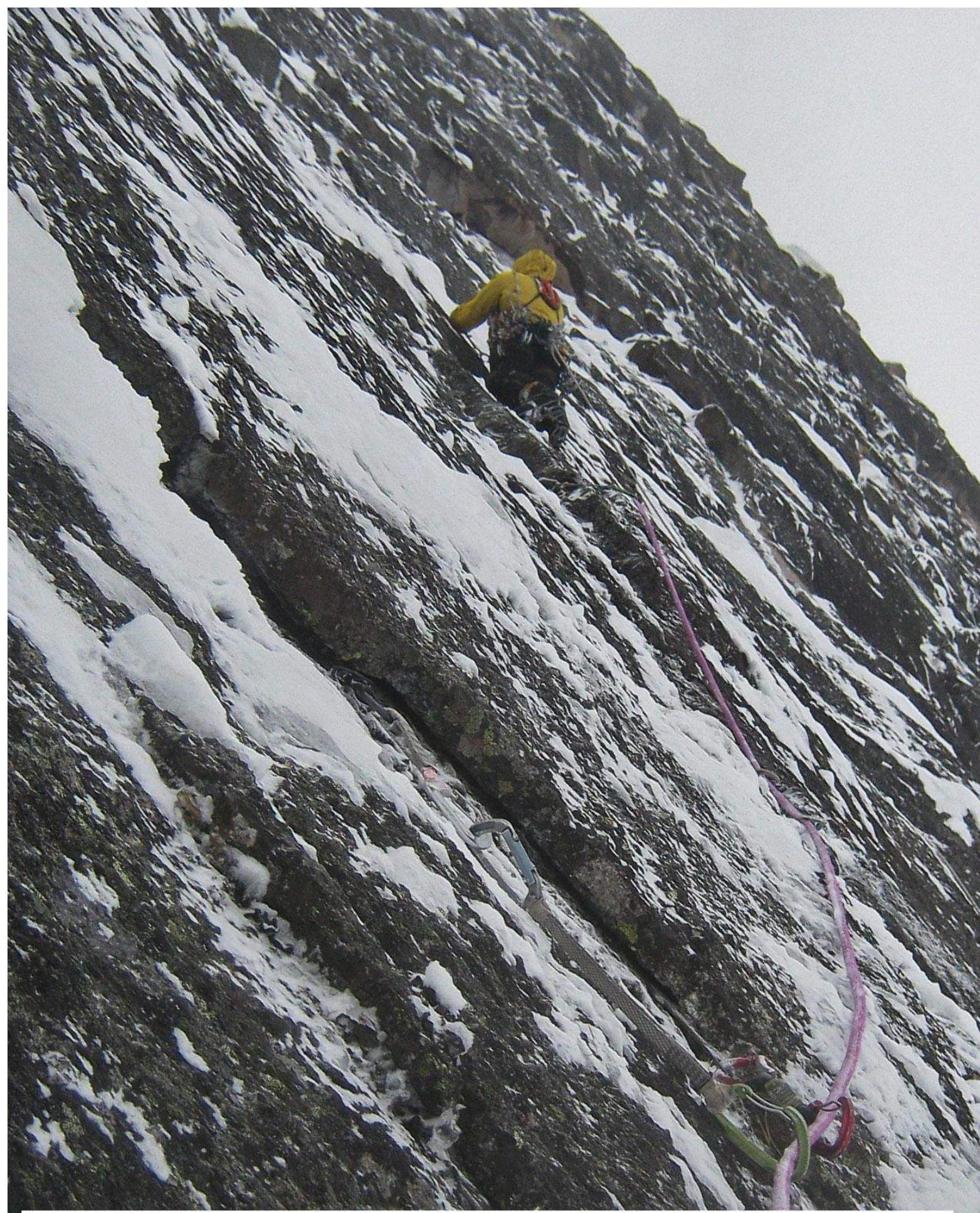
Passage of a complex section R6–R7 on skyhooks.
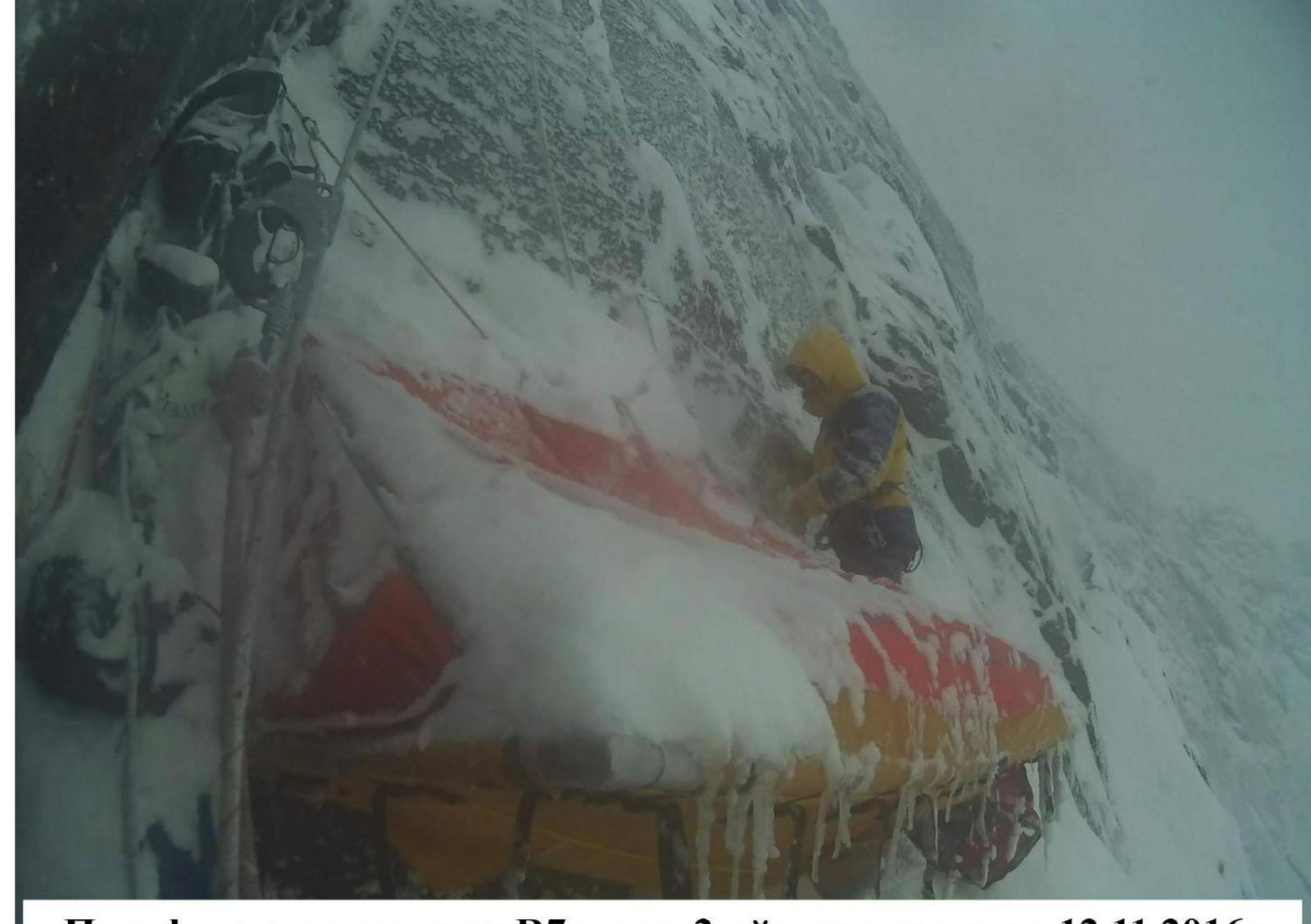
Platform on station R7 after the 2nd overnight stay, morning of November 12, 2016.
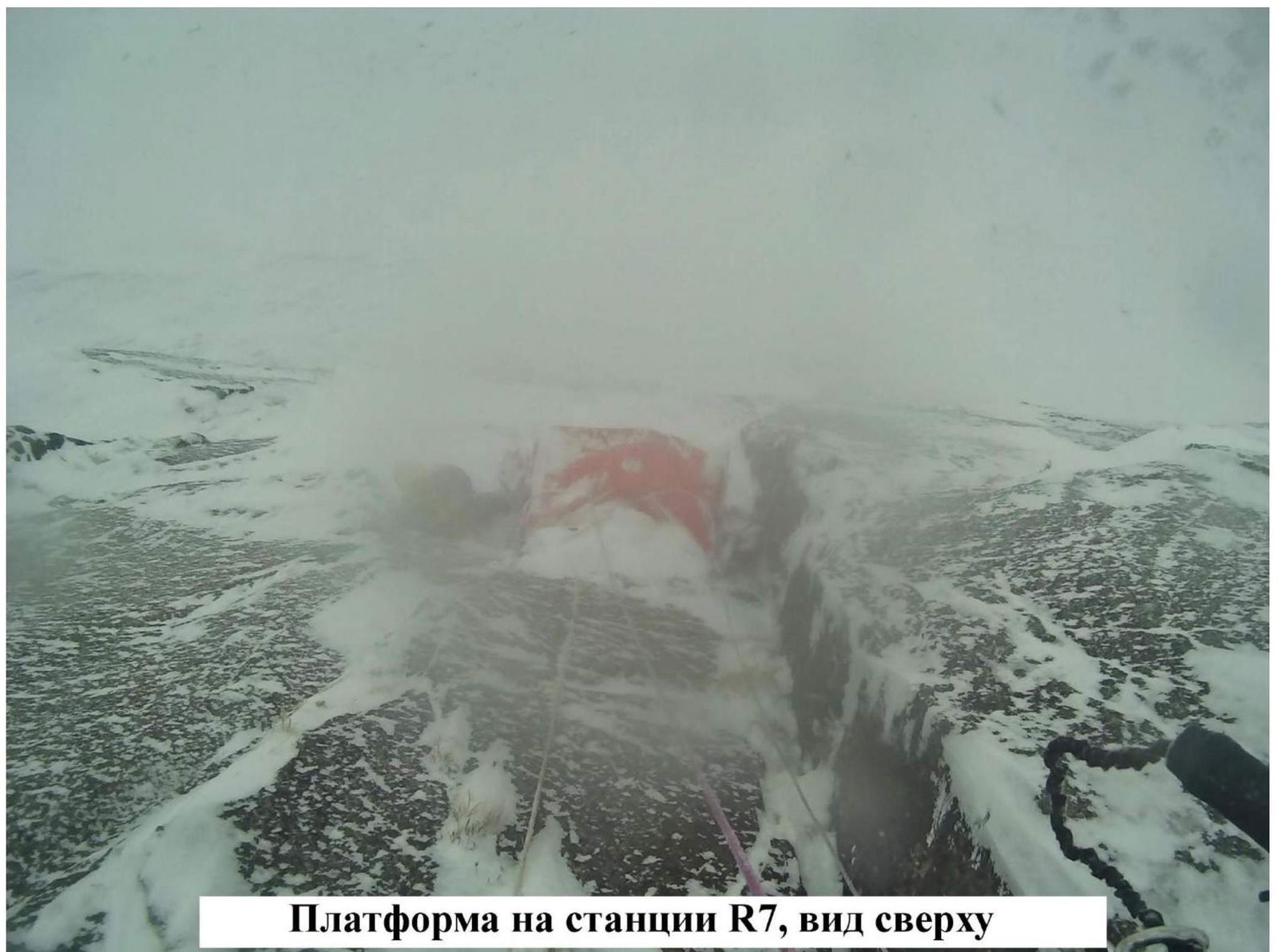
Platform on station R7, top view.
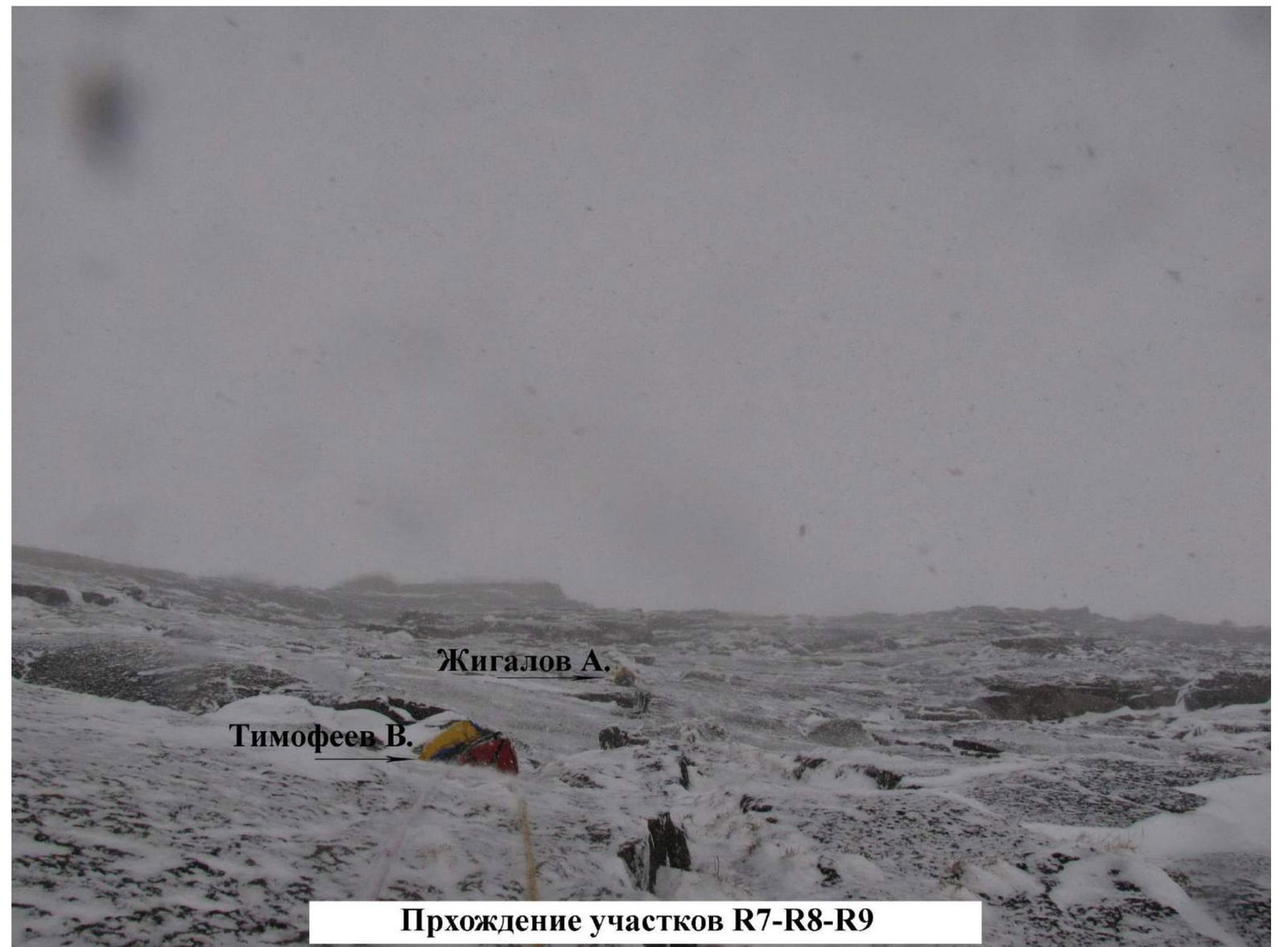
Zhigalov A., Timofeev V. Passage of sections R7–R8–R9.
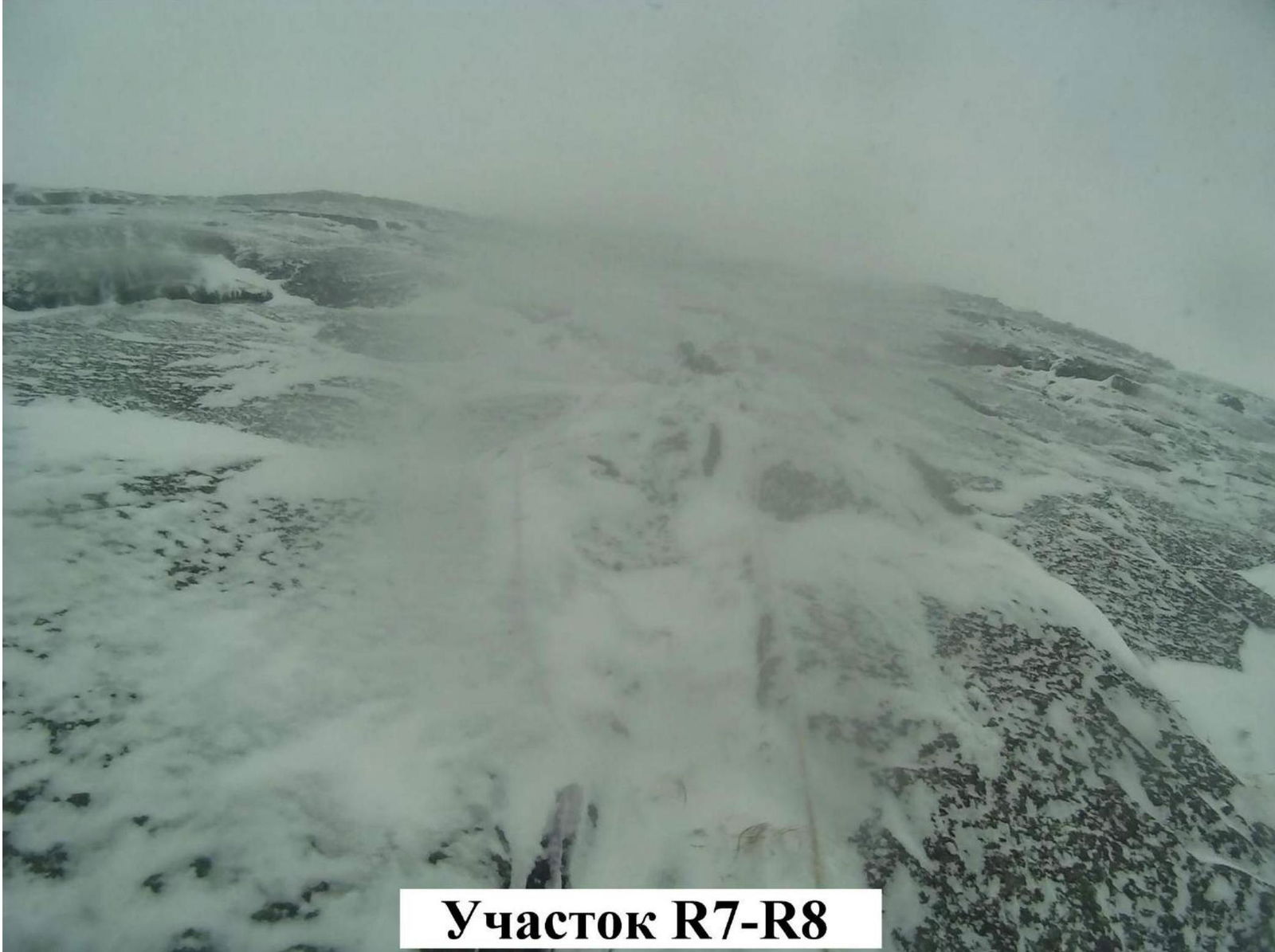
Section R7–R8.
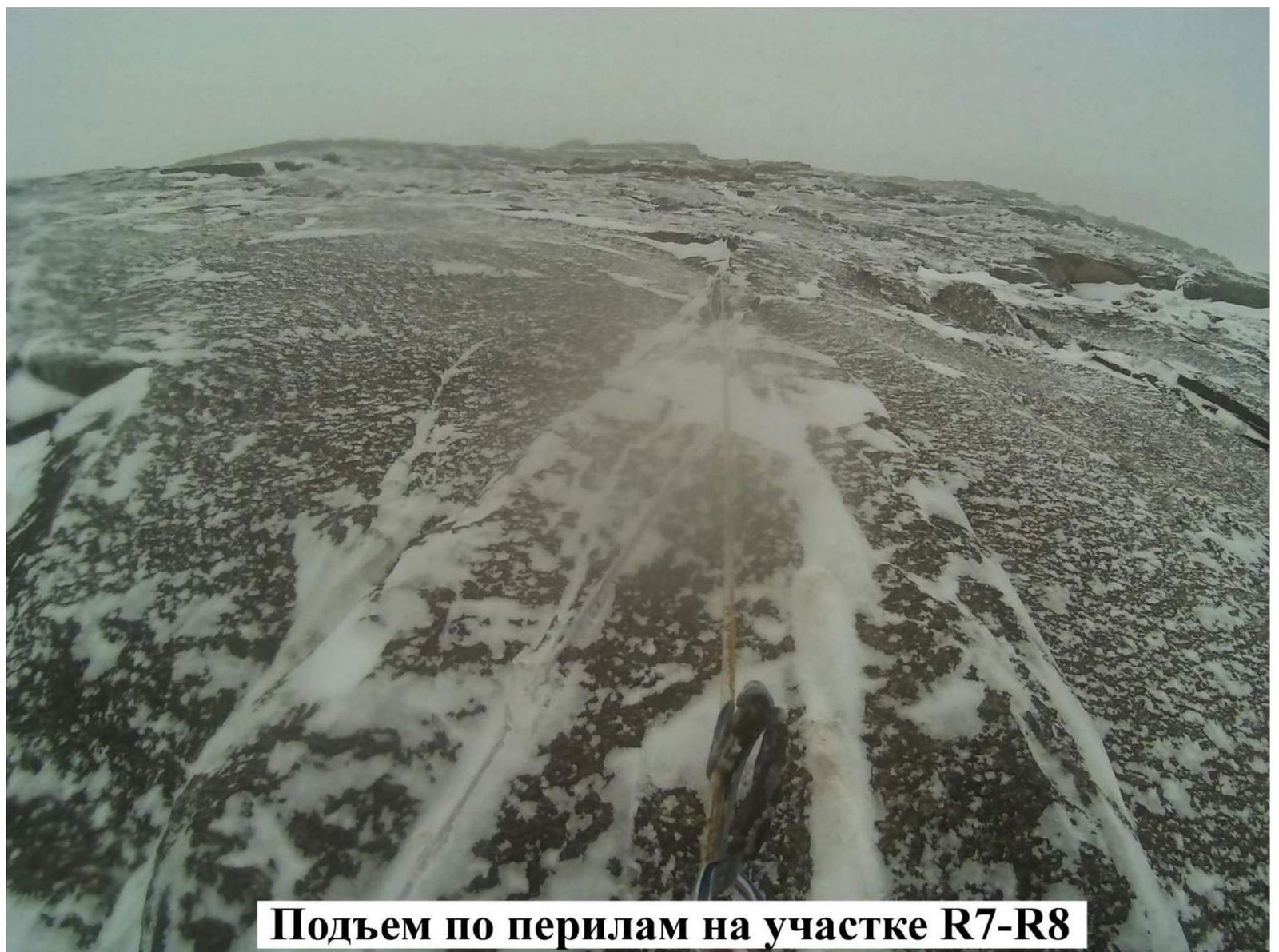
Climb on perils on section R7–R8
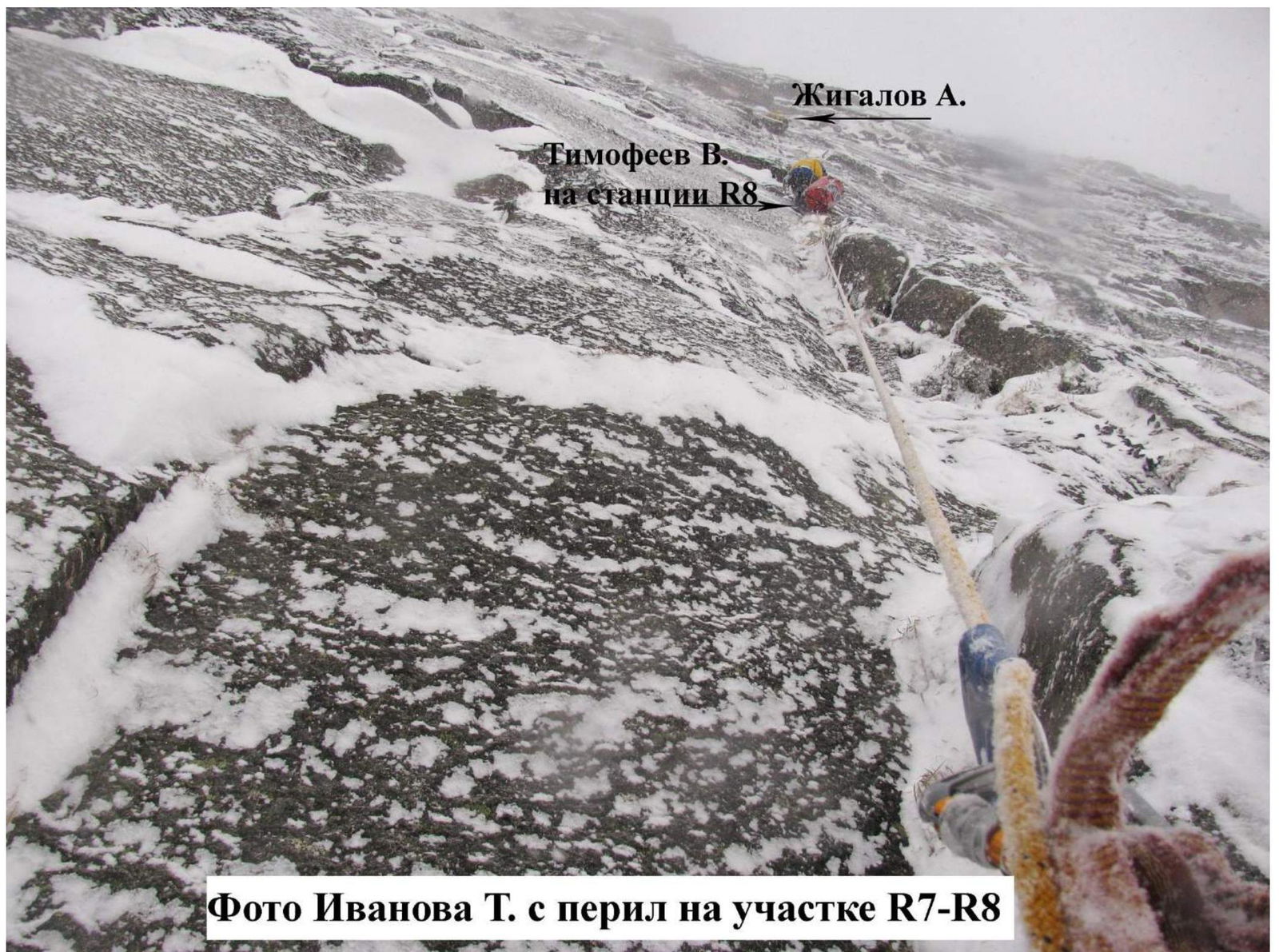
Photo of Ivanov T. from perils on section R7–R8
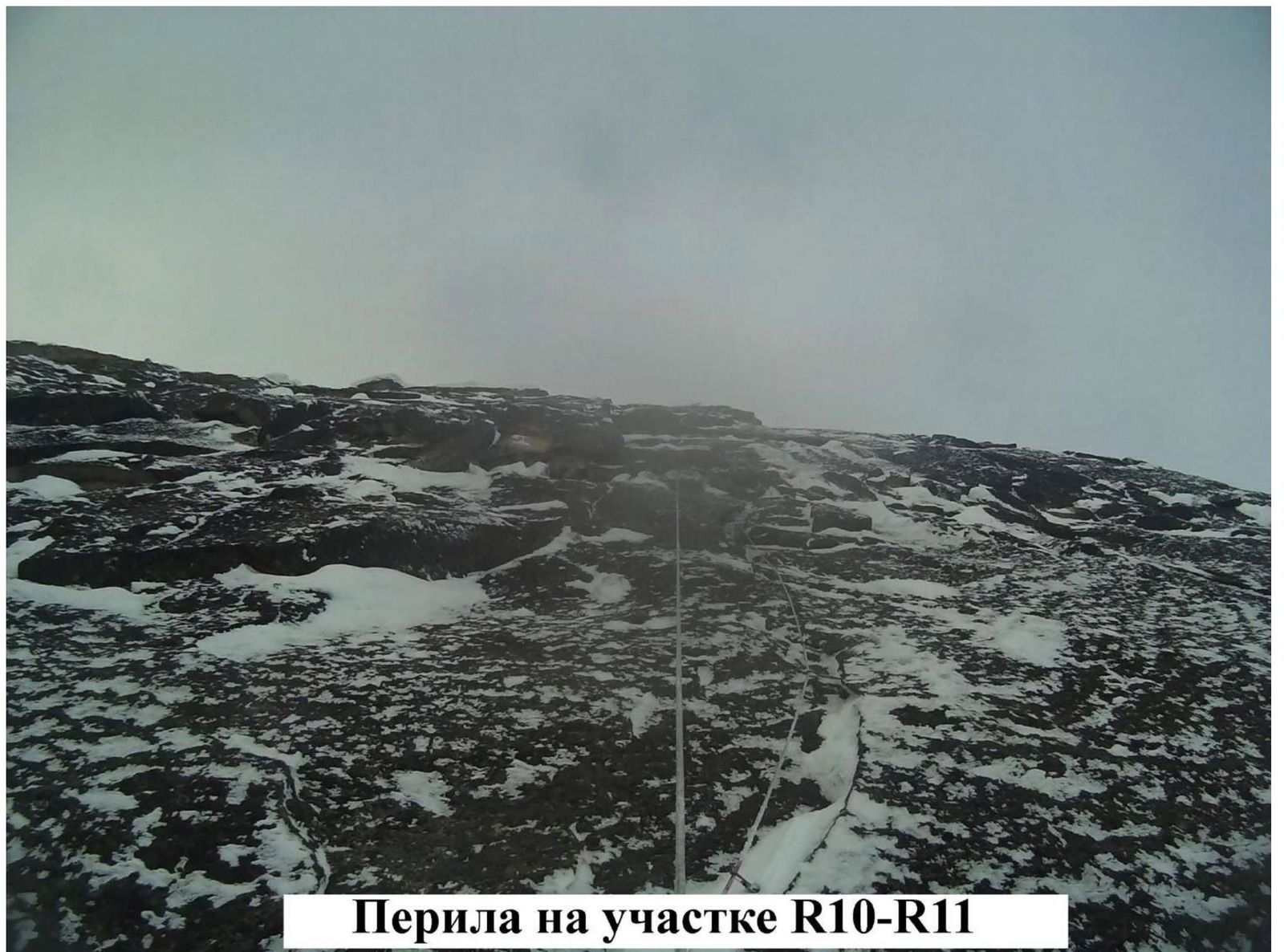
Perils on section R10–R11

Platform on station R9 after the 3rd overnight stay, top view from station R10.
Zhigalov A. passes section R11–R12.
Timofeev V. on station R10.
Sections R9–R11, taken from station R9.
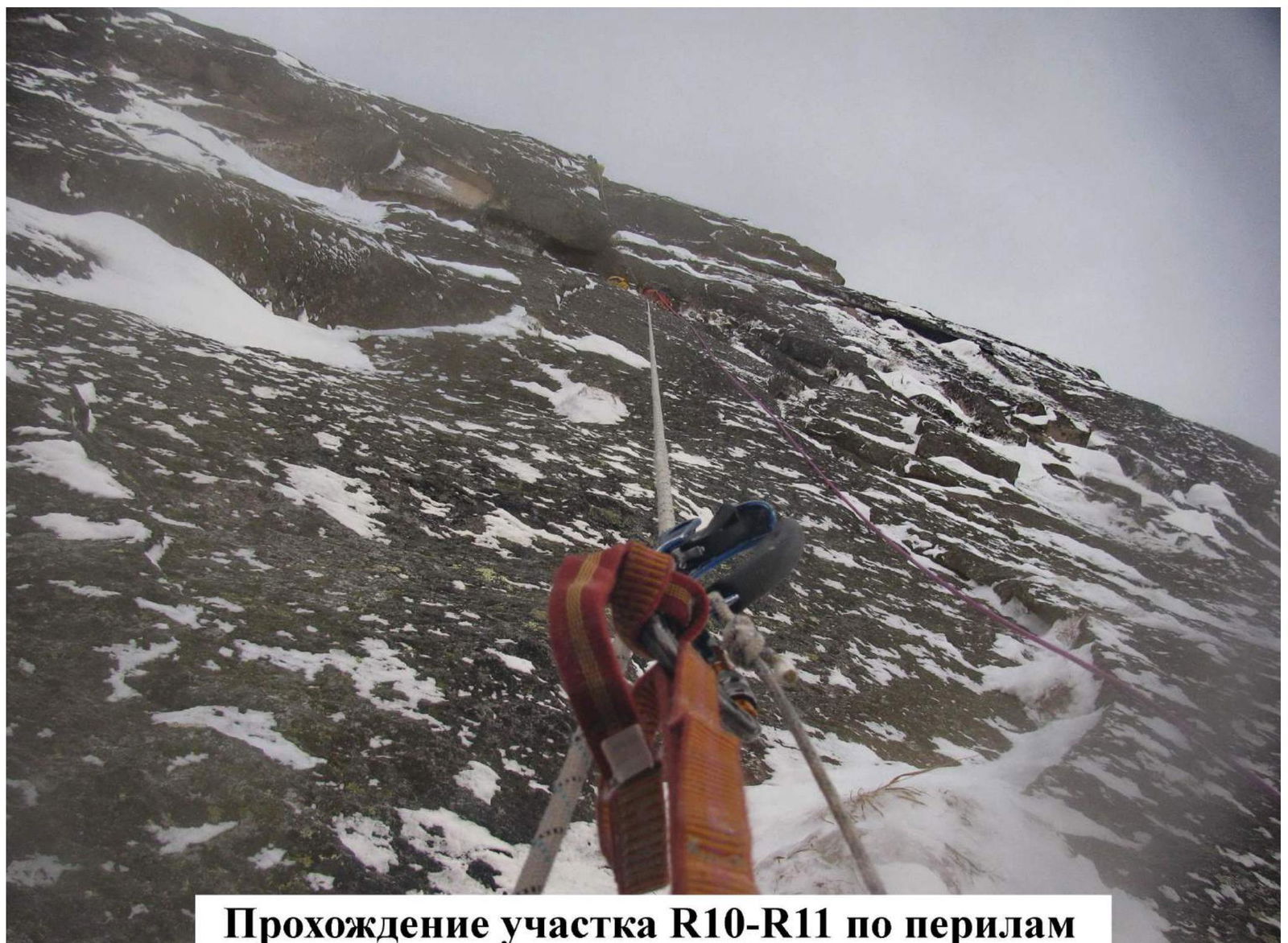
Climb on perils on section R10–R11