
Ascent Log
Region — Western Sayan, Ergaki Ridge, p. 6.2. Peak — Golova, 1970 m, direct route up the E wall, route name "Slesarnya". Category — 5B cat. sl., first ascent. Route type — rock climb.
Route characteristics: height difference — 400 m, total route length — 470 m, length of wall section — 320 m, length of sections with 6 cat. sl. — 225 m, 5 cat. sl. — 15 m, average steepness of main section 74°.
- Equipment used on the route: anchor hooks — 70/39, cam hooks — 24/40, about 55 ITO on "fifas", about 90 ITO on skyhooks, 14 ITO on bolted hooks, 17 bolted hooks hammered in and left, 5 knots twisted, 11 knots left, on all stations and some intermediate sections.
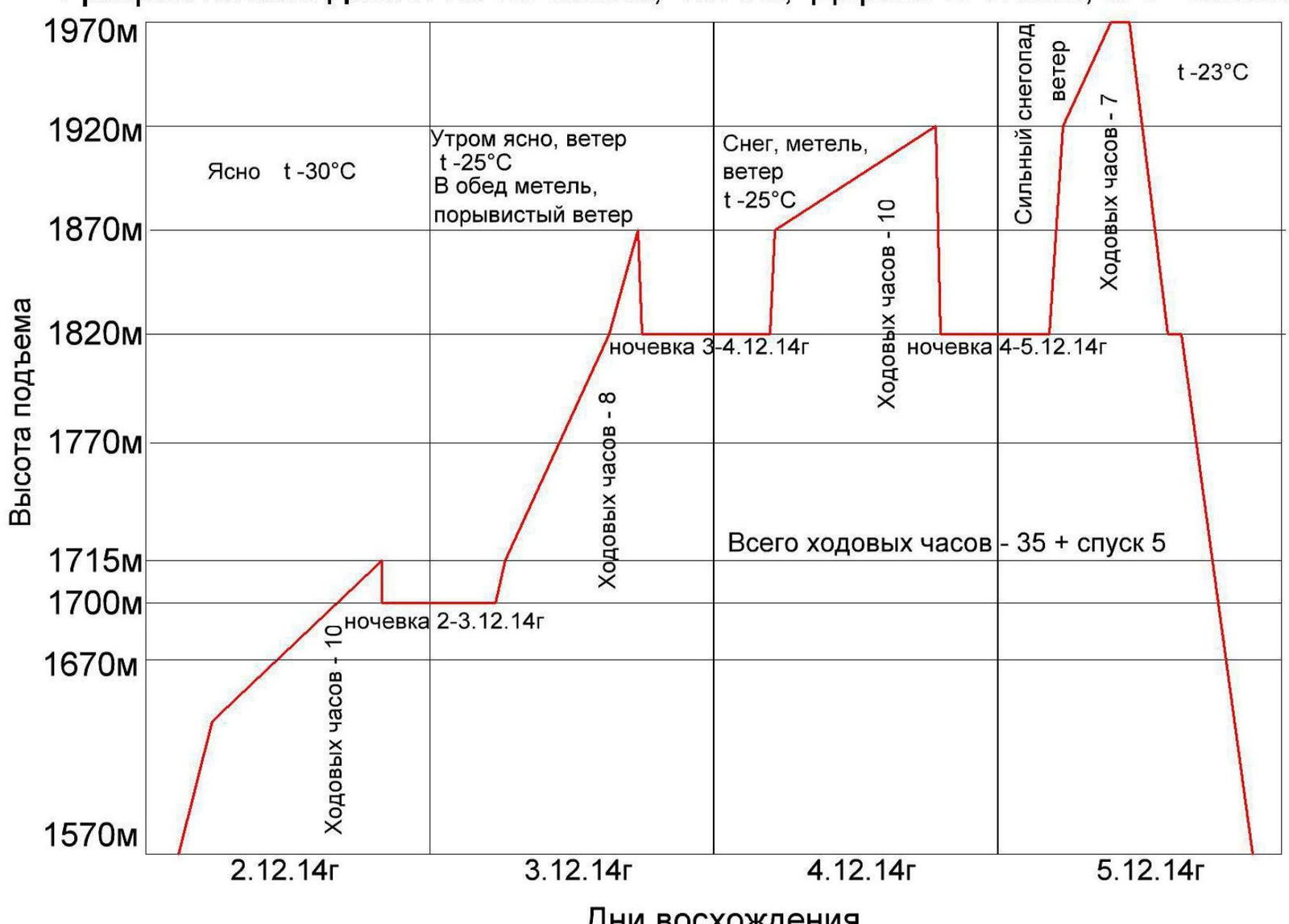
- Time taken — 35 hours, days — 3.5.
Number of bivouacs — 3, all on a platform on the wall.
-
Team leader: Zhigalov Alexander Vladimirovich, MS Team member: Ivanov Timofey Pavlovich, 2nd sp. category
-
Team coaches: Balezin Valery Viktorovich, MSMK, ZTR; Zakharov Nikolai Nikolaevich, MSMK, ZTR
-
Departure date: Started ascent — at 6:45, December 2, 2014. Reached summit — at 14:30, December 5, 2014. Returned to B.L. under the wall — at 19:15, December 5, 2014.
-
Ascent organized by — Ministry of Sports and Tourism of Krasnoyarsk Krai, 2014.

Peak Golova, 1970 m
1 — ascent route "Slesarnya"
2 — 5B, center of E wall (Cherezov, 2002)
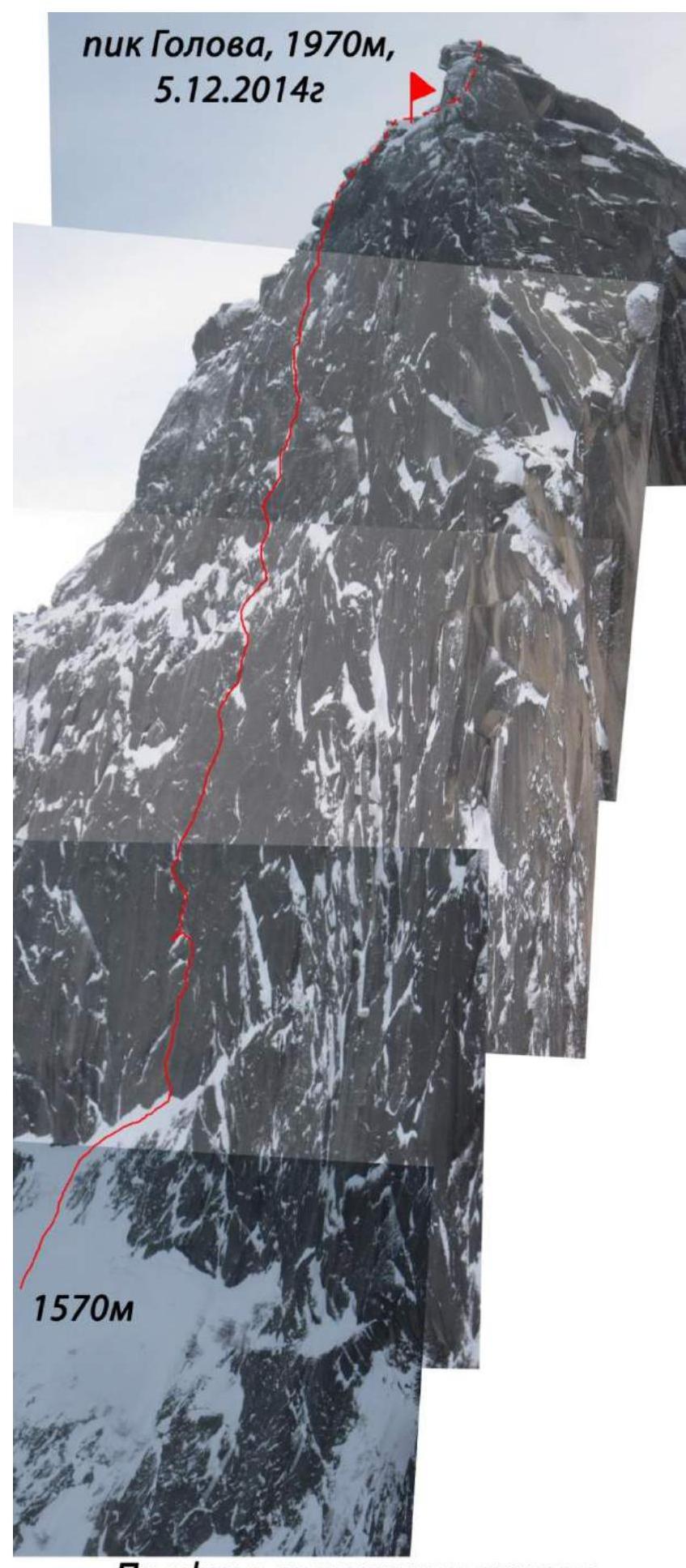
Route profile on the right. Taken from "Volosy" pass.
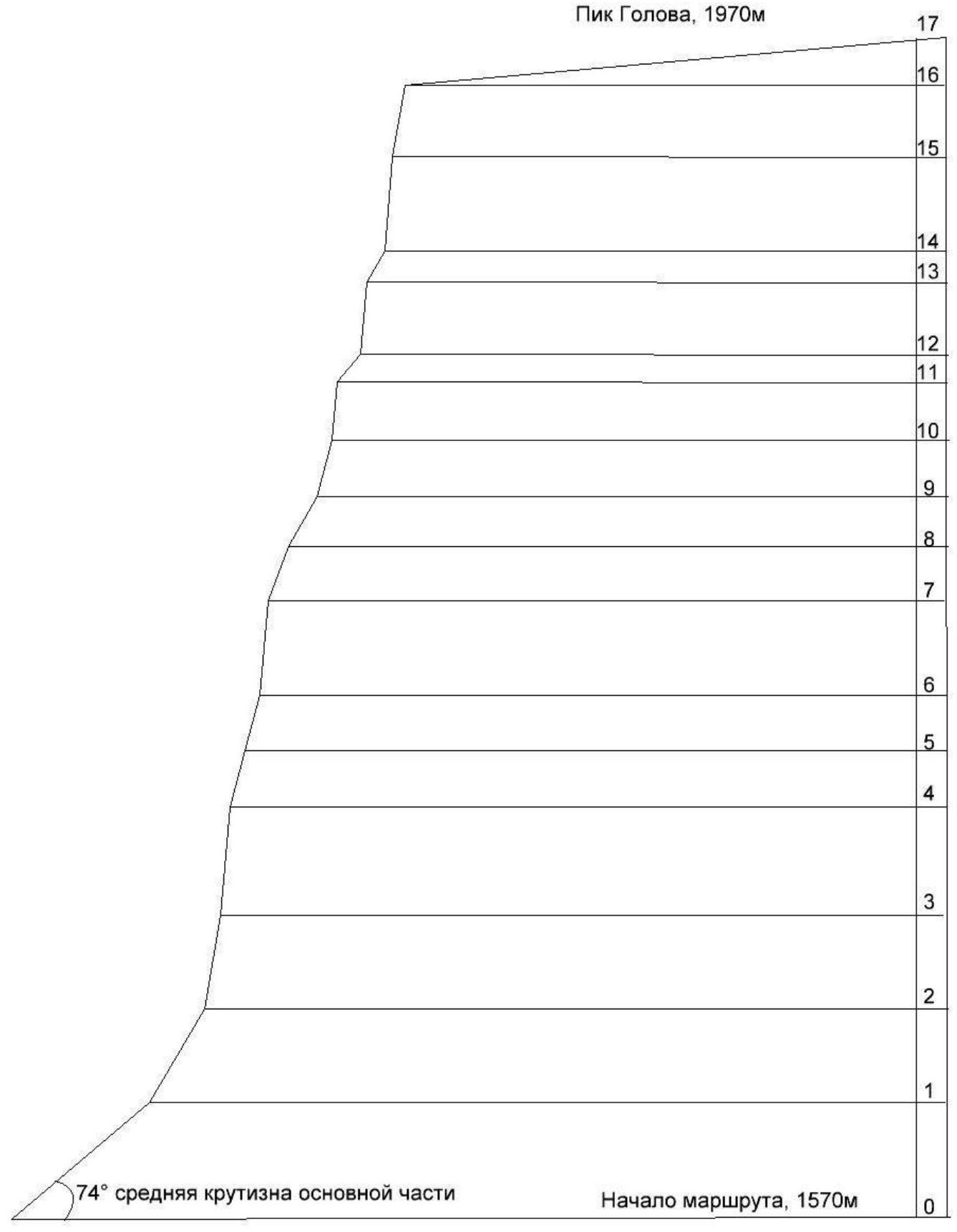
Hand-drawn route profile
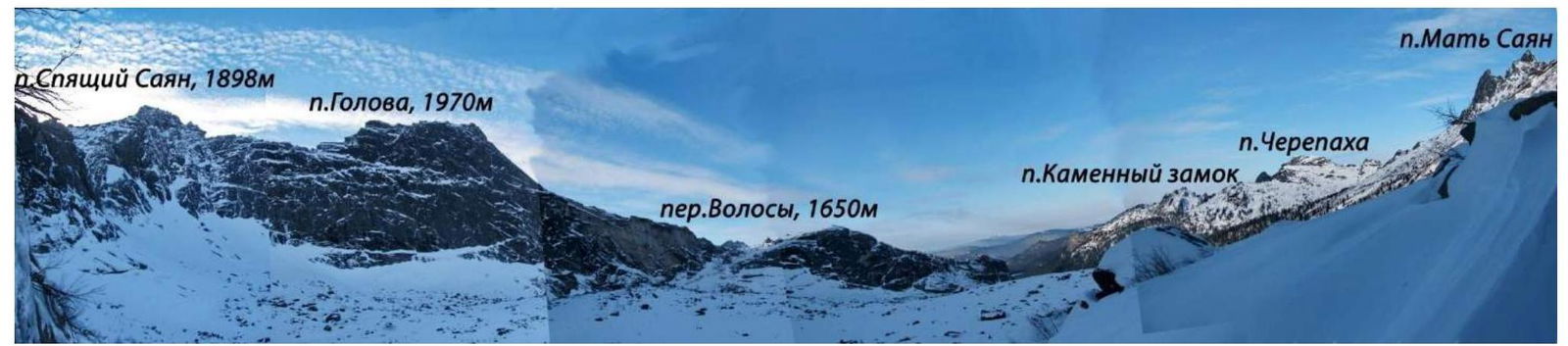
Panoramic photo of the area
Team's tactical actions
When choosing the intended route, we aimed to make it as direct as possible. After studying the eastern wall of Golova and consulting with the first ascensionists, I found that there was very little relief, so we brought a large number of bolted hooks. All visible relief on the wall consists of macro-ledges and corners with blind, drawn cracks.
We planned to connect sections of pronounced cracks and chimneys in the center of the wall, thereby achieving a straight line without pendulum movements or traverses.
Since there is only one inclined ledge in the middle of the wall, we decided to bring a platform. We also resolved to make the ascent as a two-person team, in "alpine style" if possible, without prior route preparation.
We reached the wall on snowshoes 2 days before the ascent from the Tormazakovsky bridge. Under the wall, in ABC, we dug a snow cave due to the -37 °C temperature the day before.
On December 1, 2014, we assembled the platform and pulled it with all the gear to the start of the route.
On December 2, we started at 6:45. We climbed 1.5 ropes. Due to the complexity of the relief, we had to drill many holes for skyhooks (6 mm) and hammer in bolts (8 mm).
The first climber worked on a 20–30 m section, set up a station, and then, using simultaneous movement, the second climber with the platform and backpack moved along the fixed ropes while the lead climber continued working.
Since we initially decided to descend via the ascent route, the second climber would arrive at the station and hammer in one or two bolts, depending on the relief features.
At 17:00, we began hanging the platform. By 18:00, we were sitting in it, resting and having dinner.
December 3:
- Started ascent at 6:00
- Began working at 9:00
- Reached the middle ledge at 16:00
A gusty, hurricane-force wind picked up. We had to set up the platform. It took us about 2 hours to hang it and secure it with our bodies. The entire evening and night were spent being tossed and shaken in it.
On December 4, we rose at 6:00 and started working at 8:00. We decided to leave the platform in place and storm the summit from there. However, due to the lack of relief that day:
- We hammered in many bolts
- Made many holes for skyhooks, which didn't leave enough daylight to climb the remaining 40 m to the summit. We had to rappel into the platform by 18:30 and spend the night.
On December 5, 2014, we rose at 6:00. The entire evening and night had seen heavy snowfall. By morning, a large amount of precipitation had fallen, and powder avalanches began to slide down the wall. We started jumaring the worked-out ropes at 7:30. Then we worked out the remaining distance to the top. We reached the summit at 14:30. We wrote a note, took photos, and rappelled down to the platform via the pre-made bolted stations. We dismantled the platform and descended from the wall to the start of the route by 19:00. We headed towards the cave in ABC.
The cave had collapsed, burying our belongings. We spent about 2 hours digging out the remains of our supplies and left-behind gear. Then we had dinner and, after packing up, set off towards the Tormazakovsky bridge at midnight. We reached the highway by 5:30 am.
Entire route:
- Zhigalov A. led
- Ivanov T. was second
- On the middle ledge, on one of the bolts, we left a control cairn with a note.
In some sections of the route, it is recommended to hammer in bolted hooks or bring removable bolts.
We named the route "Slesarnya" due to the colossal work with hammers and drill bits.
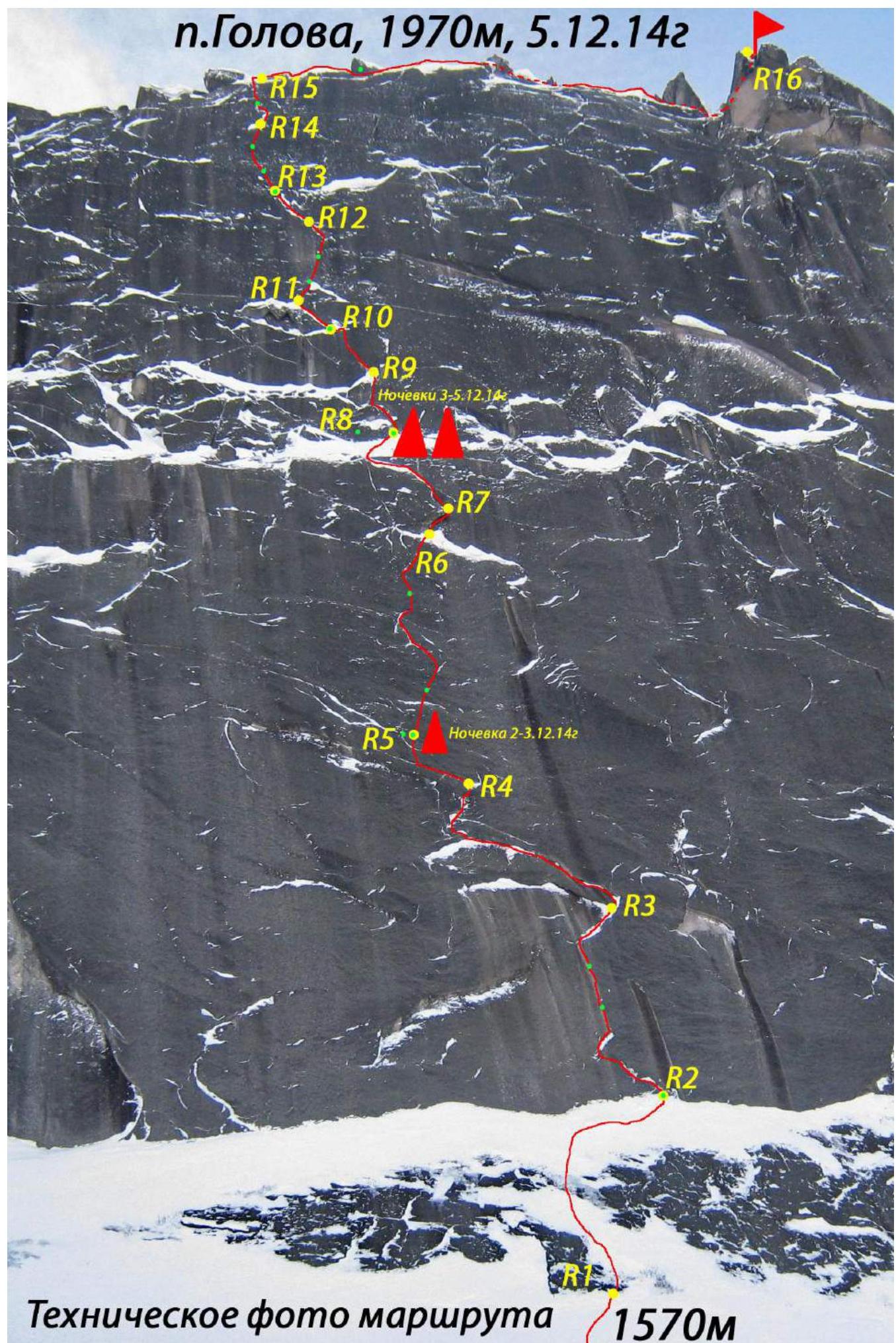
Ascent graph for p. Golova, 1970 m, direct E wall, route "Slesarnya"
Description by sections:
Section R0–R1 — Start of the route, on a snowy slope, the slope's steepness increases with altitude, and avalanches are possible.
Section R1–R2 — The wall is gentle, without relief. A series of "ram's foreheads" covered in ice. Then, via frozen grassy tufts, exit to a ledge with a steep snowpatch. Had to dig a trench. Traverse right along the ledge to the base of an inclined crack in an internal corner. There's a bolt with a sling here.
Section R2–R3 — Inclined internal corner from right to left. Then a step on a skyhook, transition to the next internal corner with a thin crack. Further up a smooth wall, left of a black streak, straight up on 6 mm skyhooks. Insurance: 2 bolts in between. The lower one has a twisted knot, a nut with a washer left (nuts and washers left on all bolts). Exit to a small ledge right of a large серп-shaped ledge.
Section R3–R4 — From the ledge straight up a crack to the upper crack, above the ledge. Then traverse left along the серп. In the left part of the серп, transition through the ledge. Step on a skyhook, then through a series of short ledges, direction right and up. Station is hanging, on own points.
Section R4–R5 — Traverse left and up along a thin, interrupted crack. Here, a station on two bolts, linked by a sling. Left of the station, there's relief to set up another station for hanging the platform.
Section R5–R6 — Straight up a smooth wall on skyhooks towards a large black chimney. Occasionally, some relief and thin, blind cracks appear. Two bolts hammered in between, the upper one has a twisted knot. Exit to a ledge under an overhanging chimney. Station on own points.
Section R6–R7 — Through the overhanging wide chimney to a ledge. The ledge is traversed on ITO.
Section R7–R8 — After the ledge, an inclined internal corner, traversed on frozen grassy tufts and snow. Exit to an inclined middle ledge. Traverse right along the ledge on snow to a crack. Here, a station on two bolts for hanging the platform. On one of the bolts, a control cairn.
Section R8–R9 — Straight up a crack, through a small ledge. The crack continues and leads to a slab. Here, a station can be set up on large and medium cam hooks.
Section R9–R10 — From the slab, direction left and up along a crack to a small ledge at the base of an internal corner. There's a bolt here. It can be linked with own points to set up a station.
Section R10–R11 — Inclined internal corner from right to left with a split, transitioning into a chimney. Exit to the top of a large leaning slab onto a snowy ledge. Station on own points.
Section R11–R12 — Internal corner with a blind crack, direction right and up. Then, on skyhooks, up a smooth, overhanging slab, slightly right, towards a серп-shaped ledge. A hazardous section; there's a sloping ledge under the wall. For insurance, two bolts are hammered in, but knots are twisted. Transition through the серп-shaped ledge, then along the internal corner left and up. Station in the corner on own points.
Section R12–R13 — The internal corner continues, becomes vertical. Station at the end of the corner on own points, and a bolt is hammered in.
Section R13–R14 — From the station, straight up a smooth slab on skyhooks. For insurance, two bolts are hammered in, knots twisted. Exit to a horizontal crack, traverse left along it into a vertical internal corner. Station in the corner, in an overhang, on own points.
Section R14–R15 — The corner continues, then abuts a smooth wall. Up the wall on skyhooks; for insurance, a bolt is hammered in. Exit to a small slab, from it to an opening horizontal crack, exit to the ridge. On the ridge, right, in a large overhanging rock, a bolt is hammered in for rappelling.
Section R15–R16 — Along the ridge, right, a straightforward exit to the summit.
Peak Golova, 1970 m, December 5, 2014

Passage of section R2–R3
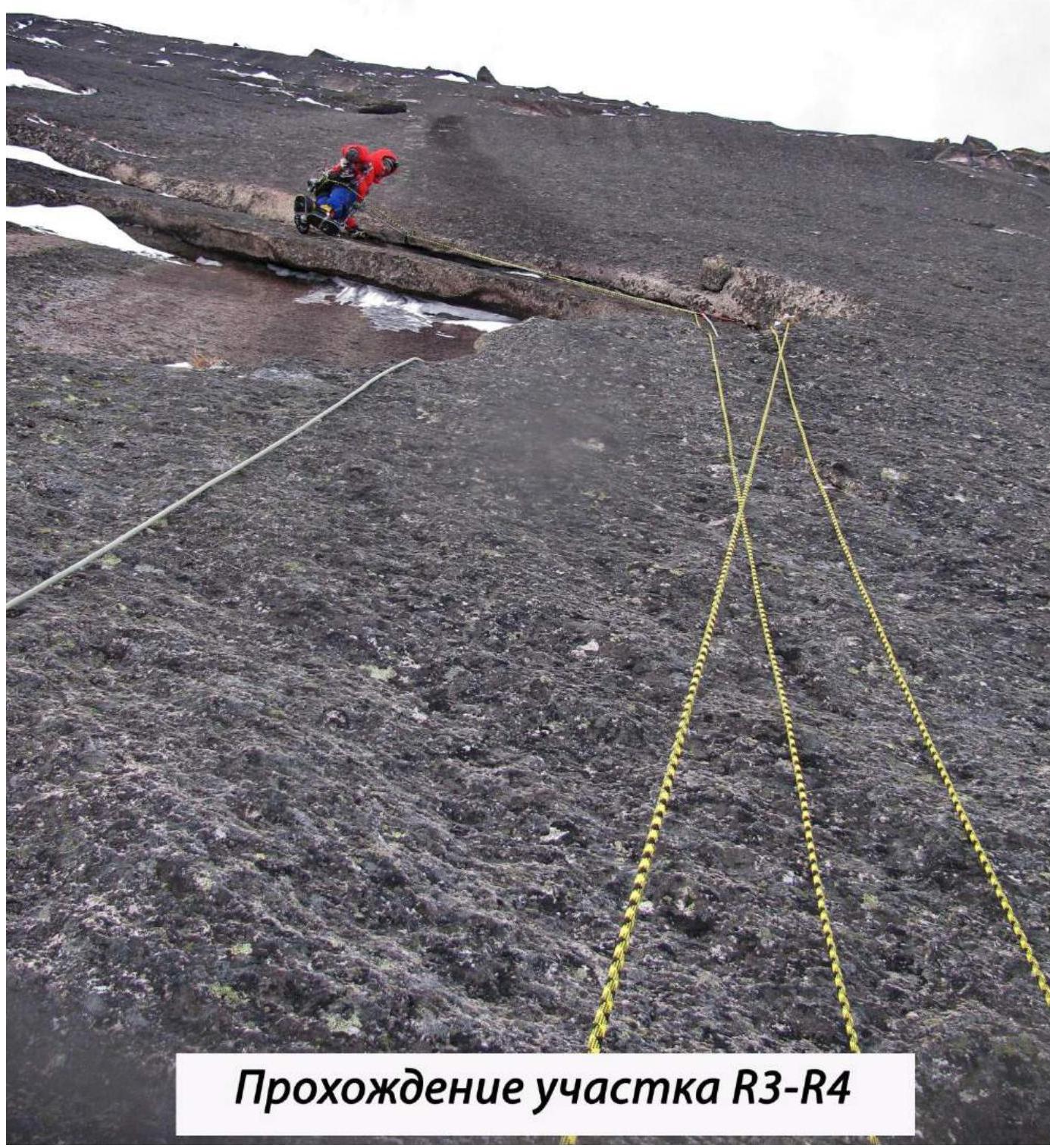
Passage of section R3–R4
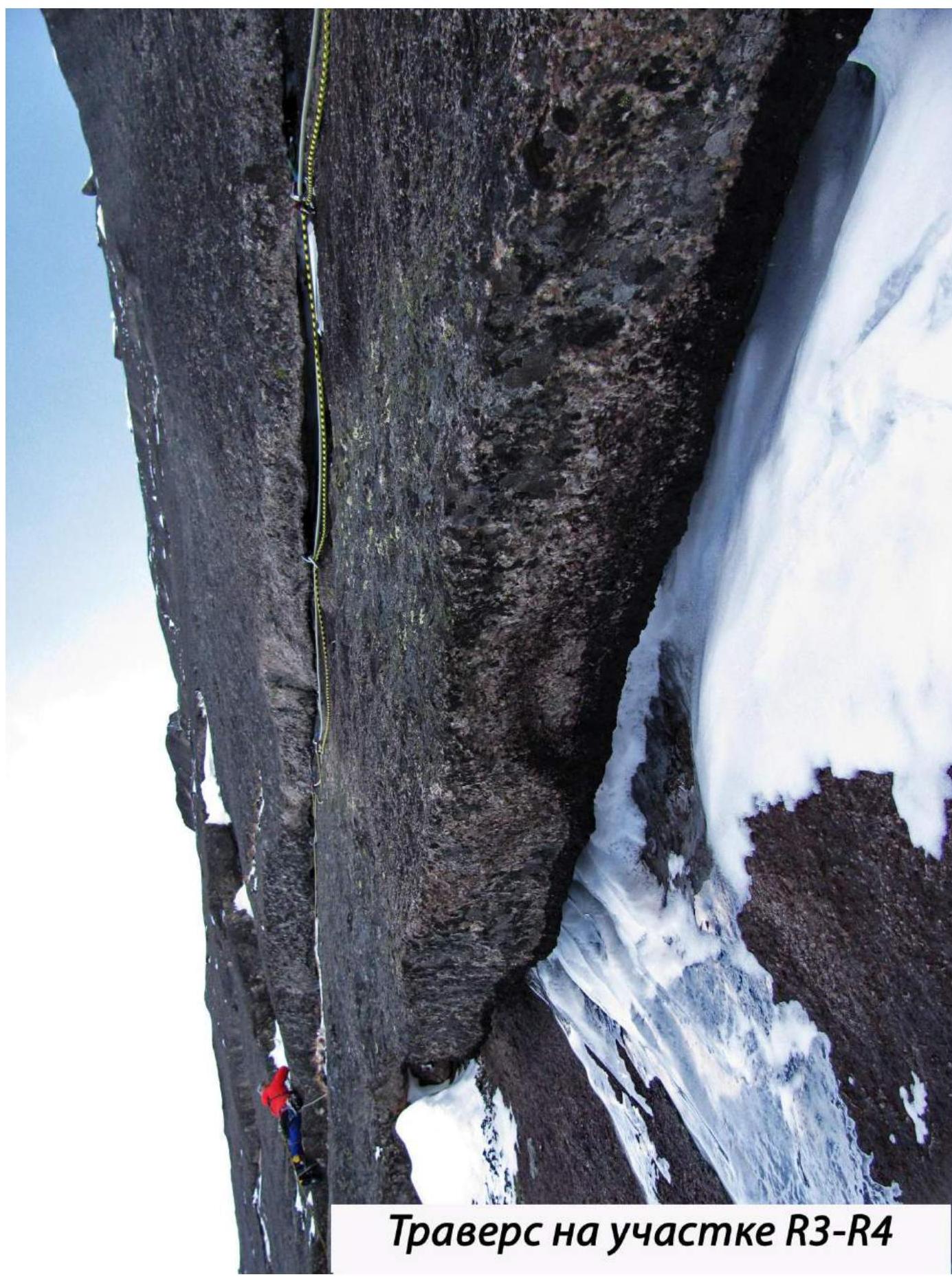
Traverse on section R3–R4
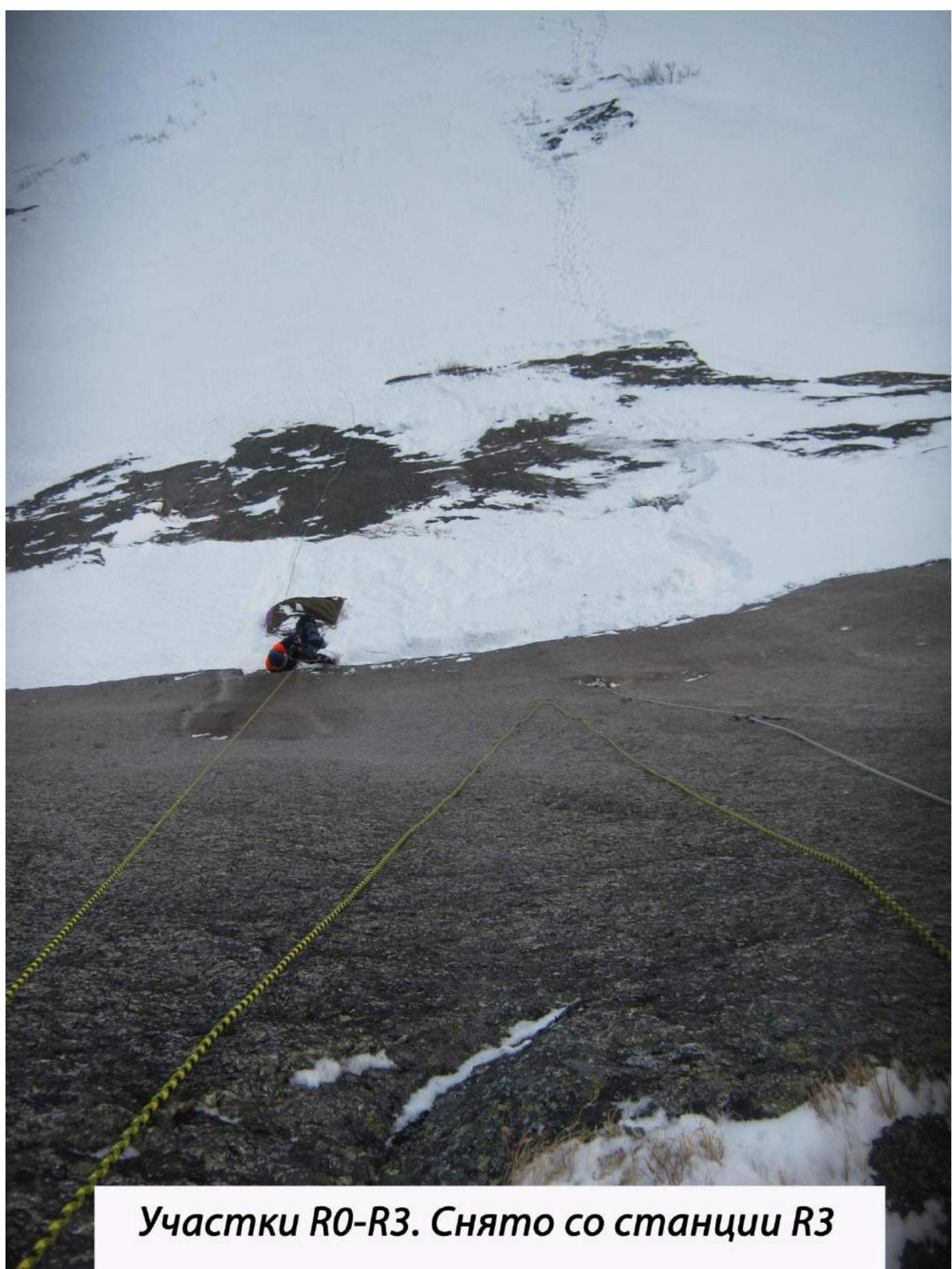
Sections R0–R3. Taken from station R3
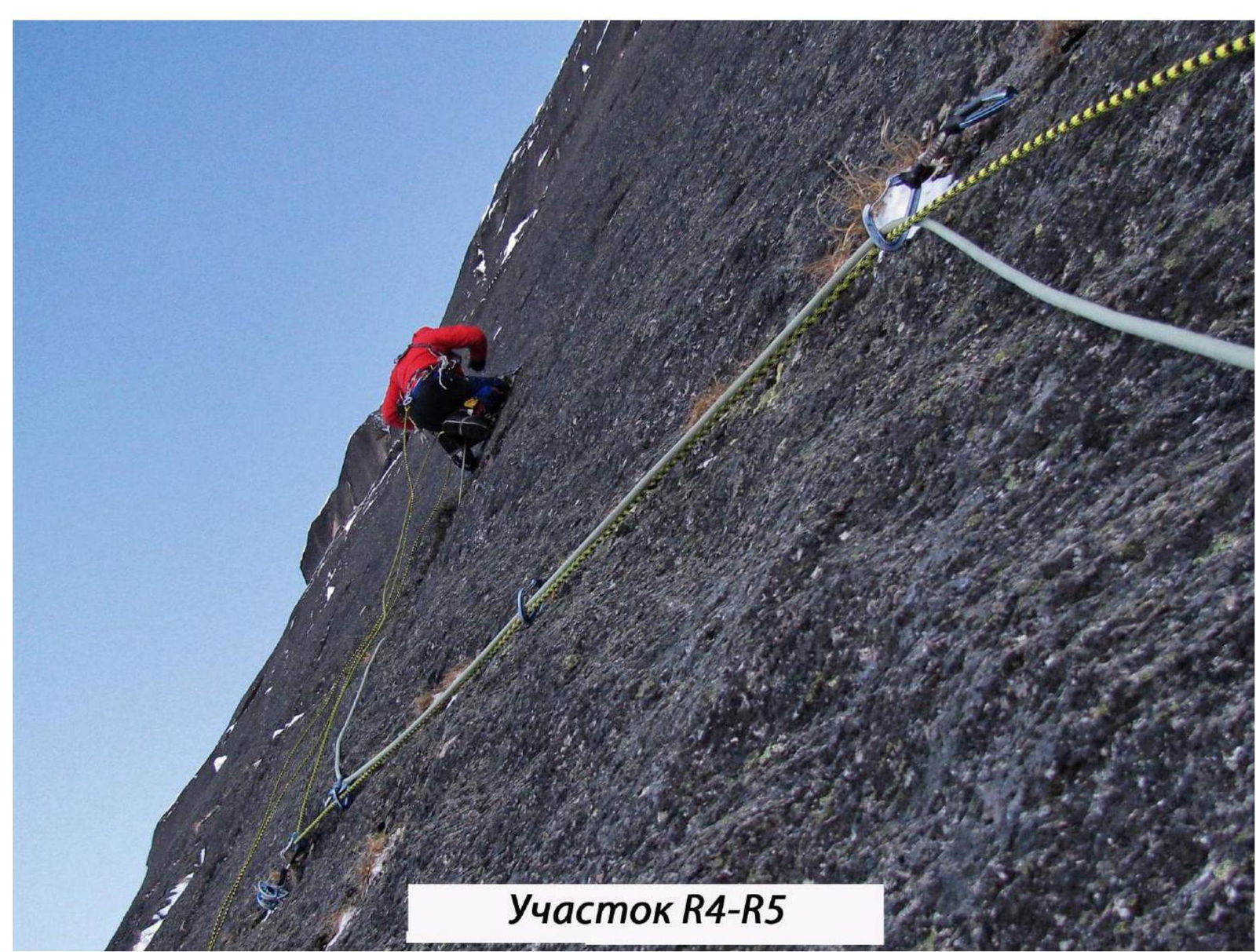
Section R4–R5
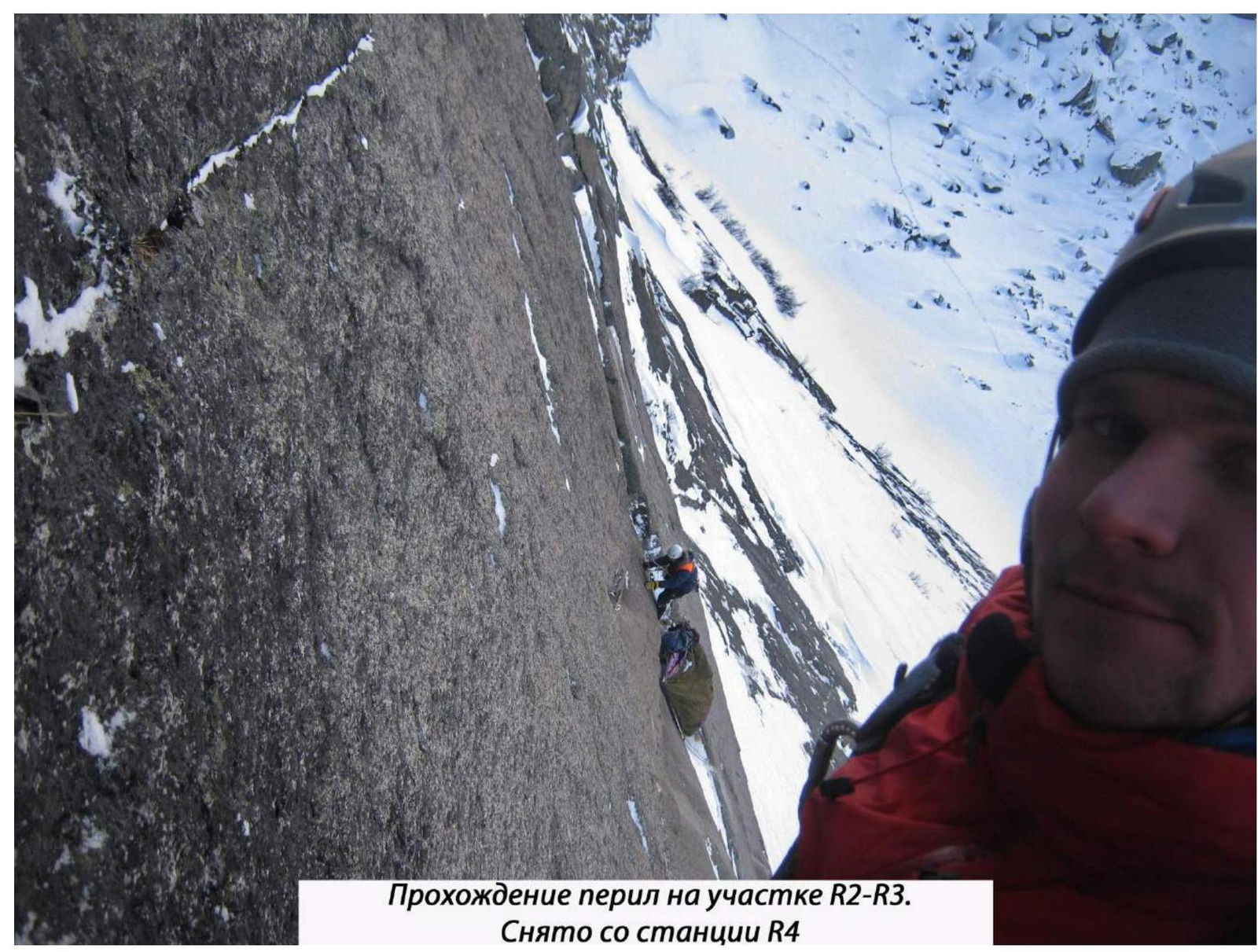
Passage of fixed ropes on section R2–R3. Taken from station R4
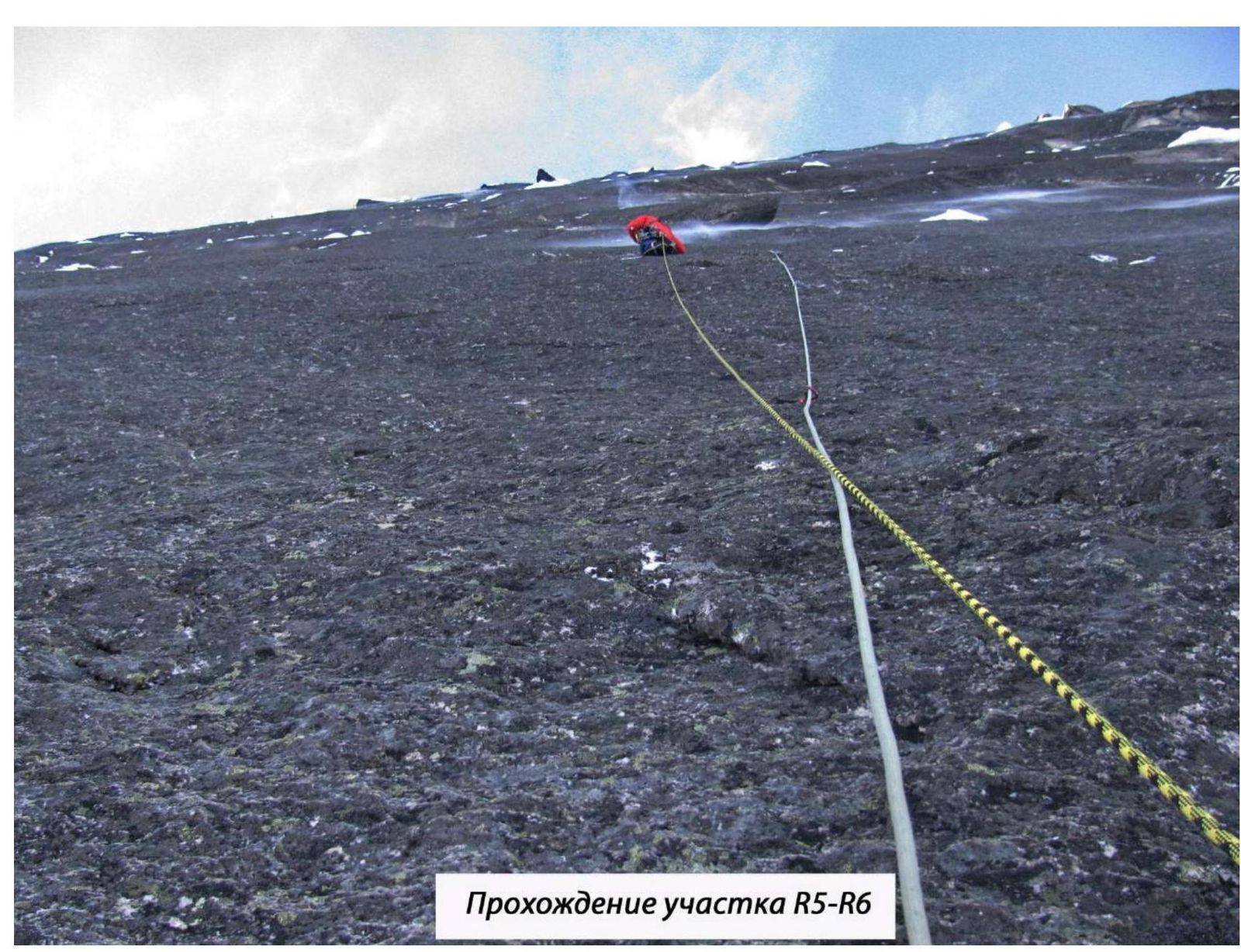
Passage of section R5–R6
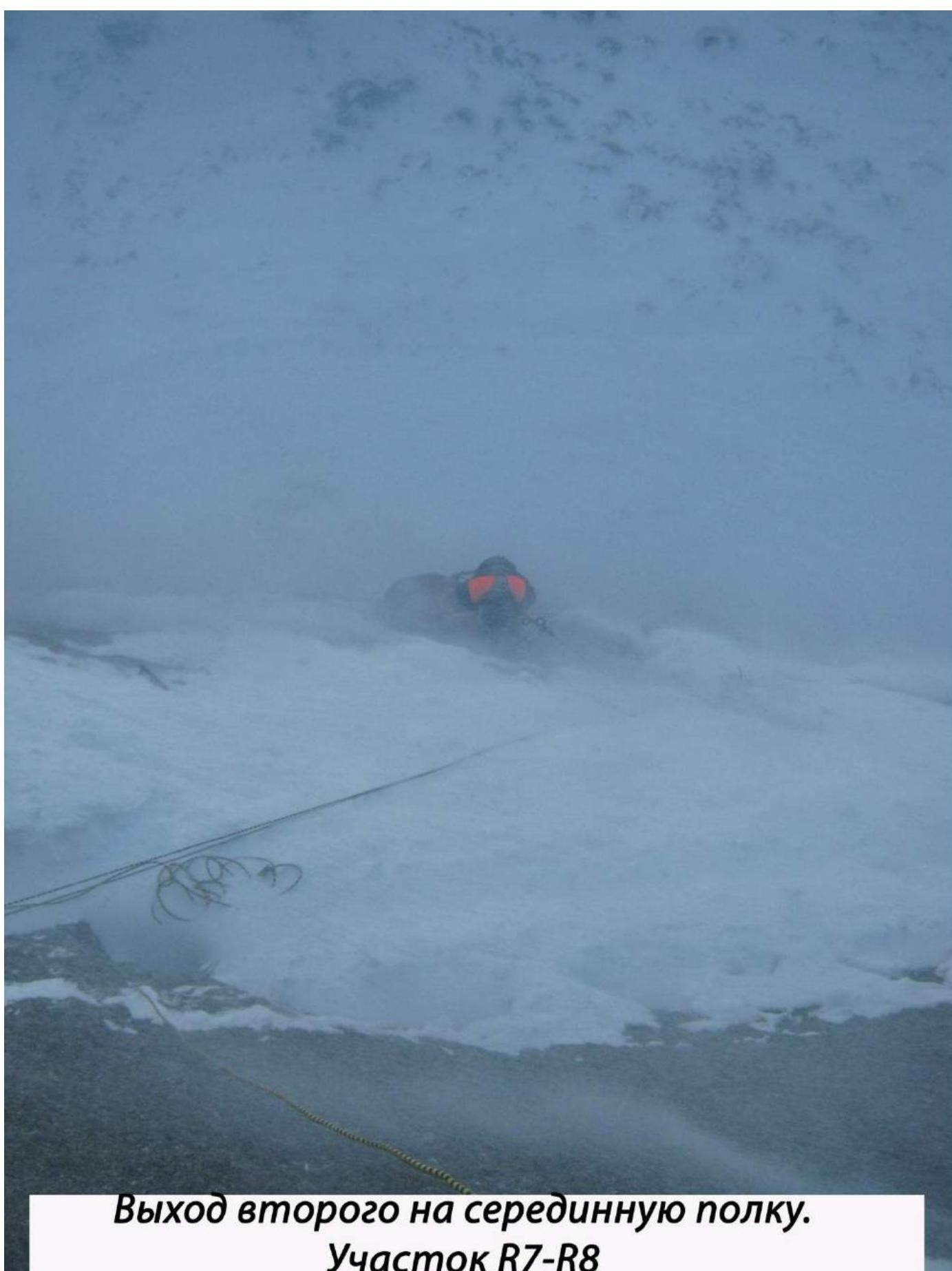
Second climber reaching the middle ledge. Section R7–R8
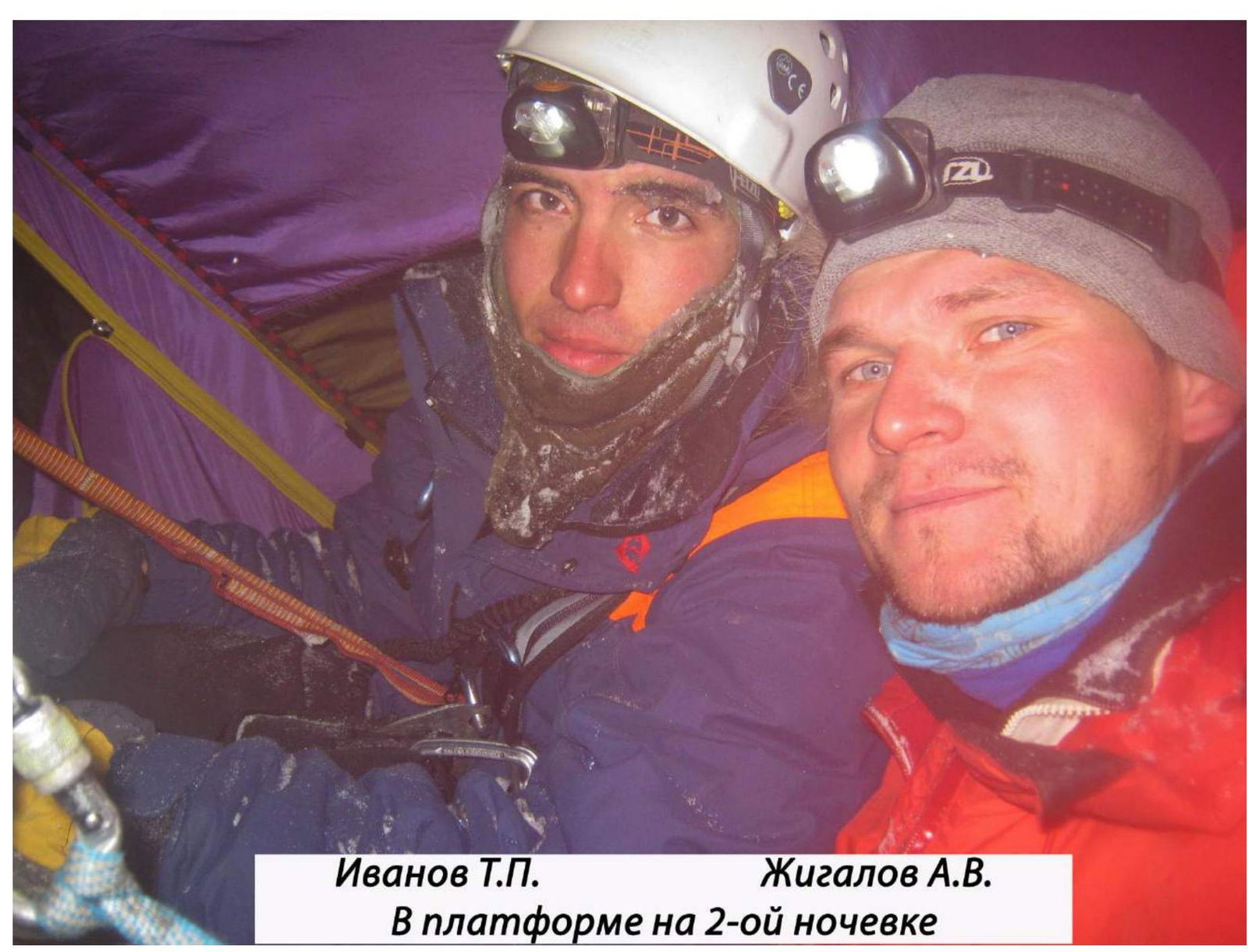
Ivanov T.P., Zhigalov A.V. In the platform on the 2nd bivouac
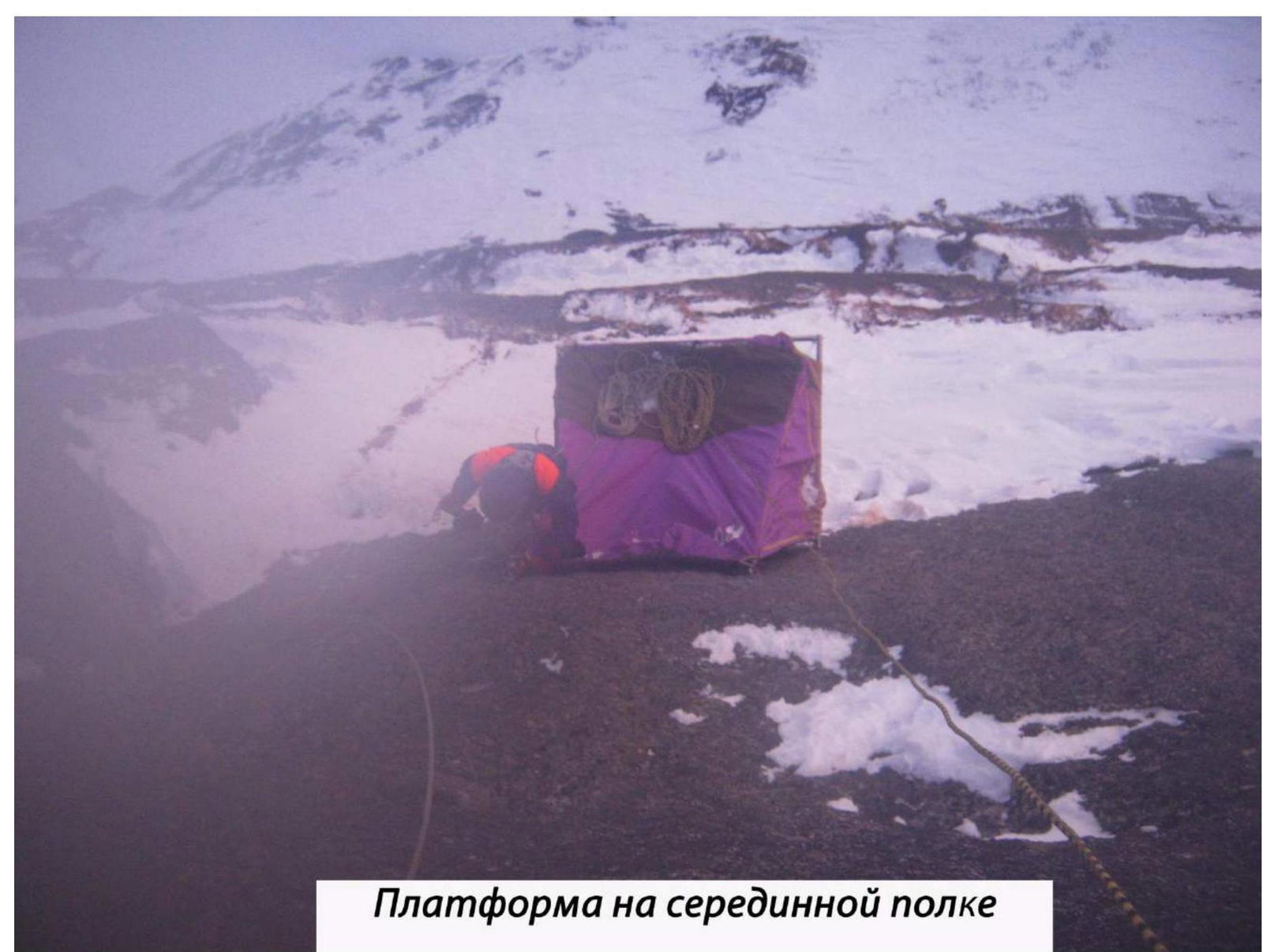
Platform on the middle ledge
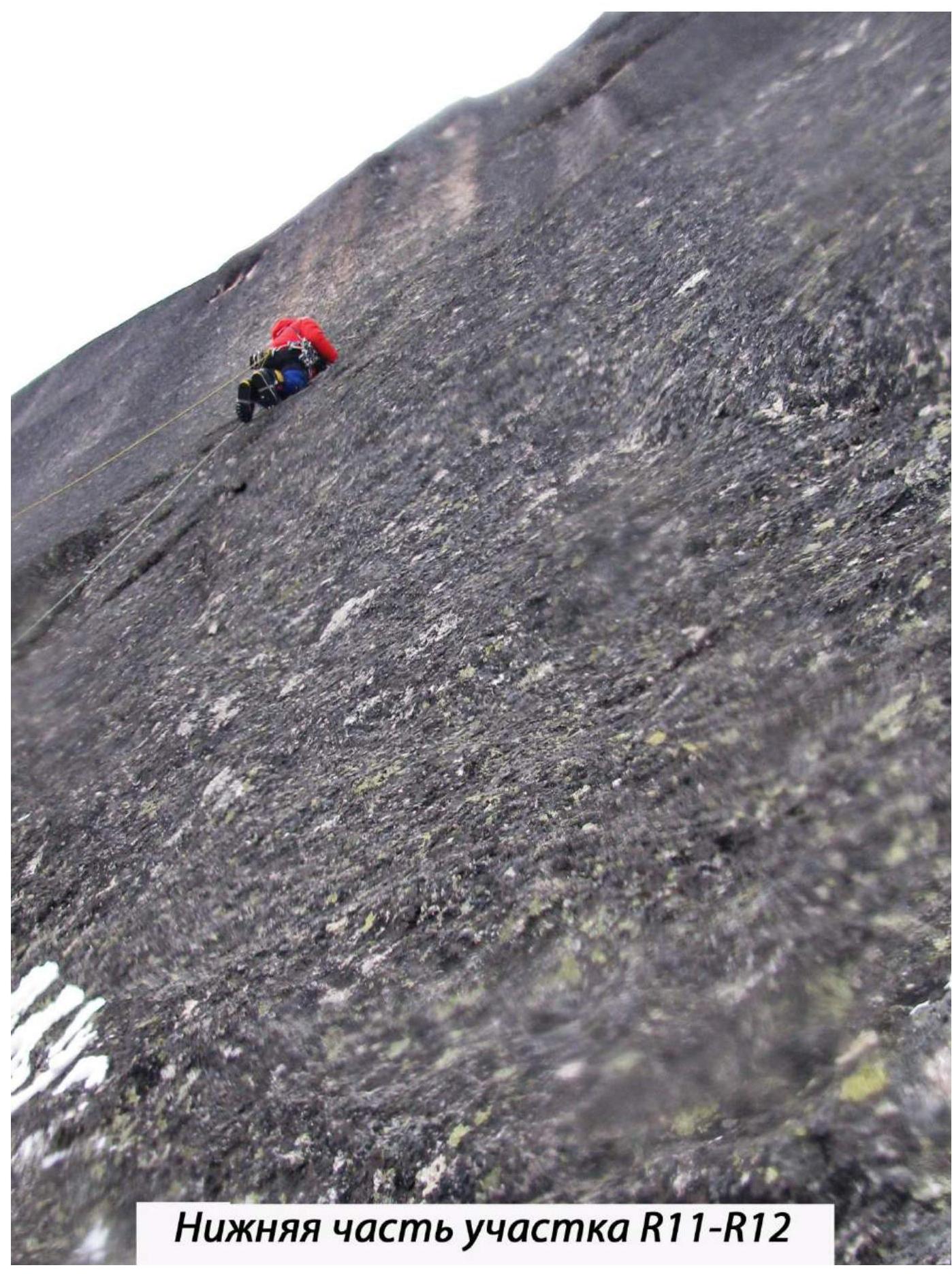
Lower part of section R11–R12
Passage of upper part of section R11–R12

Section R13–R14
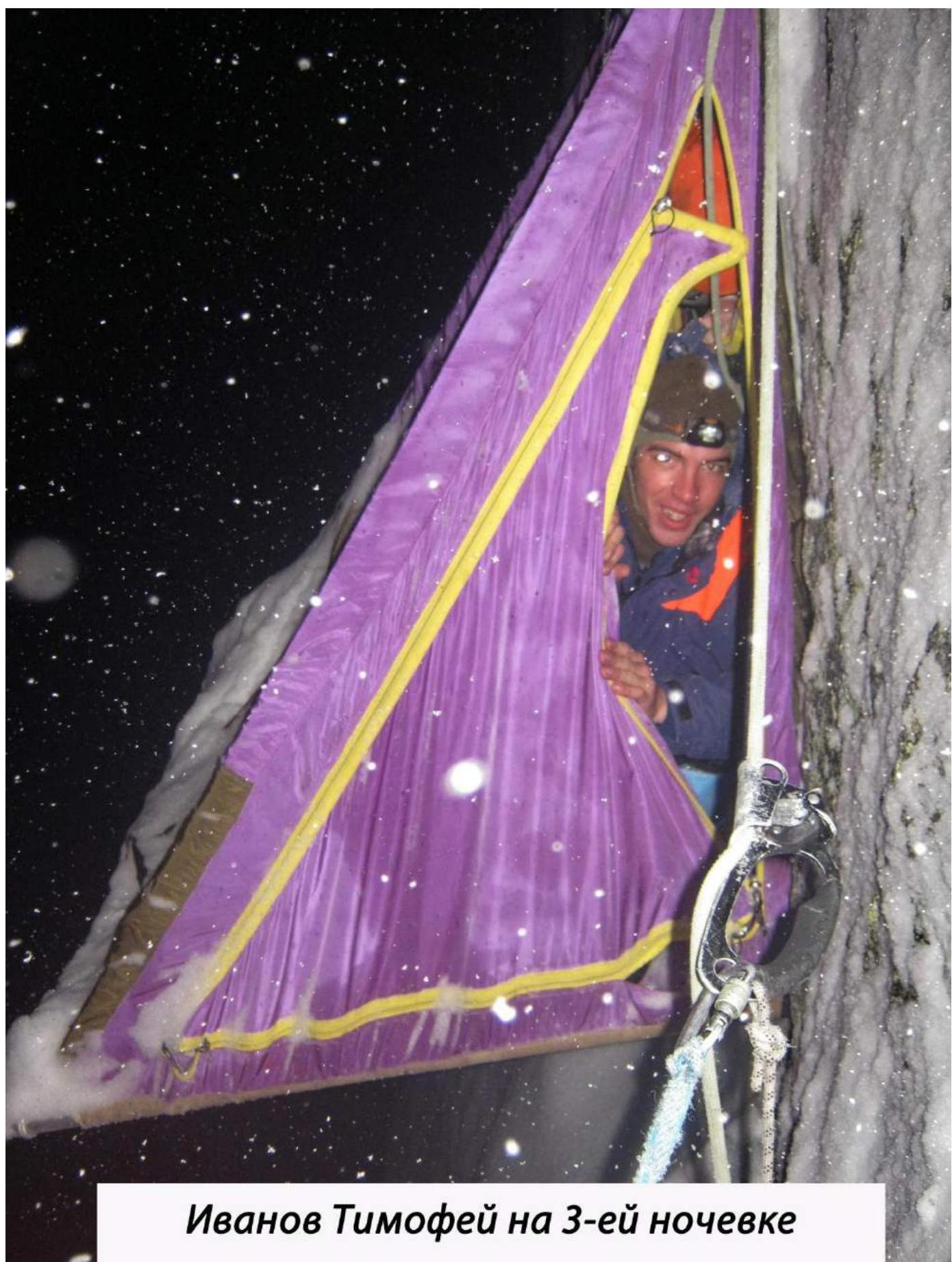
Ivanov Timofey on 3rd bivouac
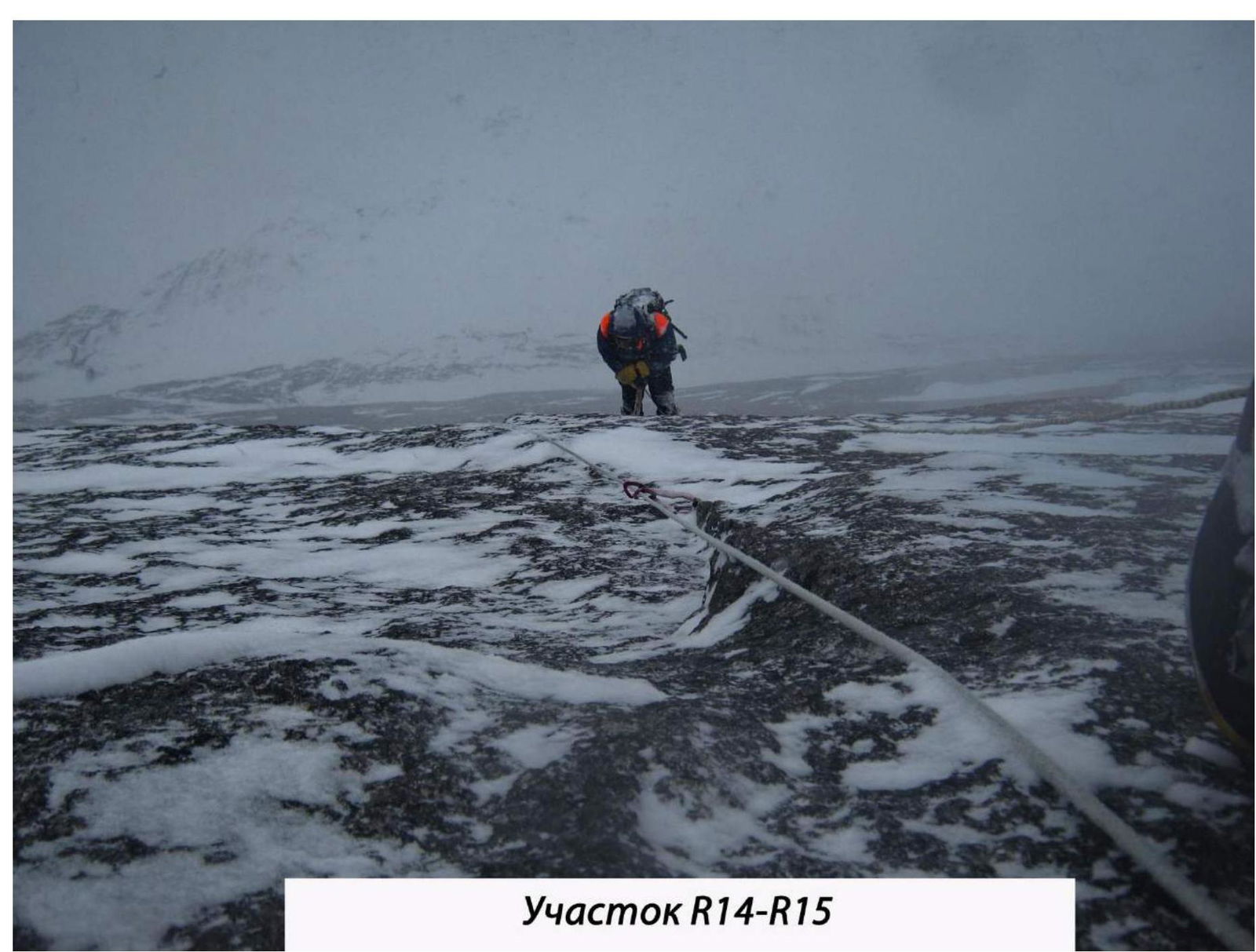
Section R14–R15
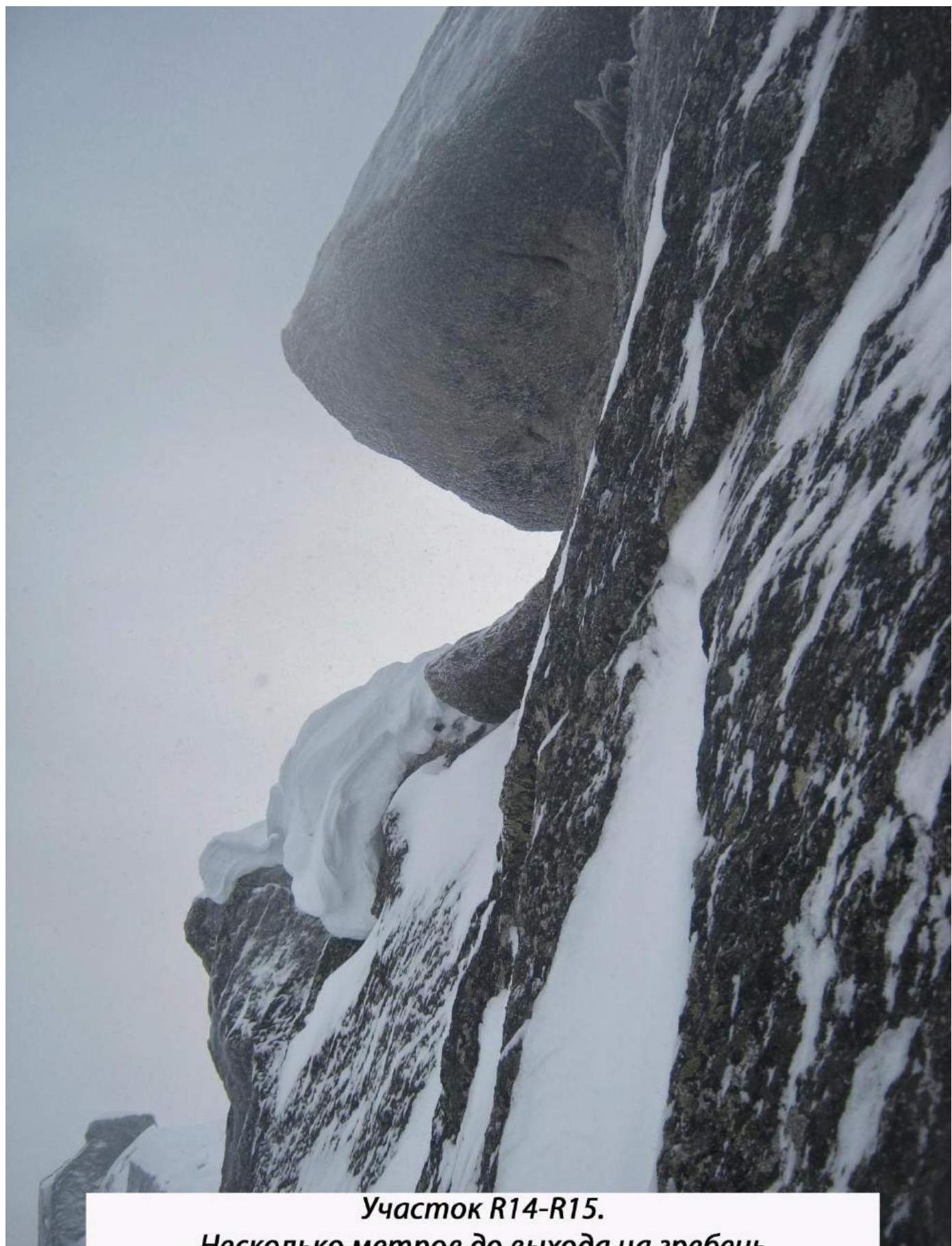
Section R14–R15. Several meters to the exit onto the ridge.
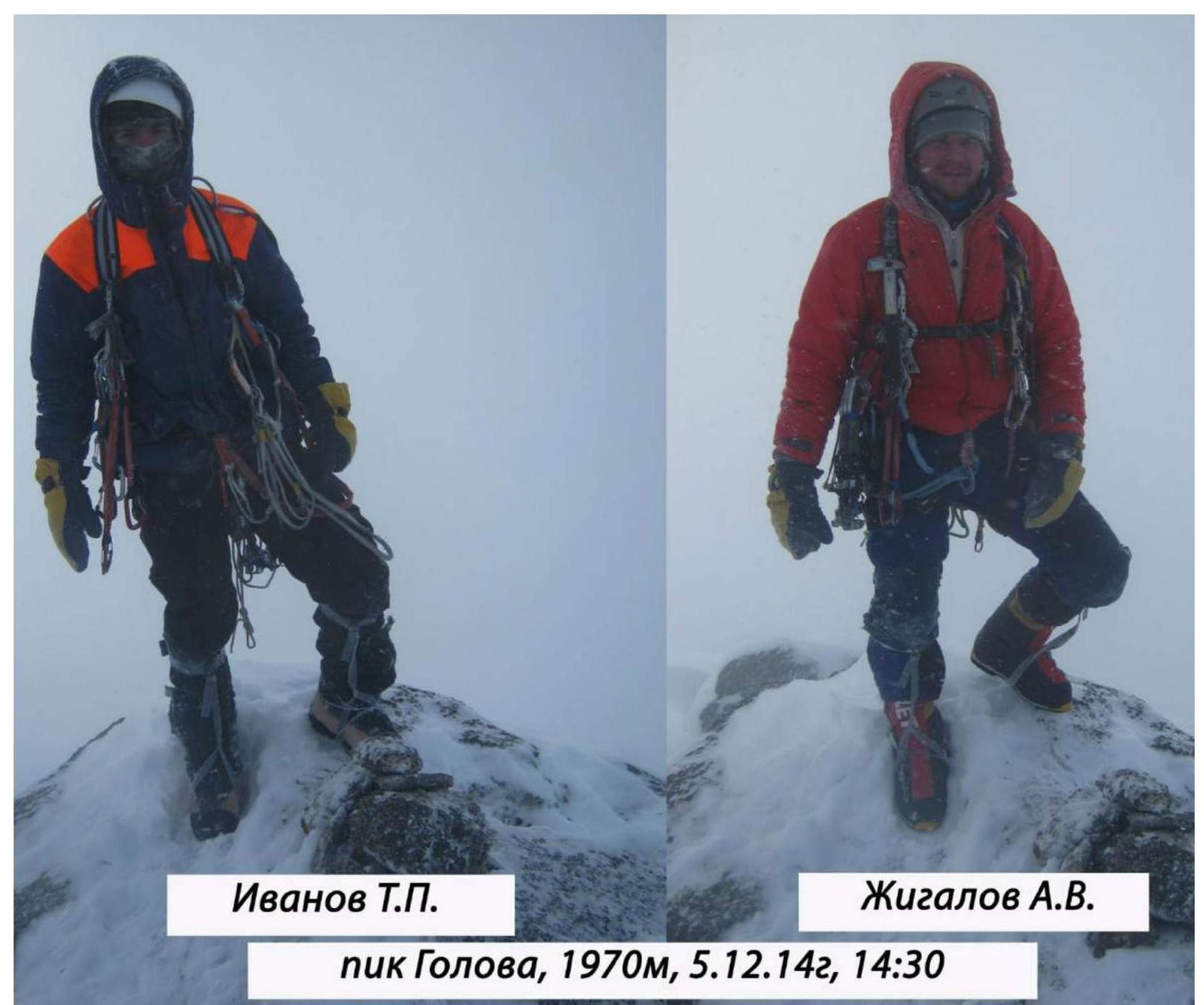
Ivanov T.P., Zhigalov A.V. Peak Golova, 1970 m, December 5, 2014, 14:30