

Passport
- Class — high-altitude technical.
- South-West Pamir, Shabo valley.
- Peak Engels via the north wall (Gaas route, 1974). 2nd ascent in 1976. 3rd ascent.
- 6B category of difficulty, 2nd ascent.
- Height difference — 1950 m. (1560 m).
Main part height difference — 1150 m (b.sh – ridge).
Length — 2305 m.
Length of 6A and 6B sections — 365 m.
Average steepness:
- route (up to Mikh, on the ridge) 60° (59)
- main part of the route: 70° (68)
- middle part of the wall: 80° (✓)
- overhanging part of the wall: 92° (red and light bastion)
- Pitons left on the route — 3 pcs.
- Team's climbing hours: 48 hours, days — 5 (6).
- Overnight stays: ice-hollowed shelves, R1–R4. 5 — on the ridge.
- Leader — Grigoriev O.E. — CMS.
Participants:
- Diyarov Boris Kamalovich — CMS,
- Bukreev Vladimir Viktorovich — CMS,
- Balmagambetov Khanif Kaldaskaevich — CMS.
- Coach — Shabanov Anatoly Vasilyevich — Master of Sports of the USSR, Honored Coach of the UzSSR.
- Departure to the route — August 13, 1991, summit — August 18, 1991, return — August 18, 1991.
- Organization: State Sports Committee of the UzSSR, team of RSCAiS UzSSR.
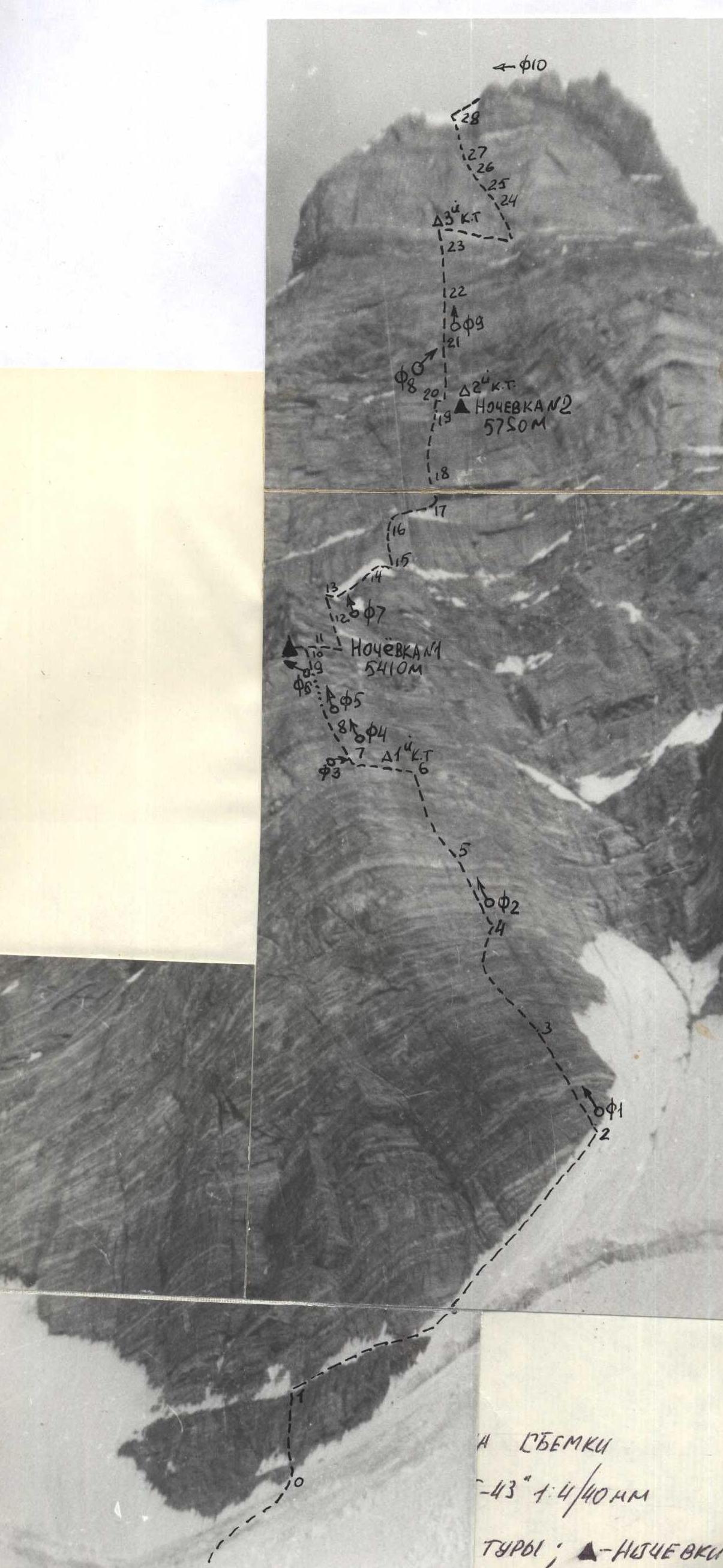
- Gaas route 1974 — 6B category of difficulty.
- Route climbed by the RSCAiS team, led by Grigoriev O.E.
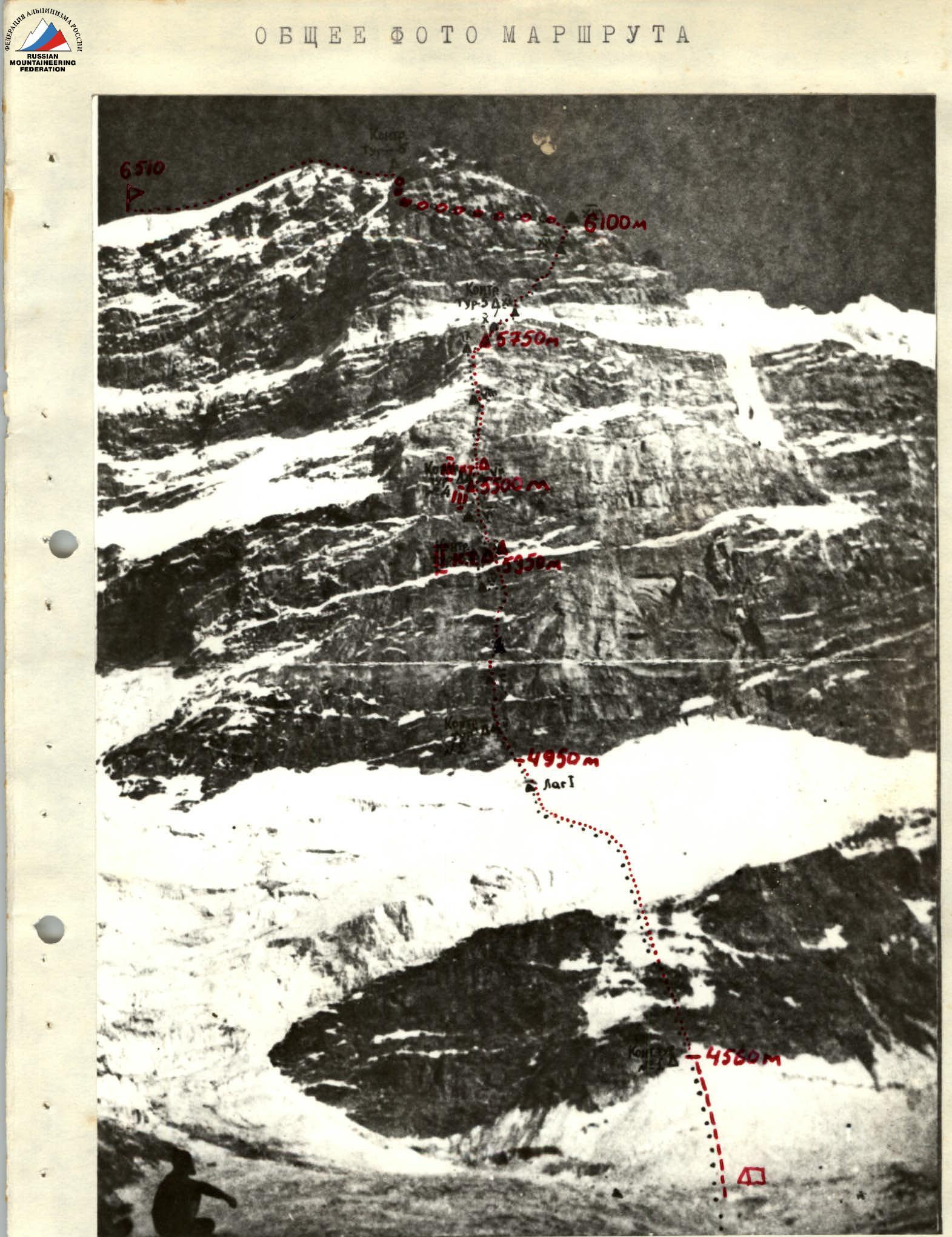
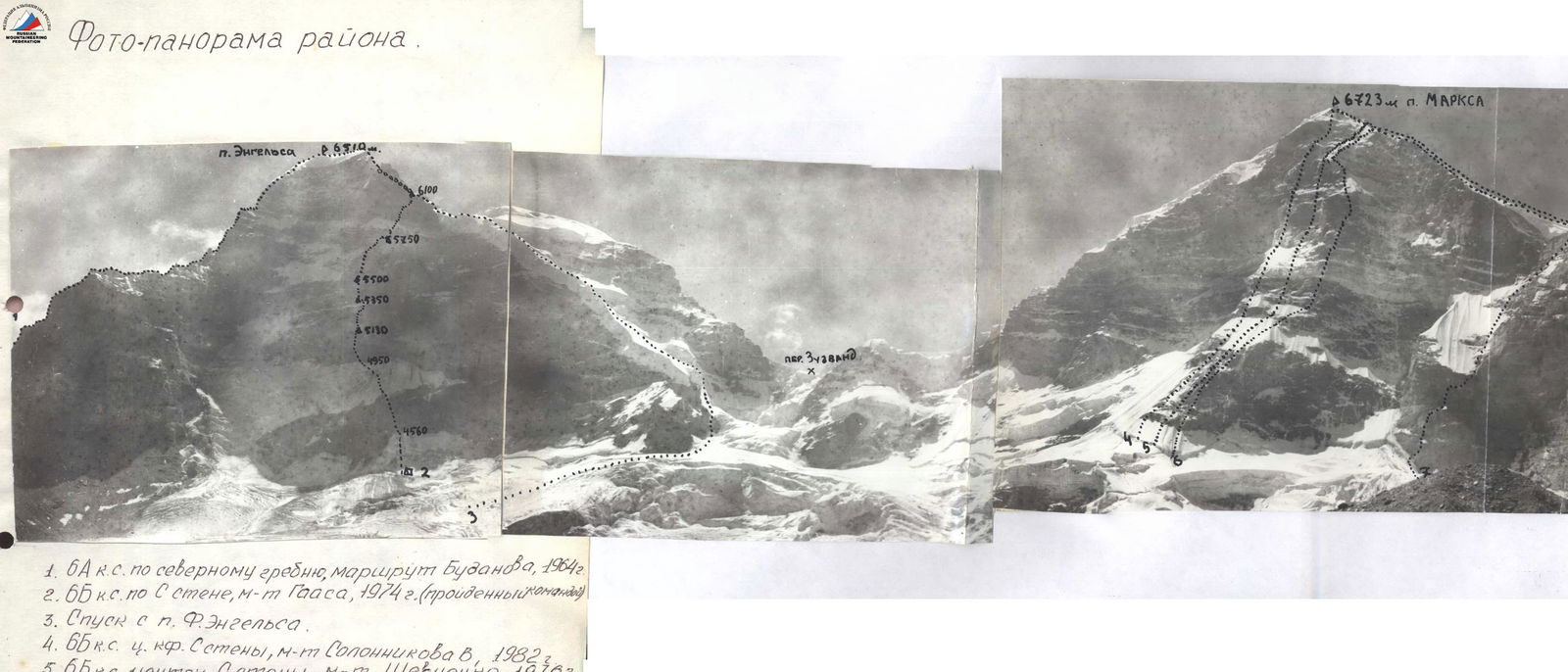
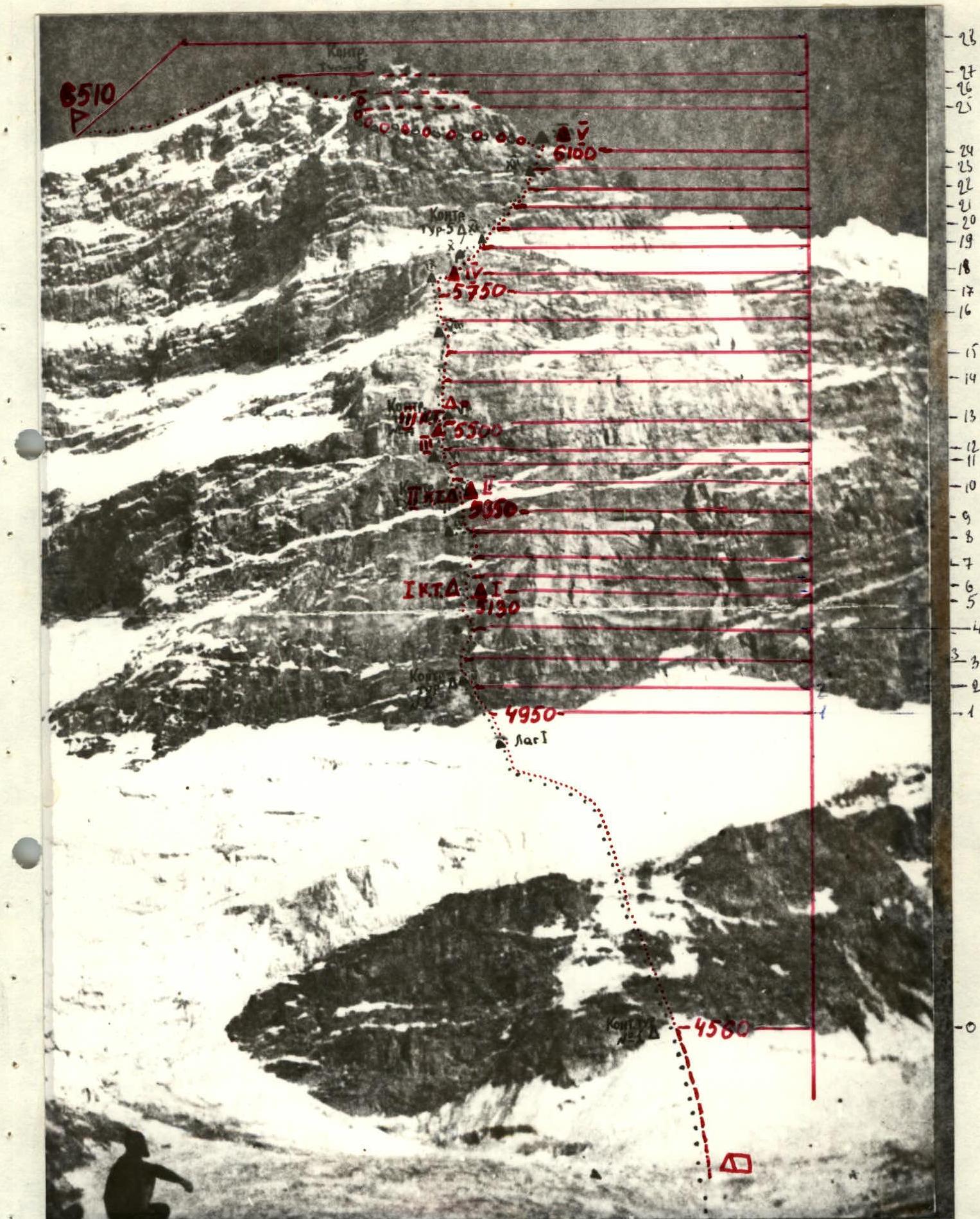
The team's tactical actions were carried out in accordance with the tactical plan. On August 13, 1991, the team started the route as planned.
August 13, 1991:
- After checking the equipment and supplies, we depart for the route at 8:30 from the observers' camp on the glacier.
The weather has improved somewhat after the cyclone that passed through the area. At 9:30, we begin moving along the route, which starts from the bergschrund. The R0–R1 section is a rock belt covered in ice, transitioning into an ice slope. We move in pairs, with alternating belays. After traversing 450 meters of the ice slope, we approach a randkluft. We find a snow bridge and cross under the wall. We start climbing the rocks to the right of the "yellow spot". The Grigoriev–Diyarov team leads. The first 50 meters are very challenging climbing on a wet wall, using a double rope 55 meters long. The R1 section has good medium-sized friends. The section ends with an internal corner. After ascending it, we exit onto the wall (R2 section), with an inconvenient belay station. The first ropes of the route give an idea of its complexity and the challenging passage.
The R3–R4 section consists of smooth rocks, making climbing unpleasant due to water pouring from above. All day, the lead team works on a double rope, while the others ascend using jumar clamps with top-rope belay. Upon reaching the ledge, we start looking for a suitable overnight spot. After moving 20 meters to the right, we find a safe spot under a cornice. The first team sets up the bivouac, while the second team extracts the pitons and retrieves the ropes. Once together, we secure the bivouac. After a hearty, high-calorie dinner, we settle in for the night in the tent. The night passes normally.
August 14, 1991. After breakfast, at 9:00, we depart from the bivouac. The Grigoriev–Diyarov team leads, while the second team dismantles the bivouac.
- The R5 section is first climbed by Diyarov, using a double rope.
- On the R6 section, Grigoriev takes over from Diyarov, passing a small wall and a cornice to reach the ice-covered rocks (R7 section).
- The section is traversed on crampons with ice axes, with belays via ice screws. The belay station is inconvenient, on a sloping, ice-covered ledge, using blocked rock pitons.
- On the R8 section, the first climber passes a small wall to reach a ruined internal corner, with belays via various rock pitons.
- After the corner, we exit to an ice belt, traversed on crampons with ice axes and an ice hammer (R9 section).
After traversing 10 meters left along the ledge, we find a suitable spot for the night. We hollow out a platform for half the tent on an icy, sloping ledge. After 3 hours of hard work, we set up the tent, securing it firmly on pitons and rigging handrails through it, and settle in for "rest." Over dinner, we discuss the day's work. After a hearty, hot dinner, we fall asleep.
August 15, 1991. We depart at 9:50, with the Grigoriev–Diyarov team leading. Immediately, we face challenging climbing in crevices and ice. It's very cold in the morning, and our hands numb.
- After 40 meters of 6B category climbing (R10 section), it becomes warmer.
- Here, we begin working on the "red" belt. This section is, according to the tactical plan, the steepest and most challenging; as we get closer, we confirm this.
- All belay stations are organized with enhanced safety measures.
- We are shielded from falling rocks, which frequently "fly" from the upper part of the belt.
- All movement is conducted strictly on a double rope.
- The first climber's belay is through a Sticht plate. The first climber uses a shock absorber.
- This is applied throughout the wall section.
On the bastion of the "red" and subsequent "light" belt, we begin searching for a suitable overnight spot: traversing left and descending 8 meters, we find a safe spot protected by an overhanging wall. Here, we put in a lot of work to make it habitable — partly by hollowing out ice and partly by building up with stones. After securing it and ourselves, we have a satisfying dinner and fall asleep while sitting.
August 16, 1991. We depart at 8:30 and immediately face the most challenging section of the route.
- Initially, we encounter a 12-meter wall of disintegrated rock, with a steepness of up to 100°, traversed using ladders — a very tense period, with no moment to relax.
- The wall transitions into an internal corner. We move along the right part of the corner.
- The corner ends with a distinctive cornice. It appears to be embedded in the internal corner, forming a solid, steep "roof."
- Two pitons and two friends are required to pass it.
- On the left part of the cornice, a thin crack is visible, leading to the left wall of the corner.
- From there, with the rope securely fixed, we swing right into a wide crack, establishing a station from securely fixed belay points.
- The lead climber changes.
Ahead, the route appears easier after the challenging section. The leading crack leads to snowy rocks, and we work in crampons. As soon as we see the upper tower, everyone's mood lifts — we haven't seen it for almost three days.
- After passing the R16–R17 section, we reach a rock "fence."
- We struggle to find an upward exit — everywhere, the walls are smooth, polished, and overhanging.
- After traversing 40 meters to the right, we spot a barely noticeable internal corner.
- It leads us to a large ice slope.
After processing this section, we descend to a ledge, where we had previously planned a safe overnight spot. Again, we hollow out ice to set up the bivouac. The overnight stay is completely safe from rockfall. After securing ourselves thoroughly, we settle in for the night. The night turns out to be very harsh and cold.
August 17, 1991. The Bukreev–Balmagambetov team begins the ascent.
- After ascending via the fixed ropes, we reach the ice slope and traverse 120 meters of ice under the upper tower with alternating belays.
- As we approach it, we are struck by its steepness at an altitude of over 6000 meters — it's a heap of crumbling rocks.
- Working on challenging 6th category sections at such an altitude is quite demanding.
- Often, we have to leave our backpacks behind, ascend, and then retrieve them.
- The R22–R24 section is a challenging wall section — sandstone.
- During the ascent, we pay great attention to safety, striving to be extremely vigilant about falling rocks from above.
- On this section, we use friends, pitons of all sizes.
Upon reaching the ridge, we congratulate each other with great joy on leaving the wall section behind. Now, we can stand upright, breathe freely, remove our harnesses, and, most importantly, sleep at full height. The overnight stay is good.
August 18, 1991. At 6:00, we begin the summit push. Everyone's mood is elevated — we should reach the summit today. Ahead lie 600 meters of ice. We move with alternating belays. The Balmagambetov–Bukreev team leads. It's very cold in the morning.
- 2 hours are spent traversing the R25 section.
- We approach the pre-summit tower — the rocks are not challenging, but the difficulty lies in the verglas.
- Within an hour, we reach the long-awaited summit dome of Peak Engels.
At 9:20, we all stand on the summit, congratulating each other. We return to base camp on August 18, 1991, at 20:00, as planned.
The organization of the teams' movement, their interaction, and lead changes were conducted in full accordance with the tactical plan. To ensure the safety of the lead climber and other participants, we used double ropes, with the application of protection gear, rock and ice pitons. The lead climber's belay at the station was through a washer. The team's movement regime throughout the day was continuous, with individual high-quality food packets used for sustenance.
When passing problematic sections of the route, we had to:
- refine the planned options along the way,
- use the time reserve allocated for these sections.
The route was climbed with a sufficient margin of safety. The organization of overnight stays began with at least two hours of daylight remaining, allowing for quality rest and preparation for the next day's movement.
All sections of the route were traversed reliably, with necessary safety measures in place for all team members. A rescue team of five, including a doctor, was positioned under the route, with the observers' radio station constantly on standby. Radio communication with the team was conducted according to schedule.
Route description by sections
R1 section — a series of walls with challenging climbing, featuring an internal corner in the middle, ending with a wall.
R2–R4 section — characterized as a single slab, traversed by climbing, with good friend placements, stoppers.
R4 section — traverse along an ice ledge to the first overnight stay. First category of difficulty. The overnight stay is inconvenient, hollowed out in ice.
R5 section — internal corner, wall with challenging climbing.
R6–R9 section — a key area, with verglas (utilizing modern ice climbing gear) in a large crevasse, forming a series of cornices resembling an internal corner. For these sections, combined belays on rocks and ice are necessary.
R10 section — ice slope, moving strictly upwards to the rocks and traversing left for 10 m. Overnight stay — required 3 hours to hollow out in ice. Second category of difficulty. Then begins an internal corner with challenging climbing, rocks of fragile rock alternating with verglas.
R11 section — continuation of the internal corner with extremely challenging climbing. Large friends were used. Ahead lies a challenging traverse leading to the foot of the light spot.
R12–R13 section — a steep wall representing a layering of "live" stones. Climbing is extremely challenging, utilizing all means for route passage. The rock structure is sandy. Rocks are very loose, pitons don't hold well, and even less so, protection gear. There's a problem with organizing belay stations. After this "ordeal" — a 20-meter traverse to the left and an 8-meter descent to organize a safe overnight stay. The overnight stay has to be constructed from stones and hollowed out in ice.
R13–R15 section — after the overnight stay, Diyarov–Grigoriev proceed to process the route. A steep, destroyed wall with few cracks leads to an internal corner and under a cornice. The corner and cornice are traversed pendulum-style from left to right. Various gear is used (pitons, friends).
R15–R16 section — Grigoriev O.E. leads. Rocks are destroyed, protection gear passes well.
R16–R18 section — traversed by Grigoriev–Diyarov and Bukreev–Balmagambetov teams with alternating belays. Rocks are destroyed, in snow.
R18–R19 section — the Bukreev–Balmagambetov team leads. A destroyed wall leads to a sloping ledge. It's decided to prepare a platform for the overnight stay. We hollow out ice, clearing the area. Diyarov–Grigoriev proceed to process the route. Diyarov leads. They fix a rope on the R19–R20 section and descend to the prepared platform for the overnight stay.
R19–R20 section — represents a series of vertical walls and internal corners, leading to a snow-ice belt. Various protection gear is used.
R20–R21 section — snow-ice belt with a steepness of 50°, traversed in crampons, with belays via ice screws. Movement is in teams with alternating belays.
R22 section — after a 40-meter traverse, a large internal corner. A steep, heavily destroyed slab. It's problematic to find belay stations; cracks are "dull," and protection gear placement is challenging.
R23 section — after the internal corner, a 40-meter traverse follows to a large internal corner. Moving upwards, it's beneficial to use medium-sized stoppers. Climbing is mostly in a "stemming" position. Then, a cornice is traversed along a field crevasse on pitons, exiting onto a small ledge.
R24 section — continuing to move up the internal corner, two cornices are encountered; the rock is destroyed, and all types of gear are used. The upper part of the internal corner leads to the ridge, exiting the wall section of the route. The overnight stay is normal on the ridge scree.
R25 section — a snow-ice slope is traversed with alternating belays in teams.
R26–R28 section — the pre-summit bastion. Rocks are covered in ice. During the ascent, the following were used:
- ice screws
- pitons
The bastion is traversed slightly to the right of the slab.
The entire route constantly requires adherence to safety measures. These include the correct choice of overnight stay locations, thorough organization of belay stations to avoid rockfall and avalanches. The route was treated with the utmost seriousness possible. A large part of the route is covered in verglas, creating additional difficulties.
It's advisable to begin the descent early in the morning towards the Zugvand pass and the upper reaches of the Shabo glacier. Through a series of open crevasses and seracs, frequently rappelling, one must be extremely cautious. There are often closed crevasses, and there's a risk of avalanches and rockfall.
The descent takes 7 hours.
Comments
Sign in to leave a comment