

Ascent Log
I. High-Altitude Technical Class
-
South-Western Pamir, Shakhdara Range.
-
Peak Tajik State University 6183 m via the east-south-eastern wall through the southern subpeak.
-
First ascent of the sixth category of difficulty (approximate).
-
Route characteristics:
- Height difference 1000–1100 m;
- Length of sections with 6 cat. diff. — 1085 m, 5 cat. diff. — 225 m;
- Average steepness 83° (steepness of sections with 5–6 cat. diff. — 86°).
-
Pitons hammered:
- Rock pitons 347, of which 147 for creating ITO;
- Bolt pitons 16, of which 14 for creating ITO;
- Chocks 24, of which 16 for creating ITO.
-
Total climbing hours — 97 h 25 min (9.5 climbing days, including 1.5 days of processing).
-
Number of bivouacs — seven,
- including: semi-reclining — 3 (in one place), sitting — 4 (two in one place) (1.5 days of processing and 8 days of ascent).
-
Team leader Solonnikov Viktor Aleksandrovich — Master of Sports of International Class (MSMK)
Team members:
- Antonikovsky Dmitry Igorevich — Master of Sports (MS)
- Vedernikov Vladislav Vasilievich — MS
- Stepanov Nikolai Vasilievich — MS
- Solonnikov Vladimir Aleksandrovich — MS
- Orlov Boris Konstantinovich — Candidate for Master of Sports (CMS)
- Povilainen Vilho Danilovich — CMS
- Nazarov Oleg Vasilievich — CMS
-
Team coach Solonnikov Viktor Aleksandrovich.
-
Departure from the base camp on July 20, 1979.
Return to the base camp on August 1, 1979 (processing July 21–22, ascent July 23–30, July 31 – August 1 — return).
Team of the Leningrad City Committee for Physical Education and Sports
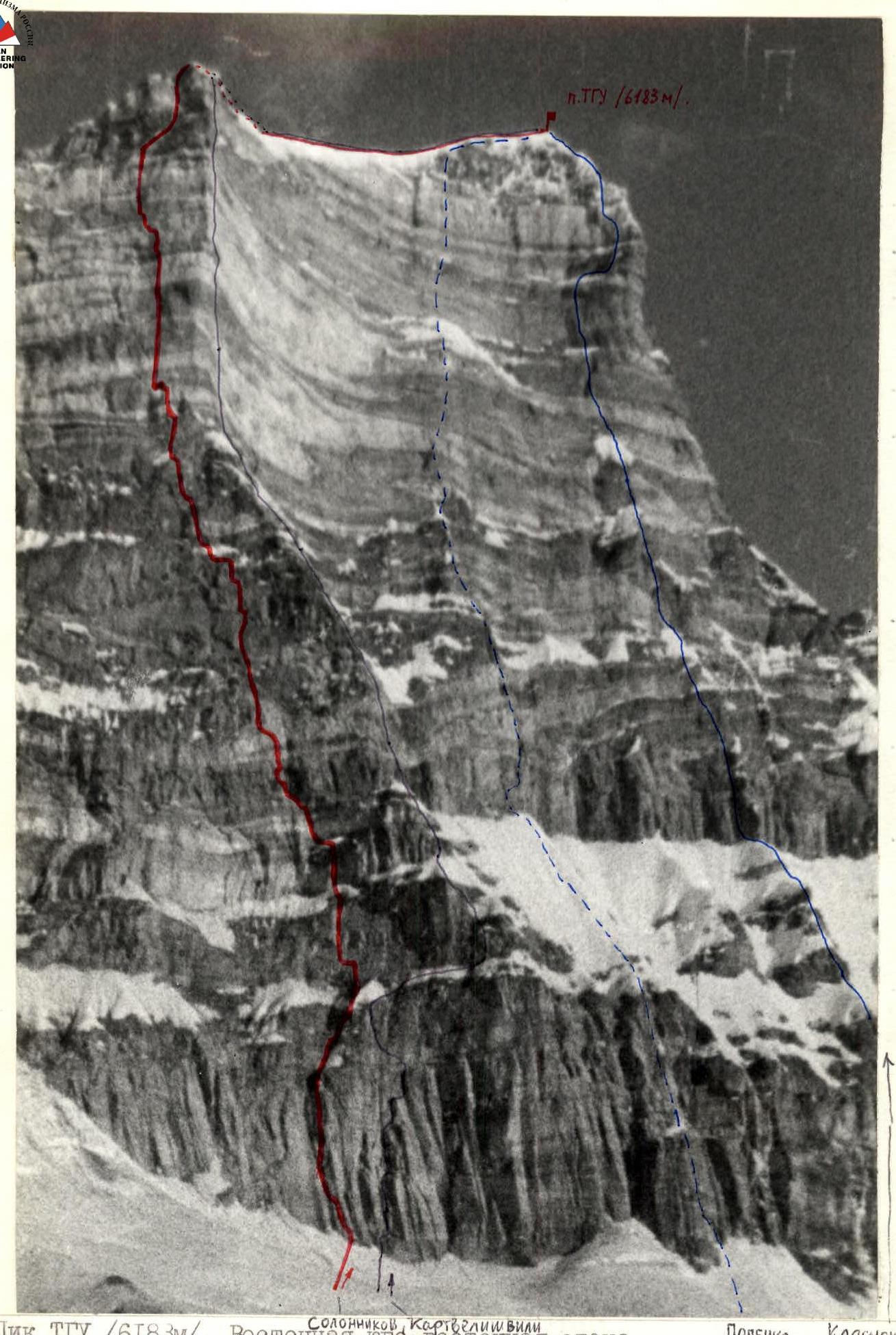 Peak TGU (6183 m). East-south-eastern wall.
— path of the Leningrad City Sports Committee team
— path of the Georgia team
Routes on the eastern wall (1978):
— path of the CS DSO "Trud" team (Leningrad)
— path of the SAVO team
Ascent was carried out simultaneously
Peak TGU (6183 m). East-south-eastern wall.
— path of the Leningrad City Sports Committee team
— path of the Georgia team
Routes on the eastern wall (1978):
— path of the CS DSO "Trud" team (Leningrad)
— path of the SAVO team
Ascent was carried out simultaneously
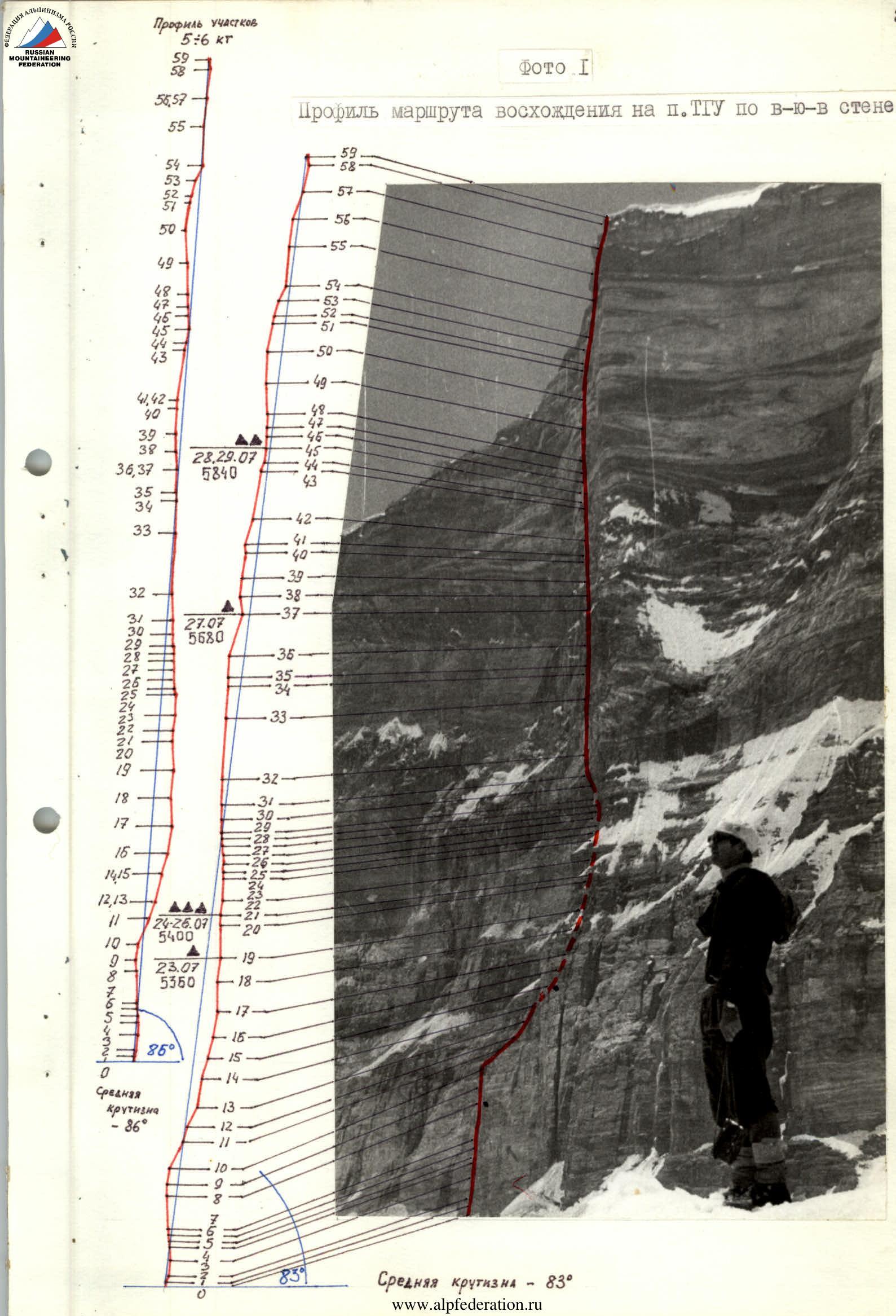
Average steepness — 83°
East-south-eastern wall of Peak TGU (6183 m)
Ascent route.
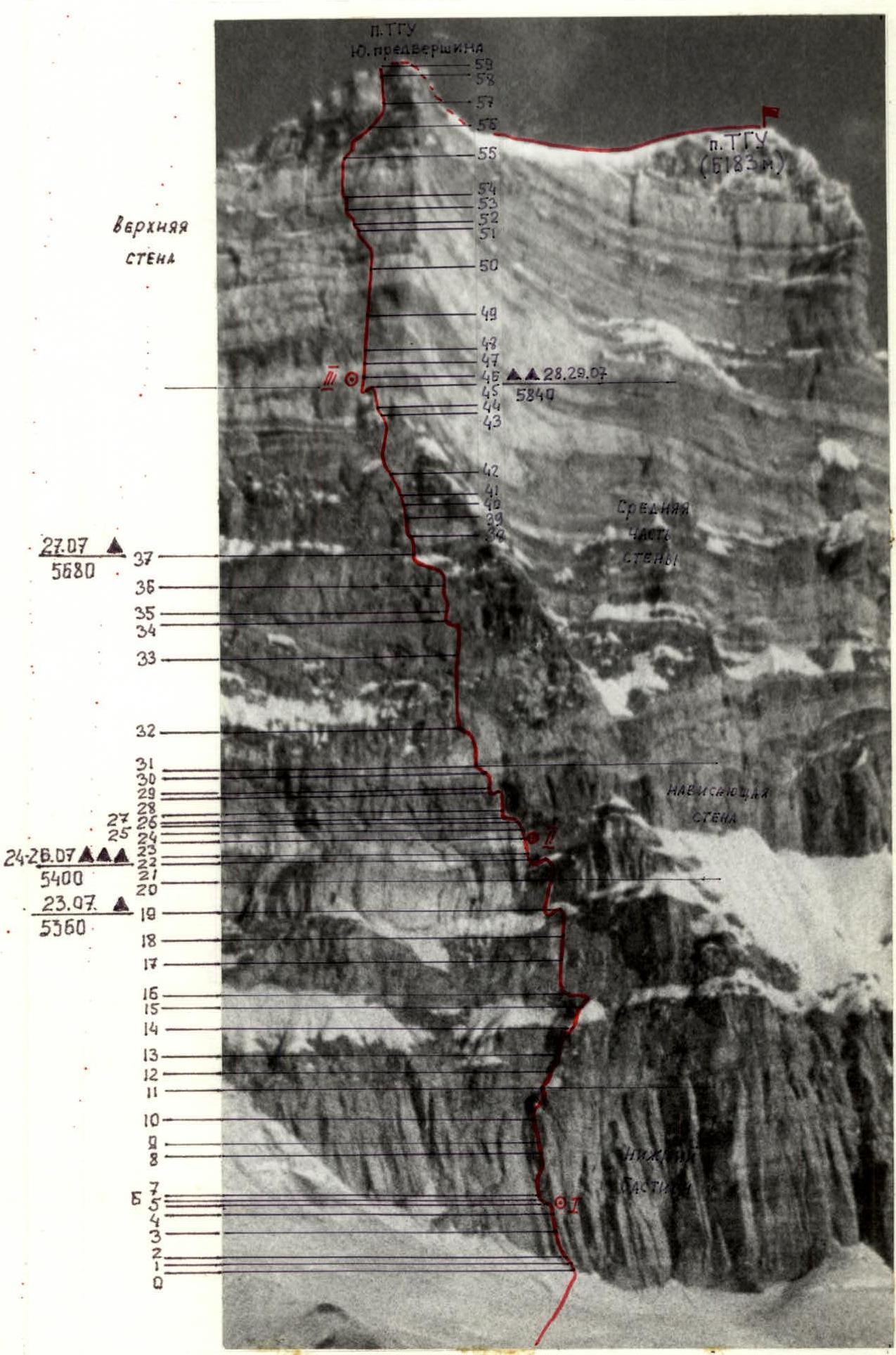 When passing the top of the overhanging wall, it is advisable to bypass the cornices from the left — there are visible gaps (although not everywhere), and when passing the upper wall, go slightly to the left of the right buttress, where climbing and using conventional pitons is almost impossible.
III. Ascent Tactics
The tactical plan was developed based on studying the wall and observations.
The technical, physical, and tactical capabilities of the team allowed planning an ascent of almost any complexity. The team's goals were: strict planning of the ascent, ensuring the reliability of the route, minimizing the probability of being hit by stones when passing the wall, and choosing a route that would allow (albeit at the cost of time) to pass without using bolt technique.
The tactics were based on the following points, which were clearly implemented during the ascent:
- When processing and passing the lower part of the wall (1st bastion), it is necessary to work on the lower 200 m in time intervals until 10:00–11:00 and after 14:00.
- Bivouacs should be in places protected from stones: in the lower part of the overhanging wall, in the upper part of the middle wall, and at the base of the upper wall.
- To cover the distances between the planned bivouac sites, it is necessary to have a large supply of ropes and plan intermediate advance processing of route sections from the planned bivouac sites.
- When choosing a route, strive to move vertically upwards but avoid extended monolithic sections that require the use of bolts.
- The entire route, including overhanging sections, must be passed without dragging backpacks; their weight should not exceed 8 kg.
- The passage of processed sections by the entire team should take a minimum amount of time.
To achieve these goals, the following measures were taken:
- The team was composed of 8 people. This allowed having a large supply of ropes (360 m) with an initial backpack weight (without ropes and pitons) of 7–7.5 kg; route processing was carried out by a group of 3–4 people, allowing for rotation of the person working first, relieving the first pair of unnecessary equipment, and better preparing the route for the group's movement — straightening ropes, knocking out unnecessary pitons, intermediate rope fixing, etc.
- Processing of the lower bastion was to be carried out in 2 days: the first day — after 14:00. At this time, 100–150 m of the lower part of the route was to be passed, and on the second day from 6:00 to 7:00, to reach safe sections by 10:00–11:00.
- Double bivouacs were planned under the overhanging wall and in the lower part of the upper wall.
- For passing monolithic sections, it was planned to use a platform, pendulum movement on a fixed rope, chocks, petal pitons, "American" titanium wedges, and other samples of the latest equipment.
- The weight of food was minimized: the team planned to use 300 g of food per person per day. This diet was carefully tested and verified in several complex ascents.
- On several ascents, including the ascent to Peak Tajikistan via a new route this season, the team had practiced an algorithm for quickly changing the order of movement along the route — from moving along processed sections with weight distribution among 8 participants to moving along a new path with weight distribution among 7 participants (the first person goes without a backpack).
The following plan for passing the route was adopted (see route sheet): 1.5 days of processing with a time regime as described above. During this time, it was necessary to hang 8 ropes and reach the end of the 1st bastion. On the first day: passing the processed sections and advancing another 100–120 m to a shelf with an ice formation at the base of the overhanging wall. Backup option — bivouac 80 m below on a shelf in the upper part of the 1st bastion. On the second day: transferring the bivouac 50–80 m upwards to the next ice formation under the overhang and processing the overhanging belt. Double bivouac. Not only the overhang but also the slope above it for 100–150 m was to be processed. There is a small ledge here, and a bivouac is possible if a place protected from above can be found on the ledge. The main bivouac, however, is another 150–200 m higher — under the cornice. From this bivouac, it is necessary to reach the base of the upper wall — there are small ledges — there will be a sitting double bivouac. From this place — 1.5 hours of processing the upper wall with a general direction straight up, bypassing cornices from the left. Here, at the level of the cornices, a small ledge was visible — a bivouac site. Backup option — reaching the subpeak without this bivouac.
This plan for passing the route was fairly accurately executed by the team. Under the overhanging wall, a tripled bivouac had to be made because, in the middle of the middle part of the wall, the bivouac site was unprotected, and passing the monolithic sections of the overhang without bolts required additional time. In the upper part of the route, it was possible to do without the planned bivouac and reach the subpeak directly.
As planned, the ascent took 8 days and 1.5 days of processing. The start of the ascent was July 21, 1979. The team reached the summit on July 30, 1979. A detailed plan and order of passing the route made it possible to solve the problem of the east-south-eastern wall of Peak TGU reliably, fulfilling all the tasks and quite quickly.
IV. Composition of the Observation Group and Distribution of Responsibilities Among Team Members
The observation group consisted of: the observation group itself, the leader, the team's rescue officer Karpov V. I., doctor Lapshin L. I., and participant Epstein A. K., and a support group of five people.
The observation group was located on the 5200 m pass, conducted constant visual observation of the team through a telescope with 60x magnification, and conducted daily radio sessions with the team (see observation and radio communication log).
The observation group maintained radio communication with the support group.
The support group provided the observation group with food and fuel for the duration of the observation. The support group's location was the base camp.
The team had the following distribution of responsibilities: all team members took turns during route processing and passage.
- Questions of organization and order of movement were decided by team leader MSMK Solonnikov V. A.
- Questions of food organization during the ascent were handled by deputy leader MS Antonovsky D. I.
V. Brief Explanation of the Table of Main Characteristics of the Ascent Route to Peak TGU (6183 m) via the East-south-eastern Wall (Ascent Description by Days)
July 20, 1979. The team in full departed from the base camp and established a storm camp on the Zugvand glacier under the east-south-eastern wall of Peak TGU by 18:00.
July 21, 1979. Observation of the wall was conducted in the morning. Details of the route were clarified. At 14:45, Stepanov N., Nazarov O., and Vl. Solonnikov departed for processing. The wall was in the shade. No rockfall. Work could begin calmly.
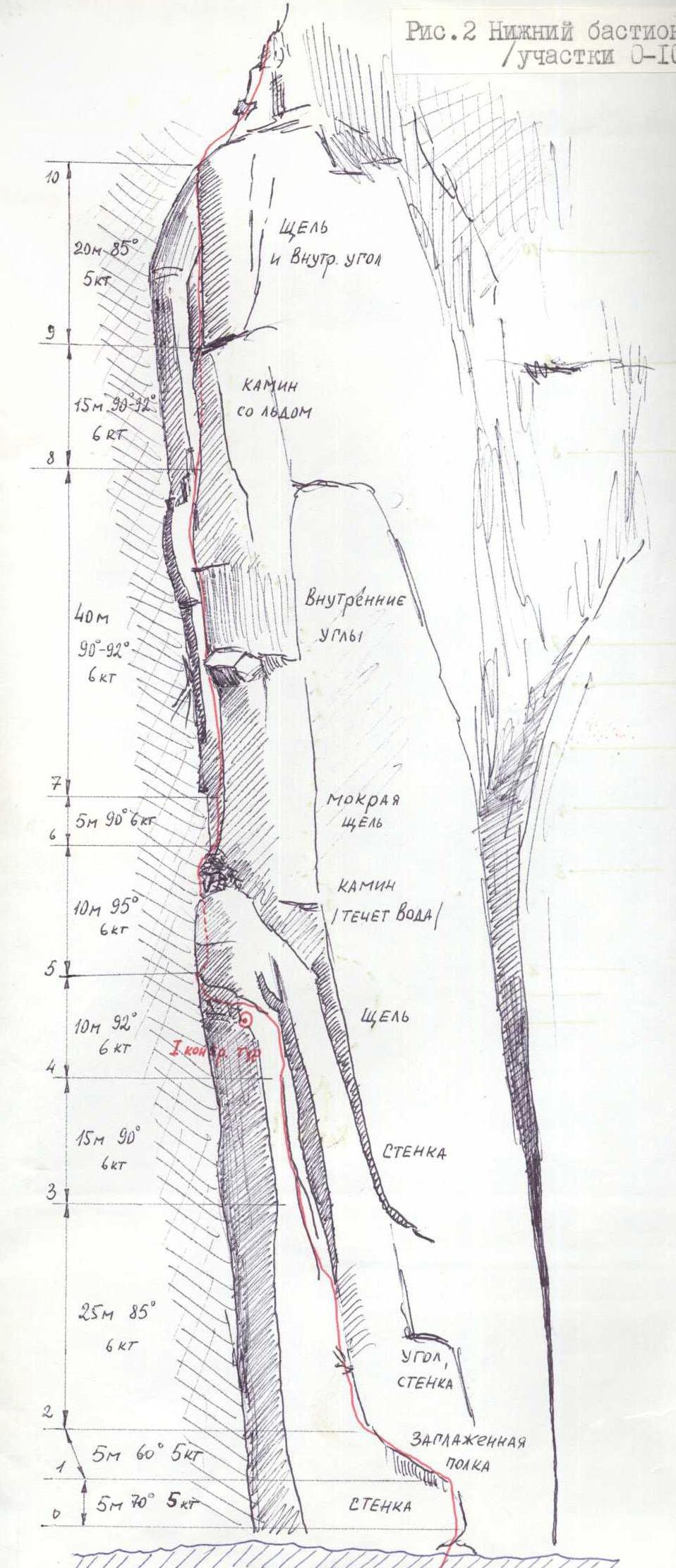
The main mass of the bastion has a negative inclination to the left. The relief is poor, smoothed (Fig. 2, Photo 3).
To the left of the bastion, water flows down the wall. Climbing is complex from the start. Using small holds, it is possible to reach a small ledge, then to the left edge of the bastion. Upwards, there is a sheer wall with small holds. The rocks are smoothed, and crampons do not hold well. Climbing is very tense.
The wall gradually turns into a not clearly defined internal corner (sect. R2–R3). To the right, a wide, slightly overhanging crack begins. Its edges are smoothed, and it is not possible to use it for climbing. One has to go alongside the crack on a wall with small holds (sect. R3–R4). Thin cracks often hit pitons; soft two-step ladders are used.
Above, there is an overhanging wide crack; wide segmental chocks are used (sect. R4–R5). The crack ends. Further on, there is a monolith. One has to move into a chimney separating the bastion from the left wall (sect. R5–R6). There are no cracks; wet rocks overhang. With difficulty, it is possible to squeeze into the chimney. The chimney is blocked by a plug. It is very difficult to bypass it on the wet wall.
Above, there is a wet crack with ice. Chocks help again. It is possible to move away from the junction with the left wall into a system of overhanging internal corners. Along these, 40 m are passed using ladders, chocks, and partially free climbing — exit under the base of a smooth ice-filled chimney.
In 5 h 15 min, 110 m are passed. 28 pitons are hammered. Chocks are used multiple times. At 20:00, the processors return. About 40 m remain to the top of the sheer part. This distance needs to be covered tomorrow before 10:00.
July 22, 1979. At 7:30, processing of the bastion continues. Four people start: Orlov, Povilainen, Nazarov, and Stepanov. After passing the sheer part of the bastion, the work is continued by three.
Above the sections processed the day before, there is an overhanging ice-filled chimney. To start moving, one has to stand on each other's shoulders (with the lower person standing in ladders), and even then, after a few meters, a bolt piton has to be hammered — the chimney walls are completely devoid of holds. Micro-holds can be chiseled in the ice.
In 1 h 30 min, 15 m are passed. Further on, there are 20 m along a crack turning into an internal corner. The crack is wet, with few holds; the steepness is close to vertical (sect. R9–R10).
By 10:00, the sheer part of the bastion is passed. 40 m are quickly passed along the destroyed rocks of the more gentle part (sect. R10–R11). Further movement is out of the zone affected by stones in the middle of the day.
Ahead, there is a wall entirely consisting of a pile of "live" stones (sect. R11–R12). Movement has to be very cautious and slow. Much time is spent searching for places to hammer pitons and reliable holds.
Again, more gentle rocks appear, but they are covered in sand and gravel, making movement significantly difficult. Further on, there is a wall ending in an overhanging internal corner (sect. R13–R14). The rocks are wet, with icicles hanging. Many "live" blocks. Climbing is extremely complex and tense. This is already the top of the bastion.
Another 30 m along the slabs and calcareous sinter under the beginning of the slope are secured with ropes. 195 m are processed. 30 conventional pitons and 1 bolt piton are hammered. The entire bastion is 300 m. 8 ropes are hung. Time — 15:30.
Today, 8 hours were worked, and a total of 13 h 15 min on the bastion. The entire wall is in the shade. It is safe to start descending — movement on the bastion is now safe.
At the end of the secured ropes, a sitting bivouac can be organized. But this is a backup option. The plan for tomorrow is to pass another 3–4 ropes to the ice formation on a small ledge under the cornice at the start of the overhang in its right part.
Tomorrow, it will be especially necessary to be attentive when moving on the upper, more gentle part of the bastion — the rocks here are very destroyed.
The observation group moved the camp to the 5200 m pass. Details of the observation were clarified.
July 23, 1979. Departure at 6:20. Active movement along the ropes. The weight of the backpacks is small, so it is possible to pass the processed sections quickly. Often, one has to go on a hanging and freely hanging rope.
In the upper part of the bastion, on sect. R10–R11, R11–R12, it is necessary to pass sections in turn, waiting for the movement on the next section to finish.
By 11:00, the processed sections are passed. Above, there is a sheer belt of rusty rocks, with soft rock, and tense, complex climbing (Photo 8, Fig. 3).
Movement begins on very unstable, steep rocks. Holds are covered in sand; the rock is like sandstone.
First, there is an internal corner, and then a traverse under the cornice (sect. R15–R16) in the direction of a sheer internal corner, closed by a cornice (sect. R16–R17).
The internal corner is deeply recessed and slightly overhangs in the upper part. Movement is on ladders. Titanium wedges are used, but the rock crumbles, and they do not hold well. Climbing is very tense.
The cornice is bypassed from the left using chocks and titanium wedges (sect. R17–R18). The section is overhanging; the overhang turns into an internal corner with a deep crack.
Above, there are 35 m along sheer rocks of layered soft rock. Extremely tense climbing. Especially complex is the organization of protection. Wide duraluminum wedges are used.
At the end of the section, behind an ice formation, there is a small niche. Here will be a sitting bivouac. Time — 15:00.
Upwards, there is an overhanging wall with an internal corner and small cornices. The overhang is not large — 92°–93°. To the left, the wall overhangs much more strongly. We are, as it were, bypassing the start of the main overhang from the right.
Above, 50 m away, there is another ice formation. The bivouac needs to be moved there tomorrow.
Vedernikov, Nazarov, and then Povilainen continue processing. Movement is from piton to piton. 40 m take 21 pitons, with the most diverse types — from petal pitons to large wedges (sect. R19–R20, Photo 9, 10, 11, Fig. 3).
Above the overhang, there is a sheer, wet slab with small holds. Straight up, under icicles, there is a thin crack — movement along it, and then a traverse to the right to the edge of the formation and exit onto it.
On sect. R20–R21, 10 pitons are hammered. 55 m of the most complex climbing are processed. Processing is finished at 19:00. Passing these two sections took 4 hours. During this time, a sitting bivouac was constructed.
At 20:00, there is communication with observers. The Georgian team, which went up to the top of the bastion next to us, went along a ledge to the right onto their route behind the bend of the counterfort. Now they are separated from us by more than 100 m, and we can no longer see them.
For the day (12 hours), 305 m of processed ropes are passed, another 135 m of the sheer rusty belt are passed, and 55 m are processed above. 50 pitons are hammered.
July 24, 1979. Departure at 8:00. By 10:00, the processed sections are passed, and processing of the main mass of the overhanging wall begins (Fig. 4, Photo 4).
The path is thoroughly developed from below:
- First, a traverse to the left until an overhanging wall is reached, with almost no height gain.
- Then, a 20 m wall with partially overhanging sections (sect. R22–R23).
- From a small ledge, an overhanging, smoothed internal corner goes up. To start, one has to stand on each other's shoulders, and then on ladders along a thin crack (sect. R23–R24).
The corner ends; there is no further path. A pendulum movement — a shift to the left by 1.5 m onto an external corner. There are no holds on the wall. Upwards, there is a thin crack. Along it, on petal pitons — 10 m. At the end of the section, there is a sloping ledge, and above it, an overhanging smooth wall.
To continue moving, it is necessary to hammer a bolt piton. On it — 1 control cairn with a note. Using this piton — a half-pendulum to the left into an internal corner (sect. R25–R26).
The corner overhangs; in its middle, there is a 1.5 m cornice. The crack in the corner is smoothed and quite wide. Movement is on ladders, but hammering pitons is a problem. Chocks help, especially when passing the cornice. On this section,
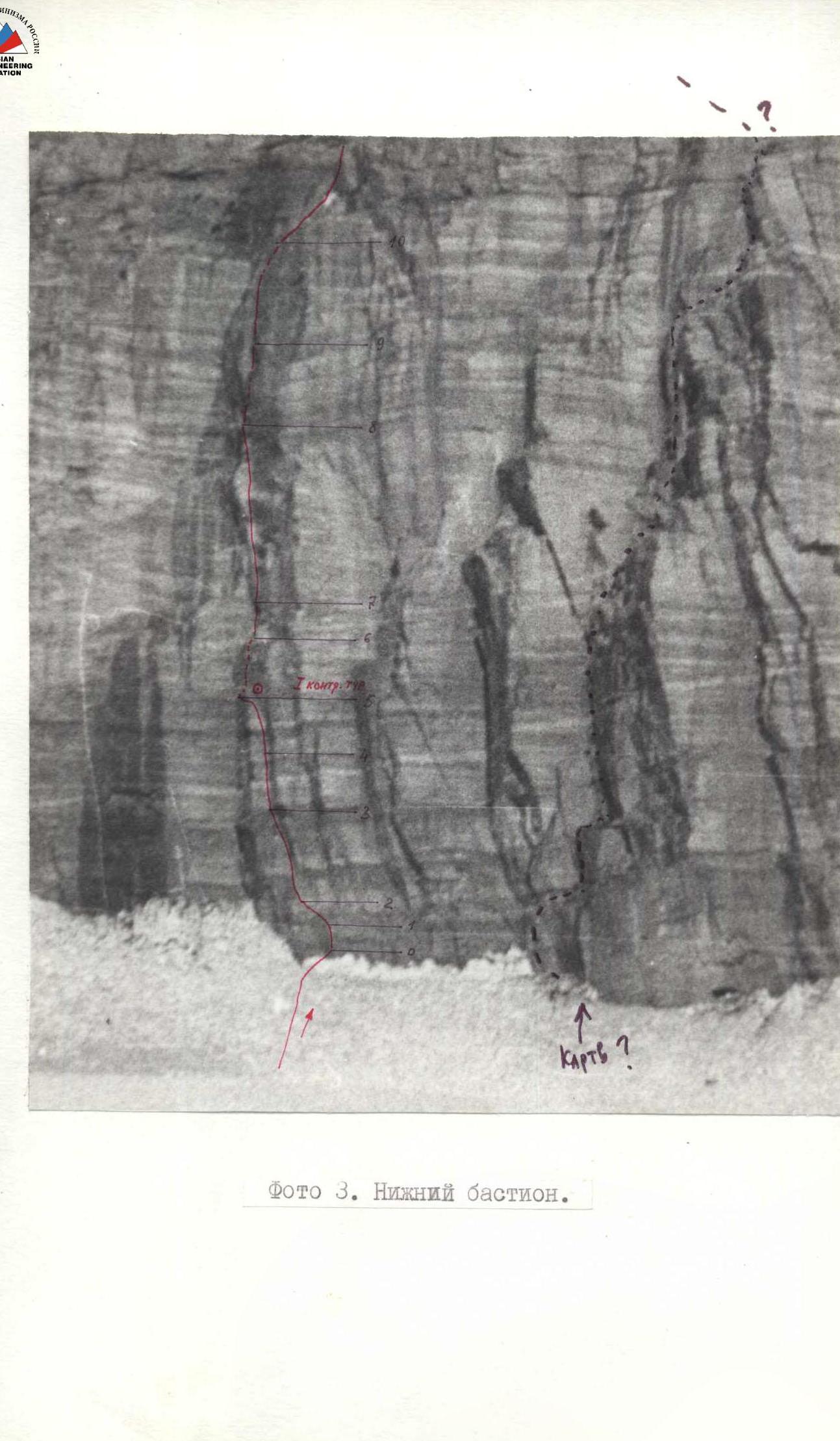
Photo 3. Lower bastion.
 12 m long, 8 times chocks are used, and 6 pitons are hammered (mainly wedges). The crack in the corner ends; the corner walls are monolithic. One has to go on a traverse to the left under the cornice using chocks and up the wall through the cornice (sect. R26–R27). On the wall, there are several small cracks, but most are not suitable for pitons — monolith. Still, it is possible to pass the wall (11 m) without bolts on simple pitons and enter an internal corner under the second cornice. Along this overhanging corner — 8 m (4 pitons).
Further on, there is a cornice without a single crack. Descent on a rope by 4 m and a pendulum to the left by 2 m into an internal corner. Along the corner, it is possible to pass another 5 m, overcoming a small cornice. The rope is secured. Unnecessary pitons are removed.
At 19:00, the processors return. In 9 hours, 90 m of the most complex route are processed, and 55 m of previously processed sections are passed (another 2 hours). During processing, 37 conventional and 1 bolt piton are hammered. Tomorrow, it is necessary to pass the main overhang and reach the middle part of the wall.
At 20:00, the results of the day are communicated to the observers.
July 25, 1979. Processing continues. Departure at 8:00; four people depart. The task for the day: to pass the main overhang and part of the middle wall and determine the possibility of organizing a bivouac there. Vedernikov suggests going further straight up between the cornices — this will require 15 bolt pitons. The option is rejected. We will go as planned — pendulum to the left and along the system of vague cracks, approach under the left cornice, and exit onto it from the left.
Continuing movement along the internal corner, it is possible to pass another 3 m. Descent by 8 m and pendulum shift to the left by 4 m. Using a platform, three bolt pitons, and hammering 5 more pitons into thin, semi-blind cracks, it is possible to rise by 12 m; there are still 5–8 m to the cornice. But there are no cracks.
Again, descent by 10 m and pendulum with pitons by 5 m to the left. Again, a thin, sometimes disappearing crack. Using ladders, a platform, and passing sections with free climbing, it is finally possible, having passed 20 m, to exit above the cornice (sect. R30–R31). On this section, 3 bolt and 8 conventional pitons are hammered. The overhanging belt is passed.
Above the overhang, there is a belt of white rocks, like marble, with weak, crumbling exits and a lack of reliable cracks. It is possible to pass another 40 m of sheer rocks. At 19:00, processing is finished. 104 m are processed, and with straightening of the ropes — 70 m.
A bivouac in the center of the middle part of the wall — on a vague ledge — is not protected from above, and it has to be abandoned. That is, a third day of processing is required because there are still enough ropes, but after it, it will be possible to exit directly to the planned bivouac site.
Today, in 11 h 30 min, 23 conventional and 6 bolt pitons are hammered. Various climbing techniques are used:
- Free climbing,
- Pendulums,
- Work on a platform,
- On ladders,
- On a fixed rope.
The processed ropes are prepared for movement — unnecessary pitons are removed, and additional rope securing is done wherever necessary.
At 20:00, there is communication with observers.
July 26, 1979. Departure at 8:00. Tasks for the day: to hang all 8 ropes (one, the ninth, is always left for continuing work the next day). Four people depart: Vedernikov, Orlov, Nazarov, Povilainen. Antonovsky and Vl. Solonnikov must additionally prepare the route for tomorrow — straighten the rope in two places, hammer additional pitons in some areas.
Continuation of work on the white marble belt (sect. R31–R32) — this is a system of shallow and short internal corners with small cornices. The organization of protection is complex. For this purpose, a bolt piton has to be hammered on the section. The remaining 8 pitons hammered on these 30 m are mostly unreliable and are used only for passing.
Further on, there is a belt of smoothed gray rocks 80 m long (sect. R32–R33). This is a wall turning into an internal corner with small cornices. Climbing is very complex, on small holds. Another 40 m along the corner and sheer slab (sect. R33–R34) lead under an overhanging corner with a cornice. Here, the ropes are secured.
At 16:30, processing is finished. It is snowing; cold. For the day, 8 h 30 min of climbing hours, 150 m are processed. According to our calculations, in another 100 m, there will be the planned bivouac site. As expected, the wall remains sheer; there are no simple sections or ledges; climbing is always at the limit of capabilities. Much trouble is caused by ensuring reliable protection, especially due to the constant change in the nature of the relief and rock.
At 20:00, there is the usual communication with observers. We learn that the Georgian team is already significantly higher than us, under the upper wall.
July 27, 1979.
- Departure at 7:00.
- Cloudy, sleet.
- By 11:00, the processed sections are completely passed.
- By this time, the first ones have already passed sections R34–R36.
Section R34–R35 — an overhanging internal corner covered with a cornice (Fig. 5, Photo 20). Extremely complex climbing. Pendulum movement to the left and ascent along the wall with a subsequent traverse to the left upwards. Very tense climbing. Holds are unreliable; the slope is sheer; niches for hands and feet are filled with sand (sect. R35–R36).
Further on, there are 60 m of simpler rocks, and by 15:00, the entire team is on a small ledge — the planned bivouac site. Construction of a platform begins. At 16:00, processing of the route continues.
- Immediately from the bivouac, there is an overhanging wall 20 m (92°–95°) (Photo 22, 23) (sect. R37–R38).
- Then, there is an internal corner filled with ice 20 m (sect. R38–R39).
- Further on, there is a wall made of blocks (sect. R39–R40) — 30 m.
- And a ten-meter overhanging internal corner (sect. R40–R41).
An abundance of dusty stones complicates movement; it is necessary to work very carefully. Another 40 m of simpler rocks — and processing is finished. At 21:00. About 100 m remain to the base of the upper wall. For the day, 310 m of processed sections are passed, another 100 m to the bivouac, and 120 m of the route are processed. 40 pitons are hammered. The results of the day are communicated to observers. It is cold. Snow and sleet fall at intervals throughout the day.
July 28, 1979.
- Departure at 8:00.
- Cloudy.
- Sleet.
Directly from the bivouac, movement is along a freely hanging rope (Photo 24). By 11:00, the processed sections are passed. Further on, there is an ascent along sheer internal corners. The rock is very weak. Sandstone, with many loose stones. Climbing is very tense (sect. R42–R43). Then, there is a wet slab 10 m (sect. R43–R44) and a sheer wall. Exit onto it from under the cornice, traverse along small holds, and exit along an internal corner (sect. R44–R45). Here — a small ledge. Icicles hang. Upwards, there are monolithic sheer walls. There are no cracks. Straight up — only bolt work.
Construction of a bivouac begins, and further processing continues.
- Descent to 2 m down to the left.
- Along a sheer corner on ladders using chocks and conventional pitons — ascent by 15 m (sect. R45–R46, Photo 28).
Further on, there is a monolith of light granite, and still, using a platform, it is possible to pass:
- First, a wall 10 m,
- And then something similar to a corner, hammering petal pitons into the thinnest cracks and passing some sections with climbing on small holds (sect. R46–R47 and R47–R48).
So far, it is possible to manage without bolt technique. At 18:00, processing is finished. It is snowing. It is practically impossible to climb; cold. For the day (10 climbing hours):
- 120 m are passed along processed ropes,
- Another 100 m to the bivouac,
- 40 m of the upper wall are processed.
37 pitons are hammered. The bivouac turned out to be sitting, uncomfortable. The radio's power supply is frozen and damp; besides, there is fog, and the transmitter's power is not enough for communication, although observers hear us perfectly. At a distance of two ropes on the rib, members of the Georgian team are working. We can barely see them and ask them to transmit to our observers that everything is fine with us.
July 29, 1979.
- Continuation of processing.
- 5 cm of snow fell overnight.
- Fog and light snow in the morning.
- Departure at 10:00.
Ahead, there is a belt of monolithic rocks. Our path:
- First, straight up through monoliths to a system of internal corners,
- Then, a traverse to the left upwards, bypassing the cornice belt (Fig. 6).
The chosen path has, although poor, some micro-relief — small corners, recesses, sometimes shallow short cracks. Using a platform, it is possible to pass 40 m, hammering 6 bolt and 20 conventional, mostly petal pitons (sect. R48–R49).
The next section is not clearly defined corners, closed by cornices. The relief is somewhat richer. There are more opportunities for free climbing (sect. R49–R50).
9 ordinary and only 1 bolt piton are hammered on the section. Climbing is very complex, at the limit of capabilities. The platform is used several times.
Above, there is a cornice and a section of monolithic rocks. Traverse to the left under the cornice and further along the wall to an internal corner ending in a detached "pen" (sect. R50–R51). The rocks are less strong — the rusty belt. Climbing is along small holds; the entire traverse is done with free climbing of extreme complexity, and when ascending the corner, ladders are used.
Another 10 m along the wall and further — an inclined slab under the cornice (sect. R52–R53). The slab leads to an inclined ledge. Here, a semi-hanging bivouac can be organized. The ropes are secured.
At 19:00, 150 m of the most complex route are completed in 9 hours. Hammered:
- 41 rock pitons,
- 7 bolt pitons.
The bivouac is at the previous site. In the evening, the results of the work and the plan for tomorrow are communicated to observers — we will try to reach the summit, so there may not be an evening connection tomorrow.
July 30, 1979. Departure at 7:00. By 10:00, the processed sections are passed. The path upwards is blocked by a huge cornice.
Traverse to the left upwards along slabs — 20 m, then along the wall under the left part of the cornice (sect. R54–R55). Directly under the cornice, there is another small cornice. Traverse to the left and climbing — exit onto a slab above this cornice. Bypassing the main cornice from the left.
Climbing is very tense: on the wall and slab — dusty, detached slabs and flakes. Pitons do not hold well, and there is hardly anywhere to hammer them.
Above — straight up: very tense climbing along axial, layered, weak rocks with pitons hammered only for passing (sect. R55–R56). At the end of the section, there is a pile of dusty stones, but it is still possible to hammer reliable pitons for securing the rope.
Here, under the overhanging belt, a scar-like path to the right goes along an inclined ledge with dusty stones, and after 40 m upwards — between two overhangs — an internal corner filled with ice. Along the corner — 35 m of tense, complex climbing (sect. R57–R58) — and 10 m remain to exit to the subpeak.
The most difficult exit on ladders — the rock is detaching, and the steepness is about 95° (7 pitons for 10 m), and participants one by one exit to the top along a freely hanging rope (Photo 29).
At 15:00, the team is on the southern subpeak of Peak TGU, and at 16:30, having passed 300 m of a snowy and ice-snow ridge and slope, everyone reached the summit of Peak TGU (6183 m).
A note from the "Avangard" team, which passed the Popenko route (1978 route) a week earlier, is found.
Descent to the Rovny glacier. July 31, 1979 — the team is in the Zong settlement, and on August 1, 1979, at 9:00, they are in the base camp.
The ascent took 8 climbing days and another 1.5 days of processing. 97 h 25 min of climbing time were spent. Hammered:
- 347 rock pitons,
- 16 bolt pitons.
VI. Additional Data on the Route
The route to Peak TGU via the east-south-eastern wall is logical, going practically straight up without significant deviations from the vertical. This is a first ascent, 6B — the wall has clear boundaries: on the left — a giant internal corner, on the right — a counterfort.
The wall was passed for the first time; there were no other routes on it. The wall is characterized by high tension and concentration of sections of extreme complexity. There are practically no gentle sections on the wall (its steepness is more than 80°). Sections of the 6th category of difficulty have a large continuous length, and their total length is about 1000 m with a height difference of more than 700 m.
On the wall, there are:
- Extended overhanging sections, the longest of which — in the lower half of the wall (sect. R21–R31) — is an overhanging "concave" wall more than 120 m long;
- Various relief sections: cornices, internal corners, monolithic walls with poor relief, slopes with small holds, made of soft and hard rocks, cornices, etc.;
- Alternating belts of soft and hard rocks.
To pass the wall, diverse techniques are required:
- High individual skill in free climbing;
- Work with ladders, a platform, an arsenal of various pitons and chocks;
- Ability to move pendulum-style, etc.
According to the team, this route is more complex than routes passed by participants, such as:
- Peak Engels — from the north and along the eastern wall;
- Peak TGU — along the eastern wall (route of the 1978 team);
- Peak Akhmad-i-Donish;
- Chapdra;
- Bodhona.
Its complexity is on the same order as the route to Peak Moskovskaya Pravda (1977), however, passing the east-south-eastern wall of Peak TGU requires more diverse techniques than on the wall of Peak Moskovskaya