ASCENT DOCUMENT
1. Ascent Category
High-altitude and technical.
2. Ascent Region
Shakhdarin Range. South-West Pamir.
3. Ascent Route with Indication of Peaks and Elevations
Peak TadGU, 6183 m, via the East-South-East wall, 6B category of difficulty.
4. Ascent Characteristics
Elevation gain — approximately 1000 m, average steepness — 75°, length of complex section — 500 m.
5. Number of Pitons Driven
Rock pitons — 284, bolt pitons — 13, chockstones — 61.
6. Number of Climbing Hours
7. Number of Nights and Their Characteristics
7 nights. 1, 2 — under overhanging rocks, platform. 3 — middle part of the wall, sitting. 4, 5, 6 — under the gray belt, platform. 7 — above the gray belt, sitting.
8. Team Name
Combined team of Uz Council of the "BUREVESTNIK" Sports Club.
9. Participants
- Azegov A.K. — CMS, captain.
- David'yan D.A. — CMS.
- Khukhlyakov V.M. — CMS.
- Mirkarimov A.M. — CMS.
- Kononerov V.P. — CMS.
- Borisov E.I. — CMS.
10. Team Coach
Kharlanov G.L.
11. Dates of Departure and Return
August 18 – August 26, 1982.
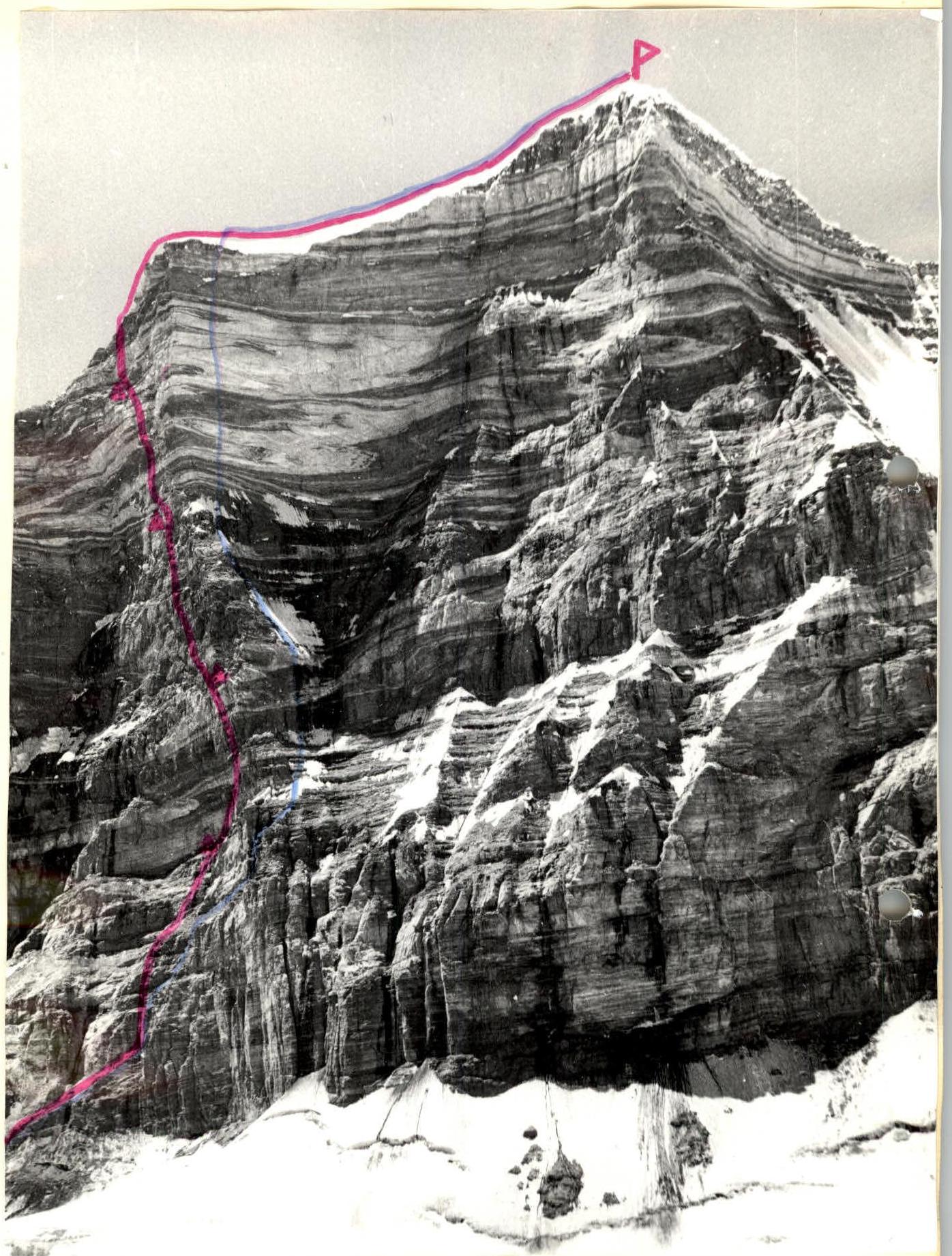
General View of the TadGU Massif
- Path taken by the team of climbers from UzD SO "Burevestnik" via the Solonnikov route.
- Kartvelishvili route.
- Overnight locations.
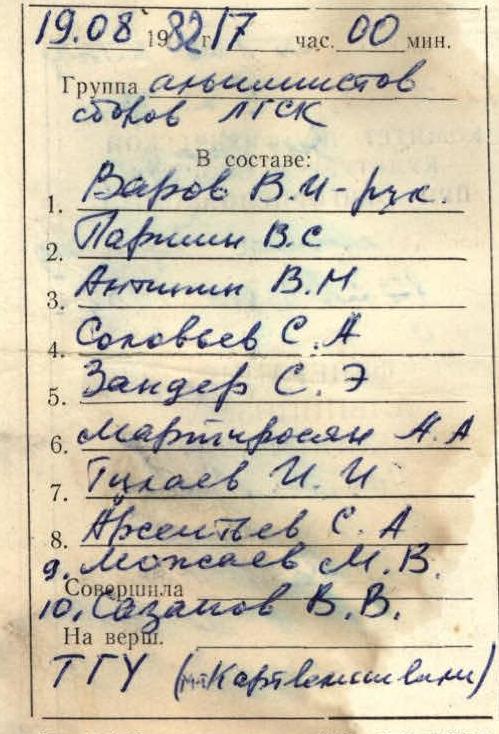
Type. 5-2 Lenuprizdat, order No. 3408-1000 23-05-79
Via the 100-meter edge of the East wall, 6th category of difficulty, from the Zugvand glacier. Departing from the bivouac on the Zugvand glacier on August 14, 1982, at 9:00. Descent started at 17:20 via the path to the "refuge" Rovimiy. A note from the Kartvelishvili group dated August 3, 1979, was found.
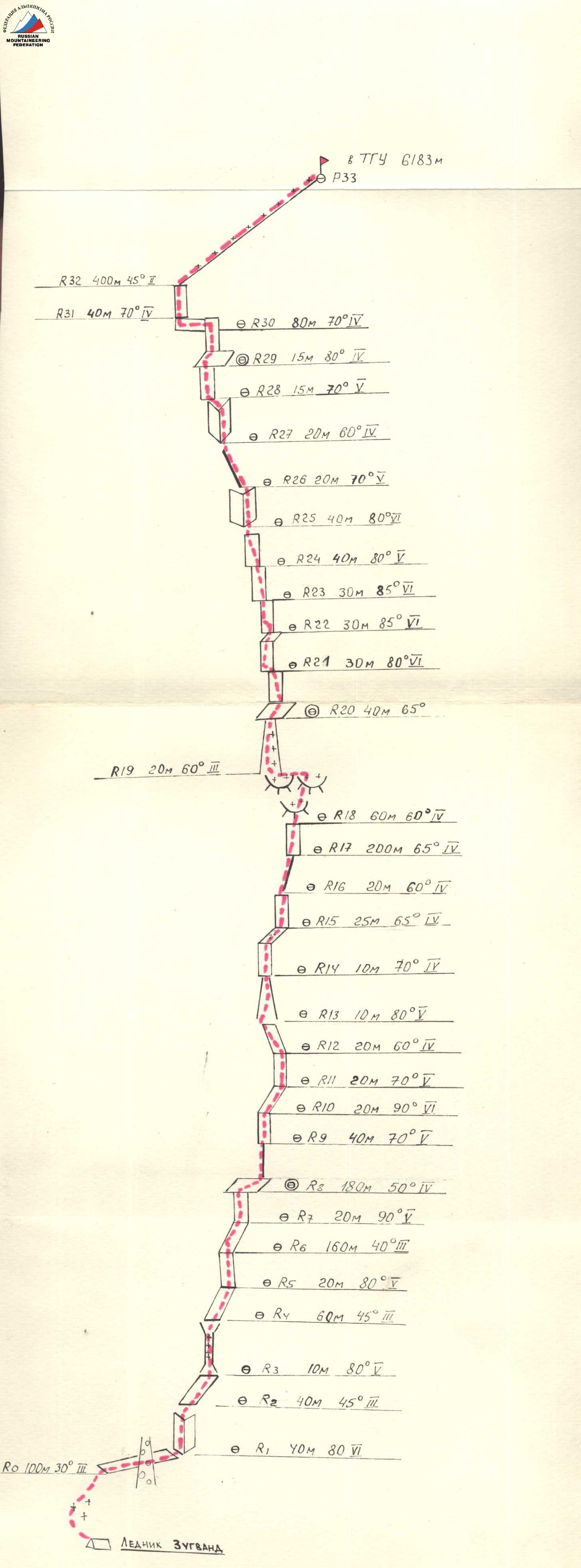
Ascent Route Diagram to Peak TadGU via the East-South-East Wall
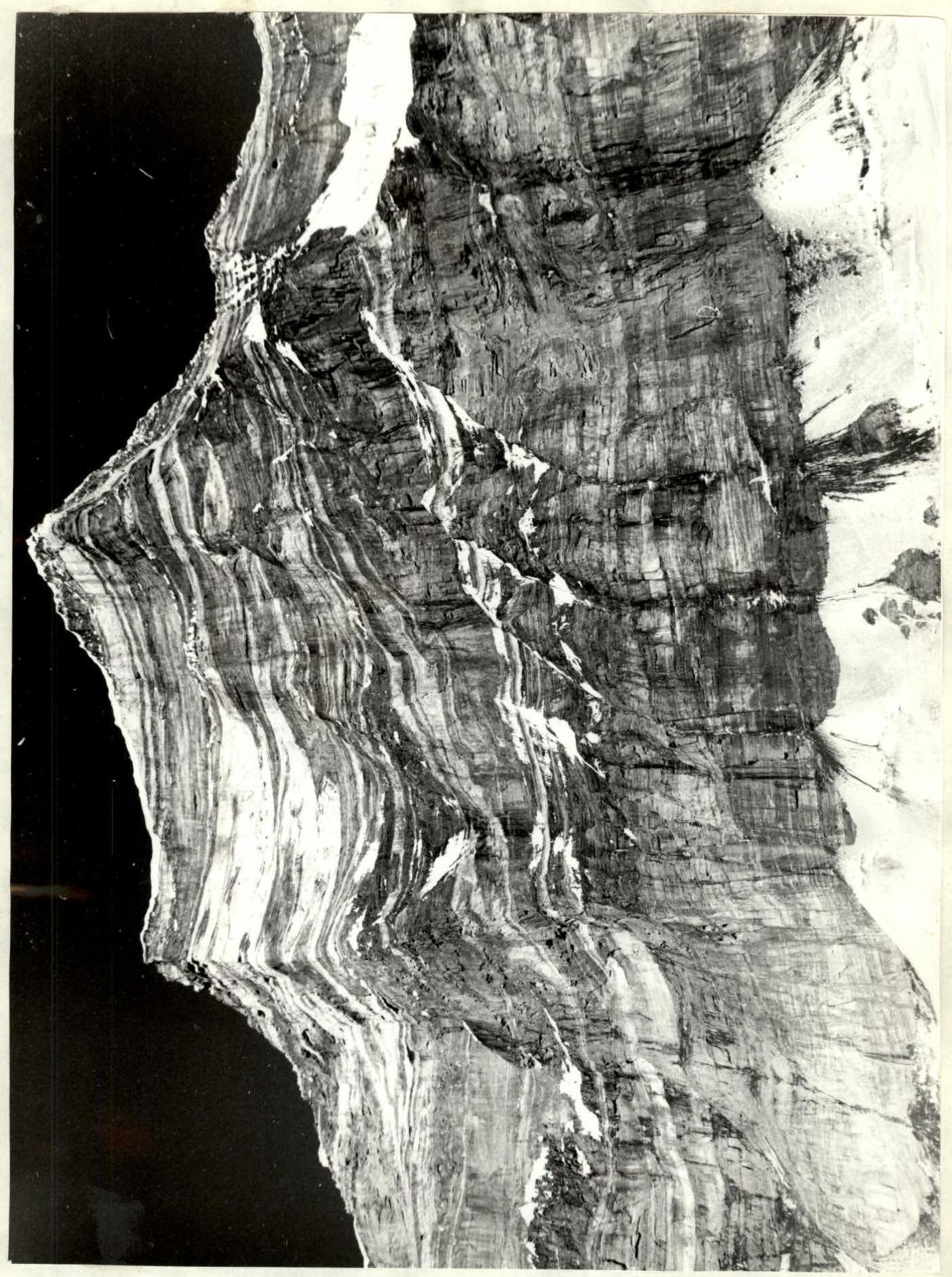
General View of the TadGU Massif
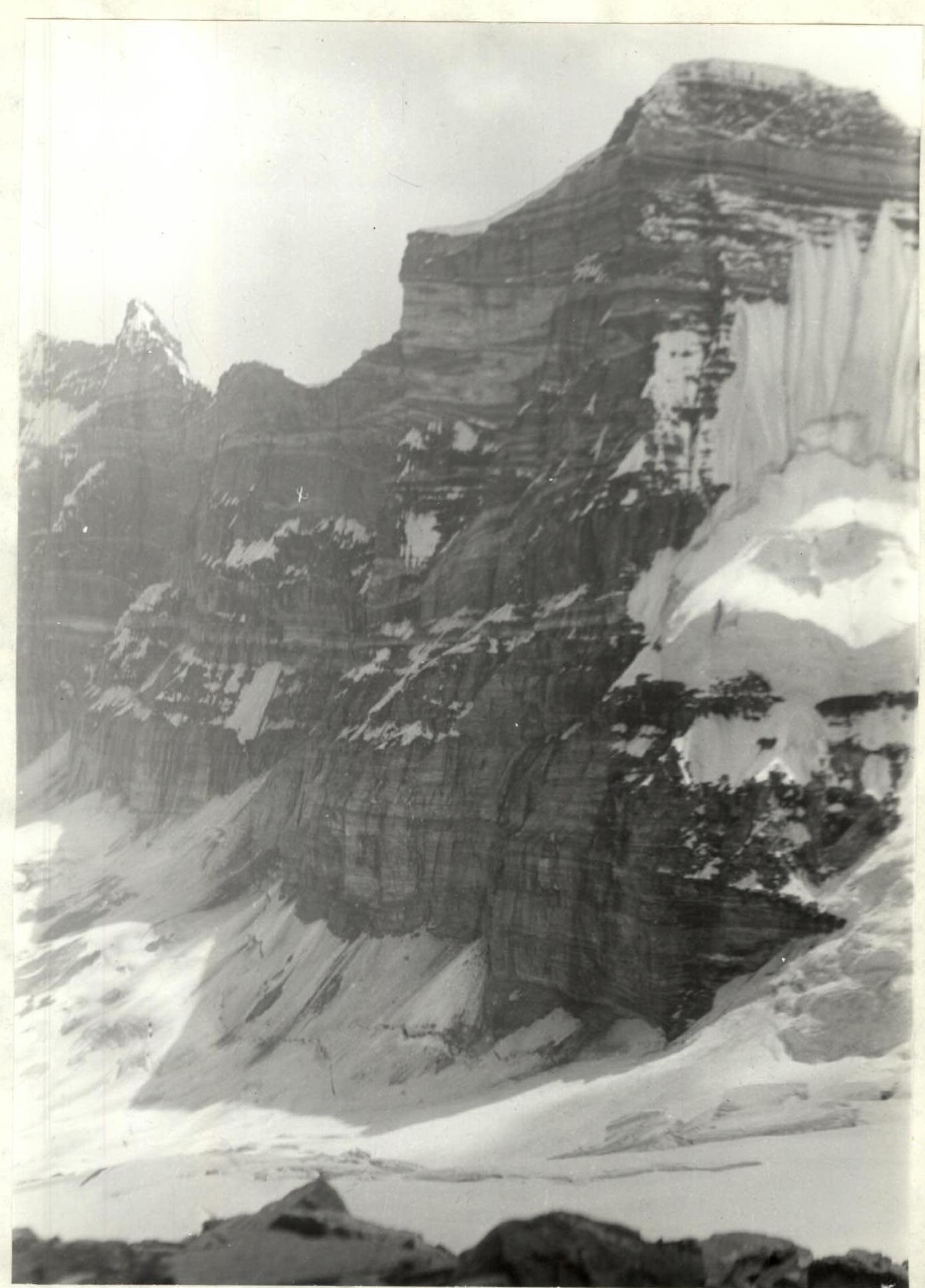
Profile of the Edge between the South-East and East Walls
Table of Main Characteristics of the Ascent Route
Ascent route: Peak TadGU, 6183 m, via the East-South-East wall, 6B category of difficulty.
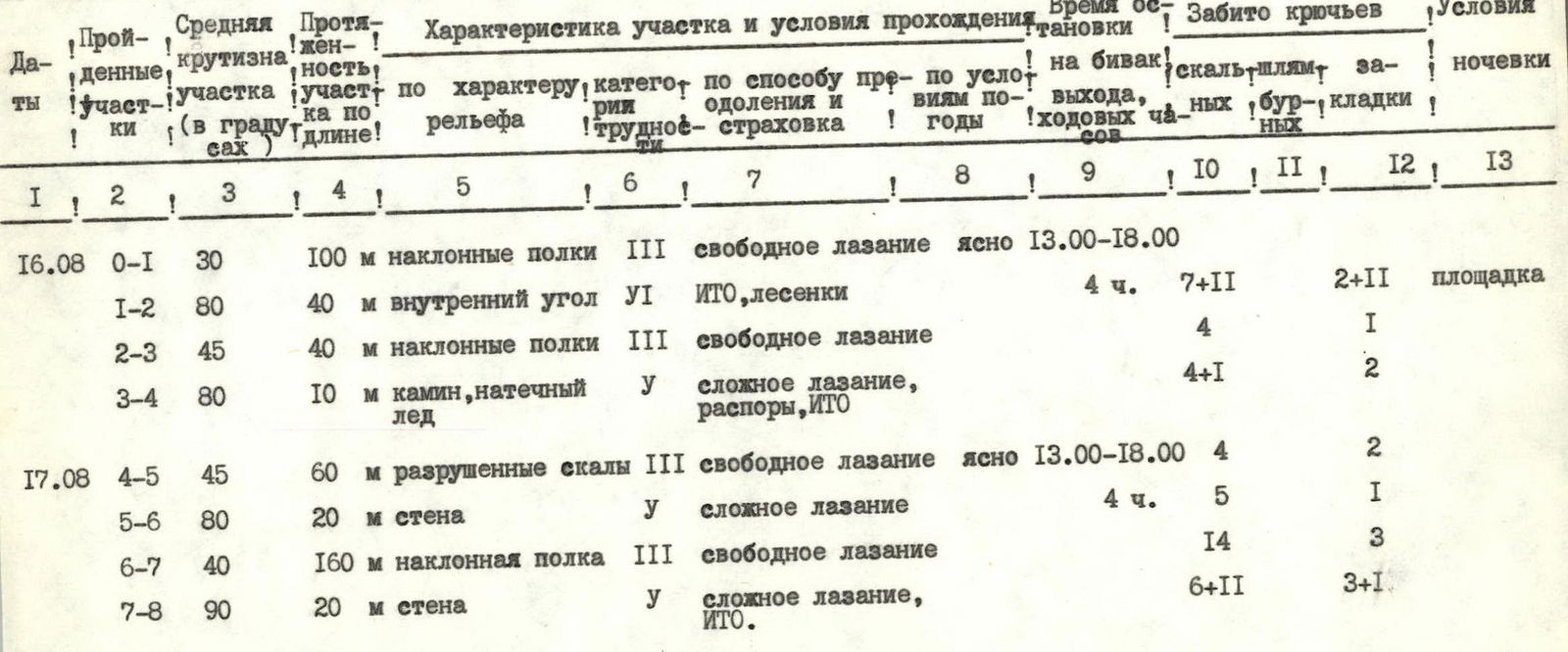 Sheet 1.
| Dates | Sections Covered | Average Steepness of Section (in degrees) | Length of Section | Characteristics of Section and Passage Conditions (by terrain character) | Difficulty Categories | By Method of Overcoming and Belay | By Weather Conditions (departure time, climbing hours) | Pitons Driven (rock, bolt, chockstones) | Overnight Conditions |
|---|---|---|---|---|---|---|---|---|---|
| 16.08 | R0–R1 | 30 | 100 m inclined shelves | 3 | free climbing | clear 13:00–18:00 | 7+2 | 2+2 | platform |
| R1–R2 | 80 | 40 m inner corner | 6 | artificial aids, ladders | 4 hours | 7+2 | |||
| R2–R3 | 45 | 40 m inclined shelves | 3 | free climbing | 4 | 1 | |||
| R3–R4 | 80 | 10 m chimney, flowstone | 5 | complex climbing, wedging, artificial aids | 4+1 | 2 | |||
| 17.08 | R4–R5 | 45 | 60 m destroyed rocks | 3 | free climbing | clear 13:00–18:00 | 4 | 2 | |
| R5–R6 | 80 | 20 m wall | 5 | complex climbing | 4 hours | 5 | 1 | ||
| R6–R7 | 40 | 160 m inclined shelf | 3 | free climbing | 14 | 3 | |||
| R7–R8 | 90 | 20 m wall | 5 | complex climbing, artificial aids | 6+2 | 3+1 |
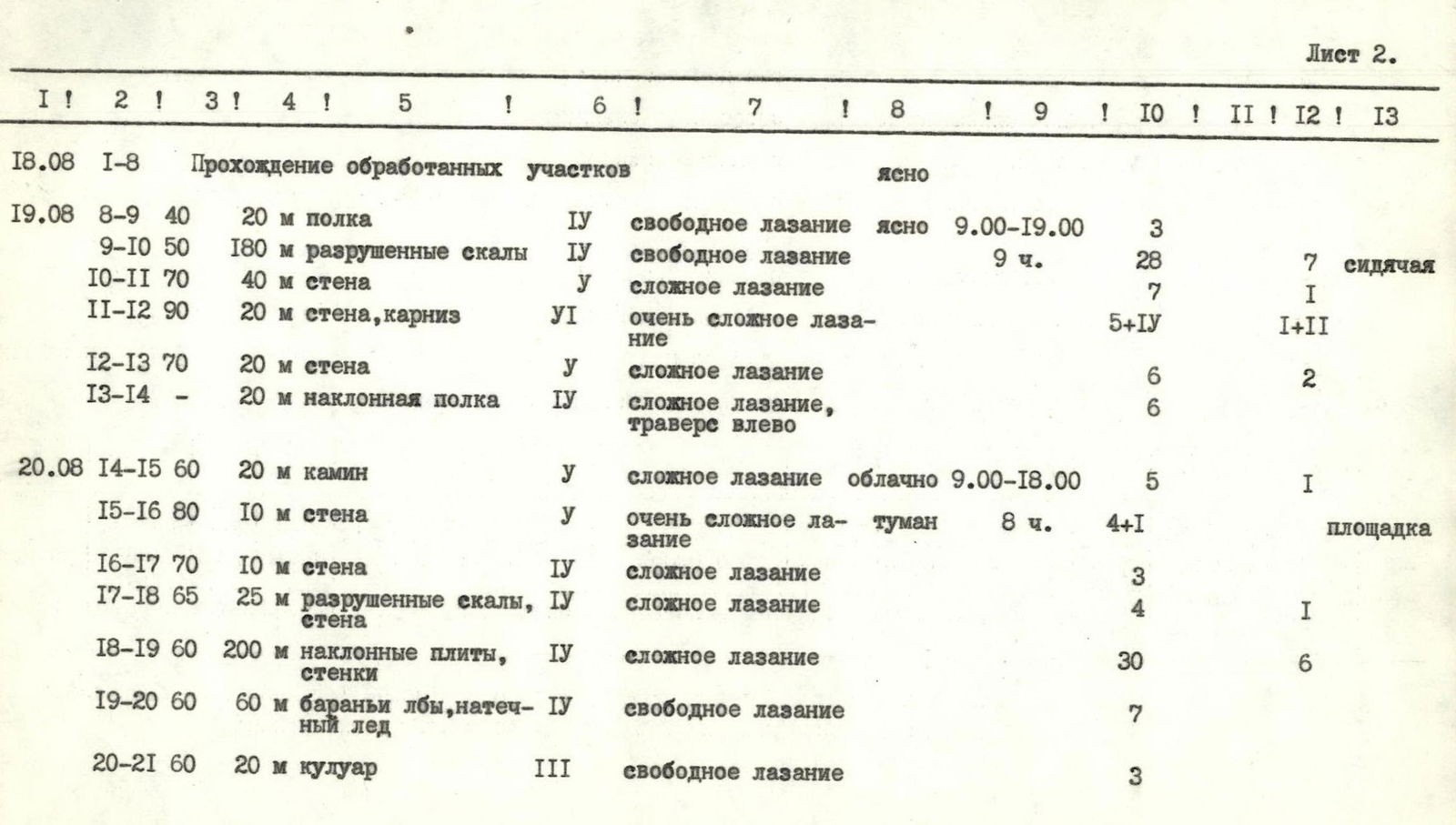 Sheet 2.
| Dates | Sections Covered | Average Steepness of Section (in degrees) | Length of Section | Characteristics of Section and Passage Conditions (by terrain character) | Difficulty Categories | By Method of Overcoming and Belay | By Weather Conditions (departure time, climbing hours) | Pitons Driven (rock, bolt, chockstones) | Overnight Conditions |
|---|---|---|---|---|---|---|---|---|---|
| 18.08 | R1–R8 | - | Passage of processed sections | - | clear | - | - | - | - |
| 19.08 | R8–R9 | 40 | 20 m shelf | 4 | free climbing | clear 9:00–19:00 | 3 | 7 sitting | |
| R9–R10 | 50 | 180 m destroyed rocks | 4 | free climbing | 9 hours | 28 | |||
| R10–R11 | 70 | 40 m wall | 5 | complex climbing | 7 | 1 | |||
| R11–R12 | 90 | 20 m wall, cornice | 6 | very complex climbing | 5+4 | 1+2 | |||
| R12–R13 | 70 | 20 m wall | 5 | complex climbing | 6 | 2 | |||
| R13–R14 | - | 20 m inclined shelf | 4 | complex climbing, traverse left | 6 | 6 | |||
| 20.08 | R14–R15 | 60 | 20 m chimney | 5 | complex climbing | cloudy 9:00–18:00 | 5 | 1 | |
| R15–R16 | 80 | 10 m wall | 5 | very complex climbing | fog 8 hours | 4+1 | platform | ||
| R16–R17 | 70 | 10 m wall | 4 | complex climbing | 3 | ||||
| R17–R18 | 65 | 25 m destroyed rocks, wall | 4 | complex climbing | 4 | 1 | |||
| R18–R19 | 60 | 200 m inclined slabs, small walls | 4 | complex climbing | 30 | 6 | |||
| R19–R20 | 60 | 60 m ram's foreheads, flowstone | 4 | free climbing | 7 | ||||
| R20–R21 | 60 | 20 m couloir | 3 | free climbing | 3 |
 Sheet 3.
| Dates | Sections Covered | Average Steepness of Section (in degrees) | Length of Section | Characteristics of Section and Passage Conditions (by terrain character) | Difficulty Categories | By Method of Overcoming and Belay | By Weather Conditions (departure time, climbing hours) | Pitons Driven (rock, bolt, chockstones) | Overnight Conditions |
|---|---|---|---|---|---|---|---|---|---|
| 21.08 | R21–R22 | 65 | 40 m wall | 4 | free climbing | 14:00–18:00 | 7 | platform | |
| R22–R23 | 80 | 30 m wall | 6 | complex climbing, traverse left | snowfall 4 hours | 5+4 | |||
| wind | |||||||||
| 22.08 | R23–R24 | 85 | 30 m wall | 6 | very complex climbing, artificial aids, ladders, platform | Clear 9:00–21:00 | 2+ XI 1+4 | 2 | platform |
| R24–R25 | 85 | 30 m wall | 6 | very complex climbing, ladders, platform | 2+ XIII 1+5 | 4 | |||
| 23.08 | R25–R26 | 80 | 40 m wall | 5 | very complex climbing, ladders | cloudy 9:00–19:00 | 10+5 | 2 | 4 platform |
| R26–R27 | 70 | 20 m inner corner | 6 | complex climbing, ladders | wind 10 hours | 4+2 | 3+3 | ||
| R27–R28 | 60 | 20 m destroyed rocks | 4 | complex climbing, traverse left | 6 | ||||
| R28–R29 | 70 | 15 m wall | 5 | complex climbing, ladders | 3+2 | 1 | |||
| R29–R30 | 80 | 15 m wall | 4 | complex climbing, ladder, traverse left | 4+1 | 3 | |||
| 24.08 | R21–R30 | Passage of processed sections | - | - | cloudy 9:00–21:00 | - | sitting | ||
| wind 12 hours |
Sheet 4.

| Dates | Sections Covered | Average Steepness of Section (in degrees) | Length of Section | Characteristics of Section and Passage Conditions (by terrain character) | Difficulty Categories | By Method of Overcoming and Belay | By Weather Conditions (departure time, climbing hours) | Pitons Driven (rock, bolt, chockstones) | Overnight Conditions |
|---|---|---|---|---|---|---|---|---|---|
| 25.08 | R30–R31 | 70 | 40 m wall | 4 | complex climbing | 9:00–14:00 | 5+1 | 2+2 | |
| R31–R32 | 70 | 80 m wall, traverse | 4 | complex climbing | overcast | 18+4 | in the gorge | ||
| R32–R33 | 70 | 40 m destroyed rocks | 4 | complex climbing | wind 5 hours | 7 | |||
| R33–R34 | 45 | 400 m ridge | 2 | free climbing, snow, simultaneous belay |
Descent from the summit to the Dridzh gorge 15:00–21:00 6 hours.
August 26 Return to the base camp in the Kishty-Dzherob gorge.
Team Captain (Azegov A.K.) Team Coach (Kharlanov G.L.)
Description of the Ascent Route to Peak "TadGU" 6183 m via the East-South-East Wall, 6B Category of Difficulty
The group departed from the base camp on the "green meadow" in the Kish ty-Dzherob gorge on August 14, 1982, at 9:00. They reached the overnight location under the "Alpinist" pass by 19:00. On August 15, 1982, they crossed into the Zugvand gorge and set up the lower camp by 14:00. On August 15, 1982, and the first half of August 16, 1982, they observed the route and planned the ascent schedule.
On August 16, 1982, at 13:00, they began processing the lower part of the route.
Section R0–R1. The start of the route is to the left of the rockfall-prone couloir with characteristic rock ejections under the wall. After exiting the couloir onto an ash shelf, they quickly crossed the shelf (the most dangerous area) and emerged under the wall. Simultaneous belay through ledges.
Section R1–R2. The wall was ascended via an inner corner (complex climbing), using ladders in the middle section. Rock pitons and chockstones were used.
Section R2–R3. Traversed right along shelves and destroyed rocks to a wall with a chimney filled with ice. Free climbing. Belay via pitons.
Section R3–R4. Ascended 10 m up the chimney. Extremely complex climbing, cracks filled with ice, use of artificial aids and ladders. Descent to the lower camp followed.
On August 17, 1982, at 13:00, they ascended via previously hung ropes and continued processing the route.
Section R4–R5. Traversed right along ash shelves, with destroyed rocks, water, and flowstone. Piton belay.
Section R5–R6. Ascended 20 m directly up to a tower. Complex climbing. Pito n belay, using shveltera.
Section R6–R7. 40 m ascent along an ash shelf, followed by a 120 m traverse right towards the edge. Shelves are inclined, heavily destroyed, and prone to rockfall. Belay via pitons and ledges.
Section R7–R8. Ascended 25 m along easy rocks and ram's foreheads to an overhanging cornice. The cornice was traversed in the middle section via an inner corner. Artificial aids and ladders were used. A convenient location for belay and a platform for overnight stay followed.
Descent to the lower camp.
On August 18, 1982, 13:00 – 19:00. Ascent via pre-hung ropes. Transfer of the lower camp to the first camp on the wall. Ropes were used to pull up backpacks on sections R1–R2, R3–R4, R5–R6, and R7–R8.
On August 19, 1982, processing of the route continued.
- Section R8–R9. Traversed right 20 m from the overnight location. Ash shelf, water, ice. Pito n belay.
- Section R9–R10. Ascended 180 m along rocks of moderate steepness. Rocks are destroyed, wet in places, with flowstone. Pito n belay, using chockstones.
- Section R10–R11. Ascended 40 m up a gray wall, exiting under gray cornices. Complex climbing. Rocks are monolithic. Belay via pitons.
- Section R11–R12. Slightly deviated left along an inner, not clearly defined angle under the base of the cornice. Extremely complex climbing. Use of artificial aids and ladders. Exit to the top followed.
- Section R12–R13. Ascended along the wall, adhering to the right side, to an overhanging marble cornice. Complex climbing, petal pitons.
- Section R13–R14. Traversed left under the cornice onto ash shelves to a projection of a red wall. Complex climbing, inclined shelves, flowstone. Belay: pitons, chockstones. Convenient location for a sitting overnight stay.
Descent to the first camp.
On August 20, 1982, ascent via ropes and further processing of the route.
- Section R14–R15. Ascended up a chimney, free climbing, rocks are fragmented, belay via pitons.
- Section R15–R17. The chimney ends at a wall 10 m high. After passing the wall, they exited onto an ash shelf before the second gray wall. Rock is monolithic, petal pitons, complex climbing.
- Section R17–R18. Traversed right along the shelf and destroyed rocks towards the edge. Free climbing, pitons, shveltera, chockstones.
- Section R18–R19. Ascended directly up along inclined slabs and small walls to rocks resembling ram's foreheads, filled with water and flowstone. Complex climbing, piton belay, chockstones.
- Section R19–R20. Ascended slightly left along ram's foreheads under the wall. Simple climbing. Pito n belay.
- Section R20–R21. Ascended up a couloir under the powerful gray walls of the upper belt. Platform for overnight stay.
Transfer of the camp from I to II, which was set up behind section R13–R14. A small platform, sitting overnight stay.
On August 21, 1982, ascent via ropes to the platform and further processing of the route. Organization of camp III.
- Section R21–R22. Ascended left up the wall, adhering to the inner corner formed by the gray belt and the marble belt, to a small shelf. Convenient location for belay. Pito n belay.
- Section R22–R23. Ascended along a smooth wall, slightly traversing left to a small inner corner. Exit to a platform under the base of the gray smooth belt followed. Ladders were used on this section, extremely complex climbing.
This marked the beginning of the key section of the route. Descent to camp III.
On August 22, 1982, further processing of the route.
Section R23–R24. Ascended directly up the smooth gray wall 7 m (3 bolt pitons). Then traversed left 10 m to white outcrops. Ascended up a not clearly defined angle with a thin crack. Artificial aids were used exclusively.
A location for belaying the next participant was organized in a hanging position (bolt piton with ladder).
Section R24–R25. Continued ascent up the monolithic wall 35 m. Belay via pitons (5 bolt pitons), using shveltera and petal pitons for hanging platforms and ladders. The rope was also ascended using artificial aids.
Descent to camp III for overnight stay.
On August 23, 1982, ascent via ropes past section R20–R21. Continued processing of the route.
Section R25–R26. Traversed left along the wall to a large gray outcrop. Ascended 10 m up the wall to a convenient belay location. Pito n belay, using bolt pitons in the middle section and after the outcrop. Very complex climbing, ladders, platform.
Section R26–R28. Ascended along an inner corner with an overhang in the upper part. Complex climbing. Pito n belay.
Section R28–R30. Ascended up the right edge of the light wall under the overhang. Then traversed left and ascended onto an ash shelf. Pito n belay, shveltera, chockstones. Organization of camp IV followed. Descent to camp III.
Camp IV was set up in a snow ash (sitting).
On August 24, 1982, transfer of camp III to camp IV. All participants were belayed on all sections from R21 to R30.
On August 25, 1982, passage of the final ropes on the wall, exit to the ridge, and reaching the summit.
Section R30–R31. Ascended 40 m up and left under a large cornice. Complex climbing, pulling up backpacks. Belay via pitons and chockstones.
Section R31–R32. Traversed left towards the ridge, to the end of a horizontal shelf. Convenient belay location.
Section R32–R33. Ascended 40 m up along an inner corner to the ridge. Simple climbing. Pito n belay.
Section R33–R34. Ascended along the ridge, along the boundary of snow and rocks, to the summit (400 m).
The group reached the summit on August 25, 1982, at 14:00. Descent followed along the Rovny glacier to the Dridzh gorge.
Team Captain (Azegov A.K.) Team Coach (Kharlanov G.L.)
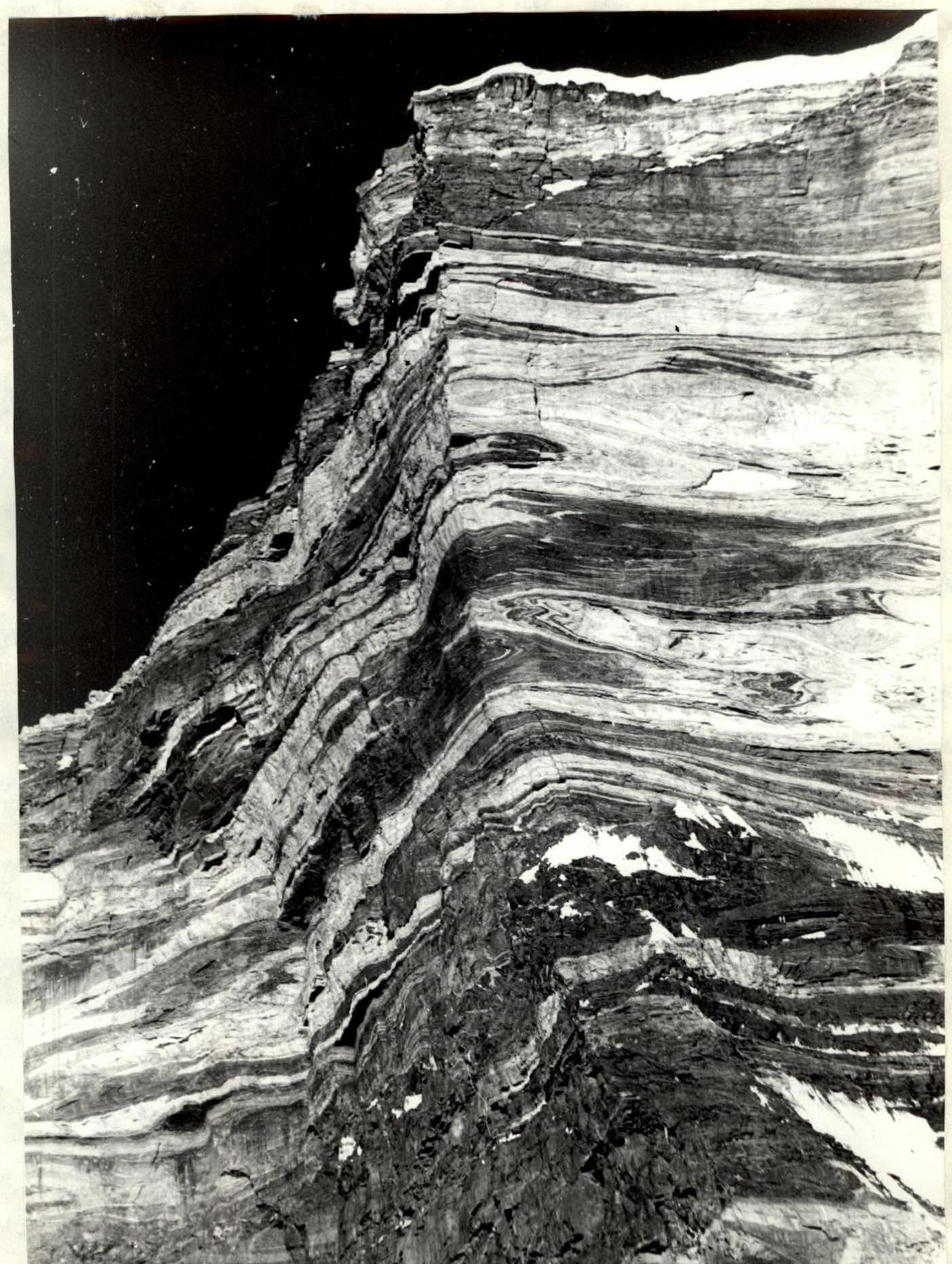
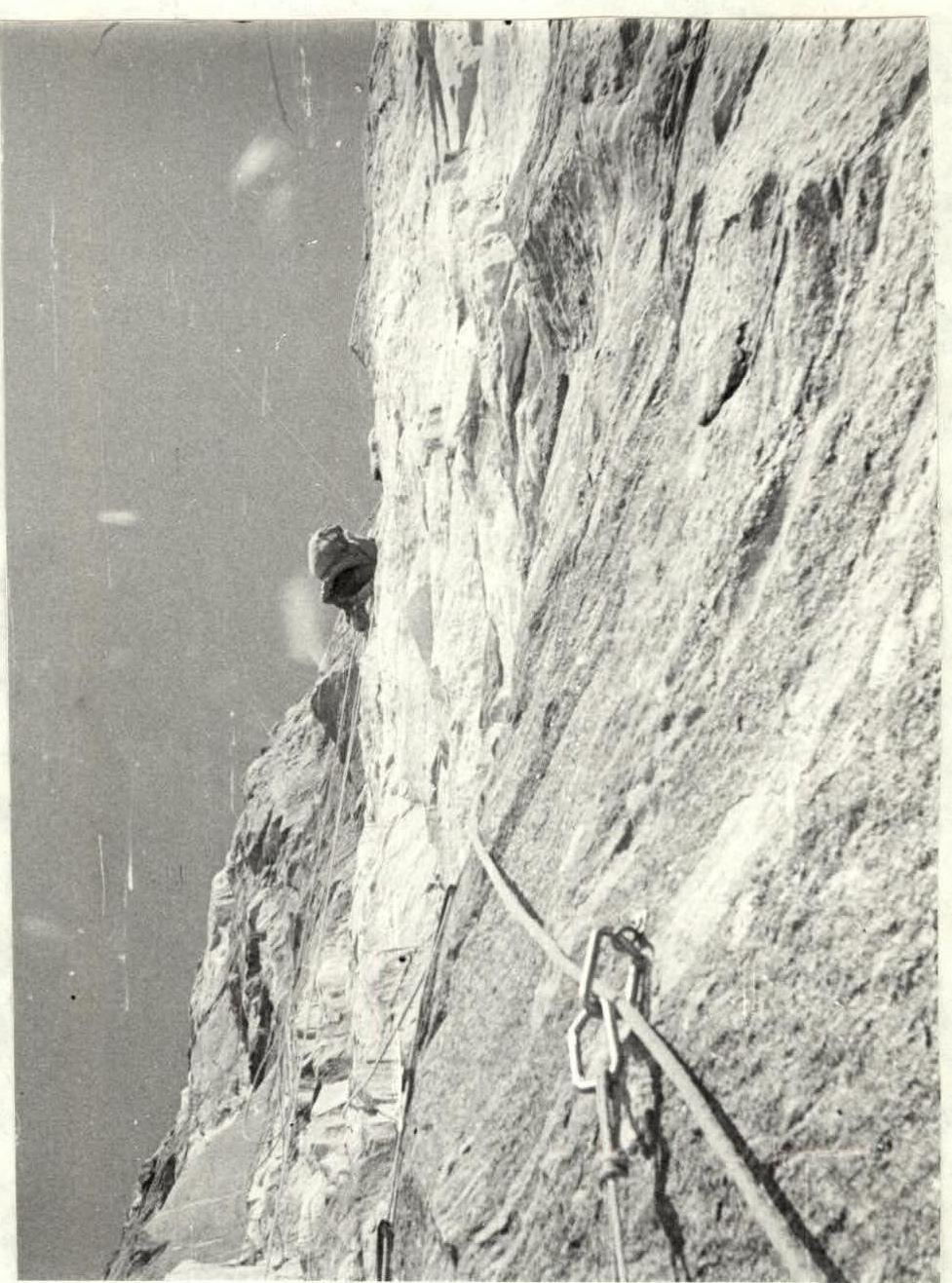
Upper Part of the Edge between the South-East and East Walls
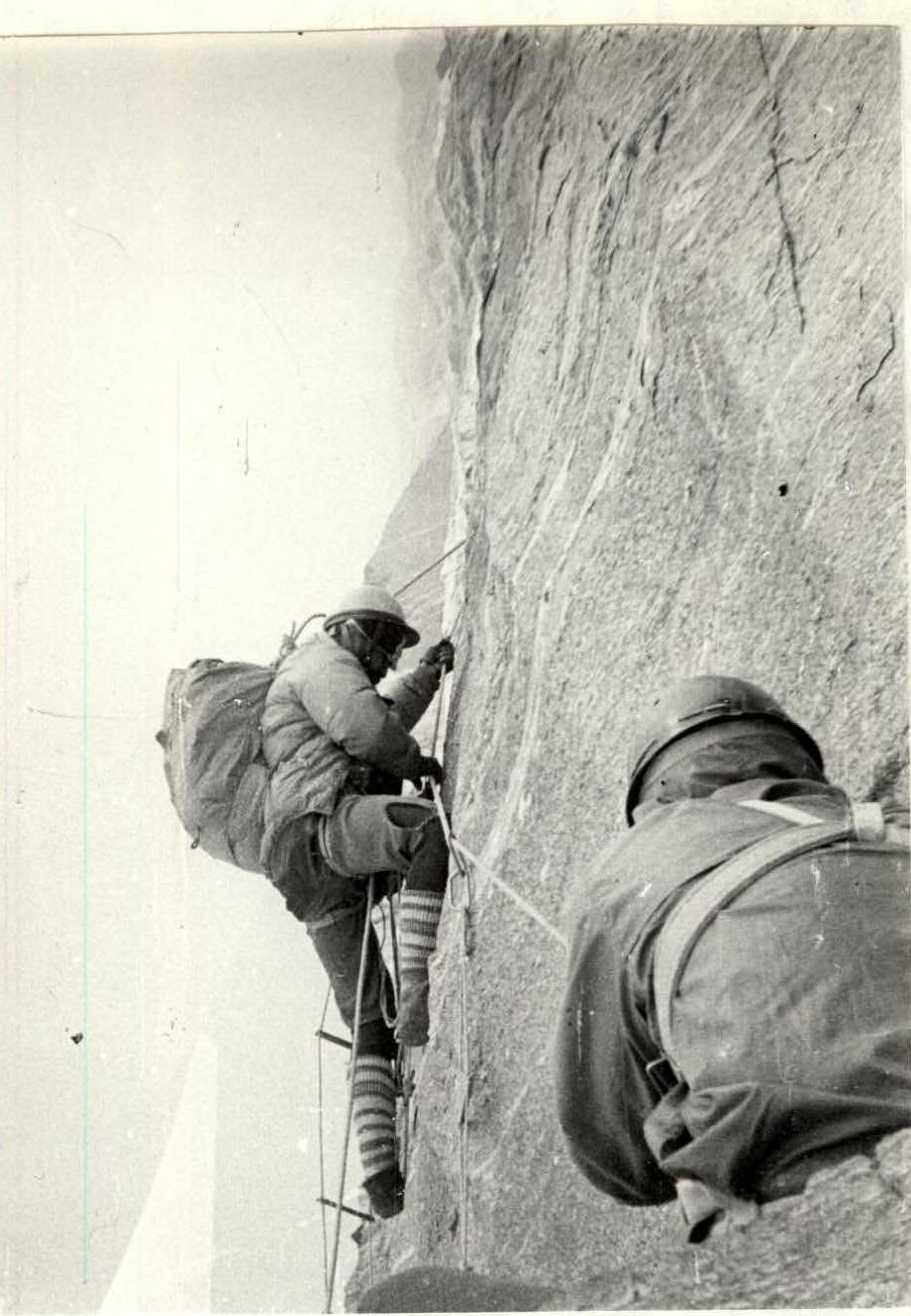
Passage of Ropes on Section R22–R23