
Climbing Passport
- Climbing type — high-altitude technical.
- Climbing area — SW Pamir, Shakhdara Range.
- Peak, its height, climbing route: peak Moskovskaya Pravda 6075 m, N-E wall. /variant/
- Anticipated category — 6th category of difficulty.
- Route characteristics: height difference: 1180 m, length of sections with 5B, 6th category of difficulty — 1325 m, wall steepness 83°.
- Number of pitons used: 464.
- for belaying: rock 238, ice 19, bolt 3.
- for artificial climbing aids (ITО): rock 226, bolt 1.
- Number of climbing hours — 118.
- Number and characteristics of bivouacs: — 10: 2 lying down, 2 sitting, 6 hanging.
- Full name of team leader, participants, and their qualification:
- Kapitanov Oleg Viktorovich — Master of Sports of International Class (MSMK) — team leader.
- Galaktionov Viktor Ivanovich — MSMK.
- Rizaev Leonid Mukhamedovich — MSMK.
- Dzhurabekov Telabek Khalimbekovich — MSMK.
- Kalmykov Sergey Georgievich — MSMK.
- Bakman Alexander Romanovich — Candidate Master of Sports (KMS).
- Team coach — Honored Coach of Tajik SSR Sogrin Sergey Nikolaevich, MSMK.
- Departure date — August 2, 1978. Return date — August 13.
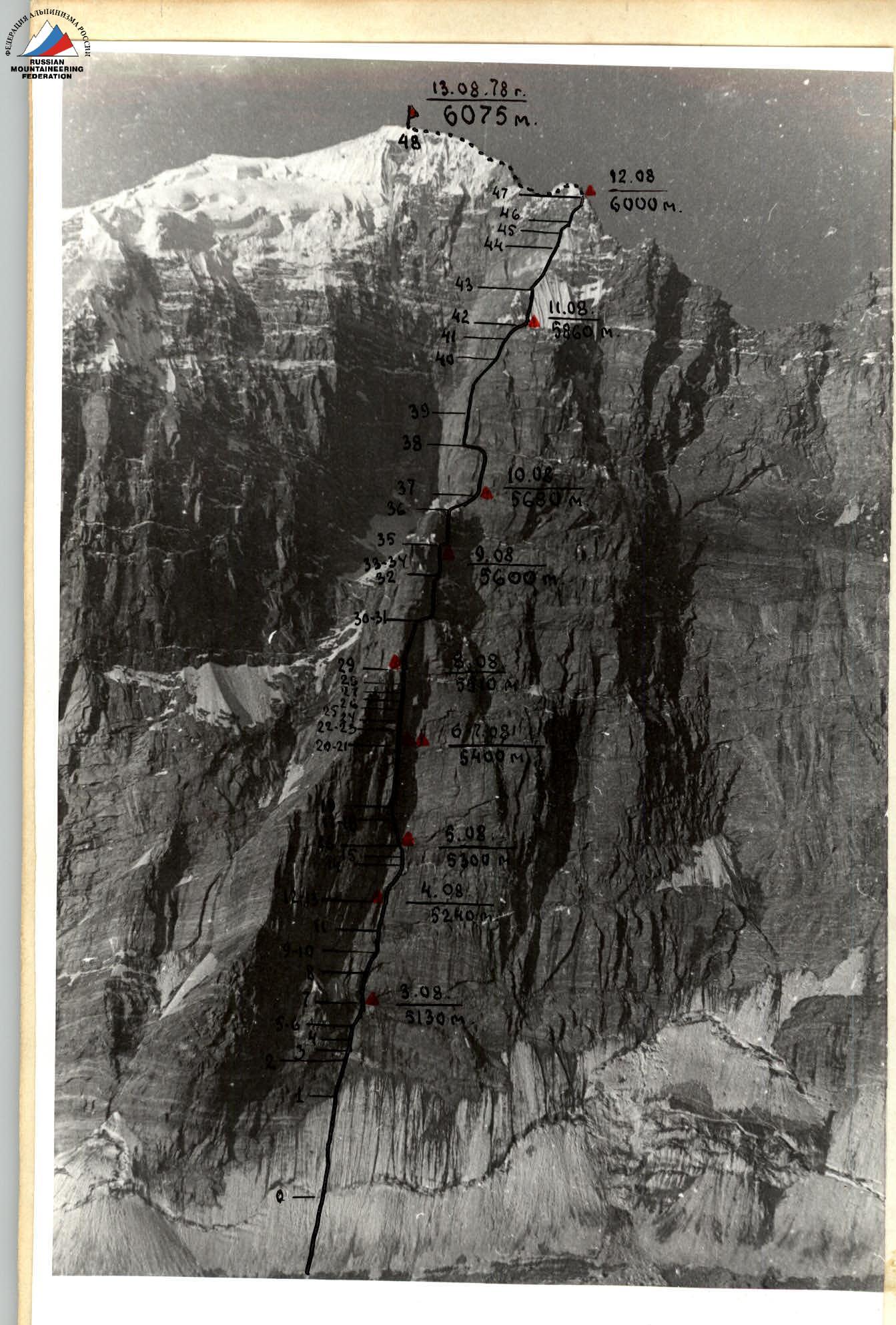
"Tactical Plan"
The tactical plan is based on ensuring a reliable and safe passage of the route within the framework of the 1978 USSR Alpine Climbing Championship. The route was chosen after:
- thorough observation and study of the northeast wall;
- consultations with leaders of previously climbed routes (Snesarev A.A., Solonnikov V.A.).
Observation Results
Although SW Pamir is considered a warm high-altitude region, it is characterized by a sharp difference in climbing conditions between north and south walls. There is no water on the northern routes — low temperatures and significant ice coverage on the rocks. The northeast wall has an impressive steepness (Snesarev, Solonnikov 82–85°). The route follows the contact zone between the western slope of a steep and beautiful counterfort (known as "White Bear") and the northeast wall, consisting of strong monolithic rocks with few suitable locations for organizing, possibly even sitting, bivouacs. Low temperatures are an undesirable companion for climbers. However, most of the chosen route is not exposed to the sun, and the upper part of the wall is only lit in the morning from 6:30 to 11:00. The route is not affected by regular rockfall; only occasional rock and ice falls are possible with sharp changes in weather conditions, which is not typical for this area during this period.
Rationale for Route Selection
- The route is complex, logical, beautiful, and safe.
- The variant of passing the wall via the counterfort is no less beautiful and steep but is extremely dangerous in its lower part and thus lacks logical resolution and technical interest. Blocks of ice and rocks falling from the crest of the "Moskovskaya Pravda" massif regularly hit the counterfort from the left edge, particularly intensely in good sunny weather.
- Rock and ice falls from the "White Bear" pinnacle are possible, but their paths do not intersect with the route. Some ice falls follow a couloir descending from the pinnacle to the center of the wall, while others fall into a large couloir that cuts through the wall to the left of the counterfort.
- Ice falls from the upper part of the route are possible, but their paths also have a southeast orientation and end in the couloir to the left of the counterfort.
- The route avoids rockfall zones, and to eliminate the possibility of being hit by an unexpected ice and snow fall, it is led directly under the base of the "White Bear" pinnacle to the crest of the counterfort (5th bivouac) with a subsequent ascent to the "White Bear" summit.
The schedule for passing the route was presented by the team to the judging panel and is reflected in the route sheet.
The team decided to process large sections of the route each day from one bivouac to the next planned one. After ensuring its safety, they would move to the new bivouac location.
This achieved the following:
- The route is processed lightly, without backpacks, with a constant change of lead climber, which is crucial for a complex and cold route.
- Since there are practically no ledges for bivouacs, organizing them requires significant effort and time, which is possible during processing.
- Most bivouacs are shifted to the left of the route, so participants on a bivouac are completely safe relative to the processing climbers.
- The possibility of organizing a bivouac in a random and unsafe location is excluded.
- The team can get necessary rest and reasonably manage their energy reserves.
To implement this tactical plan, the team had a sufficient supply of ropes — 300 m. The weight of backpacks did not exceed 10–12 kg, allowing for movement on complex sections. There were enough people for both processing with a change of lead and organizing bivouacs (6 people).
For this route, the group composition and chosen ascent tactics allowed for a reasonable distribution of forces, organization of participant rest, and creation of necessary reliability.
On the route, when passing processed sections, participants moved with backpacks, which was practiced during training ascents.
The monolithic nature of the rock relief, cold, and steep wall impose special requirements on the selection of equipment: both personal and group.
90 pitons of various types, "nuts" of different systems, a lightweight platform, and crampons, titanium carabiners (70 pcs.), and a full set of ice screws ensured the team could resolve technical challenges of any complexity. For organizing bivouacs, there were bolt pitons in the necessary quantity (7 × 2 = 14 pcs.).
Well-chosen footwear and clothing for participants, considering the route's specifics, ensured its completion according to the presented schedule.
Tactical Movement Scheme of the Group
Three participants process the route, changing throughout the day. The remaining three ascend on previously fixed ropes, remove the protection, extract pitons, and organize a bivouac.
The next morning, the team ascends on the processed ropes, but the first trio is replaced by the second, and so on. If necessary, one climber from the processing trio is "seconded" to help the lower group with rope hauling. Pitons are passed using spare ropes.
Each trio has its own first-aid kit.
Communication with observers is maintained by the lower group.
The upper trio takes photos, keeps a diary.
Climbing hours are limited to 11 per day.
Departure is not later than 9:00 due to lack of water.
Meals are twice a day — morning and evening. A "pocket ration" is provided for the day.
Route Description (Brief Explanation of the Table)
Day One, August 2, 1978
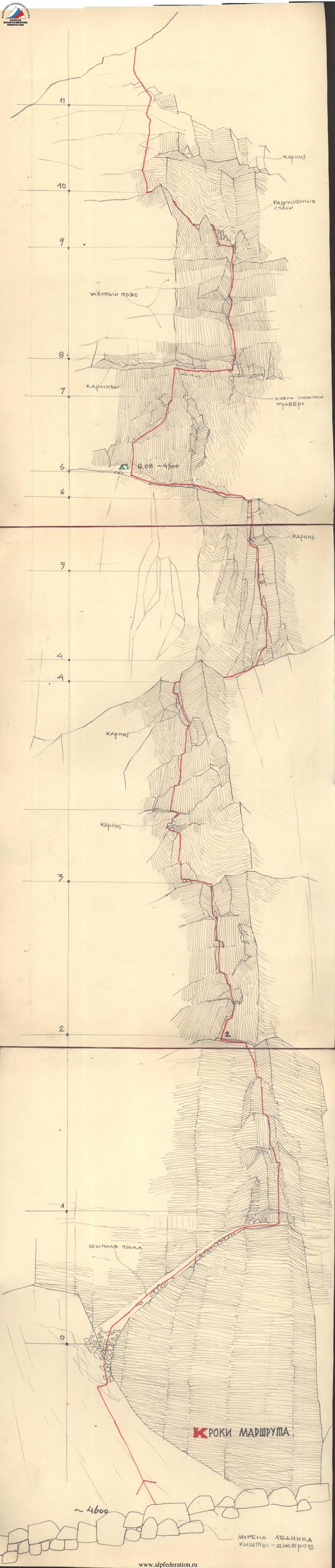
The route follows the north-northeast wall of peak Moskovskaya Pravda along the line where the right slope of the northeast counterfort meets the northeast wall. The camp is located directly under the route on the Kheshy-Dzherob glacier.
From the bergschrund, ascend 140 m up a steep ice slope to the rock band. Ice is climbed on front points with the use of "tubes" and corkscrews (R0–R1).
The rock band starts with a gray (60 m) wall with cracks, which in its upper part turns into a smooth slab.
Sections R0–R2 are completed in 6 climbing hours.
Second Day
On the left part of the gray slab, there is a five-meter cornice wrapping around the wall. R2–R3. The cornice is passed with complex climbing using ladders and pitons with artificial climbing aids (ITО).
Beyond the cornice, there is also a slab with "live" layers (30 m). Climbing is tense and difficult psychologically (R3–R4).
The slab leads to a 15-meter internal corner with a slit and is capped by a cornice.
Climbing involves:
- Traversing right to bypass the cornice along the right side of the corner to reach a belt of broken rocks.
- Free climbing with the use of "petals" and wedges (R5–R6).
The belt of broken rocks is not steep (65°) but very crumbly.
Climbing features:
- Psychologically tense climbing.
- Almost no possibility to hammer in a piton.
- Complex belaying through ledges and pitons (30 m, R6–R7).
At the top of the belt under the wall to the right of two "triangular" snow patches — a bivouac (sitting). The ledge is narrow but quite long.
Above the bivouac, there is a clearly defined gray internal corner with a steepness of 80°. 60 m of combined, difficult climbing: from free climbing to using ladders and " закладок" (R7–R8).
Third Day
The internal corner leads to a steep 35-meter wall with a crack. Handholds are small. Climbing is complex, at the limit of possibility. At the top, there is a ladder. The wall leads to a 40 cm ledge under a cornice. Along the ledge, traverse right to rocks of block type with a system of small internal corners. There are few cracks. Steepness is 80°. Climbing is free and tense. After 30 m (R10–R11) — 1st Giant internal corner. Traverse right behind its right edge and enter a smooth, narrow internal corner (R11–R12). 45 m of desperate climbing with the use of ladders and закладок — and we are under the 1st giant cornice blocking the path. Traverse left 10 m. Climbing is psychologically complex. 2nd bivouac. Carved into ice settled on narrow inclined ledges. A bolt piton is hammered in for belaying. The bivouac is complex to organize, sitting.
Fourth Day
Directly above the bivouac — a 40-meter steep white-gray wall. Above it, there is a cornice (R14–R15). The wall (R13–R14) is climbed with the most complex climbing using:
- pendulums,
- ladders,
- закладок.
The 8-meter cornice requires enormous physical tension; it is passed using:
- "Zaltsug",
- ladders,
- pendulum.
The cornice leads under a 10-meter bastion of rock blocks transitioning into an outer corner of sharp rock "feathers" (R16–R17) — free climbing. The outer corner leads to the 2nd Giant cornice. The cornice is bypassed by traversing left with extremely complex climbing along an 80° inclined smooth slab. At the end of the traverse, there are small ledges where backpacks are hauled up. Bivouac at the top of the bastion of blocks (R15–R16).
Fifth Day
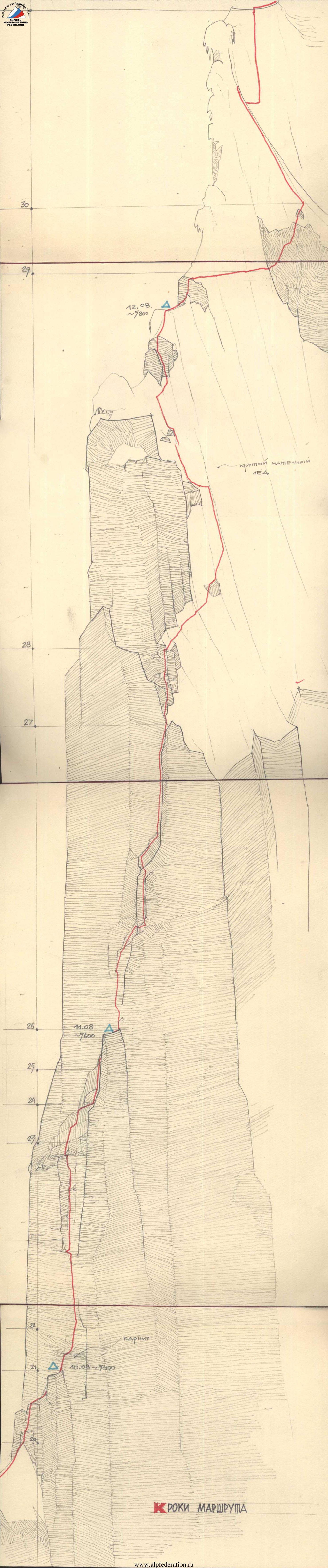
Above the second giant cornice — a huge internal corner with three smaller corners inside, formed by rock slabs. Along the left (R18–R19) side of the giant corner — 25 m of complex climbing with ladders upwards to a smooth, sheer slab. From here, descend 25 m to the base (roof) of the giant cornice or the bottom of the internal corner. Climb up the second "petal" of the corner along a crack. At the top, the corner turns into an overhang. Climbing is complex, combined: from free climbing at the limit of possibility to using ladders, platforms, "Zaltsug", and pendulum. The 90-meter corner leads to narrow ledges filled with ice. Backpacks are hauled up (R19–R20). Bivouac is hanging under the 3rd giant cornice with a white face.
Sixth Day
- The cornice is bypassed on the left along an icy belt of blocky rocks (R21–R22),
- Traverse right (20 m) under the internal corner on the left face of the cornice.
Climbing is cautious, psychologically tense. The internal corner is closed by a cornice (R25–R26), under which one can pass with complex climbing along a 15-meter wall and an offset. Ladders are used (R23–R25). The 6-meter cornice is passed using the highest technique and leads into a sheer internal corner with slab layers. "Zaltsug", free climbing, ladders, закладок — required enormous physical tension to pass section R26–R28 (corner with a cleft, 60 m). Bivouac is below the cornice at the previous location.
Seventh Day
The cleft leads under a brown 85° wall of blocks under the wall; there is a ledge a meter wide. Backpacks are hauled up here. The 40-meter wall (R28–R29) leads to the left edge of the 3rd giant internal corner under the base of the "White Bear" pinnacle. The base of the pinnacle is the 4th giant cornice. Free climbing along the wall and using ITО on the corner edge leads under the cornice.
Eighth Day
Along small ledges, traverse the cornice to the right to bypass it. The traverse is difficult psychologically and leads under a steep 85° rock wall filled with ice. The wall (R31–R32) is climbed with very tense climbing on the edge of free climbing (80 m). It approaches a not clearly defined internal corner with a negative slope (100°, 55 m). Climbing is exclusively on artificial holds with the use of ladders (R32–R33). Bivouac is hanging under the internal corner.
Ninth Day
Along an inclined ledge, traverse right (15 m) to the left edge of the lateral couloir descending from the "White Bear" pinnacle. The edge is a sheer wall filled with ice (45 m), transitioning into an ice wall with a steepness of 65°, which leads to the "White Bear" wall. Climbing is desperate, psychologically difficult, using the highest rock-ice technique. The ice wall (R35–R36) is climbed in crampons. "White Bear" consists of huge ice cornices facing east. Cornices are bypassed on the left with relatively easy climbing (R36–R37). A huge bastion leads to the pinnacle. At the base of the bastion — a bivouac on ledges. Control pitch. Overall height gain on the ledges is about 40 m.
Tenth Day
On the left part of the bastion — a 60-meter wall with rock "feathers" (R38–R39) with a steepness of 90°. The wall leads to the main wall of the bastion (R39–R40). 180 m of complex climbing, sometimes using ITО, — and we reach an internal corner filled with ice and clogged with icicles (R40–R41). Tense climbing with ladders passes through the internal corner and a 30-meter rock wall under the snow-ice ridge (R41–R42). Bivouac is hanging under the wall's base. The bastion is passed; the wall is passed.
Eleventh Day
A 40-meter ice wall with a 50° steepness leads to an ice ridge. 150 m along the ridge upwards and a 20 m traverse left — to a rock groove. Crampons, ice screws of various types, rock pitons, and belaying through ice ledges were used (R42–R45). The rock groove (R45–R46) leads to a large-block wall (100 m). Climbing is free with the use of pitons. The wall leads to the main ridge. Bivouac.
Twelfth Day
Along the ridge, on несложных, разрушенных скалах — выход на вершину 300 м.
Thus, the route was completed in 12 climbing days, or 122 climbing hours.
464 pitons were hammered in, including 19 ice and 3 bolt pitons.
The route length to the pre-summit ridge is about 2000 m, with an average steepness of 75° and a height difference of 1400 m.
The length of the route along the wall section is about 1500 m (without traverses — 1210 m).
The average steepness is 83°, and the height difference is 1170 m. Out of 10 bivouacs: 2 lying down, 2 sitting, and 6 hanging.
The weather was clear, except for the last two days. It was cold on the route, with no water — only ice.
Team Coach
 Trem Korangn.
ВСТОЛИ МАЙБУВА
Live maput!
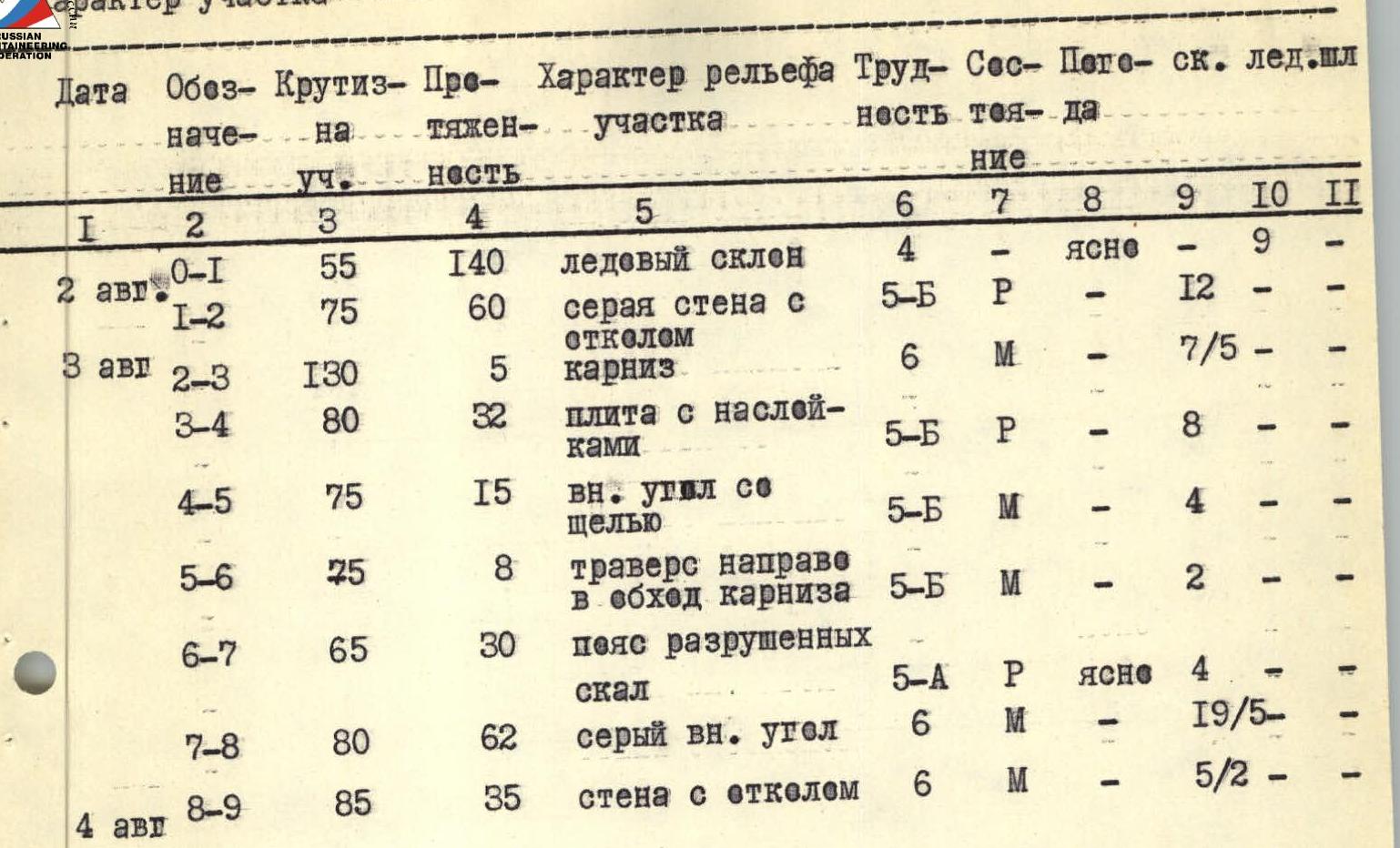
August 2, 1978. Processing. In 7 climbing hours, 200 m of the route were covered (R0–R2). 12 rock, 9 ice pitons were hammered in.
August 3. In 11 climbing hours, 350 m of the route were covered and processed (R0–R8). 44 rock pitons were hammered in, including 10 ITО.
Bivouac was sitting at the top of the belt of broken rocks (R6–R7).
Control pitch.
| Date | Section | Steepness | Length | Terrain Characteristics | Difficulty | Category | Weather | Rock Pitons | Ice Pitons | Bolt Pitons |
|---|---|---|---|---|---|---|---|---|---|---|
| Aug 2 | R0–R1 | 55 | 140 | ice slope | 4 | Clear | 9 | |||
| R1–R2 | 75 | 60 | gray wall with cracks | 5B | P | 12 | ||||
| Aug 3 | R2–R3 | 130 | 5 | cornice | 6 | M | 7/5 | |||
| R3–R4 | 80 | 32 | slab with layers | 5B | P | 8 | ||||
| R4–R5 | 75 | 15 | internal corner with a slit | 5B | M | 4 | ||||
| R5–R6 | 75 | 8 | traverse right to bypass the cornice | 5B | M | 2 | ||||
| R6–R7 | 65 | 30 | belt of broken rocks | 5A | P | Clear | 4 | |||
| R7–R8 | 80 | 62 | gray internal corner | 6 | M | 19/5 |
August 4, 1978. In 9 climbing hours, 120 m of the route were covered (R8–R13). 31 rock pitons were hammered in, including:
- 7 ITО,
- 1 bolt piton for the bivouac.
Bivouac was sitting at the end of section R12–R13.
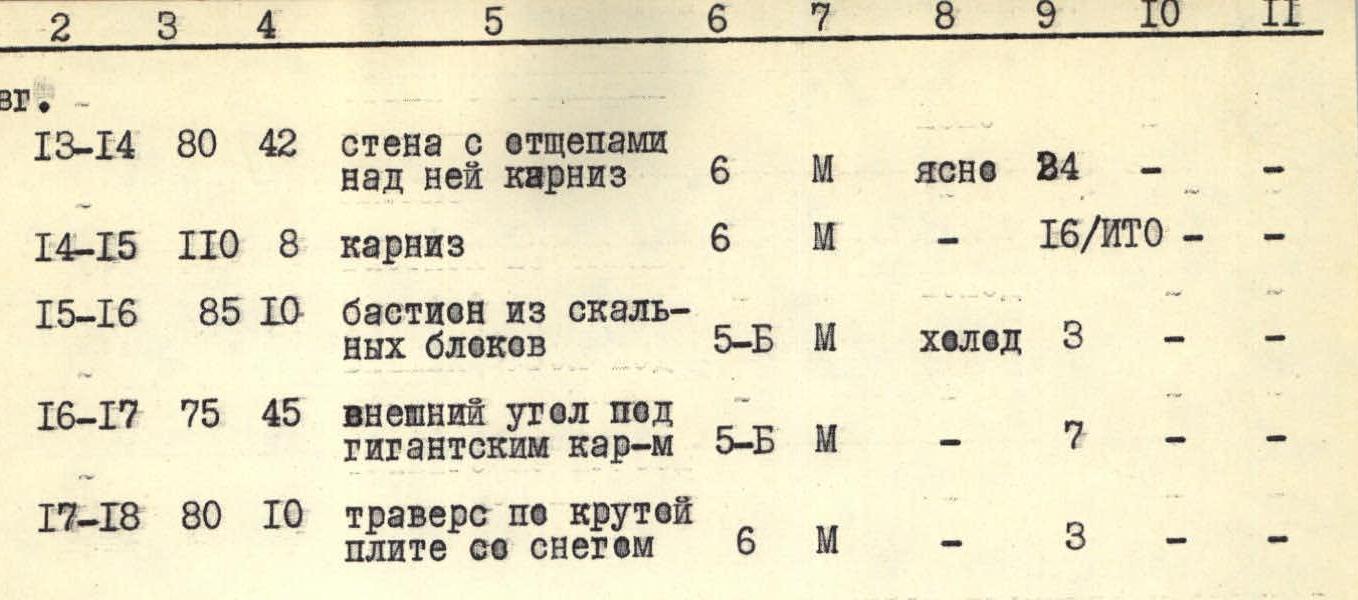
August 5, 1978. In 11 climbing hours, 115 m of the route were covered and processed (R13–R18). 53 rock pitons were hammered in, including:
- 30 ITО.
Bivouac was hanging at the top of the bastion (R15–R16).

August 6, 1978. In 11 climbing hours, 122 m of the route were covered:
- 60 rock pitons were hammered in.
- 51 ITО, 3 bolt pitons.
Bivouac was hanging at the end of the traverse of section R20–R21.
| Date | Section | Steepness | Length | Terrain Characteristics | Difficulty | Category | Weather | Rock Pitons | Ice Pitons | Bolt Pitons |
|---|---|---|---|---|---|---|---|---|---|---|
| Aug 5 | R13–R14 | 80 | 42 | wall with offsets and a cornice above | 6 | M | Clear | 34 | ||
| R14–R15 | 110 | 8 | cornice | 6 | M | 16/ITО | ||||
| R15–R16 | 85 | 10 | bastion of rock blocks | 5B | M | Cold | 3 | |||
| R16–R17 | 75 | 45 | outer corner under the giant cornice | 5B | M | 7 | ||||
| R17–R18 | 80 | 10 | traverse along a steep slab with snow | 6 | M | 3 | ||||
| Aug 6 | R18–R19 | 85 | 22 | wall with a crack on the left edge of the giant internal corner | 6 | M | Clear | 6 (ITО) | 3 | |
| R19–R20 | 90 | 90 | giant internal corner with an overhang | 6 | M | Cold | 45 (ITО) | |||
| R20–R21 | 70 | 10 | traverse right to bypass the cornice | 5B | 3 |
August 7, 1978. In 11 hours, 106 m of the route were covered (processed).
- 54 rock pitons were hammered in, including 31 for ITО.
- Bivouac was hanging at the same location.
| Date | Section | Steepness | Length | Terrain Characteristics | Difficulty | Category | Weather | Rock Pitons | Ice Pitons | Bolt Pitons |
|---|---|---|---|---|---|---|---|---|---|---|
| Aug 7 | R21–R22 | 80 | 25 | icy wall of blocky rocks | 5B | M | 8/3 | |||
| R22–R23 | 65 | 18 | traverse right to the internal corner on the left face of the cornice | 4 | M | Clear | 3 | 2 | ||
| R23–R24 | 75 | 13 | gray wall at the base of the internal corner. | 5B | M | 4 | ||||
| R24–R25 | 80 | 12 | offset under the cornice | 5B | M | Cold | 8/ITО | |||
| R25–R26 | 130 | 6 | Cornice closing the entrance to the internal corner. | 6 | M | Clear | 10/ITО | |||
| R26–R27 | 90 | 36 | sheer internal corner with slabs | 6 | M | 21/10 |
August 8, 1978. In 11 hours, 112 m of the route were covered. 42 rock pitons were hammered in, including 21 ITО. Bivouac was above the brown wall (R28–R29).
| Date | Section | Steepness | Length | Terrain Characteristics | Difficulty | Category | Weather | Rock Pitons | Ice Pitons | Bolt Pitons |
|---|---|---|---|---|---|---|---|---|---|---|
| Aug 9 | R30–R31 | 80 | 30 | traverse right under the "Bear's" cornice | 5B | M | 5 | |||
| R31–R32 | 85 | 80 | rock wall filled with ice. | 6 | M | 21/8 | ||||
| R32–R33 | 100 | 55 | not clearly defined internal corner, overhanging | 6 | P | Clear | 46/ITО |
August 9, 1978. In 11 hours, 165 m of the route were covered. 72 rock pitons were hammered in, including 54 ITО. Bivouac was semi-sitting under the internal corner R32–R33.
| Date | Section | Steepness | Length | Terrain Characteristics | Difficulty | Category | Weather | Rock Pitons | Ice Pitons | Bolt Pitons |
|---|---|---|---|---|---|---|---|---|---|---|
| Aug 10 | R33–R34 | 30 | 15 | traverse right to the left edge of the "Bear's" couloir | 3 | Clear | 3 | |||
| R34–R35 | 90 | 45 | left edge of the couloir, wall | 6 | 29/9 | |||||
| R35–R36 | 65 | 15 | ice wall of "White Bear" | 5B | Л | Cold | 5 | |||
| R36–R37 | 30 | 50 | bypassing the pinnacle along rocks under the bastion | 3 | P | 3 | ||||
| R37–R38 | 40 | 180 | inclined ledge at the base of the bastion. | 3 | P | 9 |
August 10, 1978. In 11 hours, 305 m of the route were covered. Hammered in:
- 44 rock (9 ITО)
- 5 ice pitons.
Bivouac was on laid-out platforms, lying down.
| Date | Section | Steepness | Length | Terrain Characteristics | Difficulty | Category | Weather | Rock Pitons | Ice Pitons | Bolt Pitons |
|---|---|---|---|---|---|---|---|---|---|---|
| Aug 11 | R38–R39 | 90 | 60 | wall with rock "feathers". | 5B | M | Cold | 10/2 | ||
| R39–R40 | 85 | 112 | "Bastion" | 5B | M | 22/7 | ||||
| R40–R41 | 85 | 60 | internal corner with icicles. | 6 | M | Snow | 18/8 | |||
| R41–R42 | 75 | 30 | wall under the snow ridge. | 5B | M | Snow | 4 |
August 11, 1978. In 11 climbing hours, 262 m of the route were covered, 54 rock pitons were hammered in (17 ITО). Bivouac was hanging under the wall (R41–R42).
| Date | Section | Steepness | Length | Terrain Characteristics | Difficulty | Category | Weather | Rock Pitons | Ice Pitons | Bolt Pitons |
|---|---|---|---|---|---|---|---|---|---|---|
| Aug 12 | R42–R43 | 50 | 40 | ice wall of the ridge | 4 | Л | Clear | 5 | ||
| R43–R44 | 40 | 150 | snow-ice ridge | 4 | 4 | |||||
| R44–R45 | 20 | traverse to the rock groove. | 3 | M | Clear | 1 | ||||
| R45–R46 | 60 | 25 | rock groove | 4 | M | 2 | ||||
| R46–R47 | 60 | 100 | large-block wall leading to the main ridge. | 5B | M | 9 |
August 12, 1978. In 11 climbing hours, 325 m of the route were covered. Hammered in:
- 16 rock pitons
- 5 ice pitons.
Bivouac was on the ridge, lying down.
| Date | Section | Steepness | Length | Terrain Characteristics | Difficulty | Category | Weather | Rock Pitons | Ice Pitons | Bolt Pitons |
|---|---|---|---|---|---|---|---|---|---|---|
| Aug 13 | R47–R48 | 400 | main ridge | 3 | P | Clear | 4 |
In 3 climbing hours, 400 m of the route were covered. 4 rock pitons were hammered in. 12:00 — summit.
| Date | Departure from camp | Arrival at bivouac | Climbing hours | Daily ration per person |
|---|---|---|---|---|
| Aug 2 | 11:00 | 18:00 | 7 | 600 g |
| Aug 3 | 9:00 | 20:00 | 11 | 400 g |
| Aug 4 | 9:00 | 18:00 | 9 | 400 g |
| Aug 5 | 9:00 | 20:00 | 11 | 350 g |
| Aug 6 | 9:00 | 20:00 | 11 | 350 g |
| Aug 7 | 9:00 | 20:00 | 11 | 350 g |
| Aug 8 | 9:00 | 20:00 | 11 | 350 g |
| Aug 9 | 9:00 | 20:00 | 11 | 350 g |
| Aug 10 | 9:00 | 20:00 | 11 | 350 g |
| Aug 11, 12 | 9:00 | 20:00 | 11, 11 | 300 g |
| Aug 13 | 9:00 | 12:00 | 3 | 250 g |
Recommendations
The wall is composed of strong, monolithic gray rocks. There are many cracks, but few suitable locations for organizing even sitting bivouacs. Ledges are inclined, small, and filled with ice. For organizing a bivouac, the following are necessary: ice screws (at least 3 pcs.), bolt equipment, hammocks, foam or porolon mats (for sitting bivouacs). It should be borne in mind that organizing a bivouac will take at least 2–3 hours. The optimal team size is 6 people. The route is cold — there is no water on it, only ice. One "Febus" stove fuel refill barely lasts a day. Various types of pitons are necessary, at least 80 pcs. The route is combined. The team used titanium crampons — 2 pairs and 7–8 ice screws. There is little free climbing, so ladders, закладок, and a lightweight platform are necessary.
Recommended bivouac equipment: Zdrovsky tents, pressure cooker. Personal equipment: "Vibram" boots, down jacket, "leg" — down, fur socks (for the first), woolen mittens, water flask.
60 m long ropes were used. Recommended food: cookies, soups, lard, crackers, dried fruits, sausage, and dried fish, honey with nuts. The weather is stable during late July — August.
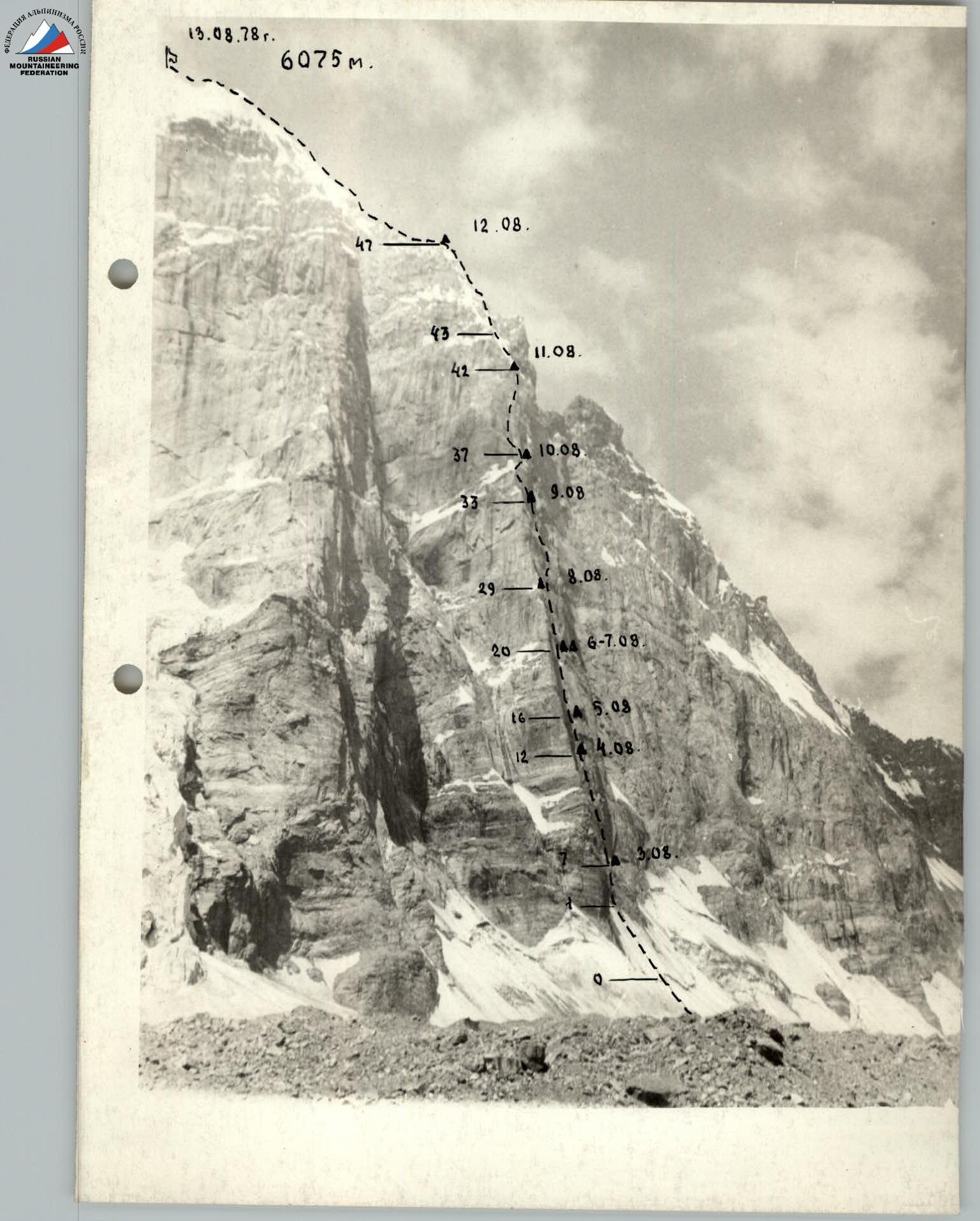
 Section R19–R20