
Ascent in the USSR Championship in alpinism
1979
- Class of ascent - high-altitude
- Region of ascent - Pamir
- Route of ascent - Peak Moskva (6785 m) via the southeast wall.
- Characteristics of the ascent: a) height difference - 2600 m. b) average steepness of the route - 75°. c) length of the most difficult sections vertically - 1500 m.
- Number of pitons used - rock 152 (including 40 channels and placements), ice - 46, and bolted - 5.
- Number of travel hours - 80.
- Number of bivouacs - 8 (including 6 sitting bivouacs on the wall).
- Team name - Team of the Sports Committee of the Georgian SSR or Gruzalpclub?
- Team composition - Khazaradze Otari Longinozovich (captain), Mirianashvili Shota Mirianovich (coach), Dandagze Dmitry Davidovich, Barliani Sergo Magevanovich, Gabisiani Shakro Nestorovich, Rybinsky Viktor Felixovich, Khergiani Akaky Vakhtangovich.
- Date of ascent - from August 12 to August 20, 1979.
- Place taken by the team

III. Bastion
1. Brief geographical characteristics of the Peak «Moskva» region
Peak Moskva is located at the intersection of two powerful mountain ranges of the Pamir, the latitudinal (Petra Pervogo) range, on which the highest peak of the Soviet Union - Peak Kommunizma is located, and the meridional range. Both of these ranges belong to the zone of the Northern Pamir - a young mountain region that began to rise in the Tertiary period. The region of Peak Moskva is characterized by powerful glaciation and a harsh climate with significant precipitation (from 500 to 1000 mm per year). According to geographers, the Northern Pamir is a humid and very cold country.
Many Soviet geographers and climbers have contributed to the study of the Peak Moskva region, which plays a huge role in the water basin of the rivers of Central Asia:
- I. Dorofeev (1933–1937)
- Yu. Walter
- B. Fedchenko
- D. Tsirelti
- E. Abalakow
- A. Letavet
- E. Timashev (1947–1949)
- and others.
2. History of alpinist exploration of the Peak «Moskva» region
Despite the fact that the study of the Sugran basin began in the XIX century, the main questions of the orography of this region were resolved only in 1947. The first attempt to ascend Peak Moskva via the western ridge was made by participants of the expedition led by the well-known Soviet geographer V. Lipsky. E. Abalakow took part in the ascent, along with the strongest climbers from Moscow, but they failed to conquer the peak.
Speaking about the sporting characteristics of the object of ascent, we can cite the words of E.M. Abalakow:
"I suppose that the first ascent of the peak bearing the name of the capital of the USSR will be a victory of the same class as the conquest of Khan-Tengri (6995 m) and Peak Stalin (7495 m). Peak Moskva is a worthy goal for our climbers."
The honorable mission of the first ascent of Peak Moskva fell to the lot of Georgian climbers, who in 1956 made an ascent to the summit via the western ridge and took second place in the USSR Championship (the first place was awarded to the "Spartak" team led by V. Abalakow for the first ascent of Peak Pobeda). Here is what the head of the expedition, O. Gigineishvili, wrote about this:
"There are several possible options for ascending Peak Moskva. The most expedient is an ascent either via the western or the eastern ridge of the peak. An ascent via the southern rocky-ice ridge is also possible, but it is extremely difficult and dangerous. We chose the path via the western ridge."
O. Gigineishvili was right. The second ascent of Peak Moskva was made via the eastern ridge in 1959 by a group led by I. Bogachev, and the third - via the southern ridge in 1975 by our team (second place in the high-altitude class). In the same year, 1975, participants of the Pamir expedition of Gruzalpclub made a number of interesting ascents in the region of Peak Moskva, including first ascents:
- to Peak 30 Years of the Soviet State (6447 m) via the northwest ridge,
- to Peak Oshanina (6390 m) via the eastern ridge,
- to Peak Dushanbe (5456 m) via the western ridge,
- to Peak Soyuz-Apollon (6047 m).
In 1975, a group of climbers from the Moscow Sports Committee, while traversing Peak Moskva - Peak Kommunizma, conquered Peak Moskva from the Gand glacier side, with an exit to the southern ridge of the massif at an altitude of 6300–6350 m (led by V. Vanin). This ascent marked the beginning of the development of complex wall routes on Peak Moskva.
The year 1976 brought new significant achievements in the sporting development of the Peak Moskva region.
- A group of climbers from the Moscow "Burevestnik" made a traverse of the meridional ridge from the Shinibini pass to Peak Moskva, and a new interesting route was laid to Peak Moskva via the northwest ridge.
- Georgian climbers successfully completed the traverse of the large Sugran horseshoe from Peak Nablyudenia to Peak Dushanbe in 1976 (first place in the USSR Championship).
- Another new route was laid to Peak Moskva - via the northwest snow-ice slope.
Thus, by 1976, the development of the Peak Moskva region from the Sugran glacier side was fully completed. After the conquest of Peak Moskva by Ukrainian climbers in 1977 from the Fortambek glacier (second place in the USSR Championship), the only unclimbed route remaining was the southeast wall of Peak Moskva. Conquering this wall would crown the development of the entire Sugran-Gando mountain region by Georgian climbers. This task was set for the 1979 Gruzalpclub expedition.
Preparing for the ascent of Peak Moskva from the Gando glacier, the national high-altitude team of Gruzalpclub thoroughly analyzed the materials of the expeditions and reconnaissance trips of 1956, 1975, and 1978 and outlined a route via the center of the southeast wall of the peak.
3. Conditions of ascent in the Gando glacier region
Participants of the 1979 Pamir expedition of Gruzalpclub have extensive experience of climbing in this region of the Pamir. (Peak E. Korzhenevskaya and Peak Kommunizma in 1972, Peak E. Korzhenevskaya via the southeast wall in 1973, Peak Moskva via the southern ridge, Peak 30 Years of the Soviet State, Peak Oshanina in 1975, traverse of the large Sugran horseshoe in 1976, Peak Kommunizma in 1977, etc.).
As noted above, the region of the Sugran and Gando glaciers is one of the richest in terms of precipitation in the Pamir. The region is characterized by remarkably unstable weather. The prevailing westerly and southwesterly winds often reach significant strength. The significant heights and powerful glaciation of the entire Peak Moskva region also largely determine the microclimate of the region - harsh and cold. The snow-covered and icy rock faces create serious additional difficulties for climbers.
The climatic and weather conditions of the 1979 season were sharply different from the norm. Characteristic phenomena were:
- frequent snowstorms and blizzards,
- heavy precipitation,
- hurricane-force winds.
According to synoptics, the variability of the weather in the Pamir in July-August 1979 was more like the Tien Shan weather. And this happens once every 12-15 years.
The rocks that make up the Peak Moskva massif are mainly shale, heavily destroyed, but nevertheless, the slopes of the massif are cut off to the north, south, and southeast by rocky-ice drops, walls, with a length of more than 2500 m. The rocky wall of Peak Moskva, rising above the Gando glacier, is especially steep. With a vertical length of 2500 m, it ends at the very summit. The southeast wall of Peak Moskva is one of the most difficult high-altitude routes in the Pamir.
4. Organization of the expedition
The choice of the route to Peak Moskva via the southeast wall was made in 1975, when our group first visited the upper reaches of the Gando glacier. Since we were planning to traverse the large Sugran horseshoe in 1976, we included the ascent of Moskva from the Gando glacier in the 1977 plan. However, this plan was not destined to be realized, as the USSR Alpine Federation planned differently for our team for both the 1977 and 1978 seasons, and we did not get to the Pamir (within the framework of the championship).
In 1976, after completing the large traverse in the Sugran glacier region, the Gruzalpclub expedition thoroughly examined the Gando glacier region and possible options for ascending Peak Moskva via the southeast rocky wall.
Gruzalpclub began serious preparations for the ascent of Peak Moskva from the southeast in 1977. To strengthen the national team with experienced rock climbers and high-altitude climbers, an expedition was organized in 1977 to the region of Peak Kommunizma (from the Belyaev glacier). The team included:
- SPORTS GROUP COMPOSITION
| № | Surname, name, and patronymic | Sports rank | Year of birth | DSO | Profession | Year of starting alpinism | Home address |
|---|---|---|---|---|---|---|---|
| 1 | Khazaradze Otar Longinozovich | MS | 1931 | "Burevestnik" | Physicist | 1947 | Tbilisi, Guramishvili, 11 |
| 2 | Mirianashvili Shota Mirianovich | MSМК | 1936 | — "—" | — "—" | 1952 | Vaja Pshavela № 52, kv. 26 |
| 3 | Dandagze Dmitry Davidovich | MSМК | 1933 | — "—" | Artist | 1950 | Kote Meskhi, 34 |
| 4 | Gabisiani Shakro Nestorovich | MS | 1942 | "Gantiadi" | Teacher | 1965 | Kutaisi, Ordzhonikidze, 2 |
| 5 | Barliani Sergo Magevanovich | MS | 1943 | "Burevestnik" | Teacher | 1966 | Mestia, GSSR |
| 6 | Khergiani Akaky Vakhtangovich | CMS | 1947 | — "—" | — "—" | 1966 | Mestia, GSSR |
| 7 | Rybinsky Viktor Felixovich | CMS | 1947 | — "—" | Physicist | 1965 | Tbilisi, Didube, 20 |
9. Ascent chronicle
Day 1 - August 12, 1979. From the assault camp (4100 m), the team set out in full force at 10:30. The groups were accompanied by members of the observation group, D. Baidouri and M. Khutsishvili, who remained at the beginning of the southwest wall of Peak Moskva on August 12 and 13 and observed the initial stage of the ascent. The path goes through a heavily broken icefall with steep sections of firn and ice. By 18:30, we reached the planned location for the first bivouac. We set up tents. The rest of the day was spent observing the visible part of the route. The weather was cloudy in the second half of the day, as usual. Control radio communication with the assault camp was normal.
Day 2 - August 13, 1979. We set out at 5:00. Low cloud cover. The route is visible only up to the beginning of the rocks. Sometimes the lead was taken by the Khazaradze - Mirianashvili - Dandagze team, and sometimes by Gabisiani - Dandagze. We quickly gained altitude. After bypassing several broken sections of the icefall, we reached a steep ice slope. Having organized reliable protection, we overcame the steep ice sections on the front teeth of our crampons, without exhausting step-cutting. The rocks gradually approached. At 18:30, the group reached the lower belt of rocks. Here, at the junction of the rocks and the ice slope, we managed to set up tents with great difficulty. A storm broke out at night. Communication with the observation group was normal.
Day 3 - August 14, 1979. By morning, the weather had somewhat cleared. We set out at 6:35. The rocks were snow-covered. The initial meters were overcome with great difficulty. Much time was spent organizing reliable protection (constantly having to clear the rocks of snow and ice). 80 m of very difficult climbing, along steep snow-covered and icy rocks, led to the beginning of a steep rocky counterfort, which rested against an almost vertical wall of large shale blocks and slabs.
Weather:
- snow or graupel fell almost all day;
- by the end of the day, the weather had somewhat improved;
- through breaks in the clouds, a clear sky appeared.
Features of the passage of the section:
- the group's movement was relatively slow due to weather conditions;
- at 19:20, tired and exhausted, we reached the planned location for organizing the next bivouac (on a narrow inclined ledge);
- after a long and strenuous effort, we managed to lay out a platform for one tent (sitting bivouac).
Communication with the expedition's assault camp was normal throughout the day.
Day 4 - August 15, 1979. The first team (Khergiani - Barliani) set out on the route at 8:00. The path goes along the left edge of the inner obtuse angle (25 m). The edge is riddled with cracks, allowing the use of placements. Above the inner angle, the captain of the team took the lead. The exit to the beginning of the rocky counterfort, in the middle part of the southeast wall of Peak Moskva, along steep slabs and destroyed rocks, turned out to be quite complex and dangerous. The steep destroyed rocky ascent of the counterfort was heavily snowed. With great difficulty, we found:
- handholds,
- cracks for organizing reliable protection.
We changed the lead every 20-25 m. The weather improved significantly after yesterday's bad weather. During the next communication, they reported from the camp that we were clearly visible. At 19:00, we reached the planned section. On the inflection of the counterfort, we managed with great difficulty to "set up" tents (from below, the bivouac site looked better).
Day 5 - August 16, 1979. The night was cold. We didn't get enough sleep and rest after the difficult day. We set out at 7:30. Two ropes of difficult climbing led slightly to the left and upwards, and the Rybinsky - Mirianashvili team reached a wide ledge where the whole group could gather. Above R16, the wall is 45-50 m. The steepness of the section is 80°, with few handholds. The rocks are slippery, and the vibram soles don't grip well. We had to use ladders. The weather is deteriorating. After a slight inflection, we continued on steep slabs. Khergiani confidently passed them and reached the key section of the entire southeast wall of Peak Moskva. Bivouac on a rocky ledge. Communication with the observation group was normal.
Day 6 - August 17, 1979. We set out relatively late. The rocks were cold. Section R19 is a wall with an overhanging belt of rocks in the middle part. There are large cornices on the left and right. The path goes through the center.
- Initially, 12 m along the slabs,
- then a traverse to the right and upwards along a wide crack to the base of the inner angle (5 m),
- along the right edge of the inner angle straight up - 20 m to the base of the overhanging belt of rocks,
- the overhanging section (12-15 m) is passed exclusively with the use of artificial supports,
- a narrow chimney (20 m) in the upper part of the section is passed by free climbing.
At the end of the section, there is a ledge where the whole group can gather.
Section R20 is a rocky wall with a small cornice in the upper part, passed by Sh. Gabisiani. The destroyed rocky ascent (in some places the rocks are covered with snow) leads to the base of the second key section of the route. We stopped for a bivouac at 19:15. Communication throughout the day was normal. We couldn't set up a tent. We spent the night on a ledge.
Day 7 - August 18, 1979. Finally, excellent weather. We set out late. The rocks were partly covered with a thin layer of ice, with few handholds and cracks. D. Dandagze led the way. The height and sleepless night took their toll.
Section R22 is an almost vertical slab. The entrance is made using channels, placements, and ladders. 15 rock pitons were hammered in.
Section R23 is a wall of large slabs and blocks. As the temperature rose, climbing became enjoyable. At 17:45, we stopped for the night. A narrow ledge allowed us to set up only one tent. The night was starry and cold.
Day 8 - August 19, 1979. The weather was good. We set out at 10:00.
Snow-covered and icy slabs (section R25) - the last complex section of the southeast wall of Peak Moskva. The steepness decreases noticeably.
The pre-summit and summit ridge were passed - and we were on the summit of Peak Moskva. In the cairn, as expected, there was a note from the Ukrainian climbers of 1977.
Descent was made along the southern ridge via Peak Soyuz-Apollon. On August 19, we descended to an altitude of 6350 m.
Day 9 - August 20, 1979. We set out at 5:00. The descent along the second and first rocky bastions of the southern ridge of Peak Moskva was mainly made in a sporting manner. On the night of August 20, the weather deteriorated sharply again. The whole night it snowed. We reached Peak Soyuz-Apollon at 16:00. In the cairn, there was a note from our auxiliary group. We left the equipment and began our descent to the Letaev pass. At 20:00, we were met by the auxiliary group on the Gando glacier.
10. Evaluation of the participants' actions
Despite the bad climatic conditions of the 1979 season, the team as a whole successfully coped with the task, showing:
- tactical literacy,
- excellent technical and physical preparation,
- endurance and reasonable persistence.
This is the result of extensive experience of joint performances in the USSR Championship and excellent preparation for the 1979 season.
The new team members, V. Rybinsky and A. Khergiani, performed well. D. Dandagze, O. Khazaradze, S. Barliani, and Sh. Gabisiani confirmed their high class.
The coordinated work of the teams allowed us to pass any complex section of the route at a high pace. The actions of all participants were accurate and purposeful. Each found their place regardless of the order of movement. The atmosphere on the route was calm and businesslike.
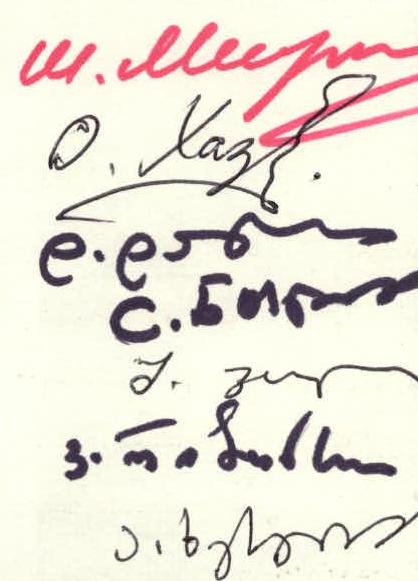
Team coach (Mirianashvili Sh.) Team captain (Khazaradze O.) Participants: (Dandagze D.) (Barliani S.) (Gabisiani Sh.) (Rybinsky V.) (Khergiani A.)
11. Route evaluation
The southeast wall of Peak Moskva is the most complex high-altitude wall route in the Pamir. The height difference of the route is more than 2500 m. The route is combined. The length of the most difficult sections is 1500 m (including:
- ice sections - 450 m;
- rock sections - 1080 m).
The relief of the wall is diverse. The route is logical and safe. The route via the southeast wall of Peak Moskva is classified as 6B category of difficulty.

Table
Main characteristics of the ascent route. The ascent route - Peak Moskva (6785 m) via the southeast wall. Height difference of the route 2590 m, including the most difficult sections - 1500 m. Average steepness of the route - 75°.

| № | Date | Section | Steepness of section | Length of section (vertically) | Relief characteristics | Technical difficulty | Method of overcoming and protection | Weather conditions | Time of stop | Pitons used (rock, ice, bolted) | Bivouac conditions |
|---|---|---|---|---|---|---|---|---|---|---|---|
| 1 | 2 | 3 | 4 | 5 | 6 | 7 | 8 | 9 | 10 | 11 | 12 |
| 12.08.1979 | R0–R1 | 20–25° | 270 | Glacier | Simultaneous in teams | Overcast | Departure 13:30 | - | - | - | |
| R1–R2 | 30–35° | 150 | First step of icefall p. Moskva | Average difficulty | Simultaneous and alternate in teams | Overcast | - | - | - | ||
| R2–R3 | 40–45° | 250 | Second step of icefall p. Moskva | Above average difficulty | Movement in teams. Protection: pitons | Overcast | - | 4 | - | ||
| R3–R4 | 35° | 80 | Third step of icefall p. Moskva | Above average difficulty | Movement in teams. Protection: pitons. | Overcast | Stop for bivouac 19:25 | - | 1 | - Snowy plateau (4945 m) | |
| Total: | 750 m | Travel hours | 5 h 55 min | ||||||||
| 13.08.1979 | R4–R5 | 45° | 220 | Ice slope covered with fresh snow | Above average difficulty | Movement in teams on front teeth of crampons. Protection: pitons | High cloud cover | Departure 5:30 | - | 5 | - |
| R5–R6 | 50–55° | 90 | Steep ice slope (exit to bergschrund at 5255 m) | Difficult section | Movement in teams. Protection: pitons | Weather starts to deteriorate | - | 4 | - | ||
| R6–R7 | 55° | 200 | Steep ice board covered with fresh snow (5–6 cm) | Very difficult section. Steepness increases in upper part. | Alternate movement. Step-cutting. Protection: pitons. | Low cloud cover | - | 11 | - | ||
| R7–R8 | 65° | 225 | Ice shield (wall) covered with snow | Extremely difficult section | Alternate movement on lifelines. Step-cutting. Protection: pitons | Low cloud cover, fog | Stop for bivouac 18:30 | - | 3 | 17 One tent on a platform cut into the ice, another slightly higher on rocks. Sitting bivouac (5680 m). | |
| Total: | 735 m | Travel hours | 13 h 00 min | ||||||||
| 14.08.1979 | R8–R9 | 75° | 80 | Steep snow-covered and icy rocks | Extremely difficult climbing | Alternate movement. Protection: pitons. Lifelines, jumar. | Storm at night. Weather improves in the morning | Departure from bivouac 6:35 | - | 9 | 1 |
| R9–R10 | 75° | 65 | Rocky counterfort. Difficult to find cracks for pitons | Difficult climbing on snow-covered and cold rocks. Protection: pitons. | Alternate movement on lifelines. Use of artificial supports. | Snow, wind, fog. Weather deteriorates sharply | - | 7 | - | ||
| R10–R11 | 85° | 75 | Vertical wall of large shale blocks and slabs | Extremely difficult climbing with use of artificial supports | Alternate movement. Lifelines, jumar. | Snow, graupel, fog, visibility 50 m. | Stop for bivouac 19:50 | - | 11 | 1 On an inclined rocky ledge, sitting (5900 m). | |
| Total: | 220 m | Travel hours | 13 h 15 min | 27 | 1 | ||||||
| 15.08.1979 | R11–R12 | 90° | 25 | Vertical edge of inner angle covered with snow | Difficult climbing. | Alternate movement with use of artificial supports. | High cloud cover | Departure from bivouac 8:00 | - | 8 | - |
| R12–R13 | 80° | 55 | Icy and snow-covered rocky exit | Very difficult climbing | Alternate movement, protection: pitons | Weather slowly deteriorates | - | 6 | - | ||
| R13–R14 | 75° | 140 | Steep rocky counterfort | Extremely difficult section | Alternate movement in teams. Protection: pitons | Occasional light precipitation in the form of snow and graupel | - | 12 | 1 | ||
| R14–R15 | 70° | 70 | Rocky exit of counterfort | Difficult climbing | Alternate movement in teams. Protection: pitons | Overcast, poor visibility | Stop for bivouac 19:00 | - | 5 | 1 Sitting bivouac on rocky counterfort (6190 m). | |
| Total: | 290 m | Travel hours | 11 h 00 min | 31 | 2 | 1 | |||||
| 16.08.1979 | R15–R16 | 75° | 90 | Steep ascent of counterfort | Extremely difficult section | Free climbing with use of artificial supports | High cloud cover | Departure from bivouac 7:30 | - | 11 | - |
| R16–R17 | 80° | 50 | Rocky wall | Extremely difficult section | -" | Signs of deteriorating weather | - | 13 | 1 | ||
| R17–R18 | 75° | 70 | Steep slabs with vertical sections | Difficult section | Difficult free climbing | Overcast, visibility 100 m. | Stop for bivouac 19:15 | - | 8 | - On a rocky ledge (6400 m). | |
| Total: | 210 m | Travel hours | 11 h 45 min | 32 | 1 | ||||||
| 17.08.1979 | R18–R19 | 90° | 70 | Wall with overhanging belt of rocks in middle part | Extremely difficult section | Difficult climbing with use of artificial supports. | Variable cloud cover without precipitation. | Departure 8:15 | - | 21 | 3 |
| R19–R20 | 80° | 40 | Rocky wall with cornice | Difficult section | Difficult free climbing | High cloud cover, wind | - | 5 | - | ||
| R20–R21 | 75° | 30 | Destroyed rocky ascent | Difficult section | Difficult climbing. Protection: pitons. | Normal weather. | Stop for bivouac 19:15 | - | 2 | - On a rocky ledge (6540 m). | |
| Total: | 140 m | Travel hours | 12 h 00 min | 28 | 3 | ||||||
| 18.08.1979 | R21–R22 | 85° | 60 | Rocky wall | Extremely difficult section | Difficult climbing with use of artificial supports. | Clear sky, strong wind | Departure 9:30 | - | 15 | - |
| R22–R23 | 80° | 30 | Rocky wall of large slabs and blocks | Difficult section | Difficult free climbing | Good weather | - | 4 | - | ||
| R23–R24 | 75° | 25 | Steep icy rocks | Difficult section | Difficult free climbing | Good weather | Stop for bivouac 17:45 | - | 2 | 1 On a ledge at 6655 m | |
| Total: | 115 m | Travel hours | 8 h 15_min | 21 | 1 | ||||||
| 19.08.1979 | R24–R25 | 70° | 60 | Snow-covered and icy slabs | Difficult section | Difficult climbing. Protection: pitons | Clear but windy weather | Departure 10:00 | - | 7 | - |
| R25–R26 | 55° | 40 | Snow-covered rocks. | Above average difficulty | Alternate movement. | Cold, strong wind | - | 3 | 1 | ||
| R26–R27 | 40° | 20 | Pre-summit ridge | Average difficulty | Simultaneous movement | — | - | - | - | ||
| R27–R28 | 20° | 10 | Summit ridge | Simultaneous | Movement | High cloud cover, strong wind | Time of reaching the summit 16:00 | - | - | - | |
| Total: | 130 m | Travel hours | 6 h 00_min | ||||||||
| Total: | 2590 m | Travel hours | 80_h 10_min | 152 | 46 | 5 |
Descent from the summit along the southern ridge via Peak Soyuz-Apollon (6047 m) was completed on August 20 at 20:00 (on August 19, we descended to an altitude of 6350 m).


Comments
Sign in to leave a comment