
Ascent Passport
- Ascent class — high-altitude.
- Ascent area — North-West Pamir.
- Peak, its height, ascent route — Peak Kommunizma, 7495 m, from Belyaev Glacier via south-west face of Peak 6950 m.
- Expected difficulty category — 6B.
- Route characteristics:
Total height difference — 2795 m; length of sections with 5–6 diff. cat. — 1300 m; average steepness — 70°.
- Pitons hammered:
for belaying rock 296, ice 15, for creating Intermediate Technical Objects (ITO): rock 14, ice —.
-
Number of climbing hours: total 108.5 h, to the summit 95.5 h.
-
Number of overnight stays and their characteristics:
- 12, of which 9 are uncomfortable on the wall.
- Surname, name, patronymic of the leader, participants, and their qualification:
Nevorotin Vadim Kirillovich MS Bozhukov Valentin Mikhailovich MSMK Ermakov Boris Ivanovich CMS Putrin Valery Semenovich MS Puchkov Vladimir Nikolaevich MS
- Team coach Honored Master of Sports Ovchinnikov A.G.
- Dates: departure on the route — July 21, return — August 2.

- Team "Pamir-79" route … 1959 diff. cat. route. 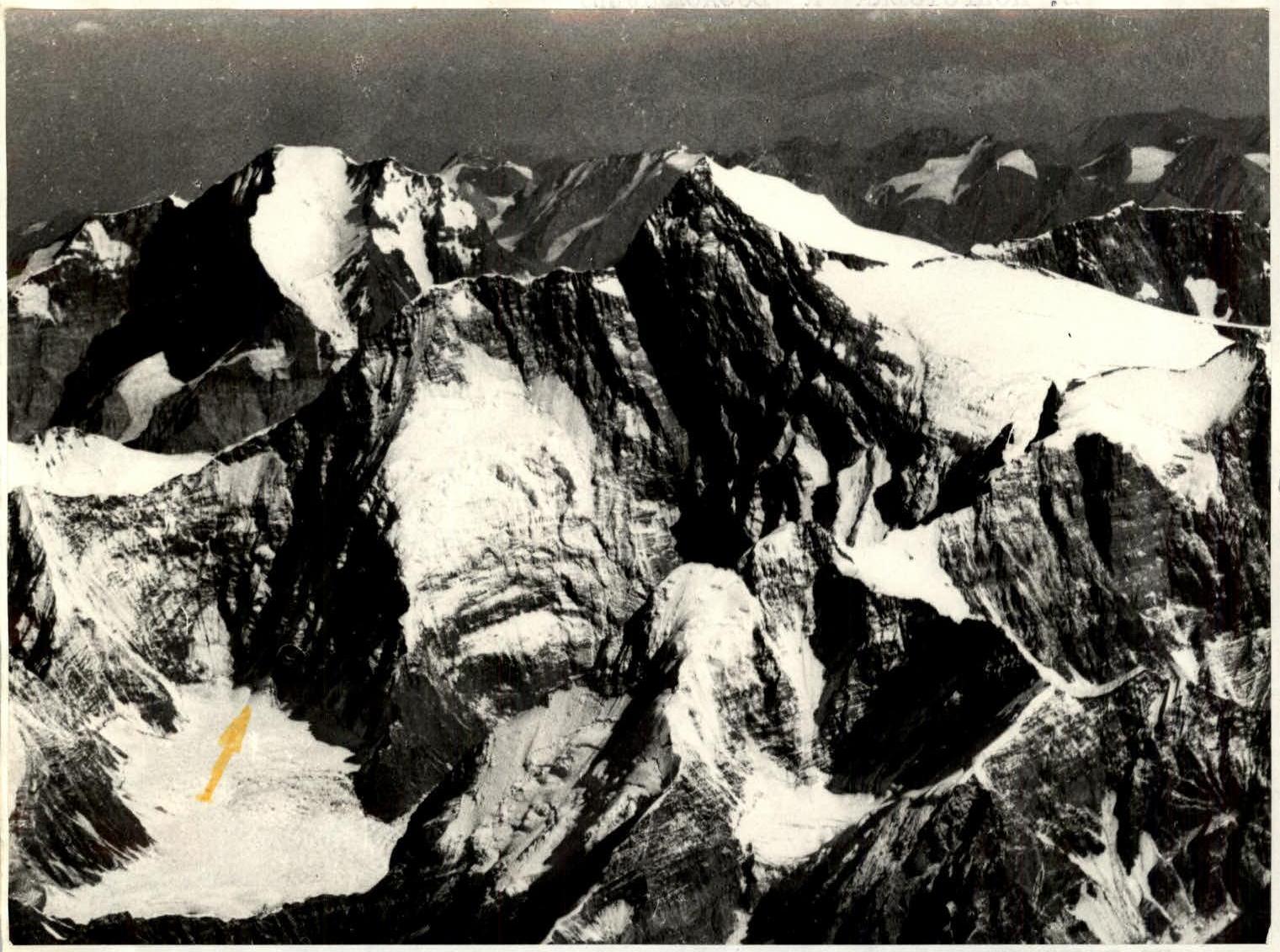
Peak Kommunizma from the south. Equipment taken for the ascent was typical for routes of 5–6 diff. cat. Notably, we used 12 mm imported rope, titanium pitons, a high-altitude tent of individual design, and an autoclave.
Using an autoclave allowed us to:
- Save fuel,
- Bring fresh meat, rice, and buckwheat groats, which greatly diversified the menu.
It's worth noting that we took mostly natural products on the route, practically excluding canned goods.
The tactical plan for the ascent included:
- Dropping the team off at Surkovaya Polyana,
- Approaching the western cirque of Belyaev Glacier,
- Observing the route,
- Processing the beginning of the route,
- Ascending the wall to Peak 6950 m,
- Passing the Western ridge and ascending to Peak Kommunizma,
- Descending to the firn plateau and returning to the base camp at Suloyeva Polyana via Burevestnik ridge.
As an alternative, we considered ascending via the north-west ridge. We planned to reach the summit in six to seven days. However, extremely unfavorable weather conditions prevented us from meeting the planned timeframe.
For communication with the base camp, we took a "Lastochka" radio station, which had proven itself over the years in the international camp. A group of camp coaches was located on the plateau, maintaining communication with the team and ready to provide assistance at any time.
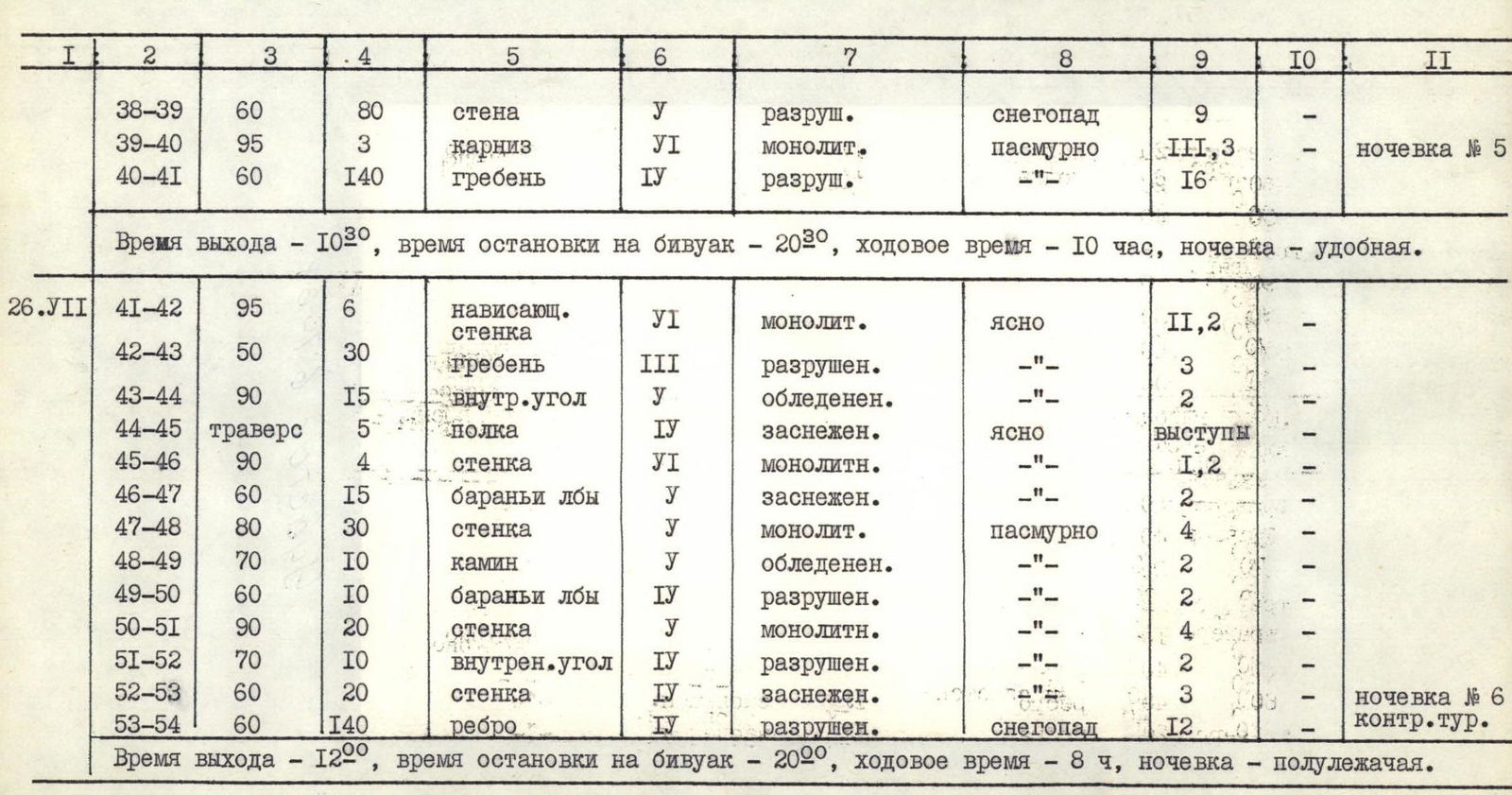
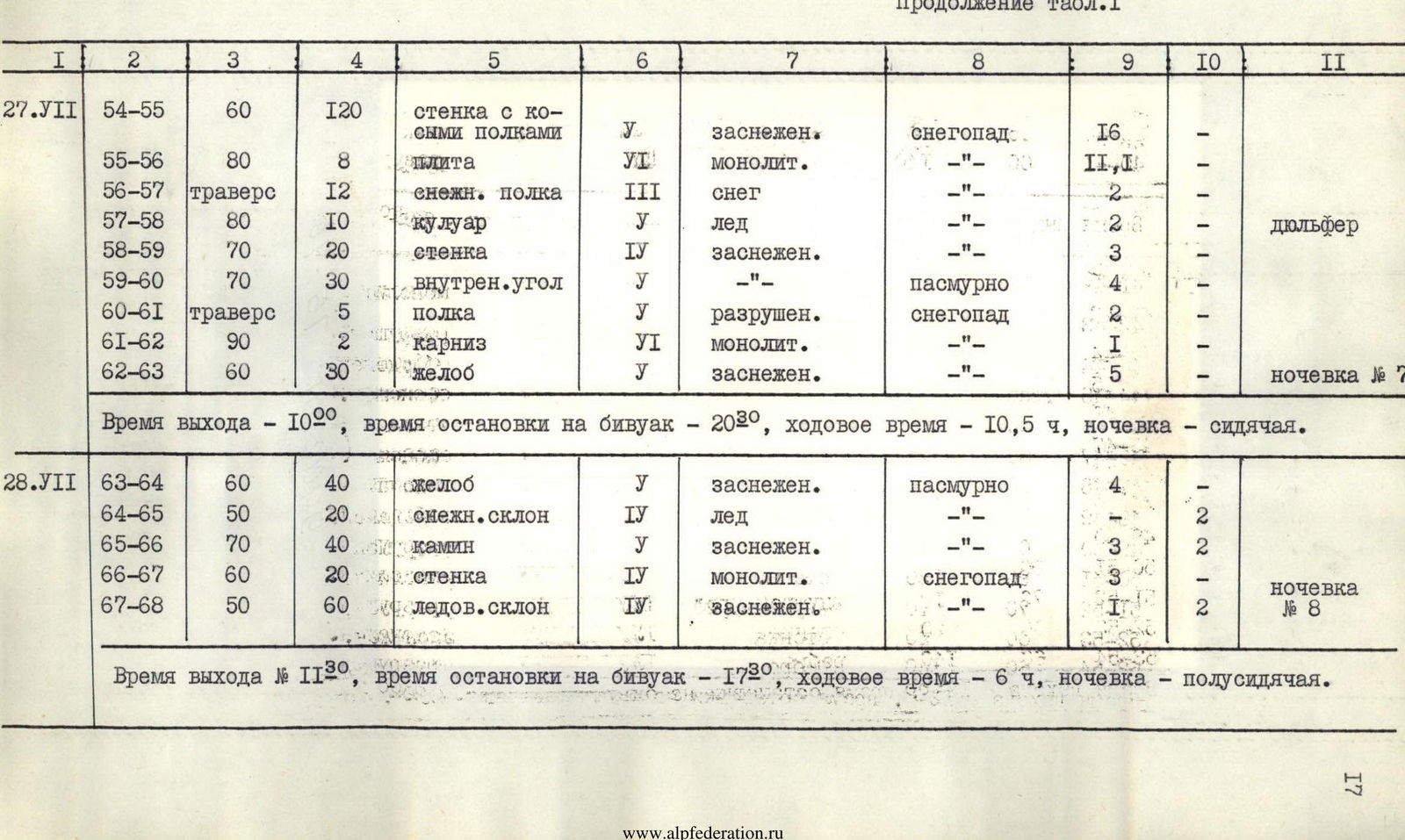
The main characteristics of the ascent route are presented in Table I, and explanations are provided in the "Ascent Chronicle" section.

The beginning of the path
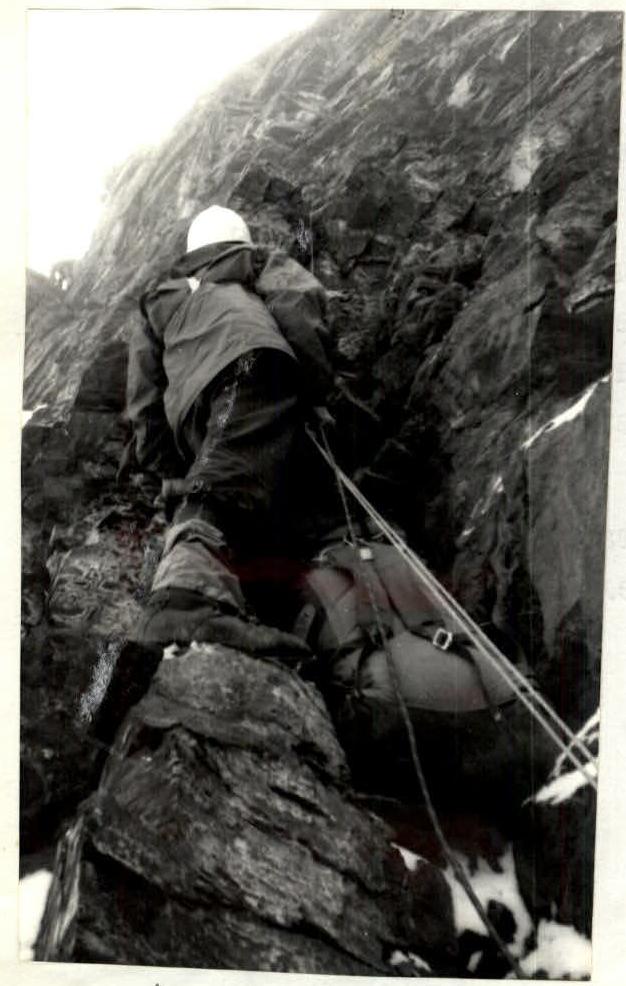
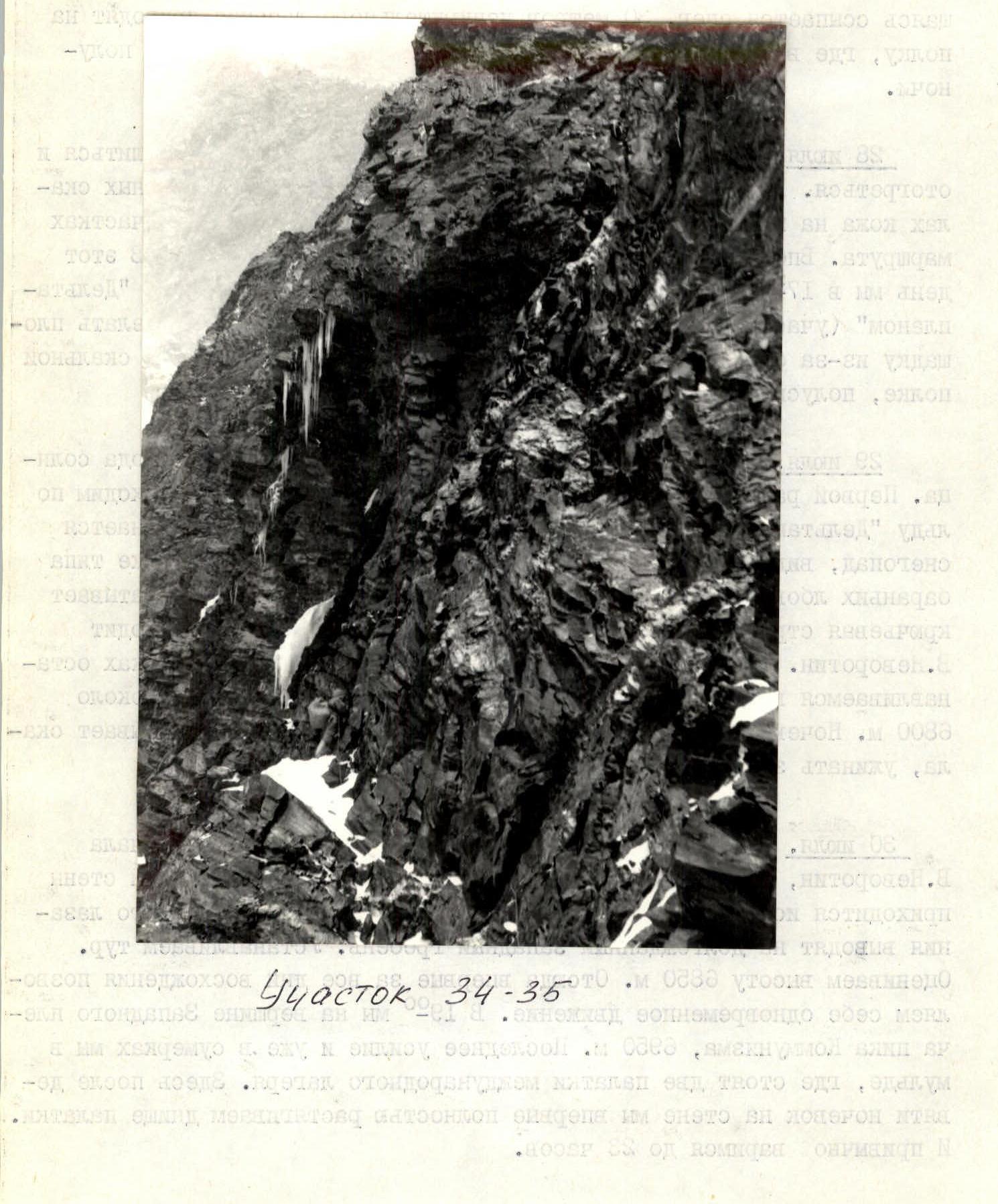
Section R5–R6
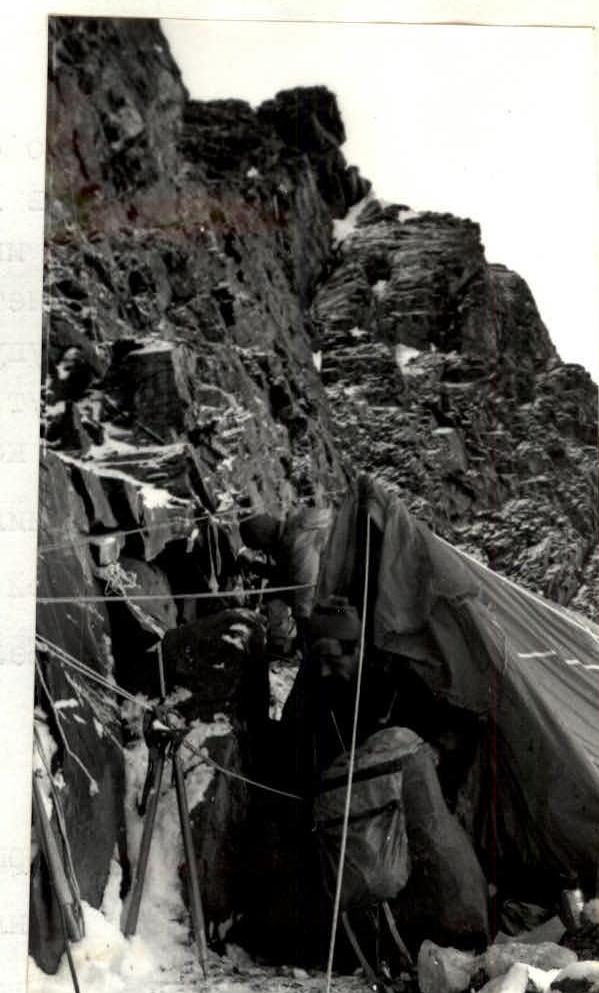
Bivouac №1
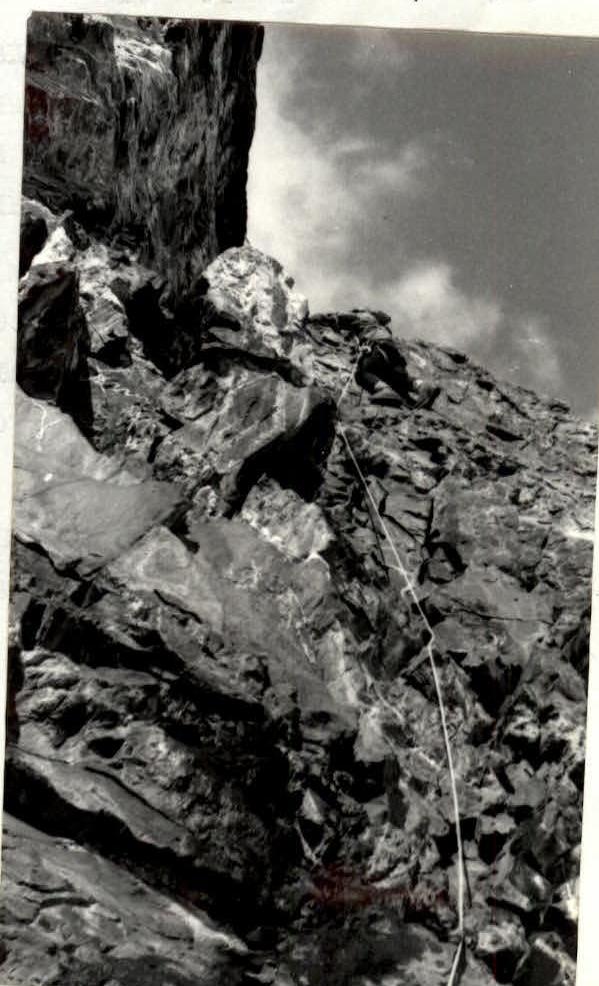
Section R9–R10
3. Ascent Chronicle
July 18. At 15:30, the Mi-8 helicopter, piloted by Bondarchuk B.I., drops off the team of coaches from the "Pamir-79" camp on Surkovaya Polyana: Nevorotin V.K., Bozhukov V.M., Ermakov B.I., Putrin V.S., and Puchkov V.N. Supplies are dropped at the "Georgian" camps on Belyaev Glacier. The weather is sunny. Altitude 3750 m. The area is dominated by marmots. On the opposite side of Vavilov Glacier, tents and people are visible. There's no time to identify who they are. We settle in early, as tomorrow promises to be a tough day.
July 19. We rise at 4:00. By 5:00, it's daylight. The weather is good. We hurry to start moving to avoid the heat of the day on the glacier. We begin our journey at 5:45, initially through a pocket, and then along a rangklyuft on the left orographic side of Belyaev Glacier. We quickly find a passage through the icefall and reach the median moraine within 1.5 hours. At 10:00, we are at the "Georgian" camps. Altitude 4400 m. We continue for another hour and stop between two glacial lakes under the slopes of Peak Olga. From here, our route is clearly visible, and we begin to appreciate its complexity. To reach Peak 6950 m, we have two kilometers of wall with almost no snow due to its steepness.
After lunch, the trio of Putrin, Puchkov, and Ermakov makes a supply drop and equipment delivery under the wall. Nevorotin and Bozhukov head right along the glacier to photograph the wall's profile and scout a passage through the upper step of the icefall into the western cirque. However, due to the wall being situated in a trough, it's impossible to take a good photo of its profile from the glacier; the ridge of the Kuzmin route blocks the view. We establish that the simplest way to access the western cirque is under the slopes of Peaks Olga and Kuibyshev. We give names to the most notable sections of the wall: "1st tooth", "2nd tooth", "Funnel", "Sloping shelf", "Hang glider".
We return to the tent at 20:30. It's warm.
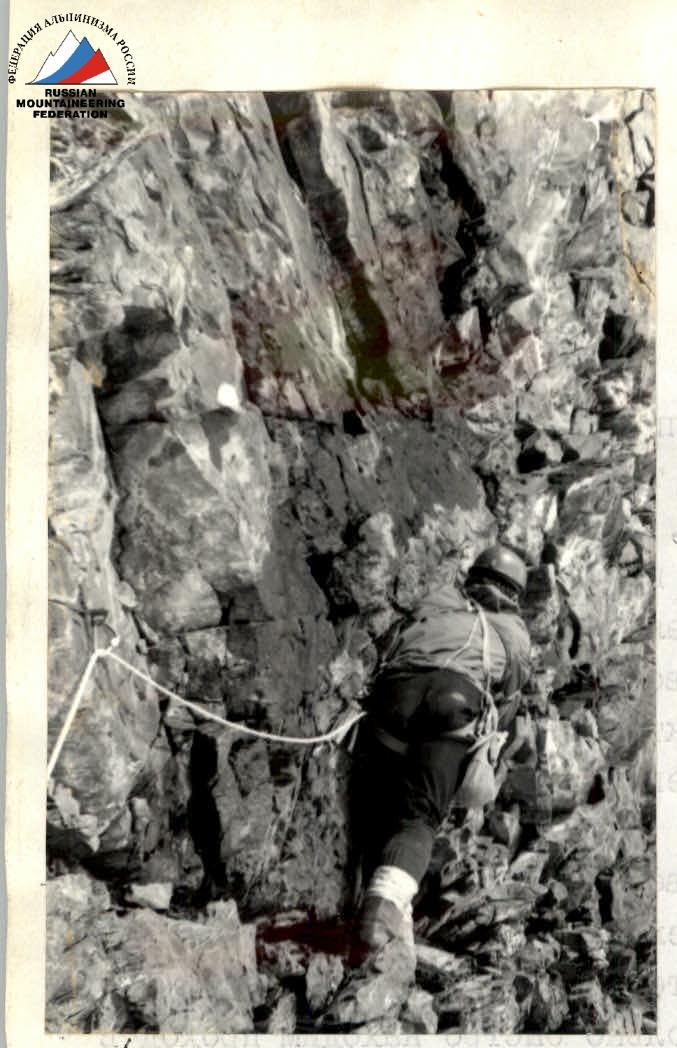
Sections R11–R12, R12–R13
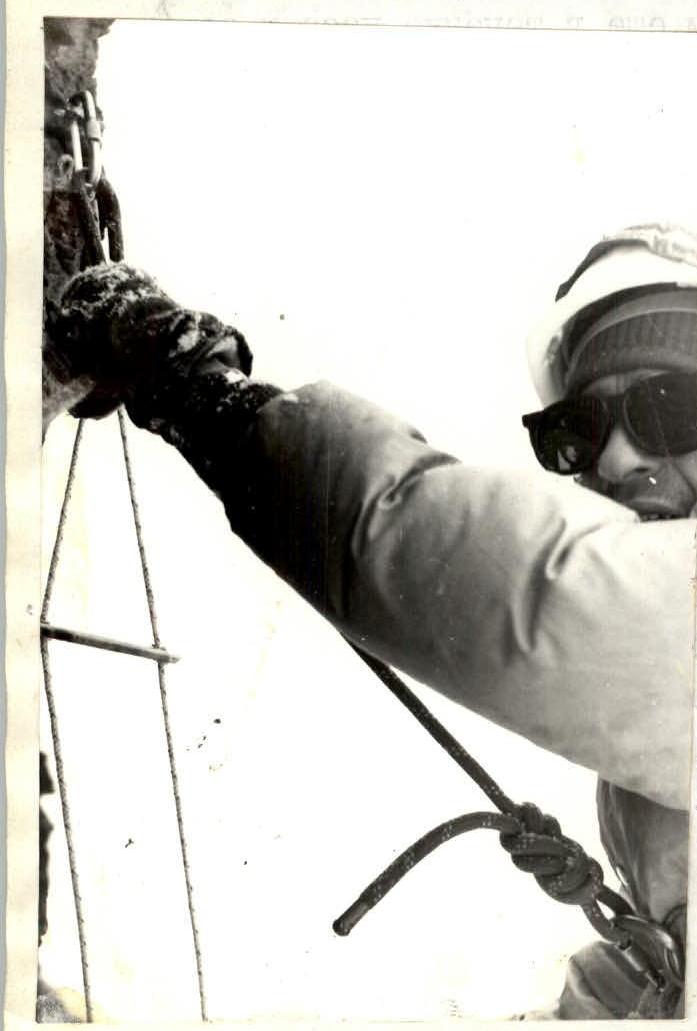
Section R25–R26
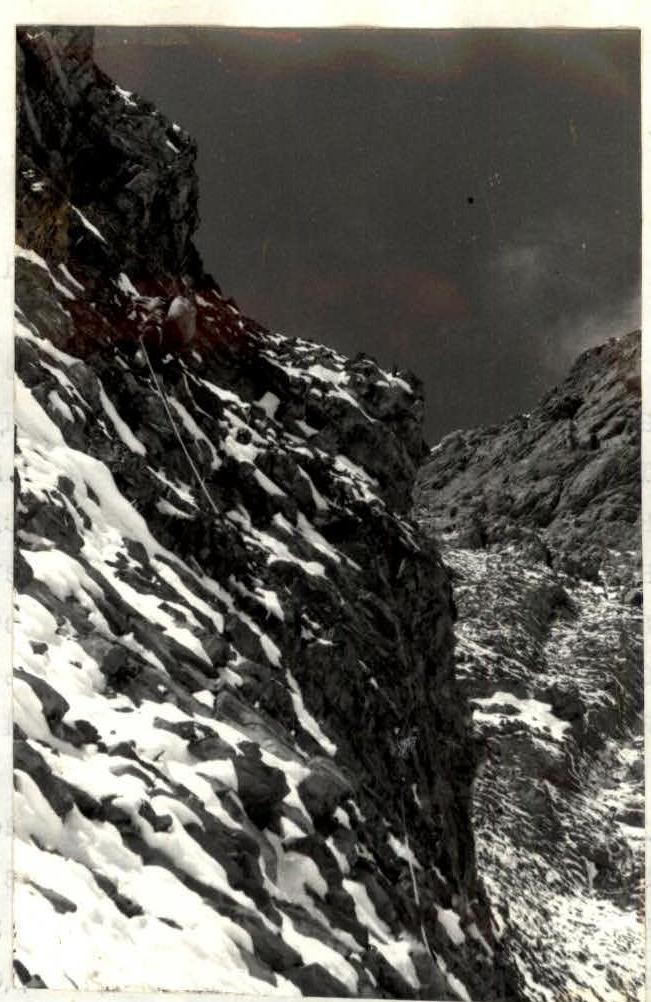
Section R21–R22
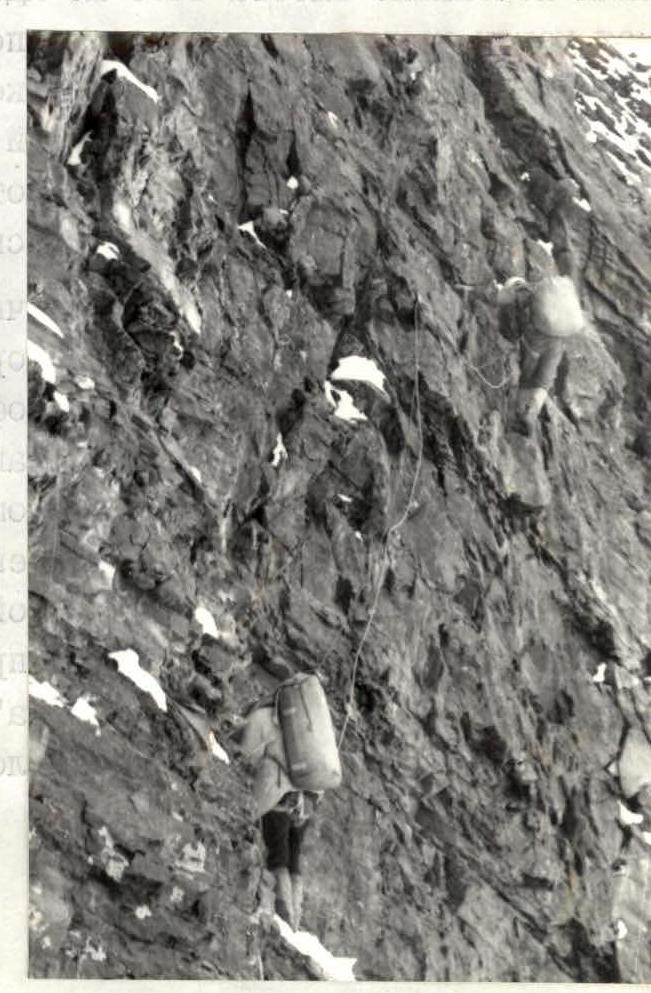
Section R30–R31 July 20. We wake up at night due to the sound of snow. The weather is deteriorating. We rise at 6:00. At 9:00, we begin transferring loads under the wall using a shuttle system. By 14:00, we complete this task, setting up a tent in the middle of the western cirque, near the route. It's snowing. Visibility is poor. Volodya Puchkov and Valera Putrin go to process the bergschrund. The rest make final preparations. We conduct an inventory of our supplies, leaving about 400 g/day per person for 10 days. The guys return at 17:00, having passed the bergschrund, ice slope, and the first rope of rocks. The first impression of the route is good: the rocks are steep, quite solid, and nothing is falling from above.
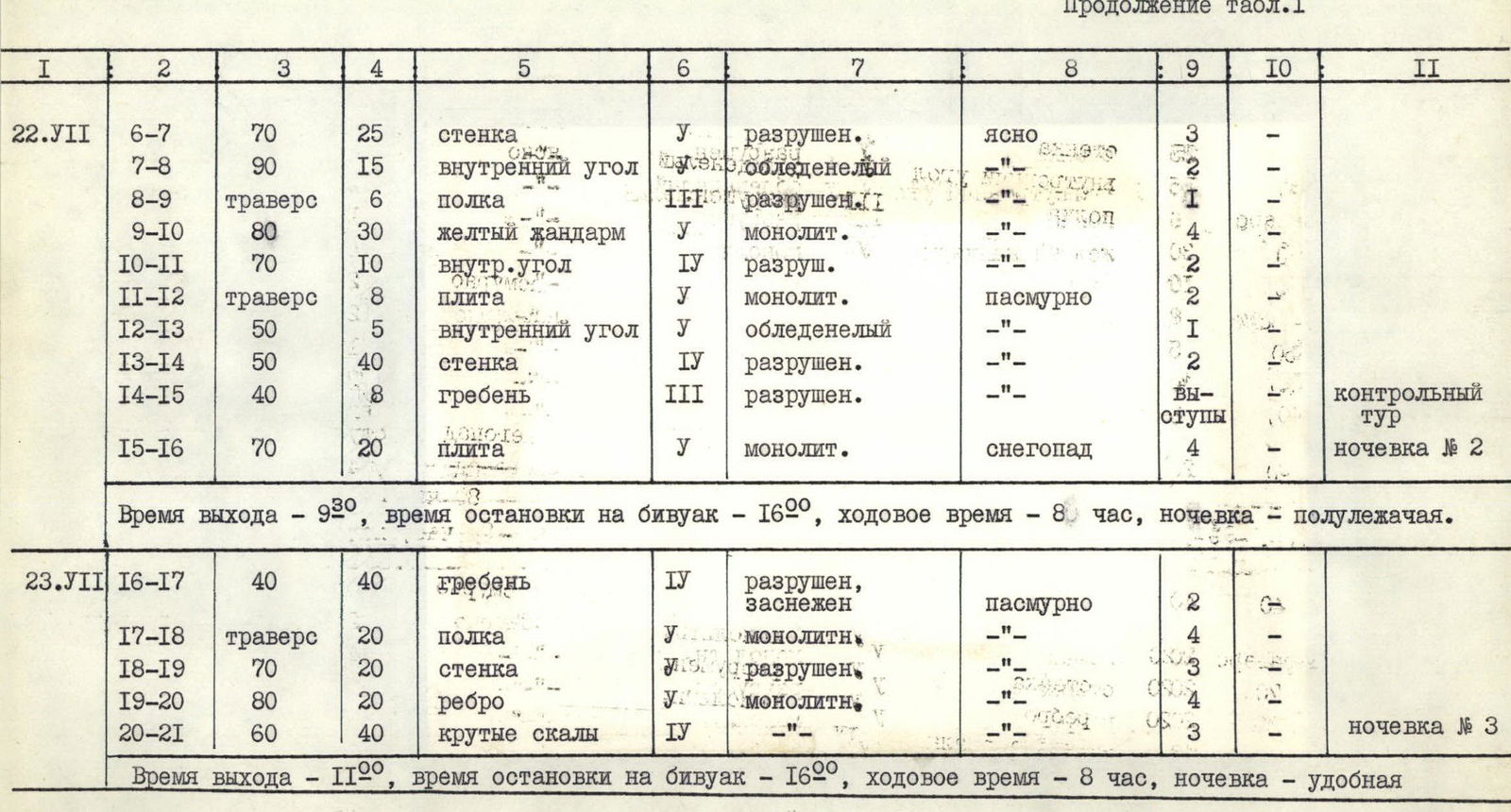
July 21. The weather continues to worsen. About 10 cm of snow fell overnight. Visibility is poor, and snowfall continues. We depart at 9:00. Fortunately, we marked the beginning of the route and even hung ropes the day before. The snowy slope becomes steeper, with a complex passage at the bergschrund with a steepness of about 70°. Next is an ice slope, slightly covered with snow. Everyone is wearing crampons. From the bergschrund, we pass two ropes straight up to the rocks. From there, we make a small traverse left along a shelf to the beginning of the fixed rope. Here, we remove our crampons and put away ice axes, which we use for the next almost ten days only for building platforms for the tent. The first team, consisting of V. Puchkov, B. Ermakov, and V. Putrin, works first. We ascend via a couloir filled with ice, reaching a rusty wall, which becomes sheer after 40 m with overhanging sections. The weather doesn't improve, and snowfall continues. To the right under the wall, we see a ledge where we can make an overnight stay. We decide to stop here, as we can't see anything above. Time is 15:00. The duo V. Nevorotin and V. Puchkov continues upward, processing the route for tomorrow — sections R6–R10. The other three set up a platform. By 20:00, we finish the rock work, and we have a platform for a semi-reclined overnight stay. By this time, the first duo, having hung two ropes, returns to the tent. We dine in the dark.
July 22. About 5 cm of snow fell overnight. It's cold. We depart at 9:30. The first team, V. Bozhukov and V. Nevorotin, goes first. After passing the hung ropes, we continue to the right of the wall with cornices. We reach the left side of the rib. An attempt to pass the wall from the left is unsuccessful. It's snowing. The team V. Puchkov, V. Putrin, and B. Ermakov moves up the slab of the inner angle (sections R15–R16) to a spot where we start setting up a platform for the tent at 16:00. V. Puchkov and V. Nevorotin process sections R16–R19 of the route. We decide to go to the right of the ridge along rocky walls with shelves, allowing for maneuvering, although the proximity of the right couloir forces us to be constantly on guard. In the second half of the day, stones and snowy avalanches are constantly falling through it. After a short break, snowfall resumes and continues until morning. By 19:00, we finish setting up the platform. However, two large boulders in the middle remain untouched. Bozhukov breaks his ice axe attempting to rock the stones. The overnight stay is semi-reclined. We dine in the dark again. It's warm. The tent leaks.
July 23. Wet snow has covered the entire route. It's overcast, and there's no hope that the rocks will dry. We depart at 11:00. Using hung perils in very difficult conditions, we approach sections R19–R20. From here, straight up, there's one rope to a shelf under a monolithic wall of a gendarme. Straight up, a нависающая стена (overhanging wall) requires shaky technique. To the right, along the left edge of the couloir, a real path is visible. The snowfall starts. The duo V. Bozhukov and B. Ermakov goes up. The rest work on setting up a platform. Time is 16:00. At 18:00, a large avalanche comes down the gully. Fortunately, we are slightly to the left, but we still have to endure a few unpleasant moments. By 20:00, the duo returns, having processed sections R21–R24. Three hours of rock work allow us to obtain a good platform, and tonight we have a comfortable overnight stay where we can stretch out to our full height.
July 24. Snowfall stopped overnight, and it got colder. We rise at 8:00. The first to go up is V. Nevorotin, followed by V. Bozhukov. We climb up the icy ropes to a shelf where we wait for the others to catch up with the ropes. The tactics for passing subsequent sections are as follows:
- The first person, with a lightened backpack, climbs with lower belay.
- The second person follows with upper belay.
- They carry the end of the second rope, which is fixed at the top.
- The second team works on the fixed rope, while the first team continues as before.
In the conditions of a complex route with poor weather, this tactic is fully justified, as it ensures high reliability of the ascent. We pass sections R26–R29 along solid rocks, partially covered with fallen snow. At 13:00, we contact the group of coaches on Peak Leningrad via radio. We maintain regular communication every day at 8:00, 13:00
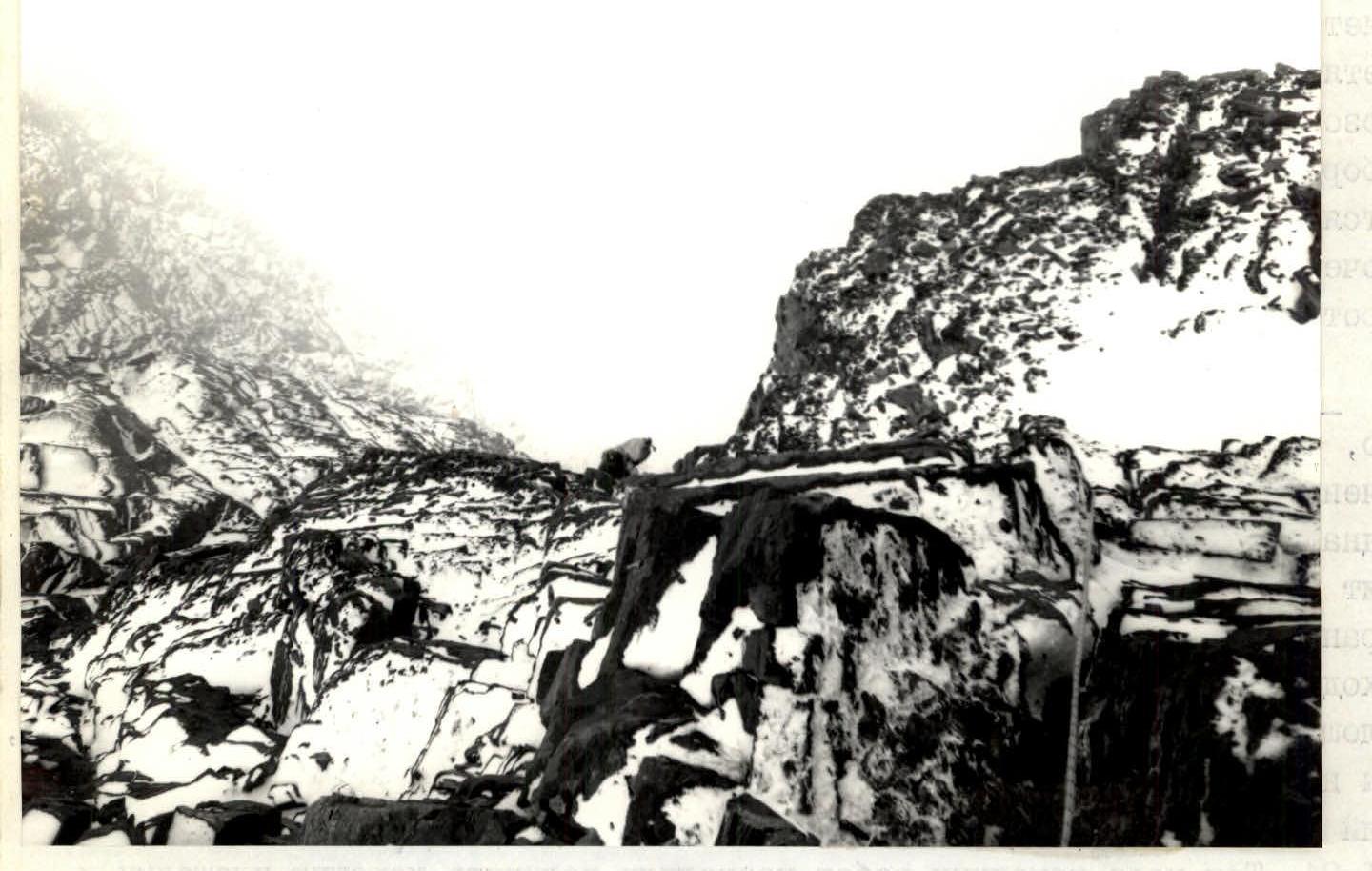
and 17:00. By 18:00–20:00, everyone gathers on a sharp ridge crest, the "1st tooth". Hopes for a good platform are not justified. We have to dismantle the ridge to obtain a semi-reclined overnight stay. The duo V. Puchkov and V. Putrin processes 80 m of rocks (sections R29–R31) leading to the mouth of the "Funnel".
July 25. The weather improved overnight. Today should be sunny. We wait for the sun and depart at 10:30. The first team to work is V. Puchkov and V. Putrin. We ascend along the processed sections to a sheer rusty wall with quartz veins. The climbing is very difficult. Volodya reaches the left edge of the "Funnel", from where the path logically leads along snowy walls (sections R35–R40) to a heavily destroyed ridge. However, there are no places even for a sitting overnight stay, so we continue upward until the "2nd tooth". We stop at 20:30. Here, after an hour of work, we obtain a practically convenient platform for the night. There's no time to process the route for tomorrow. We dine at 23:00.
July 26. We depart at 12:00 after the sun has dried the tent and warmed the rocks a bit. The first team to go is V. Nevorotin and V. Bozhukov. The day begins with passing an overhanging wall (sections R41–R42), which leads to a simple ridge. Then the route becomes complicated again. First, there's a sheer inner corner with ice, then an overhanging wall where we have to use ITO. On the yellow wall (sections R50–R52), a large stone falls from under V. Bozhukov's hands, threatening the guys below. We spend more than an hour securing the stone to a piton using a rep cord. Then we pass four ropes along rocks of medium difficulty to a suitable spot for a bivouac. Time is 20:20. It's snowing. Due to a boulder in the middle of the platform, the overnight stay is semi-reclined. We estimate the height at 6200 m. We dine in the dark.
July 27. Snowfall continues throughout the night. The first team to depart is V. Puchkov and V. Putrin. We ascend along oblique snowy shelves (sections R54–R55) in crampons. We gain height along sheer walls. The most notable section (R55–R56) is a monolithic slab where we have to use ladders. We approach the wall of the quartz belt with cornices. After traversing to the right, we have to descend using a rappel by 10 m to continue the ascent along the wall, which has good ledges. Snowfall intensifies after 17:00. Volodya traverses under the cornice
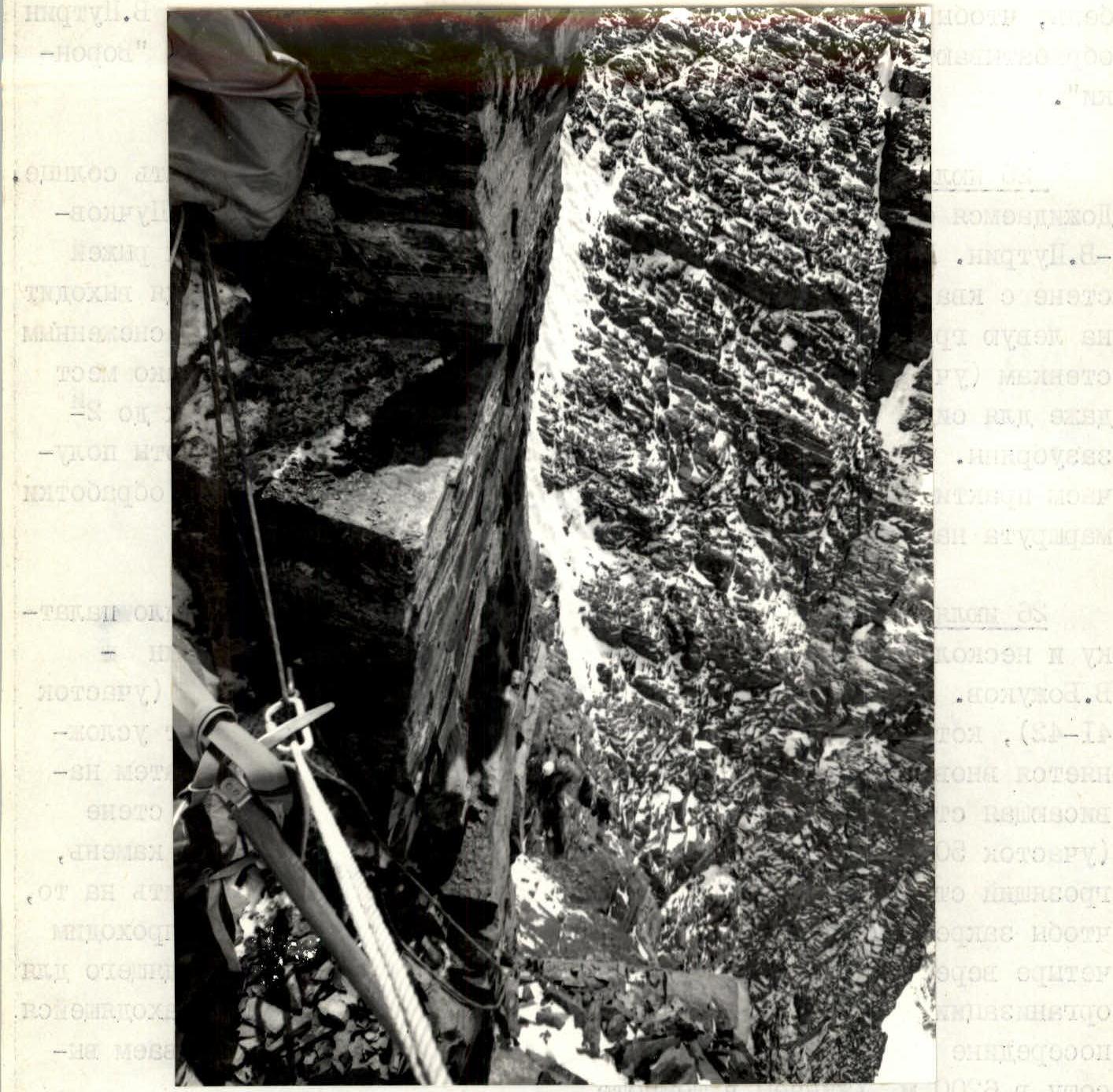
(section R61–R62), and then through it into a gully where snow is constantly falling. 30 m of exhausting climbing lead us to a shelf where we organize a sitting overnight stay in the dark. We settle in by midnight.
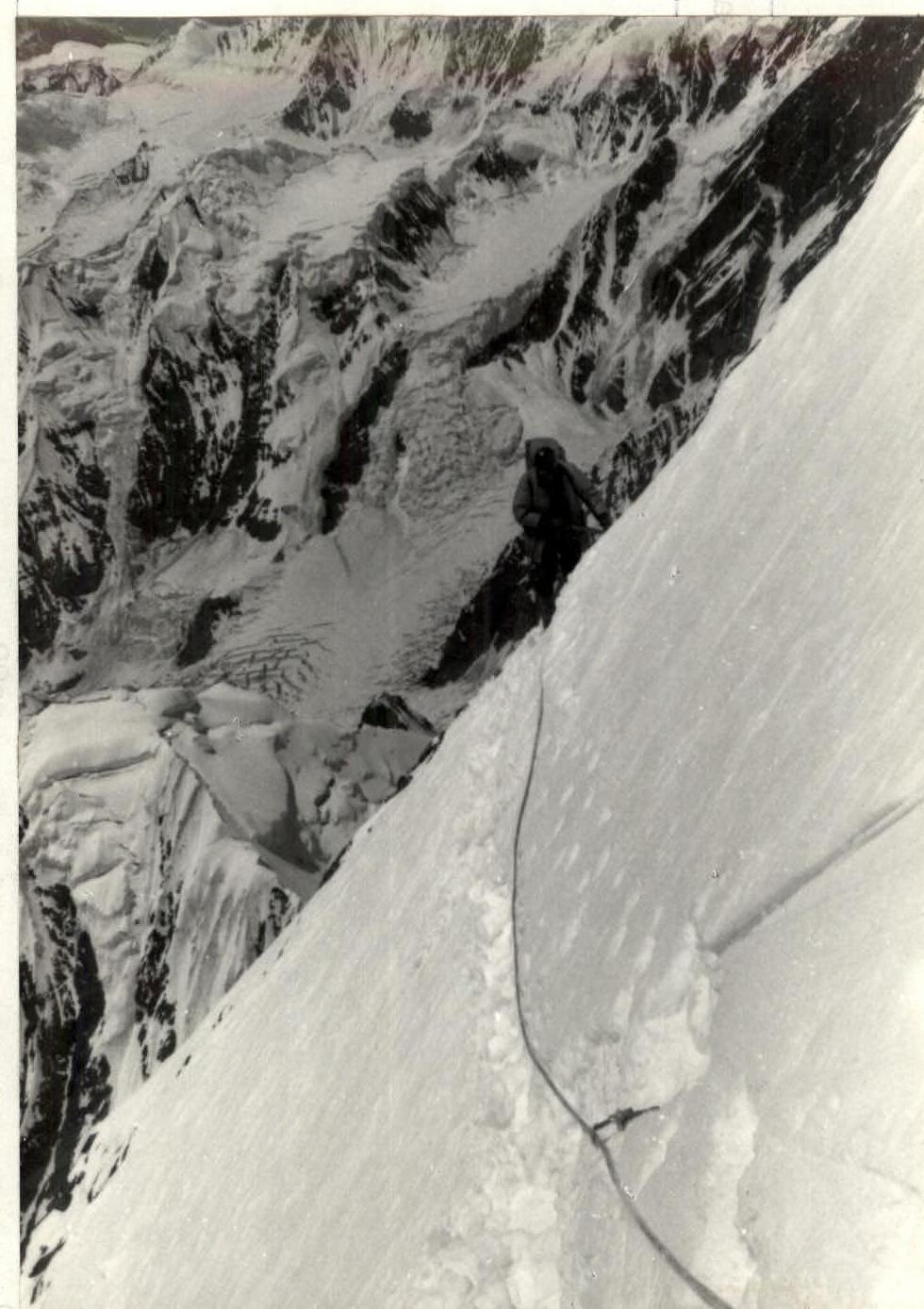
July 28. In the morning, we wait for the sun to dry out a bit and warm up. We depart at 11:30. After a long time working on snowy rocks, the skin on our fingers is cracked and bleeding on complex sections of the route. The team V. Bozhukov and V. Nevorotin works ahead. On this day, we reach the snowy-icy slope, named "Hang glider" (sections R67–R68), at 17:30. Contrary to expectations, we can't make a platform due to its steepness. So, we settle on a narrow rocky shelf, semi-sitting. We dine at 22:00.
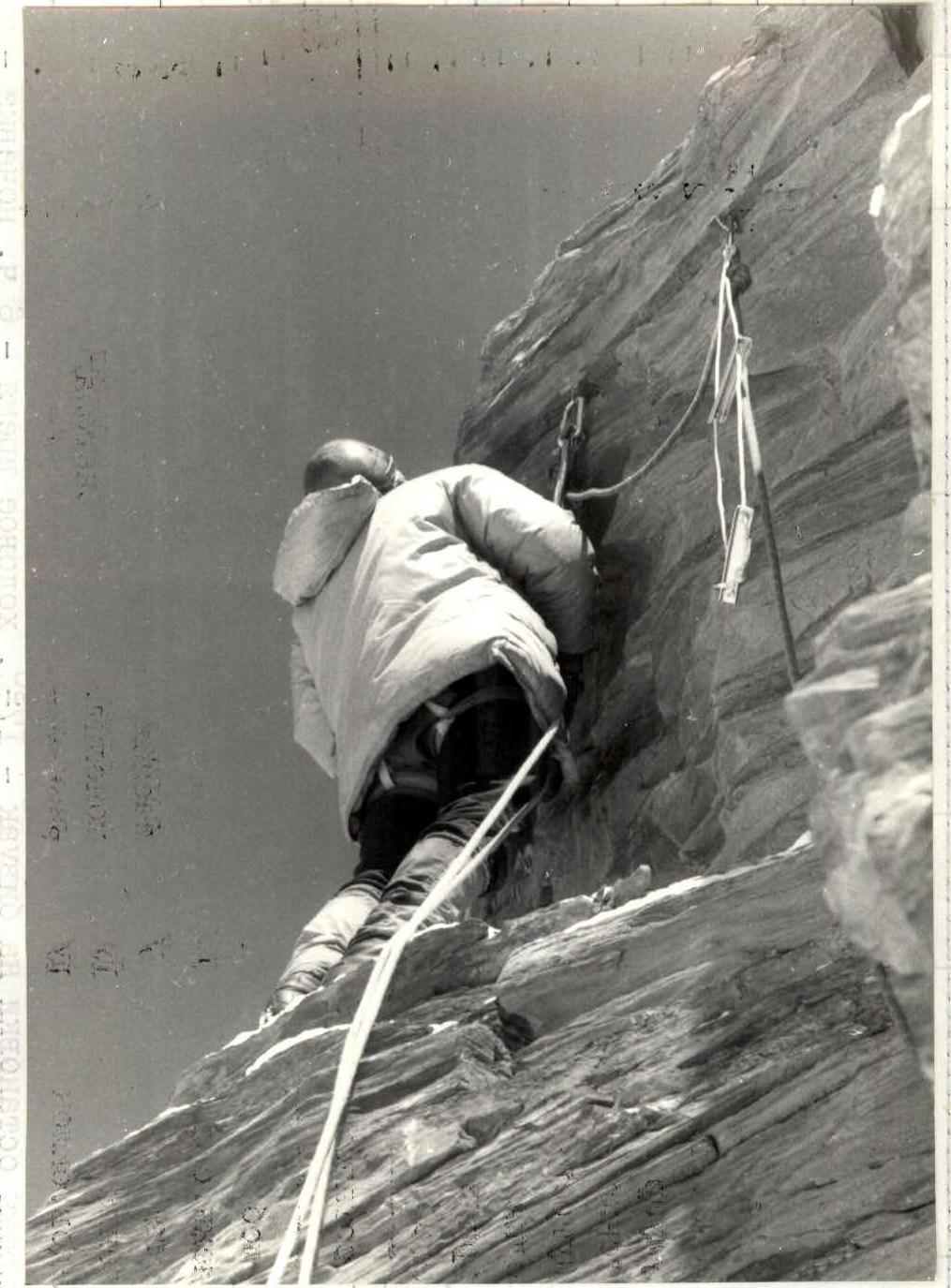
July 29. We rise at 8:00 and depart at 11:30 after the sun arrives. The first team to work is V. Puchkov and V. Putrin. First, we pass along the ice of the "Hang glider", then move to rocks. After 13:00, snowfall starts, and visibility worsens. On a complex snowy wall resembling "ram's foreheads" (sections R72–R73), Volodya Puchkov slips. The piton belay works. Everything ends благополучно ( благополучно translates to благополучно which is not translated directly but means "happily" or "successfully" in this context, a more suitable translation would be "without incident" or "all is well"). The first to go up is V. Nevorotin. We pass three ropes straight up and stop in a niche under an overhanging rock in the evening. Time is 20:30. The height is about 6800 m. The overnight stay is sitting, but dry, as we're protected from above by a rock. We finish dining at 24:00.
July 30. We start working at 9:00. The first to go up are V. Nevorotin, followed by V. Bozhukov. To exit from under the overhanging wall, we have to use ladders. Then two ropes of straightforward climbing lead us to the long-awaited Western ridge. We set up a cairn. We estimate the height at 6850 m. From here, for the first time in all the days of the ascent, we allow ourselves simultaneous movement. At 19:00, we are on the summit of the Western shoulder of Peak Kommunizma, 6950 m. With one final effort, we reach the mulde where two tents of the international camp are standing. Here, after nine overnight stays on the wall, we finally fully stretch out the tent floor. And, as usual, we cook until 23:00.
 July 31. The morning is clear but windy. We depart at 10:00. We ascend along a snowy-icy slope to the north-western ridge. By noon, the wind strengthens, becoming stormy at times. The first to reach the summit is the team V. Putrin and B. Ermakov at 15:45. We retrieve last year's note from Tomsk climbers dated August 8. We descend along the ascent route and return to the tent at 19:00, finding it half-buried in snow.
August 1. The wind doesn't subside. We depart at 9:00 and descend to the plateau within 2 hours. After a 3-hour rest, we continue toward Peak Parashyutists, reaching it in 5 hours. The Pamir plateau is bustling. Groups of climbers are moving in both directions. Americans are camped in the eastern part, Austrians in the middle, and Czechs and Slovaks in the western part. We receive congratulations from everyone we meet.
August 2. We begin our descent at 8:00 along Burevestnik ridge. At 12:00, we arrive at the base camp on Suloyeva Polyana. Here, we congratulate each other on the successful ascent.
In conclusion, the ascent can be summarized as follows:
- Total height difference equals 2795 m;
- Length of the wall section of the route to the Western shoulder 6950 m is 2334 m, of which 2175 m is ascent and 159 m is traverse;
- Height difference along the wall equals 2050 m (bergschrund — 4800 m, Western ridge — 6850 m);
- Average steepness of the wall equals 2050/2175 = 0.94, corresponding to 70°;
- Total number of pitons hammered — 325;
- Climbing time: to the summit — 95.8 h, total — 108.5 h;
Climbing time includes time spent processing route sections.
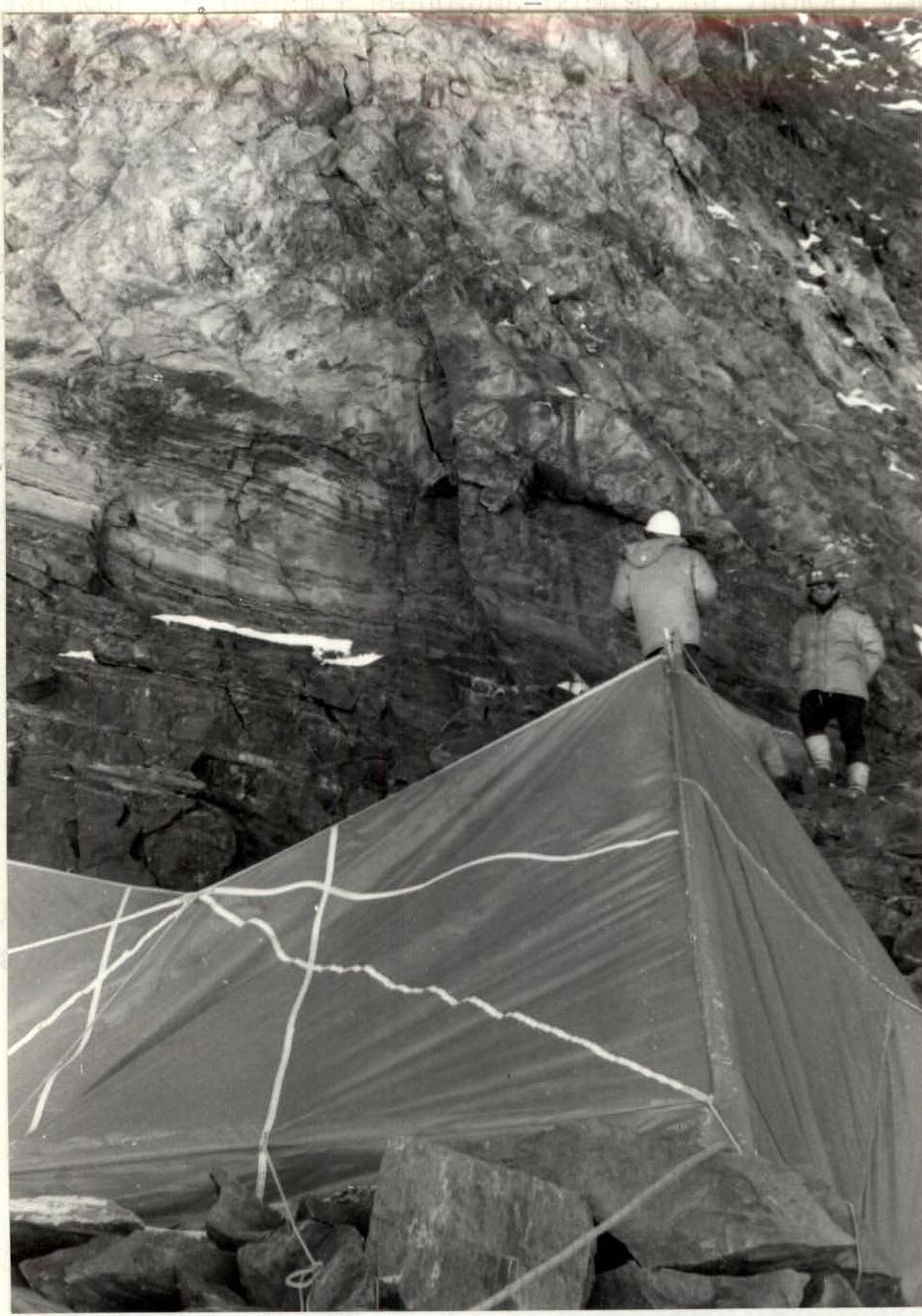
Bivouac №3
Table I
Main characteristics of the ascent route to Peak Kommunizma from Belyaev Glacier via the south-west face of Peak 6950 m
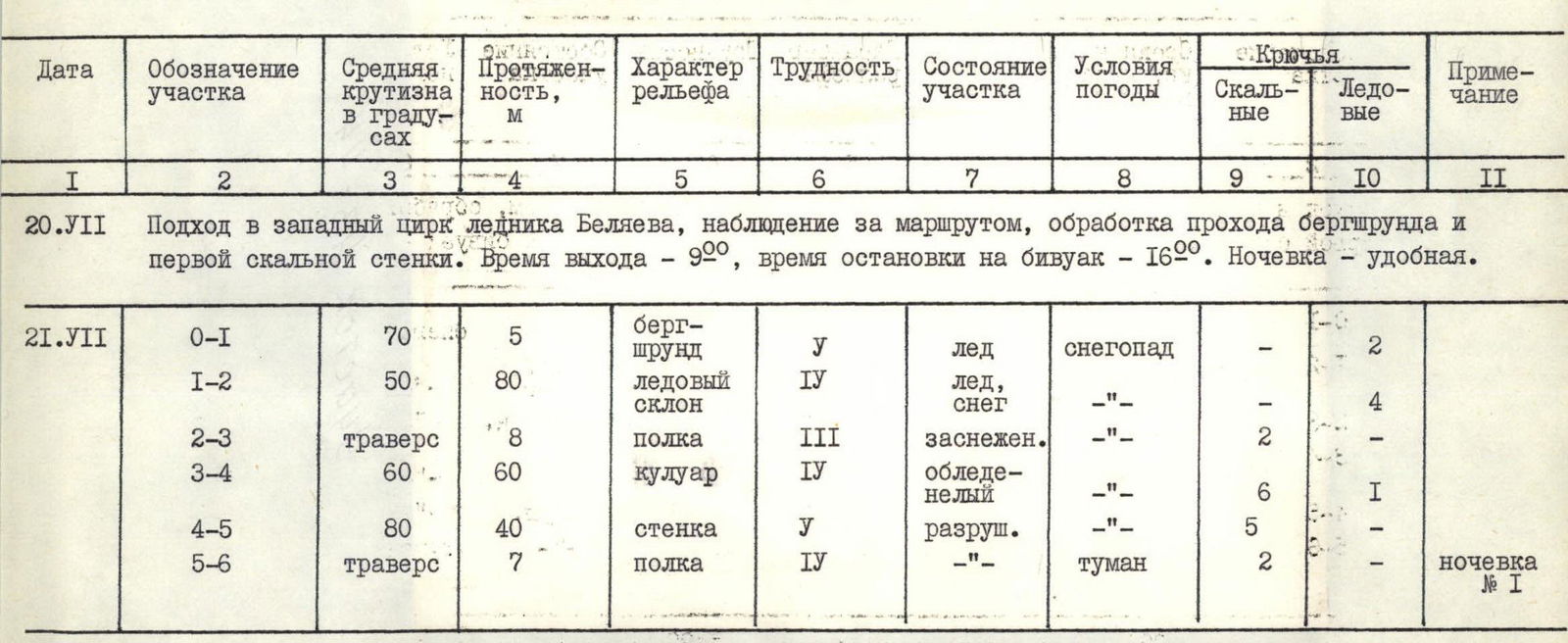
Departure time — 9:00, arrival time at bivouac — 16:00; climbing time — 9 h, overnight stay — semi-reclined.
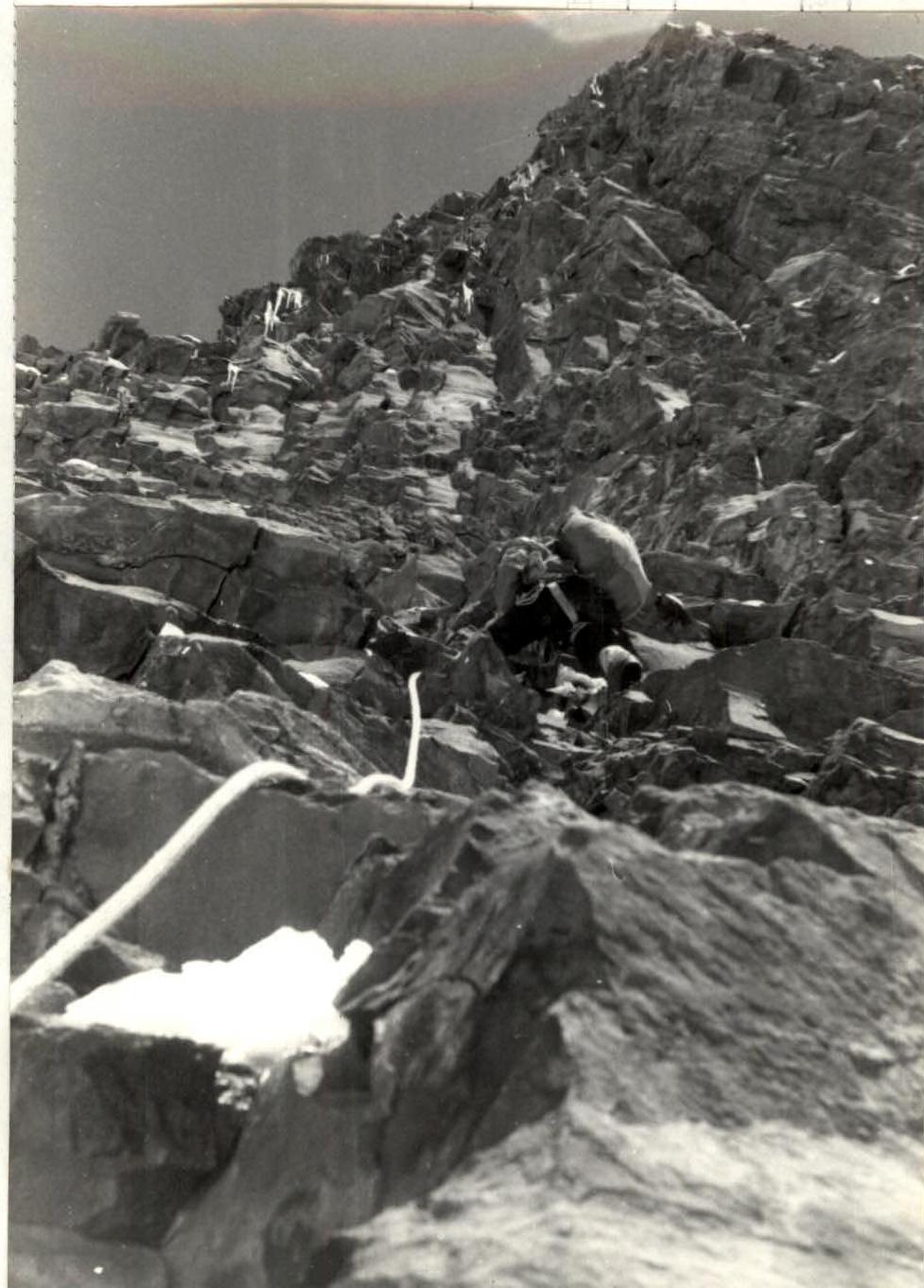
Section R43–R44. Continuation of Table I
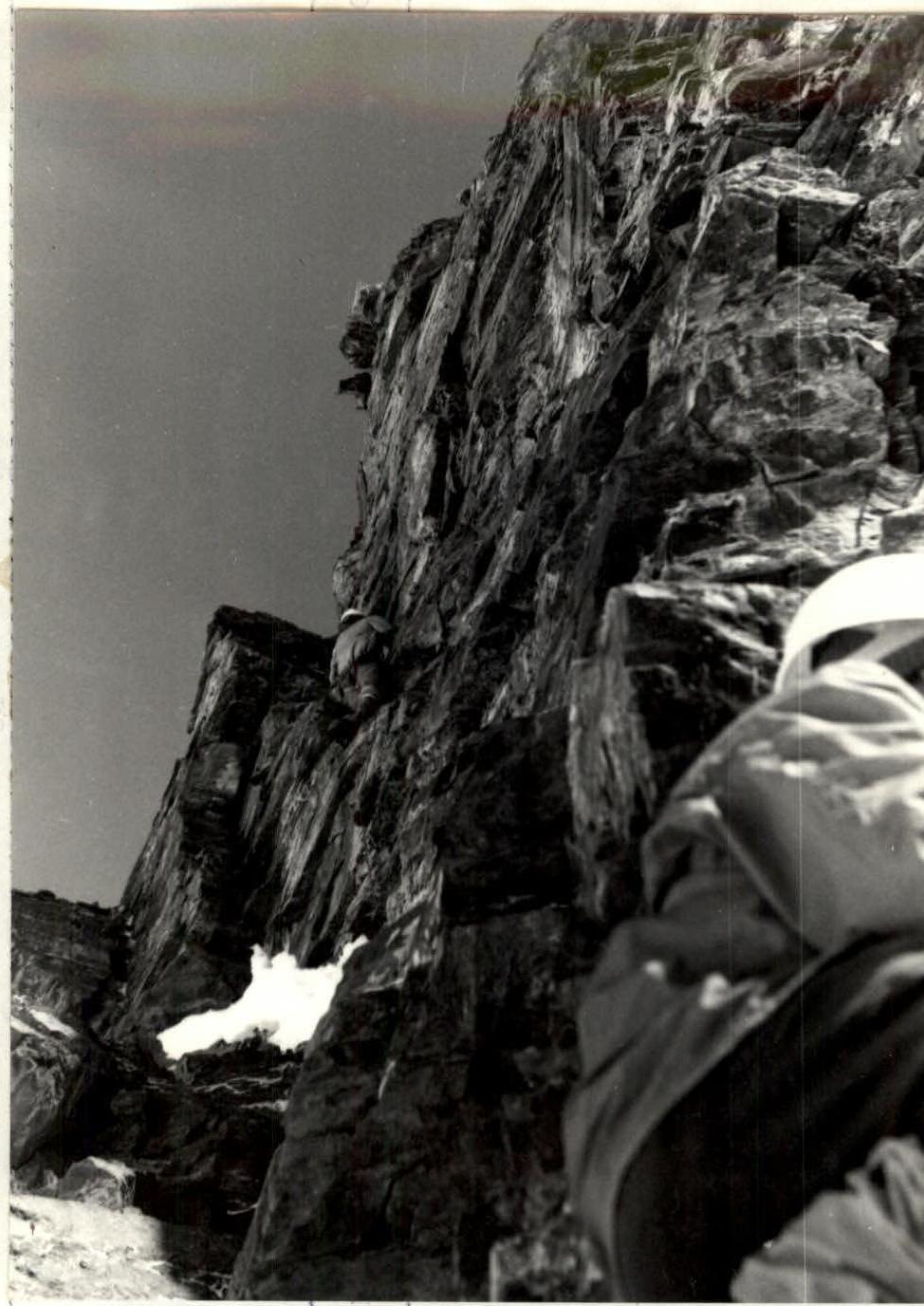
Section R50–R57
Continuation of Table I

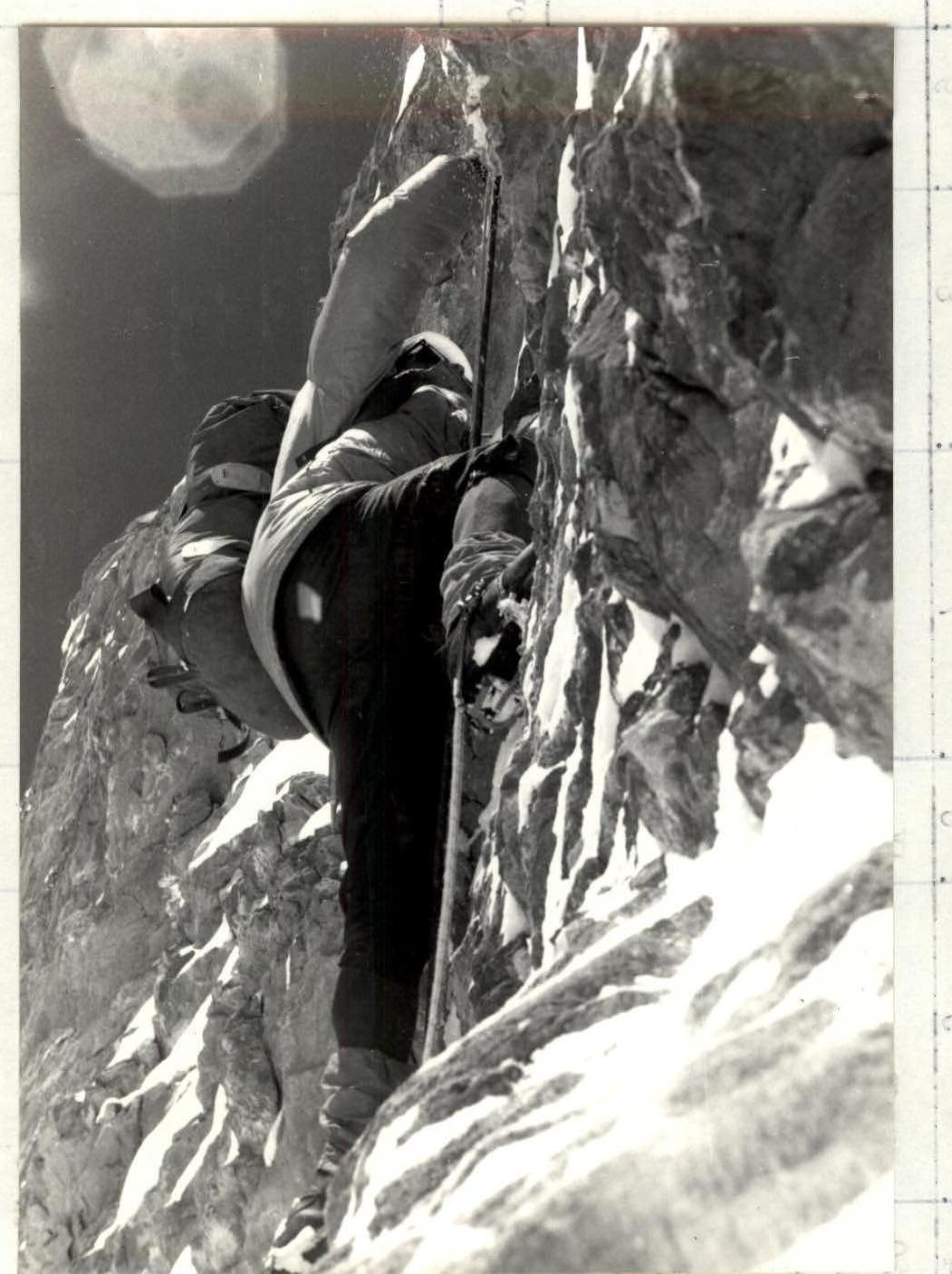
Section R45–R46
Continuation of Table I
Section R67–R68
Continuation of Table I
Section R75–R76
Continuation of Table I
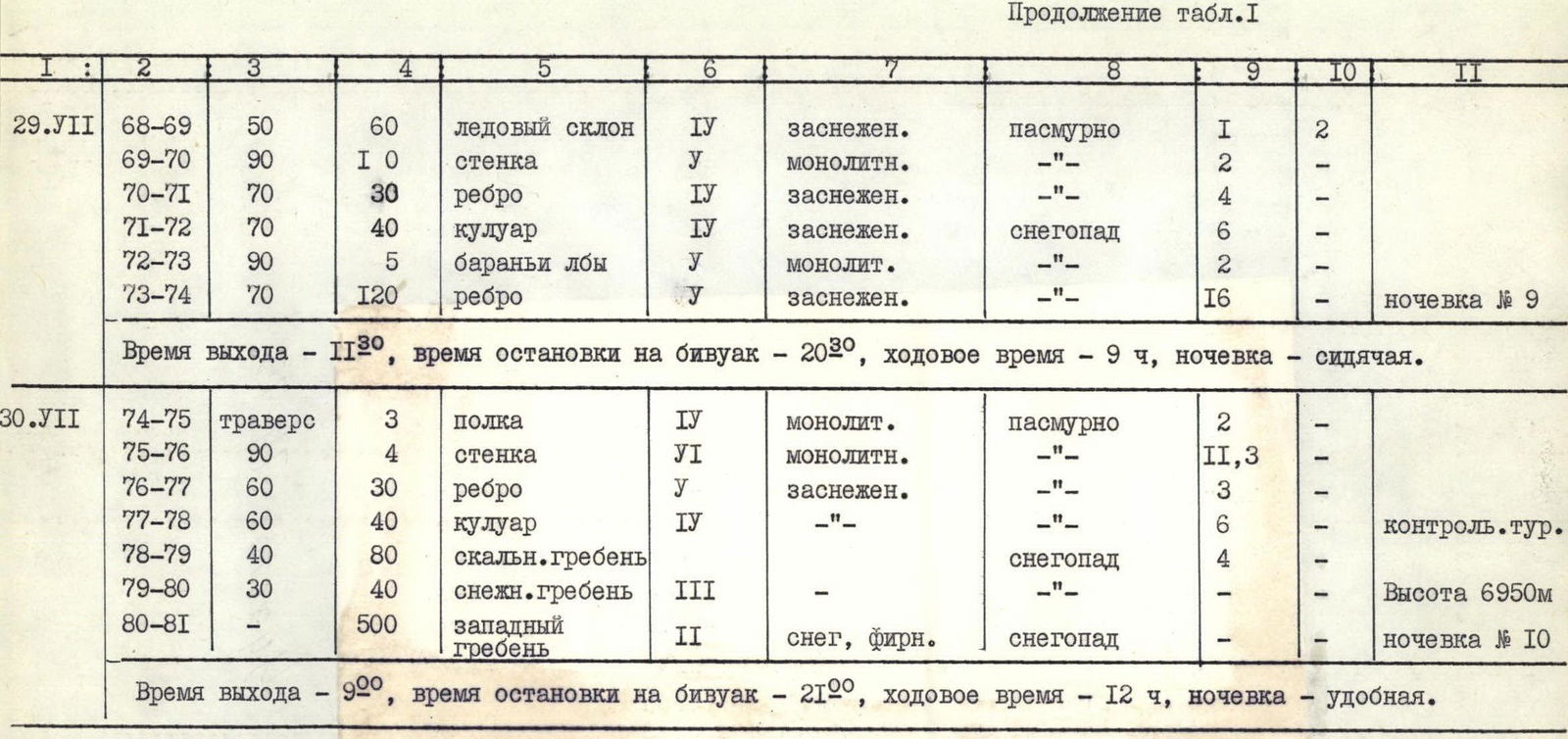
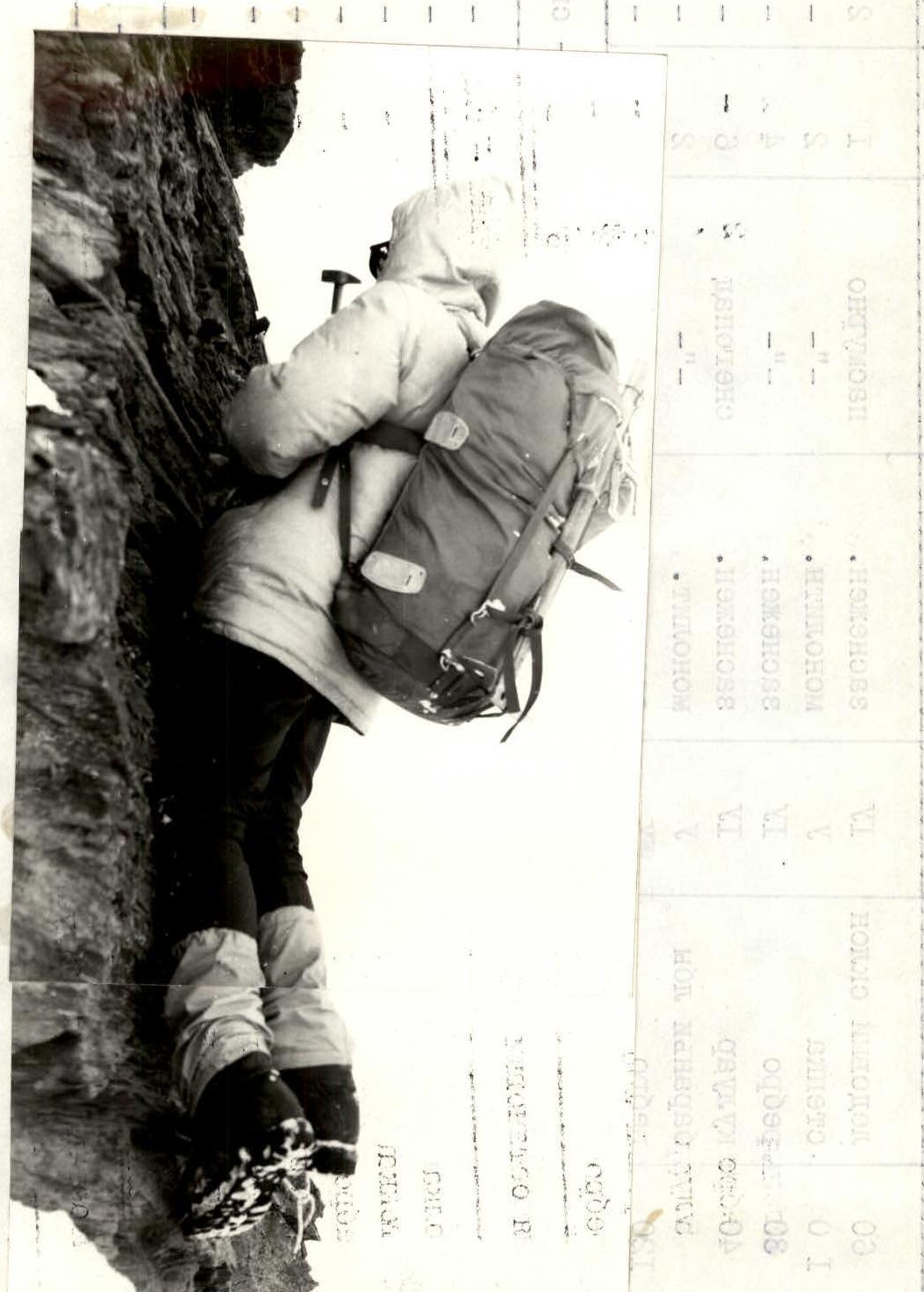
Section R74–R75. Continuation of Table I
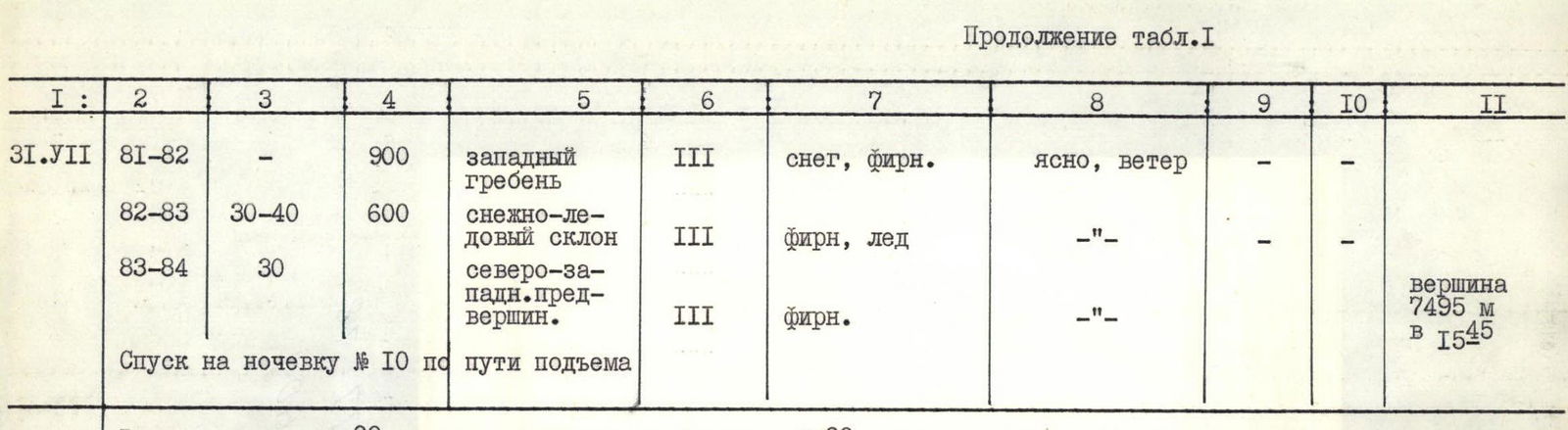
| 1.у. | Descent to Pamir firn plateau to Peak Parashyutists. Departure time — 10:00, arrival time at bivouac — 19:00, climbing time — 7 h, overnight stay — comfortable. | |||||||||
| 2.VIII | Descent along "Burevestnik" ridge to base camp on Suloyeva Polyana. Departure time — 8:00, arrival time at base camp — 12:00, climbing time — 3 h. |
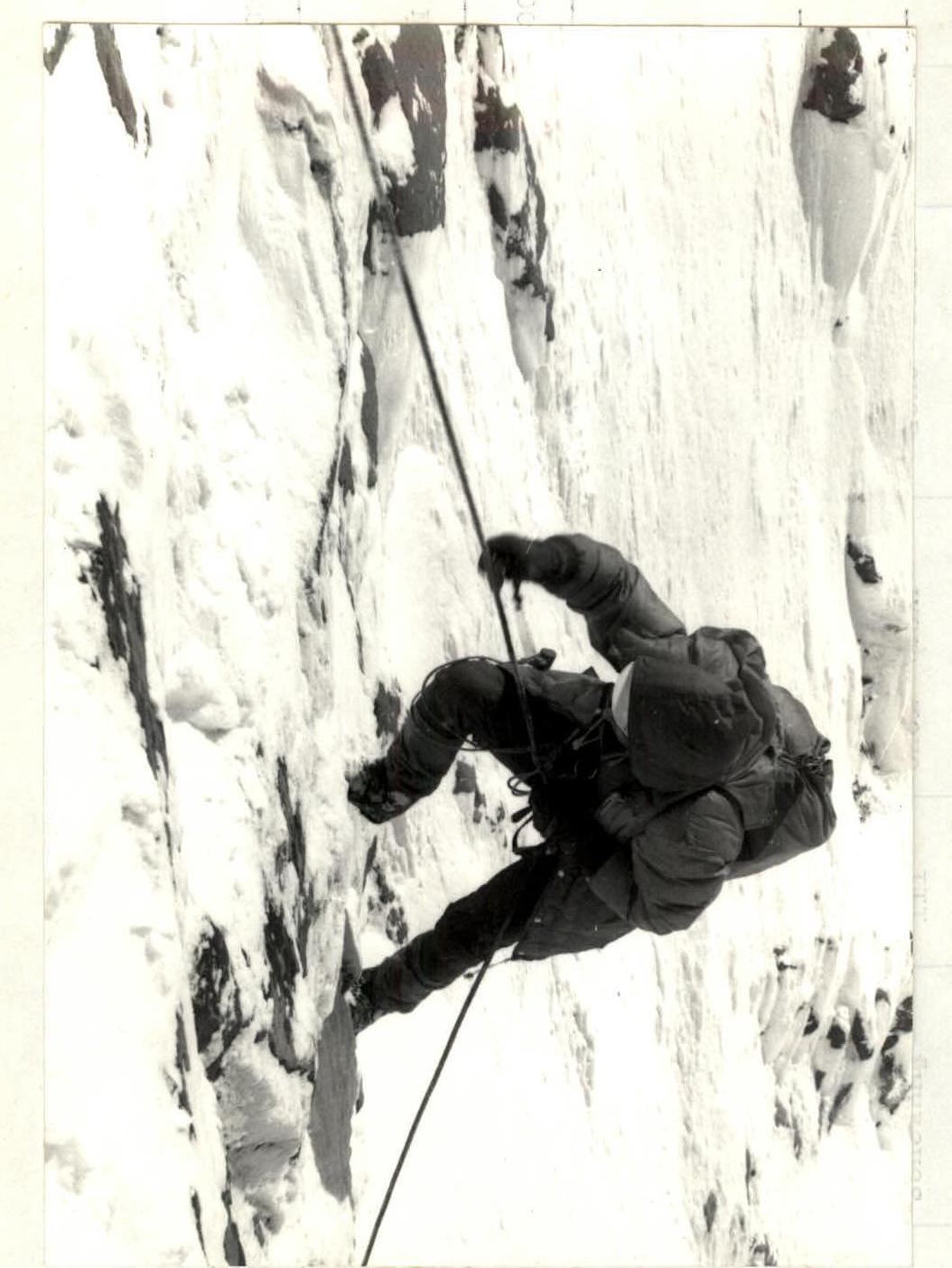
Section R77–R78 (steepness 60°)

Comments
Sign in to leave a comment