
I. Altitude class
- Central Pamir, Bivachny Glacier
- Peak Akhmad-Donish via South Face.
- 6B, second ascent
- Elevation gain: 2300 m, length 2585 m, length of sections 5–6 cat. diff.: 2142 m. Average steepness of the main part of the route 73°30′, including 6 cat. diff.: 80° (80 m), 85° (65 m), 90° (175 m), 95° (56 m).
- Pitons driven:
| Rock | Bolt | Nuts | Ice |
|---|---|---|---|
| 335 | 0 | 137 | 54 |
| 18 | 0 | 15 | 0 |
-
Team's climbing hours 77.5 and days 7.5.
-
Bivouacs:
- 1st bivouac on a snow-covered ledge
- 2–3 bivouac on a snowy ridge
- 4th bivouac on a narrow snowy ridge
- 5th bivouac hacked out on a slope covered with regelation ice
- 6th bivouac on a snow-covered ledge with regelation ice
- 7th bivouac on a snow-covered ledge All bivouacs were reclining.
-
Team leader: Gerga Sergey Lvovich, Candidate Master of Sports
Team members:
- Brook Mikhail Aleksandrovich, Candidate Master of Sports
- Mikhailov Andrey Vladimirovich, Candidate Master of Sports
- Fedorov Yuri Semenovich, Candidate Master of Sports
- Mingalev Vladimir Nikolaevich, Candidate Master of Sports
- Fedorov Vyacheslav Anatolyevich, Candidate Master of Sports
- Coach: Lebedikhin Alexey Veniaminovich, Honored Master of Sports II. Departure to the route: August 7, 1987
Summit: August 14, 1987
Return: August 15, 1987
12. Organization: Sverdlovsk Regional Sports Committee.
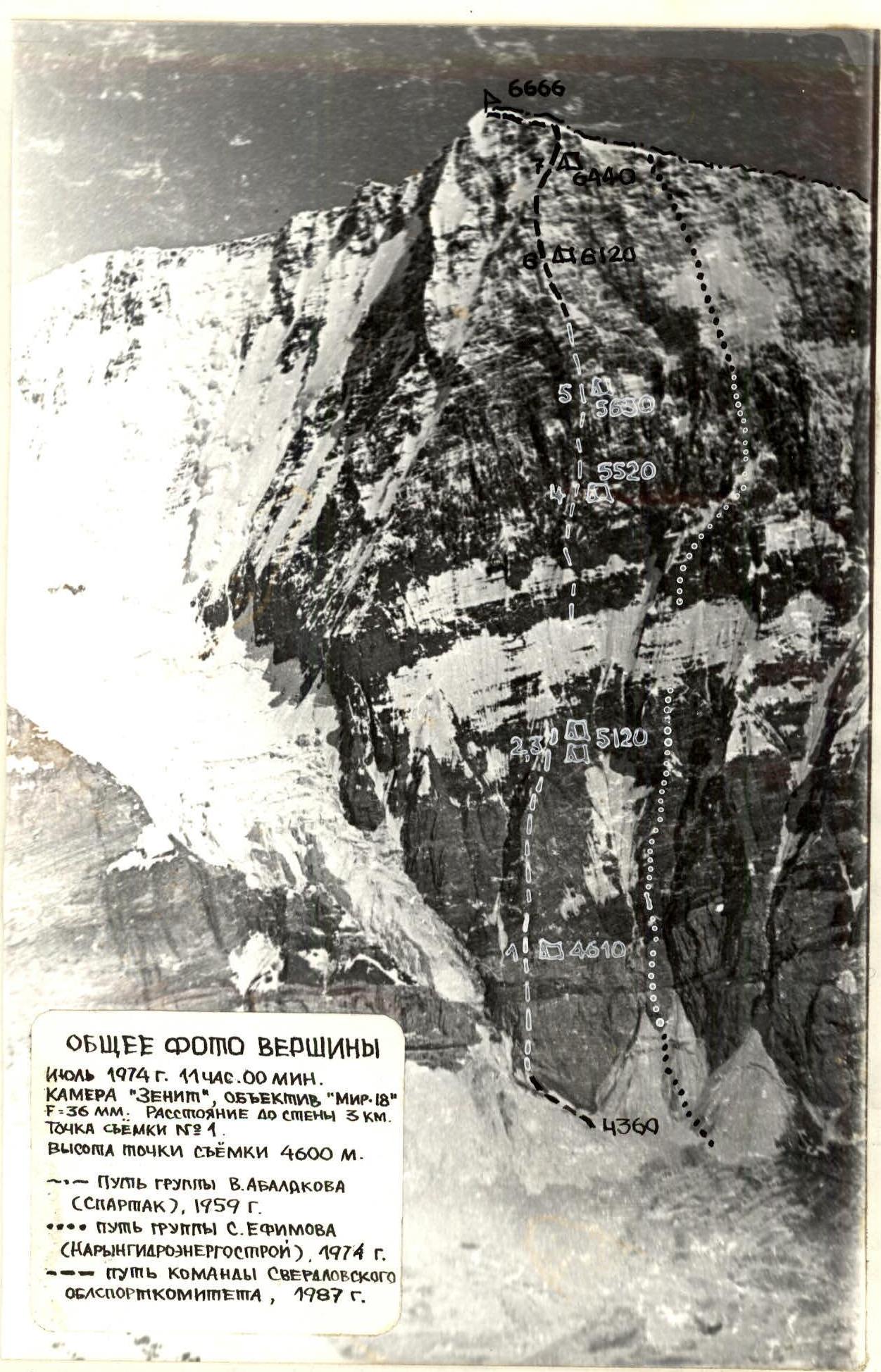
General photo of the summit
July 1974, 11:00. Camera "Zenit", lens "Mir-18", F=36 mm. Distance to the wall 3 km. Shooting point No. 1. Height of the shooting point 4600 m. — Route of V. Abalakov's team (Spartak), 1959 — Route of S. Efimov's team (SNRANGIDROENERGOSTROY), 1974 — Route of the Sverdlovsk Regional Sports Committee team, 1987
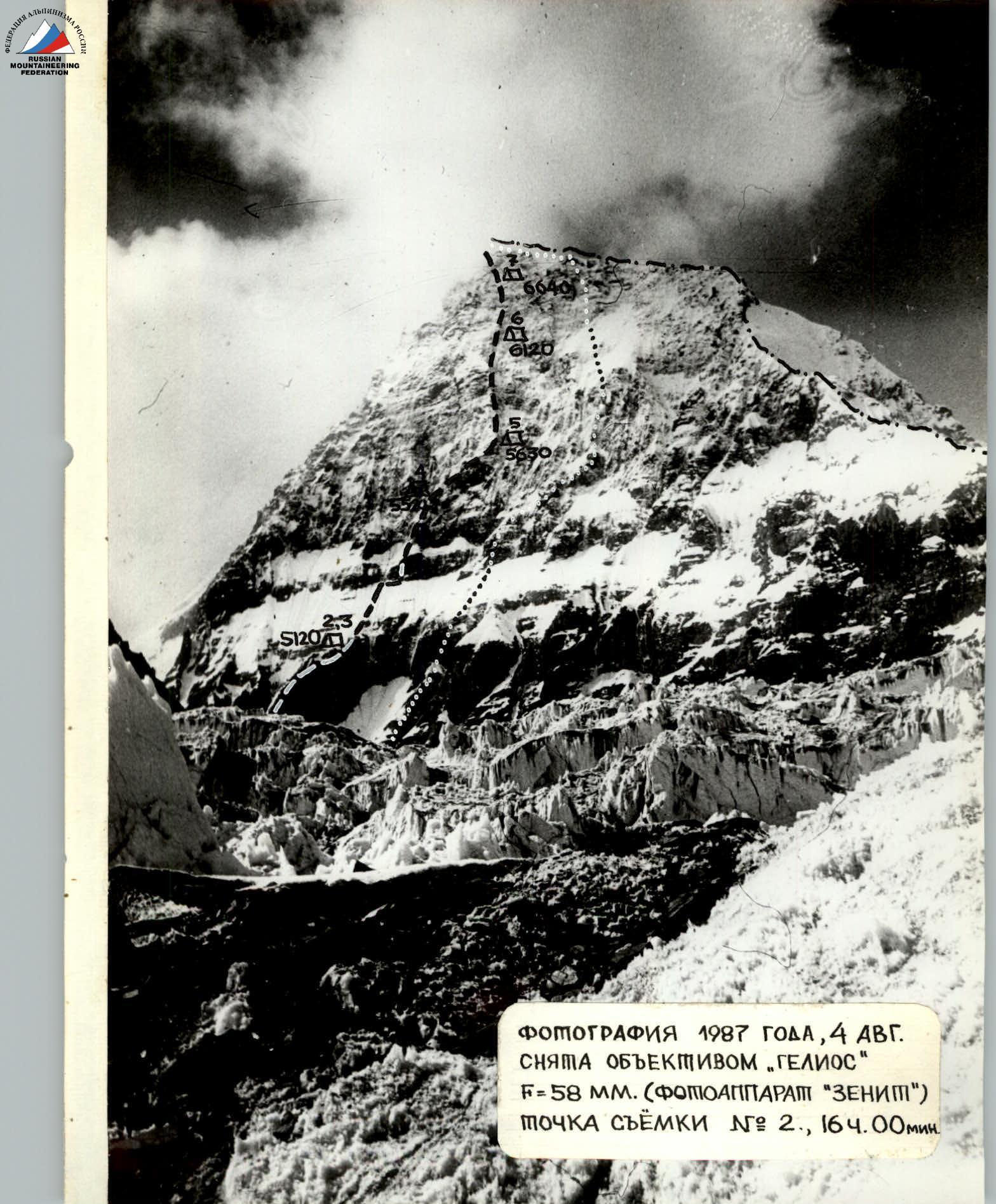
Photograph of 1987, August 4
Taken with a "Helios" lens F=58 mm. (camera "Zenit") shooting point No. 2, 164:00 min.

Profile of the wall on the right (photograph of 1974) — shooting point No. 4
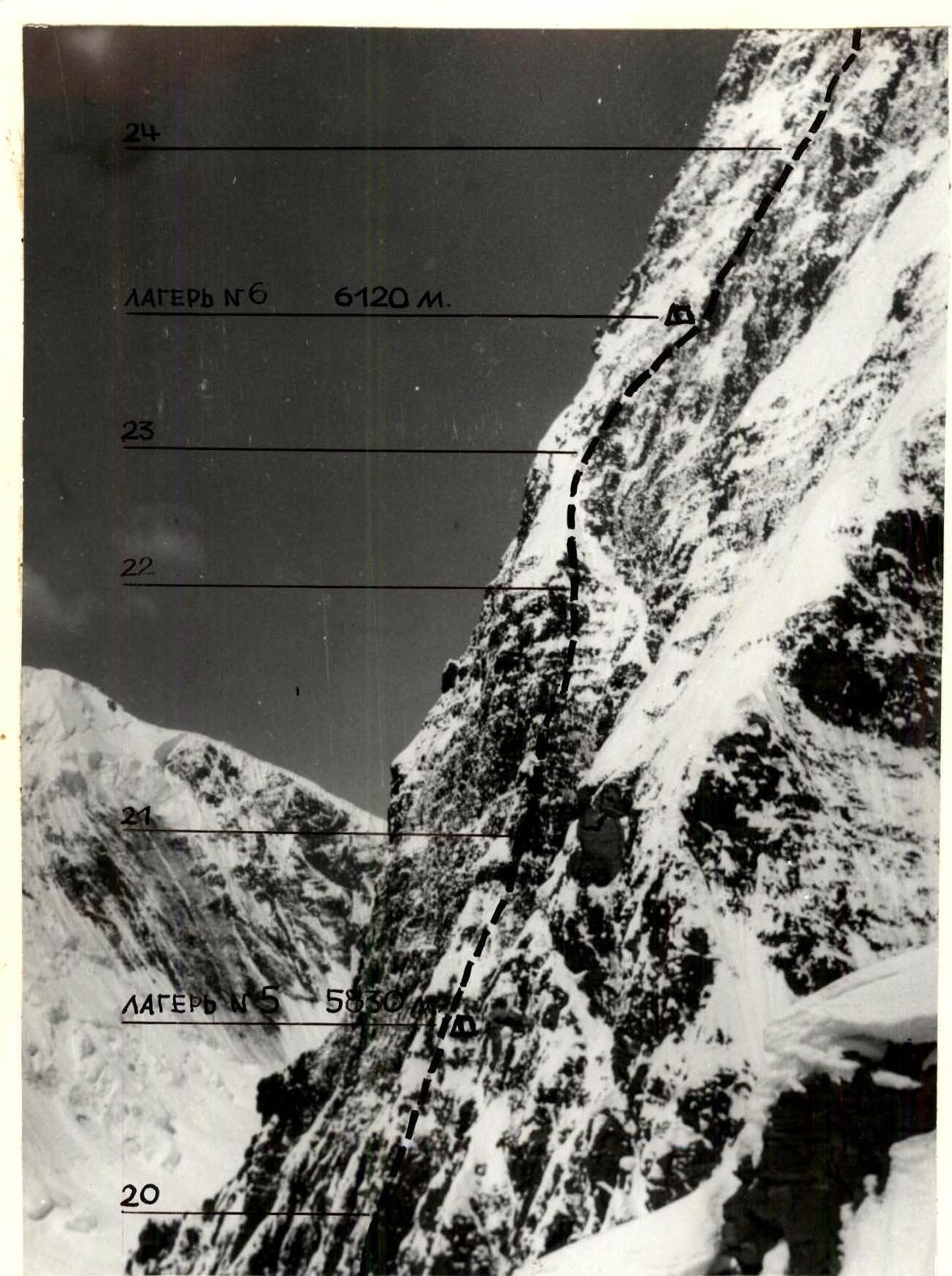
Profile of the wall on the right (sections 20–24)
August 15, 1987, 10:00. Camera "Lyubitel - 1668". Shooting point No. 3.
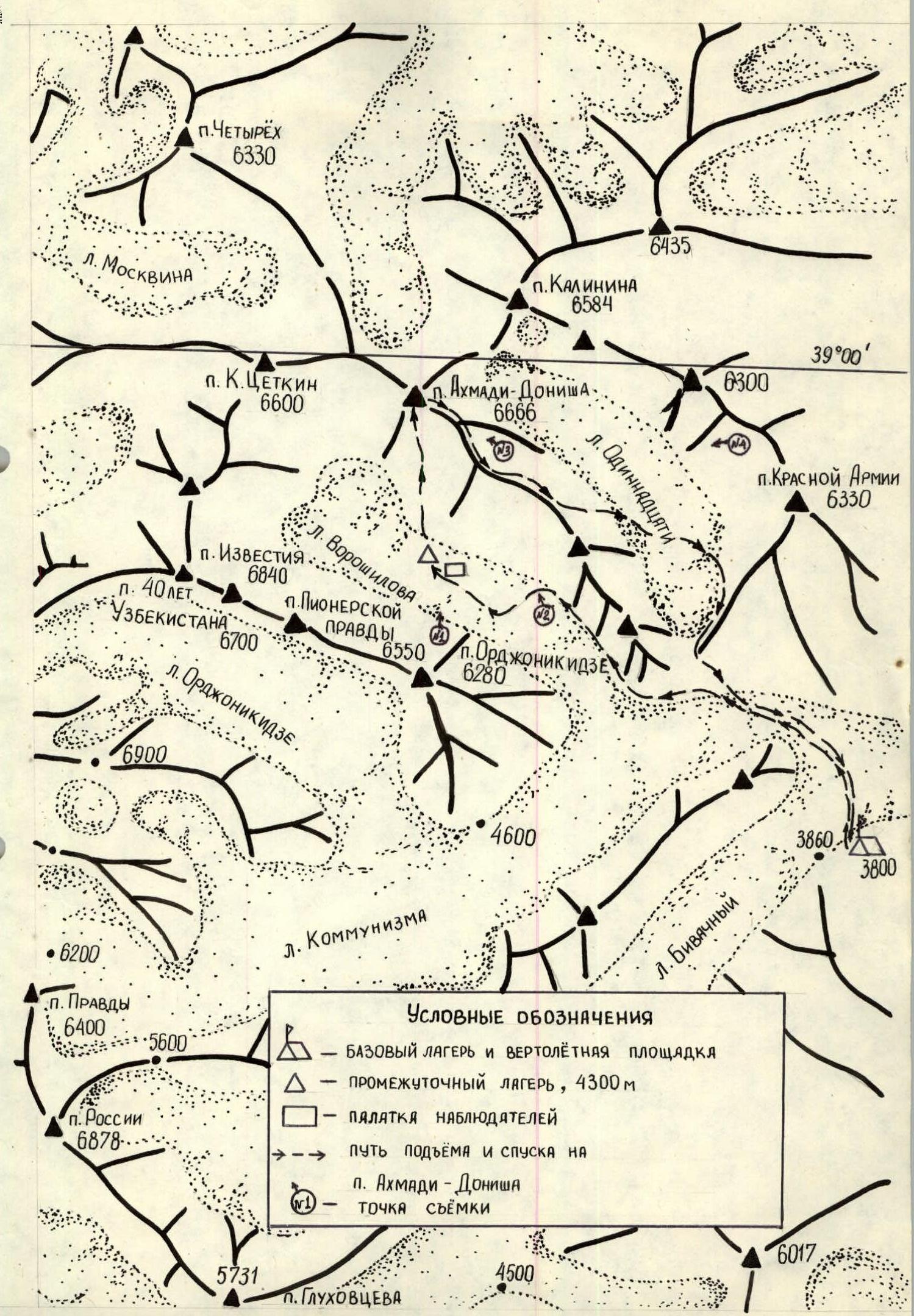
Tactical actions of the team
When drawing up the tactical plan for the ascent, we were guided by the time schedule of Smirnov's team, taking into account the high snow cover on the route. Six days were planned for the ascent, with one reserve day for bad weather and changes in the route conditions. The "claw" was planned to be climbed in two days, with the third bivouac above the snow-ice belt. The departure was planned for August 5, but due to an accident in the Uzbekistan team and the need for transportation work, it was delayed until August 7.
The snow-ice belt was planned to be climbed in the morning hours, wearing crampons, without prior evening preparation. In the evening, the snow-ice slope became rockfall-prone. The couloir at the top of the belt had to be crossed in the morning as well, before the rocks started falling. Changes in the snow conditions forced us to slightly alter our tactics:
- The snow did not harden overnight,
- It did not hold in the morning,
- It crumbled underfoot.
Climbing the snow-ice belt required significantly more time than expected, and a lot of time was spent on organizing reliable belays. Belaying through an ice axe was ineffective; we had to dig down to the ice (snow thickness reached 1 m) and drill ice screws. In connection with this, it was decided that in the morning, a pair would process the snow-ice slope, trample down steps, and hang ropes. The other team members would remain at the tent on a ridge safe from rockfall. The ascent through the snow-ice belt and crossing the couloir were planned for the next morning, which was carried out.
The team's physical and technical preparedness was quite even. This allowed each participant to take turns being the first to climb. On the first day, August 7, A. Mikhailov was the first on the route, covering sections R0–R6; on August 8, M. Brook (R7–R12); on August 9, S. Gerga (R13–R14); on August 10, Yu. Fedorov (R15–R18); on August 11, V. Mingalev (R19–R21); on August 12, V. Fedorov (R22–R24); on August 13, S. Gerga (R25–R26); on August 14, Yu. Fedorov (R26–R27).
The first climber moved on a double rope. One of the ropes was marked UIAA. The second rope was used to organize fixed ropes. All others ascended on the fixed rope using two ascenders with additional belay, either from above or below. Backpacks were not pulled up but carried on the climbers' backs, thanks to the use of two ascenders. On steep and overhanging sections, backpacks were attached to the harness. The route was mainly climbed using free climbing.
In the first two days, when climbing the "claw", the first climber wore galoshes. In subsequent days, the first climber typically wore crampons. During the ascent, there were no falls.
Throughout the ascent and descent, constant and stable radio communication was maintained with observers. Not a single communication session was missed. The second half of the ascent took place in unfavorable weather:
- It snowed constantly.
- Visibility was poor.
Poor visibility, however, did not cause delays in the movement, thanks to the logical nature of the route.
During the ascent, part of the rescue team was under the route on the Voroshilov Glacier. The main rescue team was in the base camp on the Bivachny Glacier, with which the observers had stable radio communication.
| Rock | Nuts | Bolt | Ice | Route diagram in UIAA symbols | Cat. diff. | Length, m | Steepness |
|---|---|---|---|---|---|---|---|
| 12 | 4 | - | - | V+ | 60 м | 85° | |
| 8 | 4 | - | - | V+ | 40 м | 75° | |
| 7 | 2 | - | - | V- | 35 м | 60° | |
| 4 | 8 | - | - | Photo 2 | V+ | 10 м | 80° |
| VI | 30 м | 85° | |||||
| 6 | 2 | - | - | Photo 1,2 | V+ | 30 м | 70° |
| 5 | 4 | - | - | Photo 4,5 | VI | 25 м | 80° |
| 7 | 3 | - | - | VI A3 | 25 м | 90° | |
| V+ | 5 м | 50° | |||||
| 4 | 1 | - | - | Photo 5 7.08.1987, 11 climbing hours, 265 m, 72 pitons | VI A2 | 20 м | 85° |
| IV- | 5 м | 55° | |||||
| 6 | 3 | - | - | Photo 7 | V+ | 25 м | 83° |
| V- | 6 м | 50° | |||||
| 8 | 5 | - | - | V+ | 40 м | 75° | |
| V+ | 10 м | 80° | |||||
| V+ | 45 м | 76° | |||||
| - | - | - | 6 | V- | 20 м | 70° | |
| 6 | 2 | - | - | V- | 25 м | 65° | |
| - | - | - | 4 | V- | 50 м | 60° | |
| 8 | 6 | - | - | VI | 55 м | 80° | |
| 3 | - | - | - | IV+ | 20 м | 60° | |
| 2 | 1 | - | - | VI A2 | 30 м | 90° | |
| 5 | 2 | - | - | Photo 11 10.08.1987, 13:30, 345 m, 70 pitons | V- | 35 м | 75° |
| 7 | 3 | - | - | V+ | 40 м | 75° | |
| 3 | - | - | - | IV+ | 20 м | 65° | |
| 4 | 1 | - | 4 | V+ | 40 м | 70° | |
| 9 | - | - | - | V+ | 40 м | 80° | |
| 3 | - | - | - | V+ | 10 м | 65° | |
| 10 | 2 | - | - | V+A2 | 50 м | 80° | |
| 5 | 1 | - | 2 | Photo 12 | VI A3 | 20 м | 95° |
| 4 | 3/2 | - | - | VI | 15 м | 95° | |
| 10 | 5 | - | - | VI A2 | 50 м | 90° | |
| 6 | 3 | - | 3 | Photo 13 | IV- | 8 м | 45° |
| 5 | 2 | - | - | V+ | 55 м | 85° | |
| 3 | 5 | - | - | V+ | 30 м | 80° | |
| 6 | 2 | - | - | VI | 10 м | 95° | |
| 7 | 3 | - | - | V+ | 35 м | 80° | |
| 5 | 2 | - | 4 | VI A4 | 20 м | 95° | |
| 4 | 2 | - | - | V- | 20 м | 75° | |
| 3 | - | - | - | V- | 30 м | 80° | |
| 10 | 4 | - | - | V+ | 30 м | 84° | |
| 5 | 2 | - | 4 | SNOW SHOULDER 12.08.1987, 10 climbing hours, 305 m, 80 pitons | V+ | 60 м | 78° |
| V+ | 50 м | 83° | |||||
| 5 | 2 | - | 4 |   | V+ | 30 м | 75° |
| 4 | - | - | - |  | IV+ | 20 м | 50° |
| 3 | - | - | - |  | V+ | 10 м | 80° |
| 6 | 2 | - | 2 |  | V+ | 45 м | 74° |
| 15 | 6 | - | - |  | V+ | 95 м | 73° |
| 2 | - | - | - |  | V+ | 10 м | 82° |
| 12 | 4 | - | 1 |  | V+ | 70 м | 75° |
| 10 | 6 | - | 5 |   | V+ | 100 м | 68° |
| - | - | - | 6 | Section not to scale. 14.08.1987, 13:00. 530 climbing hours, 280 m, 17 pitons | III- | 200 м | 30° |
Description of the route by sections
The entire route was climbed with the first climber setting fixed ropes and the rest of the team following on the fixed ropes with backpacks, using two ascenders and having upper belay. The first climber went without a backpack on a double rope. The belay was piton-based.
Section 1. Represents steep "ram's foreheads" with few cracks for belaying; the first climber wears galoshes; climbing is difficult.
Section 2 — slabs with narrow cracks; for belaying, long, narrow titanium pitons are used; climbing is difficult.
Section 3 — rocks composed of crumbling shale; titanium pitons ("carrots") are used for belaying; climbing is difficult and moderately difficult.
Section 4 — an internal corner with solid rocks; climbing is difficult; it is good to use nuts for belaying.
Section 5 — a smoothed-out gutter; climbing is difficult.
Section 6 — a wall composed of large blocks that easily flake off.
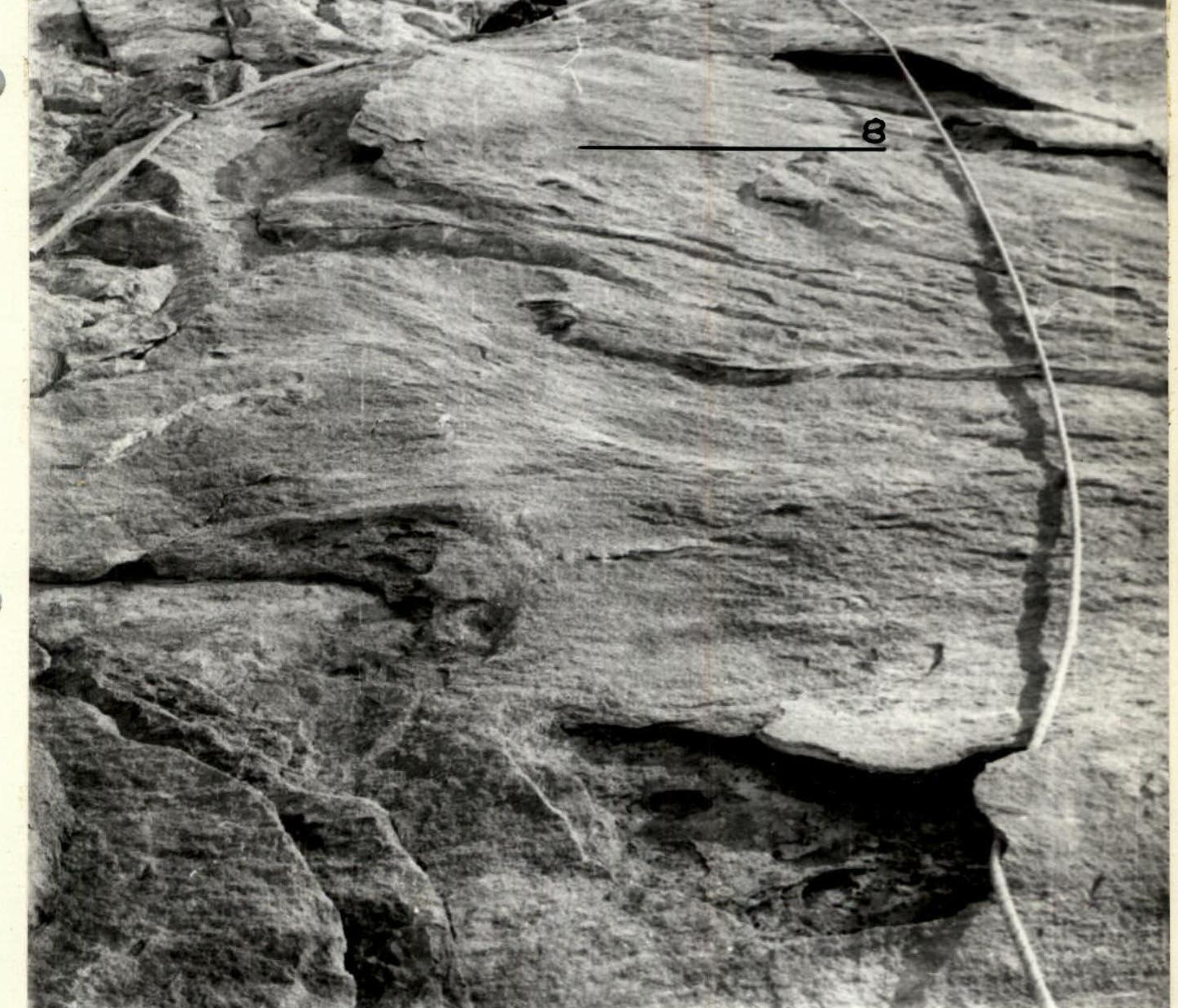
Section 7 — slabby rocks composed of marbleized limestone, heavily weathered on the surface; holds are smoothed out; sections of smoothed-out rocks like "ram's foreheads", sprinkled with sand; climbing is difficult; long pitons are used.
Section 8 — characterized by a well-defined, rugged micro-relief, but the rocks are steep; climbing is made difficult by the fact that the rock structure consists of easily flaking shale slabs; belaying is piton-based.
Section 9 — large, ice-covered rocks, with regelation ice in the cracks; belaying is piton-based.
Section 10 — a snow-covered internal corner with a cornice at the top; rocks are monolithic; to set belay points, the surface needs to be cleaned of snow and ice; climbing is very difficult.
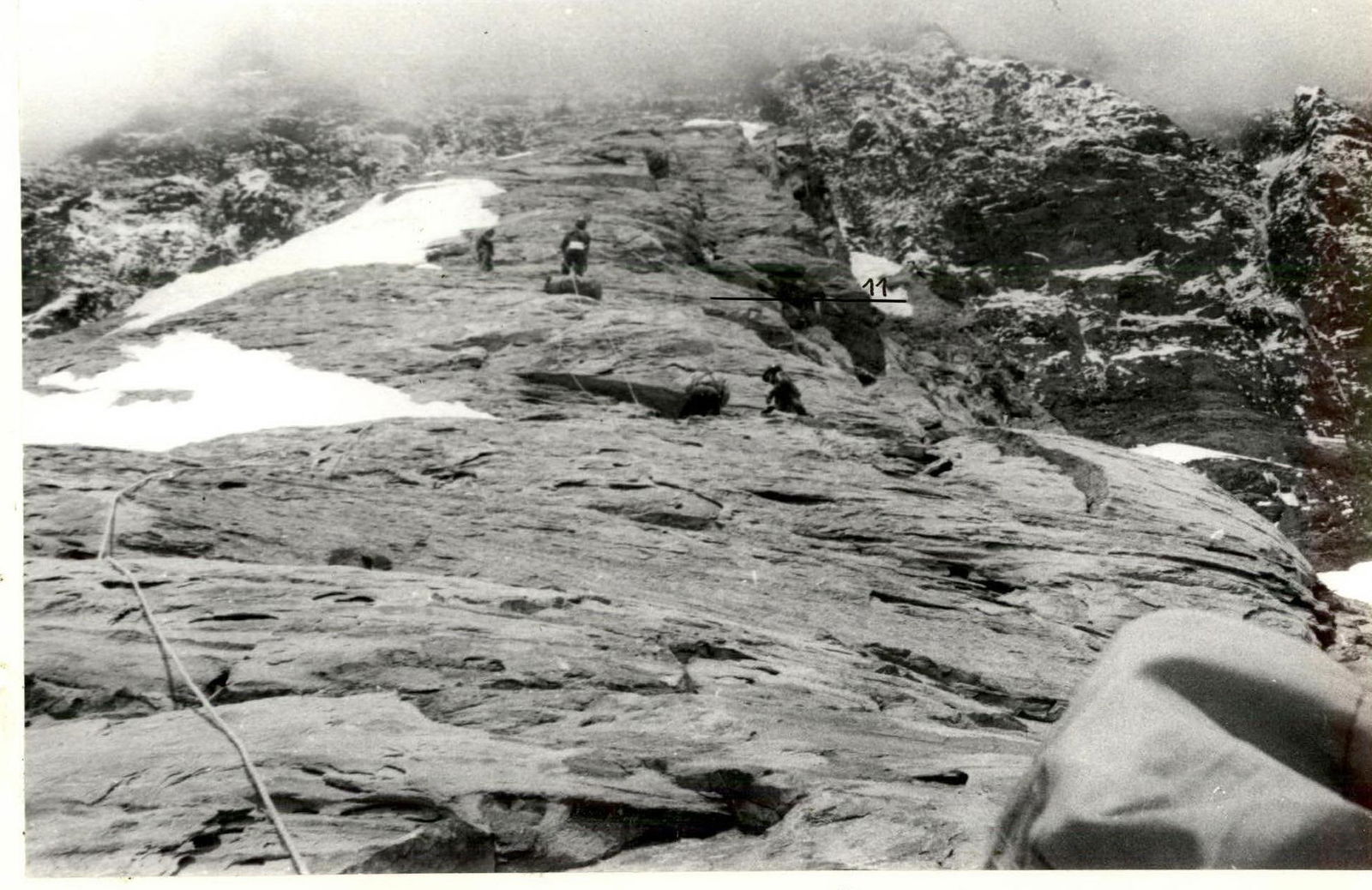
Section 11 — a steep wall composed of solid, porous rocks on the surface; a snowy cap hangs from above; there are few cracks and holds; climbing is very difficult, with the use of ladders.
Section 12 — rocks covered with snow; climbing is moderately difficult, but setting belay points is complicated; a poorly defined ridge.
Section 13 — rocks of moderate difficulty:
- Climbing is complicated by the presence of ice and snow.
- Climbed in crampons.
- Belaying is piton-based.
Section 14 — a snow-ice belt; snow is deep and loose; movement is complicated; belaying is through ice screws or, where rocks outcrop, through rock pitons; there is a high probability of rockfall in the second half of the day; the section is climbed in the morning, wearing crampons.
Section 15 — a snow-ice slope; belaying is on rock outcrops through pitons; a 60 m traverse to the right.
Section 16 — a wall; rocks are monolithic and large, covered with regelation ice; climbing is very complex; there is an overhang in the middle; the first climber works in crampons.
Section 17 — a snow-ice slope; ice screws were used for belaying.
Section 18 — "tile-like" rocks; climbing is very difficult; belaying is piton-based; in the upper part:
- large, loose rocks,
- climbing is extremely difficult.
Section 19 — snow-covered, ice-covered rocks; in the upper part — a destroyed, sharp rocky ridge with a snowy cap; at the end of the section — a couloir with regelation ice; climbing is difficult; the first climber goes in crampons.
Section 20 — large-block, monolithic rocks, steep, filled with snow; climbing is very difficult; belaying is piton-based; the first climber goes in crampons.
Section 21 — a large wall with an overhang; rocks are large-block, with ice, filled with snow; in the end, it forms a chimney filled with ice, ending in a cornice; holds are poorly defined; climbing is complicated by the need to clear the rocks to set belay points; the first climber goes in crampons; belaying is piton-based; climbing is extremely complex; ladders are used.
Section 22 — large-block rocks; a steep wall; holds are solid and large, but with snow; at the end of the overhanging rocks — a snowy cornice; climbing is difficult to very difficult; belaying is piton-based; the first climber goes in crampons.
Section 23 — an internal corner filled with snow, turning into a steep, snowy-ice ridge; climbing is difficult; the first climber goes in crampons.
Section 24 — a rocky-ice couloir; rocks are snow-covered, large-block monoliths frozen in ice; climbing is difficult, complicated by the need to:
- clear snow,
- chop ice to set belay points. Climbing in crampons.
Section 25 — a wall; monoliths; at the end of the section — a couloir; rocks are heavily snow-covered; snow is heavy and loose; climbing is moderately difficult to difficult; climbed in crampons.
Section 26 — heavily snow-covered rocks; a steep wall turning into a rocky-ice couloir; climbing is difficult; climbed in crampons; belaying is piton-based.
Section 27 — the pre-summit ridge; snowy ascents; snow is deep; belaying is alternating, through an ice axe where the ice is close — through ice screws.
Photo 7, section 8
 TECHNICAL PHOTO OF THE ROUTE
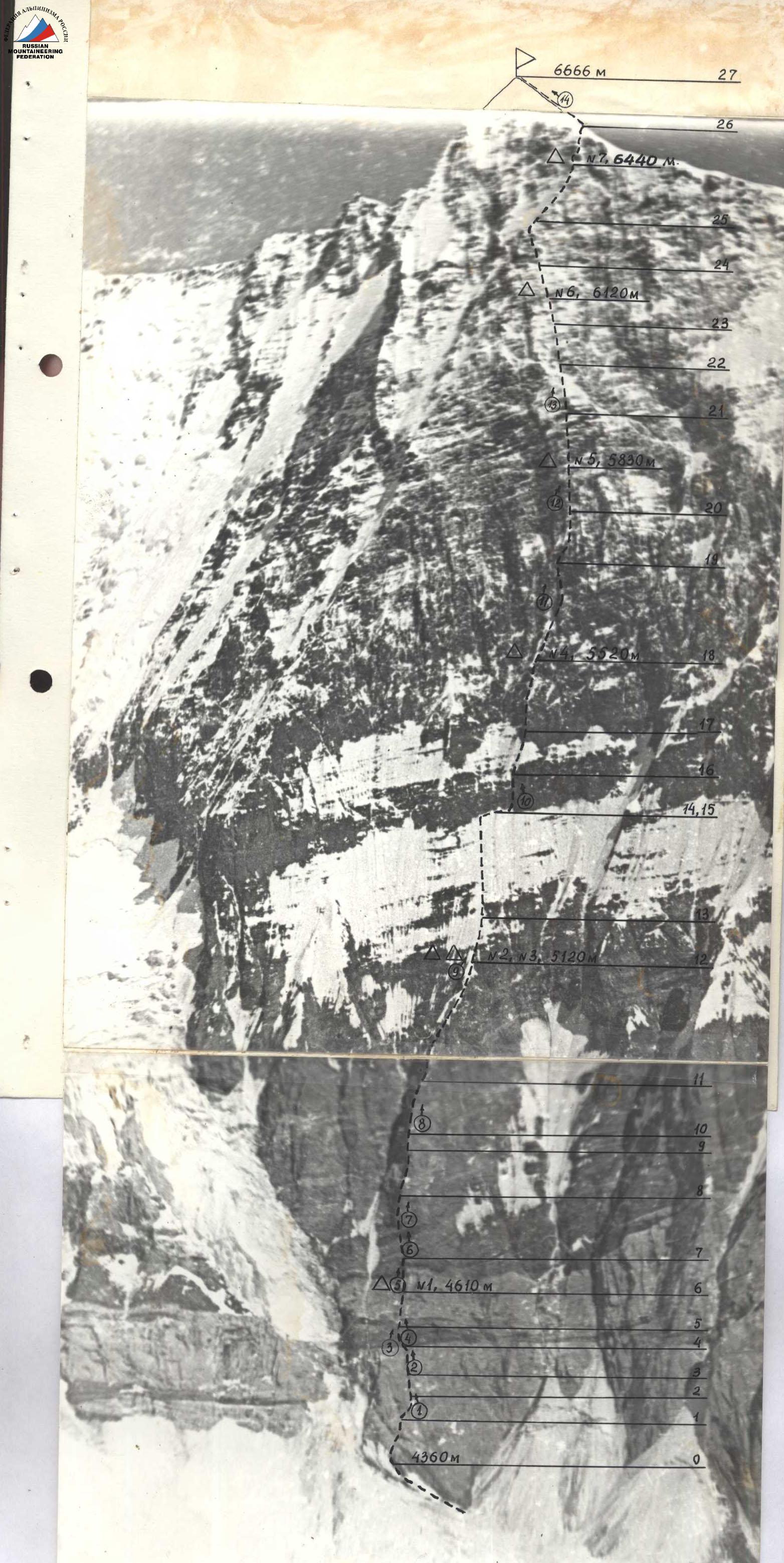
July 1974, 11:00. Camera "Zenit", lens "Mir-18", F=36 mm. Distance to the object 3 km. Shooting point No. 1. Height of the shooting point 4600 m.
TECHNICAL PHOTO OF THE ROUTE
July 1974, 11:00. Camera "Zenit", lens "Mir-18", F=36 mm. Distance to the object 3 km. Shooting point No. 1. Height of the shooting point 4600 m.
Passing the steep wall. Photo 8, section 11

Comments
Sign in to leave a comment