
- Class - winter
- Caucasus Eastern, Dagestan, Chekhychay river gorge
- Erydag via the center of the West wall
- Nekrasov's Route (86, Leningrad) - second ascent
- Height difference 480 m, length 530 m, sections of 5th cat. diff. 300 m, 6th cat. diff. 30 m, avg. slope 65°
- Pitons driven:
| rock | nut | ice | bolt |
|---|---|---|---|
| 4/2 | 68/1 | 0/0 | 4/2+1 |
- Team's travel hours - 22, days - 4
- Overnights: 1st in a tent semi-reclining, 2nd in a tent semi-reclining
- Leader: Leonov Pyotr Georgievich, MS, 367018, Makhachkala, Komsomolsky prospekt 45B, apt. 29
Team members:
- Voronin Sergey Valerievich, 1st sports category, 367010, Makhachkala, Ozyornaya st. 1
- Mazanov Tagir Mazanovich, 1st sports category, Kaspiysk, Michurin st. 19–20
- Coach: Murtazaliev Ziyabutin Murtazalievich
- Departure for the route: February 24, 1999 summit February 27, 1999, return to base camp - February 27, 1999
- Organization: Dagestan Republican Search and Rescue Service of the EMERCOM of Russia, Makhachkala, Erlicha st. 17
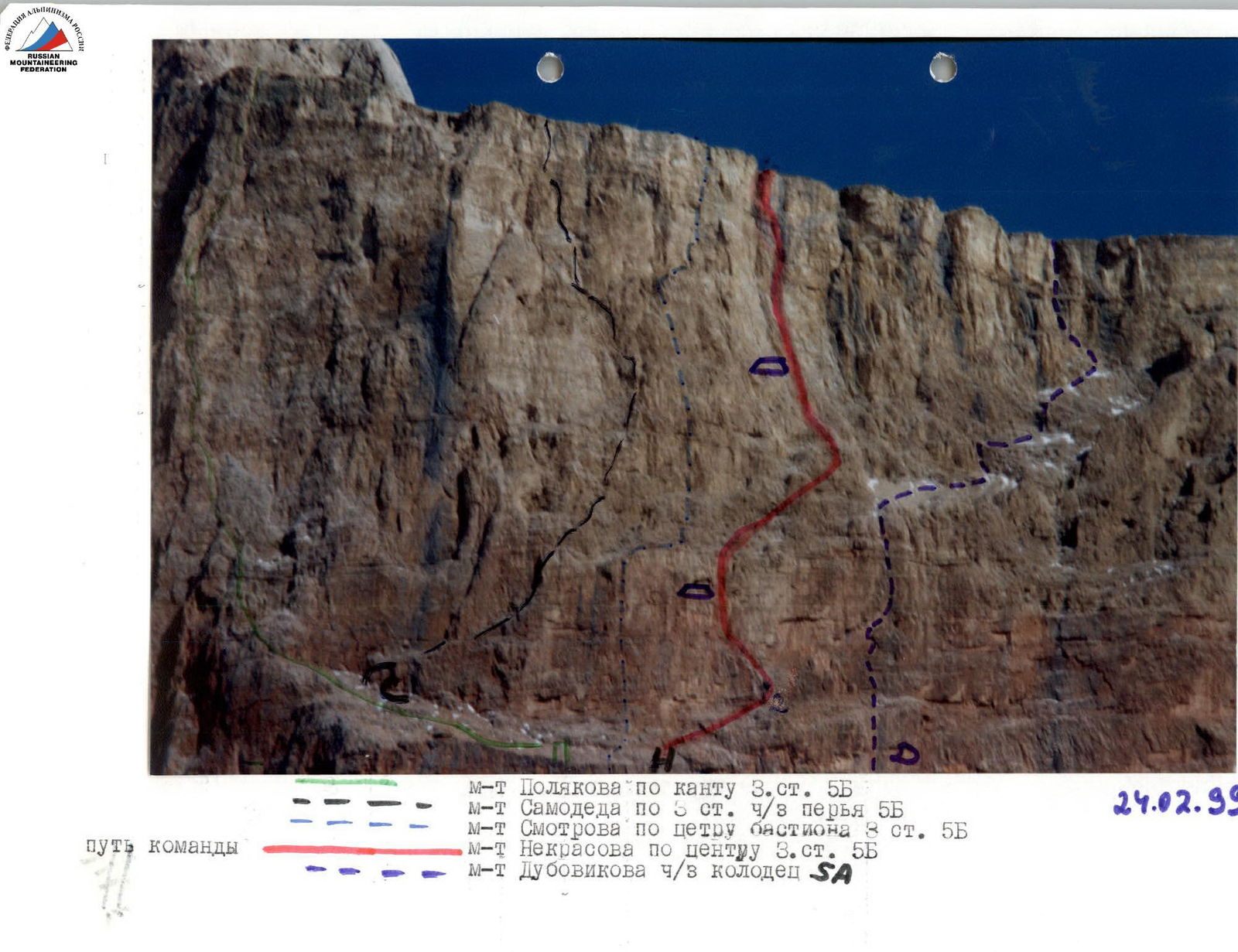 The team's tactics were based on the following factors:
- harsh winter conditions (frost, wind)
- purely rock nature of the route
- need for 2 overnight stays on the route.
The tactic of evening processing (25 m on the first day, 90 m on the second day) was applied. Preliminary processing was 40 m. This tactic allowed saving 2-3 hours daily, as the sun appears on the West wall of Erydag at 11:00.
The entire load was distributed into 2 backpacks, transported using the "American" method. A standard scheme of the triple team's work was applied:
- The first worked without a backpack in rock shoes.
- To secure the lead, the latest generation climbing rope was used.
- Insurance for the second and third - only upper, except for moments of passing processed sections.
- Insurance stations were organized at three points (piton-nut) in safe locations.
However, for the triple team, the route is not rockfall-prone. The first overnight stay was decided to be organized not on the первопроходцев's ledge, but in a niche, which provided protection from the wind and safety.
Equipment, climbing techniques, and insurance were classic. They slept in a homemade (0.6 kg) Pamir-style tent. A small amount of snow on the ledges made it possible to limit water supplies to just 2 liters. The second overnight stay was on the первопроходцев's site, which had to be improved.
Deviations from the tactical plan were insignificant. The rescue team during the ascent was located directly under the wall at the "2900" bivouac. Radio communication was maintained according to the schedule on the "Lastochka" radio station, as the most reliable in winter conditions. An all-terrain vehicle was on standby at the "Erydag" base.
All information was transmitted 3 times a day to Makhachkala via HF communication. The necessary set of medications was available both to the group on the wall and to the rescuers.
The total weight of equipment and food at the beginning of the work was 44 kg. There were no accidents or injuries.
Knotty sections of the route were processed during the most favorable hours in terms of sunlight from 14:00 to 16:00.
For cooking, a gas burner was used. All products were quick to prepare.
The team recommends to subsequent groups:
- Maintain VHF and HF communication with the "Kurush" border post, where they have good acquaintances.
- Exclude the use of cameras with electronic systems (our "point-and-shoot" camera froze on the plateau).
- When descending, return from the summit via the plateau along the route of 1st cat. diff. (1-2 hours).
- Descend 50-200 m to the right of the State border between Russia and Azerbaijan.
- In case of sudden bad weather on the wall, provide shelter for the team in niches and grottos.
West wall of Erydag mountain
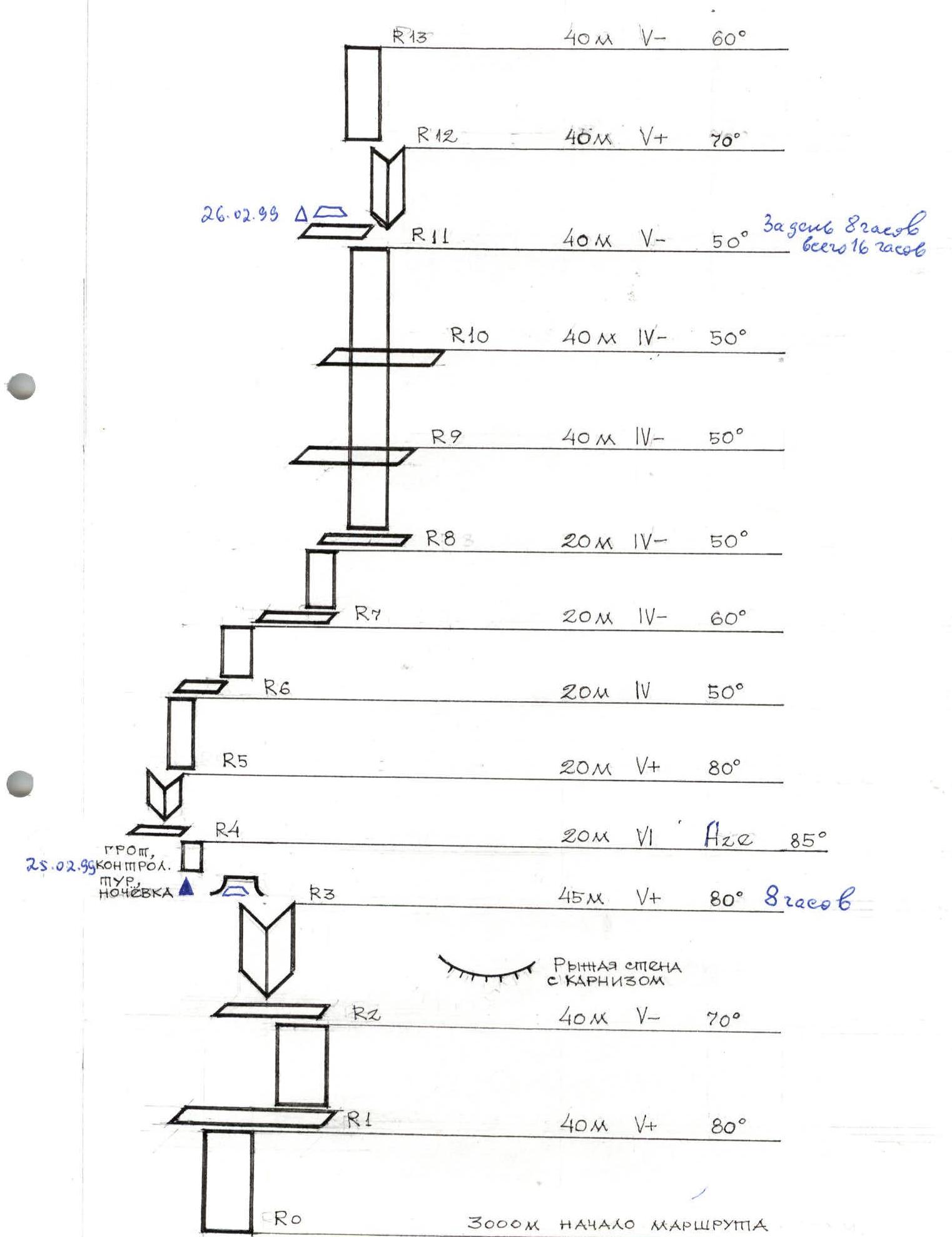
UIAA symbol route diagram
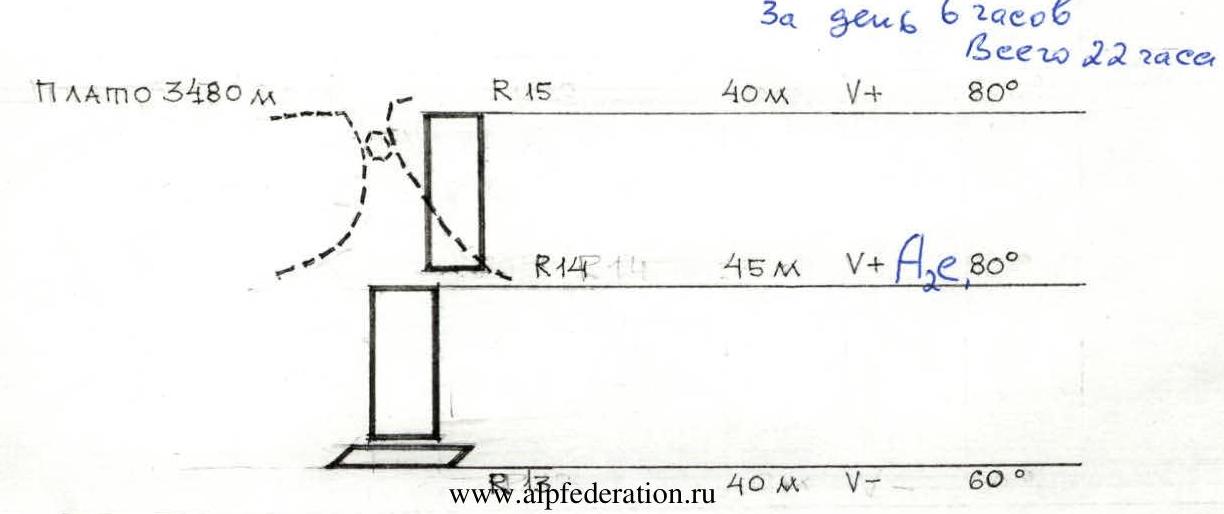
Continuation of the route
Scale 1:2000
Route description by sections (Erydag via the center of the W. wall - Nekrasov's route, 86, second ascent February 99)
The West wall is the most developed by climbers. The entire route via the center of the W. wall is divided into three large parts:
- lower bastion
- middle belt
- upper bastion
Section R0–R1
From the talus, exit through a monolithic difficult wall to the right edge of the "Polyakowskaia" ledge 40 m. Along the ledge 30-40 m (easy rocks) to the right under the next wall.
Section R1–R2
- Upwards to the right under the reddish wall with a cornice.
- Nekrasov's bivouac.
- Then traverse left to approach under the steep inner corner.
Section R2–R3
Difficult inner corner (45–50 m) leads to a grotto-niche. Bivouac. Control cairn. Process the next section.
Section R3–R4
- From the grotto left 5 m and straight up (aid climbing) to a narrow ledge (bolted piton).
- From the piton left 5 m under the inner corner.
Section R4–R5
- Along the inner corner, exit to the top of the lower bastion. Talus ledge.
Section R5–R11
- First, upwards to the right 60–70 m.
- Then slightly left 100 m under a small bastion to a light wall.
- Bivouac.
- Control cairn.
Section R11–R12
- From the bivouac to the right along the inner corner.
Section R12–R13
- Steepness decreases slightly.
Section R13–R14
- Slightly left-upwards through a gray wall. Very difficult (45–50 m).
- Enter a large (4–5 m) chimney. Bivouac possible.
Section R14–R15
- Along the right wall of the chimney 30 m (climbing V+, VI), then through a very difficult crack (10 m, V+) - exit to the plateau.
- Along the plateau to the summit 1-1.5 hours.
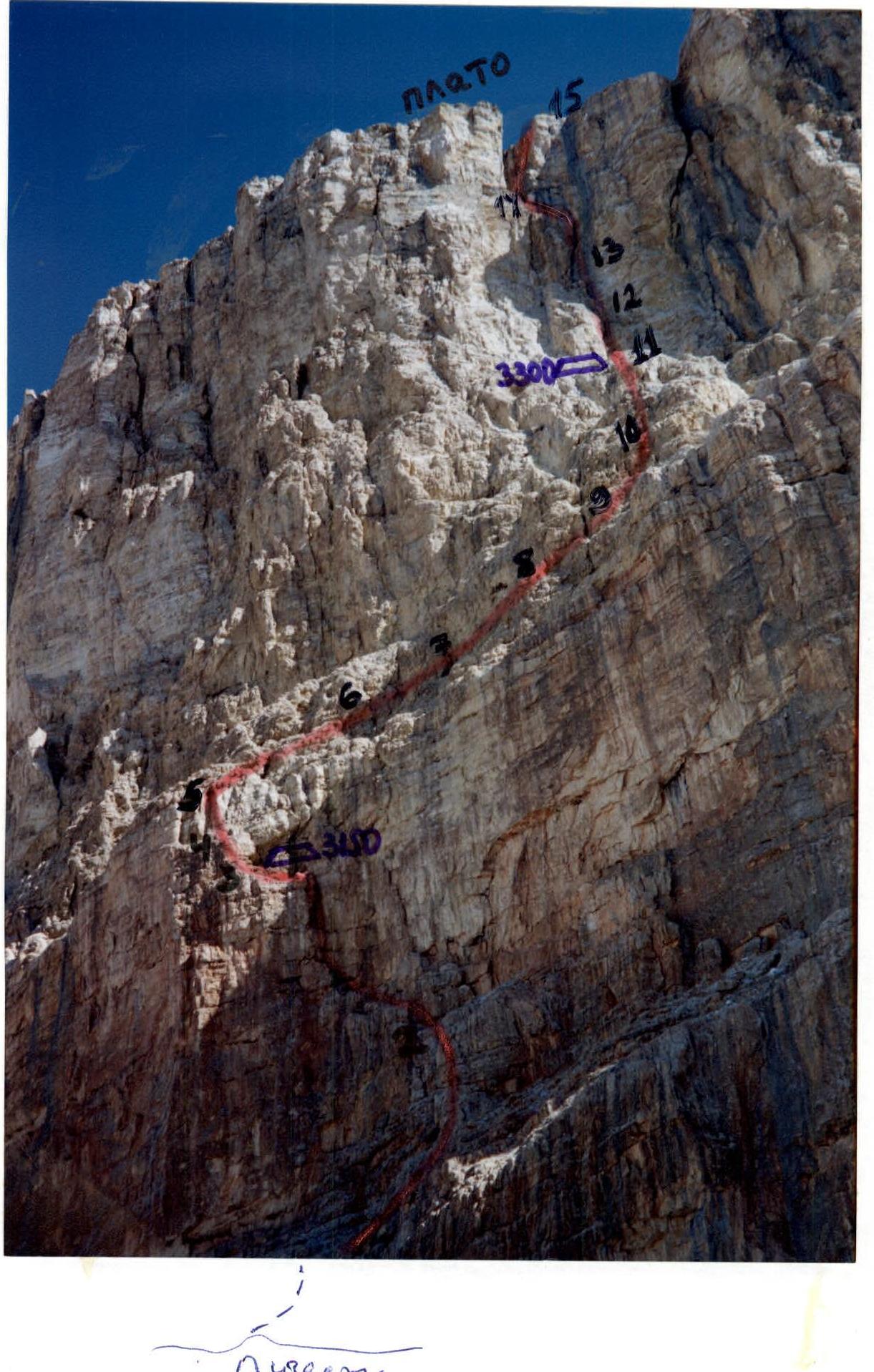
Technical photograph of the route /semi-profile from the right/

Middle of Section R14–R15, the 10-meter crack leading to the plateau is visible
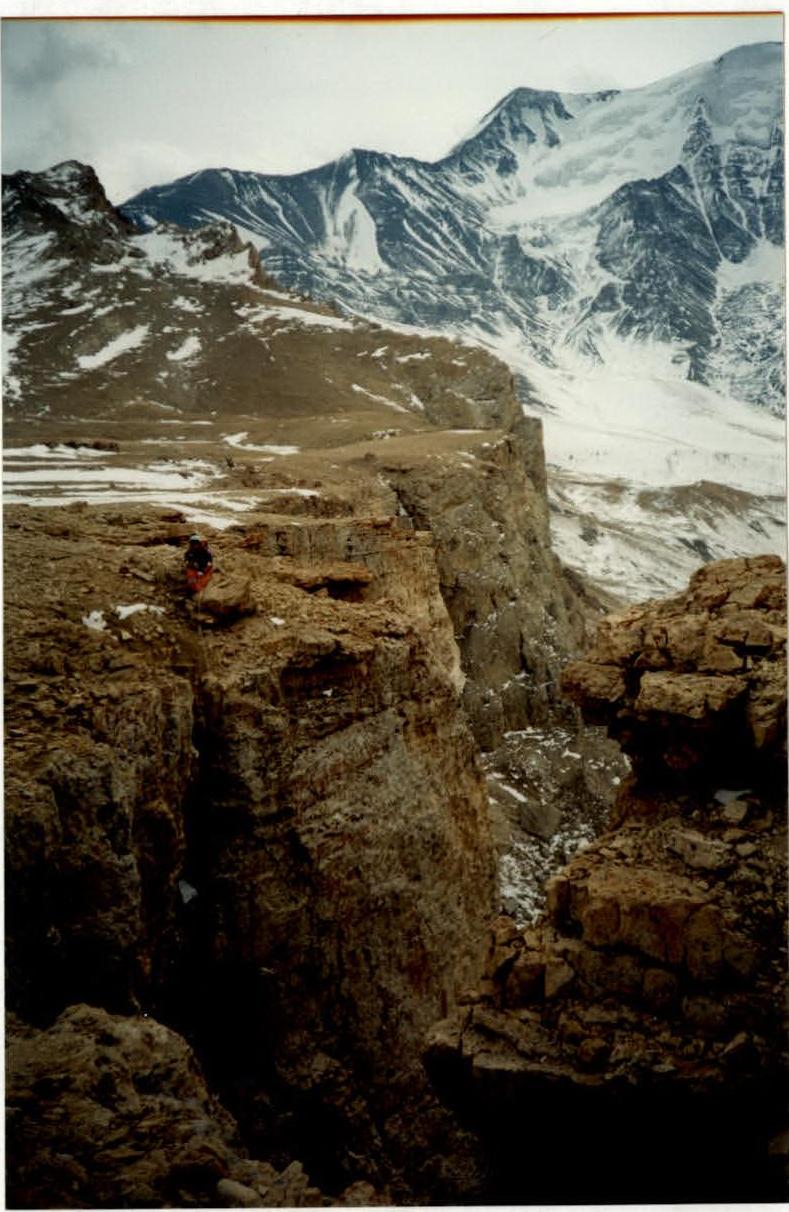
Section R14–R15. Photo taken from the plateau on February 27, 1999
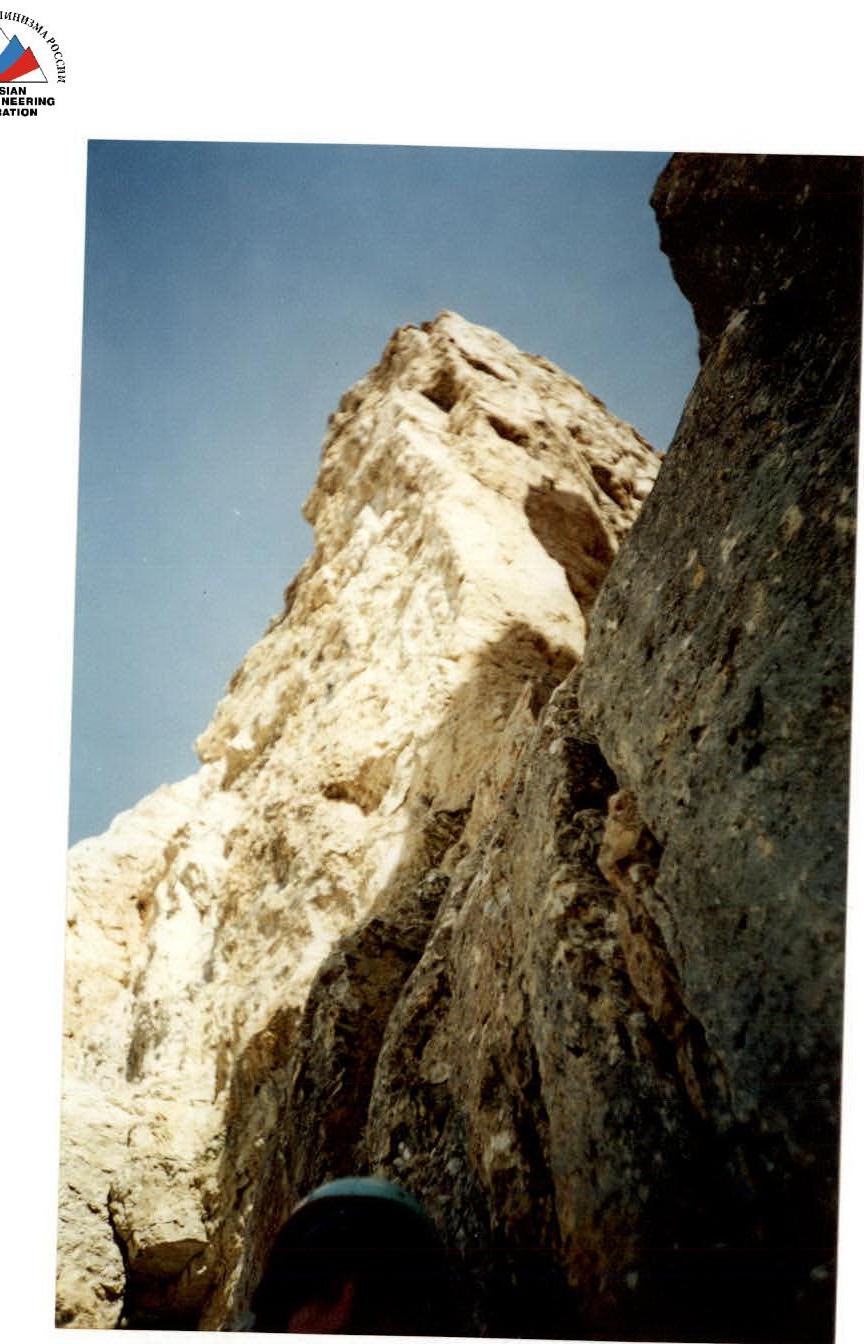
Section R13–R14 ends after 8 m with an entrance to a large chimney
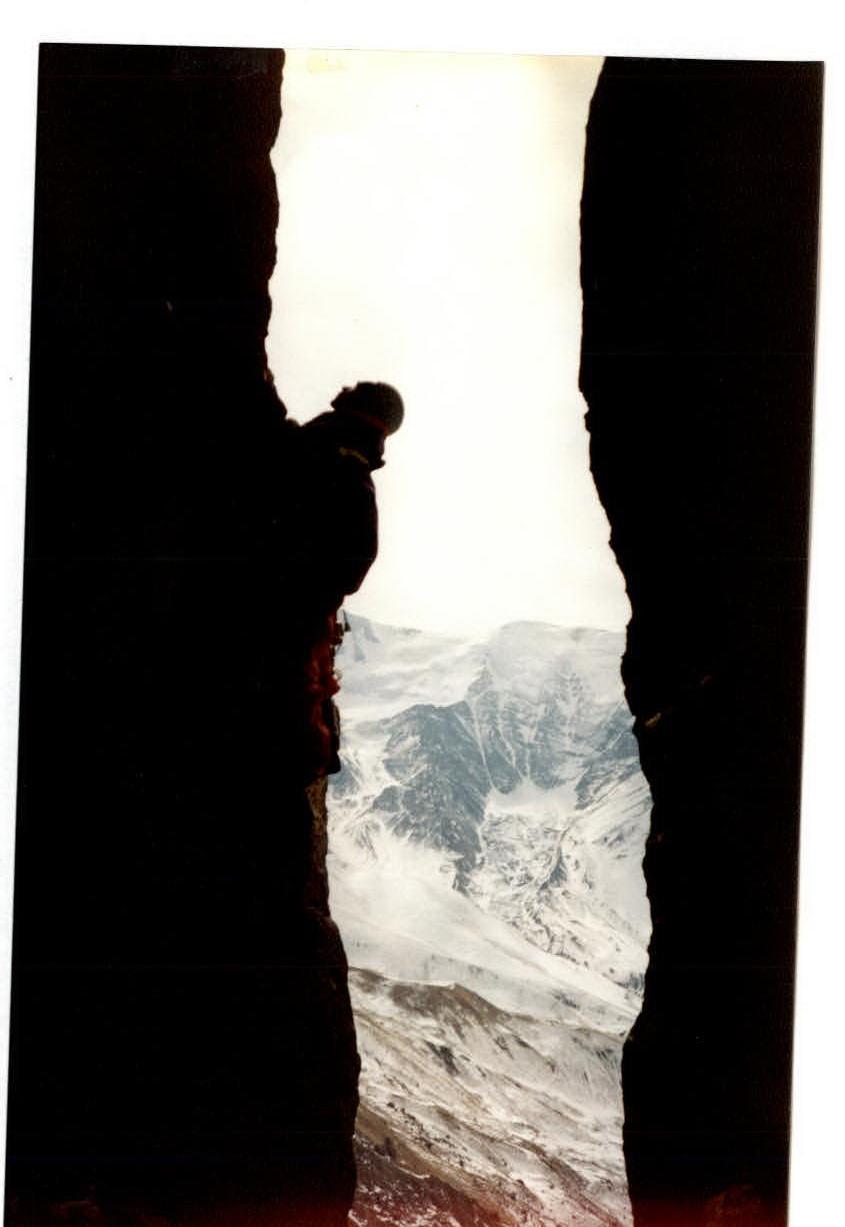
Beginning of movement on Section R14–R15 (right wall of the chimney). Around 12:00 on February 27, 1999


