
Ascent Log
-
Technical class
-
Caucasus, Tsey district
-
Chanchakhi (4450 m) via the Left Bastion of the North Face
-
Difficulty category — 5B, combined, second ascent
-
Height difference — 840 m
length of sections with 5B difficulty category — 447 m, including 6th category — 30 m, average steepness 65°, with main sections at 85°
-
Pitons driven
rock bolted chocks ice 102 – 36 6 for ITO: 14 – 11 – -
Team's climbing hours: 34 hours and days — 3
-
Overnights:
first — lying in tents; second — semi-sitting on a ledge, carved on a shelf
-
Leader: Zagirnyak Mikhail Vasilievich, Master of Sports
Participants:
- Volokhatykh Nikolai Grigorievich, Candidate for Master of Sports
- Dulepov Evgeny Nikolaevich, Candidate for Master of Sports
- Korneev Valery Nikolaevich, Candidate for Master of Sports
- Suprun Valery Ivanovich, Candidate for Master of Sports
- Tsymbal Leonid Vasilievich, Candidate for Master of Sports
-
Coach: Neborak Valentin Stepanovich, Master of Sports of the USSR
-
Departure from "Tsey" alpine base: July 18, 1985
Departure to the route: July 19, 1985. Summit: July 20, 1985. Return: July 21, 1985.
B. Korablin's route, taken by the alpine base team
V. Abalakov's route, 5B difficulty category
Brief explanation of the route diagram in UIAA symbols
- R0–R1 — Approach to the bergschrund, left of the rock spur;
- R1–R2 — Overcoming the ice wall of the bergschrund, "rockfall danger" in the second half of the day;
- R2–R3 — Movement along the snowy slope along the rock spur, movement in crampons;
- R3–R4 — Upwards to the right along a steep oblique ledge. Rocks of medium difficulty;
- R4–R5 — Upwards to the right along smooth slabs. Wet slabs.
- R5–R6 — Traverse left-upwards 10 m, wet rocks, then upwards along the wall with small holds. Exit to a ledge. I category cairn.
- R6–R7 — Overcoming an overhanging wall, using ladders, wet rocks, difficult;
- R7–R8 — Along a smooth inclined corner left-upwards;
- R8–R9 — Upwards along rocks of medium difficulty to a large oblique ledge;
- R9–R10 — Traverse along an oblique ledge to the right to a vertical wall with a cleft, overhanging in the upper part. Wet rocks;
- R10–R11 — Overcoming a vertical wall, rocks wet, climbing difficult;
- R11–R12 — Traverse left along an oblique ledge, overnight stay under a large overhang. Ledge covered with ice. II category cairn.
- R12–R13 — Traverse left 10 m, then upwards along the face of the Big Internal Corner, rocks of medium difficulty;
- R13–R14 — Upwards, through a 5 m vertical light wall. "Live" stones;
- R14–R15 — Left-upwards along wet slabs left of the snowpatch, under an overhang, right of the internal corner. Easy climbing.
- R15–R16 — Upwards along the internal corner, difficult climbing;
- R16–R17 — Overcoming a 5 m wall with an overhang, using ITO;
- R17–R18 — Left-upwards along smooth rocks. Climbing difficult;
- R18–R19 — Ascent along smooth slabs right-upwards and then along a wall with a vertical cleft upwards. Rocks wet under a red-brown cornice. IV control cairn.
- R19–R20 — Right of the "red-brown" cornice upwards;
- R20–R21 — Ascent left-upwards, rocks with a tile-like structure
- R21–R22 — Along easy rocks of the ridge left-upwards under a small gendarme on the ridge;
Route to Chanchakhi peak via the Left Bastion of the North Face / and passage description
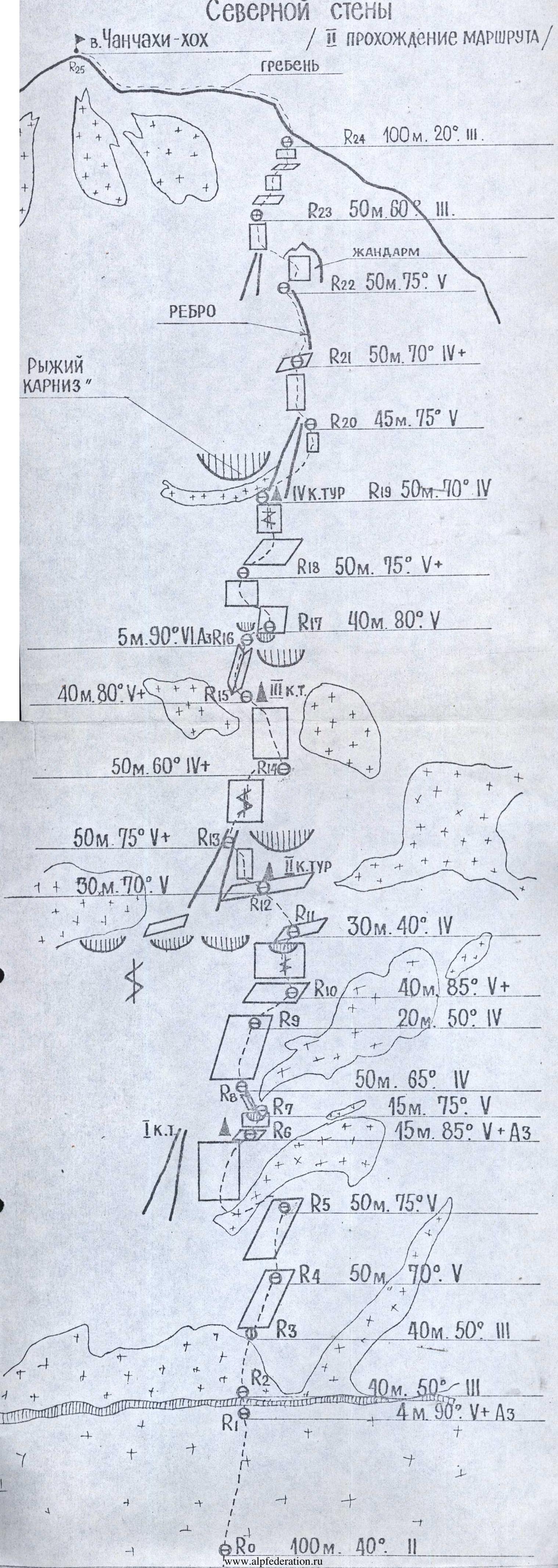
- R22–R23 — Left of the "gendarme" along a small couloir and then ascent along the couloir wall left-upwards;
- R23–R24 — Along easy rocks, exit to the ridge;
- R24–R25 — Along the sharp ridge leftwards, exit to the summit.
Team leader M. Zagirnyak
Protocol of the ascent to Chanchakhi peak via the Left Bastion of the North Face, 5B difficulty category (second ascent)
dated July 23, 1985
Review conducted by:
- Neborak V.S. — first release supervisor
- Gerasimov V.V. — head of the KSP Tsey district
Present:
- Sukharev V.N. — head of the rescue team,
- Zagirnyak M.V. — leader,
- Volokhatykh N.G. — participant,
- Dulepov E.N. — participant,
- Korneev V.N. — participant,
- Suprun V.N. — participant,
- Tsymbal L.V. — participant.
Zagirnyak M.V. — The team prepared for the route from 1983. This year, we entered the route for the Caucasus Championship, as the camp team was unable to complete the route in 1984 as part of the USSR Championship.
At the beginning of the season, during a reconnaissance trip, we observed the route. It is logical and beautiful, going from the plateau (lower wall) to the summit. Before the ascent, the team in full made an ascent to Songuti peak via the Grishchenko–Vergoda route, 5B difficulty category, one of the most challenging in the area. Before the ascent, we received consultations from:
- V.V. Gerasimov — head of KSP, member of the first ascent team,
- A. Martynov and A. Sushko — members of the camp team that made the ascent via this route as part of the 1985 USSR Championship, reaching the third steel belt.
Based on the consultations and available materials at KSP and the base, a route diagram was compiled using UIAA symbols.
About the route. It is a combination of walls and ledges with snow. The route is logical and accurately shown in the photograph obtained by the team before departure. There are no ice sections on the ascent, but crampons are necessary for all on the descent. Additionally, crampons or ice axes are needed to overcome the bergschrund. The bergschrund, essentially an ice wall, must be overcome in the evening or early morning. During work on the bergschrund (after 15:00), rocks were not falling. The lower part of the rocks (first bastion) has a complex tile-like structure with the "tiles" pointing downwards. Climbing is quite tense. The upper part of the wall (second and third bastions) is more monolithic, with fewer holds, but climbing is more reliable. However, the difficulty of climbing is significantly complicated by water flowing in streams starting from 10:00. The length of sections with 5B difficulty category is about 500 m, 6th category — about 40 m.
Average steepness is 65–70°.
Time schedule: 1st day (July 18) — approach, observation of the wall, processing the bergschrund; 2nd day (July 19) — departure on the route at 6:30 due to bad weather, by 16:30 the first climber reached the overnight stay location of the first ascent team (on Abalakov's ledge) and by 19:00 they processed three more ropes; 3rd day — departure at 7:30, by 12:00 they approached the wall below the "red-brown" gendarme (third belt), by 15:30 they exited under the wall at the exit to the ridge, at 17:30 they were on the summit and immediately began descending via the 4A category route to the south. The description matches the route well (corresponds). Unfortunately, like the camp team that passed more than half of the route last year for the USSR Championship, we did not find the control cairns of the first ascent team. Although we encountered their "traces" (pitons). First and foremost — three bolted pitons on a small ledge (first overnight stay), a bolted piton on the red-brown wall before the "red-brown" gendarme, a titanium piton — when exiting to the "roof" (we are returning it to the first ascender, Comrade Gerasimov, present here). In addition, during the processing of the second belt on the first day and its passage on the second day, we passed through loops left by the camp team last year during their emergency departure from the route. We also encountered metal poles from a tent left by the participants of this team at the base of the internal corner (their overnight stay location). We left our control cairns according to the description, hung on pitons under overhangs. We retrieved a note from previous climbers from the summit.
The tactics of the ascent were determined by the nature of the route, representing a system of walls with steep inclined ledges. Many "live" stones, rocks are falling. Therefore, insurance locations were chosen under overhangs. Departure on the route in normal weather should be made, as planned by the team, at 4:00–5:00 am.
Key locations — two walls in the lower part (first bastion) and upper walls (second and third bastions) — in bad weather will be extremely difficult (without bolted pitons).
Our team is well-coordinated, having climbed together three 6th category routes in recent years. The movement scheme on the route is well-established. The first climber moves on a double rope and without a backpack, the last also on a double rope with a lightened backpack. The rest, depending on the steepness and situation, move on a double rope or on a single rope with lower insurance. Movement was carried out with alternating lead teams and the first in the team. I would like to note Dulepov, who processed the bergschrund; Volokhatykh, who passed key locations on the first day, and Tsymbal, who passed key locations on the second day. There are no comments on the team as a whole.
About the route, I will add. Chock stones and boxes work well. Rocks, often falling arbitrarily (thawing), pose a significant danger. In terms of difficulty and length, the route is not inferior, in our opinion, to Korablin's route on Nakhar, 6th category difficulty.
Korneev V.N. — The nature of the route is such that its passage largely depends on the weather. Therefore, in conditions of unstable weather in Tsey, teams should take a supply of food and fuel. Have the appropriate psychological mindset.
Volokhatykh N.G. — I believe the bergschrund should be crossed early in the morning. The route is rockfall-prone, and it's better to climb in a group of four.
The equipment received from the camp, especially the down gear, could be better. The food was well-organized. The correct distribution of the load in the group contributed to a steady pace for all participants.
Neborak V.S. Who else wants to speak? Any other questions?
Gerasimov V.V. In which direction did you cross the steel depression? How did you move after that?
Zagirnyak M.V. We crossed the steel depression left-upwards. Then — traverse left from the overhang and up along the internal corner.
Gerasimov V.V. How did the middle climbers in the group move?
Zagirnyak M.V. Mostly along the fixed ropes with lower insurance.
Gerasimov V.V. I believe the route was passed correctly, following the path of the first ascenders. Recommendation to future teams: everyone should move on a double rope, as our team did.
Neborak V.S. I believe the route was completed by the team without deviating from the description, tactical plan, and without violating safety rules. The leadership and ascent are confirmed.
1st release supervisor: V.S. Neborak Protocol led by: V.I. Suprun

Comments
Sign in to leave a comment