27.12.83
Passport
Ascent to Mt. Mamisong-hokh via icefalls of the North Face
-
Ascent category — snow and ice climb.
-
Ascent area — Caucasus, Tsey.
-
Ascent route — “Mamisong-hokh, 4358 m, via icefalls of the North Face.”
-
Route description:
- route length — 920 m
- height difference — 858 m
- average steepness — 55°
- length of complex sections — 600 m
-
Pitons used: rock — none, ice — 64, bolt — none
-
Number of climbing days — one
-
Number of climbing hours — 12
-
Number of overnight stays and their characteristics — none
-
Team name — LOS DSO “Zenit” Team
-
Captain — Shoping Vladimir Grigorievich — Master of Sports of International Class
Team members:
- Surzhik Mikhail Vladimirovich — Master of Sports
- Oshe Eduard Andreevich — Master of Sports
- Kozyrev Vladimir Nikolaevich — Candidate Master of Sports
- Maiorov Evgeny Evgenievich — Candidate Master of Sports
- Denisov Igor Andreevich — 1st sports category
-
Date of ascent — July 16, 1983
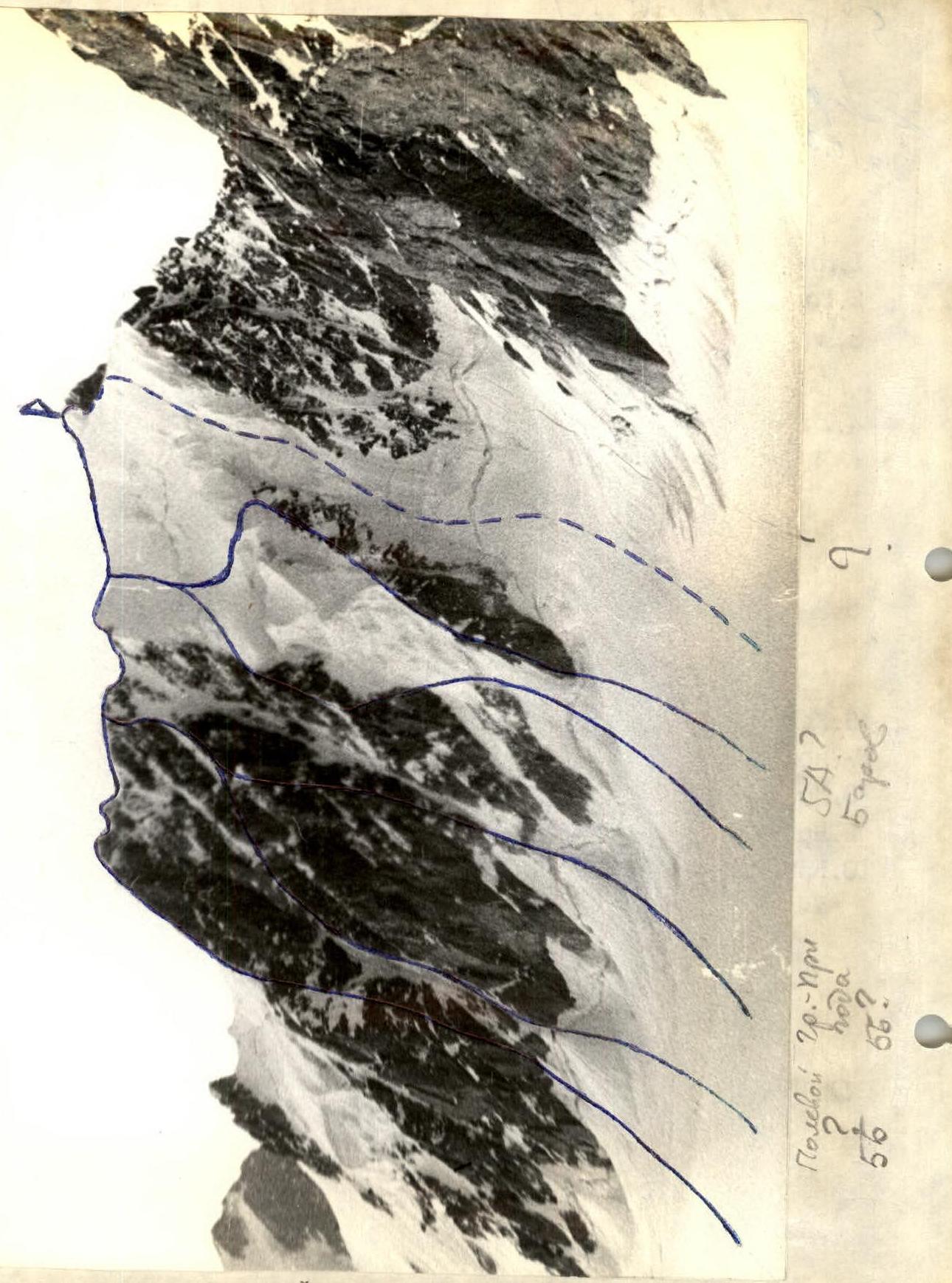
- classified routes of 5th category of complexity — route of LOS DSO “Zenit” team.
IV. Organizational and Tactical Plans for Ascents
The tactical plan was to complete the ascent in one daylight period. The estimated time to reach the summit was by 15:00. The plan included a rapid nighttime passage of the lower part of the route (5 ropes above the bergschrund).
The entire ice section of the route was to be climbed:
- Using front points of crampons
- With the use of ice axes and ice screws
- With ice piton protection
The day before the ascent, tracks were made from the overnight camp to the bergschrund, and potential paths to cross it were examined. The departure was scheduled for July 16, 1983, at 16:00, but due to cloud cover obscuring the moon and resulting in zero visibility, the start of the ascent was postponed to 02:00.
The team had the following equipment on the route:
| Tent "Pamir" | 1 pc. |
|---|---|
| Headlamps | 3 pcs. |
| “Shmel” burner | 1 pc. |
| Down sleeping bags | 6 pcs. |
| First aid kit | 1 pc. |
| Gasoline | 2 l |
| Main rope | 6×40 m |
| Auxiliary rope | 20 m |
| Ice axes | 2 pcs. |
| Ice pitons | 20 pcs. |
| Carabiners | 20 pcs. |
| Ice screws | 2 pcs. |
| Rock pitons | 5 pcs. |
| Ladders | 2 pcs. |
To ensure timely nutrition on the route, each participant had an individual food package. It included:
- fresh and dried apples
- prunes
- chocolate
- crackers at a rate of 400 g per day.
Additionally, the team had a set of products:
| Grape juice | 1 l |
|---|---|
| Roasted meat | 600 g |
| Vobla (dried fish) | 300 g |
| Dry sports drink | 100 g |
| Condensed coffee | 500 g |
| Crackers | 300 g |
| Total | 2800 g |
The tactical plan was largely executed. Adjustments were made only regarding the departure time and a minor deviation from the previously planned route in the upper part. The deviation in the upper part was determined during the ascent when a passage was found through the glacier crevices.
V. Composition of the Assault Team
The team composition was formed from pre-nominated participants.
Team members Shoping V.G., Surzhik M.V., Oshe E.A., Kozyrev V.N. had previous joint ascents in past seasons and significant experience participating in various competitions.
Members Maiorov E.E. and Denisov I.A. were included by the coaching council's decision as they performed well during training for the ascent and demonstrated themselves as promising athletes.
Team members in the 1983 season completed training ascents:
- 3rd category of complexity
- 4th category of complexity
- 5th category of complexity.
VI. Route Passage Procedure
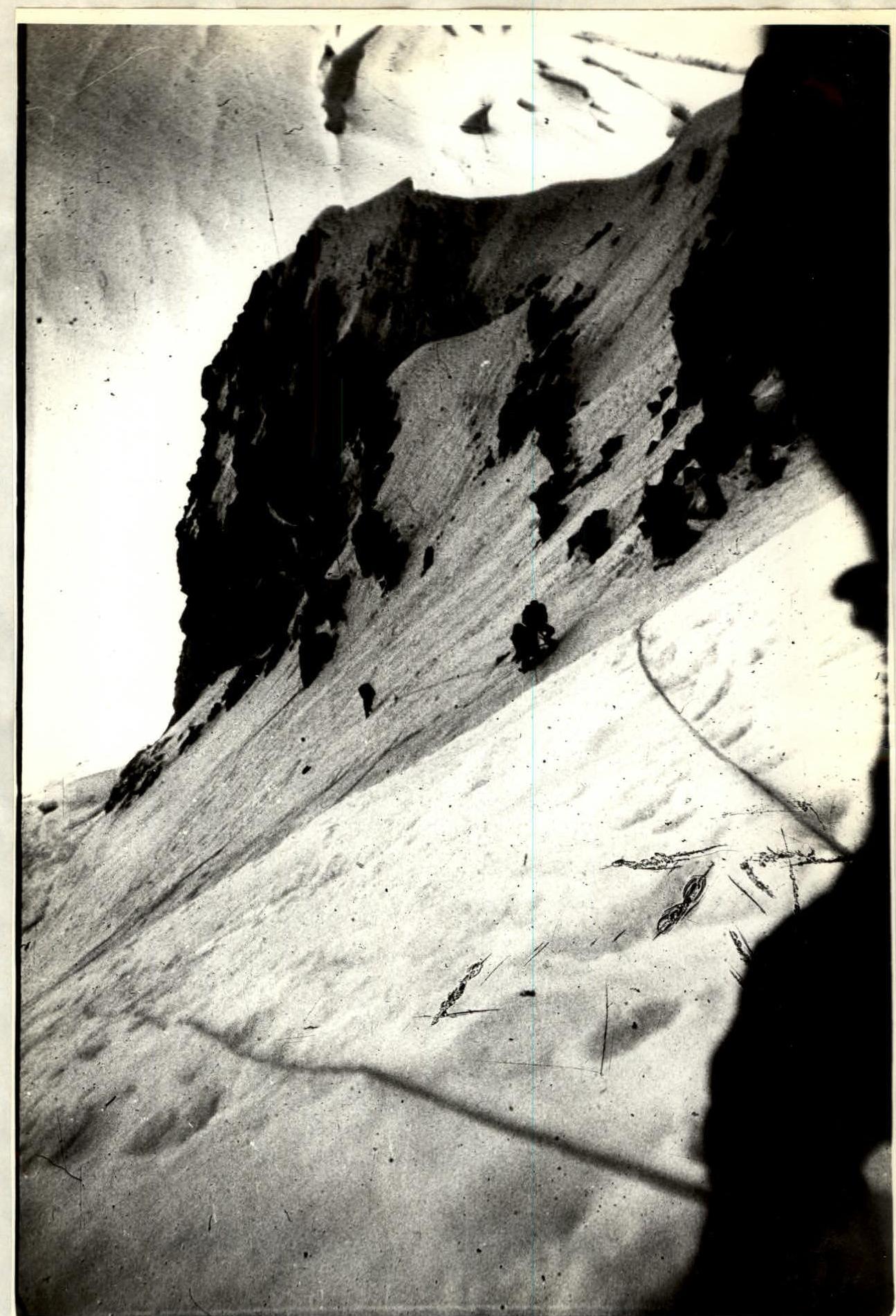
- From the bivouac on Tsey Glacier, move to a steep avalanche path. Then, along the avalanche path for 250–300 m until the bergschrund.
- The bergschrund spans the entire slope, is approached head-on in its narrow part. Height is about 5 m (1 piton) with the use of a ladder and ice axes.
- Then, on a steep 50-degree slope for 5 ropes. Piton protection (20 pitons). Movement on front points of crampons using ice axes and ice hammers. The slope is subject to avalanches during the day.
- One rope. Steepness increases to 60° (4 pitons). The section is also climbed using ice axes.
- Two ropes using ladders. Difficult climbing. Ice walls with an average steepness of 70° are interspersed with sheer walls of 90° or more, up to 10 m long (20 pitons).
- 20 m at 40°. The ice flattens. At the end of the section, snow appears (2 pitons). Approach to the ice wall.
- 40 m on very poor snow — approach to the ice wall (2 pitons).
- Wall 80°, 10 m (1 piton), a small step 3 m, 20°, sheer wall 90°, 12 m (4 ladders, 6 pitons), 15 m 40° — approach to a cornice that leads to a snow dome (4 pitons).
- The cornice is traversed leftward along a sheer wall for 15 m (2 pitons), then straight up 5 m (4 ladders, 4 pitons). Psychologically and technically challenging spot transitioning from ice to snow on a sheer wall. Movement is aided by pitons, ice axes, and ice hammers. Then, on an ice slope covered with a loose, shallow layer of snow. The amount of snow gradually increases.
- Two ropes at 40° on deep, wet snow (avalanche hazard). Climbed vertically upward. Protection on ice axes.
- One rope. The slope flattens to 25° and transitions into a snow ridge.
- Along the ridge for two ropes, bypassing a bastion on snow to the left, approximately 30°, and overcoming several crevices (like bergschrunds). One rope on a sharp snow ridge — exit to the summit.
- Descent via route 3A category of complexity.
Note from the summit:
19:00 A group of instructors from Tsey alpine camp, consisting of: Mityukhin F.P. Svistun S.S. completed an ascent of Mamisong-hokh via the Left Edge of the North Face Triangle. 5B category of complexity. Weather: snowmelt, poor. Route in a challenging condition: rocks and ice. Greetings to the next climbers. July 16, 83, signature (illegible)

The fact of completing the route is also confirmed by photographs clearly showing team members on the route during the ascent.
VII. Overall Assessment of Team Members' Actions
The significant experience of joint ascents among most team members allowed for extremely clear interaction between rope teams, which was especially necessary for ensuring the safety of the ascent as a whole.
Good mastery of ice climbing techniques by all participants enabled a rapid passage of the route with frequent changes of lead climbers.
Throughout the ascent, all participants also demonstrated good rope work, complete mutual understanding, and a benevolent attitude towards each other.
Team Captain V. Shopin
VIII. Data on the Support Group
The area of the North Face of Mamisong-hokh is considered remote for the Tsey area, which significantly complicates communication with the camp. Therefore, the team's departure for the ascent required the presence of a support group in this area. One such group was a team of trainees from the camp, who were completing an ascent to Peak South Double via a 2B category route.
Members of this group were able to continuously monitor the team visually, take photographs of the route passage. With their help, clear and constant radio communication with the camp was maintained according to schedule.
It should also be noted that, at the time of the ascent, sports groups from Torpedo and Tsey alpine camps were present in the area.
Route Characteristics
Ascent route — Mamisong-hokh via icefalls of the North Face
- Route length — 920 m
- Route height difference — 858 m
- Length of most complex sections — 600 m
- Route steepness — 55°
Table
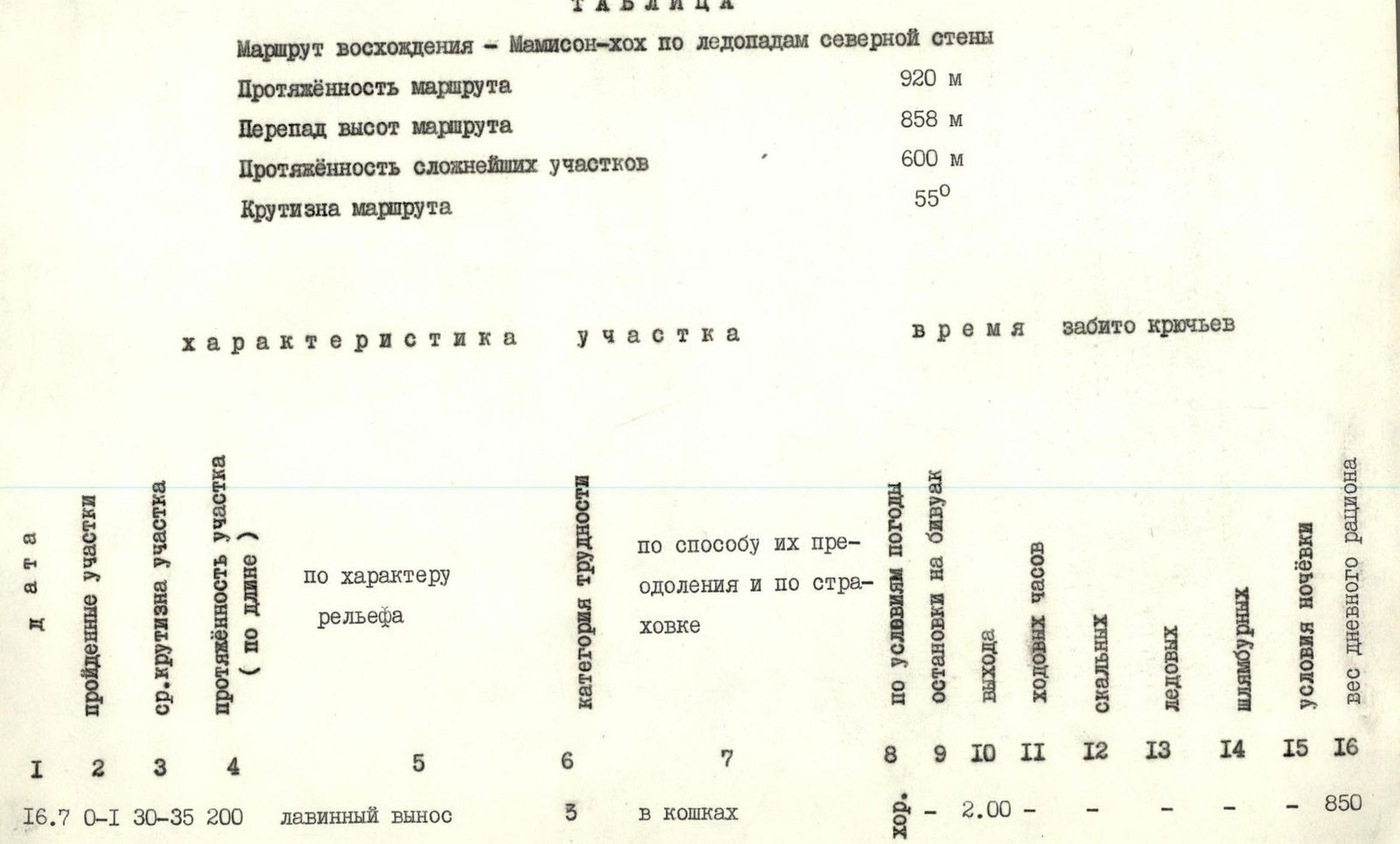
| 1 | 2 | 3 | 4 | 5 | 6 | 7 | 8 | 9 | 10 | 11 | 12 | 13 | 14 | 15 | 16 |
|---|---|---|---|---|---|---|---|---|---|---|---|---|---|---|---|
| 16.07 | R0–R1 | 30–35° | 200 m | avalanche path | 3 | in crampons | exc. | – | 2:00 | – | – | – | – | – | 850 г |
| – | R1–R2 | 90° | 5 m | bergschrund | 5 | using ladders | – | – | – | – | – | – | – | – | – |
| – | R2–R3 | 50° | 200 m | ice slope | 5 | crampons, ice axes, ice hammers | – | – | – | – | 20 | – | – | – | – |
| – | R3–R4 | 60° | 40 m | ice slope | 5 | same | – | – | – | – | 4 | – | – | – | – |
| – | R4–R5 | 70–90° | 80 m | ice wall | 5+ | crampons, ice hammers, ladders | – | – | – | – | 20 | – | – | – | – |
| – | R5–R6 | 40° | 20 m | ice slope, snow at the end of the section | 4 | crampons, ice axes | – | – | – | – | 2 | – | – | – | – |
| – | R6–R7 | 40° | 40 m | ice slope under a layer of snow | 4 | crampons, ice axes | – | – | – | – | 2 | – | – | – | – |
| – | R7–R8 | 80, 20, 90, 40° | 10, 3, 12, 15 m | ice wall | 5+ | crampons, ice hammers, ladders | – | – | – | – | 11 | – | – | – | – |
| – | R8–R9 | 90–95° | 15 m | ice cornice, snow-covered at the exit | 6 | crampons, ice hammers, ladders | – | – | – | – | 6 | – | – | – | – |
| – | R9–R10 | 40° | 80 m | deep, wet snow under snow — ice | 4 | ice axes | – | – | – | – | – | – | – | – | – |
| – | R10–R11 | 25° | 40 m | same | – | same | – | – | – | – | – | – | – | – | – |
| – | R11–R12 | 30° | 80 m | same | – | same | – | – | – | – | – | – | – | – | – |
| – | R12–R13 | – | 40 m | ridge | – | same | – | – | – | 14 | 12 | – | – | – | – |
Passage of section R2–R3