
ASCENT PASS
- Class — snow and ice climb.
- Main Caucasus Range, Bezengi gorge.
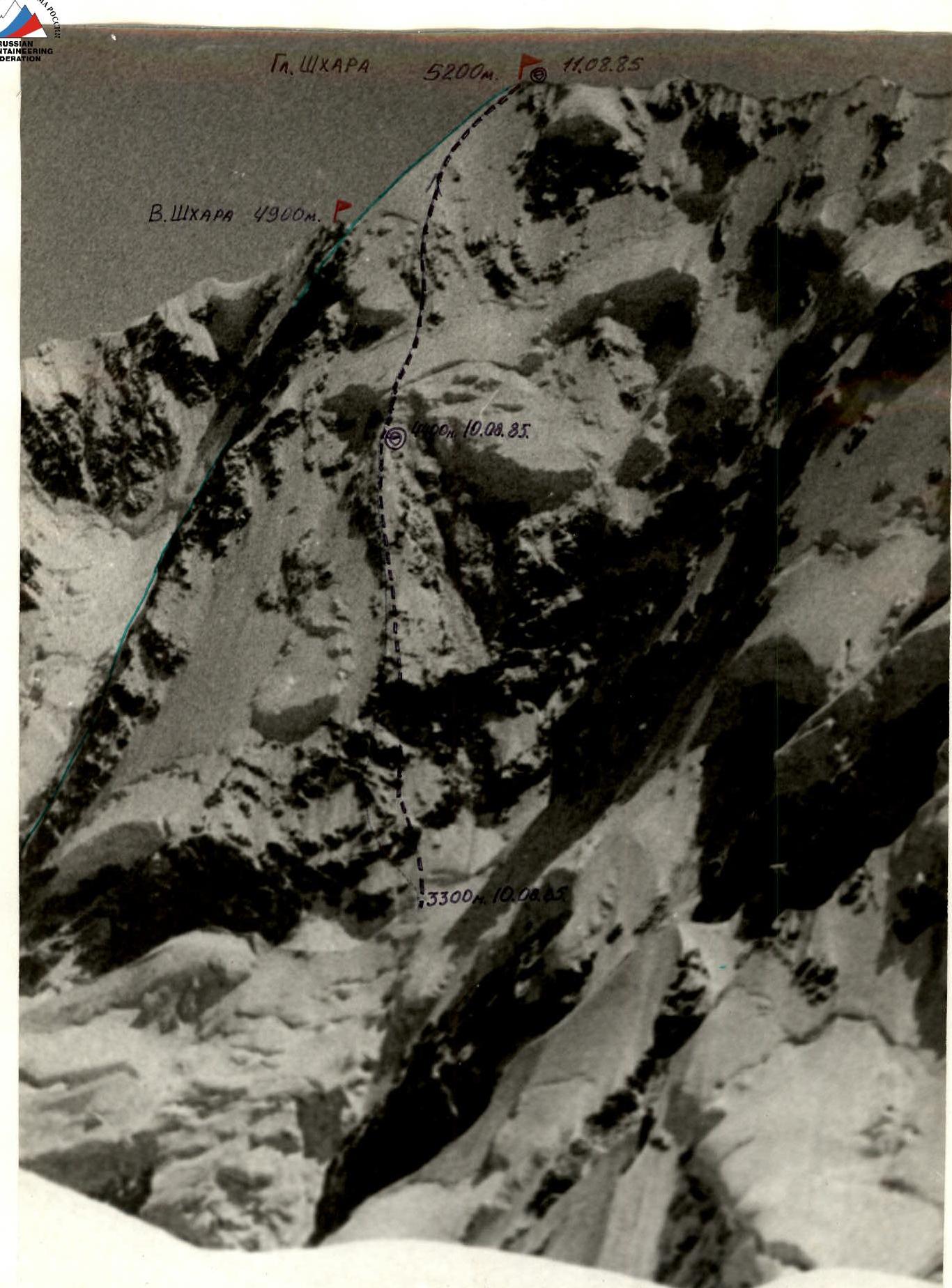
- Shkhara Main via the North face.
- Complexity category — 5B.
- Height difference — 1900 m, length — 2400 m, length of sections with 5–6 category complexity — 1590 m, of which 6 category complexity — 200 m.
- Average steepness of the route — 54°, average steepness of main sections — 63°.
- Pitons used on the route:
- ice screws: 217
- rock pitons: 19
- chocks: 7
- 2 (ice), 4 (rock), 1 (chock) left in place
- Climbing hours — 26, days — 2.
- First bivouac — on a platform cut out in a snow and ice ridge, second — in a cirque near the summit.
- Team captain — Gorbenco Mstislav Mstislavovich, Master of Sports
Team members:
- Leontiev Vadim Gennadievich, Master of Sports
- Pozniakov Viktor Olegovich, Candidate Master of Sports
- Alperin Vladimir Maevich, Candidate Master of Sports
- Sitnik Mikhail Alexandrovich, Candidate Master of Sports
- Fenov Alexander Alexandrovich, Candidate Master of Sports
- Team coach — Serenkov Pavel Sergeevich, Master of Sports
- Departure to the route August 10, 1985. Summit — August 11, 1985. Return — August 12, 1985.
- Sports Committee of the Ukrainian SSR (Odessa Regional Sports Committee)
- Tomashek's route via the North ridge
- Krainov's route via the North face
TACTICAL ACTIONS OF THE TEAM
Early departure to the route (2:30) was due to the large amount of snow and ice work planned for the day and for safety reasons when passing the lower part of the route. In the following days, work on the route began at 7:00. Movement on the route stopped at 19:00–20:00 to set up a bivouac in daylight. In the second half of the day, the team rested for 1 hour (food, tea) to recover.
To maintain a high pace of movement, the team worked mainly in independent pairs on the route. The leading rope team changed periodically:
- Gorbenco — Pozniakov (sections R0–R2; R11–R16)
- Leontiev — Sitnik (sections R2–R11)
- Alperin — Fenov (sections R16–R18)
Belays on the route were provided through pitons left by the first rope team.
Passage of the key section — ice wall at the beginning of the route — using "ice fixtures". The second key section — rock and ice belt — was passed using the full arsenal of ice and rock climbing techniques, with some use of artificial climbing aids. The rocks were covered with flow ice. The third key section — ice barrier — was passed on "ice fixtures", with ice being broken off, requiring particularly careful belays, with pitons placed every 1.5–2 meters.
To increase safety when passing key sections (second and third) and on section R10–R11, due to the poor condition of the ice, safety ropes were used.
A semi-reclined bivouac was organized on a snow and ice ridge (4400 m), with the platform being cut out in an hour. The second bivouac in a cirque near the summit was comfortable.
The route is objectively safe. Main safety measures when moving on the route: piton belays on ice and rocks, axe belays on snow; the first climber in the leading rope team moved on a double rope, avoiding being above each other during movement and belaying. There were no falls or injuries.
Constant communication with observers was maintained throughout the ascent using a "Tulip" radio station.
The use of "ice fixtures" and "platform" type crampons for steep ice sections significantly increased the pace of movement.
The tactical plan for the route was executed by the team with virtually no deviations.
Description of route sections:
- R0: 80 m, 80°
- R1: 90 m, 70°
- R2: 60 m, 90°, VI
- R3: 160 m, 60°, IV
- R4: 120 m, 70°
- R5: 60 m, 90°, VI
- R6: 40 m, 80°
- R7: 40 m, 30°, !!!
- R8: 200 m, 60°
- R9: 80 m, 50°
- R10: 320 m, 60°
- R11: 80 m, 45°, !!!
- R12: 120 m, 45°–100°; 40 m, !!!; 80 m, VI
- R13: 120 m, 35°, !!!
- R14: 180 m, 50°
- R15: 260 m, 60°
- R16: 110 m, 50°, IV
- R17: 260 m, 30°, !!!
(Additional data from the diagram: 26 climbing hours, 243/7; 16 climbing hours, 173/3)