
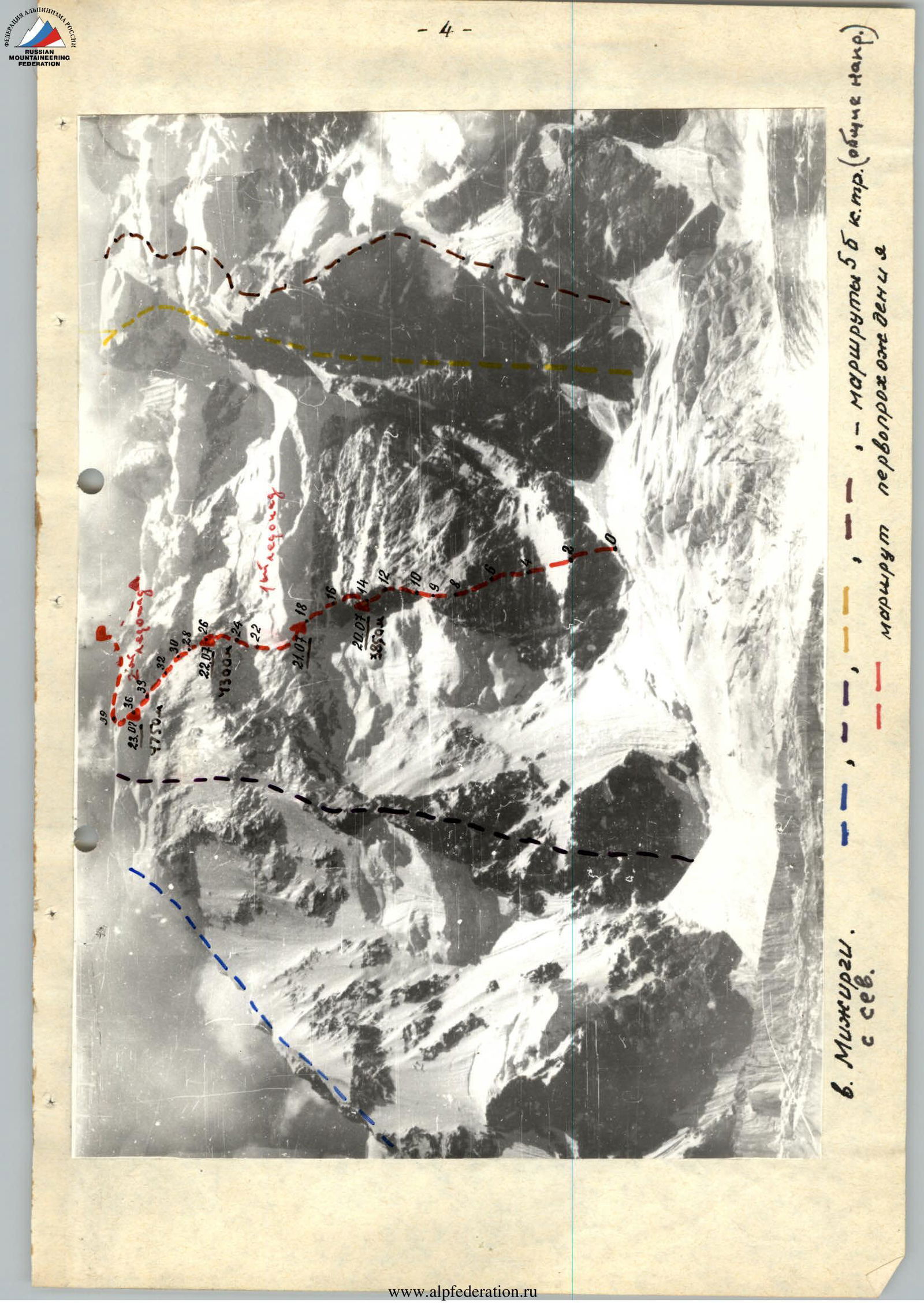
 U. Mizhirgi. North wall. Routes 5B cat. sl. (general directions). Route of the first ascent.
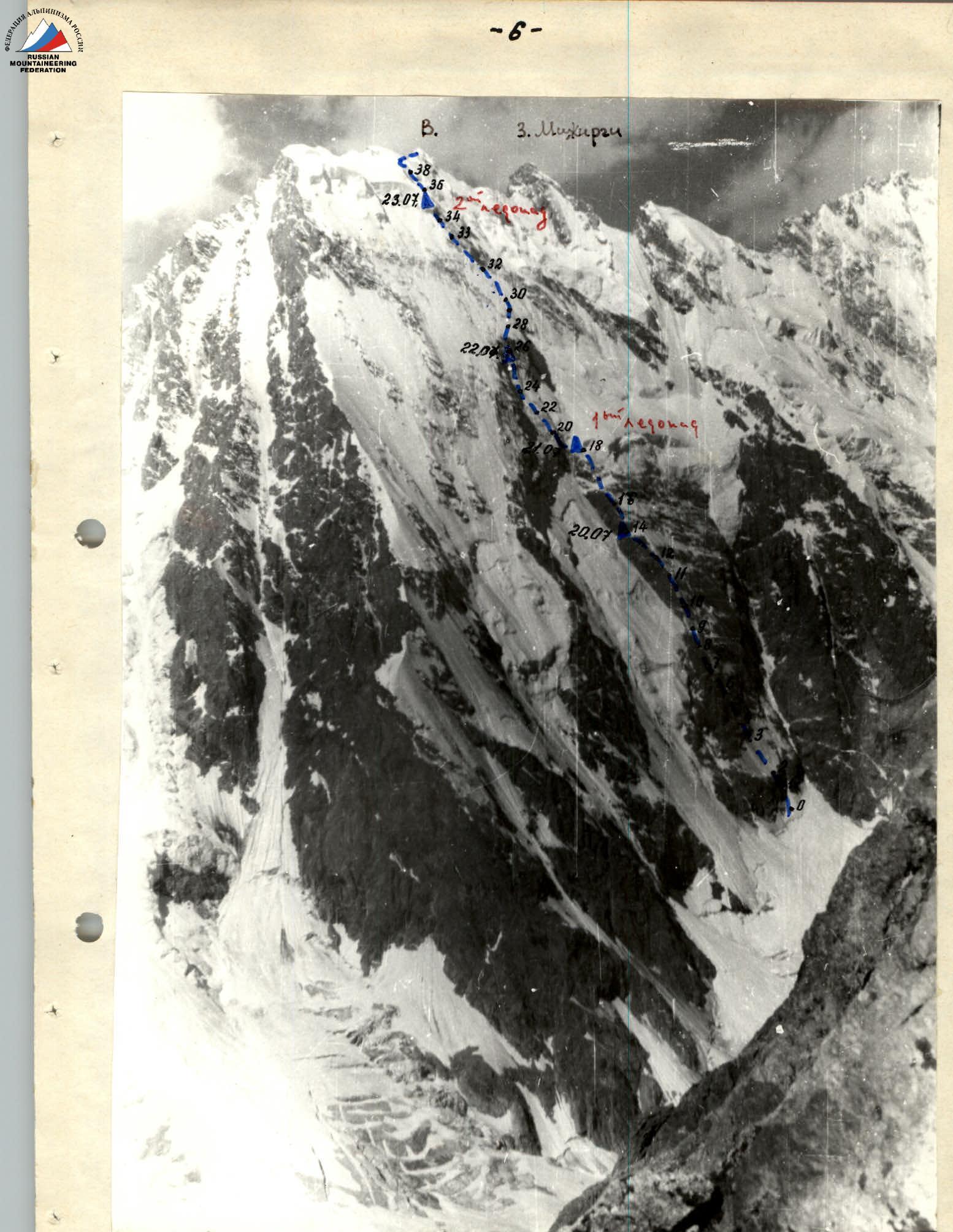 U. Mizhirgi. View from p. Panoramny.
U. Route description. Order of passage
The tactical plan for passing the route provided for processing the lower, most dangerous part of the wall, about 250 m long, and this had to be done before the sun heated the upper glaciers, i.e., before 10–11 am.
During the observation, several recorded avalanches and collapses occurred in the middle of the day.
July 19 — we went out to process at 3 am by the light of lanterns, taking only ropes and hooks with us. It's snowing a bit from above, and a few centimeters of snow have already fallen. We're nervous — the first meeting with the wall. We're a bit shivery from sleep, but it's not cold. We cross a long avalanche cone with several branches, all pitted with pits, crevices, and approach the wall. All the rocks are snowy, damp, quiet, but there are clearings in the fog and we can hope for improvement.
The route starts with a steep wall right away, but there is some relief, although not clearly expressed. For belay, there are small inclined shelves, but they are all snow-covered and iced over.
The second rope is particularly difficult, going up a small sheer gully. After two ropes — an icy slope, powdered with snow, and crampons slip, not reaching the solid ice. At every step, you have to rake up the soft snow. After three ropes — rocks, a solid wall with small ledges and recesses. Very difficult: feet are set on friction, and for hands, there are only small cracks and supports. Organizing belay takes a lot of time.
Yes! The start of the route is impressive! And we're still going without backpacks!
July 20. Like yesterday, we leave before dawn to pass the lower, processed part as early as possible. We go at maximum pace and on the approach — along the already familiar avalanche debris, but also along the processed part of the wall. Further, the wall becomes a bit more gentle, relief appears, but the ice still doesn't give us a break — we have to clean every handhold. Five ropes have been passed, and the movement has stalled:
- A smooth, steep wall in ice and snow — with a backpack, it's impossible to pass such areas — we have to remove it.
- The wind has picked up significantly and greatly hinders movement.
- No overnight stops are visible, and it's getting close to evening, we're pretty tired — we need to save our strength, the main challenge is ahead.
Finally, under the sheer wall, we can build a platform in the snow. There's a lot of work, but there's no choice — we don't want to spend the night sitting, the weather has cleared, so the night is going to be cold. And the first icefall is already visible in the distance — a solid wall of ice about 50 m high.
July 21. Again, we leave early — we need to find a passage through the icefall. The rocks are icy, but yesterday's snow has been blown away, and we can find handholds. In some places, the path goes along frozen snow with patches of solid ice. The belay is reliable, and we can use rocky outcrops. Movement is slow — all the time we have to:
- chop ice
- clean rocks
Crampons on rocks are also a hindrance, but removing them too often is not an option — we need to endure and adapt. The weather is exceptionally clear, the sun is already starting to burn, and we approach the icefall in the heat — water is flowing down the rocks.
After a detailed inspection of the ice wall, we decide that the most rational path lies through the ice gully to the left of the icefall onto the rocky-ice wall. We need to wait until sunset and calmly process the transition. For an overnight stop, we find a narrow ice crevice:
- it's cold in there,
- but it's safe,
- close to the transition.
We manage to set up a tent, but with great difficulty! The ice is solid and somehow viscous; the ice axe gets stuck after a hit. Fortunately, there's enough time until evening, and we manage to gradually carve out a tolerable living space and somehow hang the tent on hooks.
From under the icefall, the route passes, crossing the ice gully in its narrowest part, and then vertically up the rocks, completely covered with flow ice and polished by avalanches and ice fragments. 40 meters of pure ice work on the transition are replaced by extremely difficult climbing on sheer rocks in crampons. We have to:
- hook with our crampons on every handhold,
- wedge them into cracks,
- take unimaginable and far from aesthetic poses — just to hold on and move forward.
The belayer below is under a small overhang, but still, ice fragments cause him a lot of trouble, pressed against the cold rocks. It's hard to say who's having a harder time — the first (on whom it's not snowing), the second (who can warm up from their own shivering), or the rest (who enjoy watching others work).
July 23. We got up before dawn, and at dawn, the ice gully was passed. It's very cold in our cave, but it won't be warmer further on — the kingdom of ice has begun. There's ice everywhere — on rocks, on the surface of the snow, under the snow, in crevices. For every step, you need to make several hits with an ice axe. The second glacier is not visible, but a view of the rocky wall of intimidating appearance has opened up:
- Vertical, with a cornice at the top,
- Everything shines in the sun from flow ice,
- Even protruding parts of rocks and small buttresses are covered with an iridescent crust.
It's a beautiful sight! But we need to overcome all this, find a path — more or less simple. We choose the middle part with a small buttress, and to the right of it — an internal corner.
The movement is very slow:
- Crampons, breaking through a thin layer of ice, scratch the smooth rocky slabs,
- To hammer in a hook, you need to clear more than one square meter of rock from ice.
We've never encountered anything like this before. We try to choose the most direct path — an extra meter, extra time. The rocky wall somewhat resembles the ends of sports sleds — the beginning is gentler, and the top is curved upwards.
We're going, as it turned out, right in the middle and along the "simplest" route. To the left and right — there are drill walls. The second half is particularly difficult — even with a lightened backpack, it's impassable.
Luckily for us, a small rocky ridge before the cornice could be turned into a sitting bivouac. Well, the cornice had to be processed in the twilight — we couldn't descend from the middle.
Finally, this long, long day is over. But the tasks that the wall sets for us are not over yet.
July 24. An overnight stay in such conditions is, of course, a purely symbolic concept. Every ten to fifteen minutes, different parts of the body become numb, and the seemingly comfortable position we've managed to adopt has to be changed. But still, we're all together, in a tent, and can:
- light a stove
- eat the allotted 200 g of product for breakfast.
In the morning, having one by one overcome the cornice, we realize that nothing good awaits us — the same rocks, covered in ice, ice as dense as glass, snow that's loose and dry, which needs to be dug to the ground, otherwise, there's nothing to hold onto. We move in the direction of a snowy ridge. The pace of movement is still slow; the second icefall is not visible yet. Hooks, hooks, and more hooks. Rare rocky outcrops have neither shelves nor ledges. Fortunately, they have cracks.
Finally, we reach the ridge; the snow here is a bit better, and something becomes clear. The second glacier is visible, and right on our course, it's torn apart, as if someone had opened the gates in the wall at our approach, inviting us to rest on a gentle ridge. But we won't make it there today, so we can't accept the invitation yet. We offer our deepest apologies. The gates can remain open.
The overnight stay under the wall of the icefall is excellent — a horizontal platform, it seems, made specifically.
July 25. Further, the path is unambiguous — the ice gates are not very simple, but you can't climb the wall. These are the last ropes, the last steps, the last hooks. Up the steep ice, again slowly, we emerge through three ropes onto a gentle snowy slope and along it to the ridge — the summit ridge, from which it's one hour to the top.
VI. Route features
The main features of the route are as follows:
- Extreme saturation with complex sections with frequent alternation of various states of the wall (icing, snowing).
- Lack of convenient places for bivouacs. To organize a more or less tolerable overnight stay, it took from 2 to 4 hours of work daily (except for the 19th).
- Mental tension. In this regard, the route should be considered unique not only for the "Bezengi" region but also for all mountain regions of the country!
- The need to adhere to the correct tactical plan for the ascent, taking into account the specific ice-snow situation on the North wall of Mizhirgi and the Bezengi region as a whole.
The team evaluates the route along the North wall of East Mizhirgi as the most difficult of all those laid to the summit and believes that it fully meets the requirements for routes of 6B category complexity.
Team captain W. Shevchenko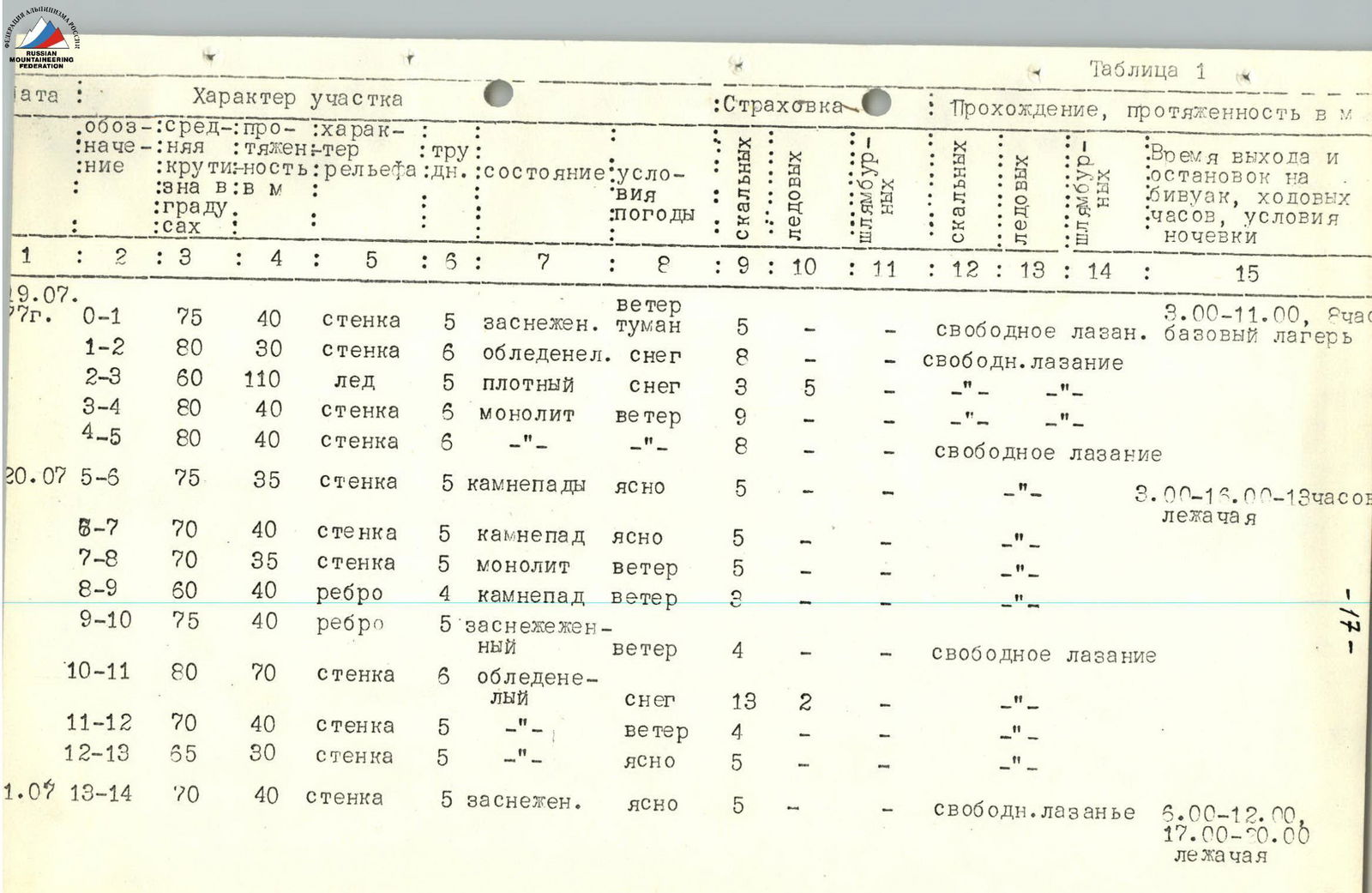
Table 1
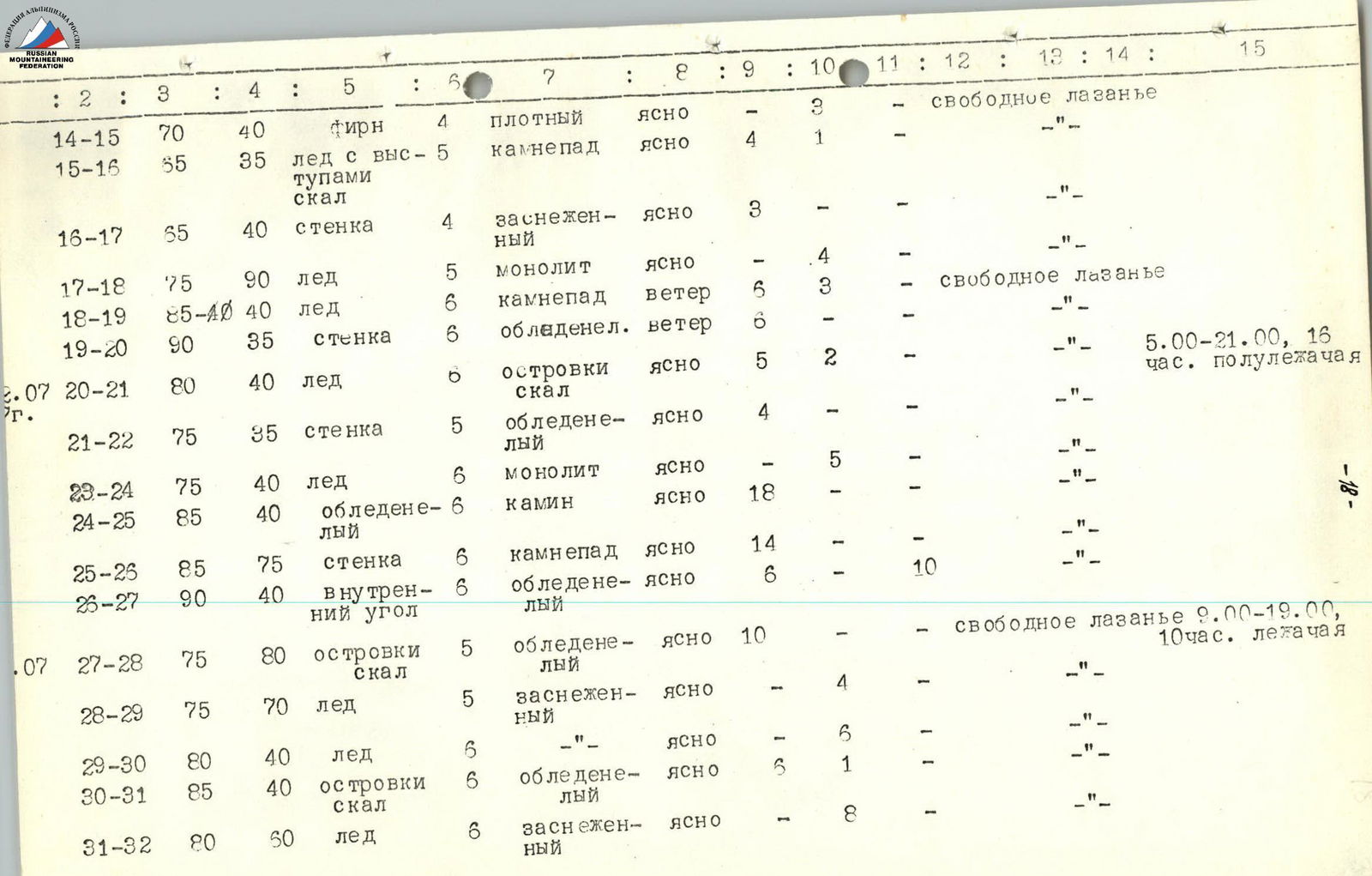
| 1 | 2 | 3 | 4 | 5 | 6 | 7 | 8 | 9 | 10 | 11 | 12 | 13 | 14 | 15 |
|---|---|---|---|---|---|---|---|---|---|---|---|---|---|---|
| July 19, 1977 R0–R1 | 75 | 40 | wall | 5 | snowy | fog | 5 | — | — | free climbing | — | — | 3:00–11:00 | base camp, 8 h |
| R1–R2 | 80 | 30 | wall | 6 | icy | snow | 8 | — | — | free climbing | — | — | — | — |
| R2–R3 | 60 | 110 | ice | 5 | dense | snow | 3 | 5 | — | — | — | — | — | — |
| R3–R4 | 80 | 40 | wall | 6 | monolith | wind | 9 | — | — | — | — | — | — | — |
| R4–R5 | 80 | 40 | wall | 6 | — | — | 8 | — | — | free climbing | — | — | — | — |
| July 20 R5–R6 | 75 | 35 | wall | 5 | rockfall | clear | 5 | — | — | — | — | — | 3:00–15:00 | 13 h, lying down |
| R6–R7 | 70 | 40 | wall | 5 | rockfall | clear | 5 | — | — | — | — | — | — | — |
| R7–R8 | 70 | 35 | wall | 5 | monolith | wind | 5 | — | — | — | — | — | — | — |
| R8–R9 | 60 | 40 | edge | 4 | rockfall | wind | 3 | — | — | — | — | — | — | — |
| R9–R10 | 75 | 40 | edge | 5 | snowy | wind | 4 | — | — | free climbing | — | — | — | — |
| R10–R11 | 80 | 70 | wall | 6 | icy | snow | 13 | 2 | — | — | — | — | — | — |
| R11–R12 | 70 | 40 | wall | 5 | — | wind | 4 | — | — | — | — | — | — | — |
| R12–R13 | 65 | 30 | wall | 5 | — | clear | 5 | — | — | — | — | — | — | — |
| July 21 R13–R14 | 70 | 40 | wall | 5 | snowy | clear | 5 | — | — | free climbing | — | — | 6:00–12:00, 17:00–20:00 | lying down |
| R14–R15 | 70 | 40 | firn | 4 | dense | clear | — | 3 | — | free climbing | — | — | — | — |
| R15–R16 | 55 | 35 | ice with rock outcrops | 5 | rockfall | clear | 4 | 1 | — | — | — | — | — | — |
| R16–R17 | 65 | 40 | wall | 4 | snowy | clear | 3 | — | — | — | — | — | — | — |
| R17–R18 | 75 | 90 | ice | 5 | monolith | clear | — | 4 | — | — | — | — | — | — |
| R18–R19 | 85–40 | 40 | ice | 6 | rockfall | wind | 6 | 3 | — | free climbing | — | — | — | — |
| R19–R20 | 90 | 35 | wall | 6 | icy | wind | 6 | — | — | — | — | — | 5:00–21:00 | 16 h, semi-reclining |
| July 22 R20–R21 | 80 | 40 | ice | 6 | rock outcrops | clear | 5 | 2 | — | — | — | — | — | — |
| R21–R22 | 75 | 35 | wall | 5 | icy | clear | 4 | — | — | — | — | — | — | — |
| R23–R24 | 75 | 40 | ice | 6 | monolith | clear | — | 5 | — | — | — | — | — | — |
| R24–R25 | 85 | 40 | icy | 6 | chimney | clear | 18 | 1 | — | — | — | — | — | — |
| R25–R26 | 85 | 75 | wall | 6 | rockfall | clear | 14 | — | 10 | — | — | — | — | — |
| R26–R27 | 90 | 40 | internal corner | 6 | icy | clear | 6 | — | — | — | — | — | — | — |
| July 23 R27–R28 | 75 | 80 | rock outcrops | 5 | icy | clear | 10 | — | — | free climbing | — | — | 9:00–19:00 | 10 h, lying down |
| R28–R29 | 75 | 70 | ice | 5 | snowy | clear | — | 4 | — | — | — | — | — | — |
| R29–R30 | 80 | 40 | ice | 6 | — | clear | — | 6 | — | — | — | — | — | — |
| R30–R31 | 85 | 40 | rock outcrops | 6 | icy | clear | 5 | 1 | — | — | — | — | — | — |
| R31–R32 | 80 | 60 | ice | 6 | snowy | clear | — | 8 | — | — | — | — | — | — |
| R32–R33 | 60 | 110 | snow | 5 | loose | clear | — | 10 | — | free climbing | — | — | — | — |
| R33–R34 | 75 | 40 | ice | 5 | snowy | clear | — | 4 | — | — | — | — | — | — |
| R34–R35 | 75–40 | 40 | ice | 6 | monolith | clear | — | 5 | — | — | — | — | — | — |
| July 24, 1977 R35–R36 | 80 | 40 | ice | 6 | monolith | fog | — | 5 | — | — | 4 | —15 | 7:00–15:00 | 8 h, lying down |
| R36–R37 | 80 | 40 | ice | 6 | — | — | — | 6 | — | — | — | — | — | — |
| R37–R39 | 50 | 40 | snow | 4 | dense | fog | via ice axe | — | — | — | — | — | — | — |
| R38–R39 | 40 | 120 | snow | 3 | dense | — | — | — | — | — | — | — | — | — |
Footnotes
-
- Between themselves