Passport
- Technical class
- Caucasus, Kundryum-Mijirgi gorge
- v. Krumkol via the left part of the northern wall
- Proposed — 6B category of difficulty, first ascent
- Elevation gain: 1570 m, length — 1960 m. Length of sections with 5–6 category of difficulty — 390 m. Average steepness of main sections 75° (3400–3680, 4090–4290) and of these, 6 category of difficulty 270 m (3400–3680, 4090–4290)
- Pitons hammered:
| Rock | Bolt | Nuts | Ice |
|---|---|---|---|
| 153 | 2 | 4 | 149 |
| 17 | 2 | 3 | 2 |
- Team's working hours: 50.5 hours and 5 days
- Overnights: 1st — in a rock niche after cutting down the firn snow — sitting; 2nd, 3rd, 4th — platforms cut out on a snow-ice slope (on the 2nd overnight on 2 and 3 people, on the 3rd overnight on 5 people, on the 4th overnight on 4 and 1 people)
- Leader: Melentyev Vasily Ignatyevich CMS
Team members:
- Belousov Evgeny Borisovich CMS
- Ivlev Vladimir Mikhailovich CMS
- Gasilov Evgeny Fedorovich CMS
- Trofimov Mikhail Georgievich CMS
- Coach: Kudinov Igor Borisovich, Honored Coach of the RSFSR
- Exit to the route: August 10, 1982
Summit: August 14, 1982
Return: August 15, 1982

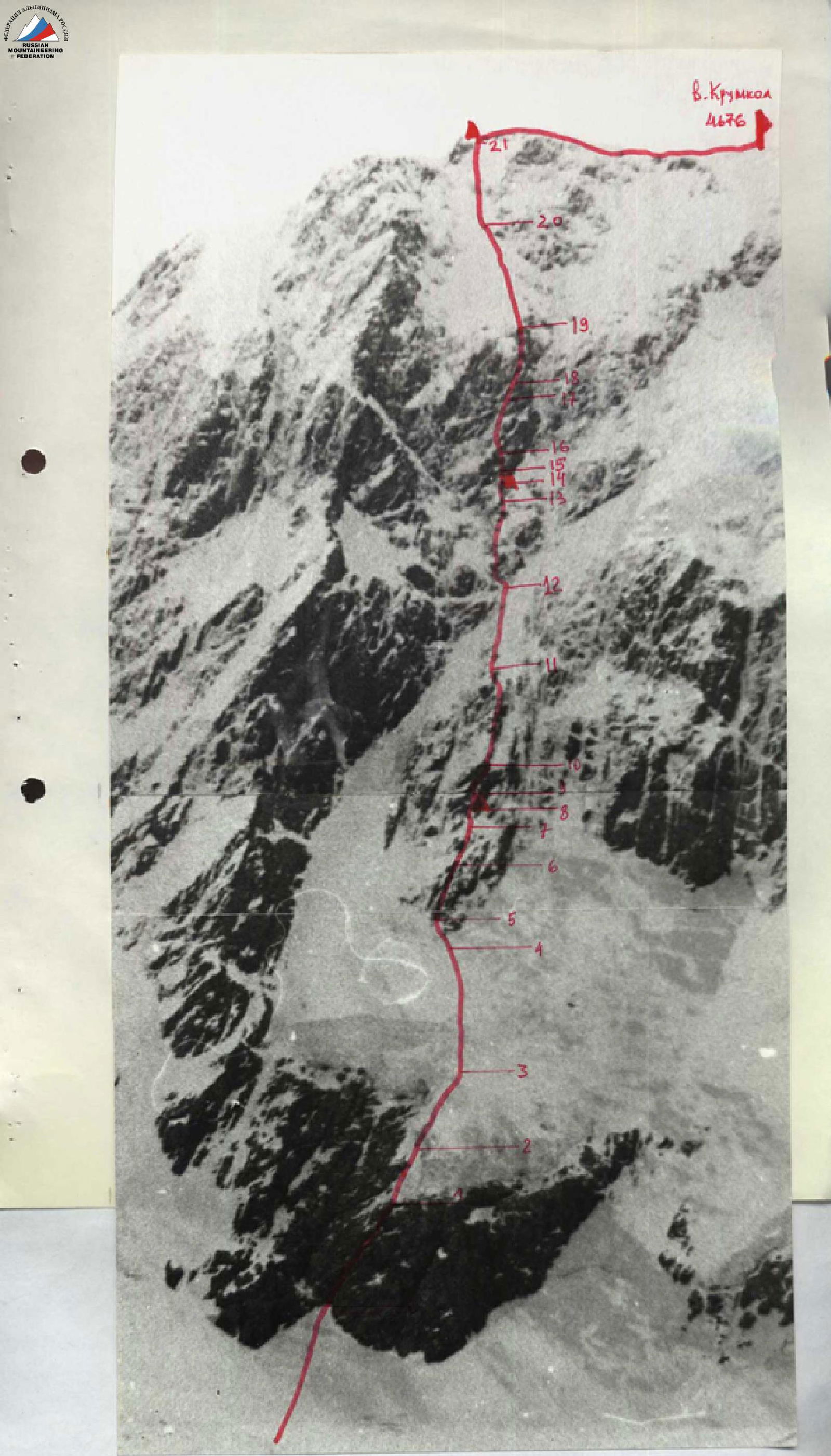
Timofeev's Route 3100 — Team's Route
General photo. Taken on August 17, 1982, 17:00, T-22 lens (F=75), distance 3 km from the summit. Photo from the slope of p. Brno, H = 3100 m, №.
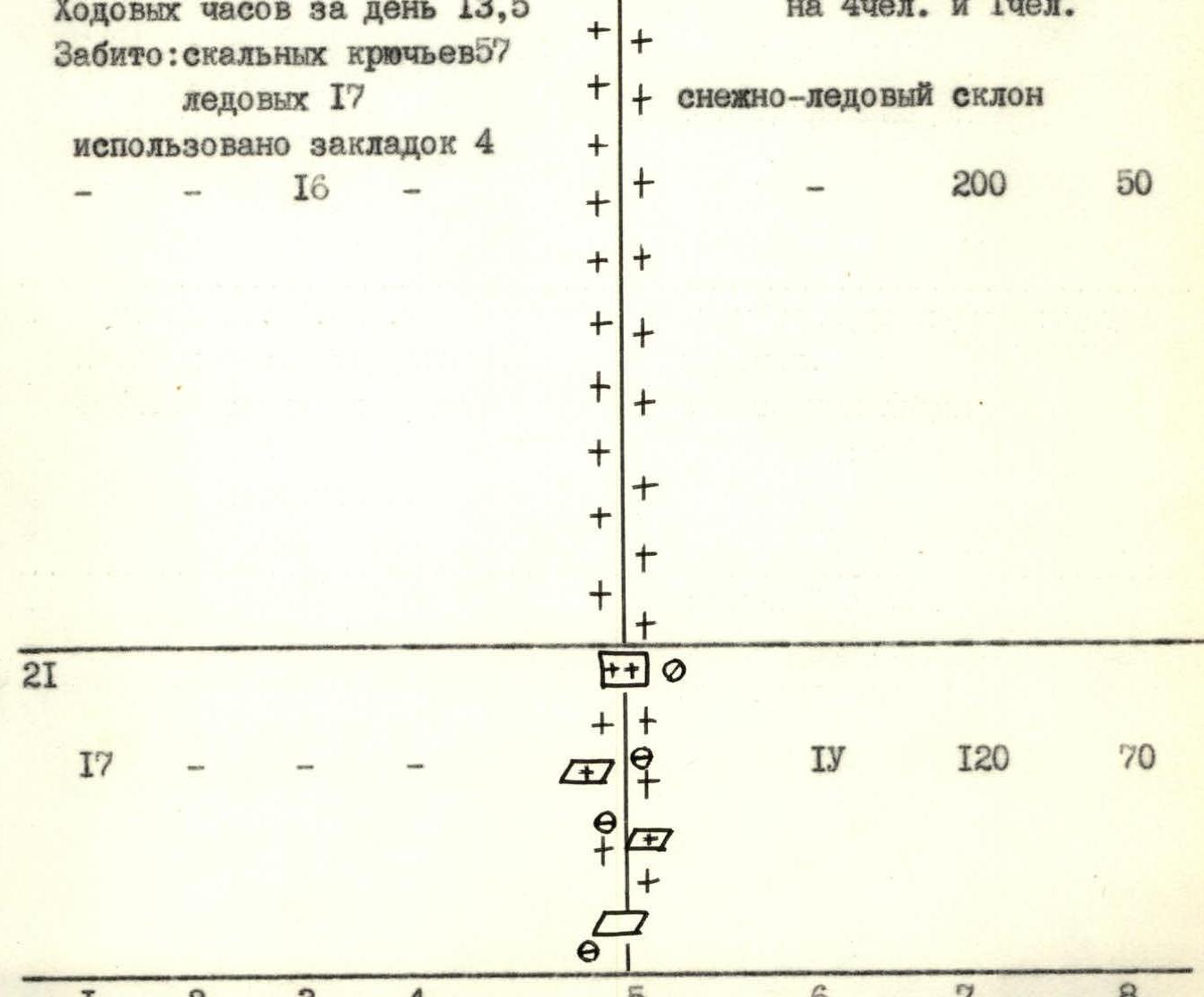
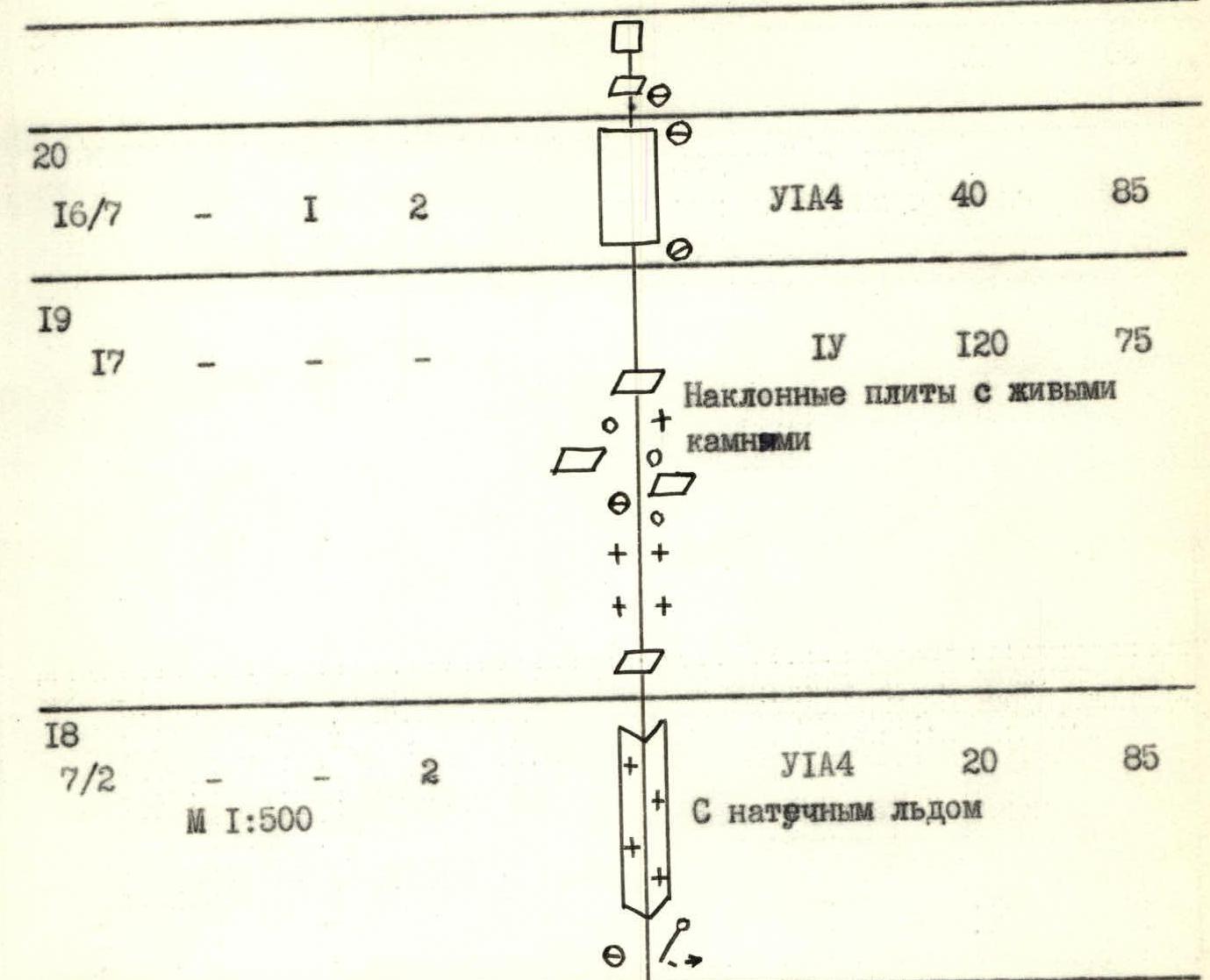
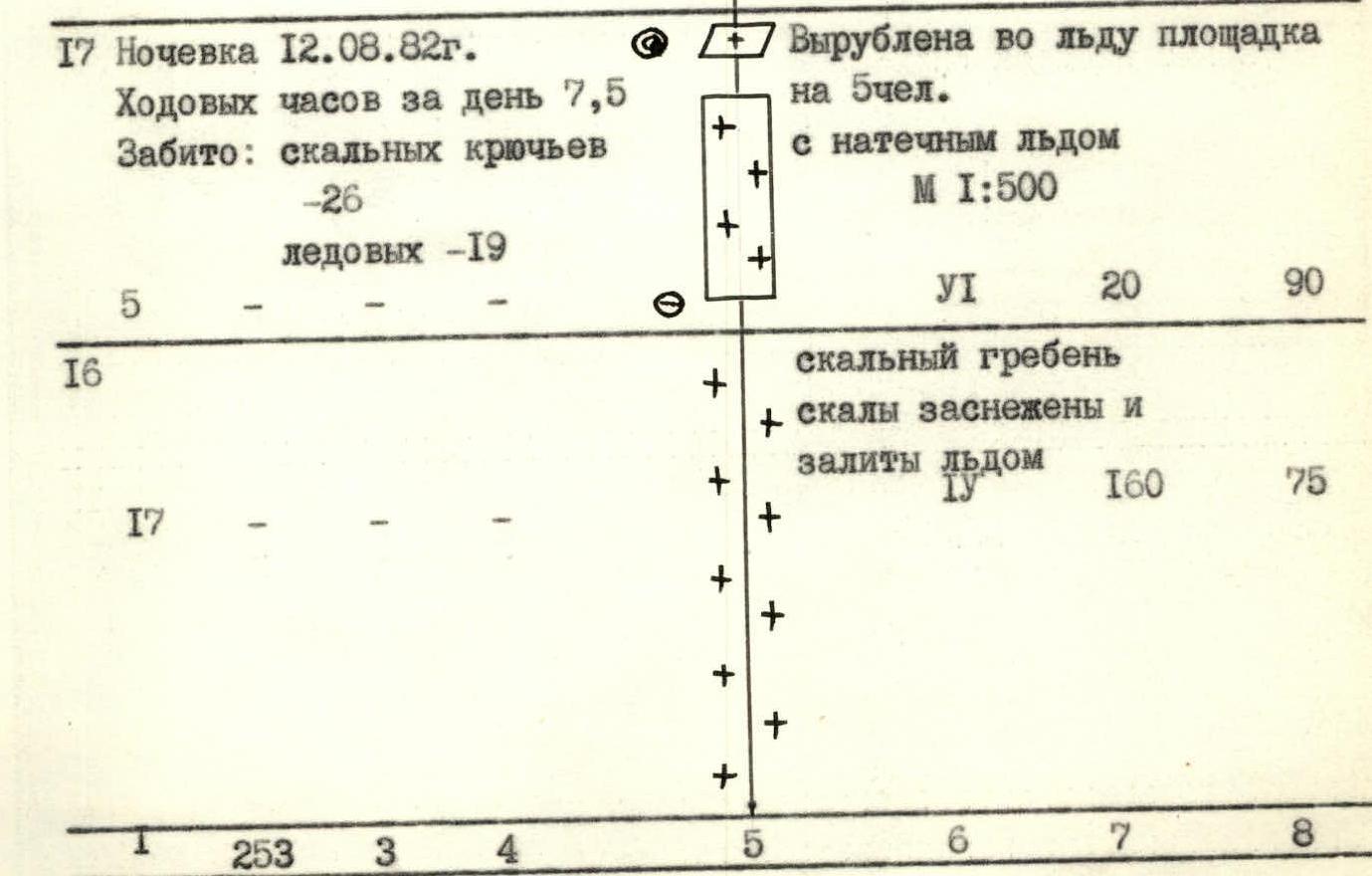
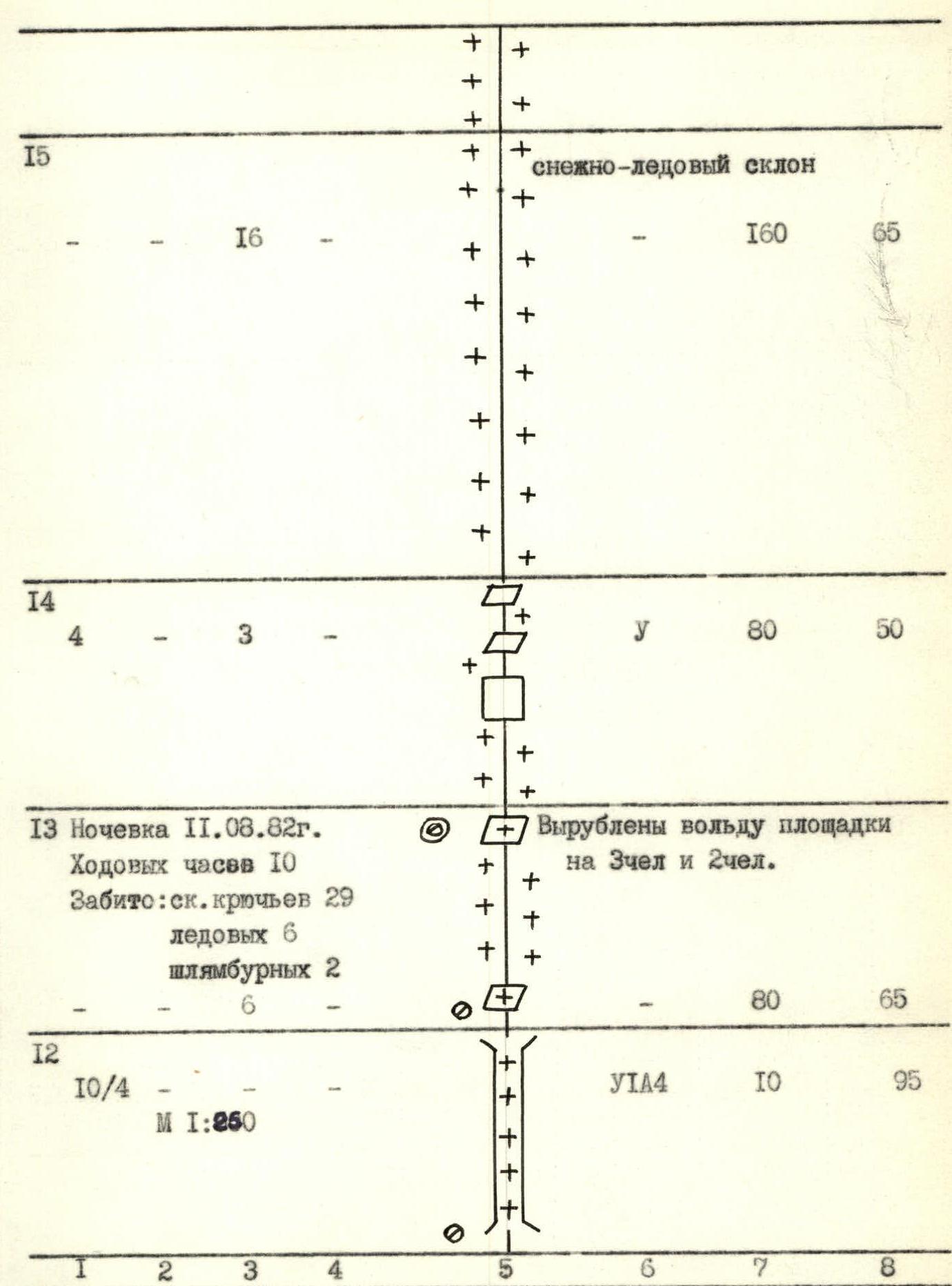
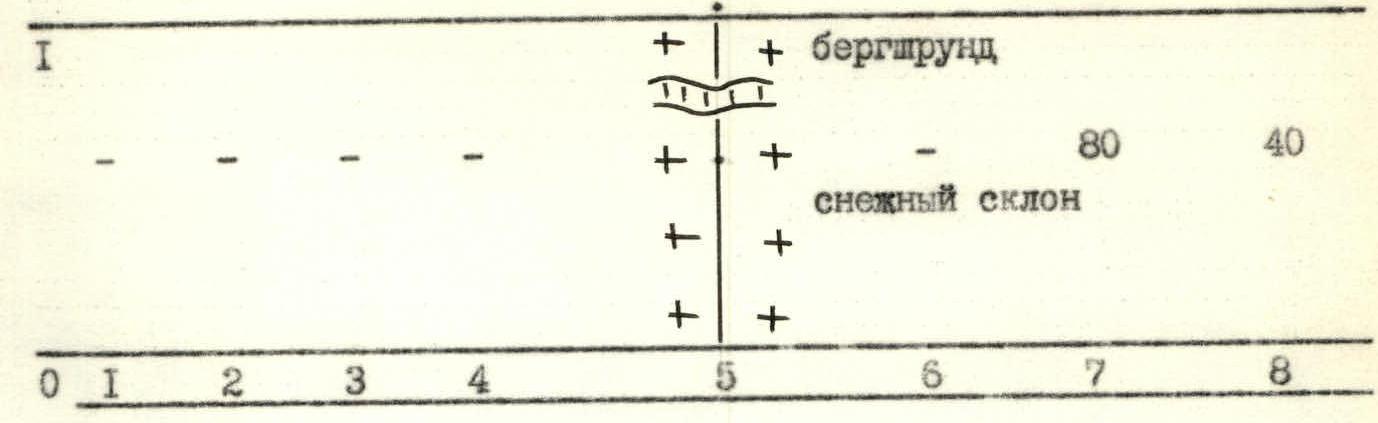
Route diagram in symbols
M 1:2000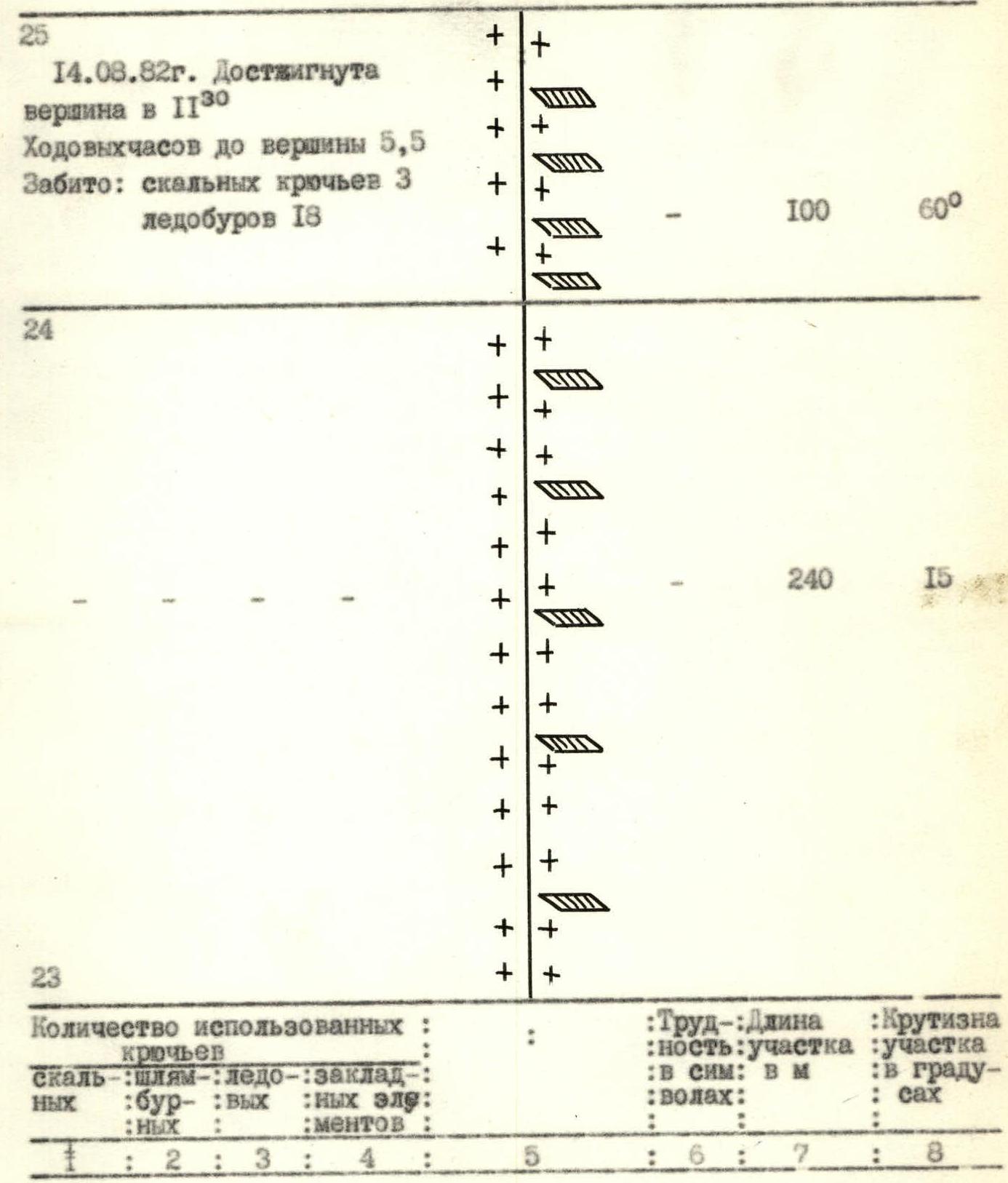


| Section № | Rock | Bolt | Ice | Nuts | Difficulty (symb.) | Length (m) | Steepness (°) | Description/Notes |
|---|---|---|---|---|---|---|---|---|
| R25 | 3 | 18 | 100 | 60 | August 14, 1982. Reached the summit at 11:30. Working hours to the summit: 5.5 hours. | |||
| R24 | 240 | 15 | ||||||
| R23 | 3 | 18 | IV | 180 | 65 | Ice slope leading to the ridge. | ||
| R22 | 57 | 17 | 4 | 200 | 50 | Overnight on August 13, 1982. Working hours for the day: 13.5 hours. Platforms cut out in the ice for 4 people and 1 person. Snow-ice slope. | ||
| R21 | 17 | Iy | 120 | 70 | ||||
| R20 | 16 | 1 | 7 | 2 | VIA4 | 40 | 85 | |
| R19 | 17 | IV | 120 | 75 | Inclined slabs with loose rocks. | |||
| R18 | 7 | 2 | VIA4 | 20 | 85 | With ice formations. | ||
| R17 | 26 | 19 | УІ | 20 | 90 | Overnight on August 12, 1982. Working hours for the day: 7.5 hours. 26 rock pitons hammered, 19 ice pitons hammered. Platform cut out in the ice for 5 people with ice formations. M 1:500. | ||
| R16 | 17 | 160 | 75 | Rocky ridge. Rocks are snow-covered and ice-covered. | ||||
| R15 | 16 | 160 | 65 | Snow-ice slope. | ||||
| R14 | 4 | 3 | Y | 80 | 50 | |||
| R13 | 29 | 2 | 6 | 80 | 65 | Overnight on August 11, 1982. Working hours: 10 hours. 29 rock pitons hammered, 6 ice pitons hammered, 2 bolt pitons hammered. Two platforms cut out in the ice (for 3 people and 2 people). | ||
| R12 | 10 | 4 | УІАА | 10 | 95 | M 1:250. | ||
| R11 | 9 | 2 | 4 | 2 | VIA4E | 20 | 90 | |
| R10 | 10 | VI | 40 | 80 | ||||
| R9 | 38 | 33 | 4 | Y | 40 | 60 | Overnight on August 10, 1982. Working hours: 13.5 hours. Platform cut out in the firn for 5 people. Rocky-ice slope. M 1:500. | |
| R8 | 5 | 3 | 60 | 55 | Snow slope. | |||
| R7 | 18 | УI | 120 | 70 | Ice formations. | |||
| R6 | 2 | 4 | 40 | 60 | ||||
| R5 | 10 | 200 | 45 | Bergschrund. Snow-ice slope. | ||||
| R4 | 12 | 100 | 85 | Ice barrier. | ||||
| R3 | 4 | 40 | 40 | Ice formations. Snow slope. | ||||
| R2 | 9 | Iy | 120 | 75 | Ice formations. | |||
| R1 | 80 | 40 | Bergschrund. Snow slope. |
Description of the route by sections
R0–R1 Bergschrund is traversed alternately on the left part, with observation of the left part of the ice barrier, where ice avalanches are possible. R1–R2 The section is traversed with alternate belay using rock pitons. When exiting to the ice barrier — an internal corner (20 m) with ice formations. R2–R3 The passage is made alternately with belay through ice screws. Movement in crampons. R3–R4 The section is traversed using "ice axes" and ice hammers on the front teeth with the installation of handlines. Vertical handlines are traversed on stirrups using jugs. R4–R5 Movement is alternate. Belay through ice screws and ice axes. R5–R6 It is traversed with alternate belay through ice screws and rock pitons. R6–R7 Movement in crampons with alternate belay using handlines. The leader is handed a free rope. R7–R8 Movement is alternate. Belay through ice screws. R8–R9 The section is traversed with alternate belay through rock pitons. Organization of a bivouac in a rock niche:
- Cutting down the firn overhang.
- Sitting overnight.
- To ensure safety during the overnight stay, 8 rock pitons are hammered. R9–R10 The internal corner is traversed by the leader without a backpack. Difficult climbing. The group follows the handlines on jugs. R10–R11 The leader traverses the section using ladders with the installation of bolt pitons. The rest on stirrups with jugs. R11–R12 Very difficult climbing in crampons with the installation of rock pitons in the walls of the "chimney", using ladders in the upper part. Pulling up backpacks. R12–R13 At the exit from the chimney, there are oblique shelves with ice formations. The snow-ice slope is traversed in crampons with alternate belay through ice screws. Organization of a bivouac on an ice slope:
- Two platforms are cut out in the ice under the rock wall (for 2 and 3 people).
- To ensure safety during the overnight stay, 7 rock pitons and 3 ice screws are hammered. R13–R14 Snow-ice slope, rock wall (20 m) are traversed alternately using ice screws. R14–R15 Snow-ice slope is traversed using ice screws alternately. R15–R16 Rocky ridge is traversed with alternate belay through rock pitons. R16–R17 Rock wall is traversed by the leader without a backpack. Very difficult climbing. Exit to an oblique shelf. Organization of a bivouac:
- A place is cut out in the ice for a sitting overnight stay.
- To ensure safety during the overnight stay, 5 ice screws and 3 rock pitons are used. R17–R18 The leader traverses without a backpack with the installation of rock pitons. The rest — on handlines. Pulling up backpacks. R18–R19 The section is traversed with alternate belay. LOOSE ROCKS!!! R19–R20 Rock wall is traversed by the leader without a backpack using ladders. The rest climb on stirrups with jugs. Pulling up backpacks. R20–R21 The section is traversed with alternate belay through rock pitons and ledges. LOOSE ROCKS!!! R21–R22 Snow-ice slope is traversed with alternate belay through ice screws. Organization of a bivouac:
- A platform is cut out on the ice slope under the rock wall.
- Sitting overnight.
- To ensure safety during the overnight stay, 6 rock pitons are hammered and 4 ice screws are used. R22–R23 Snow-ice slope with rock outcrops (in the lower part) is traversed with alternate belay. Rock pitons and ice screws are used. R23–R24 The ridge is traversed simultaneously. Belay through ledges and ice axes. CORNICES TO THE NORTH!!! R24–R25 Snow ascent leading to the summit. Belay through ice axes.
Tactics of passage:
- Throughout the entire route, a free (third) rope was fed to the leader by their partner in the rope team.
 N1 Sect. R0–R1, shot from point N1 (sheet 13)
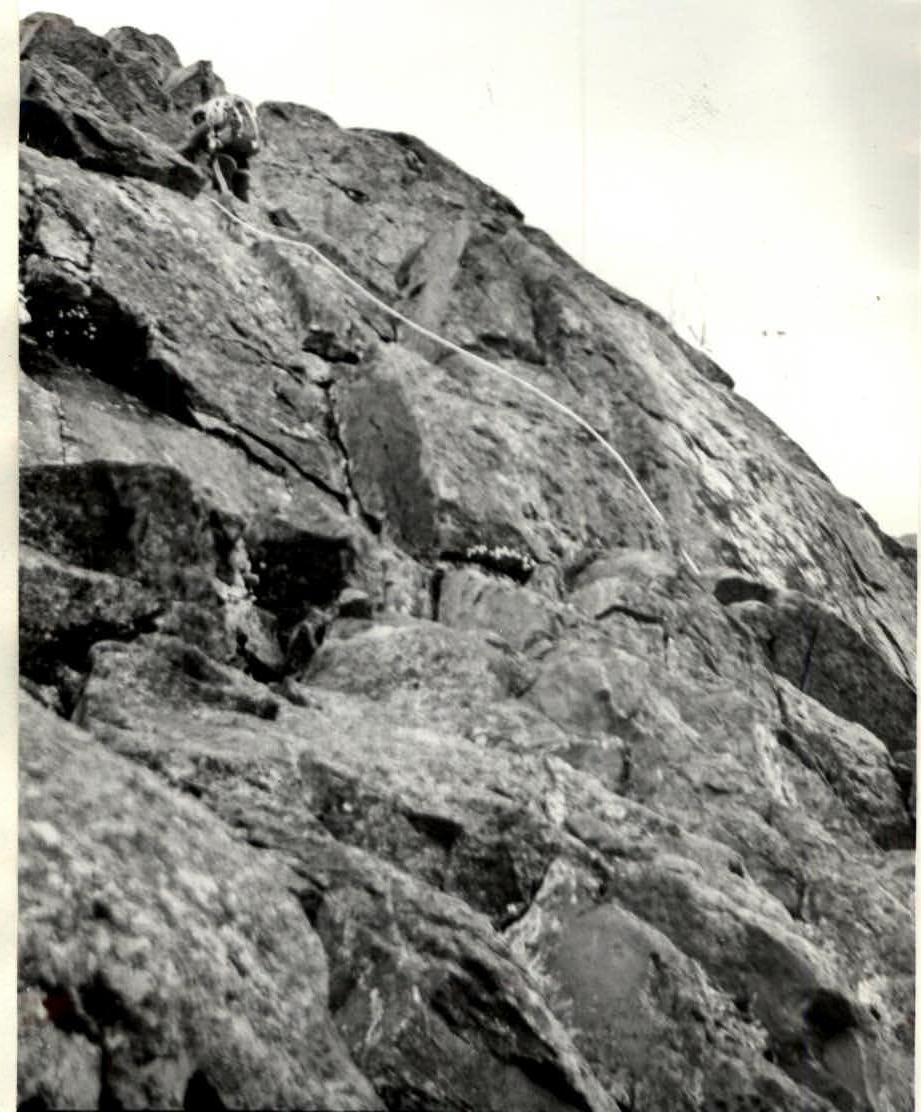 N2 Sect. R0–R1, shot from point N2 (see photo N1)
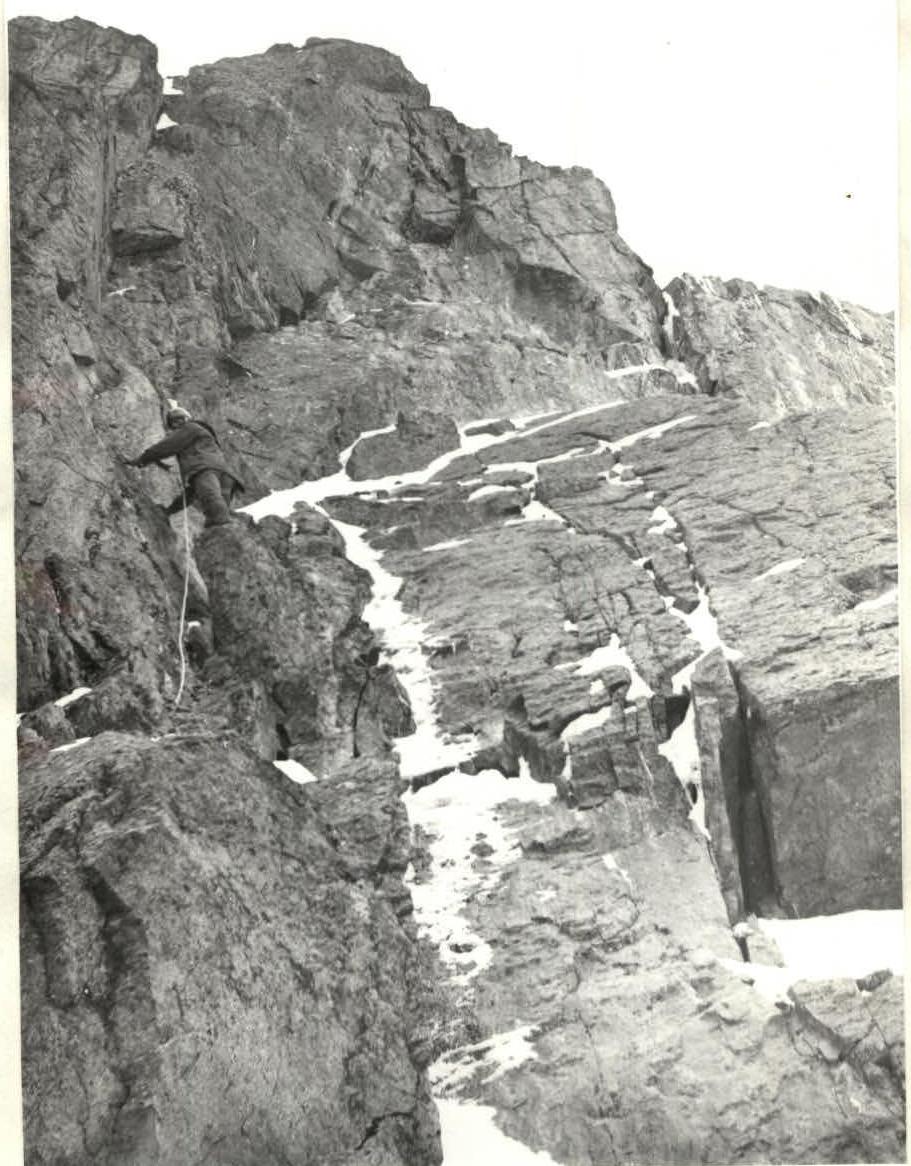 N8 Sect. R9–R10, point N8 (sheet 13)
 N10 Sect. R10–R11, shot from overnight stays