
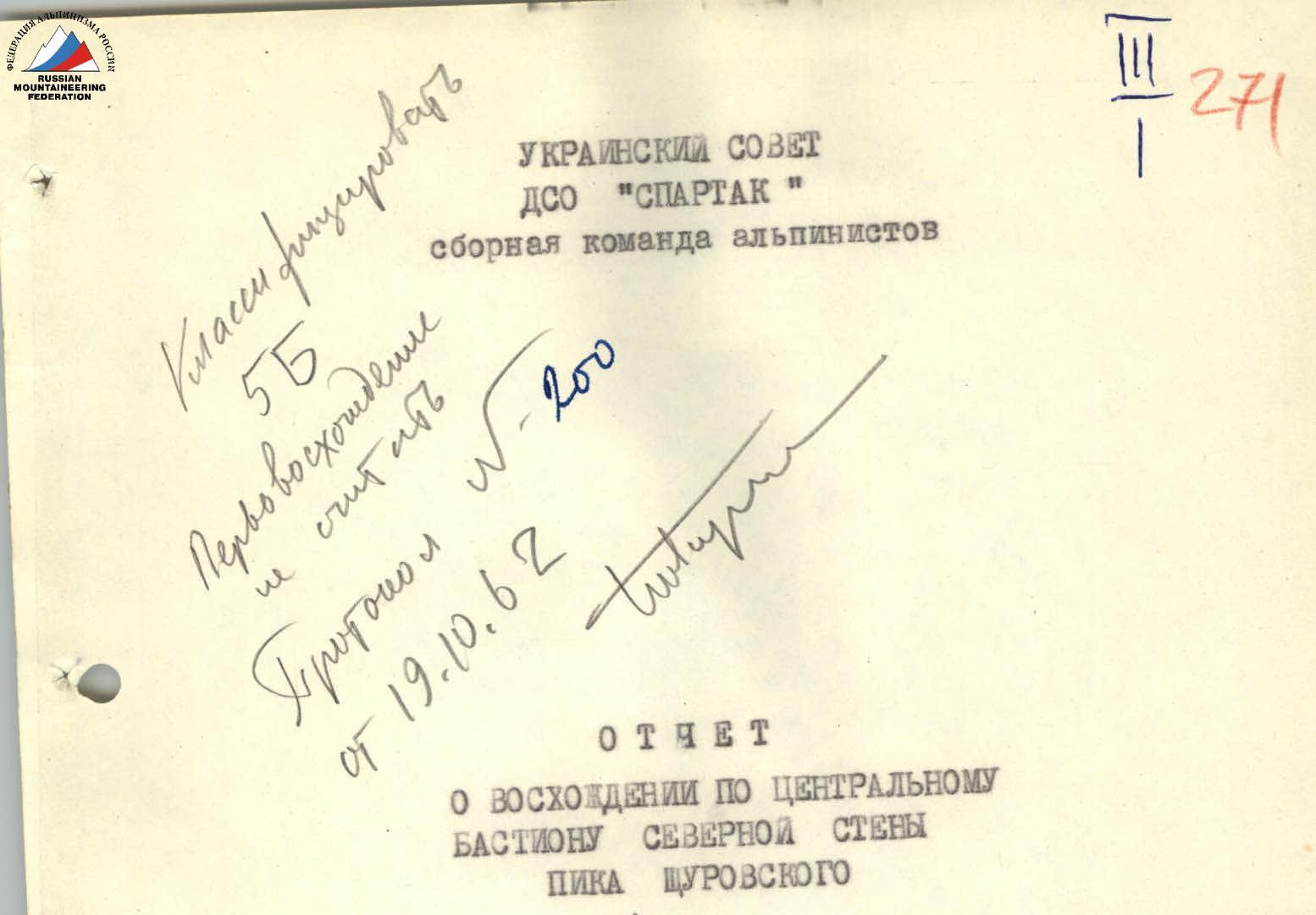
Report on the ascent via the Central Bastion of the northern wall of Peak Burovsky (via the center of the bastion)
List of participants in the assault group
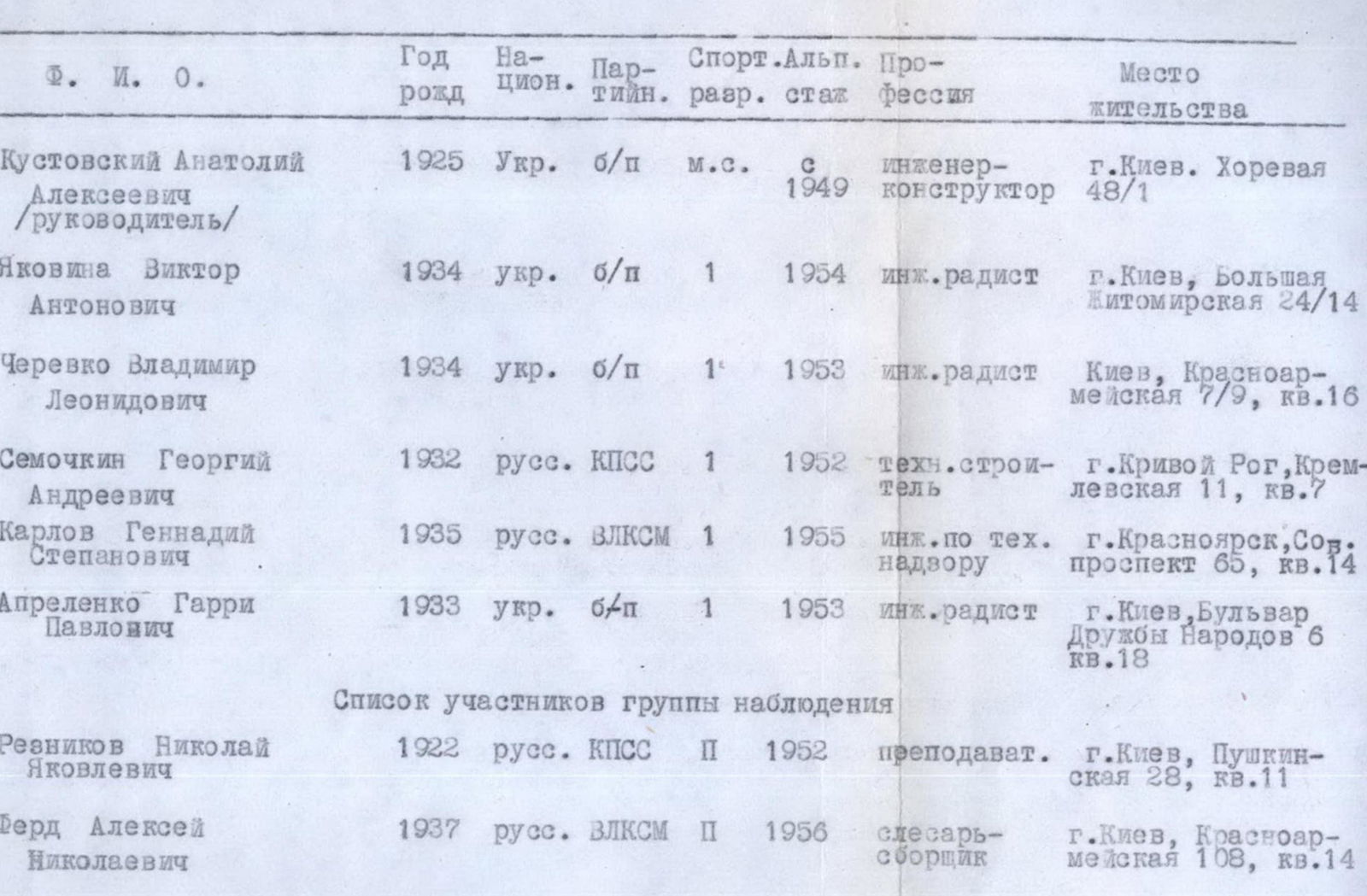
TABLE of the main characteristics of the ascent route to Peak Burovsky via the Central Bastion of the northern wall.
- Height difference of the route: 1060 m
- Including the most challenging sections: 410 m
- Steepness of the route: 80–90°
- Including the most challenging sections: 80–90°
| Date | Section № | Steepness of the section | Height of the section, in m | Terrain characteristics | Technical difficulties | Type of belay | Weather conditions | Departure time | Time of stopping at bivouac | Travel hours | Rock pitons | Ice screws | Bolts | Dural and wooden wedges | Bivouac conditions | Weight of daily ration, in grams |
|---|---|---|---|---|---|---|---|---|---|---|---|---|---|---|---|---|
| (Pitons driven) | (Pitons driven) | (Pitons driven) | (Pitons driven) | |||||||||||||
| 19.07 | R0–R1 | 40° | 80 | Snow slope | Alternate movement on crampons | through ice axe | clear | 4:00 | – | 1 h 30 min | – | – | – | – | – | 650 |
| « | R1–R2 | 45° | 60 | Ice slope | Step cutting | Piton belay | « | « | – | 2 h 30 min | – | 11 | – | – | – | « |
| « | R2–R3 | 50° | 280 | Edge of rocks and ice. Overnight stay under a rocky ridge. | Step cutting, driving pitons into rocks. | « | « | « | 16:00 | 8 h 00 min | 46 | – | – | 1 | Sitting overnight stay | « |
| 20.07 | R3–R4 | 85° | 20 | Wet wall | Wet rocks, difficult climbing, backpacks are pulled up; a 10 m ladder is hung. | « | « | 6:00 | – | 1 h 30 min | 9 | – | – | 2 | – | 650 |
| « | R4–R5 | 60° | 60 | Snow-covered rocks, sometimes small walls 2–3 m. Base of the bastion, 1st control point. | Rocks of medium difficulty, alternate movement | « | « | « | – | 2 h 30 min | 13 | – | – | 3 | – | « |
| « | R5–R6 | 70° | 60 | Outer corner, ice flow | Difficult climbing using ladders | « | « | « | – | 3 h 60 min | 17 | – | – | – | – | « |
| « | R6–R7 | 85° | 30 | Wet inner corner, overhanging exit. | Difficult climbing using ladders (3 pcs). A 15 m ladder is hung upwards. | « | « | « | – | 4 h 00 min | 19 | – | – | 2 | – | « |
| « | – | – | – | Descent to overnight stay under the bastion. | – | « | « | « | 18:00 | 1 h 00 min | – | – | – | – | Overnight stay half-lying, covered with a tent | « |
| 21.07 | – | – | – | Passage of the processed section by the first rope | – | Piton belay | clear | 6:00 | – | 2 h 00 min | – | – | – | – | – | – |
| « | R7–R8 | – | 10 | Inclined slab with ice flow | Traverse along the slab. Step cutting. Waterfall in the corner. Backpacks are pulled up in two stages. | Piton belay | clear | « | – | 1 h 30 min | 6 | – | – | 2 | – | « |
| « | R8–R9 | 95° | 50 | Smooth overhanging wall without cracks. Cornice at the exit. | Movement using platforms and bolts. 10 and 15-meter ladders are hung. | « | « | « | – | 8 h 00 min | 9 | – | 23 | 1 | Semi-suspended overnight stay on platforms | « |
| « | – | – | – | Descent to overnight stay on an inclined slab. | – | « | « | « | 19:00 | 1 h 30 min | – | – | – | – | Semi-suspended overnight stay on an inclined slab | « |
| 22.07 | – | – | – | Passage of the processed section R8–R9 by the first rope. | Backpacks are pulled up. | « | cloudy, light graupel | 7:00 | – | 2 h 00 min | – | – | – | – | – | – |
| « | R9–R10 | 90° | 30 | Smooth wall with small overhanging sections. At the beginning of the wall, a II control point is suspended in a niche. | Movement using bolts and platforms. Two 3-step ladders and one 10 m ladder are hung. Backpacks are pulled up. | « | clear | « | – | 5 h 00 min | 12 | – | 14 | 4 | Suspended bivouac on platforms. Belay on bolts. | « |
| « | R10–R11 | 80–85° | 40 | Smooth wall with a small number of holds | Difficult climbing using platforms. Backpacks are pulled up. | « | clear | 7:00 | – | 3 h 50 min | 19 | – | 4 | 2 | Suspended bivouac on platforms. Belay on bolts. | « |
| 23.07 | R11–R12 | 80° | 60 | Vertical crack with few holds. Rocks are smoothed, monolithic. | Difficult climbing, sometimes using platforms. Backpacks are pulled up. | « | « | 6:00 | – | 4 h 00 min | 11 | – | 16 | – | « | – |
| « | R12–R13 | 75–80° | 20 | Inner corner. Smoothed rocks. Three 3-step ladders. | Difficult climbing, sometimes using platforms. Backpacks are pulled up. | « | « | « | – | 2 h 60 min | 9 | – | 4 | – | « | « |
| « | R13–R14 | 70–80° | 40 | Difficult rocks, two rock walls 2–3 m high. Exit to the shoulder of the bastion to the control point of the KB ASSR group. | Alternate movement on the walls, pulling up backpacks. | « | light cloudiness | 6:00 | – | 2 h 60 min | 13 | – | – | 1 | « | « |
| « | R14–R15 | 70° | 30 | Rocky ridge of the bastion. Monolithic blocks in the form of 3–4-meter walls. | Difficult climbing. Pulling up backpacks over a 15 m section. | « | « | « | – | 1 h 00 min | 7 | – | – | 2 | « | « |
| « | R15–R16 | 75–80° | 40 | Wet inner corner, partly with ice flow. | Difficult climbing. Rocks are mossy. Backpacks are pulled up. | Piton belay | light cloudiness | 6:00 | – | 1 h 30 min | 9 | – | – | – | – | 650 |
| « | R16–R17 | 50–55° | 20 | Separate snow-covered stones and blocks. | Simultaneous movement. | through ledges | « | « | – | 30 min | – | – | – | – | – | « |
| « | R17–R18 | 40–45° | 10 | Ice slope covered with a thin layer of snow. | Movement on crampons. | Combined | « | « | – | – | 15 min | 1 | 1 | – | – | – |
| « | R18–R19 | 50–60° | 120 | Pre-summit rocky ridge, simple rocks, sometimes of medium difficulty. Summit. | Simultaneous movement. | « | « | 18:00 | – | 30 min | 2 | – | – | – | – | « |
| « | R19–R20 | – | – | Descent via route 2A cat. sl. to Ushbinskoye Plateau. | – | « | « | « | – | 40 min | – | – | – | – | Overnight stay on Ushbinskoye Plateau | « |
| Total on the bastion | 44 h 55 min | 131 | – | 41 | 38 | |||||||||||
| Total on the route | 62 h 10 min | 202 | 13 | 41 | 45 |

Description of the ascents
July 19. We leave the Shkhielda overnight stay at 3:00, cross the glacier, and, putting on crampons at 4:00, begin the ascent along the snow slope (R0–R1) to the bergschrund. By-passing the bergschrund from the right, we exit onto the ice slope (R1–R2). The ice is firm, crampons hold poorly, we cut steps, organizing belay through ice screws. Along the ice slope, we reach the beginning of the rocky ridge leading to the base of the bastion.
The further path (R2–R3) lies along the rocky ridge to the right. We go on crampons along the edge of rocks and ice, cutting steps and occasionally going onto rocks. The ridge reliably protects from falling stones. We organize belay through rock pitons. The rocks are smoothed with few cracks. By 16:00, we reach the upper part of the ridge to the planned bivouac site. There is no good platform, and we have to settle in three rows, sitting.
July 20. Leaving the bivouac at 6:00, we begin to overcome the wet 20-meter rock wall with a ledge in the middle (R3–R4). The rocks are difficult, the upper part is almost sheer. To speed up the movement, we hang a 10-meter ladder. The wall leads to the top of the rocky ridge. We move along the rocky ridge (R4–R5) towards the base of the bastion. The rocks are of medium difficulty, slightly snow-covered, with piton belay.
We reach the base of the bastion. The first stones start to fall from the rocky gullies to the left and right of the Central Bastion, but we are already under the reliable protection of the wall. The rope team goes to process the lower part of the bastion. The rest build a platform for overnight stay on a small ledge. After several hours of work, a platform is ready, where one can sleep semi-reclined.
The ascent to the bastion begins along the outer corner (R5–R6). The rocks are firm with few cracks, covered with ice flow in the lower part. Often, we have to hang ladders. The outer corner ends in a narrow niche, almost horizontally crossing the bastion. From the right part of the niche, the inner corner begins (R6–R7), along the walls of which water flows.
The place is very difficult and unpleasant, overcome on ladders, the first climber gets thoroughly wet. The inner corner rests against a cornice, turning into an ice-covered inclined slab, with a waterfall in the corner. From here, having hung a 15-meter ladder, the rope team descends to the bivouac.
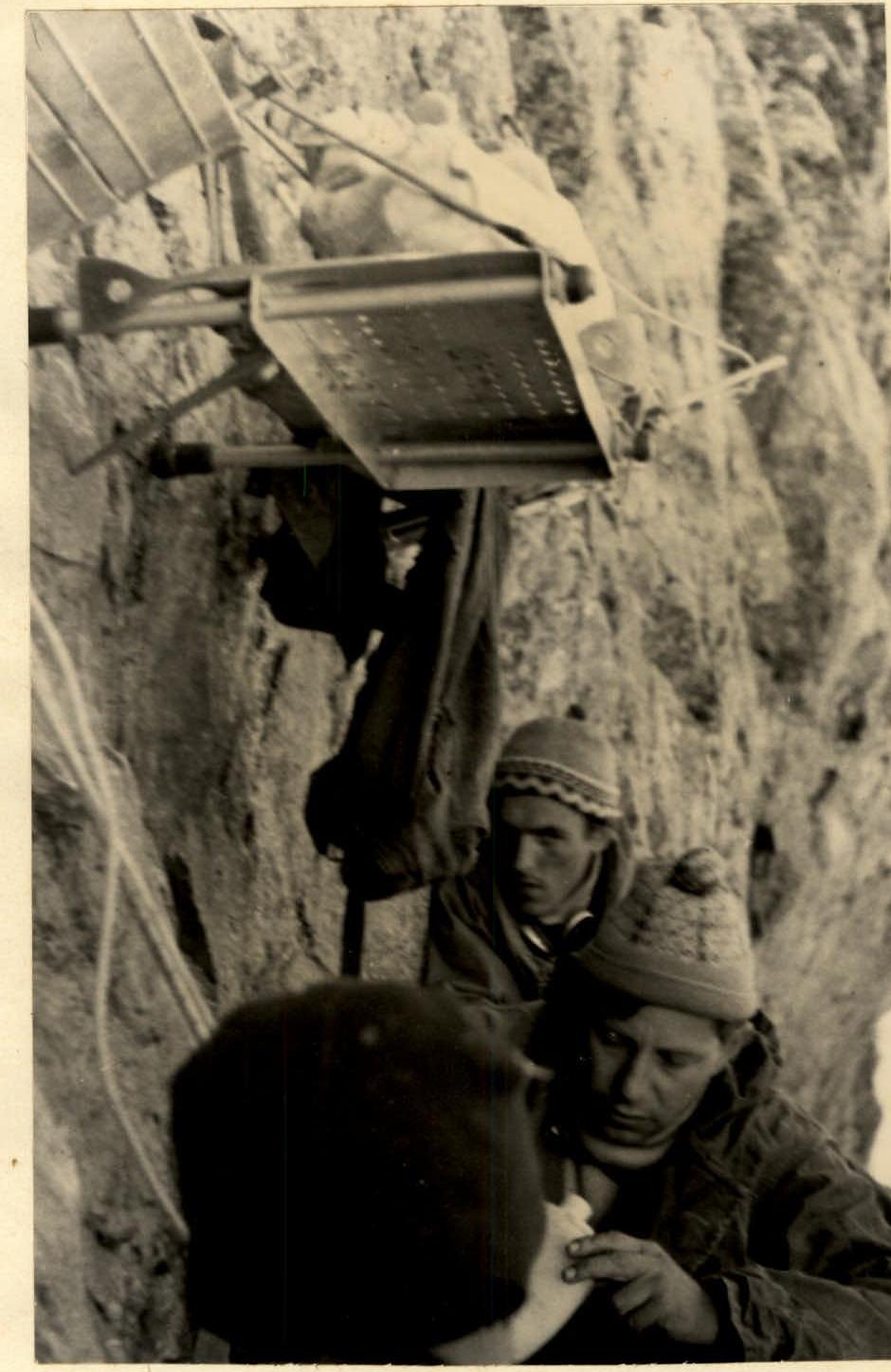
July 21. The second rope team leaves the bivouac at 6:00, passes the processed section, and after a ten-meter traverse (R7–R8) to the left along the slab, begins processing the most difficult section of the bastion. This is a smooth, crack-free, overhanging wall (R8–R9), crowned with a two-meter cornice. In the middle part, the cornice narrows to half a meter, and here the exit is planned. Processing this section using a platform and bolts took a whole day's work. By 17:00, Karlova, who passed this section, managed to drive a dural wedge and exit onto the cornice. The rest of the group, having passed the previously processed section in the left corner of the slab (R7–R8), organized a semi-suspended bivouac.
July 22. The rope team leaves the bivouac at 7:00, passes the processed section, and, having hung 10 and 15-meter ladders, continues processing. Above the cornice, the wall is without overhangs, and although it is also passed mainly on bolts, cracks begin to appear, which speeds up the movement. Above the cornice, for 30 meters (R9–R10), the bastion is crossed by a short horizontal crack, where you can put the toe of a boot. Here, the first rope team was forced to stop, as all the carabiners were used up, and it was no longer possible to issue a rope necessary for pulling up backpacks. Having organized a transfer point on platforms above the cornice, the rest of the participants pulled up their backpacks and climbed up here themselves. After that, the first rope team went further.
Above the crack, the wall (R10–R11) is again passed on platforms, but the pace of movement significantly accelerates, as cracks have appeared. After forty meters, a vertical crack appeared (R11–R12). Having passed about 30 meters along it, the first rope team descended to the beginning of this crack, where the rest of the participants had already arrived by that time. For this, they had to:
- organize one more point for pulling up backpacks.
Here, a suspended bivouac was organized on platforms.
July 23. We start moving at 6:00. Having passed the processed section, the first rope team organizes a transfer point for pulling up backpacks and goes further along the crack.
The crack gradually widens and turns into an inner corner. Here, we hang three ladders and go mainly without platforms. At 13:00, the first rope team reaches the edge of the bastion right onto the platform of the Khergiani group (R13–R14). Two hours later, the whole group gathers here.
From here, along the edge (R14–R15), we exit onto the shoulder of the bastion. This section is composed of monolithic blocks in the form of 3–4-meter walls, passed without backpacks, but after the sheer walls of the bastion, it seems easy.
Before us is the final part of the wall (R15–R16), cut by an inclined inner corner. The rocks are wet, water flows.
We climb up the inner corner and pull up our backpacks for the last time. Before us is a несложный pre-summit slope. Along the gentle snowfield (R17–R18), we reach the ridge (R18–R19).
At 18:00, we reach the summit. We leave a note and, without delaying, begin the descent to the Ushbinskoye Plateau. Here, we organize an overnight stay.
July 24. We descend from the Ushbinskoye Plateau and return to the camp.
Conclusion
In preparation for the ascent, the Ukrainian council of the "Spartak" Sports Society team carried out an extensive program of physical and technical training for the participants. Particular attention was paid to:
- mastering new equipment and new technical techniques;
- polishing high-level rock climbing techniques.
The team included climbers who had experience in wall ascents, participated in the 1961 USSR championship ("Aksaul", via the northern wall), and repeatedly participated in the Ukrainian championship (USSR championship 1959–1961).
The core of the team has been working together for 3–4 years, and therefore, by the time of the ascent to Peak Burovsky, the group came as a united collective.
Careful and serious preparation, clear and purposeful actions of all participants ensured the successful passage of the complex wall route.
The assessment of the speed of passage of the route by the group was correct; The assessment of the complexity of the ascent was correct.
All participants confidently and reliably passed the difficult sections of the wall. The work of the rope teams was built on the principle of interchangeability of leaders, which ensured a uniform load on all team members.
The route to Peak Burovsky via the Central Bastion is a safe, albeit very complex, wall route. In terms of its length, steepness, and terrain characteristics, it is a very complex route of category 5B.

Before departure
November 29
Section R8–R9
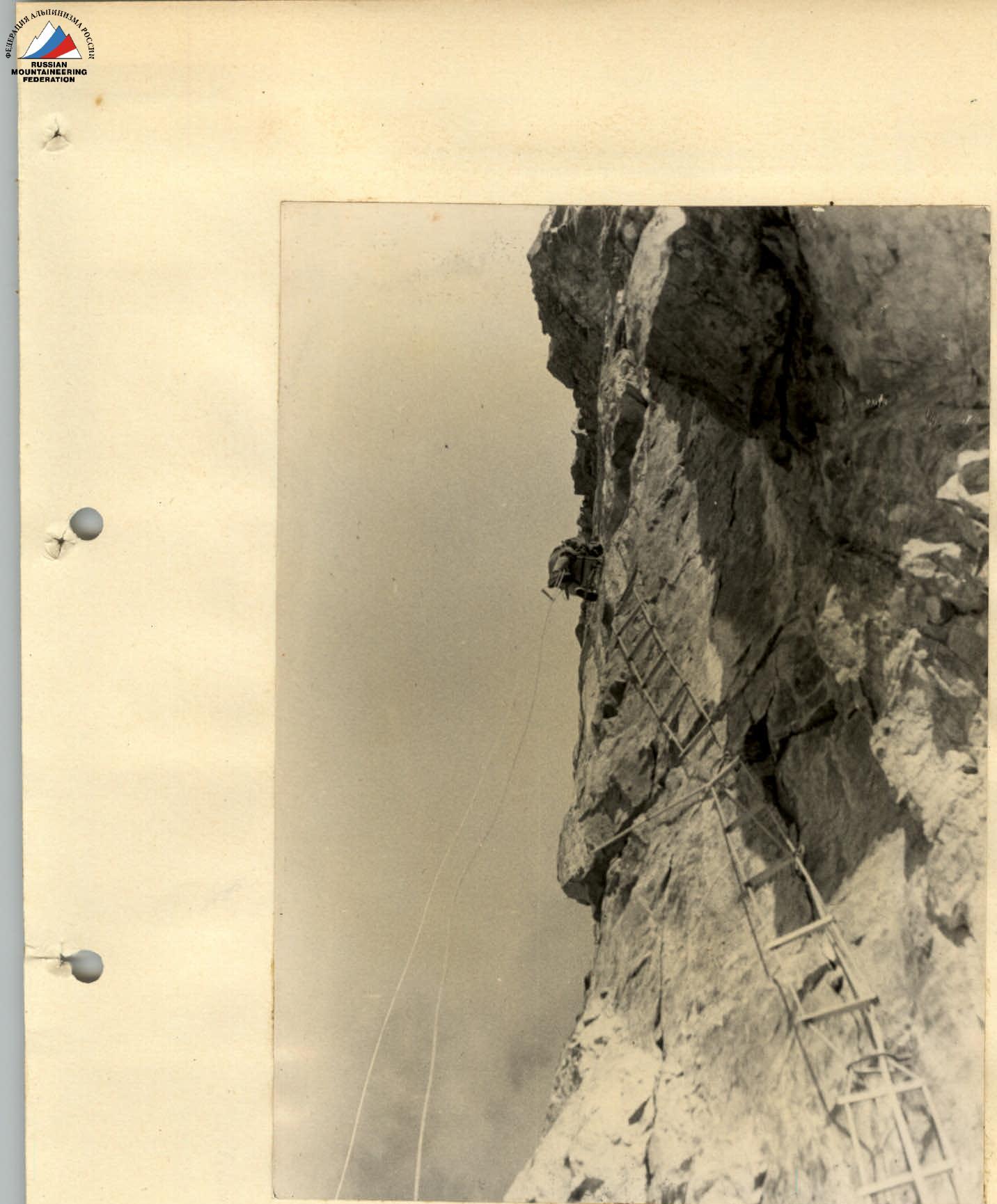
Passing the cornice on section R8–R9


Comments
Sign in to leave a comment