
- Class of winter ascents.
- Central Caucasus, Main Caucasian Range.
- Chatyn via "Romb" chimneys of the Northern wall (Myshlyaev's route).
- Difficulty category — 6B.
- Height difference — 768 m, route length — 1175 m.
- Length of sections with 5–6 diff. cat. — 575 m.
Length of sections with 6 diff. cat. — 515 m. Average steepness of the wall part of the route — 86°.
- Pitons driven:
| rock | ice | protection elements | bolt (used) |
|---|---|---|---|
| 142/78 | 32 | 67/33 | 59/32 |
-
Team's travel hours — 59, days — 7, including 2 days of processing.
-
Overnights: 3 lying on a shelf with snow drift, 1 semi-reclining on the "roof".
-
Team leader and senior coach: Pogorelov Alexander Grigorievich — Master of Sports of International Class Participants: Astakhov Mikhail V. — Candidate for Master of Sports Zaporozhsky Mikhail Yuryevich — Candidate for Master of Sports Koshelenko Yuri Vladimirovich — Candidate for Master of Sports Polokhov Vitaly Fedorovich — Candidate for Master of Sports
Team coach: Shemenev Alexander Grigorievich.
-
Departure to the route: February 18, 1994. Summit: February 24, 1994. Return to camp: February 25, 1994.
-
Organization: Rostov Regional Federation of Alpinism and Rock Climbing.
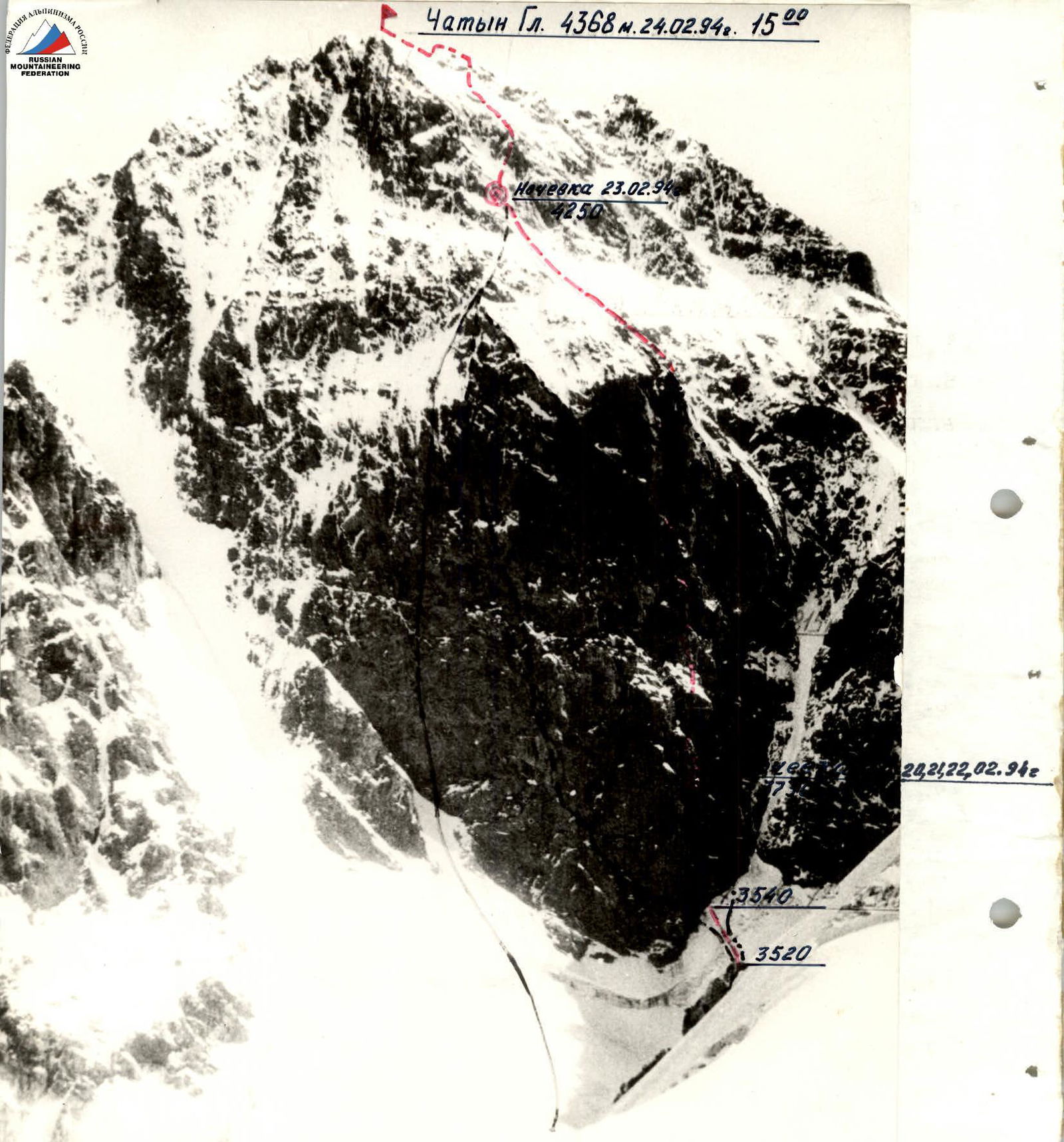
Photo 1. General photo of Chatyn peak. The photograph is retaken from the report of the team of "Baksan" alpine camp 1984.
— Myshlyaev's route 1959 — 6A cat. diff., climbed by the team — Chernoslivin's route 1965 — 6A cat. diff. — Snesarev's route 1959 — 6A cat. diff. — Grakovich's route 1972 — 6A cat. diff.
Tactical actions of the team
The ascent was carried out according to the tactical plan. Initially, the team planned to climb Chernoslivin's route as the most technically difficult and longest route on the "Romb" and not yet climbed in winter conditions. But after being dropped off on the Chalaat glacier plateau and viewing the entire "Romb" through a monocular, it became clear that there were fixed ropes on all routes to the left of Myshlyaev's route, namely:
- on Chernoslivin's route — almost along the entire length of the route;
- on Snesarev's route — almost along the entire length of the route.
Out of the initial options considered by the team as possible ascent objects, only Myshlyaev's route was "clean".
The tactical plan for the route was drawn up directly under the route itself, which made it possible to take into account all the subtleties of the upcoming ascent. Since two other competing teams: UMTS "Elbrus" and Elbrus KSS led by Avtomonov were also present under the wall at that moment, re-registration and re-issuance of discharge documents did not cause any problems.
February 17, 1994. Our group: 5 team members + 2 observers, overnight stay together with two competing teams, was airlifted by helicopter to the Chalaat glacier plateau under the Northern wall of Chatyn.
To climb the "Romb", we had all the necessary equipment:
- specially made wall tent
- stock of ropes
- "hook-legs"
- bolt pitons
- spare pair of crampons
On the route, the team worked in two rope teams:
- Pogorelov–Polokhov–Astakhov
- Zaporozhsky–Koshelenko.
It was planned to complete the route in 7 days with 2 days of processing. The ascent showed that the assessment of the possibilities and the winter condition of the wall were made correctly.
- February 18, 1994 — 1st day of processing: from 9:00 to 15:00, the Zaporozhsky–Koshelenko rope team worked, from 15:00 to 18:00 — Pogorelov–Polokhov.
- February 19, 1994 — 2nd day of processing: from 9:00 to 17:00, the Pogorelov–Astakhov–Polokhov rope team worked.
- February 20, 1994 — departure on the route at 9:00. The Pogorelov–Polokhov rope team worked ahead, the rest were engaged in carrying loads and setting up a bivouac on the wall. End of work — 18:00.
- February 21, 1994 — processing of the middle chimney: from 9:00 to 15:00 — Zaporozhsky–Koshelenko, from 15:00 to 18:00 — Polokhov–Astakhov.
- February 22, 1994 — processing of the upper chimney: from 9:00 to 18:00 — Pogorelov–Polokhov.
- February 23, 1994 — passage of the upper part of the chimney, exit to overnight stay on the "roof": from 9:00 to 14:00 — Pogorelov–Polokhov–Astakhov, from 14:00 to 18:00 — Zaporozhsky–Koshelenko.
- February 24, 1994 — start of work at 9:00. Reached the summit of Chatyn Main — 15:00. Descent via Route 3A to the Ushba plateau.
Main difficulties faced by the team during the ascent:
- heavy snow cover on the lower and middle parts of the route, up to the upper chimney;
- limited choice of cracks (most are filled with ice and dirt) for protection and passage, which required additional time to ensure proper reliability of movement;
- very hard winter ice on the "roof" of the Northern wall and on the descent via Route 3A.
During the ascent:
- the first climber worked with one dynamic and one static rope;
- double rope or single rope with a backup was used for organizing belays;
- bolt pitons were not driven, most of the old ones were torn off.
In the upper part of the large chimney, excess equipment was dropped to observers on the Lozhny Chatyn pass.
The ascent was facilitated by:
- proper distribution of team forces;
- quality rest in a fairly spacious and warm wall tent;
- good assortment of food products.
The first bivouac on the "Romb" was organized on a shelf with a snow drift under a cornice, a rope below Abalakovskaya shelf. The bivouac turned out to be very convenient and safe, allowing:
- effective processing of the upper part of the "Romb";
- good recovery of strength.
The second bivouac on the "roof" of the "Romb" was less convenient; a large stone and an ice ridge descending from it were used to organize it. Expanding the site by using ice from the cut ridge allowed spending the night in a semi-reclining position. The canopy above the bivouac protected from possible rockfall and avalanches.
Radio communication with the camp was carried out using the "Lastochka" radio station through observers and an auxiliary group led by rescue team leader A. Shemenev, who was at Aristov's bivouac in the Shkhelda valley. There were no missed radio communication sessions.
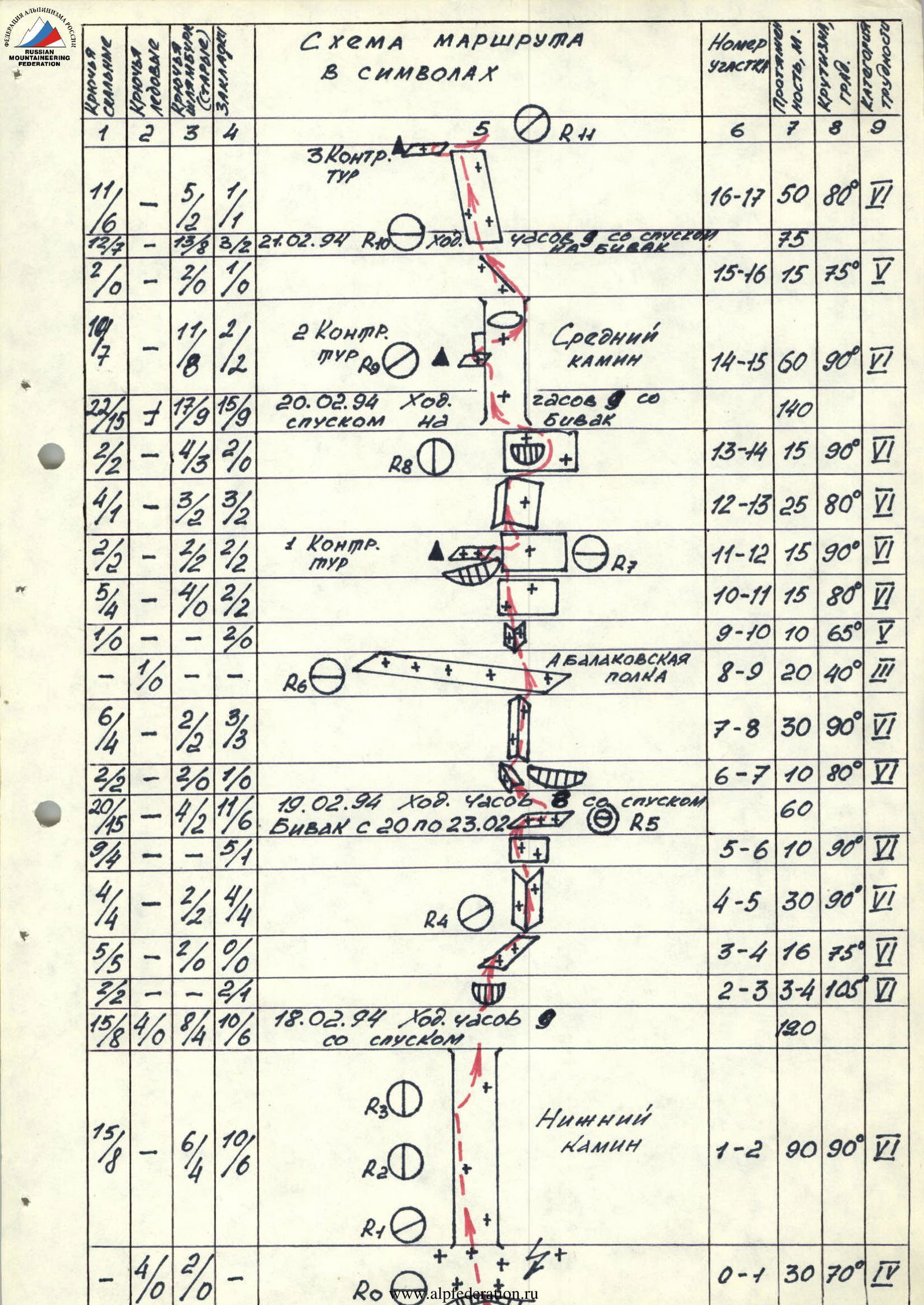
Route scheme in symbols
| Rock pitons (driven/used) | Ice pitons (driven/used) | Bolt pitons (driven/used) | Protection elements (driven/used) | Description / Event | R-point | Section number | Length, m | Steepness, deg. | Difficulty category |
|---|---|---|---|---|---|---|---|---|---|
| 11/16 | 5/12 | 1/1 | 3rd control tour | R14 | 16–17 | 50 | 80° | 6 | |
| 12/2 | 13/8 | 5/2 | 21.02.94 hours with descent | 75 | |||||
| 2/6 | 2/6 | 1/6 | 15–16 | 15 | 75° | 5 | |||
| 14/17 | 11/18 | 2/12 | 2nd control tour R6 Middle chimney | R10 | 14–15 | 60 | 90° | 6 | |
| 23/25 | 17/9 | 15/9 | 20.02.94 hours with descent to bivouac | 140 | |||||
| 2/2 | 4/5 | 2/6 | R8 | 13–14 | 15 | 90° | 6 | ||
| 4/11 | 3/2 | 3/2 | 12–13 | 25 | 80° | 5 | |||
| 2/2 | 2/2 | 2/2 | 1st control tour | R7 | 11–12 | 15 | 90° | 6 | |
| 5/4 | 4/6 | 2/2 | 10–11 | 15 | 80° | 5 | |||
| 1/6 | 2/6 | R6 | 9–10 | 10 | 65° | 4 | |||
| 1/16 | R5 | 8–9 | 20 | 40° | 3 | ||||
| 6/14 | 2/2 | 3/13 | Abalakovskaya shelf | R4 | 7–8 | 30 | 90° | 6 | |
| 2/5 | 2/6 | 1/6 | 6–7 | 10 | 80° | 5 | |||
| 20/15 | 4/2 | 11/6 | 19.02.94 hours with descent. Bivouac from 20 to 23.02 | R3 | 60 | ||||
| 8/4 | 5/4 | 5–6 | 10 | 90° | 6 | ||||
| 4/14 | 2/2 | 4/14 | R2 | 4–5 | 30 | 90° | 6 | ||
| 5/5 | 2/6 | 0/6 | 3–4 | 16 | 75° | 5 | |||
| 2/3 | 2/4 | 2–3 | 3–4 | 105° | 6 | ||||
| 15/8 | 4/6 | 8/4 | 10/16 | 18.02.94 hours with descent | R1 | 120 | |||
| 15/18 | 6/4 | 10/16 | Lower chimney | 1–2 | 90 | 90° | 6 | ||
| 4/10 | 2/10 | R0 | 0–1 | 30 | 70° | 4 |
Route description by sections
| Section: | |
|---|---|
| R0–R1 | Bergschrund is overcome by a snow bridge, then the ice slope is climbed in crampons, protection through ice screws. |
| R1–R2 | Lower chimney. Steep, snow-covered rocks. Cracks are filled with dirt and ice. Climbing is very difficult, multiple use of artificial climbing techniques. Difficulty finding suitable cracks for pitons. Belay positions are inconvenient. Most old bolt pitons are torn off. |
| R2–R3 | Overhanging section. Rocks are washed out, destroyed. Artificial climbing techniques are used for passage. |
| R3–R4 | System of steep slots and shelves, heavily covered with snow. Lack of reliable holds. Artificial climbing techniques. At the end of the section, a station on two bolts. |
| R4–R5 | Indistinctly expressed snow-covered R internal angle. Strenuous climbing using artificial climbing techniques. |
| R5–R6 | Wall. Disjointed rocks are covered with snow. Artificial climbing techniques. At the end of the section, a shelf under an overhang with a snow drift, used for organizing a bivouac. |
| R6–R7 | Inclined internal angle. Belay through pitons. Artificial climbing techniques. |
| R7–R8 | Vertical internal angle with a crack in the center. Small and medium-sized protection elements and pitons are used. There are very few reliable holds. Artificial climbing techniques. |
| R8–R9 | Abalakovskaya shelf. Stones with ice. Ice is very hard, belay through pitons and ice screws. |
| R9–R10 | Indistinctly expressed, heavily disjointed internal angle. Belay through protection elements and pitons. |
| R10–R11 | Wall. Overhang on the left. Difficult climbing. Artificial climbing techniques. Traverse left onto a shelf with the 1st control tour. Possible bivouac site. |
| R11–R12 | Difficult slab-like wall. Traverse along it several meters to the right, then up. Holds are filled with snow. Artificial climbing techniques. |
| R12–R13 | Internal angle, the left wall of which is overhanging. A split runs along the center, forming a wide gap. The right wall of the internal angle has a slab-like structure, holds are practically absent. Medium and large protection elements are applicable. Artificial climbing techniques. |
| R13–R14 | Wall with a sheer drop in the middle. Traverse under the sheer drop to the right. A slab-like "roof" of the sheer drop leads to the base of the middle chimney. Strenuous climbing using artificial climbing techniques. |
| R14–R15 | Difficult middle chimney with overhanging sections and snow plugs. Destroyed rocks, cracks are reliable. In the center of the chimney — a slab with a belay position and the 2nd control tour. Possible bivouac. Artificial climbing techniques. |
| R15–R16 | Small rocky, snow-covered ridge. Belay through pitons and protection elements. |
| R16–R17 | Heavily snow-covered slab-like wall leads to the base of the upper 120-meter chimney. Strenuous climbing using artificial climbing techniques. Up to the left, a shelf with a control tour. Possible sitting bivouac. |
| R17–R18 | Upper overhanging chimney. Very narrow at the bottom, gradually expanding upwards, in some places with a complete absence of cracks for pitons. Climbing is done using chimney climbing techniques and artificial climbing techniques. Belay positions are inconvenient. Ropes are hanging, in many places 3–4 m away from the wall. Old bolts are rare, mostly on stations. |
| R18–R19 | Upper part of the chimney. Wider and more gentle. There are more cracks for pitons and protection elements than at the bottom. At the point of division of the chimney — 4th control tour under the wall, leading to the "roof" of the "Romb". |
| R19–R20 | Rocky, snow-covered ridge of medium difficulty. |
| R20–R21 | Ice slope. Very hard winter ice, requires maximum concentration on movement and good ice equipment. Belay through ice screws. |
| R21–R22 | Wall, covered with ice. Leads to the summit of a large stone, with an adjacent ice ridge. Canopy above. Site of the 2nd bivouac. |
| R22–R23 | Heavily snow-covered, iced wall. Belay through pitons and protection elements. |
| R23–R24 | Ice couloir. Belay point on a rocky "island". |
| R24–R25 | Steep, difficult, disjointed wall. Climbing is done using artificial climbing techniques. |