
Introduction
Peak Volnaya Ispaniya is located in the central part of the Main Caucasian Range between the peaks Bzhedukh and Ullu-Kara, and is very popular among both Soviet and foreign mountaineers. The most interesting and challenging routes, climbed in the right part of the eastern wall (Subbotovich, Myshlyaev), have repeatedly received awards and have rightfully earned recognition as classics.
The first ascent of the left part of the eastern wall was made in 1978 by a team from the Bauman Moscow State Technical University and received an award. Since the route was only classified at the end of 1979, it did not gain much popularity and was repeated only in June 1980, although its technical difficulty and logic (it follows a nearly direct line) are no less than those of previously climbed routes on this wall.
TABLE OF MAIN CHARACTERISTICS OF THE ASCENT ROUTE 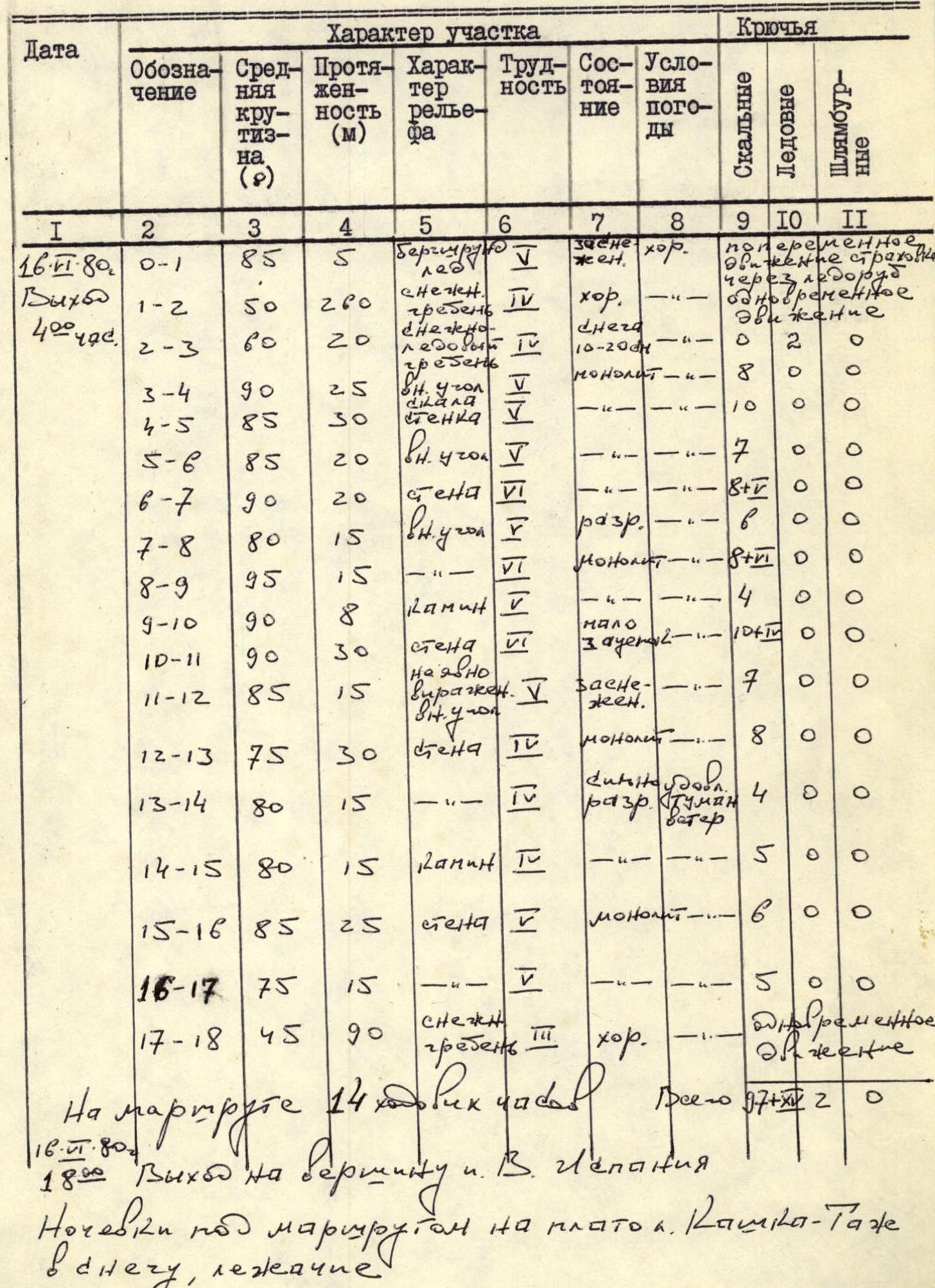
Protocol No. 20
Ascent
Debriefing of the group of instructors from the "Shkhielda" alpine camp led by Parshin V.S. on peak Volnaya Ispaniya via route 5B cat. sl. (Kolomyttsev's route on the left part of the eastern wall) on June 16, 1980.
Attendees:
- Release supervisor Shepalova G.N.
- Head of the rescue camp Barulin B.
- Commander of the разрядников detachment Volkov V.
- Instructor - Peshcherikova N.
Ascent participants:
- Parshin V.S.
- Glushkovsky A.E.
- Khitrov M.V.
- Paikov A.D.
Parshin V.
As planned in the tactical ascent plan, on June 15, the group ascended to the upper step of the Kashka-Tash glacier by 18:00 and set up a bivouac near the wall of peak Volnaya Ispaniya. At 4:00 in the morning, after a hearty breakfast and packing a full set of bivouac gear, they set out on the route. The rope teams were arranged as follows:
- Parshin V. - Paikov A.
- Glushkovsky A. - Khitrov M.
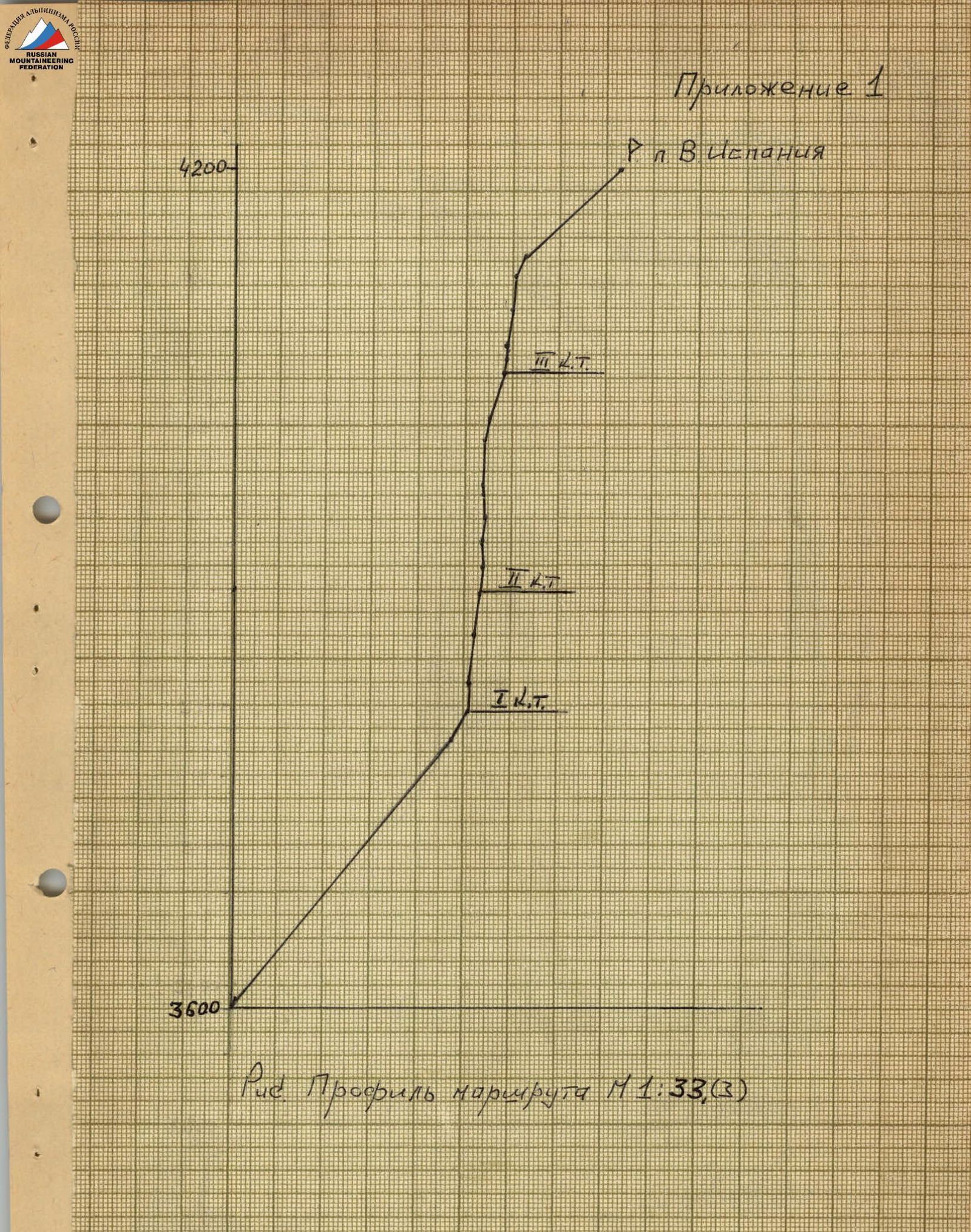
By 6:30, they reached the first control point. By 12:00, they were at the second control point, where they took a short break with hot tea without slowing their pace significantly. By 15:30, no more than two rope lengths from the ridge, they decided to continue ascending to the summit, especially since the first signs of deteriorating weather began to appear. In the worst case, they planned to spend the night on the ridge near the summit or on the descent.
Upon reaching the summit by 18:00, it became clear that they needed to descend, given the obvious signs of an approaching storm, via the route through the saddle between peak Bzhedukh and peak Volnaya Ispaniya, category 3A. By 21:00, having safely descended to the plateau under the sound of the storm beginning, they set up a bivouac.
Thus:
- The tactical plan was ahead by 3 working hours.
- This allowed them to avoid an overnight stay on the route in unfavorable weather conditions.
- As well as descending via a steep, closed glacier in a clearly avalanche-prone situation after the bad weather.
The next day, by 11:00, they returned to the camp. There were no remarks on the participants' work, and no violations were observed. On the route, everyone took turns leading.
The high speed of the lower part of the route was due to:
- Good snow conditions.
- Frequent changes of the lead climber when working in autonomous rope teams.
Glushkovsky A. completed the main part of the rock section of the route, which was also advantageous on the short and steep wall, where changing the lead would have only resulted in a loss of tempo and time.
The route's condition was good, despite the early season. Special attention should be paid to the possibility of avalanches in the lower part when approaching the wall after 10:00.
Glushkovsky A. The route was to my liking, fully corresponds to category 5B. The rock section is comparable to the 5B route on peak Kirpitch via the diamond. I have no complaints about the leader or the participants.
Khitrov M. The ascent was made at a good pace, but there were a few instances of time loss, particularly:
- Not having enough pitons for the first climber's further work.
There were no insurance breaches; leadership was clear, concise, and timely.
Paikov A. I agree with Khitrov's remark. I consider this ascent one of the most challenging category 5B I've done.
Barulin B. How was communication with the camp maintained?
Parshin V. Communication was maintained as follows:
- Radio communication with the observation group, within line of sight, was conducted regularly according to the schedule using the "Vitalka" radio station.
- Communication between observers and the camp was maintained using the "Karat" radio station.
Recommendations for future climbers: start the route around the same time, i.e., 4:00, as before 7:00 the wall is not lit, and working will be very cold. Pay special attention to:
- "Live" rocks in the upper part of the route before reaching the ridge.
Conclusion I of the release supervisor
The ascent is to be credited to the participants and leader Parshin V. I recommend submitting a report on the third ascent of the route to the USSR Alpine Federation.
June 18, 1980 Release supervisor of "Shkhielda" alpine camp, Master of Sports of the USSR Shepalova G.N.
Secretary Peshcherikova N.
Conclusion
In addition to favorable weather conditions and snow conditions in the lower part of the route, the following factors contributed to the rapid ascent:
- High individual physical and technical preparation of the team members.
- Clear interaction between rope teams when passing key sections of the route on fixed ropes without pulling up backpacks.
- The use on the route of new type ladders with rings and ladder systems with pitons under the knee for creating artificial footholds.
 www.alpfederation.ru↗