Ascent Log
- Ascent category — winter.
- Ascent region — Central Caucasus, Adyrskiy ridge.
- Chegem (4461) NE wall, NE ridge, 6A cat. diff. Forostyan's route.
- Height difference of the wall section — 550 m.
- From the foot of the wall section to the summit — 1050 m.
- Average steepness of the wall — 85°.
- Length of sections with 5–6 cat. diff. — 385 m.
- Pitons driven
| Rock | Bolt | Nuts | Ice |
|---|---|---|---|
| 210 | 114 | 113 | 22 |
- Climbing hours — 77, including processing days.
- Overnights — all bivouacs, including processing days: 2 on the route, 5 during processing.
- Team of Voronezh Alpine Section.
- Leader: Zaichikov V. O. — Candidate Master of Sports — 2nd class.
Team members:
- Zadohin V. Yu. — Candidate Master of Sports — 3rd class.
- Belskikh I. V. — Candidate Master of Sports — 3rd class.
- Coach: Kudashov A. O. — Candidate Master of Sports — 2nd class.
- Departure to the route on February 22, 2000.
Reached the summit on February 27, 2000. Returned to base camp on February 28, 2000.

A. Kurochkina!
- This is how they supposedly climbed Kurochkin's route, 6A! (K. Zaitsev, via Porokhnya?) www.alpfederation.ru↗
V. Chegem (4461) NE wall. NE ridge.
- Kurochkin's route 6A cat. diff. (incorrect!)
- Forostyan's route 6A cat. diff. (?)
- Laskavyy's route 5B cat. diff. (?)
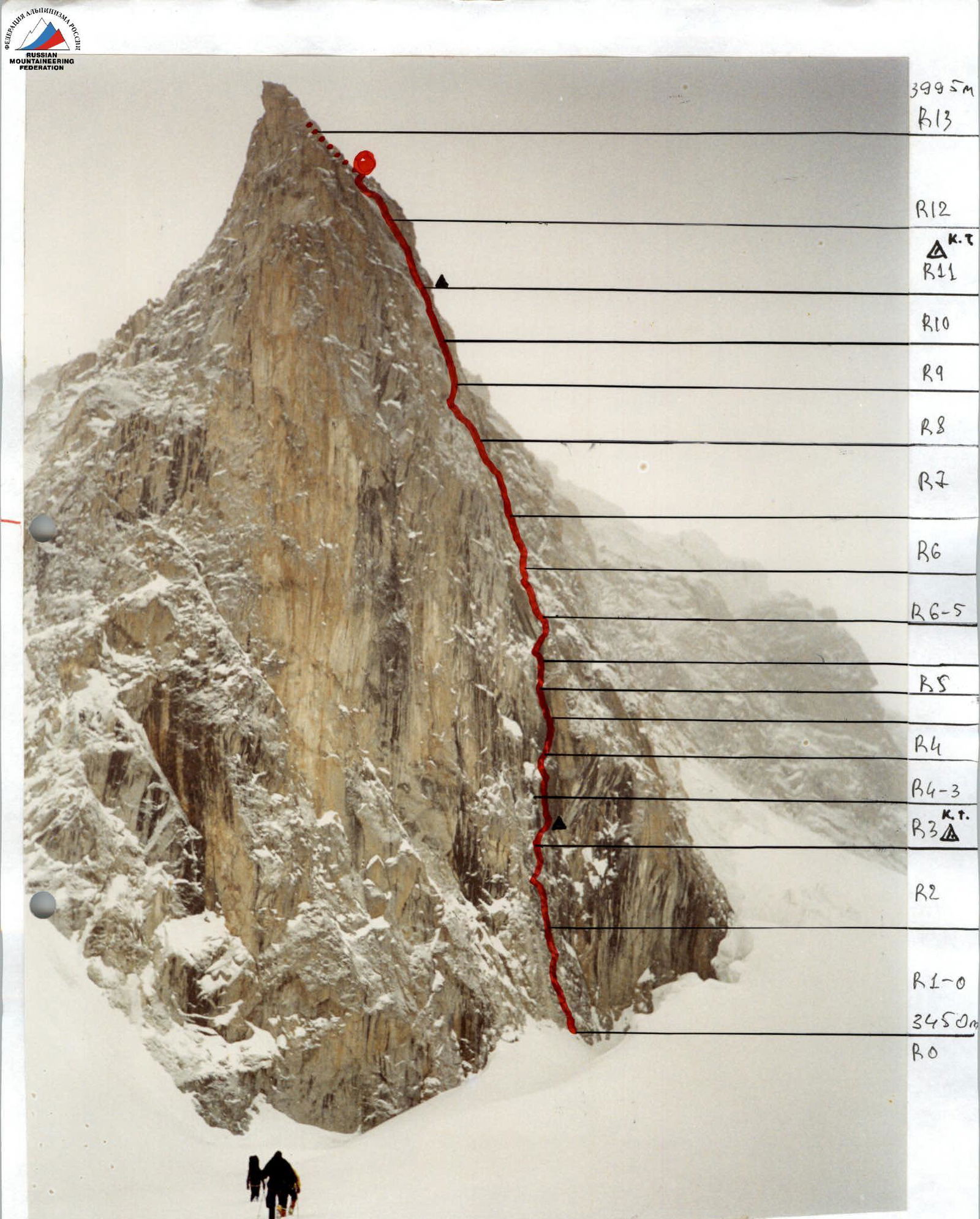 www.alpfederation.ru↗
Route Description
Chegem NE wall. NE ridge. 6A cat. diff.
According to the training department of AUSP "Ullu-Tau".
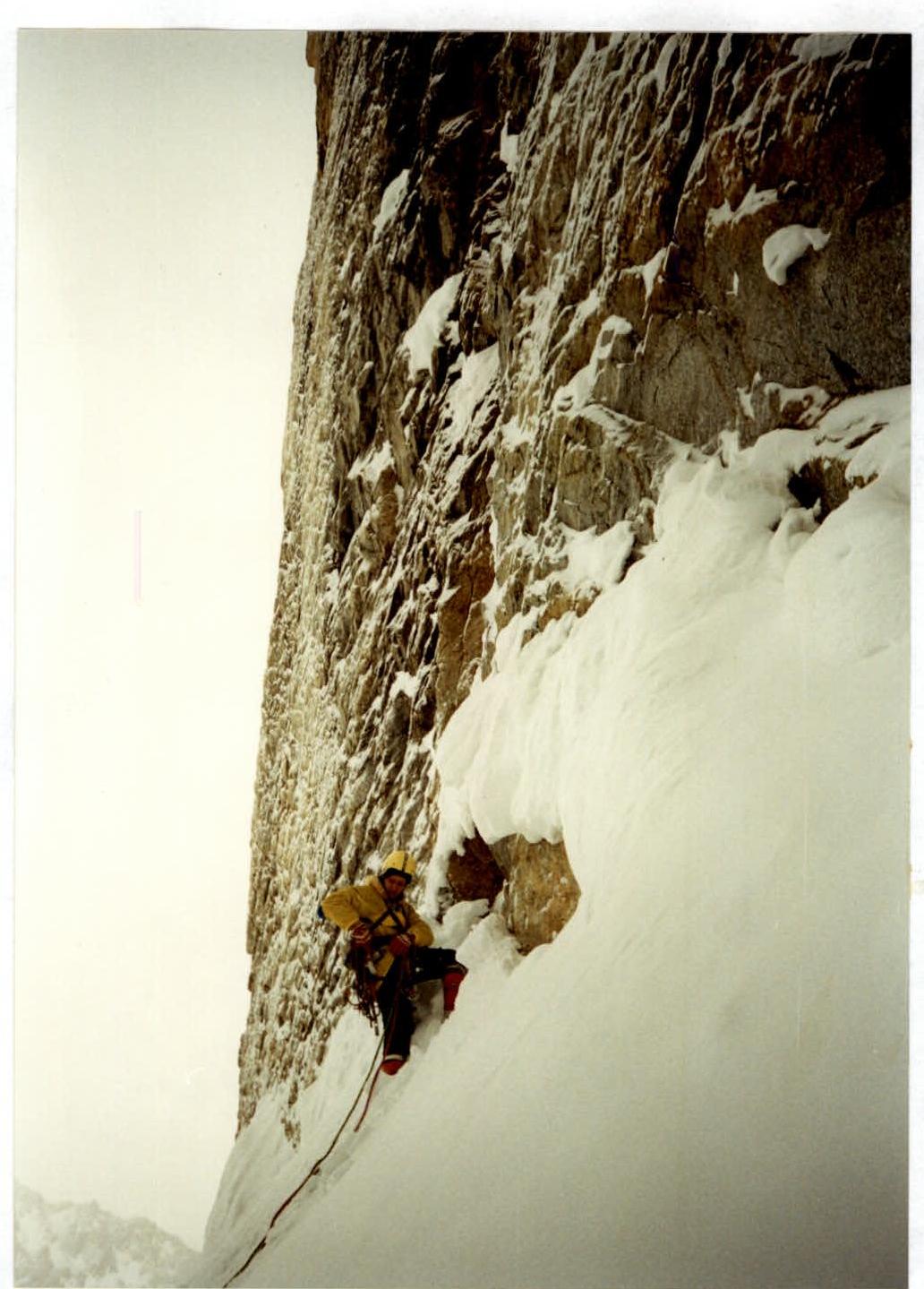
Approach to the route via Dzhailyk glacier to the not clearly defined inner corner on the right side of the base of the NE wall of Chegem. A narrow rantkluft, 40 m straight up very complex monolithic iced rocks of the not clearly defined inner corner (aid climbing) to a small triangular cornice, from which the ascent begins up a very complex overhanging crack with a cornice at the top. Further ascent under an overhanging chimney 30 m. After the chimney — a cornice, and then up very complex inner corners with cornices and iced inclined ledges straight up 180–200 m. Very difficult, tense climbing (aid climbing). No convenient belay points. Gets blown off. Then exit to small ledges. Live rocks. Possible sitting bivouac. From the ledges up very difficult blocky rocks 45–50 m under cornices, which are overcome head-on (aid climbing). From the cornices up very difficult iced rocks of the wall 80 m straight up to small ledges. Live rocks. Cairn. From the ledge up an overhanging inner corner turning into a chimney. Very complex climbing. Gets blown off. Aid climbing. 30 m. Then exit up snowy steep rocks 50–60 m to a small ledge of the shoulder below the first gendarme of the NE ridge. Possible bivouac. From the shoulder up narrow ledges with difficult short walls, traverse 150 m on the left side of the NE ridge. Then up a steep narrow ice couloir 50 m to the col between the first and second gendarmes. From the col, traverse 150 m along rocks and ledges of medium difficulty on the right side of the NE ridge and exit to the saddle of the third gendarme. From the saddle up rocks and ledges of medium difficulty and then up a not clearly defined rib to the main ice-snow not steep 450-meter NE ridge. Along the ridge to a small rock tower near the summit. Up rocks of medium difficulty of the tower 20–25 m to the summit of Chegem.
Descent along the western ridge 3A cat. diff. or along the eastern ridge 2B cat. diff. to Chegem glacier.
Team's Tactical Actions
The team's tactical actions were as follows: thorough reconnaissance of the snow cover condition in the upper part of the glacier, visual study of the ice-snow situation on the NE ridge and the condition of the wall section of the route. The tactical plan for the ascent was based on reconnaissance data. Visual study of the route using optics revealed its extremely complex condition. Inner corners, crevices, ledges, and even small holds were filled with ice, clogged with snow, and on many ledges, wind had formed small firn cornices. Sometimes small powder avalanches came off the ledges. From which it followed that the ascent required thorough preliminary processing. Reconnaissance was carried out with an approach under the route, setting up a base camp, and forwarding all necessary equipment. The team worked with the support of 5 auxiliary team members having 2nd and 1st class alpine categories. After forwarding and setting up the base camp, the team with the auxiliary team determined the interaction tactics and radio communication schedule.
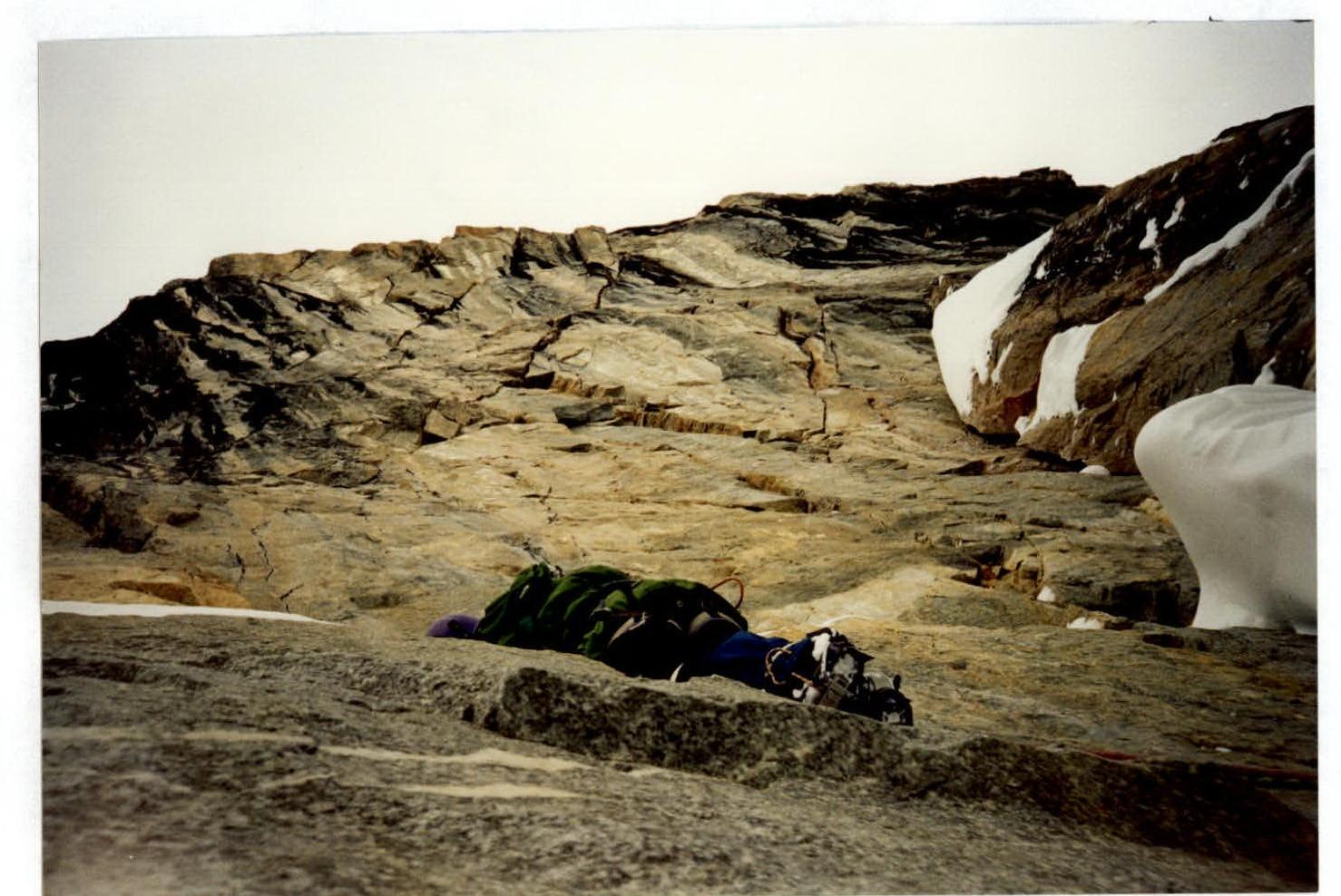
On February 22, using excellent weather, Belskikh began processing sections R0–R1. Zadohin provided belay. The ascent was made up a not clearly defined inner corner clogged with snow and filled with ice. Extremely complex climbing. Practically from the first meters, it was necessary to use the entire arsenal of rock climbing equipment and artificial climbing holds (aid climbing). Friends didn't work well. Used sky hooks, thin petal hooks, small stoppers. For belay, the first bolt was driven, which was used further from the equipment. At certain sections, crampons were worn, which were not removed further while working on the wall. On February 22, only a 40-meter section of the wall was covered.
On February 23, the Zaichikov — Zadohin team worked on sections R2–R3, about 50 m. Extremely complex climbing, an overhanging crack with a cornice, then turning into an inclined monolithic iced chimney. Work on aid climbing. From the crack, gets blown off. Used tactics of ascent on sky hooks, for belay, a bolt was driven. The section was covered with a change of lead in 6 hours. Constantly, powder avalanches come from above. Psychologically very tense.
On February 24, the weather worsened, it snowed lightly, but it was decided to work, especially since everything was ready for it. The Belskikh — Zaichikov team worked on sections R4–R5. The ascent was made up very complex monolithic iced rocks with cornices. Literally had to fight for every centimeter. Feet get very cold. If hands warm up while driving in the next bolt, then feet in crampons constantly freeze. Saved only by the proximity of the base camp, to which it was possible to rappel down quickly and come to one's senses. Nevertheless, on this day, we accidentally stumbled upon a control cairn in a piton, which was literally frozen into a small ledge and turned into a firn "mushroom". In the note, it was hard to make out that the route was passed by a group from Ukraine. Nevertheless, the note was heartening, as we are on the right track.
On February 25, the Zadohin — Belskikh team worked on processing sections R5–R7. Large-block monolithic rocks abounding with small cornices. Used the same equipment as on the first meters, but already felt somewhat easier. By the evening of February 25, a full 6 ropes were processed, and, descending to the base camp, we decided to go for it the next day, despite extremely complex climatic conditions — at night, the temperature dropped to -30 °C. The 2 imported cameras available were constantly malfunctioning. Gas burners worked ineffectively in such cold. Nevertheless, the decision was made — to pass the hung ropes, to pass the remaining section of the wall to the intended convenient place for an overnight stay approximately 3–4 ropes. The ropes of the hung section of the wall were left in case of a sudden retreat.
On February 26, we departed at 4:00. We took the bare minimum necessary to pass the remaining section. Very cold, movements were stiff. By 10:30, we finished passing the fixed ropes, and Belskikh began the ascent up blocky difficult and very difficult walls with small snowy ledges. It was not possible to take normal photos again. Imported equipment finally broke down. Also, we were left with only one flashlight. The only thing that was reliable as always — the old, proven "Shmel" primus stove. Worked at -25 °C as always excellent. The ascent was made using all available equipment and aid climbing. By 18:00, we managed to pass the next problematic section of the wall and exit at dusk to a small ledge, where it was possible to organize a normal bivouac. Still very cold, but the weather was favorable. Section R13.
On February 27, at 8:00, we departed from the bivouac and, bypassing the first triangular gendarme on the left, and then along the ledges on the right side of the second gendarme, through a couloir to the shoulder of the third gendarme, from it — to the main NE ice-snow ridge. Sections R15–R17, along which we reached a small rock obelisk near the summit. No particular difficulties were encountered during the ascent, except for some complexity in organizing belay. On some sections of R14, we organized fixed ropes. Further belay was carried out alternately. The weather was favorable, there was even a feeling of warmth. Reached the summit at 16:30, where a note from tourists from Saratov was found. By 19:00, we descended along a snowy couloir of the 3rd ridge to the SE onto the plateau of Chegem glacier, where we organized a bivouac.
On February 28, passing up the plateau of Chegem glacier, under the ice-snow dome of the shoulder of the peak Kickhidar, we ascended it 150 m. From the dome down to Donkin Pass, from which we descended to Dzhailyk glacier, where we were met by our auxiliary team. Such a descent was reconnoitered in advance, as the descent along the 3rd ridge from the summit of Chegem is much more complex, abounds with numerous gendarmes and dangerous cornices. We reached Dzhailyk glacier to the base camp by 18:00.
The team unanimously with the captain, coach, and auxiliary team believes that the safety measures for passing the route were:
- thorough reconnaissance of the route condition;
- high technical, physical, and psychological preparation of the team;
- tactical plan;
- excellent equipment;
- presence under the route of a qualified safety team having a coordinated interaction plan in case of an emergency.
Observation of the team was carried out using powerful binocular optics, communication was carried out via Motorola radios.
The team on the ascent had excellent high-calorie nutrition. Working on the wall, each team member had an individual ration, a thermos with hot drinks.
The team with the coach thanks for moral support Porokhnya Yuri Ivanovich and Zaitsev Kim Kirillovich.

Route in UIAA Symbols
Chegem NE wall. NE ridge. 6A cat. diff.
| Section | Length (m) | Steepness (°) | Difficulty |
|---|---|---|---|
| R1 | 40 | 70 | VI A2 |
| R2 | 45 | 85 | VI A2 |
| R3 | 35 | 80 | VI A2 |
| R4 | 30 | 85 | VI A2 |
| R5 | 35 | 90 | VI A2 |
| R6 | 25 | 85 | VI A2 |
| R7 | 25 | 80 | VI A1 |
| R8 | 35 | 75 | VI A1 |
| R9 | 35 | 75 | VI A1 |
| R10 | 35 | 75 | VI A1 |
| R11 | 25 | 80 | VI A2 |
| R12 | 20 | 70 | VI A1 |
| R13 | 160 | 65 | IV |
| R14 | 50 | 50 | III |
| R15 | 150 | 40 | III |
| R16 | 100 | 40 | III |
| R17 | 450 | 30 | II |
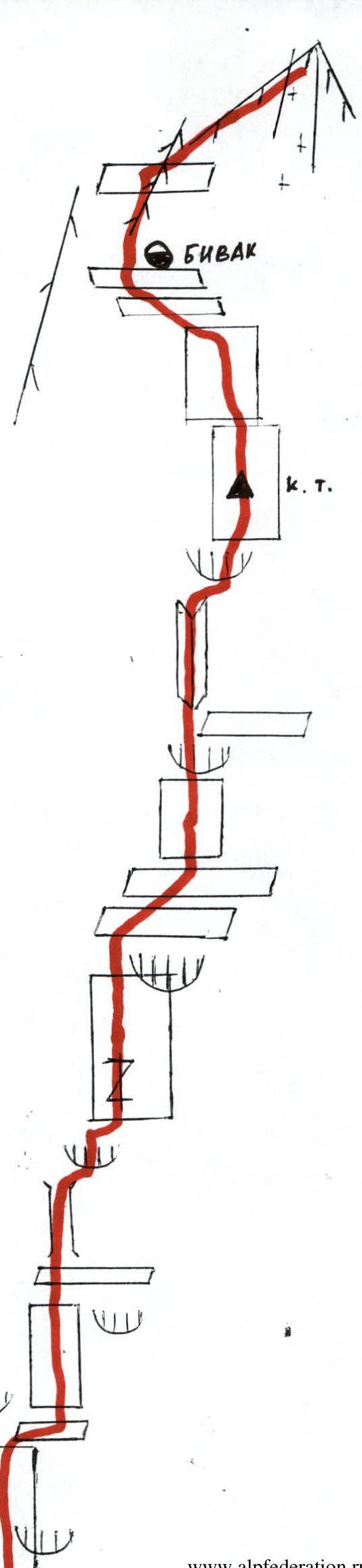
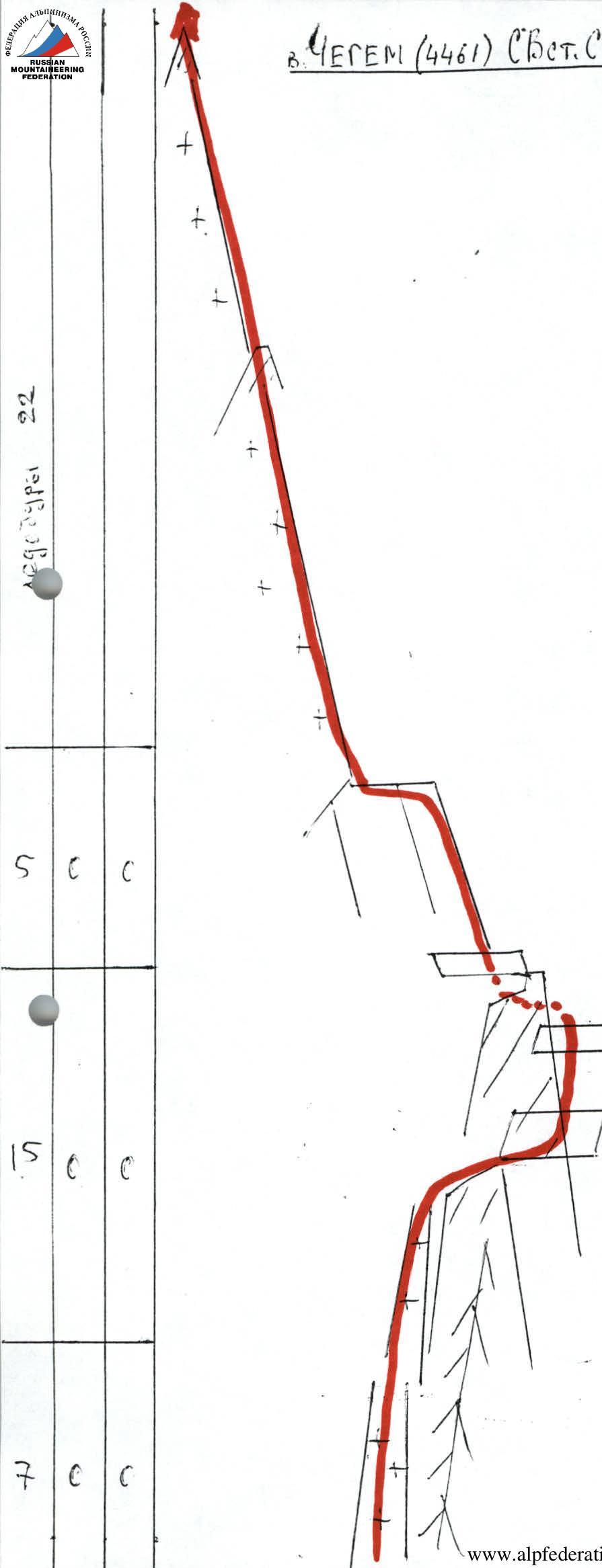
R0–R1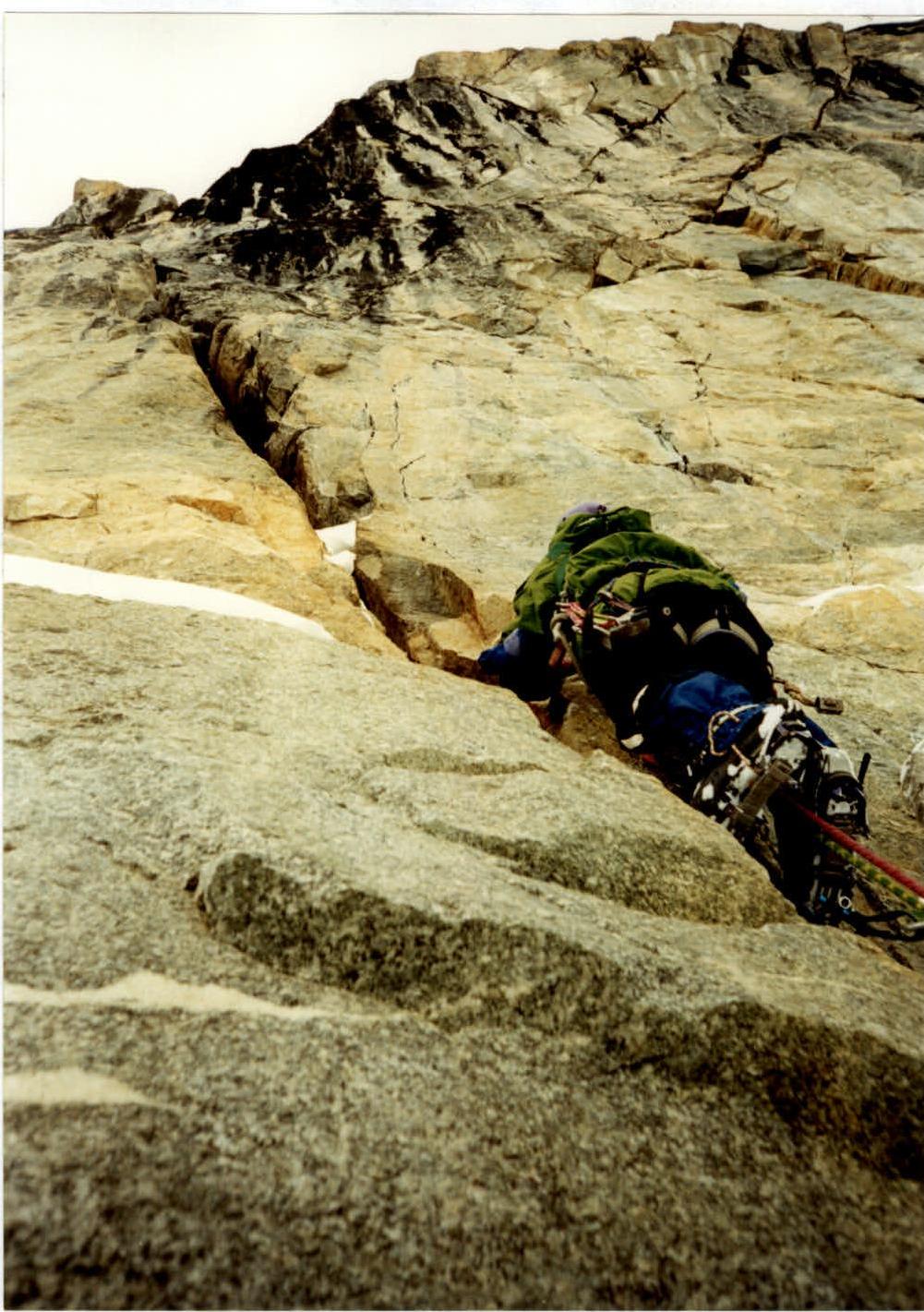
P. 2–3
www.alpfederation.ru↗