
REPORT
on the ascent to the summit
Vostochnaya Ullu-tau-chana
via the northern bastions of the shoulder
Category 5B difficulty
2. History of the massif exploration.
The exploration of the Ullu-tau-chana massif began in 1933, when A. Dzaparidze and G. Niguriiani ascended to the Main peak from the Lekzyr glacier off the Mestia pass via a Category 3B route, and to the Western peak from the Garvash pass via a Category 2B route. Before the war, both complete traverses of the massif were made, Category 4B:
- 1937 — L. Nadezhdin and V. Nazarov — from west to east,
- 1938 — A. Zolotarev, F. Kropf, V. Mauer, and V. Nesterov — from east to west;
and in 1946 — a first ascent via the "board" to the Western peak with a subsequent traverse of the massif to the east, Category 5A — D. Gudkov, M. Zvezdkin, M. Chertkov, G. Odnoblyudov.
In the 1950s, the assault on the northern walls began: 1951 — V. Abalakov, M. Anufrikov, A. Borovikov, N. Gusak, V. Kizel, V. Nagaev, L. Filimonov, V. Cherodova — Main peak "Central" via the northern wall, Category 5B.
1954 — E. Monucharov, E. Emelyanov, G. Kalepov, B. Sadovsky, G. Senachev, Yu. Chernoslivin — Eastern peak via the northern wall, Category 5B.
1956 — E. Emelyanov, N. Vinyukov, P. Dyakonov, A. Kikoin, D. Kuzminykh, V. Kindyakov, A. Rafayelyan, Z. Shakhov, A. Smorkalov, L. Sereskelidi — Eastern peak from the hut via the NE counterfort, Category 4B.
1959 — Yu. Chernoslivin, V. Ruzhevsky, G. Senachev, A. Chernyshov — Eastern peak via the ice slope and bastion of the shoulder, Category 5B.
Two first ascents were made in the 1960s:
- 1965, March — Yu. Chernoslivin, N. Margiani, Yu. Porokhnya, V. Ruzhevsky, E. Sokolovsky, M. Khergiani — ice slope with rocky outcrops between the Main and Eastern peaks, Category 5B.
- 1966, July — A. Naumov, Yu. Moiseev, M. Druy, Yu. Kozlov — Eastern peak via the Northern bastions of the shoulder, Category 5B.
And finally, in 1971, a group consisting of V. Maltsev, A. Bakulin, E. Zubov, Yu. Solovyov, M. Ovchinnikov, G. Yakovlev — ascended via the ice slope with rocky islands between the Main and Western peaks, Category 5B.
3. Brief description of the route.
This report is dedicated to the ascent to the Eastern peak of Ullu-tau-chana via the northern bastions of the shoulder, Category 5B, in July 1972. The first ascenders led by A. Naumov were the only group to have been on this route before us — they received 4th place in the 1966 USSR championship for this ascent. The almost purely rocky, kilometer-long route has an average steepness of 62° and contains about 400 meters of extremely difficult sections.
To the right and left of the route, there are paths prone to strong rockfalls, making detours impossible, but they do not affect the route.
The rocks of the upper bastions are monolithic and highly smoothed. The lower part of the wall is partially destroyed, and there are loose rocks on the monolithic upper part.
4. Route reconnaissance.
During the preparation for the 1972 season, the group thoroughly familiarized themselves with the report of the first ascender, A. Naumov, and planned reconnaissance during the approach and ascent to the Sarykol-bashi peak, Category 3B. However, bad weather and tight schedules due to being busy with instructor work at the "Dzhailyk" alpine camp made adjustments.
As a result, the reconnaissance consisted of:
- observing the route from the left bank of the Adyr-su river opposite the camp using a 40x telescope;
- observing from the Mestia bivouacs and from the Mestia hut using a 3x binoculars;
- observing and sketching the route from the bivouacs under it, where the group made a cache of equipment and supplies on July 4-5.
All this allowed them to thoroughly examine the entire route, especially its lower part, identify a section to cross the bergschrund, and develop a tactical ascent plan, which was fully executed.
5. Group composition.
The group set out on the ascent with the following members:
- MS Khatskevich I.G. — leader
- CMS Nikulin M.G.
- CMS Sobolev S.S.
- CMS Kuznetsov A.B.
- Volkov V.I. — 1st sports category
- Ryabov Yu.I. — 1st sports category
All participants are instructors at the "Dzhailyk" alpine camp, working there for many years, knowing each other for a long time, and having experience in joint ascents.
In the 1972 season, they all worked a shift at the camp, were well-acclimatized, physically and technically well-prepared, and had a joint ascent to the Cheget-tau-chana peak, Category 3A.
6. Ascent diary.
The group left the camp on July 15 at 10:00. Passing the Mestia bivouacs, they crossed to the left (orographic) bank of the Adyr-su river along the edge of the glacier tongue. Up the moraine ridge, bypassing the glacier tongue, they ascended via a snowy couloir with a rocky belt in the upper part to the snowy plateau of the cirque. To the right, before the cirque, on the scree, there were rocky outcrops — a bivouac. From the camp — 4 hours.
On July 16, at 4:00, the first pair set out on the route, and 20 minutes later, the rest followed after packing the tent. The weather was good all day, but it was cool due to the clouds and the northern exposure of the slope.
The path initially went across the closed glacier, then ascended a snowy slope, crossed the bergschrund via a "plug," and ascended ice with pitons under the rocks. They traversed 10 meters to the most convenient exit to the rocks and ascended. The steepness and difficulty continuously increased. Vertical ascents alternated with inclined sections, sometimes simply ledges, leading to the right and eventually to a couloir with falling rocks. Going further to the right was not possible.
From here, a very difficult path went straight up the wall, bypassing a characteristic "tooth" on the left, and then up a nearly sheer, smoothed wall with few handholds. 80 meters of very difficult climbing, and the rocks became somewhat easier. The 1st bastion was passed, but there was no place for a tent, only individual ledges for 1-2 people (point R9).
After searching for a path and consultations, they decided to ascend to the 2nd bastion without backpacks. First, they went left-upwards to the ridge, then exited with a small descent to a steep ice slope under almost overhanging rocks and made a long ascent left-upwards along the rocks, cutting steps. Pitons were alternately driven into ice and rock. Then, a sheer, sometimes very difficult couloir with many loose rocks led to the top of the 2nd bastion (point R14).
They spent 2 hours making a tent platform on an almost horizontal snowy ridge; one person started cutting, then two. The others pulled up the backpacks along the sheer 80-meter wall, to the right of the path taken, directly from point R9. The last person ascended via a rope to retrieve the backpacks. By 20:00, everyone was at the bivouac.
On July 17, at 8:00, they began the ascent to the 3rd bastion. The smoothed rocks were initially very difficult, then became somewhat easier and transitioned into a relatively simple ridge, abutting a wall of the 4th bastion. To the right, there was a snowy-icy slope with a small steep crest.
The weather, which was decent in the morning, completely deteriorated by the end of the day. Simultaneously with processing the wall, they started cutting the crest. Since, after cutting the ice and reaching the rocks, they still hadn't achieved a wide enough platform, they had to build it up from below with large, about 0.5 meters, snow blocks.
Three of them made the platform in 3 hours; they set up the tent as sleet began. They fixed 50 meters of rope to ascend to the 4th bastion. By 14:00, everyone was in the tent; it was snowing heavily.
On July 18, the weather gradually improved from morning. From 6:00, they began ascending via the fixed ropes on abaals and further processing the wall.
The approach to the wall was via destroyed rocks to the left of a huge rock standing before it; they ascended via an internal angle and then up the wall with a crack going left-upwards, for 40 meters. Since the rope went zigzag, they had to extend the first 40-meter rope.
Further, they had to move to the right: across a smooth slab (3 piton hooks) and a snowy-icy slope. Via a chimney filled with ice, they exited to a counterfort and along it to the ridge of the 4th bastion (point R24).
The route turned to the right, but to lift the backpacks, four had to go left, first along the ridge, then to the right of it via a ledge. From the bivouac, they pulled the backpacks up 100 meters onto this ledge and ascended.
The path along the ridge was not difficult, with bypasses to the right. Then, they crossed a couloir and ascended via simple but very destroyed rocks to a steep snowy crest — the bivouac site. They again spent about 3 hours cutting and preparing the platform.
The next day, it became clear that from this site to the wide, flat saddle under the "ogurtsy" was only 1-1.5 hours away. The tent was set up by 20:00.
July 8 — the weather was excellent, but it was very cold at high altitude among the snow in the morning. The group set out around 8:00; they ascended via simple, strongly destroyed rocks to the left-upwards to the saddle in the Ullu-tau ridge. Without backpacks, they ascended to the peak via a Category 3B route.
Returning to the backpacks, they began the descent from the saddle to the south via a snowy couloir (in August, it's icy). Before reaching the end of the couloir, they exited left onto the scree and descended to the glacier.
The path to the Mestia pass went with a slight ascent.
By 19:00, the group was back at the "Dzhailyk" camp.
8. Overall assessment of the participants' actions.
The participants of the ascent are instructors at the "Dzhailyk" alpine camp, working there for many years, knowing each other for a long time, and having experience in joint ascents both in previous seasons and in 1972.
All participants actively worked both during the preparatory period and during the entire ascent. The group acted clearly and cohesively on the route. Practically everyone got to work at the front, which they all constantly strived for.
All participants demonstrated good physical, technical, and moral preparation and successfully completed the route.
TABLE
MAIN CHARACTERISTICS OF THE ASCENT ROUTE
Ascent route: Vostochnaya Ullu-tau-chana via the northern bastions of the shoulder Height difference of the route: 950 m Including the most difficult sections: 400 m Steepness: 62°

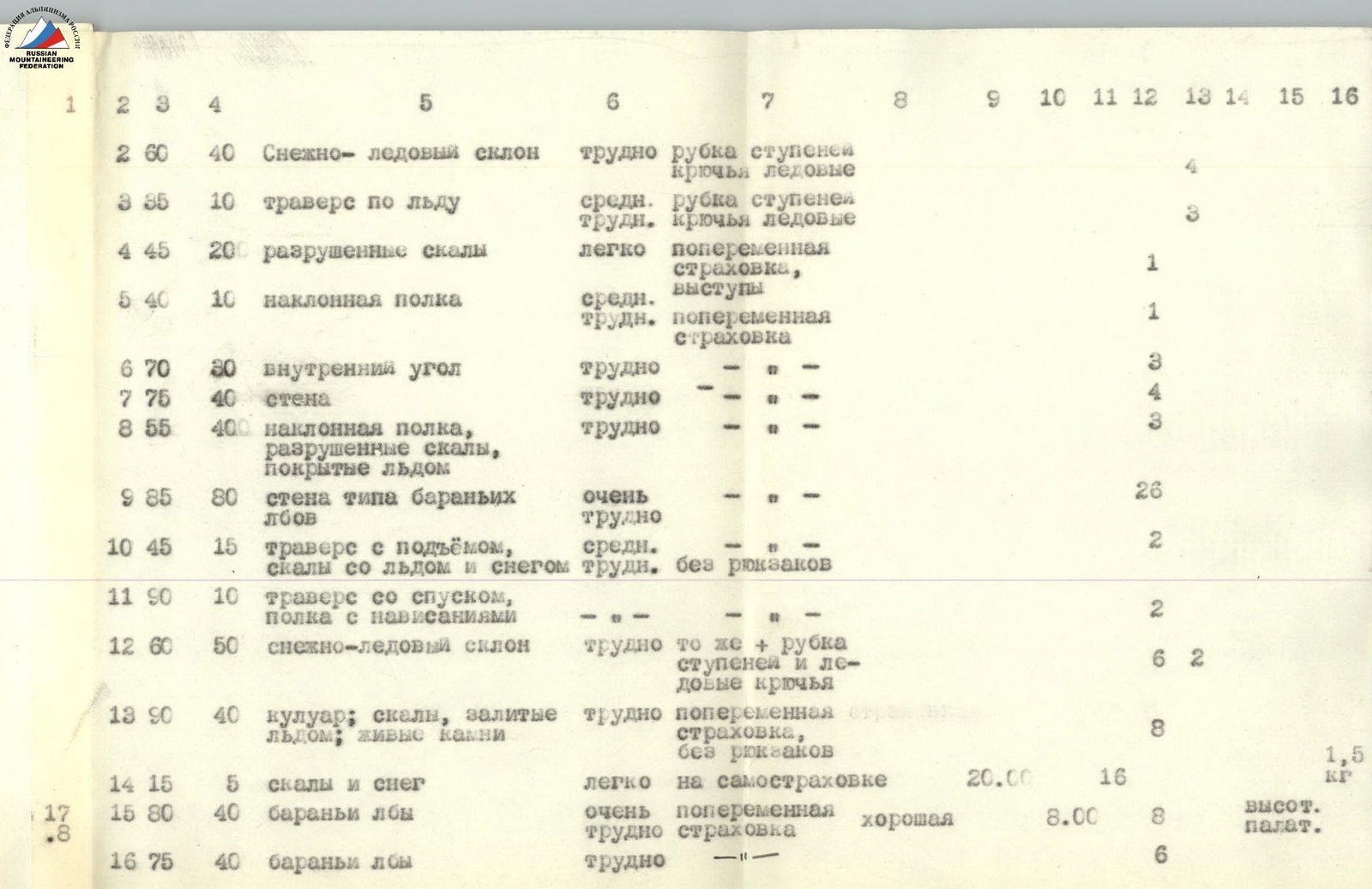
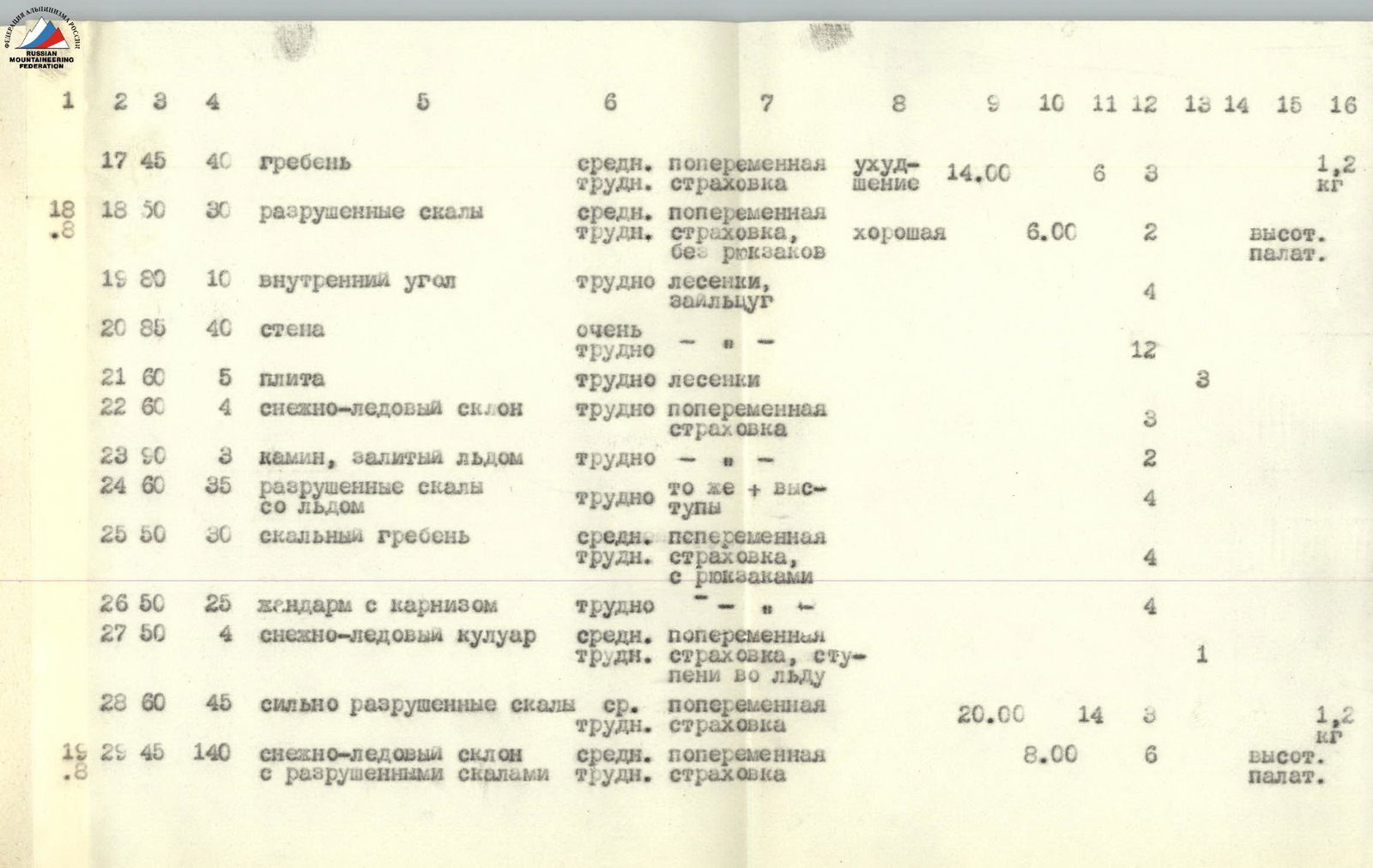
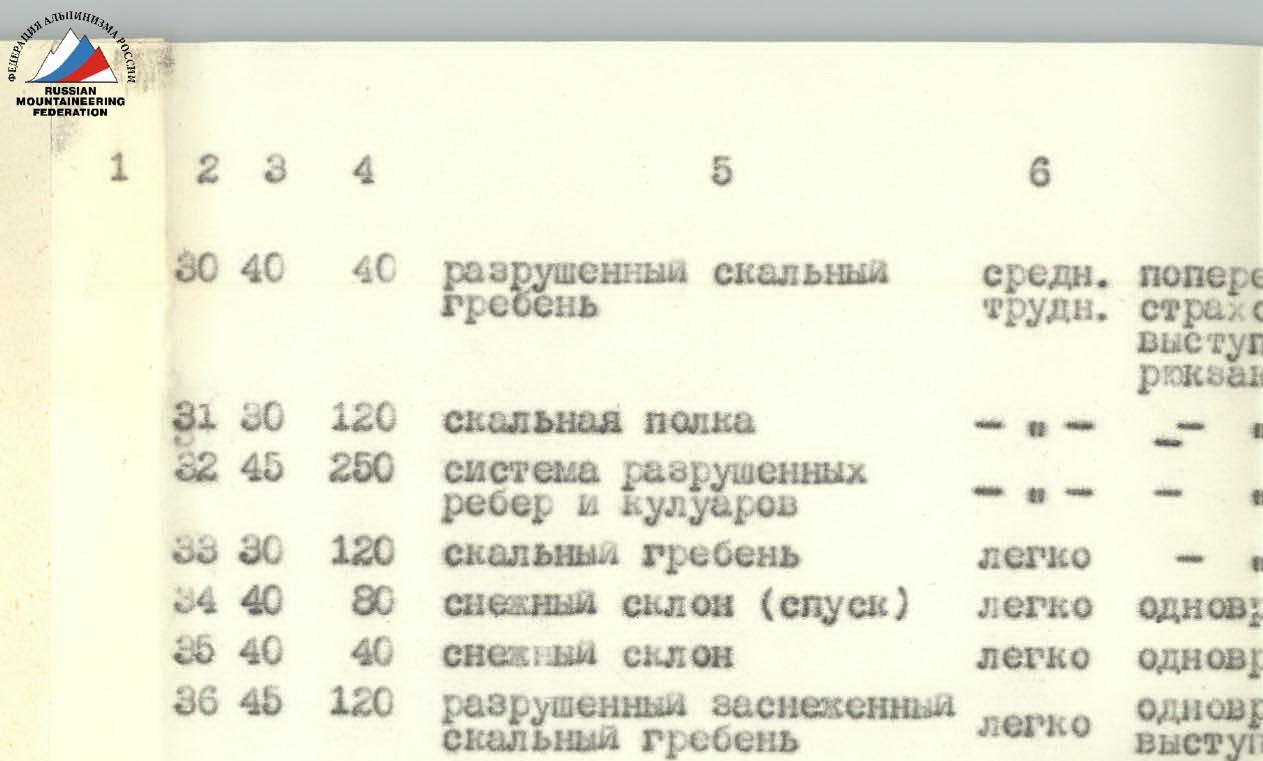
| Date | R | L | H | Characteristics of sections | By technical difficulty | By method of overcoming and insurance | By weather conditions | Situation at bivouacs | Time of exit | Climbing hours | Rock | Ice | Piton | Conditions of overnight stay | Weight of daily ration |
|---|---|---|---|---|---|---|---|---|---|---|---|---|---|---|---|
| July 16 | R1 | 20 | 300 | Closed glacier | easy | links, with step cutting | good | 4:00 | High-altitude tent | ||||||
| R2 | 60 | 40 | Snowy-icy slope | hard | step cutting, ice pitons | 4 | |||||||||
| R3 | 35 | 10 | Traverse on ice | medium difficulty | step cutting, ice pitons | 3 | |||||||||
| R4 | 45 | 200 | Destroyed rocks | easy | alternate insurance, ledges | 1 | |||||||||
| R5 | 40 | 10 | Inclined ledge | medium difficulty | alternate insurance | 1 | |||||||||
| R6 | 70 | 30 | Internal angle | hard | --- | 3 | |||||||||
| R7 | 75 | 40 | Wall | hard | --- | 4 | |||||||||
| R8 | 55 | 400 | Inclined ledge, destroyed rocks covered with ice | hard | --- | 3 | |||||||||
| R9 | 85 | 80 | Wall like "baran'i lby" | very hard | --- | 26 | |||||||||
| R10 | 45 | 15 | Traverse with ascent, rocks with ice and snow | medium difficulty | without backpacks | 2 | |||||||||
| R11 | 90 | 10 | Traverse with descent, ledge with overhangs | --- | --- | 2 | |||||||||
| R12 | 60 | 50 | Snowy-icy slope | hard | same + step cutting and ice pitons | 6 | 2 | ||||||||
| R13 | 90 | 40 | Couloir; rocks filled with ice; loose rocks | hard | alternate insurance, without backpacks | 8 | |||||||||
| R14 | 15 | 5 | Rocks and snow | easy | on self-insurance | 20:00 | 16 | 1.5 kg | |||||||
| July 17 | R15 | 80 | 40 | "Baran'i lby" | very hard | alternate insurance | good | High-altitude tent | 8:00 | 8 | |||||
| R16 | 75 | 40 | "Baran'i lby" | hard | --- | 6 | |||||||||
| R17 | 45 | 40 | Ridge | medium difficulty | alternate insurance | deterioration | 14:00 | 6 | 3 | 1.2 kg | |||||
| July 18 | R18 | 50 | 30 | Destroyed rocks | medium difficulty | insurance, without backpacks | good | High-altitude tent | 6:00 | 2 | |||||
| R19 | 80 | 10 | Internal angle | hard | ladders, zaiceug | 4 | |||||||||
| R20 | 85 | 40 | Wall | very hard | --- | 12 | |||||||||
| R21 | 60 | 5 | Slab | hard | ladders | 3 | |||||||||
| R22 | 60 | 4 | Snowy-icy slope | hard | alternate insurance | 3 | |||||||||
| R23 | 90 | 3 | Chimney filled with ice | hard | --- | 2 | |||||||||
| R24 | 60 | 35 | Destroyed rocks with ice | hard | same + height stops | 4 | |||||||||
| R25 | 50 | 30 | Rocky ridge | medium difficulty | alternate insurance, with backpacks | 4 | |||||||||
| R26 | 50 | 25 | Gendarme with a cornice | hard | --- | 4 | |||||||||
| R27 | 50 | 4 | Snowy-icy couloir | medium difficulty | alternate insurance, steps in ice | 1 | |||||||||
| R28 | 60 | 45 | Strongly destroyed rocks | medium difficulty | alternate insurance | 20:00 | 14 | 3 | 1.2 kg | ||||||
| July 19 | R29 | 45 | 140 | Snowy-icy slope with destroyed rocks | medium difficulty | alternate insurance | High-altitude tent | 8:00 | 6 | ||||||
| R30 | 40 | 40 | Destroyed rocky ridge | medium difficulty | alternate insurance, ledges; without backpacks | 3 | |||||||||
| R31 | 30 | 120 | Rocky ledge | -"- | -"- | 12 | |||||||||
| R32 | 45 | 250 | System of destroyed ridges and couloirs | -"- | -"- | ||||||||||
| R33 | 30 | 120 | Rocky ridge | easy | -"- | ||||||||||
| R34 | 40 | 80 | Snowy slope (descent) | easy | simultaneously | ||||||||||
| R35 | 40 | 40 | Snowy slope | easy | simultaneously | ||||||||||
| R36 | 45 | 120 | Destroyed snowy rocky ridge | easy | simultaneously, ledges | 11 | 1 kg |
Note to item 7: Where not specifically stated otherwise, the route was traversed by free climbing with piton insurance.