
Ascent Passport
1. Ascent category — technical
2. Region — Western Caucasus
3. Route — Bolshoy Nakhara via 6B category route, 3780 m.
4. Characteristics of the ascent: height difference — 1080 m.
- Average steepness: 81°
- Length of complex section: 760 m.
5. Pitons hammered: rock
- 315
- Ice: 0
- Bolts: 19
6. Number of travel hours
- 60
7. Number of nights
- 5 (semi-reclining)
8. Team name — "Dombay" alpine camp team
9. Team members:
- Yakovlev Vladimir Semyonovich — Candidate Master of Sports — team leader
- Pomazuev Vladimir Vasilyevich — Candidate Master of Sports — participant
- Savchuk Valery Arkadevich — Candidate Master of Sports — participant
- Kuzmuk Valery Ivanovich — Candidate Master of Sports — participant
- Bodnik Vitaly Nikolayevich — Candidate Master of Sports — participant
- Evseev Yuri Ivanovich — Candidate Master of Sports — participant
10. Coach
- Master of Sports of the USSR, Honored Coach of the Ukrainian SSR
- Ovcharov Vitaly Vasilyevich
11. The team started the route on August 5, 1976.
- Returned: August 10, 1976. The Khariniyak group observed the assault six until August 8. Then they were replaced by a group of instructors from the "Dombay" alpine camp consisting of:
| 1. Nikolaev V. | – | 1st category | – | leader |
|---|---|---|---|---|
| 2. Zharkova A. | – | Master of Sports of the USSR | – | participant |
| 3. Vitsev V. | – | 1st category | – | -"- |
| 4. Rybak B. | – | 1st category | – | -"- |
| 5. Efremov A. | – | Candidate Master of Sports | – | -"- |
This group repeated the 5B category route before them. Both interaction groups:
- visually observed the assault group,
- maintained radio contact with them via "Vitalka",
- maintained radio contact with the "Dombay" alpine camp via "Nedra".
The communication was well established.
6. Route progression.
First day — August 5. At 7:00, the pair Bodnik — Yakovlev starts processing the route and at 7:40 approaches the base of the wall.
Under the wall, a huge bergschrund with a small bridge opened up. When approaching the bridge, it collapsed. Yakovlev hacked through the bergschrund on its right side and, under the cover of steep rock formations, crossed the snowfield, reached the wall, and moved 80 m along the base of the wall, secured the rope, and sent Bodnik forward.
Along the boundary between snow and rocks, Bodnik approached the overhanging part of the wall. Here, ladders and all the skill of a candidate master of sports in rock climbing were required. After the overhanging part, a convenient small couloir went to the left, but it was filled with water and rocks. They had to go straight up to a narrow internal corner, which ended in an overhang. Behind it, on a small foothold, they could rest and secure the second eighty-meter rope (section 1–2).
Then the route went along a vaguely expressed counterfort and an internal corner to a narrow (up to 60 cm) shelf with snow (section 2–3). Here, the pair took a snack and started descending down double ropes at 17:00. After adjusting the ropes and regulating their direction, the pair returned to the base camp at 18:00.
After that:
- Voices died down early
- The camp fell asleep
In the morning — a general departure.
Second day — August 6. At 6:00, the first pair of the group, consisting of Kuzmuk — Pomazuev, started on the route. After 30 minutes, the second and third pairs followed. Everyone carried backpacks and pull-up bags with food and equipment.
The first pair, taking spare ropes and pitons, began to ascend along the hung ropes.
The group of four organized the hauling of cargo to the shelf at the end of section 3.
Having passed the first bivouac, the first ascenders, Kuzmuk — Pomazuev, continued processing the route. The path went along a smoothed wall for 40 m to a small outcrop (section 3–4). Here, behind the outcrop, they could stand safely, sheltered from splashes. From the outcrop, they moved right-up along the wall with a small number of holds (using ladders) to the second outcrop (section 4–5). From the second outcrop — up to the internal corner, 30 m. The wall inclination was 90°, and at the point of exit to the internal corner, it overhung. Here, two bolted pitons were hammered by the first ascenders. Having hung ladders on them and hammered another piton, Kuzmuk entered under the waterfall and within a few seconds, his clothing became completely wet. It was impossible to climb the internal corner, so he moved to the right onto the overhanging part of the wall. Section 5–6 was traversed with very complex climbing.
The overhanging part (20 m) ended on a small shelf and an entrance to a huge chimney formed by the wall and an outcrop. Climbing on the outside of the outcrop was dangerous (rocks!), so Kuzmuk entered the chimney and, under the waterfall, using opposition climbing, ascended (section 6–7). In the upper part, the chimney narrowed. Having reached the outcrop, Kuzmuk secured double ropes and received Pomazuev.
To the right of the route and over the pair's heads, rocks and small ice fragments frequently flew. It was already afternoon, and the snow on the summit was melting intensively, flowing down the wall in huge waterfalls. From the outcrop, there was an overhanging section of 3 m, and further flattening was visible. After consulting, the pair decided to descend and pass section 7–8 early in the morning.
During the work of the first pair, the group of four lifted cargo to the site of the first bivouac on the wall and organized a bivouac. The descending pair was sent to the base camp to dry off, as the sun did not illuminate the wall at all. At 20:00, the pair descended to the base, and Yakovlev, Savchuk, Bodnik, and Evseev settled on the shelf for the night. The night was semi-reclining, in a tent. Their legs hung over the wall.
Third day — August 7
- At 6:00, the pair Kuzmuk — Pomazuev left the base camp and approached the start of the route in the dark. The weather was bad, with drizzle and fog.
- At 6:00, the pair Yakovlev — Bodnik started further route processing.
- The pair Savchuk — Evseev set up further cargo lifting.
After 3 hours, the first pair reached the upper part of the outcrop and began further route processing. The weather was bad, with light rain. Bodnik, having passed the overhanging part, reached inclined slabs covered with water. In the morning, the flow was less. Approaching the bivouac site (section 7–8) of Korablin, the pair found a control cairn. The site was covered with snow, which had already frozen.
From the site, they moved left-up along the slabs to a narrow inclined shelf. Here, the shelf ended in an overhang and broke off into a sheer drop, visible from below. The overhanging part was covered with moss and consisted of destroyed rocks. This section required great skill from Bodnik. Using the highest technique of rock climbing, he passed the section (9–10), consisting of live slabs and sheer walls.
Further, the path went along:
- inclined smooth slabs,
- alternating with sheer sections.
Having passed section 10–11, Yakovlev approached the site before the key section of the route. Not finding the bolts hammered by Korablin's group, Bodnik moved left-up for 40 m (section 11–12), using extremely complex climbing, and approached a narrow inclined shelf. The shelf on the right side approached the crest of a vertical outer corner.
At 17:00, the pair started descending. Before that, the group of four had lifted cargo to the shelf on section 7–8.
At 19:00:
- Everyone gathered at the previous bivouac site,
- Had a quick dinner,
- Settled in a sitting position, with their backs against the wall.
Water drummed against the tent.
Fourth day — August 8.
At 6:00, the first rope team started ascending along the hung ropes. At 10:30, Kuzmuk began to traverse the 40-meter key section. The weather was bad, with fog.
The pair decided to check what was to the right of the comb. Having hammered a bolt, Bodnik moved along the shelf on friction to the comb of the outer corner and exclaimed with joy. There it was, a bolt trail!
- Bolts were hammered every 2 m.
- With a height of 185 cm, he could barely reach the next bolt and hung a ladder.
- Standing on it, he rose and said that the next bolt was 3.5 m away.
- The rocks were wet, and the climbing boots held poorly.
- He hammered two of his own bolts.
Thus, they traversed these 120 m (section 11–12). It was no coincidence that only 32 bolt pitons were hammered on this entire sheer section!!!
Having passed this most complex section and another 20 m, the pair set up a bivouac at 19:00 and spent the night in a tarp. This decision was made because the upper part of section 11–12 was destroyed, and rocks could have fallen directly onto the tent where the group of four was spending the night.
Fifth day — August 9.
At 7:00, the group started lifting backpacks and remaining food bags. The weather was bad, with rain.
During the lifting of three bags and backpacks:
- three people ascended on jumar to the shelf at the end of section 11–12,
- the pair moved on to further route processing.
The route went along an internal corner, ending in a wall with live slabs (section 12–13). Having passed the wall (5 m) on the right, the first ascender reached a small site.
Section 12–13 was very destroyed and required great attention and care during passage.
Having passed section 13–14, the first rope team decided to set up a bivouac here. The weather had finally deteriorated: rain mixed with hail.
Having pulled up the pull-up bags and backpacks to the shelf, the group set up a bivouac at 20:00, storing extra ropes in a backpack. The night was again spent sitting, in a tent under a heavy downpour.
Sixth day — August 10, 1976.
In the morning, it cooled down, and snow began to fall. At 7:00, the first rope team started on the route. At 8:00, a backpack with extra ropes was thrown down. The route went along smoothed walls to a vaguely expressed ridge (section 15–16). Along the destroyed walls of the ridge to a clearly expressed ridge (section 15–16) and along it (section 16–17), the group reached the summit at 11:30.
They began descending from the summit at 12:00 and returned to the base camp at 17:30.
| Date | Sections | Steepness of sections | Length | Character of relief | Category | Method of overcoming | Weather | Departure time | Stop time | Travel hours | Rock pitons | Ice pitons | Bolt pitons | Bivouac conditions |
|---|---|---|---|---|---|---|---|---|---|---|---|---|---|---|
| 05.08.1976 | 0–1 | 50° | 100 m | snow, firn | 4Б | stepping, piton belay | clear | 8:00 | 13 | in base | ||||
| 1–2 | 85° | 80 m | wet slabs | 5Б | with ladders | 30 | ||||||||
| 2–3 | 90° | 40 m | wet wall | 6 | very complex climbing, double rope belay | 18:00 | 10 | 24 | 2 | |||||
| 06.08.1976 | 2–3 | 90° | 40 m | wet wall | 6 | alternating free climbing with artificial aids | clear | 7:00 | 18 | 1 | two in base, four on shelf | |||
| 3–4 | 90° | 80 m | smoothed wall | 6 | -"- | 39 | 1 | |||||||
| 4–5 | 90° | 80 m | -"- | 6 | -"- | 42 |
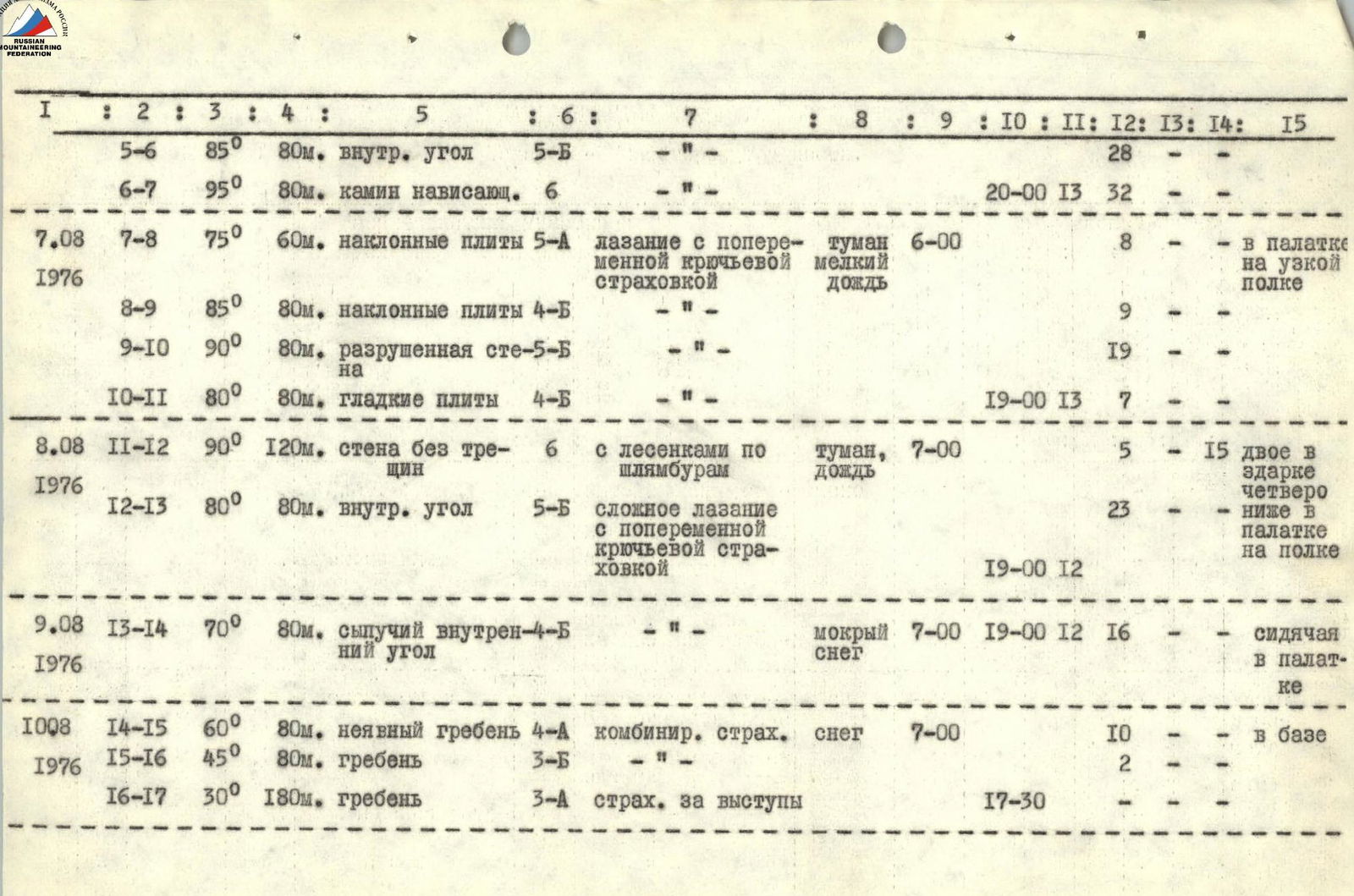
| Date | Sections | Steepness of sections | Length | Character of relief | Category | Method of overcoming | Weather | Departure time | Stop time | Travel hours | Rock pitons | Ice pitons | Bolt pitons | Bivouac conditions |
|---|---|---|---|---|---|---|---|---|---|---|---|---|---|---|
| 5–6 | 85° | 80 m | internal corner | 5Б | -"- | 28 | ||||||||
| 6–7 | 95° | 80 m | overhanging chimney | 6 | -"- | 20:00 | 13 | 32 | ||||||
| 07.08.1976 | 7–8 | 75° | 60 m | inclined slabs | 5А | climbing with alternating piton belay | fog, light rain | 6:00 | 8 | in tent on narrow shelf | ||||
| 8–9 | 85° | 80 m | inclined slabs | 4Б | -"- | 9 | ||||||||
| 9–10 | 90° | 80 m | destroyed wall | 5Б | -"- | 19 | ||||||||
| 10–11 | 80° | 80 m | smooth slabs | 4Б | -"- | 19:00 | 13 | 7 | ||||||
| 08.08.1976 | 11–12 | 90° | 120 m | wall without cracks | 6 | with ladders on bolts | fog, rain | 7:00 | 5 | 15 | two in tarp, four below in tent on shelf | |||
| 12–13 | 80° | 80 m | internal corner | 5Б | complex climbing with alternating piton belay | 19:00 | 12 | 23 | ||||||
| 09.08.1976 | 13–14 | 70° | 80 m | loose internal corner | 4Б | -"- | wet snow | 7:00 | 19:00 | 12 | 16 | sitting in tent | ||
| 10.08.1976 | 14–15 | 60° | 80 m | unexpressed ridge | 4А | combined belay | snow | 7:00 | 10 | in base | ||||
| 15–16 | 45° | 80 m | ridge | 3Б | -"- | 2 | ||||||||
| 16–17 | 30° | 180 m | ridge | 3А | belay on ledges | 17:30 |

Comments
Sign in to leave a comment