
PASSPORT
Ascent to the summit of Bolshaya Nakhara, completed as part of the USSR Alpine Climbing Championship 1974.
Climbing category — Technically challenging Region — Nakhara Valley Route — v. Bolshaya Nakhara via the northwest wall
Characteristics of the ascent:
Height difference — 1000 m Average slope — 80° Length of complex sections — 745 m Total length — 1335 m
Pitons used:
Ice — 0 Rock — 377 Bolts — 46 Old pitons reused — 0 Total climbing hours — 98 Number of bivouacs — 6
Team from "Uzunkol" Alpine Camp:
- KORABLIN — Master of Sports; team leader
- GRUBRIN — Candidate for Master of Sports; deputy leader
- SHOPIN — Candidate for Master of Sports; team member
- SNETKOV — Candidate for Master of Sports; team member
- KRYUKOV — Candidate for Master of Sports; team member
- SURZHIK — Candidate for Master of Sports; team member
The ascent took place from August 4 to August 11, 1974.
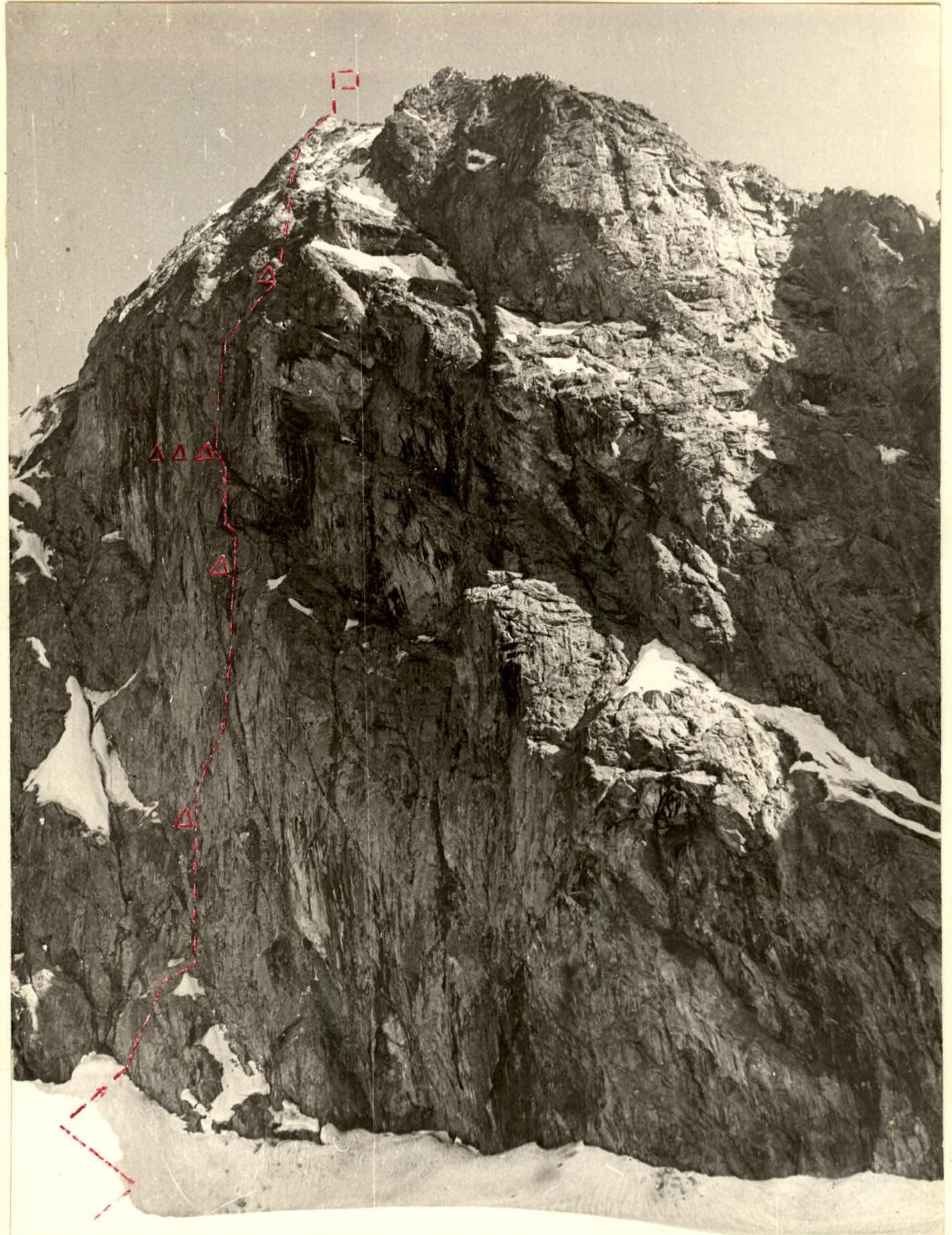
Route of ascent to the summit of Bolshaya Nakhara (3780 m) via the northwest wall.
 "...from the Nakhara valley, only the summit of B. Nakhara is visible".
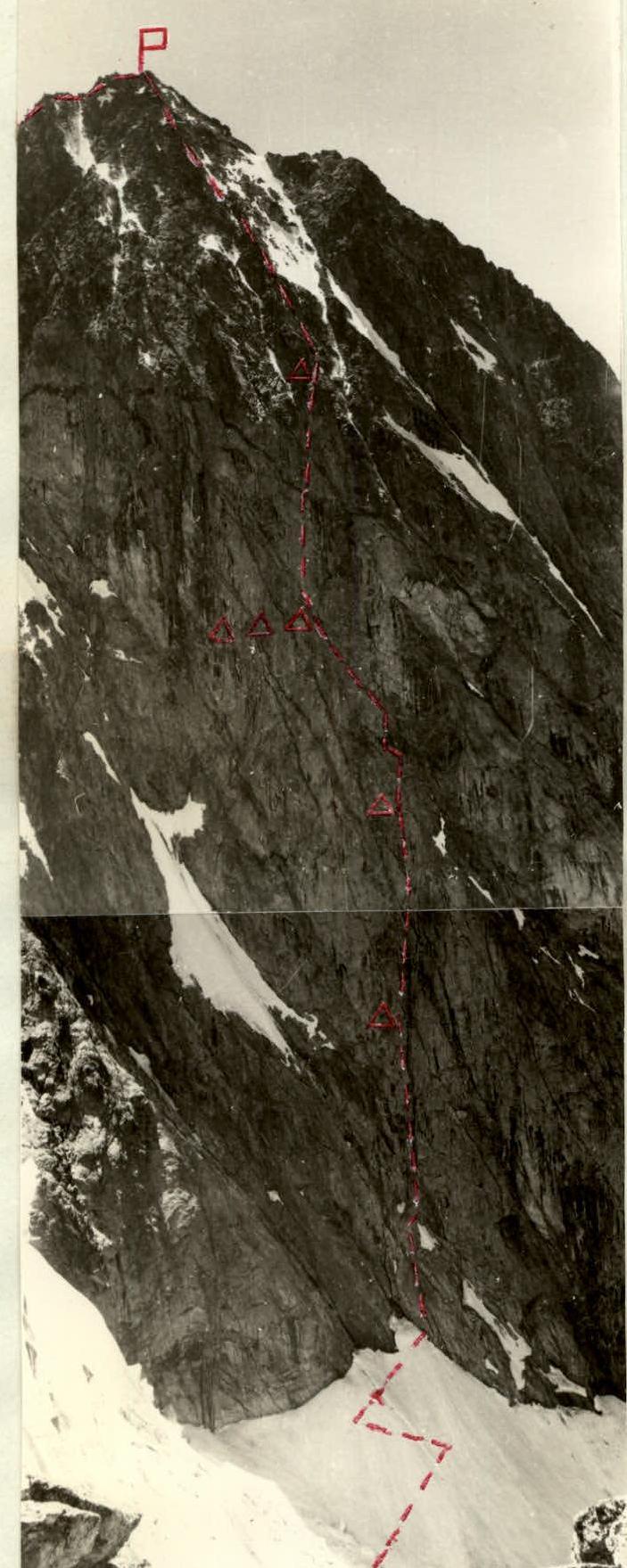
Route of ascent to the summit of Bolshaya Nakhara (3780 m) via the northwest wall.
VI. Route Description
August 2, 1974
Early rise, quick breakfast, and the team, observers, and camp participants involved in transporting supplies and equipment under Nakhara, accompanied by good wishes from those staying behind, leave the "Uzunkol" Alpine Camp for the Nakhara valley.
After several hours of a tiring car ride along mountain roads, we unloaded in this picturesque valley. Quickly sorting the pre-weighed kilograms of cargo, we headed up towards the Nakhara walls.
The ascent to the moraine, located opposite the wall, under the scorching sun, was no less tiring than the bumpy car ride.
But now everything is behind us. A brief farewell to the guys who helped us a lot, and 8 people remain on the moraine before the majestic wall of B. Nakhara: two observers and 6 team members.
After a short rest and snack, we set about preparing the tent sites and kitchen.
Tired, we went to bed early.
August 3, 1974. Rise — and straight to work. Two people are busy in the "kitchen," and Yevgeny Snetkov is secluded in his tent, preparing his camera for shooting.
After breakfast, three of us set out:
- to photograph the wall;
- to check the approaches to it from the bivouac site.
The observers are busy, stretching the antenna and establishing communication with the camp in the Dombay region.
Kostya Grubrin armed himself with binoculars and examines the route once again.
The observations are discouraging: the lower part of the wall receives almost no sunlight throughout the day, except for an hour and a half in the evening; the rest of the wall is lit for only 1-1.5 hours early in the morning; a significant part of the route is drenched by water dripping from the overhanging cornices. But the route is absolutely free of rockfall hazards.
The "photographers" return — lunch and an early bedtime: tomorrow is a working day.
August 4, 1974
At 6:00, the Korablin–Grubrin rope team sets out to process the wall. Today's task is to process a 200-meter section of the wall towards a small snow patch.
Through snow and firn, and in some places, via steps cut into the ice, the first rope team approached the bergschrund (section R0–R1).
The first serious obstacle, after the pair reached the narrowest part of the gap, was the transition from snow to rock.
Immediately from the snow patch, a 400-meter wall rises, rich in:
- cornices;
- overhangs;
- simply smoothed, convex foreheads.
Having overcome the gap, they began the ascent up the wall (section R1–R2) towards a small snow spot.
From the first steps, pitons came into play. It's very cold. Climbing is challenging even without backpacks. The rocks are partially covered with rime ice, heavily smoothed, and there are few cracks. Immediately after the transition from snow, we had to put on galoshes, and now our feet are freezing. Progress is very slow, periodically we have to:
- warm our hands in down gloves.
Finally, several wide cracks appeared, into which we managed to hammer wooden wedges.
By 9:30, only 70 meters were covered. Below, on the snow-ice slope, the second rope team appeared, ascending via the cut steps towards the wall. The first rope team secured the rope and began the descent.
The Kryukov–Surzhik rope team takes over. The character of the rock remains the same, but the steepness has decreased to 50° (section R2–R3). The ascent continues upwards to the right for 20 meters.
The steepness increases sharply again, the wall seems to overhang us (section R3–R4): sheer drops alternate with overhangs and cornices. Climbing is very challenging. We had to hammer in three bolt pitons.
At 14:30, the Shopin–Snetkov rope team sets out on the route. Carefully securing themselves, the guys climb upwards. Not a single ledge, not even a small platform. Finally, with great difficulty, overcoming a 10-meter overhang with the help of ladders (we found several good cracks), by 17:00, Shopin reaches the level of a large snow patch to the left, at the intended bivouac site. Securing the rope, the rope team begins the descent and returns to the bivouac by 18:30.
August 5, 1974. 3:00. Rise. Quick packing. After clarifying the communication schedule and signal procedure with the observers once again, the team sets out from the bivouac at 4:00.
Passing the processed section of the route proved to be far from straightforward.
The last 150 meters required pulling up the backpacks. At the point where the processing was completed the day before, the team split: the Shopin–Snetkov rope team began the ascent up the wall at 15:00 (section R4–R5), while the rest focused on setting up the bivouac. The "decent spot" for the night, as it seemed from afar, turned out to be a small ledge, barely accommodating three people. We have only two hammocks, so we conduct "construction work" to fit the fourth person on this ledge.
Meanwhile, the rope team on the route makes futile attempts to escape the increasingly intense flow of water streaming from above. The rocks, already very difficult, become almost impassable with the water.
After several more attempts to move left or right onto dry rocks, the rope team, having climbed 60 meters in 4.5 hours and reached the base of a negative internal corner, receives the order to stop work.
It's decided to start earlier the next day, while everything is still frozen. At 19:30, we settle in for the night. Although the term "settle in" is not entirely accurate.
We didn't really settle in; we simply sat down and covered ourselves with a "sleeping bag," a tent, and tarps.
August 6, 1974. The Shopin–Snetkov rope team departs at 5:30. The wall is partially covered with ice.
The others dismantle the "bivouac." We need to remove all the pitons used for belaying and securing the tent, "sleeping bag," and backpacks.
As they gradually begin their ascent, any hope of passing even the processed section with backpacks immediately vanishes. The backpacks had to be pulled up here and on the entire wall up to the next bivouac. The Shopin–Snetkov rope team faced:
- a very complex negative internal corner (section R5–R6);
- exiting it onto the wall.
Having passed the processed section, they approached the internal corner. Entering the corner proved difficult: it was too wide at the bottom, making it impossible to climb using free climbing techniques, and the adjacent wall of the corner was already starting to get wet.
Once again, we had to hammer in bolt pitons and hang ladders. As a result, progress slowed down significantly. 15 meters of the corner were covered. The corner ends in an overhang. After several unsuccessful attempts, Shopin manages to climb to the top. Here, two people can stand, pressed against the wall.
It's pleasant to climb rocks without using ladders. However, this opportunity, which arose after a small ledge, lasted only about five or six meters. From there, a vertical, smooth wall with overhanging sections continues upwards, almost devoid of holds and cracks (section R6–R7).
At 10:30, it's time for a change, and it's also necessary to pull up the backpacks. Volodya drops a 15-meter ladder to ease the "fate" of his comrades. The easing didn't quite work out; the ladder hung half a meter from the wall, and when Yevgeny Snetkov had to remove pitons, he experienced a feeling of "weightlessness," as he flew off the ladder with each strike against the piton. The "extractor" helped. Change. Now, the Surzhik–Kryukov rope team leads, while the others focus on pulling up the backpacks. The wall is completely sheer and smooth. Very challenging climbing. We had to:
- hammer in two pitons as artificial holds.
It's already 1:00 PM, the surroundings are bathed in bright sunlight, but we remain in the shade. The snow is melting more intensely above, and the water, carried by the wind, abundantly wets the wall. Yevgeny's situation is the worst: he has to remove pitons here. The wall's steepness has "decreased" to just 80°, but it's still not a "gentle slope." The rocks remain smooth, but there are more cracks. We hammer in pitons. Progress becomes slightly faster, but it seems that the wall is overhanging again above. The sight of the negative wall doesn't inspire positive emotions. Still, slowly but surely, the group moves upwards, rope team by rope team. Time doesn't seem to pass quickly during the work; but judging by the fatigue that takes its toll and the dwindling personal food supplies, it's clear that the work has been ongoing for quite a long time and has been quite intense.
We check in with the observers via radio: a small cornice separates us from the designated bivouac site, located at the level of a snow patch conditionally named "chicken" (due to its shape).
Mikhail Surzhik leads. He quickly figured out the "secret" of this section: all the holds are lateral, and one needs to hang to the right. With great difficulty, we manage to find a crack for a reliable belay piton. The first person reaches the cornice. The others quickly follow: time and the intensifying cold shower falling from above — drive us forward. We climb up wet. The backpacks are pulled up. The cornice is not a very comfortable spot for a bivouac. But there's no better option; it seems we'll have to settle for a sitting bivouac again. We hang the tent, organizing the necessary belays. There's no room for Yevgeny Snetkov, but he's clearly not at a disadvantage, resting in a hammock.
August 7, 1974. The night was restless. Thunder rumbled in the distance, and flashes of lightning were visible. Rise.
At 5:00, the Korablin–Grubrin rope team is already on its way to process the route. Ahead of them lies a complex section, so the others take their time packing up the bivouac.
Unnecessary items have already appeared, which we decide to drop down to the observers after checking in via radio. The advantages of a sheer route are evident: the backpack easily flies down to the glacier. Passing the route on this day more closely resembled swimming in a "water dust": the night was warm, and water began to flow from above early in the morning. The rocks are wet.
We continue the ascent up the wall (section R7–R8). The section features smoothed, tile-like rock formations. There are enough cracks. Steep — on average around 80°.
Below us, the base of the wall and the glacier are constantly in view. We climb with maximum caution. We reached a small, strongly inclined ledge from the wall, with a slope of 50°. The ledge is flooded with water. Water starts to seep into our galoshes and Vibram-soled boots. It's fortunate that it's water and not ice. Above the ledge, the wall is wet and completely smooth. Having thoroughly soaked through, the Korablin–Grubrin rope team moves left along the ledge to a barely expressed negative internal corner with smooth walls (section R9–R10). Here, they are relieved by the Shopin–Snetkov rope team. We had to hang ladders and hammer in a bolt piton again. The corner is passed.
With a "heave-ho," we pull up the backpacks. The wall continues to tower above us with its sheer, smooth faces. The upper edge of the wall is not visible due to the continuous cornice at the top.
We check in with the observers. The guys confirmed that the overhangs are slightly less pronounced to the left. We move left and upwards towards a small ledge (section R10–R11).
The weather deteriorates; rain begins. By 15:00, we reach the ledge. The view upwards is limited: 40 meters above us, there are overhanging sections, and visibility is poor. We decide to stop here. The overhang will secure our bivouac. The spot is not very comfortable, but having grown accustomed to the idea that on this route, we won't be able to stretch out full-length, we accept the sitting bivouac as a given.
August 8, 1974. The rain, which started yesterday afternoon, turned into snow by evening, and it got significantly colder. As soon as it got light enough, we, cursing the synoptics who promised good weather for the next 10 days, "jumped" from our spots and began frantically working under the continuing snowfall to somehow gather everyone together and get into the tent. For some, "jumping" from their cozy spots took a while, as their wet down pants had frozen during the night. Our efforts were successful: we managed, by breaking up several ledges with hammers and pitons, to hang the tent, pass a rope through it for belaying, crawl inside, sit down with our feet on a stretched rope, and light the stove.
The comfort level is minimal, but it became significantly warmer.
By evening, it cleared up, and it remained cold. We observed an interesting phenomenon: "mushroom snow" — the sky is blue, the sun is shining, and it's snowing. It's a relief that the weather is improving, although the surroundings have a "winter" landscape. We wait for morning.
August 9, 1974. At 4:00, having quickly eaten, the Shopin–Snetkov rope team is already on the route (section R11–R12). The frosty sun is somewhat uplifting, but doesn't provide warmth. The entire wall, already suffering from a lack of cracks and holds, is covered with an icy crust. The steepness is 90°, and in some places, the wall overhangs. Climbing freely using regular pitons is possible only in a few places. More often, we resort to using bolts, platforms, and ladders. It's very cold; our fingers barely obey us. After working for about 4 hours, the rope team descends into the tent. The Kryukov–Surzhik rope team takes over. It warms up a bit. Again, just a few meters of free climbing, followed by bolts and ladders. Water begins to trickle over the ice, complicating the work by filling the holes for bolt pitons and turning rock dust into a thick, sticky mass. Hammering in three bolt pitons takes almost an hour. As the 5th hour of work for the rope team comes to an end, there's no desire to descend, as changing takes a lot of time and energy. Moreover, already frozen hands become numb from touching the cold ladder rungs. 40 meters are covered. Now, the Korablin–Grubrin rope team is ahead, and they will likely conclude today's work. After advancing another 30 meters, the rope team descends to the bivouac at 20:30. We check in with the observers and clarify the state of the route above us.
August 10, 1974. At 4:00, the Shopin–Korablin rope team begins the ascent. The 70 meters of the wall processed yesterday are passed. Nothing has changed overnight. The morning silence is broken by the clinking of ladders, the sound of a hammer, and the ringing of ice as it begins to flake off the wall.
Those below dismantle the bivouac and figure out how to pull up the backpacks. And it will have to be done, sitting in ladders, in several stages.
The sound of hammering on bolts grows fainter; apparently, the upper part of the wall, which is exposed to sunlight for longer in the morning, is gradually freeing itself from ice, but there's still quite a bit of it. The pace of progress, despite the continuous pulling of backpacks, has noticeably increased.
Finding a decent "hold," Shopin, after several attempts, climbs onto a small cornice (section R12–R13), where two people can gather. Change. Now, Surzhik–Kryukov leads. Climbing is tense, but significantly more cracks have appeared, and the wall's steepness has decreased to 75° (section R13–R14). In total, about 150 meters are covered today. For the first time during the entire ascent, we are bathed in sunlight in the evening. Ahead is Korablin–Grubrin. At this point, the wall is drier, which is a welcome relief given the heavily smoothed relief of the wall. At 21:00, having advanced another 100 meters, we stop for the night. Finally, we managed to fit six people into the tent, almost with all the comforts.
August 11, 1974. The clear morning instilled confidence in us that the route would soon be over. At 4:00, having packed up the bivouac, we begin the ascent. The Kryukov–Surzhik rope team leads. The wall's steepness is around 70° (section R14–R15). The rocks are dry, and despite the few cracks, we progress fairly quickly. Having covered 100–120 meters, the rope teams switch places. Ahead lies a section of snow-covered rocks (section R15–R16). Then, another 30 meters of challenging climbing (section R16–R17), and the steepness of the rocks decreases significantly (to 50°) (section R17–R18). We enter rocks with a slab-like structure, covered with unpleasant, hard lichen.
At 8:30, we check in with Dombay and order a car for tomorrow. Having advanced another 40 meters, we reach the summit ridge. The last 40 meters of rocks seemed like "asphalt" — somehow very easily we traversed these final meters, although over steep rock blocks. At 9:20, we are on the summit.
We leave a note and descend via the 3A category route towards the Gonachair valley. Then, turning right towards the lakes, we descend into the Nakhara valley. We check in with the observers and stop for the night at 18:00 at the same spot where we began our ascent under the B. Nakhara wall on August 2.
August 12, 1974. After a good rest, we ascend to the moraine before our wall. Congratulations from the observers on a successful ascent, and having dismantled the bivouac, we head down. After a short rest, we head to the designated meeting point, where our car will be waiting tomorrow.
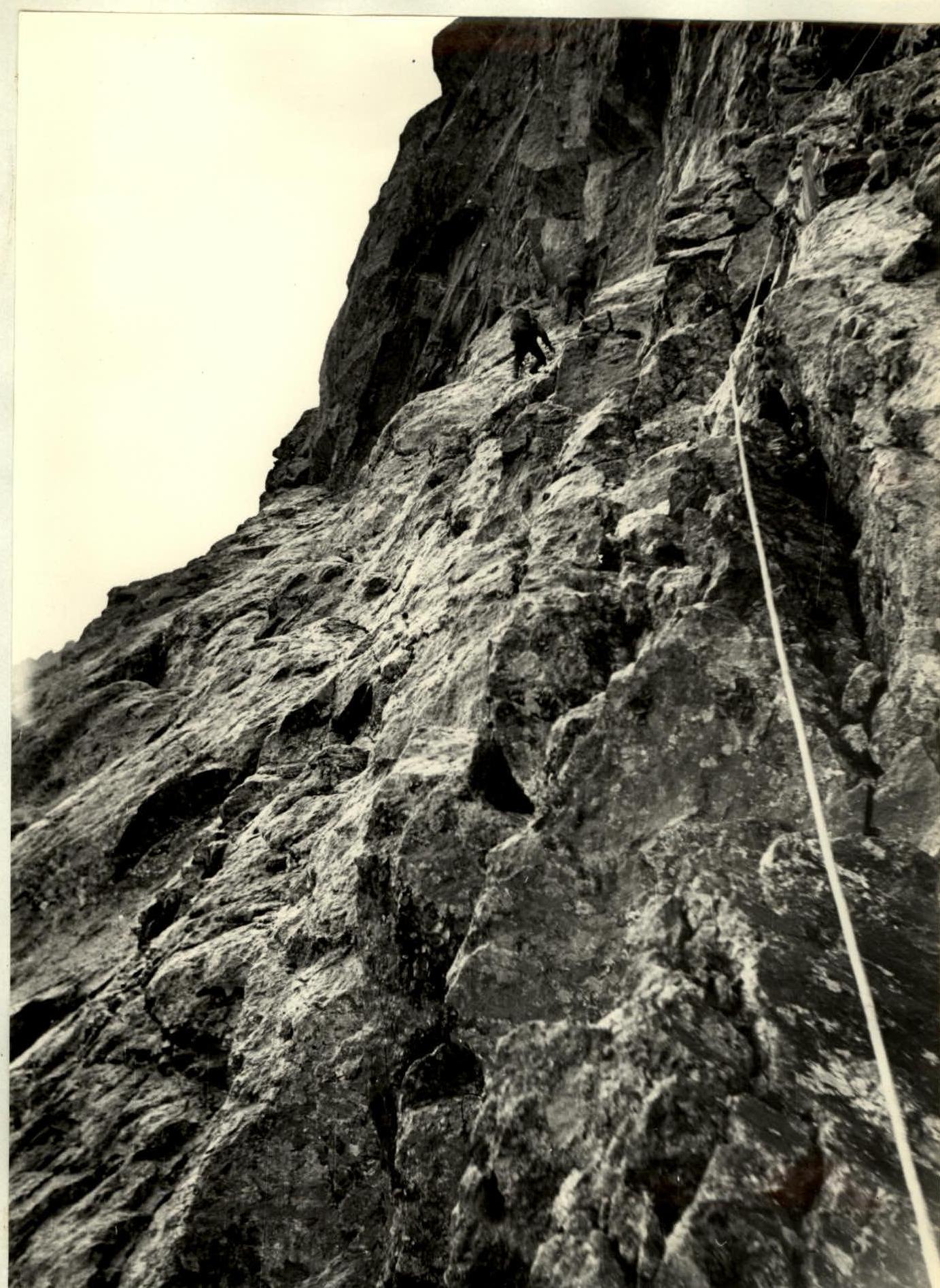
"The steepness decreased..." (Section R2–R3).
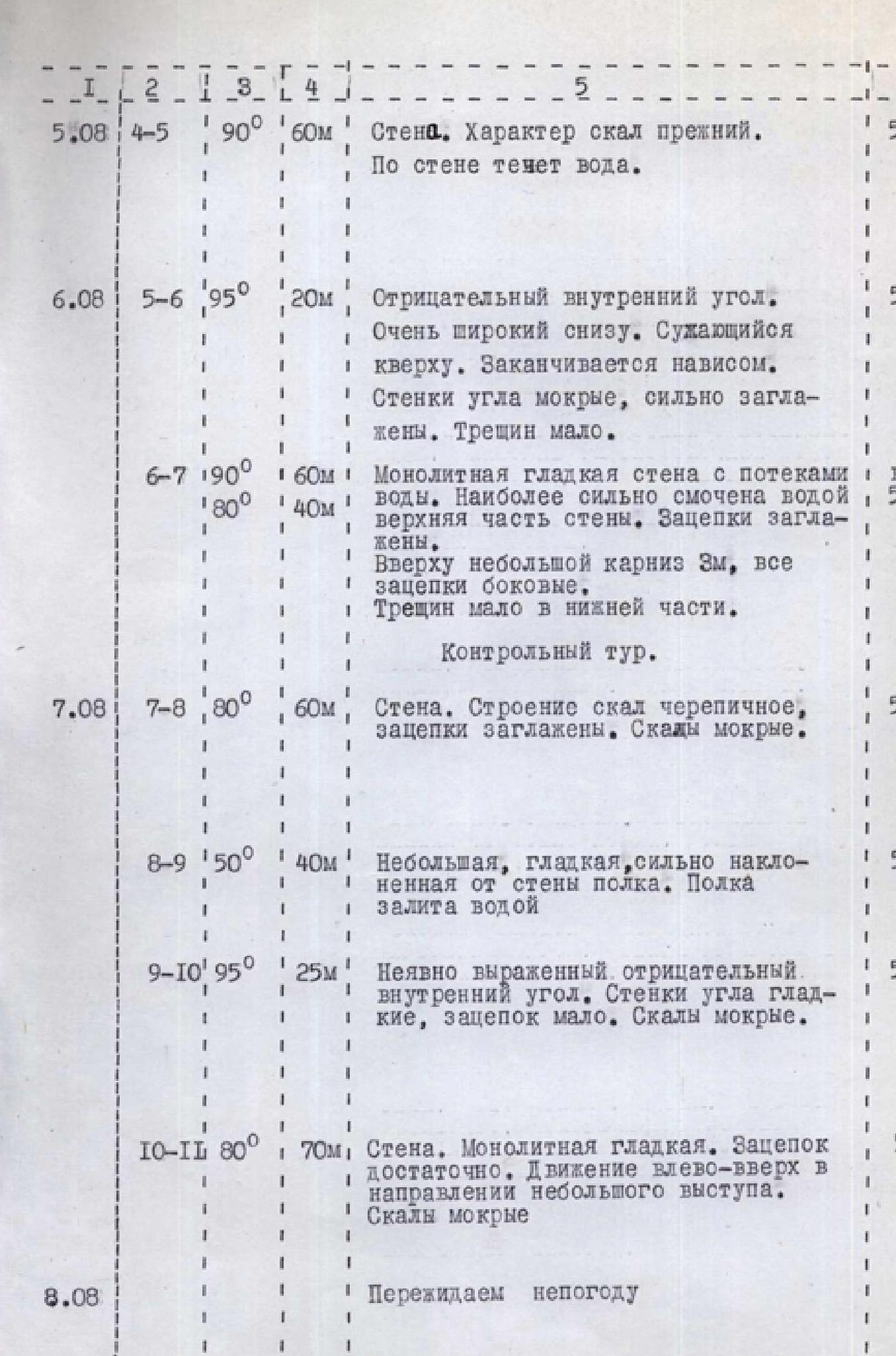
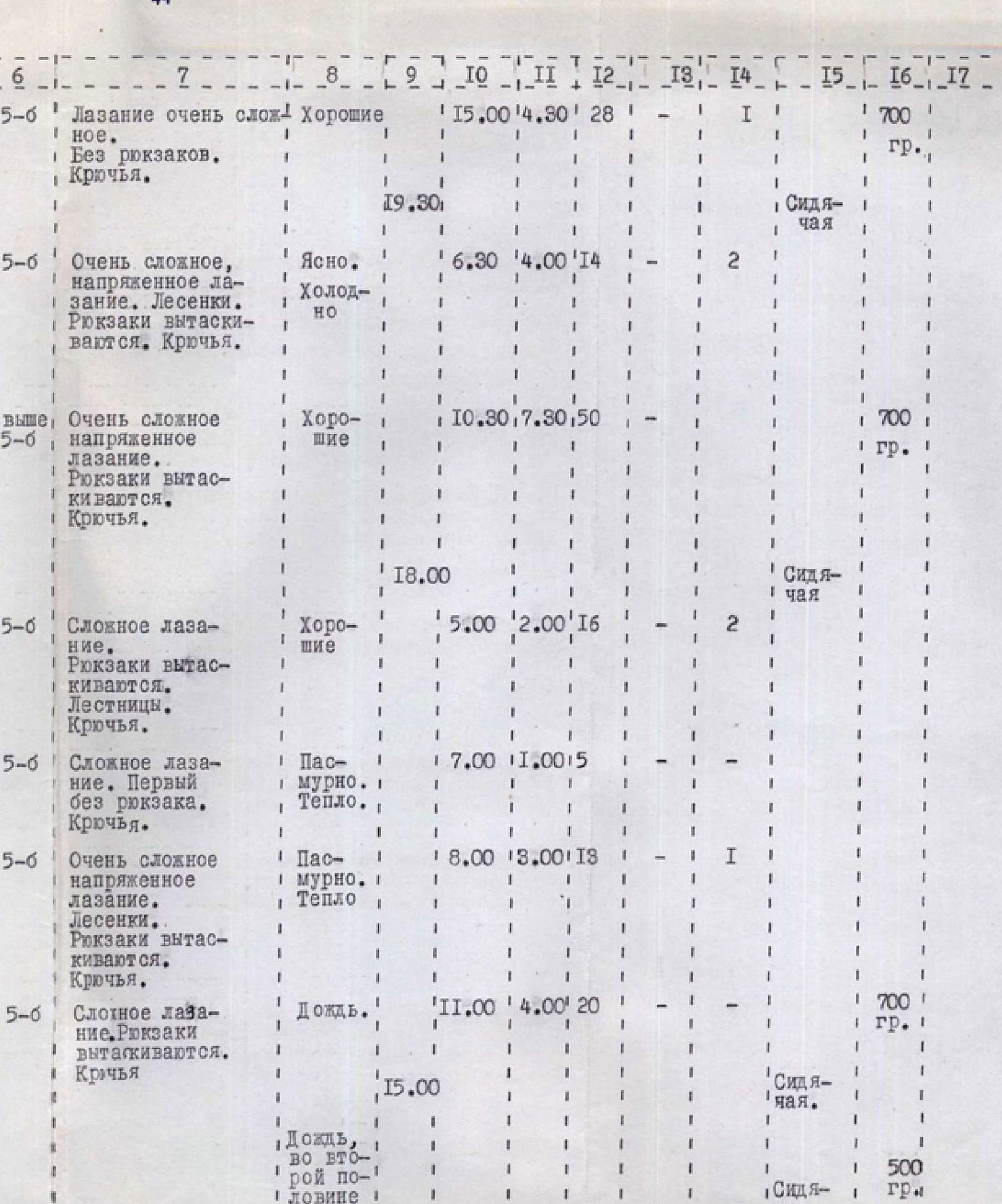
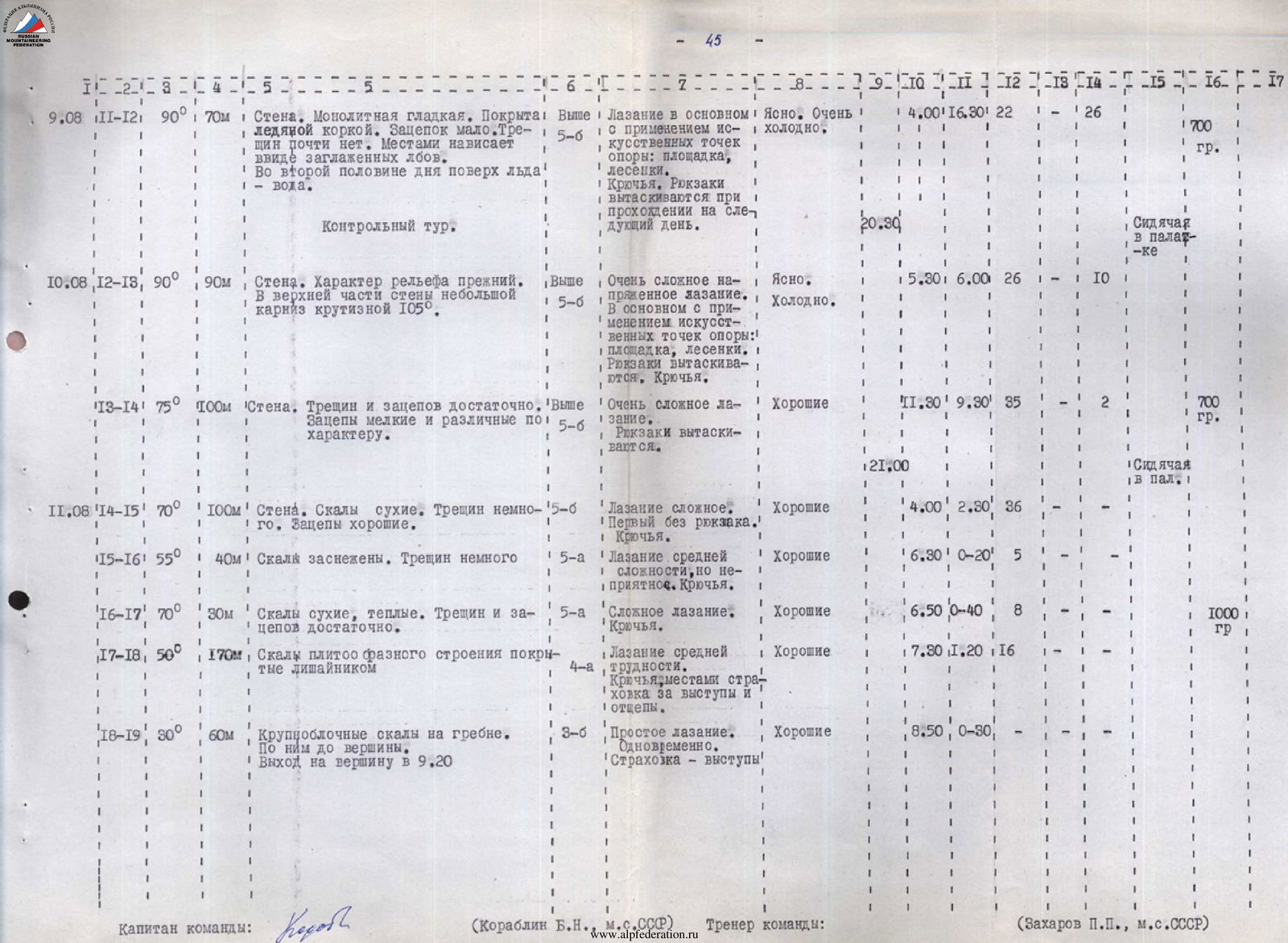
Table of Main Route Characteristics
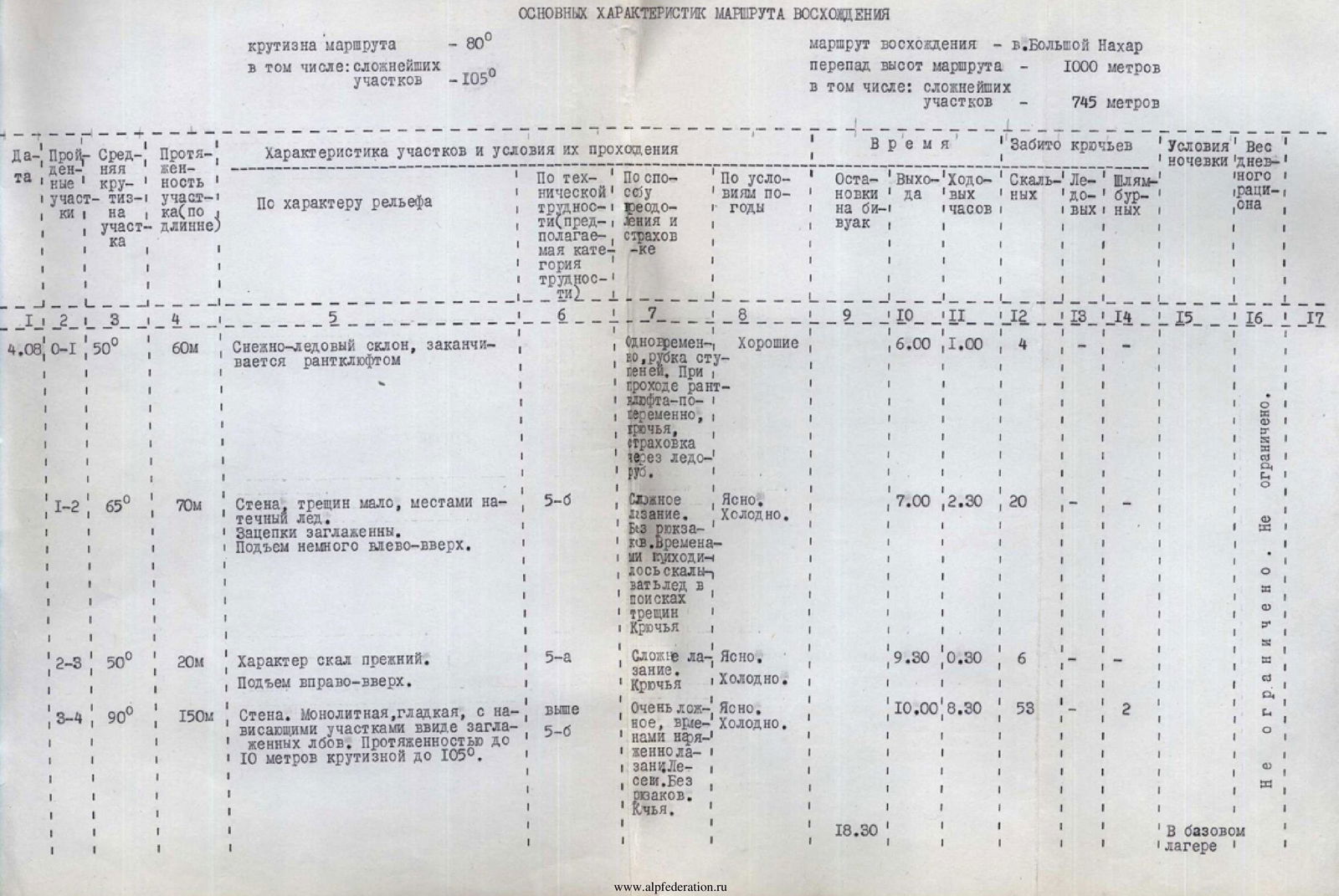
Route of ascent: v. Bolshaya Nakhara Height difference of the route: 1000 m Including the most complex sections: 745 m Steepness of the route: — 80° Including the most complex sections: — 105°
| Date | Sections Covered | Average Steepness of Section | Length of Section | Characteristics of Sections and Conditions of Passage | Time | Pitons Used | Bivouac Conditions | Daily Ration Weight |
|---|---|---|---|---|---|---|---|---|
| By Relief Character | Bivouac Stops | Departures | Climbing Hours | Rock | ||||
| 4.08 | R0–R1 | 50° | 60 m | Snow-ice slope, ends in a bergschrund. Simultaneous ascent, step-cutting. When passing the bergschrund — in turns, pitons, belay via ice axe. | Good | 6:00 | 1:00 | 4 |
| R1–R2 | 65° | 70 m | Wall, few cracks, some rime ice. Holds are smoothed. Ascent slightly left and upwards. Challenging climbing. Without backpacks. Occasionally had to clear ice to find cracks. Pitons. | Clear. Cold. | 7:00 | 2:30 | 20 | |
| R2–R3 | 50° | 20 m | Rock character remains the same. Ascent right and upwards. Challenging climbing. Pitons. | Clear. Cold. | 9:30 | 0:30 | 6 | |
| R3–R4 | 90° | 150 m | Wall. Monolithic, smooth, with overhanging sections in the form of smoothed foreheads. Up to 10 meters long with steepness up to 105°. Very challenging, sometimes tense climbing. Ladders. Without backpacks. Pitons. | Clear. Cold. | 10:00 | 8:30 | 53 | |
| 18:30 | ||||||||
| 5.08 | R4–R5 | 90° | 60 m | Wall. Rock character remains the same. Water flows down the wall. Very challenging climbing. Without backpacks. Pitons. | Good | 15:00 | 4:30 | 28 |
| 6.08 | R5–R6 | 95° | 20 m | Negative internal corner. Very wide at the bottom, narrowing towards the top. Ends in an overhang. Corner walls are wet, heavily smoothed. Few cracks. Very challenging, tense climbing. Ladders. Backpacks pulled up. Pitons. | Clear. Cold. | 6:30 | 4:00 | 14 |
| R6–R7 | 90° / 80° | 60 m / 40 m | Monolithic smooth wall with water trickling down. Upper part of the wall most heavily soaked. Holds are smoothed. At the top, a small cornice with lateral holds. Few cracks in the lower part. Control point. Very challenging, tense climbing. Backpacks pulled up. Pitons. | Good | 10:30 | 7:30 | 50 | |
| 7.08 | R7–R8 | 80° | 60 m | Wall. Rock structure is tile-like; holds are smoothed. Rocks are wet. Challenging climbing. Backpacks pulled up. Ladders. Pitons. | Good | 5:00 | 2:00 | 16 |
| R8–R9 | 50° | 40 m | Small, smooth, strongly inclined ledge from the wall. Ledge is flooded with water. Challenging climbing. First without a backpack. Pitons. | Overcast. Warm. | 7:00 | 1:00 | 15 | |
| R9–R10 | 95° | 25 m | Barely expressed negative internal corner. Corner walls are smooth; few holds. Rocks are wet. Very challenging, tense climbing. Ladders. Backpacks pulled up. Pitons. | Overcast. Warm. | 8:00 | 13:00 | 18 | |
| R10–R11 | 80° | 70 m | Wall. Monolithic smooth. Enough holds. Movement left and upwards towards a small ledge. Rocks are wet. Challenging climbing. Backpacks pulled up. Pitons. | Rain | 11:00 | 4:00 | 20 | |
| Waiting out bad weather | Rain, snow in the second half of the day. | 15:00 | ||||||
| 9.08 | R11–R12 | 90° | 70 m | Wall. Monolithic smooth. Covered with an icy crust. Few holds. Almost no cracks. In some places overhangs in the form of smoothed foreheads. In the second half of the day, water on top of the ice. Climbing mainly using artificial holds: platform, ladders. Pitons. Backpacks pulled up the next day. | Clear. Very cold. | 4:00 | 16:30 | 22 |
| Control point. | 20:30 | |||||||
| 10.08 | R12–R13 | 90° | 90 m | Wall. Relief character remains the same. At the top of the wall, a small cornice with 105° steepness. Very challenging, tense climbing. Mainly using artificial holds: platform, ladders. Backpacks pulled up. Pitons. | Clear. Cold. | 5:30 | 6:00 | 26 |
| R13–R14 | 75° | 100 m | Wall. Enough cracks and holds. Holds are small and varied. Very challenging climbing. Backpacks pulled up. | Good | 11:30 | 9:30 | 35 | |
| 21:00 | ||||||||
| 11.08 | R14–R15 | 70° | 100 m | Wall. Rocks are dry. Few cracks. Good holds. Challenging climbing. First without a backpack. Pitons. | Good | 4:00 | 2:30 | 36 |
| R15–R16 | 55° | 40 m | Rocks are snow-covered. Few cracks. Climbing is moderately difficult but unpleasant. Pitons. | Good | 6:30 | 0:20 | 5 | |
| R16–R17 | 70° | 30 m | Rocks are dry, warm. Enough cracks and holds. Challenging climbing. Pitons. | Good | 6:50 | 0:40 | 8 | |
| R17–R18 | 50° | 70 m | Rocks have a slab-like structure, covered with lichen. Climbing is moderately difficult. Pitons, sometimes belaying via ledges and flakes. | Good | 7:30 | 1:20 | 16 | |
| R18–R19 | 30° | 60 m | Large block rocks on the ridge. Easy climbing. Simultaneous ascent. Belaying — via ledges. | Good | 8:50 | 0:30 | 0 |
Team Captain: Korablin B.N. (Master of Sports of the USSR) Team Coach: Zakharov P.P. (Master of Sports of the USSR)
22
45-

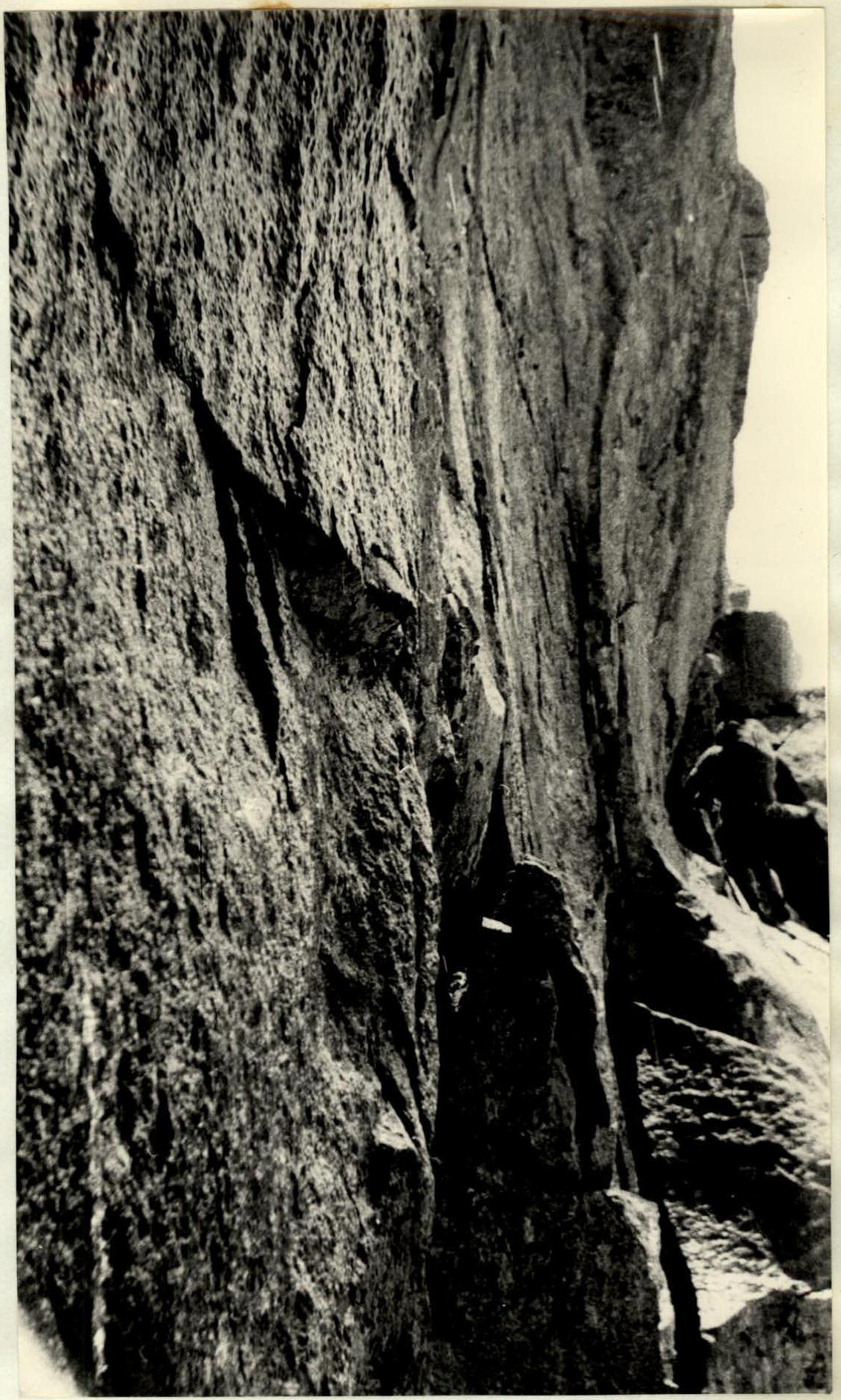 "Ascent right and upwards... The steepness increases sharply again, the wall seems to overhang us". (Section R6–R7).

Comments
Sign in to leave a comment