
- Climbing category — rock climbing.
- Climbing area — Uzunkol alpine camp.
- Climbing route with indication of peaks, their heights, route complexity (and other approximate data) — Bolshoy Nakhar peak (3780 m), complexity approximately 6th category of difficulty — via the right part of the northwest wall.
- Climbing characteristics: — route length — 1310 m. — height difference — 1000 m. — average steepness — 78°. — length of complex sections — 1095 m.
- Pitons hammered: rock — 185 ice — 20 into the rock wooden wedges — 23 protection gear — 6
- Number of climbing hours — 77 hours.
- Number of climbing days — 8 days.
- Number of overnight stays and their characteristics: total 6 overnight stays, 4 on good platforms and 2 sitting.
- Team name: Combined team of CS DSO "Spartak"
- Surname, name, patronymic of the leader, participants and their qualification: Leader — Eduard Vasilyevich Kotov — Candidate Master of Sports Participants — Sergey Mikhailovich Prusakov — Master of Sports of the USSR — Vitaly Fedorovich Yanov — Master of Sports of the USSR — Vladimir Nikolaevich Bazarov — Master of Sports of the USSR — Vitaly Sergeevich Gudkov — Master of Sports of the USSR
- Team coach — Vitaly Fedorovich Yanov — Master of Sports of the USSR — instructor
- Date of departure on the route and return: July 18–26, 1978
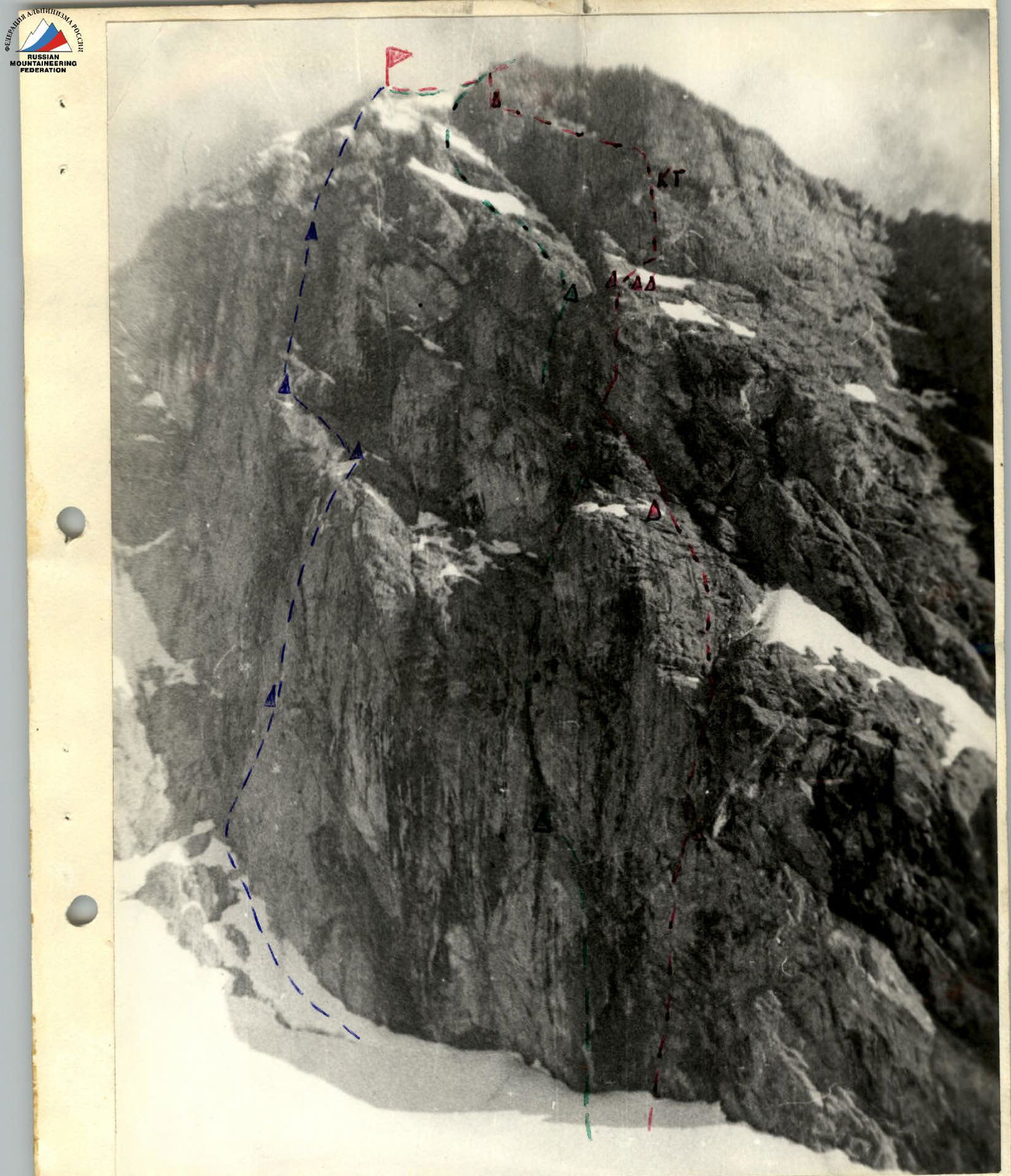

July 17, 1978. At 6:00, departure from Uzunkol alpine camp towards Nakhar peak. Ascent to the moraine opposite the wall. Prusakov–Kotov pair goes under the wall to observe the route condition and choose a starting point. The rest set up a bivouac.
July 18, 1978. Prusakov–Yanov rope team sets out to process the route. Departure at 8:00 am.
After overcoming the rancleft, they reach the wall with chimneys. The wall is monolithic, 40 m. 5 pitons hammered. Second climber's reception point. Climbing is difficult.
The wall is 8 m, slightly overhanging.
Then: — left 12 m — exit to a 10 m ledge; — wooden wedges and ladders used; — overcoming a diagonal ledge 5 m, deflects left; — vertical cleft with small ledges 5 m; — exit to a "comma"-shaped flake.
Very difficult climbing using artificial support points. 25 pitons hammered, including 5 wooden wedges and 2 ice screws into the rock.
Along the cleft with ledges under "Palets" — another 20 m. Climbing is difficult. No overnight stays.
At 18:00, the rope team descends from the route. A decision is made to continue processing the next day.
July 19, 1978. At 10:00, Prusakov–Gudkov rope team departs from the bivouac to continue route processing. Along the curved part of "Palets" 7 m — traverse left, 5 m — along overhangs, 8 m — exit to "Palets" under the "big ledge" — the гвоздь маршрута (main difficulty) in this part of the "bastion". First control checkpoint.
The ledge is 15–16 m long, 6 m outwards. Processing takes 6 hours. Used: — all types of pitons, — ladders, — platforms, — protection gear.
28 pitons hammered, total 25 m covered. Water flows down the wall — a real shower. Working is impossible, and at 17:00, the rope team descends, determining a possible overnight stay spot on "Palets" under the "Big Ledge". A decision is made to depart with the whole team the next day.
July 20, 1978. Early ascent. Packing, and all five depart under the route. Ascent via fixed ropes to "Palets" and hauling backpacks. Yanov–Prusakov rope team continues route processing above the ledge. From a narrow shelf (half a foot wide and 0.5 m long), reception in ladders along the wall to a sheer cleft: 3 pitons — 12 m under the ledge, 2 pitons on the ledge. Pendulum movement left along the sheer wall to a ledge, from the ledge up the wall — 7 m. Climbing goes along the wall with small holds to the cleft.
From the ladder, exit to a cleft, movement from left to right, 35 m under a yellow triangular flake. Reception point, backpack hauling spot. From the flake, exit right to a ridge 12 m. Traverse left along the wall for 20 m, crossing a couloir with flowing water, and exit to "Ram's Foreheads" — 8 m. From a shelf on a grey wet wall type "Ram's Foreheads" with 50°–55° steepness, few cracks, straight up under the red wall. Climbing is moderate. No overnight stays. The rope team descends to the backpack reception point. Gudkov V.S. ascends to the rope team. Backpack hauling begins. By the time the rain starts, they don't finish the work, so three spend the night on the upper shelf, and two (Bazarov V.N. and Kotov E.V.) — on "Palets" under the big ledge. Everyone has down gear and food. Overnight stay is sitting. Total 195 m covered that day.
July 21, 1978. The morning starts with hauling a backpack and the rope team's departure from under the ledge. That day, Prusakov S. and Yanov V.F. work first. Processing the "red wall", which has flowing water. Climbing is difficult, few cracks, only 6 pitons hammered. They approach a three-tiered ledge. The ledge is overcome using artificial support points. From the ledge, 10 m up a diagonal chimney, then along internal corners and clefts, movement from right to left through a wet "forehead" under the "black" ledge. Climbing is very difficult. 95 m covered. Double fixed ropes installed. 14 pitons hammered. No overnight stay.
From above, they spot a platform. The rope team descends. Along shelves with snow islands — 60 m left from the three-tiered ledge — they search for an overnight stay spot. They find Kovtun's overnight stay, which consists of two platforms: for four and two people. The overnight stay is very convenient, protected from rocks. They install fixed ropes, transfer backpacks.
That day, they worked for 10 hours, got very tired, and settled in for the night at 16:00. After a sitting overnight stay, they can rest well. This is the 2nd control checkpoint.
July 22, 1978. At 6:00, Kotov E.V.–Prusakov S.M. rope team ascends via fixed ropes under the "black" ledge. Water flows along the "black" ledge day and night. Overcoming the ledge with ladders. Then, movement from left to right along a diagonal cleft, covered by a ledge with flowing water. Wooden wedges, ladders, boxes, and channels are used. Very steep. Climbing is very difficult — deflects. Exit to a small shelf (40 cm long, 10 cm wide) — reception point. Then, along a sheer wall with a series of yellow-orange overhanging small ledges, up 40 m. The wall is sheer. Climbing is very difficult. All types of pitons used: from petal-shaped to wooden wedges and ladders. They exit to an inclined shelf — backpack reception point. From here, the wall becomes less steep, the angle decreases to 70°. For 75 m, with good holds, there are some loose rocks. Climbing is difficult. On these sections (R10–R12), 36 pitons hammered, 145 m covered. They reach the 2nd bastion. Here is a convenient overnight stay.
July 23, 1978. At 8:00, from the overnight stay, Yanov V.F. — Bazarov V.N. rope team, traversing from left to right along the wall with good holds (wet rocks with moss, 60–65° steepness, 60 m), exits under the base of the pre-summit wall, consisting of large blocks. Ascent to a 20-meter wall ending in a ledge. 5 m under the ledge, right to left, and up a crack (3 m) — exit to the ledge. Weather deteriorates completely. 14:00. Snow starts falling — visibility is low. The rope team descends to the tent. No improvement in weather by evening.
July 24, 1978. Via fixed ropes, at 6:00, Bazarov V.N. — Gudkov V.S. rope team attempts to process the further route. Only 20 m processed. Heavy snowfall. Visibility — zero. At 9:00, processing is stopped. The whole day is spent hiding in the tent.
July 25, 1978. Departure on the route at 8:00. Fog. Light rain. Ascent via fixed ropes. Hauling backpacks. Prusakov S.V. — Yanov V.F. rope team goes first. Along rocks type "Ram's Foreheads", ascent another 45 m. Then, along shelves, smooth rocks covered with moss, with flowing water, traverse left for 180 m. Climbing is difficult. Everything is wet and heavy. At 20:00, they stop on a small shelf. A sitting overnight stay can be organized. This is the most difficult day for them. Worked for 15 hours.
July 26, 1978. Variable cloudiness. Can determine the direction of movement towards the ridge.
At 5:00, Kotov E.V. and Prusakov S.M. depart. Further ascent goes along the wall (110 m) type "Ram's Foreheads", covered with moss and lichen. Rocks are wet, water flows. Steepness is 65–70°. Steepness doesn't decrease, but the character of the rocks changes: large blocks, excellent holds, cracks, and chimneys lead them to the ridge.
Along the ridge, 130 m, they exit to the summit. The sun is shining. Time — 14:00. They leave a note and descend along the route of IV category of difficulty to the moraine.
Team captain E. Kotov
Table
main characteristics of the climbing route. Average steepness of the route — 78°, most difficult sections — 90° and more.
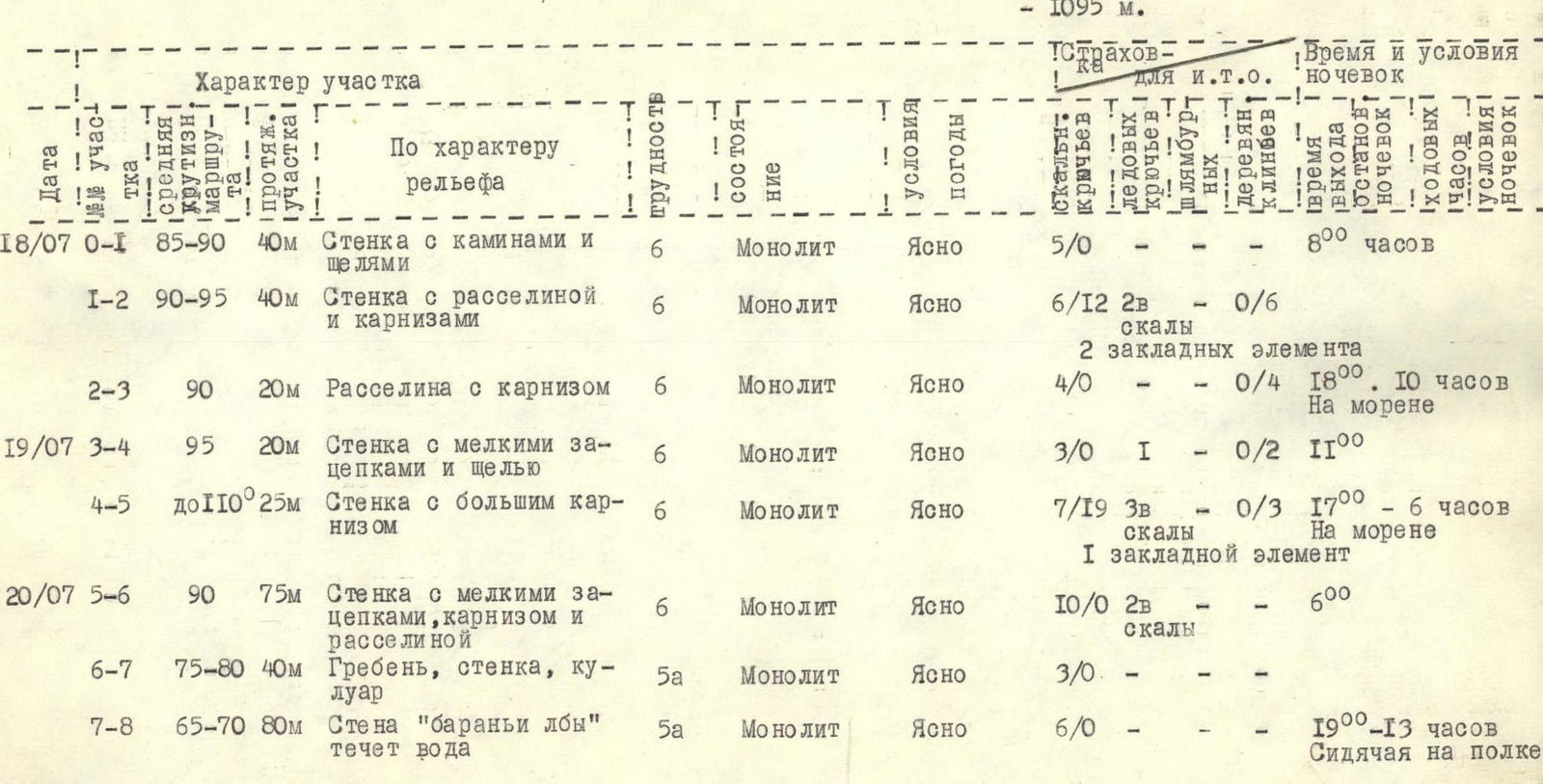
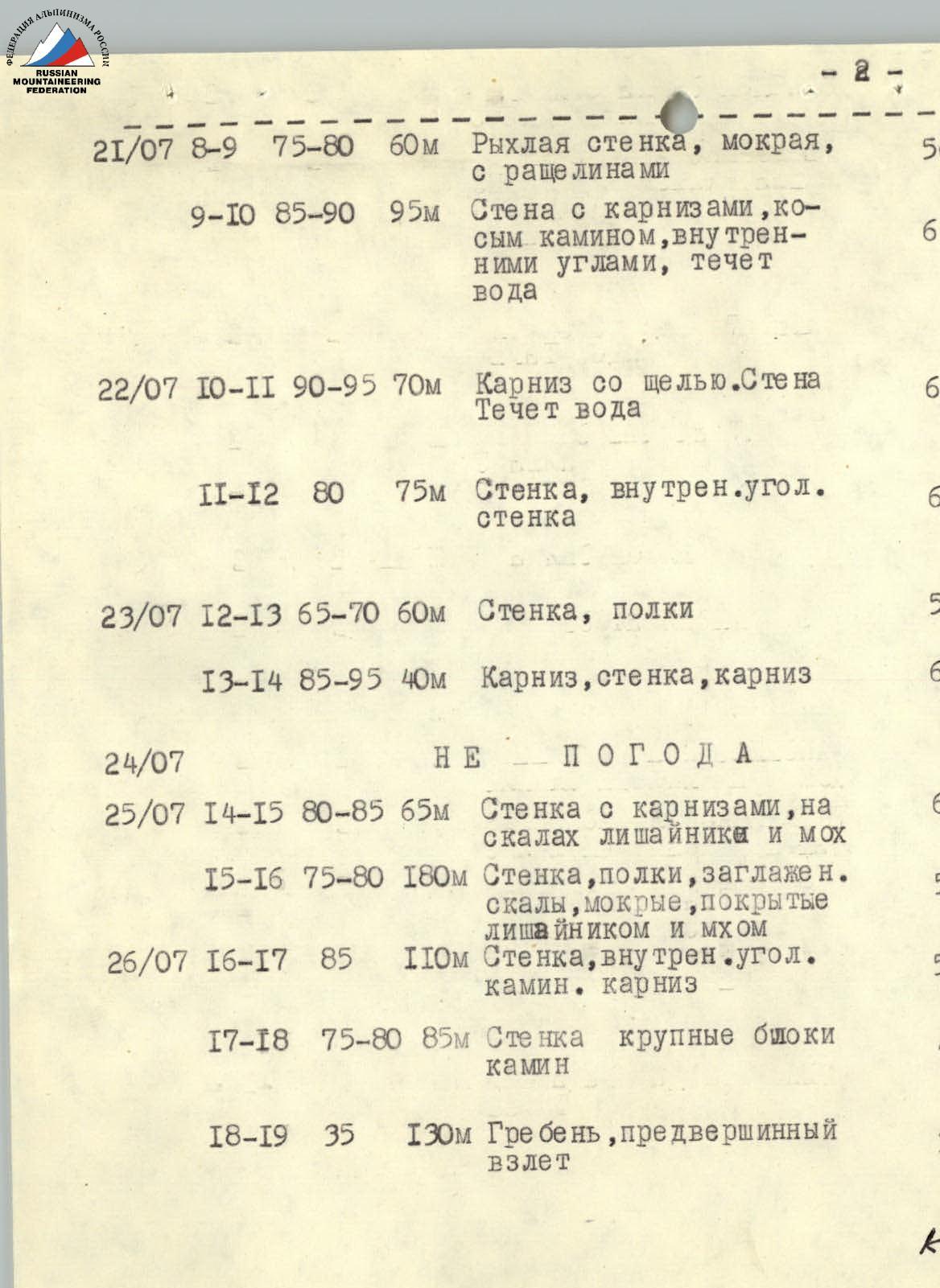
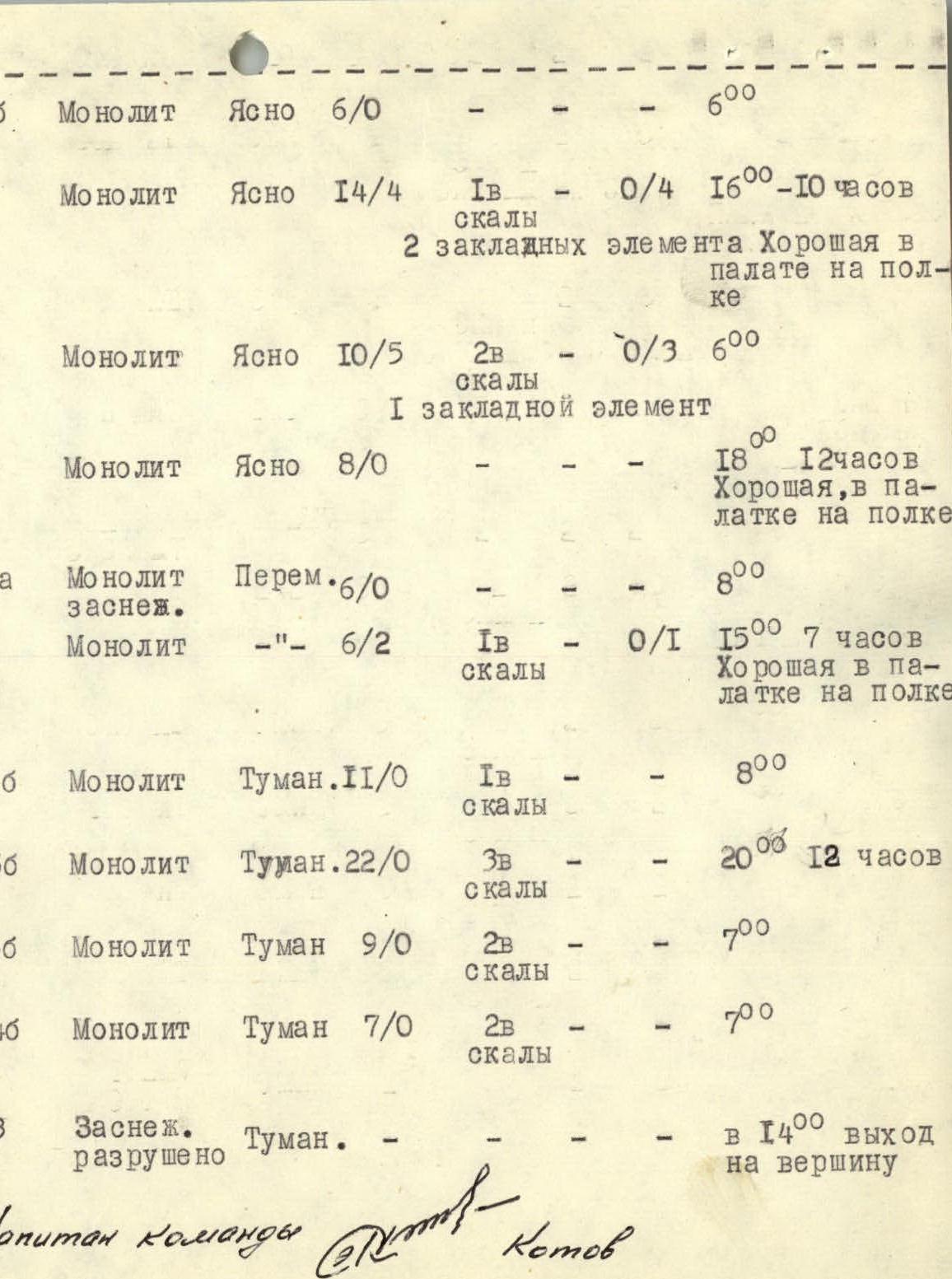 Passing the "big ledge" 44 4–5
 Passing the wall (R10–R11)


