
I. Rock Class
- Rock Class
- Caucasus, Uzunkol gorge
- Peak "Kirpich", 3800 m, via the "diamond" of the western wall
- Category 5B difficulty
- Elevation gain — 710 m, length — 960 m, length of sections with R5–R6 difficulty — 330 m, average steepness of the main part of the route — 85°
- Pitons hammered:
- rock: 39 (new), 4 (previously hammered)
- bolt: 15 (new), 8 (previously hammered)
- chocks: 69 (new), 8 (previously hammered)
- ice screws: 0 (new), 0 (previously hammered)
 — reusing previously hammered pitons
- Team's total climbing time — 11 h 30 min
- Overnight stays: none
- Team leader: Bayakin Sergey Gennadievich — Master of Sports
Team members:
- Balezin Valery Viktorovich — Master of Sports, Master of Sports of International Class
- Zakharov Nikolay Nikolaevich — Master of Sports, Master of Sports
- Chentsov Sergey Vasilievich — Master of Sports, Candidate for Master of Sports
- Bogachev Alexander Viktorovich — Candidate for Master of Sports, Candidate for Master of Sports
- Bogomaz Valery Vladimirovich — Candidate for Master of Sports
- Senior team coach: Sapozhnikov Yuri Georgievich Team coach: Mashkov Yuri Viktorovich
- Approach to the route: July 10, 1983, 4:30 am Summit: July 10, 1983, 4:00 pm Descent: July 10, 1983, 9:00 pm
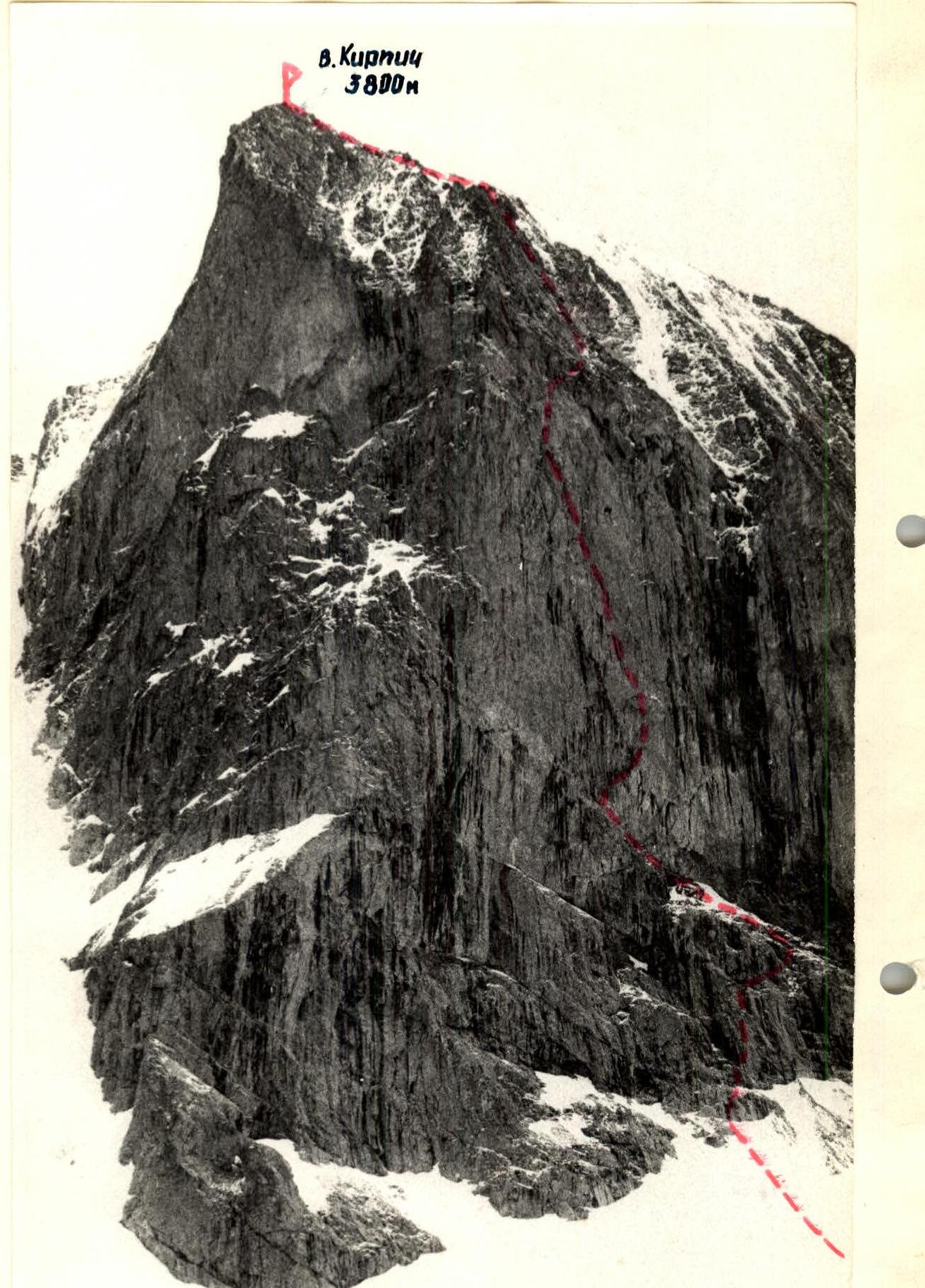
General photo of the Kirpich summit from Myrdy peak on June 24, 1983. Distance = 1 km Lens: Jupiter-37A f=135 mm
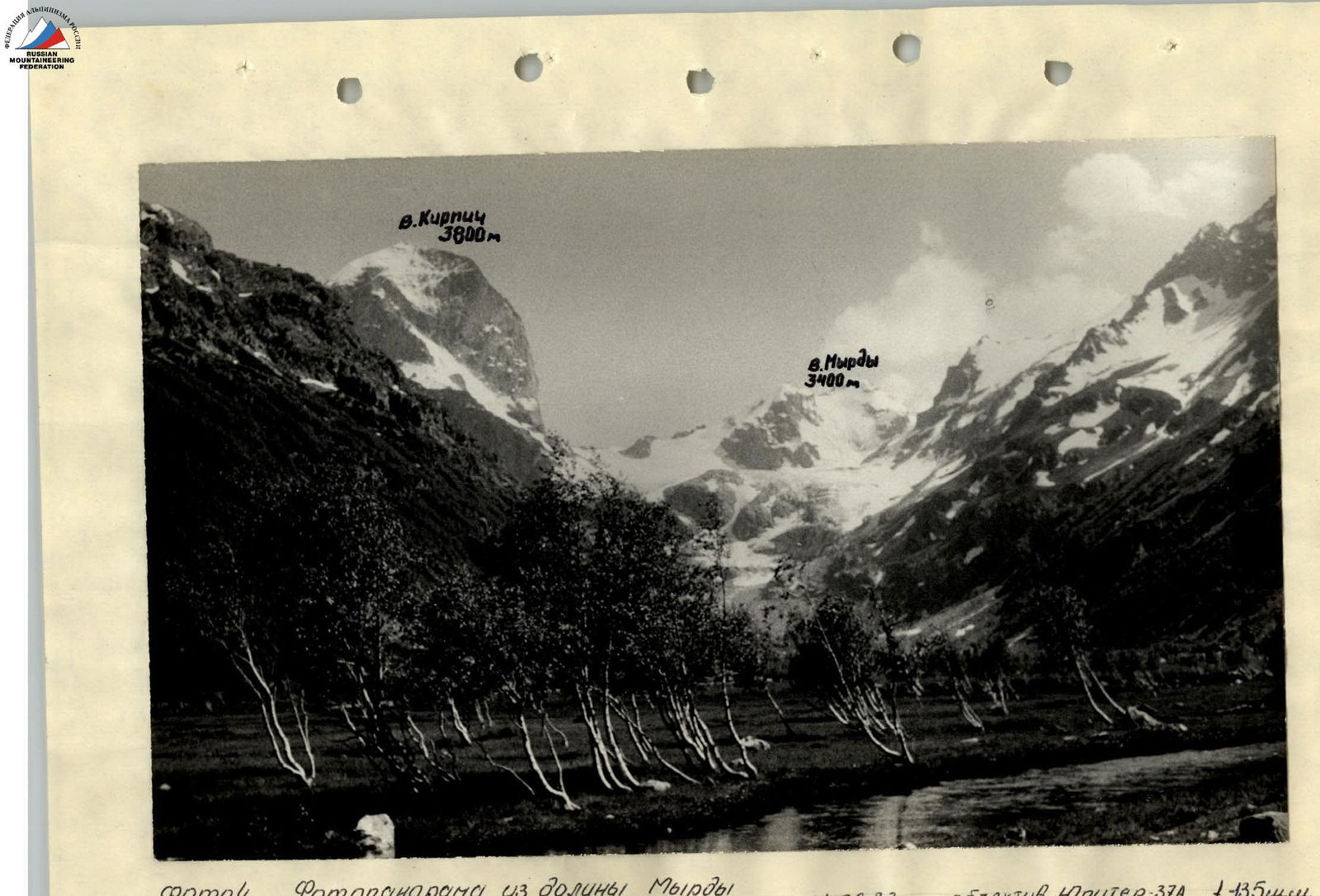
Photo 4: Photopanorama from Myrdy valley on June 24, 1983. Lens: Jupiter-37A f=135 mm.
Team's Tactical Actions
During the ascent to the Kirpich peak via the "diamond" of the western wall, the team employed a wall climbing tactic. Preliminary processing was not used due to the risk of falling rocks onto the start of the route from the waterfall on the right side of the wall. Due to unstable weather, it was decided to complete the route without overnight stays, although the team was equipped with bivouac gear in case of sudden weather deterioration.
The rotation of the rope teams was organized according to the tactical plan:
- Sections R0–R5: the first team, Bogachev — Bogomaz, led with alternating leads at each belay station.
- Sections R5–R11: Balezin (sections R5–R8) and Bayakin (sections R8–R11) worked ahead.
- Sections R7–R9: were climbed using a double rope.
- On sections R11–R18: Zakharov — Chentsov took the lead, with a change of lead at R14.
- Chentsov (sections R0–R9) and Bogachev (sections R10–R19) worked last.
- Section R18–R19: was climbed with simultaneous belay.
The team's pace was determined by the lead climber's speed (on average 50 m per 40 min). The speed of the rest of the team members was on average 50 m per 15 min. The use of chocks and a rope for extracting pitons significantly eased the work of the last climber, whose speed averaged 50 m per 20 min. This dictated the work and rest schedule for the team:
- For the lead climber — 40 min of work, 15 min of rest.
- For the last climber — 20 min of work, 35 min of rest.
- For the rest — 15 min of work, 40 min of rest.
The team did not stop for lunch; nutrition was managed individually during rest periods with pre-prepared rations.
The lead climber worked without a backpack; rope hauling was not used. Protection was provided with lower belays. The key section of the route was between R4–R11. Very steep, with some overhanging sections (see photos 6–8). Excentriques were effective. These sections were climbed on a double rope, free climbing.
- Weather started to deteriorate at 12:30 pm, with a storm approaching.
- The team increased their pace.
- They reached the summit 30 minutes ahead of the planned time.
The equipment used by the team was self-manufactured (see photo 9). New equipment samples included:
- A gas stove refillable in the field.
- "Jumar" ascenders with an ear, effective on iced ropes.
- Universal hammers with interchangeable beaks.
- Autoclave, etc.
The team used improved "Abalakov" excentriques and stoppers, both on rope loops and steel cables.
Communication with observers was regular and stable, using a P-855 UM radio station with a 60-hour power reserve.
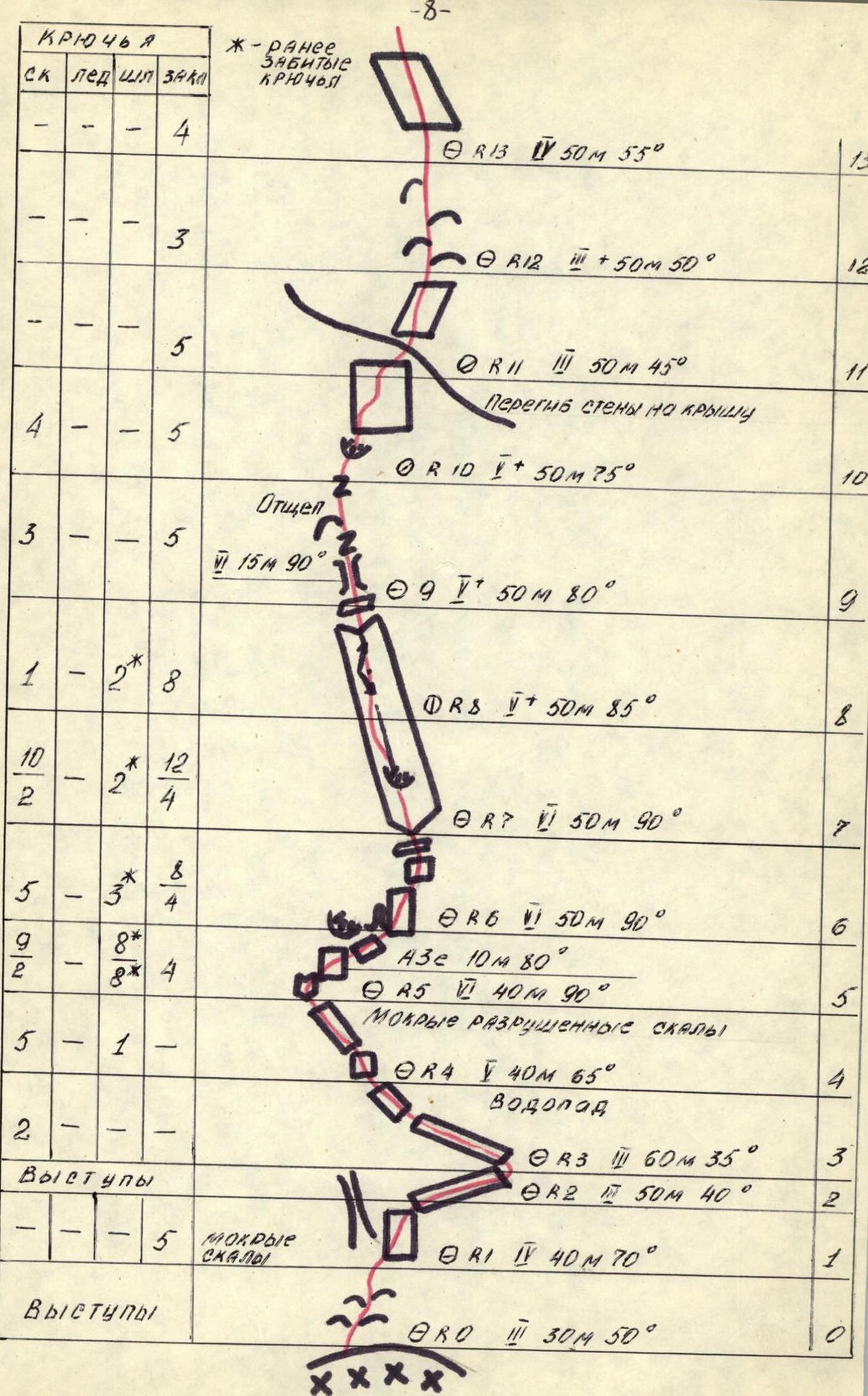
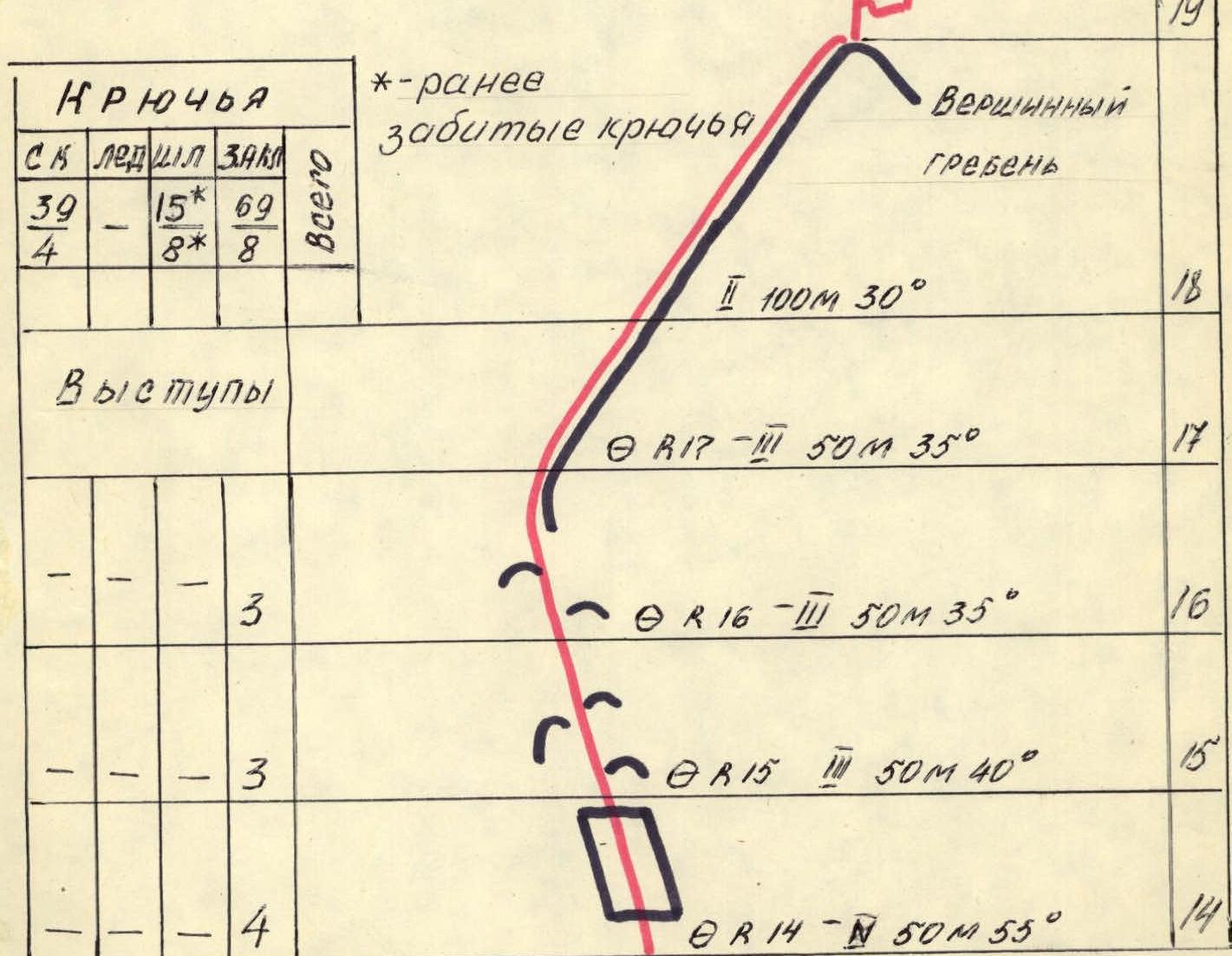
Route Description by Sections
Sections R0–R5 consist of fairly broken, wet rocks with a steepness of 40° to 70°, and difficulty ranging from 3 to 5. Water from the waterfall on the right part of the "roof" reaches here, and there are many signs of falling rocks, so an early start is necessary. Climbing here is not very complex but requires increased attention.
Section R5–R6: a 5 m corner, then a slab with 8 bolted pitons, ending in a ledge with a cave. The rocks are wet.
Section R6–R7: vertical slabs. Very difficult climbing, AID.
Section R7–R9: an inner corner with overhangs. Very difficult climbing, AID. On section R8–R9, a 3 m pendulum to the right. The rocks are monolithic, with a general inclination to the right.
Section R9–R10:
- A 15 m chimney, 90°, very difficult.
- Then a crack and a "split".
- It then becomes less steep.
Section R10–R11:
- A slab with a crack.
- A small cornice.
- A smooth slab, 70°, tense climbing.
Section R11–R12: traverse right 15 m, a wall bend onto the roof.
Sections R12–R18: walls, "ram's foreheads", up to 50° steep, not difficult climbing, monolithic rocks.
Section R18–R19: the summit ridge. Snow-covered rocks. The summit. The actions of the lead and rope teams are described on sheet 4. The route is safe except for sections R0–R5. The rocks are monolithic, with diverse relief, many different cracks, and effective use of various chocks, especially:
- "Abalakov's"
- Excentriques.
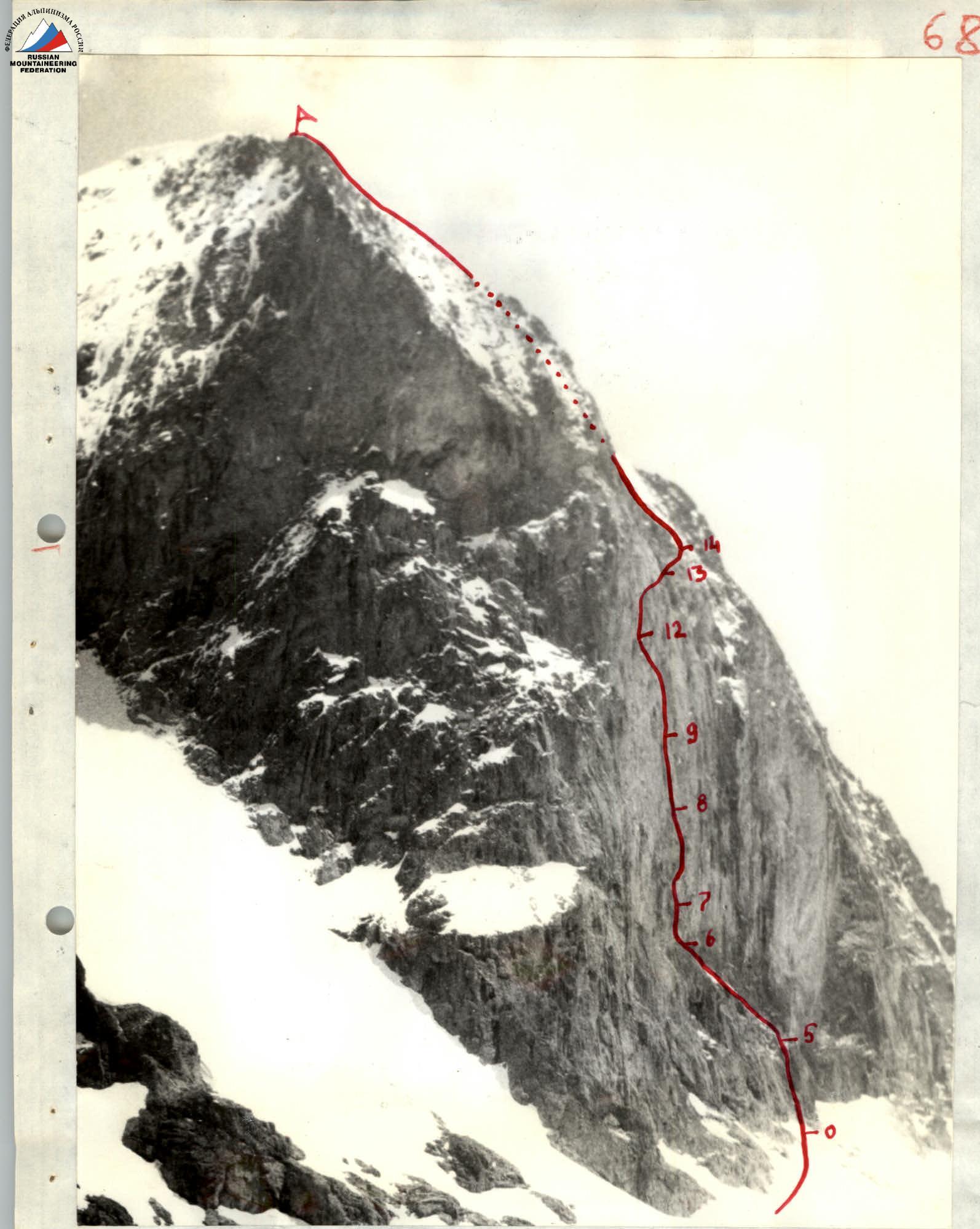
Photo of the wall profile from the right. June 26, 1983, 10:00 am. Lens: LOMO T-22, focal length 4.5/75. Distance to the wall 1.0 km. Shooting point on diagram 4, height 2700 m.
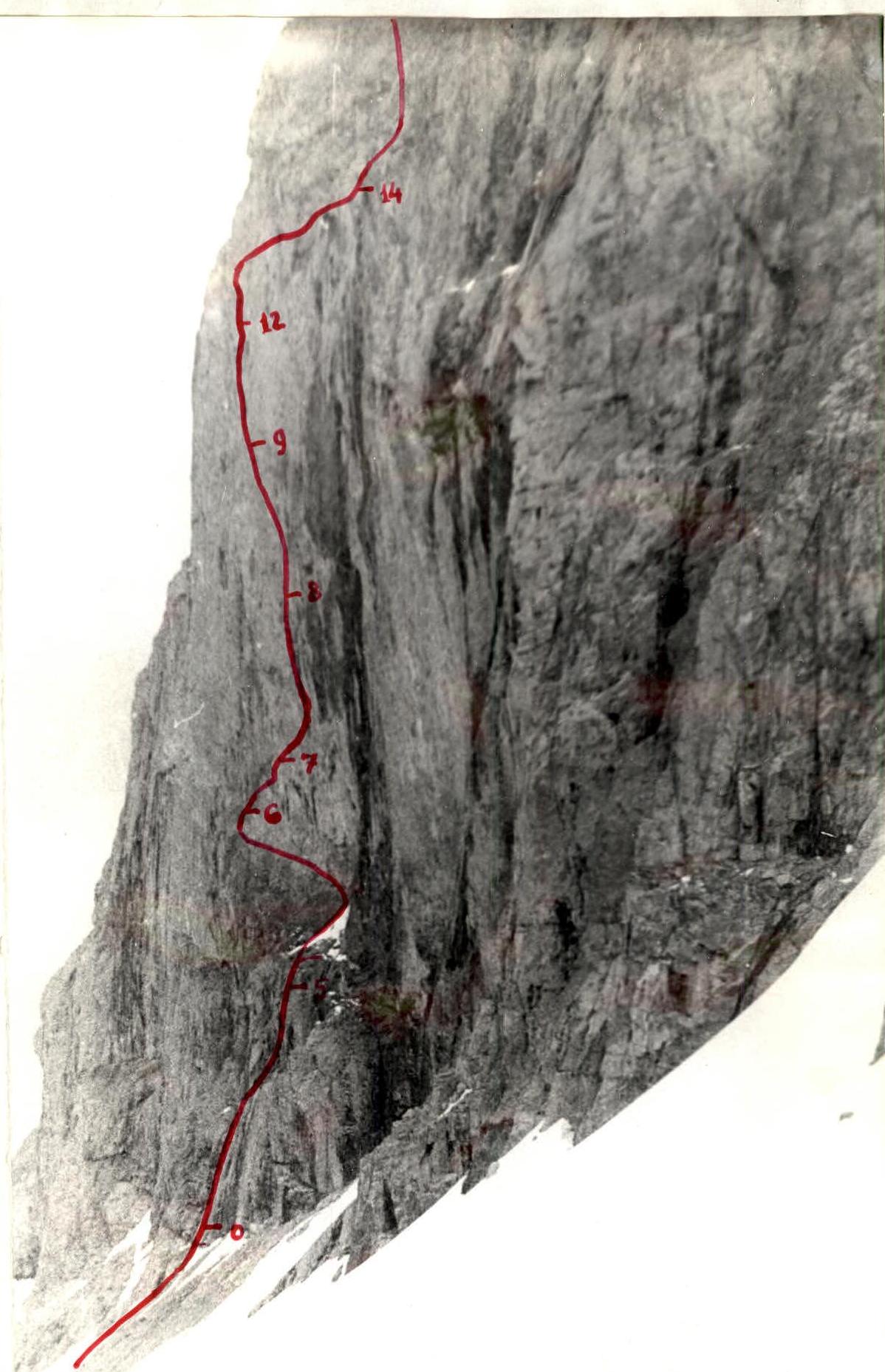
Photo of the wall profile from the left. June 26, 1983, 12:00 pm. Lens: LOMO T-22. Focal length 4.5/75. Distance to the object 500 m. Point on the area diagram 25, height 3000 m.
Area Photopanorama
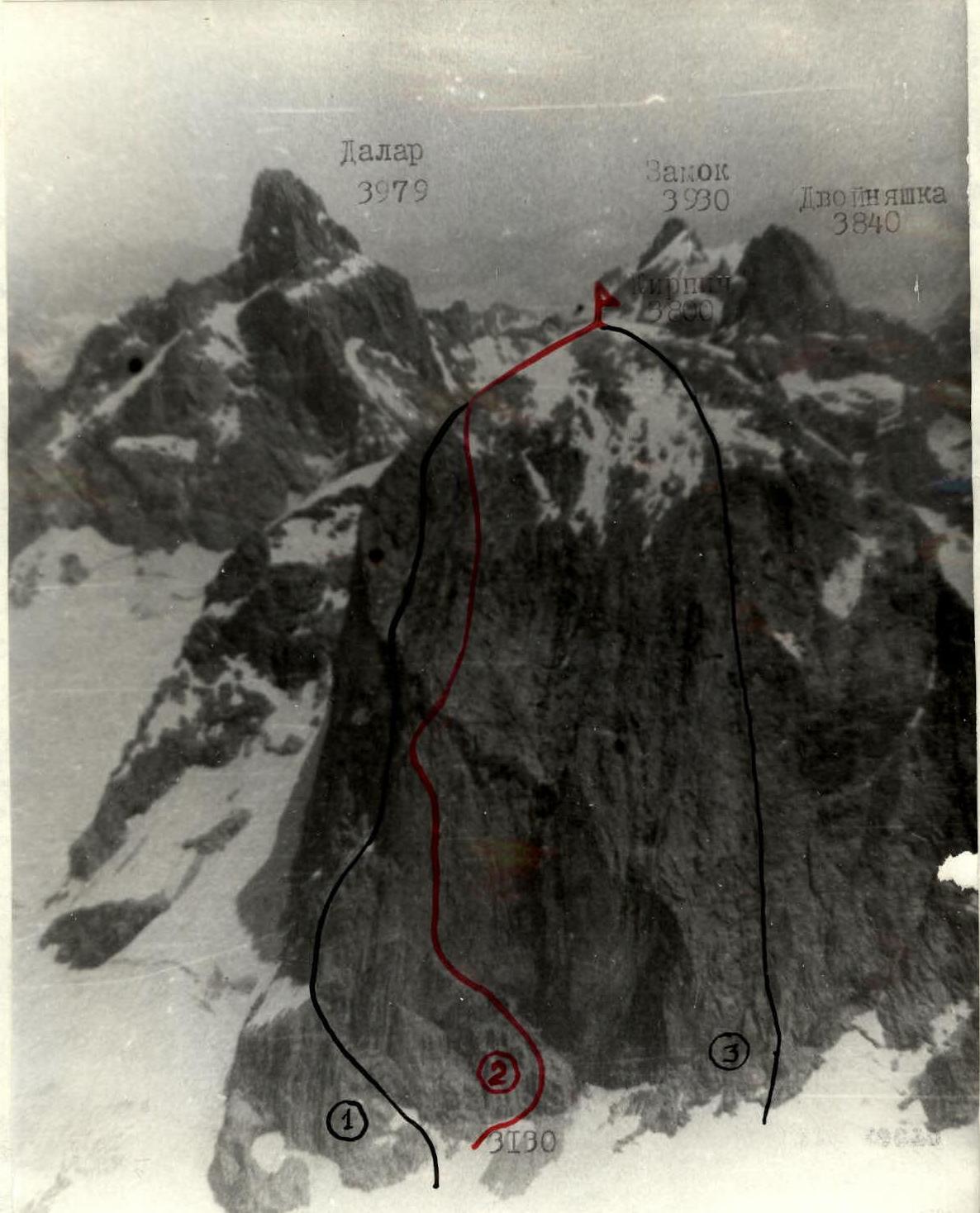
- Via the NW wall — category 5A difficulty
- Via the "diamond" of the western wall — category 5B difficulty
- Via the western wall along the gutters — category 4B difficulty
Photo from the shooting point on the area diagram №2. Camera "Smena 8M".
Route Diagram in UIAA Symbols
Pitons hammered:
- rock: 64/8
- bolt: 10/4 — previously hammered ones were used
- chocks: 53/2
- "Friend" chocks: 11
Total climbing time — 16 h 30 min
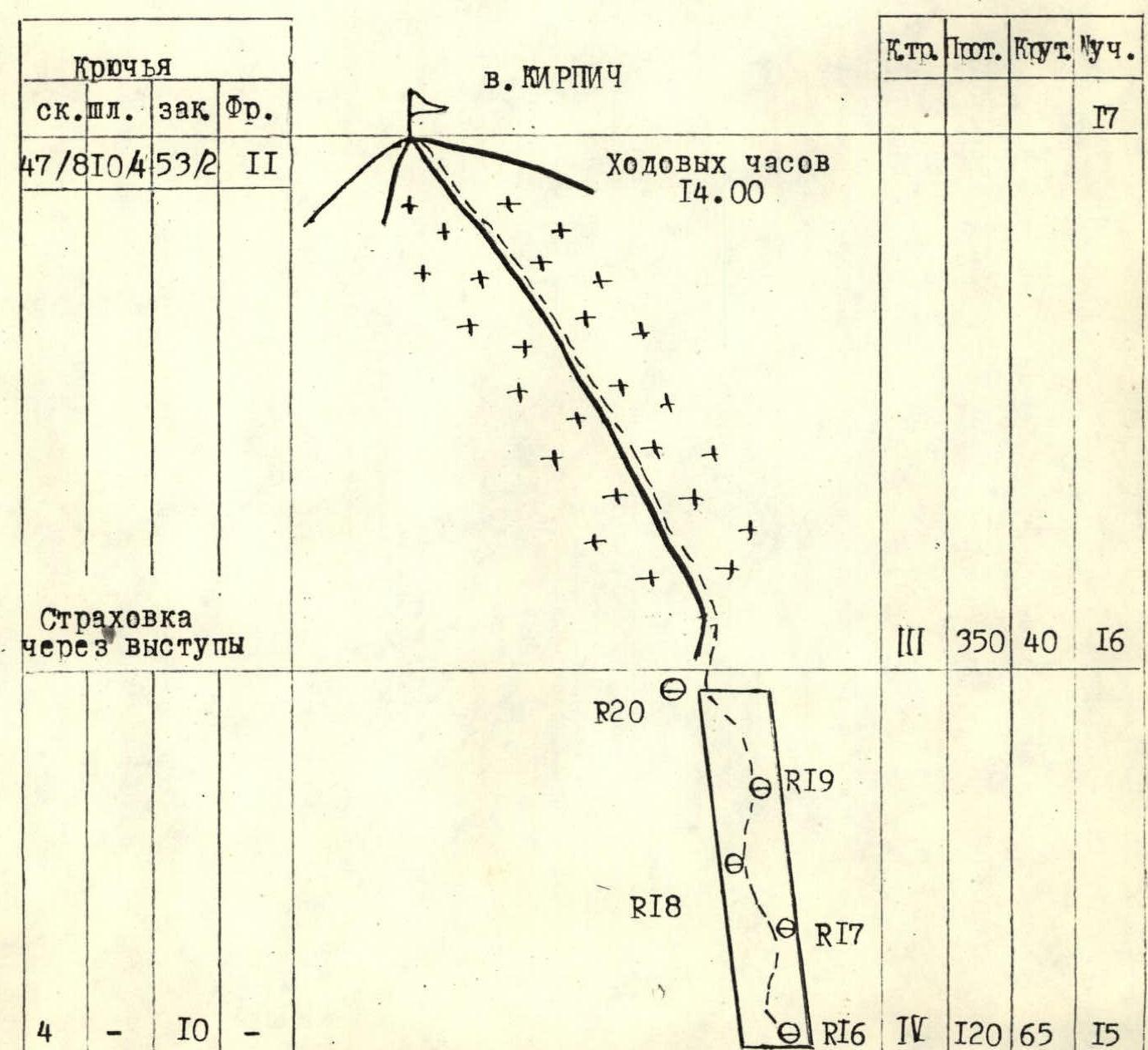
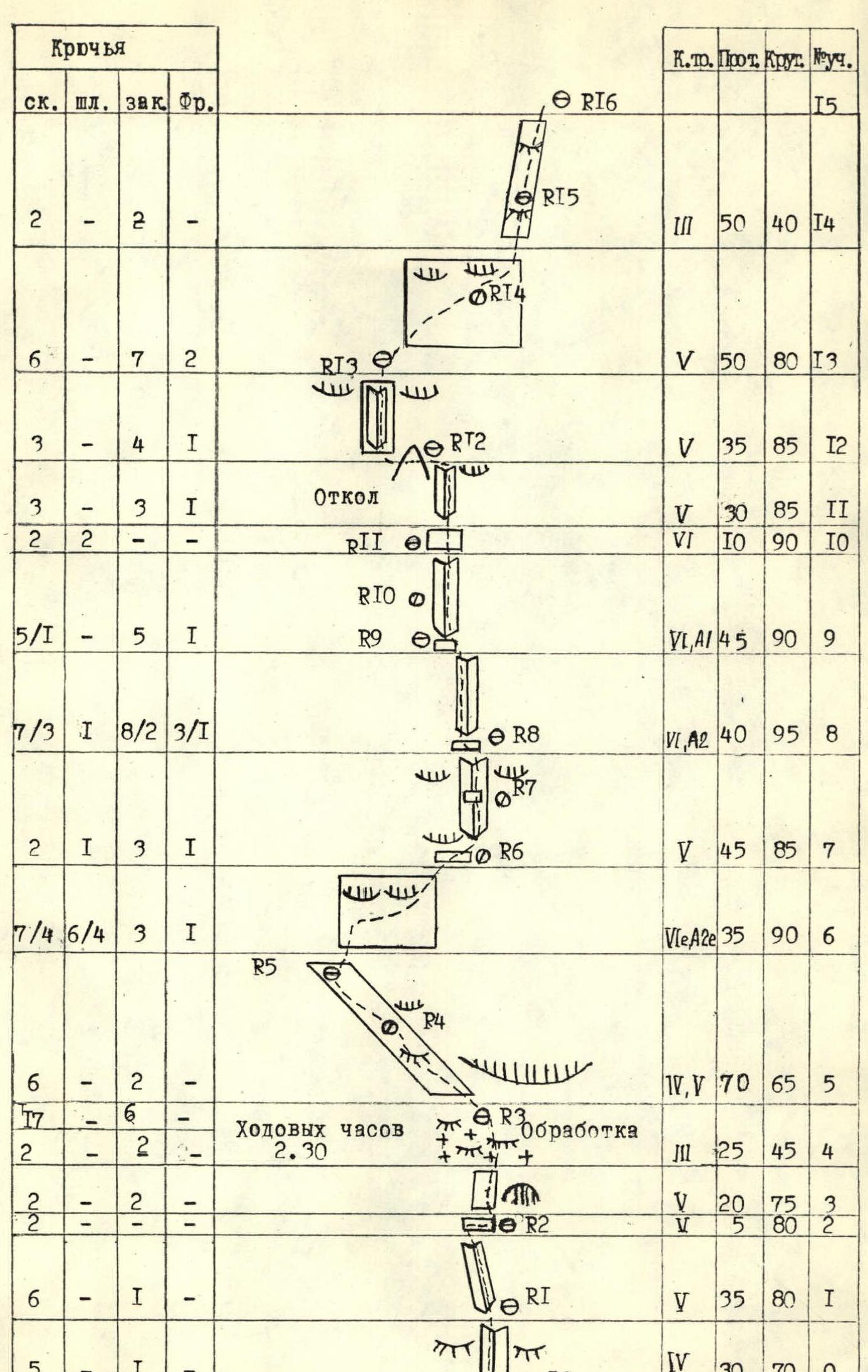
Route Description by Sections
Section R0–R5 was processed on the evening of June 27, 1983. Relatively easy rocks, but beware of falling rocks and ice from the top right. Pass quickly under the wall.
Section R5–R6: inclined slabs, covered with flow ice. Climbing is easy but made harder by ice; crampons are necessary. At the end and slightly below, there's a potential bivouac site.
Section R6–R7: a difficult section without cracks, fully protected with bolts, so it doesn't pose a particular challenge.
Section R7–R8: a difficult overhanging inner corner, heavily damaged by moisture. Climbed using artificial aids. In good conditions, it can be climbed free; there are good cracks for pitons.
Section R8–R9: an inner overhanging corner, but monolithic and dry. Plenty of opportunities for belay stations. Climbed free, with some ladder use.
Section R9–R12: a system of inner corners leading to a large spall — a possible bivouac site. The rocks are monolithic and dry.
Section R12–R13: an inner corner ending in a monolithic slab leading under cornices. At the end, a traverse to the right and upwards begins.
Section R13–R14: a traverse leading onto the summit roof.
Section R14–R17: rocks of medium difficulty, climbed with simultaneous belay. Beware of loose rocks that can be dislodged by a rope.
The wall part of the route from R5 to R14 is protected from falling rocks from above. In bad weather, precipitation doesn't reach the wall, so work can be done in any weather.
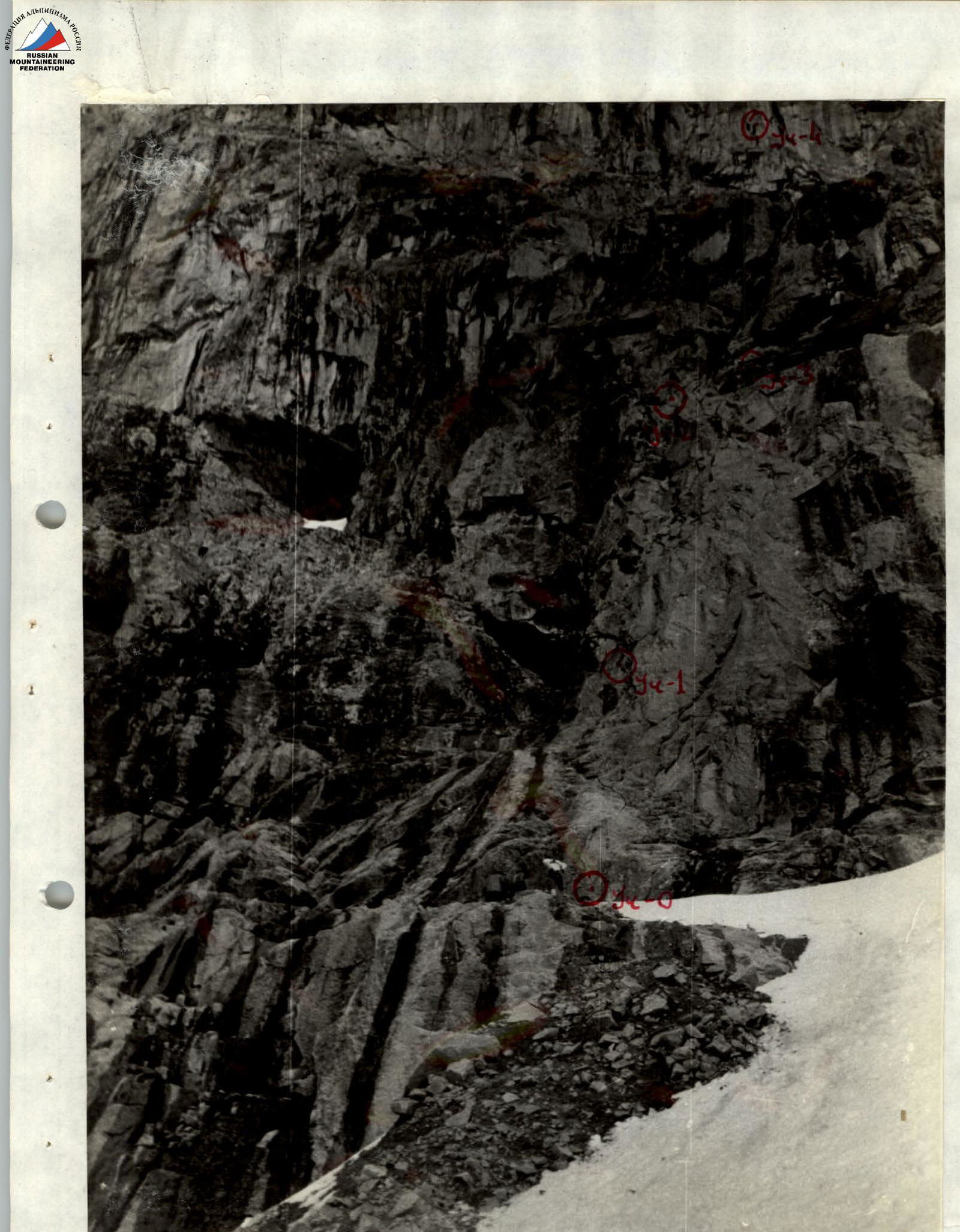
Photo ©. Section R0–R4 (processing) on June 27, 1983, 5:00 pm. Lens: LOMO T-22, focal length 4.5/75.

Comments
Sign in to leave a comment