
To the Classification Committee of the USSR Alpine Federation
V. Kirpich, 3800 m via the South Face, 5B cat. diff. (Chernoslivin's route) VARIANT 2nd ascent
Group members: — Vasiliev B.P. — MS — leader — Shchedrin G.A. — MS — Oshe E.A. — CMS — Popov V.I. — CMS
Coach — Korablin B.N.
Leningrad 1978
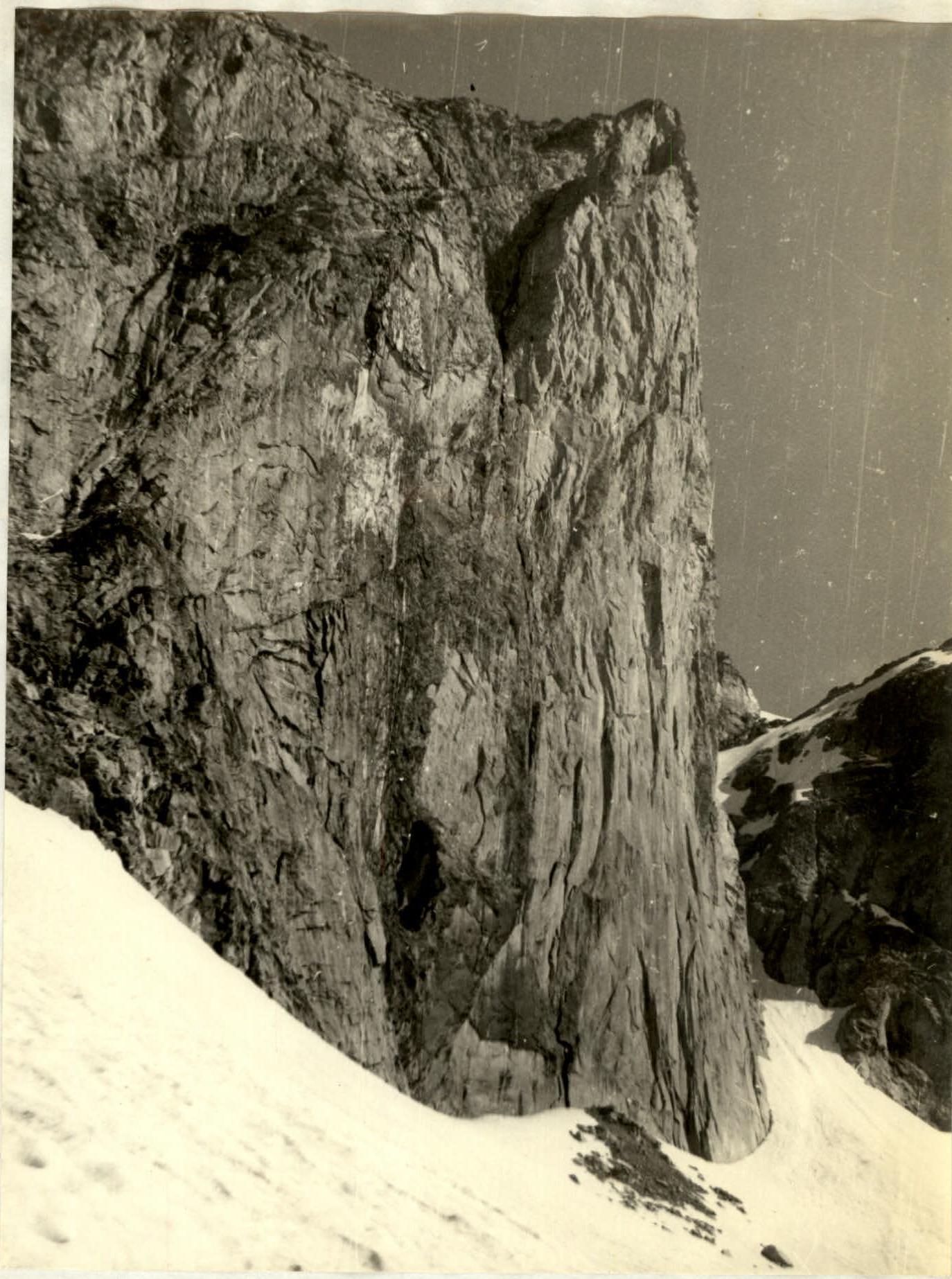
V. Kirpich, South Face Profile photograph of the route
Route Ascent Order
July 9. Today is planned as a day for approaching and reconnaissance of the new variant for the lower part of the face. The group left the Uzunkol alpine camp at 5:30, reached the Dalar pass by 10:00, and set up camp on a rocky outcrop to the right, a 20-minute walk from the face — a very convenient and safe location.
The entire group went on reconnaissance to transport all equipment to the base of the face. It was decided to go directly up to the first ledge via a characteristic spade-shaped feature pointing downwards. This would be our new variant. We decided to process it, especially since the beginning did not present particular problems. However, the first challenge arose after 20 m of free climbing (sect. R0–R1). Going straight up revealed overhanging, smooth, wide cracks. No wedges, even the widest ones, would fit. To the left, 7–10 m away, a double, fairly narrow crack went upwards, more suitable for free climbing. However, all attempts by B. Vasiliev to reach it by free climbing (photo 1) were unsuccessful — it was too steep and smooth. A pendulum was necessary (photo 2). Intuition was not misleading. The cracks turned out to be "convenient" for climbing and organizing protection. The first rope ended here. At the base of the wide cracks, a control cairn was left.
Next, we went straight up the cracks (sect. R1–R2). "The beginning greatly resembles the route on 'Pti-Dru' by Bonatti," said B. Vasiliev.
Another 40 m upwards through the cracks, leading under the eaves (sect. R2–R3). Ladders were used. There were 15 m left to a characteristic V-shaped ledge. We decided to work on it today. A 100-m end rope was lifted and secured to the ledge.
 The Vasiliev-Oshe team quickly descended down this rope, and tomorrow this rope will be used to lift the public load rucksack.
On the face, we worked for 4.5 hours, hammering in 24 rock pitons and one bolt.
The Vasiliev-Oshe team quickly descended down this rope, and tomorrow this rope will be used to lift the public load rucksack.
On the face, we worked for 4.5 hours, hammering in 24 rock pitons and one bolt.
July 10. We rose at 4:30. It was necessary to pack the transportation rucksack with water, food, and public gear properly. Finally, it was time to have a good last drink. We set out at 5:30. The face was lit by the sun early — by 6:00.
Today, Oshe worked ahead in a pair with Vasiliev. Organizing the transportation of the load and removing pitons were the responsibilities of Popov and Shchedrin. The first pitch was 100 m to the V-shaped ledge. Apart from the public rucksack, three participants (except the first) carried their personal belongings in rock bags.
From the V-ledge straight up through the exfoliations, 40 m of very tense climbing (photo 6, sect. R3–R4) led to a wide (1–1.5 m) ledge, convenient for a bivouac. Here was the second control cairn. On the ledge, we finally found signs of the first ascenders — bolted pitons, obviously used for organizing an overnight stay. However, it was still only noon, so we continued working further.
From the left edge of the ledge, we ascended left-upwards through overhanging rocks, leading into an internal corner (40 m, photo 7, sect. R4–R5). Up this corner to characteristic exfoliations on the left, another rope length (sect. R5–R6). After the second exfoliation on the left, 7 m below, there was a small ledge — the only place where a semi-sitting, semi-hanging bivouac could be organized (photo 8). By 16:00, the entire group was already at the site of the first wall bivouac, and the Popov-Oshe team went to continue working on the route. The face was overhanging in places, and ladders were used more frequently (photo 9, sect. R6–R7).
By 16:00, the entire group was at the first bivouac site, and the Popov-Oshchepkov team went to work further on the route. The face was overhanging in places, and ladders were used more frequently (photo 9, sect. R6–R7). On this day, only another 25 m were covered. The processors descended to the ledge by 18:00.
The group worked for 12.5 hours, hammering in 49 pitons, including 1 bolt.
July 11. The working day began at 6:00, but we woke up much earlier.
The Vasiliev-Oshe team went ahead, with Vasiliev B. leading. After the 25 m processed the day before, a 35–40 m overhanging "blind" wall without cracks began, pierced by the first ascenders with bolted pitons. However, we had to hammer in our own bolts for greater reliability of protection since the old pitons were 16 years old and many had rotten cores.
The wall ended at a 7-meter eave, clearly visible in the photograph in the center of the face (photo 11, sect. R7–R8). The eave was traversed on its left part. At the top of the eave, there was a steep, narrow terrace, difficult to stand on. But it was the only place to pull up the load.
Further, straight up the 60 m smooth, overhanging wall without cracks (sect. R8–R9) — rock pitons were hammered in rarely (photo 12). The path went between a large 5-meter eave on the right and a series of 3–4 m eaves on the left, leading into an internal corner with a crack, closed from above by an eave (photo 13, sect. R9–R10). Thin, universal pitons were used. The eave was traversed on its left part. After the eave, there was a traverse left-upwards into an internal corner with a niche (sect. R10–R11). It was already 18:00, but there was no suitable place for a bivouac. However, further on, free climbing resumed, although at the limit. And this was encouraging (sect. R11–R12). From the niche, the wall overhung, but was cut through by a narrow slit, where petal-shaped pitons were used. Further, a smooth 75° slab was climbed. Another 20 m of complex climbing led, finally, to a site convenient for a bivouac (photo 14). Here, a second sitting overnight stay was organized on the wall. Water seeped from the wall's cracks. With the help of gauze, it was possible to collect water. The last one climbed up in the dark.
From the first overnight stay to the second, 270 m were covered, taking 13.5 hours of walking time. 31 rock pitons, 12 bolts were hammered in, and 49 old bolts were used. There were no convenient ledges on the entire 270-meter path. The load was pulled up using ladders and harnesses.
July 12. We set out at 6:00. Oshe began processing the entrance to the 70-meter chimney through an overhanging 10-meter corner (photo 15, sect. R12–R13, R13–R14). The already complex climbing was complicated by the fact that the chimney was wet and covered in moss. However, there were reliable cracks for hammering in pitons. The chimney was closed from above by a large eave, which was bypassed on the right along a smooth slab. The exit was onto a shoulder. From here, the exit to the ridge along a 40-meter large-block wall was visible (sect. R14–R15). The last pitch of the load was organized already on the ridge. Here, the public load was redistributed, unnecessary gear was removed, and we moved towards the summit in teams.
By 12:30, the entire group was at the summit, and by evening, they descended to the camp.
To the summit on this day, the group worked for 6.5 hours, hammering in 29 rock pitons, and using 3 old bolts.
Communication with the camp was carried out as follows. There was no direct communication from the South Face of V. Kirpich to the camp, and our attempts to contact at 8:30 were unsuccessful. At 11:30, the group contacted teams of lower-category climbers from the "Uzunkol" alpine camp descending from V. Kirpich, who were in direct visibility from us at that time. Around 16:00, the team of lower-category climbers appeared under the face (as scheduled for those days).
Table of main characteristics: — Length: face — 680 m, route — 1000 m — Height difference: face — 670 m, route — 820 m — Steepness: face — ~90°, route — 75°
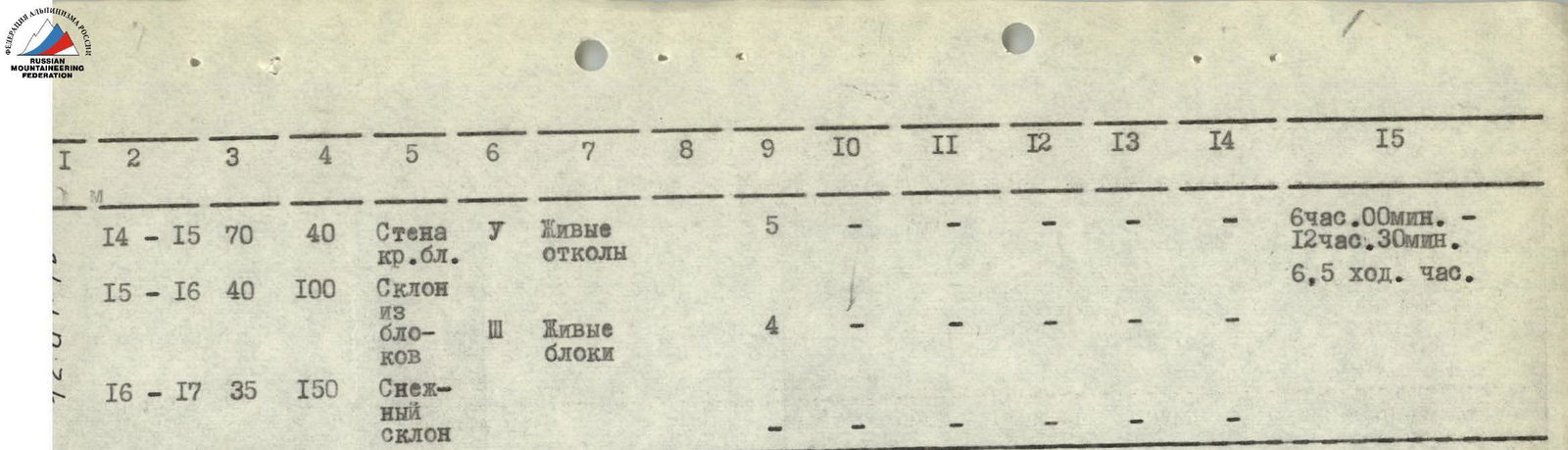
| Designation | Average steepness, deg. | Length, in m | Character of terrain | Difficulty | Condition | Weather conditions | Rock (Protection) | Ice (Protection) | Bolt (Protection) | Rock (Aid) | Ice (Aid) | Bolt (Aid) | Time and conditions of overnight stay |
|---|---|---|---|---|---|---|---|---|---|---|---|---|---|
| R0–R1 | 60 | 20 | Ledge | IV | Monolith | Good | 3 | - | - | - | - | - | 5:30 — 18:00, 12.5 walking hours. Total with processing 17 walking hours. Semi-hanging overnight stay, no water or snow. |
| R0–R1 | 90 | 20 | Wall | VI | -" | 4 | - | - | - | - | - | ||
| R1–R2 | 90 | 40 | Wall with crack | VI | -" | 8 | - | - | 2 | - | - | ||
| R2–R3 | 90 | 40 | -" | VI | -" | 9 | - | (1) | 3 | - | 1 | ||
| R3–R4 | 90 | 55 | Wall with exfoliations | VI | -" | 10 | - | - | 1 | - | - | ||
| R4–R5 | 85 | 40 | Wall with internal corner | VI | -" | 8 | - | - | - | - | - | ||
| R5–R6 | 80 | 40 | Wall with exfoliations | V | -" | 7 | - | - | - | - | - | ||
| R6–R7 | 90 | 25 | Smooth wall | VI | Monolith | Good | 2 | - | 7 (2)x | 1 | - | 7 | 6:00 — 19:30, 13.5 walking hours. Sitting overnight stay, water available (possibly signs of bad weather). |
| R7–R8 | 90 | 50 | Smooth wall with eave | VI | -" | 3 | - | 12 (2)x | 2 | - | 12 | ||
| R8–R9 | 90 | 60 | Smooth overhanging wall | VI | -" | 4 | - | 20 (3) | 3 | - | 20 | ||
| R9–R10 | 90 | 45 | Internal corner with eave | VI | -" | 6 | - | 9 (2) | 3 | - | 9 | ||
| R10–R11 | 80 | 40 | Wall with exfoliations | V | -" | 4 | - | 8 (2) | 2 | - | 8 | ||
| R11–R12 | 80 | 50 | Wall with internal corner, eaves | VI | -" | 12 | - | 2 (1) | 1 | - | 2 | ||
| R12–R13 | 95 | 10 | Internal corner | VI | -" | 5 | - | 1 (0) | 3 | - | - | ||
| R13–R14 | 75 | 70 | Chimney, wet | V | -" | 15 | - | 2 (0) | 2 | - | - | ||
| R14–R15 | 70 | 40 | Wall, large blocks | V | Live exfoliations | 5 | - | - | - | - | - | 6:00 — 12:30, 6.5 walking hours. | |
| R15–R16 | 40 | 100 | Slope of blocks | IV | Live blocks | 4 | - | - | - | - | - | ||
| R16–R17 | 35 | 150 | Snow slope | - | - | - | - | - | - | - |
Note: x in brackets — including the number of bolts hammered by the group.