
Report
of the Sverdlovsk Regional Committee of Physical Culture and Sports team on the ascent to the summit of Kirpich (3800 m) via the NW wall in the USSR mountaineering championship. Category of technically complex ascents.
Team coach and captain E. Sogrin
Sverdlovsk
1969
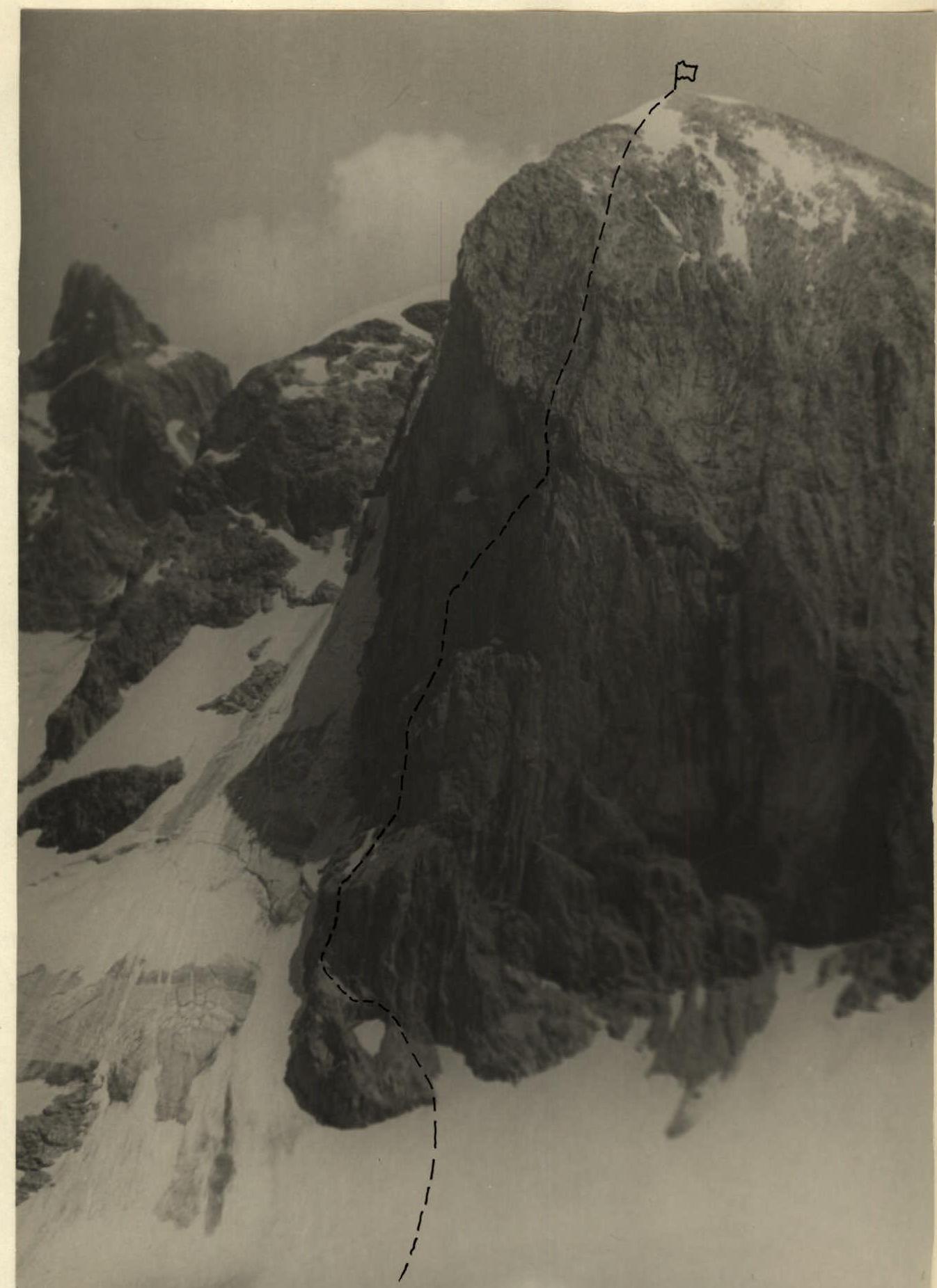 Kirpich and the ascent route via the NW wall
The radiostations were not available to the team or the camp due to a lack of power supply.
6. Team composition and technique for overcoming complex sections
The team was not randomly assigned 5 participants. Modern double-rope movement techniques allow a group of five to cover a route in the same amount of time as a group of four. The distribution of weight among five members is more rational, enabling them to tackle complex sections with backpacks and at a better pace. Eliminating the labor-intensive and time-consuming process of pulling backpacks up for most of the route saves time. Pulling backpacks is only justified on overhanging sections where the first climber spends a lot of time processing the route. This style of climbing wall routes was previously tested by the team during the ascent of Dalar's northeast ridge in 1968, where they did not pull backpacks, although most groups had to do so. The route was completed by five climbers in two days, i.e., according to the schedule of strong groups of four. Unfortunately, the fifth participant was unable to participate in the ascent due to valid reasons. This slightly increased the weight of the backpacks, but the team did not change their tactics for overcoming complex sections. Backpacks were pulled only once on an overhanging section of the triangular wall. On complex sections where it was not possible for everyone to gather, the transmission of equipment and interaction was carried out using an auxiliary rope, which was pulled by the lead climber in addition to the intermediate carabiners.
Conducting the ascent
1. Description of the ascent
August 11, 1969, Day 1. The departure was scheduled for 14:00. Five minutes before departure, during team registration, a tourist ran in from the Kichkinekol pass with news that a participant in the Italian group had been hit by a rock during their ascent of Shilt Peak via route 2B. Only after assembling a rescue team and determining that our help was not needed did we leave the camp. Although the delay was 2 hours and 30 minutes, there was enough daylight to reach the Myrd bivouac. We arrived at the bivouac at 19:30.
The weather had been excellent for several days. This fact raised concerns that it might worsen during the ascent days, as June and July had seen very unstable weather in the area: – a day or two of good weather; – followed by two or three days of rain and fog; – and so on with uneven intervals. However, there were no signs indicating a deterioration in the weather. Apparently, the weather had finally stabilized in the mountains, so we were lucky.
The backpacks were heavy. We re-sorted all our gear, but there was nothing to remove. The main weight came from the equipment that would be used on the route, and it was likely that the backpacks would get lighter.
August 12. 2nd day
We left the bivouac at 6:00. The weather was excellent, the mountain peaks were bathed in the rising sun's rays, and only "our" wall was in the shade. We ascended via the Myrdy glacier moraine and reached the glacier. We circumvented a series of crevices and the icefall at the tongue from the right, via the middle part. The glacier ascent began with a snowy slope to the base of the wall (section R1). It was difficult to make steps in the hard snow.
The slope steepness increased, and we transitioned to rocks that were heavily destroyed, making it feel like walking on scree. The slope led us to the walls, one of which featured a very beautiful rock arch, similar to Koltso-gora in Kislovodsk. We roped up. From the first meters, hammers were tapping, and pitons were clinking. The movement began along a ledge and to the left-upward, on a quite wide 0.5-1.5 m ledge, but on a sheer wall. The rocks were strong, monolithic, with cracks for wide and thick pitons. The ledge ended in a sheer wall (a complex exit, strongly tilting backwards), leading to an inclined slab (section 3). The available cracks and Vibram soles allowed for free movement, sometimes holding onto the rocks by hand. The slab led to a shoulder, from which the couloir to the left of our wall was visible, running from the northern ridge of the summit. Rocks were frequently dislodging, and some, shooting from the base of the wall below us, broke into smaller fragments.
The slab was followed by an almost vertical, seemingly completely smooth wall (section R4), and only at the top, when exiting onto a large slab, were some rock blocks and cornice visible. The wall turned out to have small, scaly irregularities - a result of weathering, not visible from below. Using this micro-relief, the section was traversed on friction, literally on the first phalanges of the fingers and on the rands. Despite the complexity and steepness, all participants climbed with backpacks, a habit formed from always climbing with a backpack (Photo 1). Cracks for pitons were small and thin. The exit onto the slab was via an internal sheer corner with a small cornice.
The slab (section 5) did not present particular difficulties; some live rocks were present. The rocks were of the "ram's forehead" type, strongly polished, requiring climbing. The steepness increased in the upper part of the slab. Movement was carried out along the middle part of the slab under the base of the next steep section, on which we saw characteristic black stripes from water.
The beginning of the wall (section 6) was traversed via oblique footholds, a foot wide. The rocks were still polished. They led to a small ledge, above which rose a sheer wall (section 7). We saw Yuri Baichenko pass it with great tension (Photo 12), hammering pitons every 1-1.5 m. We suggested using ladders, but he traversed the wall with free climbing.
The second climber immediately felt the difficulty of the section - being thrown off the wall. On small holds, fingers could not withstand the weight of the backpack (the first climbed with a lightened backpack - only a down jacket and pants). To avoid pulling backpacks, we used: – climbing protection devices (jumar, etc.); – ladders; – wire spits. This allowed us to pass the section quickly and with less tension. The last climber had the heavy task of extracting pitons.
The wall led to a steep rock gully. The ascent was made along its left wall. The rocks had good fractures. Sheer short walls alternated with ledges, internal corners, and crevices (section 8). Despite the steepness, it was easy to climb, with excellent handholds. The rocks were fairly solid, but some "live" rocks appeared.
Above the gully, a patch of snow lay on the wall. Somewhere higher and to the right should be the intended bivouac location (Photo 13). Along an oblique crack heading steeply to the right, we ascended to a small shoulder (1.5 × 2 m). It was the best spot to set up a tent, but there was no water or snow.
According to the route study, 40-50 meters to the right along a ledge, there should be snow. Malyutin went on reconnaissance, leaving behind a fixed rope. The snow was there, but all the surrounding platforms were exposed to falling rocks. The platform at the beginning of the ledge was reliably protected by an overhanging wall. It took 1 hour and 5 minutes to clear the platform and set up the tent. We stored snow in plastic bags. In the evening, the wall was shrouded in fog - it rolled in from the Myrdy pass - which was concerning.
August 13. 3rd day
The fog cleared in the morning. We departed at 6:30, using the previously fixed ropes. From the end of the ropes, the movement continued upwards. The nature of the rocks changed dramatically (section 9). With the same steepness, there were many large, unreliable blocks and live rocks. We had to climb very carefully, and when hammering pitons, we had to be cautious not to dislodge easily movable blocks. The section was traversed carefully, and the rocks remained stable. The section led to the base of the triangular wall, which was overhanging at this point. From here, the movement was directed to the left towards the uppermost point of the fracture. There were still many live rocks, with complex walls alternating with: – chimneys; – internal corners; – ledges; – crevices.
At 11:30, we reached the highest point of the fracture, and a monolithic sheer wall of the triangular wall loomed above. The Baichenko-Malyutin rope team ascended to process the wall, while Sogrin and Zemerov prepared the bivouac site. It took over four hours to clear the platform. By 17:00, Baichenko and Malyutin had fixed 50 m of rope. The climbing was very difficult and complex, with some sections overhanging, requiring the use of ledges and ladders; – 4 drilled pitons; – 25 regular pitons were hammered in. By 17:30, the weather worsened significantly, with clouds covering everything, visibility reduced to 5-10 m, thunder rumbling, and snow pellets falling. The rope team descended, leaving the fixed ropes.
August 14. 4th day
It rained all night, interspersed with snow pellets. This bad weather continued throughout the day. Emerging from the tent was pointless. We were forced to wait out the bad weather. There was no wind, just the incessant drumming of rain on the tent.
August 15. 5th day
The rain seemed to continue through the night, and there was fog in the morning. By 10:00, "windows" appeared in the sky. Why was it still raining? It turned out that the water was streaming down the wall and pouring onto our tent. The fixed ropes became twice as thick: the ropes had swollen from water and were covered in a layer of ice. By 14:00, the fog had dispersed, and the sun appeared in the gaps between the clouds. Our wall, being northwest-facing, remained in the shade, while the dome-shaped summit of Kirpich, having collected the bad weather for 1.5 days, was now releasing it onto its walls. On our northwest wall, a continuous ice crust had formed from the water streams, filling all the cracks and folds of the relief.
Nevertheless, the rope team set out again at 13:00. The condition of the route was poor. There was nothing to grasp; everything was slippery and wet. To make matters worse, the water continued to pour down, quickly soaking our clothing. We managed to advance no more than 10 m. Cracks for pitons were filled with ice. Drilled pitons held well. Again, the fog rolled in. The situation was becoming serious.
The following problems arose: – Climbing the wall in such a condition was not safe. – The weather was deteriorating again. – There was a need to hammer in a large number of drilled pitons. – This caused a delay. – There was a need for a hanging bivouac on the wall. In unstable weather conditions, this could lead to an emergency situation. After a brief discussion, the rope team descended, removing the fixed ropes.
When studying and preparing the route, we had discussed several options for traversing the triangular wall. We had noticed the right part, where between two black streaks there was an overhanging but always dry section, as the ridge above directed all the water to the left and right towards the black streaks, leaving the wall between them dry.
Based on the current situation, we decided to depart early the next day and attempt to traverse the triangular wall via the right part, where it was expected that less ice would have formed, and any ice that had formed would have melted by the afternoon. If the weather was bad or the condition of this part of the wall was unsatisfactory, we would have to: – descend.
August 16. 6th day
The night was cold. Water was not dripping from the wall, but the ice on the wall glistened. We descended to the base of the triangular wall. From there, we moved under the overhanging black rocks of the left flow (section 10). Everything was covered in ice, making it practically impossible to find holds, so pitons were often hammered in as handholds. The first climber traversed dry, but subsequent climbers were hit with streams of water - the upper dome of the summit had been illuminated by the morning sun, and the first streams of water hit us. The weather seemed to be improving. There was hope that we could dry out and traverse the wall. The fracture ended in a small ledge, from which the movement went vertically upwards (section 11). Climbing was difficult. The rocks were monolithic, with few cracks, mostly wide. The wall gradually turned into an overhang (section 12). Above, a rocky ridge was visible, overhanging the wall. At this section: – we pulled out ladders; – the first climber removed his backpack; – we decided not to use the ledge for now.
After 10 m of overhanging rock, there were no more cracks, and we had to hammer in drilled pitons. The rocks were dry, while water streamed down on either side of us. At 20:00, Baichenko traversed the overhang. It was clear that even on ladders, climbing was difficult, due to the fatigue of the sixth day of ascent. Malyutin followed, and together they organized the pulling of backpacks, which hung in the air several meters from the wall. The last climber removed the drilled pitons, leaving only the "derks" for future climbers.
The next rope length (section 13) seemed simple after the overhang, but the number of pitons hammered in indicated otherwise. The rocks were slab-like, and climbing was done on friction, mostly on the toes of boots. The slab ended in a meter-long cornice, which was traversed with free climbing using a corner-chimney. The rocky ridge remained somewhat to the left, while the corner-chimney led to the base of a gully.
Further movement (section 14) was along a rocky gully, 10-15 m wide - it presented rocks of average difficulty. Short walls alternated with ledges, slabs, and internal corners. The gully led to a rocky outcrop, which led to the summit dome (section 15).
The group reached the highest point of Kirpich at 18:30. Without delay, we began our descent to reach the Dalar moraine by nightfall, where there were platforms for camping. We arrived at the last platform in twilight, around 20:30. For dinner, we ate our last supplies.
August 17. 7th day
We hardly slept at all. A very strong wind was blowing, and the tent was battered so much that despite our fatigue, it was impossible to sleep. At 5:00, we were already leaving the bivouac and reached the camp by 6:00.
IV. Evaluation of participants' actions
The ascent demonstrated that the group was proficient in all the technical skills required for wall climbing, and also showed restraint and tactical awareness in the face of worsening weather and challenging route conditions. Throughout the ascent, there were no serious disagreements within the group, which significantly contributed to the success of the climb and its completion in difficult conditions.
Baichenko Yu.N. - a competent mountaineer, acted as deputy captain. During the preparation for the ascent, he conducted significant organizational work on developing and manufacturing specialized equipment. His persistence and determination greatly contributed to the success of the ascent. He is a good rock climber, and on the route, he confidently led the way. He competently organized belays.
Zemerov V.I. - has extensive experience in mountaineering. Having repeatedly served as expedition leader, he is well-versed in many organizational and tactical matters. On the route, he climbed quickly and efficiently organized belays. He competently ensured interaction between rope teams.
Malyutin V.M. - a highly skilled and tactically competent mountaineer, able to navigate and choose the correct route. He paid great attention to the group's safety and correctly organized movement. He climbed well as a leader, was physically very strong, and had great endurance.
General conclusion on the route
The traversed route via the NW wall of Kirpich peak proved to be an interesting and logical route of 5B category difficulty. The average steepness of the wall was 75° with a height difference of 700 m. The overall height difference from the start of the route to the summit was 1000 m. The steepness of the complex sections was close to 90°, with some even overhanging. It can be said that almost the entire route traversed steep, sheer rocks where free climbing was only possible with Vibram soles. Climbing in crampons would necessitate the use of artificial holds on a significant part of the route. The route required carefully prepared specialized equipment, excellent modern rock climbing skills, good physical and mental preparation, and sufficient experience in wall climbing. The route demanded the widest range of rock pitons, from "petals" to wedges and drilled pitons.
The group completed the route in 27 hours, hammering in 140 pitons, including: – 5 drilled pitons.
Comparing the route to those previously climbed, it can be concluded that the route via the NW wall of Kirpich belongs to the complex routes of 5B category difficulty.
| № | Steepness | Length, m | Description of relief | Technical difficulty | Method of overcoming | Time taken, h | Rock pitons | Drilled pitons | Bivouac conditions | Weight of daily ration, kg |
|---|---|---|---|---|---|---|---|---|---|---|
| 1. | 30° | 250 | Snowy slope, at the end of which are destroyed rocks of the same steepness. | Does not present technical difficulty. | Simultaneous movement without ropes. | 6:30 | The whole day had excellent weather. Fog closed the entire valley by 17:00. | 3.0 | ||
| 2. | 50° | 60 | A 2 m sheer wall, then along a 30° ledge left-upwards 50 m to a sheer wall. Along the wall, traverse 10 m to an inclined slab. The rocks are monolithic with large fractures and few holds and fractures. | Rocks of medium difficulty. The last 10 m are very complex climbing on vertical walls with minimal foot support. | Free climbing with thorough piton belay. | 5 | ||||
| 3. | 45° | 40 | Monolithic slab about 70 m wide. Dry and clean rocks with few cracks. The slab leads to a ridge that drops off with sheer walls into a large snowy couloir. | Climbing of medium difficulty; movement across smooth slabs is facilitated by Vibram soles. | Independent movement of rope teams with piton belay. | |||||
| 4. | 85° | 60 | From the ridge, directly upwards along a 5 m fracture to a 30 m sheer wall with smooth protrusions. There are no ledges, holds, or fractures, or very few. From the fracture, slightly to the right, under a clearly visible cornice above a short internal corner. A 90° ledge for one or two people on the sheer wall. From here, traverse left 10-15 m along a narrow ledge under a 20 m vertical wall, leading through a 0.8 m cornice to a large inclined slab. | One of the key sections of the route. Great steepness - almost sheer, with few fractures, complicating movement. There are no places for belay setup, and few cracks for pitons. A lot of friction climbing. | Tense natural climbing using pitons. Alternate movement on a double rope with the use of jumar and ladders, climbing with backpacks. | 21 | ||||
| 5. | 50° | 120 | Inclined slab with smoothed protrusions. Convenient relief for movement and belaying, with many protruding monolithic blocks. In some places, there are short smooth walls, wet rocks, ice, and many live rocks. Steepness increases with altitude. The slab leads under a grey wall with black water streaks. | Climbing of medium difficulty, more tense on sections covered with rime ice and on short smooth walls. | Movement of rope teams - independent with alternate belay through protrusions and pitons. | 6 | ||||
| 6. | 75° | 70 | From the ledge under the wall - up a 4 m vertical wall, then along short, indistinctly expressed ledges going left-upwards to the right onto a 2 m wide ledge. Along it, 10 m to the left under the base of a sheer black wall with a cornice. The rocks are wet, with few cracks, but rough and with sufficient small holds. | Difficult climbing on the first half of the section - mainly on friction. High load on fingers on wet sections. Upon reaching the ledge - climbing of medium difficulty. | Natural climbing on a double rope. Belay is only via pitons. Jumar used on fixed ropes. | 7 | ||||
| 7. | 90° | 30 | Along a 12 m sheer wall, several meters left of the cornices, to an inclined ledge. Along it, 10 m to the right, then up a completely smooth internal corner to a platform under a huge "plug". | One of the key sections of the route. When traversing the wall, it is strongly thrown to the right under the cornice. High load on fingers due to the vertical arrangement of holds and fractures. Movement along the corner is only possible using opposition and friction. Traversing this section is technically more complex. | Difficult climbing using artificial holds and ladders. Movement on a double rope allowing for continuous upper belay. | 10 | ||||
| 8. | 75° | 120 | From the ledge under the "plug", left onto the wall of a wide and steep gully, consisting of huge blocks with good hand and footholds, many fractures, cracks, and live rocks. Up the wall directly to a shoulder, then, circumventing overhanging cornices on the left, along a 10 m vertical wall and smoothed rocks of the "ram's forehead" type. The wall leads to a narrow inclined ledge 30 m under a vertical wall, which leads to a shoulder-platform. | Good climbing of medium difficulty, difficult in some parts due to the smoothness of the rocks. The beginning and end of the section are dangerous due to numerous loose rocks. | Natural climbing with interaction between rope teams and piton belay. | 11 | ||||
| 9. | 75° | 120 | From the bivouac, traverse right along a wide ledge 60 m (possible bivouac sites on the ledge) to a snowpatch under the base of an internal corner with an aperture of 100°, the left wall of which is sheer, and the right wall is the base of a wide vertical gully. Along the internal corner 50 m, exit to a narrow ledge under the base of a smooth 10 m wall, which is circumvented on the left along a ledge to a wide ledge. Along it, 20 m to the left under the base of a steep 40 m wall. Exit to a ledge via fractures in the lower left part of the wall. | Difficult climbing along the internal corner - great steepness and smoothed relief. The gully is rockfall-prone. Further climbing is of medium difficulty, interspersed with very tense sections due to numerous loose rocks. The section is rockfall-prone throughout, as it is located under one of the gullies above the triangular wall. | Climbing without artificial holds. Use of fixed ropes when interacting between rope teams. Belay is only via pitons. | 6:30 | 13 | Bivouac on a 1.5 × 2 m platform. The whole day had good weather with clear skies; fog at 17:00, followed by a thunderstorm, rain, and snow. | 2.9 | |
| 12. | 95° | 25 | A 15 m negative wall with a single vertical crack that turns into a 2-3 cm deep groove after 6-7 m. The rest of the wall is monolithic. Above the wall is a 0.5 × 1 m ledge with a 45-50° slope, without holds or protrusions. The left and front walls above the ledge are cornices; the right wall is a 4 m sheer wall, above which is a small 2 m outcrop leading through a 5 m wall to gentler rocks with cracks. | The most complex section of the route. Monolithic overhanging rocks without cracks or fractures. | Industrial climbing using drilled pitons, individual ladders, and jumar. Pulling backpacks. The belay point is hanging. | 12 | 5 | |||
| 13. | 80° | 45 | From the belay point upwards 15 m to a large monolith. Along its upper part at 60° to a horizontal crack on a vertical wall with a cornice. The lower part of the wall below the crack protrudes by 1.5-2 cm. Traverse left along the crack to a small ledge under a black rock. From the ledge, up through fractures in the cornice to the base of a gully. | Few holds and cracks, constant overhangs make the section one of the key parts of the route. | Very difficult natural climbing without backpacks, with interaction between rope teams and piton belay. | 11 | ||||
| 14. | 50° | 150 | Along the right part of a narrow and steep gully, which widens and becomes gentler upwards, exit to a ridge leading from the summit dome. | Rocks of medium difficulty, with a step-like character, fractures, and live rocks. | Movement of rope teams - independent with alternate belay through protrusions and pitons. | 10 | ||||
| 15. | 30° | 150 | Exit from the gully along a washed-out ridge transitioning into a scree slope of the summit dome. | Rocks of medium difficulty and easy. | Simultaneous movement. | 18:30 | ||||
| 16. | 15° | 120 | Medium scree transitioning into the snowy summit dome. Descent to the Dalar pass via the route of 1B category difficulty. | Simultaneous movement without ropes. |