10. Climbing Passport
- Climbing category: rock
- Climbing area: Gvandra region of the Caucasus
- Climbing route: v. Zamok via the South wall, 3930 m
- Climbing characteristics:
height difference — 900 m, average steepness — 85°, length of complex section — 600 m
- Pitons driven:
- rock — 228
- bolt — 7
- chocks — 9
- Time taken: 45 hours
- Number of bivouacs and their characteristics: 4 good ones in a tent
- Team name: DSO "Avangard" instructor of the Uzunkol alpine camp
- Route characteristics:
The Karablin B.N. route on v. Zamok via the south wall is rated above 5B category. It is one of the most difficult routes I've undertaken as part of the country's championship and the Ukrainian SSR championship (Chatyn-Tau, Ushba). It can be compared to routes like Chatyn-Tau. The route along the south wall of Zamok is purely rock, concentrated in 3 bastions of approximately 200 m each, with the middle bastion being the most difficult and interesting due to its chimney. The height difference of the route is 900 m, including 500 m of extremely difficult sections and 100 m of difficult sections. The average steepness is 85°.
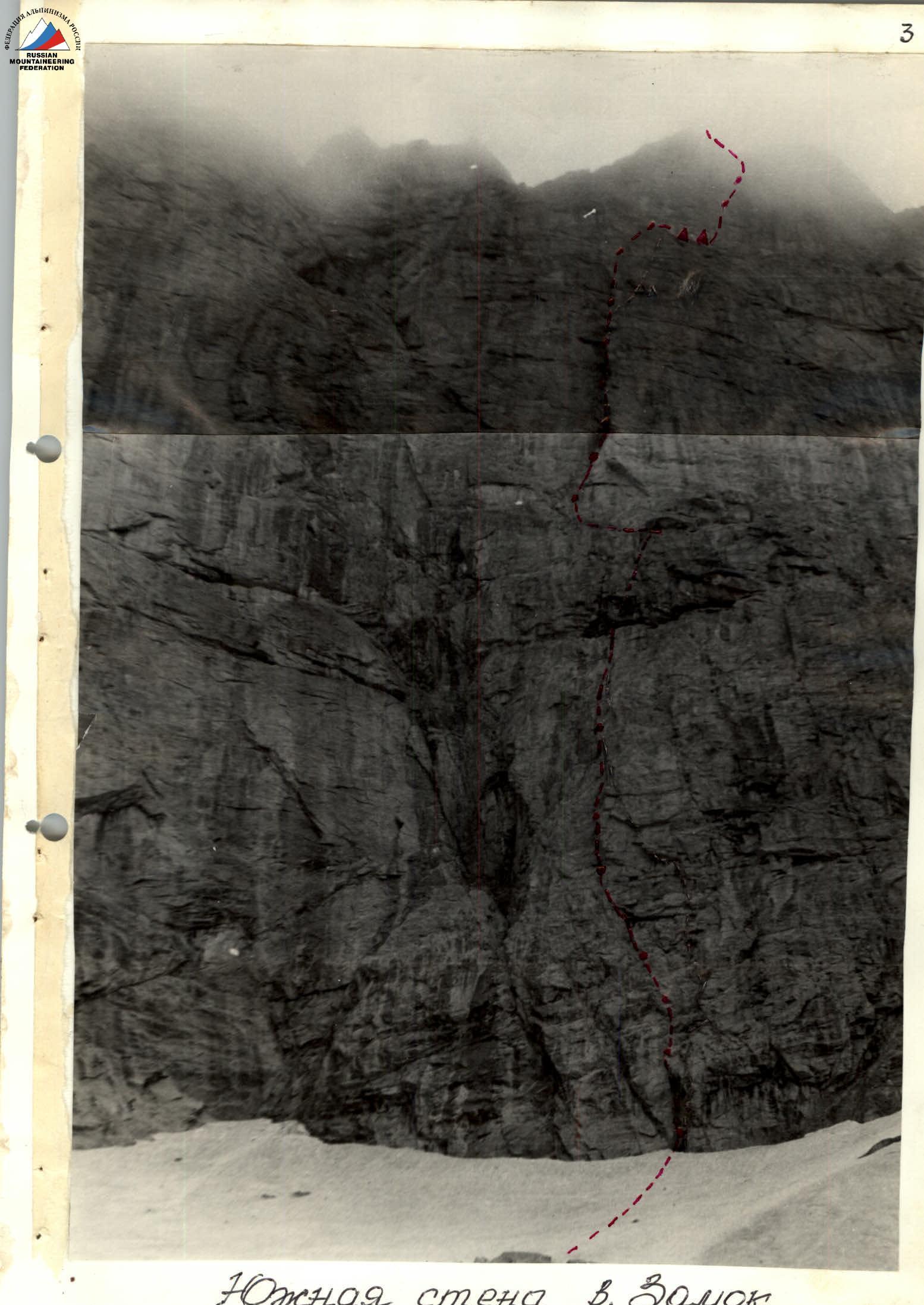
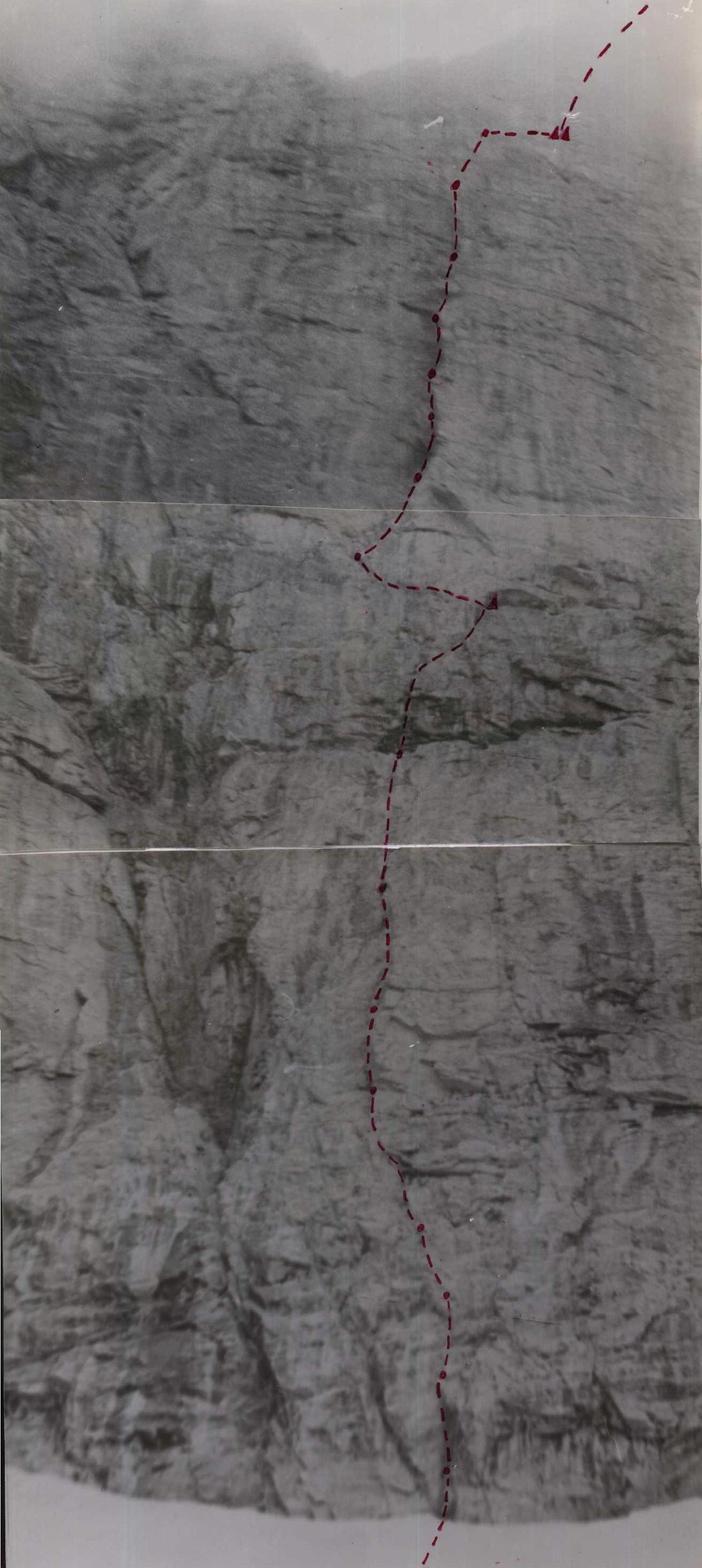
South wall of v. Zamok. Route overview
- Surname, name, patronymic of the team leader, participants, and their qualifications:
| Krasnoshchekov N.A. | CMS, team leader, captain |
| Yarovoy L.Ya. | CMS |
| Kabatsky V.I. | 1st sports category |
| Dunduk A.G. | 1st sports category |
| Babin O.F. | MS |
| Team coach | Zakharov P.P. |
Departure and return dates:
- Departure: July 27, 1979
- Return: August 1, 1979
2. Brief description of climbing conditions in the Uzunkol gorge area
All peaks in the area are primarily composed of strong monolithic granites, gneisses, and basalts. The main peaks of the area: Kirpich (3744 m), Dalar (3979 m), Dvoinyashka (3743 m), Zamok (3872 m), typically have no easy paths, and their walls are among the most challenging in the Caucasus.
The Uzunkol area is known for its unstable weather. 3–6 days of good weather are usually followed by 2–4 days of bad weather.
During the climbers' stay in this area, from July 1 to August 10, 1979, the weather changed 8 times. Climbs started in good weather were often interrupted or completed in bad weather.
3. Organization and tactical plans for the climb
The ascent of v. Zamok via the South wall using the Karablin B.N. route, which took 1st place in the rock climbing class at the USSR Climbing Championship in 1978 and was rated 5B category, was planned by us as early as 1978.
Before heading to the mountains, the team conducted joint training on the rocks at the Zuevsky quarry with training climbs before embarking on the route. The goals were to practice moving in teams on complex terrain, test new equipment samples, and check the physical and technical preparation of team members. They also completed routes like v. Dalar 5A category via the triangle and v. Dalar 5B category via the western ridge.
The preliminary tactical plan was as follows:
- July 25 — depart from the camp and set up a base camp;
- July 26 — observe the route and study the approach to the wall;
- July 27 — process the 1st bastion;
- July 28–30 — complete the route and return to the camp;
- July 31 — reserve day for bad weather.
The significant steepness of the wall and the visible two platforms between the bastions allowed for planning bivouac sites on these platforms.
The tactical plan included: simultaneous passage by teams along the route and team interaction; movement with and without backpacks.
In addition to standard equipment used on similar climbs, some new gear was utilized: harnesses, ascenders, chocks, etc.
The entire route was conducted on double ropes. Observation and radio communication were planned through two observation groups: one on the Myrdy pass; the other on the ridge spur of v. Dvoinyashka.
The route passage and all work on it were delayed by one day due to bad weather on July 30, 1979, when it's visibility worsened, the team couldn't continue the climb that day. Despite this, the ascent plan was fulfilled.
4. List of equipment used by the team on the route
- Main rope 3x60 m
- Main rope 2x40 m
6. Route passage order
July 25. A group of 5 people: Krasnoshchekov N.A., Yarovoy L.Ya., Kabatsky V.I., Babin O.F., Dunduk A.G., and 2 observers headed under the south wall of v. Zamok, where an observer's tent was set up. For communication with the camp, two observer-relays were positioned on the Myrdy pass.
July 26 — Day 1
There was a solid fog, visibility 10 m, so on this day we managed to set up only the assault group's tent on a rocky cape under the wall and check communication with observers.
July 27 — Day 2
Fog, visibility from 10–15 m to 50 m.
7:00 — the team: Yarovoy L. — Krasnoshchekov N.A. heads up under the wall for route processing.
From the tent, along a steep (50–55°) firn slope — approach under the wall. The start of the route on the wall is via a vertical crevice (15 m) in the center of the bastion, left of the inclined rusty shelf (section R1–R2). Then along a slab under the wall and along it — to a system of cornices (30 m) (section R2–R3) and further along a 40-meter more steep wall consisting of cornices (sections R3–R4 and R4–R5), climbing using ladders. Further, the system of cornices transitions into a vertical 35-meter crevice (section R5–R6) with small cornices.
The weather worsened sharply, along with fog, snow, and hail started, so on this day at 14:00 we had to stop the route passage, not reaching the 1st tur 10 m.
Thus, on the 1st day, we processed 3 ropes and returned to the bivouac under the wall. On the first day, we drove 30 rock and 1 bolt piton.
July 28 — Day 3
Fog, visibility 20–50 m.
6:00 — Yarovoy L. — Krasnoshchekov N.A. heads up under the wall along the hung ropes, followed by the rest of the climbers: Dunduk A., Babin O., Kabatsky.
We continue to pass the vertical crevice, and at its top, under a small ledge, a can with a note is fixed on a bolt piton (1 tur) (section R6–R7).
The vertical crevice on the wall turns into an internal corner ending in a sharp cornice (section R7–R8, 40 m).
To the right of the cornice and further up the wall (section R8–R9) 40 m leads to a shelf resembling a niche under an overhanging cornice, where water is pouring. After another 40 m, traversing several meters to the right, we reach a comfortable shelf (section R9–R10). Bivouac site (1 tur).
By 14:00, the entire group was already on the upper shelf, where a bivouac site had been prepared by the first ascenders. On this day, we drove 38 rock and 2 bolt pitons and covered 120 m.
The movement scheme on the route was as follows: The first climber went without a backpack (there were 4 backpacks of 6–7 kg per group). The second climber lowered it on a double rope. The third climber approached the second and brought him the freed rope from the route, after which the second climber ascended on ascenders with top protection to the first climber, and upon reaching him, again lowered him.
The fourth climber, during the passage of the 1st team on the route section, ascended to the third, and together they pulled the backpacks to their level. This work was usually performed by Dunduk A. — Kabatsky V. or Babin O. — Kabatsky V. The last one removed pitons and ascended on ascenders with top protection. And so, sections of 40 m were passed throughout the entire route.
The backpacks being pulled were hung on artificial protection points (ladders, harnesses) on certain sections.
The first team constantly worked ahead on the route, regularly receiving used ropes.
On the same day, the Dunduk A. — Yarovoy L. team started working on the middle bastion. Directly from the tent — a smooth, overhanging wall without cracks with a row of drilled bolt pitons (Route of the first ascenders). Based on the description by the first ascenders, the second bastion requires the use of 30 bolt pitons, so we decided to pass the bastion 10 m to the left along a chimney-like crevice with overhanging cornices and cornets. The chimney stretches from the shelf where our bivouac is located to the second shelf on the route (end of the second bastion). Having individual sections of 1.5–3 m with a steepness of 80–85° at an overall wall steepness of 90°.
Having moved along the shelf 10 m to the left, the Dunduk A. — Yarovoy L. team started ascending. Initially, 15 m to the right and up (section R10–R11). Then left and up along an internal corner to a cornice 35 m (section R11–R12). The 1.5 m wide cornice is overcome using ladders. After the cornice, several meters to the left up 20 m along smoothed slabs, climbing is tense, there are few cracks, petal pitons are used, one bolt piton is driven (ladders) (section R12–R13). Then, overcoming a series of cornices, we continue moving along the internal corner 30 m (section R13–R14) and reach a narrow shelf.
Climbing is extreme.
We worked for 6 hours, hung 100 m of rope, drove 48 rock and 2 bolt pitons, and the team returned to the bivouac.
July 29 — Day 4
Fog, visibility 10–15 m.
6:00 — the Dunduk A. — Yarovoy L. team heads onto the route, removing intermediate pitons along the way; the rest collect the bivouac and start organizing the pulling on the section of the hung 3 ropes of the second bastion.
After the narrow shelf, the Dunduk A. — Yarovoy L. team passes 20 m (section R14–R15) of a flattening and then again up the chimney and slightly to the right, overcoming a series of overhanging 1–1.5 m cornices (35 m section R15–R16). Climbing is extremely tense, requiring chocks, 1 bolt piton is driven when overcoming a cornice. After overcoming the cornice along the internal corner 30 m, we reach a shelf (section R16–R17).
The internal corner is passed using ladders, requiring petal pitons, 1 bolt piton is driven. Further, from the shelf to the right and up along the chimney 40 m, exiting to the top of the 2nd bastion (section R17–R18). Tense climbing using ladders. We find the bivouac site of the first ascenders. Another 125 m of the route to the top of the second bastion were passed, 54 rock and 2 bolt pitons were driven, 6 chocks were used, and we worked for 9 hours.
On the same day, the Krasnoshchekov N. — Kabatsky V. team processed 3 ropes of the 3rd bastion.
A traverse along the shelf to the right, then straight up the wall with overhanging large blocks 30 m (section R18–R19). On this section of the route, the rock relief is rich in crevices and cracks, although climbing is very difficult. A traverse to the right and up 20 m, then straight up the wall 40 m with an exit to a shoulder (section R19–R20). From the shoulder, a traverse to the right for one rope leads under the base of a 60-meter steep internal corner (like a chimney), leading to the ridge (section R20–R21).
By 20:00, the Krasnoshchekov N. — Kabatsky V. team descended to the bivouac, having processed the rocks to the base of the 60-meter steep internal corner, covering 120 m in height. On this section, 34 rock pitons were driven, and 5 hours were spent.
July 30 — Day 5
It snowed, hailed, and there was a squally wind and thunderstorm throughout the night and day. Therefore, on this day, we did not proceed with the route.
July 31 — Day 6
Fog, visibility 10–20 m. We dismantle the bivouac and depart at 6:00. The route is heavily snowed.
At 9:00, we approached the 60-meter internal corner, which took us 3 hours to pass, and we reached the ridge, and then along the ridge — to the summit. Snow and hail started, visibility 2–5 m. We were on the summit at 14:30, having driven 24 rock pitons, and began descending towards the pass between v. Zamok and v. Dvoinyashka as recommended by the Uzunkol alpine camp. On the descent, due to complex weather conditions, we organized 16 sports descents and rappels.
By 21:00, the group was at the observers' bivouac.
August 1 — Day 7
Return to the camp via the Myrdy pass. Total number of pitons driven: 228 rock and 7 bolt.
7. Overall assessment of the team members' actions
Passing a technically and morally complex route showed good physical and technical preparation, high moral and volitional qualities of each climber, common interests, and complete mutual understanding.
8. Data on auxiliary groups
Observation was organized by two groups. The first group was located on the spurs of the ridge of v. Dvoinyashka, the second — on the Myrdy pass. The observers were equipped with "Vitalka" radios and had stable communication with the team and the camp.
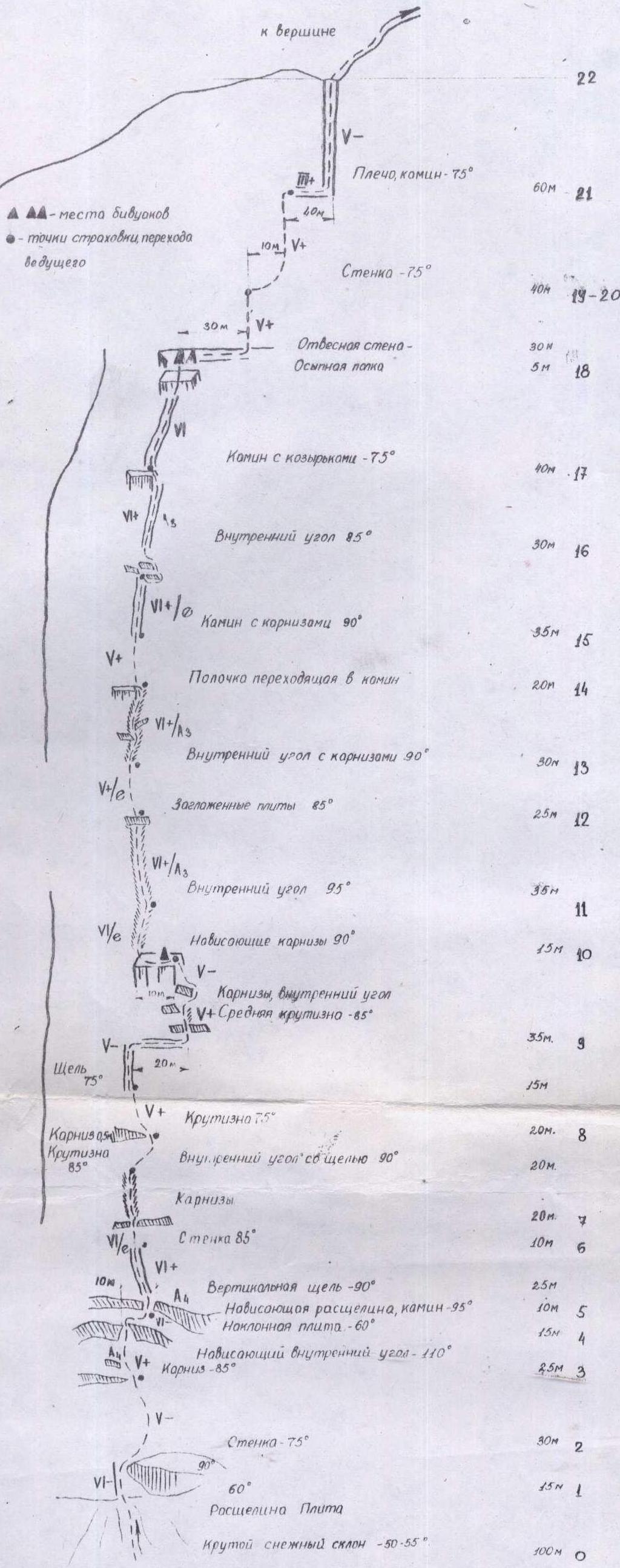
 Sections of the route on the South wall of v. Zamok
 VI+ — difficulty category of the route section: free climbing
A3 — difficulty category of the route section: climbing with artificial aids (ITO)
• — sections with bolt pitons
VI+ — difficulty category of the route section: free climbing
A3 — difficulty category of the route section: climbing with artificial aids (ITO)
• — sections with bolt pitons
to the summit
R22
V-
M+
Shoulder-chimney, 75°
60 m, section R21
▲ ▲ — bivouac locations
● — protection points, leading climber's transition
10 m V+
Wall, 75°
40 m, sections R19–R20
30 m V+
Steep wall — Scree shelf
30 m, section R18
VI
Chimney with cornets, 75°
40 m, section R17
VI
Internal corner, 85°
30 m, section R16
VI+/0
Chimney with cornices, 90°
35 m, section R15
V+
Shelf turning into a chimney
20 m, section R14
VI+/A3
Internal corner with cornices, 90°
30 m, section R13
V-
Smoothed slabs, 85°
25 m, section R12
VI+/A3
Internal corner, 95°
35 m, section R11
VI-
Overhanging cornices, 90°
15 m, section R10
V+
Cornices, internal corner + Average steepness, 85°
35 m, section R9
V-
Crevice, 75°
20 m, section R8
15 m, section R7
V+
Steepness, 75°
Cornice 0.5 m
Steepness 85°
20 m, section R8
Internal corner with crevice, 90°
20 m, section R7
Cornices
20 m, section R6
Wall, 85°
10 m, section R5
VI+
Vertical crevice, 90°
25 m, section R5
Overhanging crevice, chimney, 95°
10 m, section R4
Inclined slab, 60°
15 m, section R3
A1
Overhanging internal corner, 110°
Cornice, 85°
25 m, section R2
Wall, 75°
30 m, section R2
VI-
60°
15 m, section R1
Crevice, slab
Steep snow slope, 50–55°
100 m, section R0
Table
main characteristics of the second ascent route
The second ascent route — v. Zamok via the south wall 5B category, Karablin B.N. route, height 3930 m. Height difference of the route — 900 m. Including: most difficult sections — 600 m, route steepness — 85°.
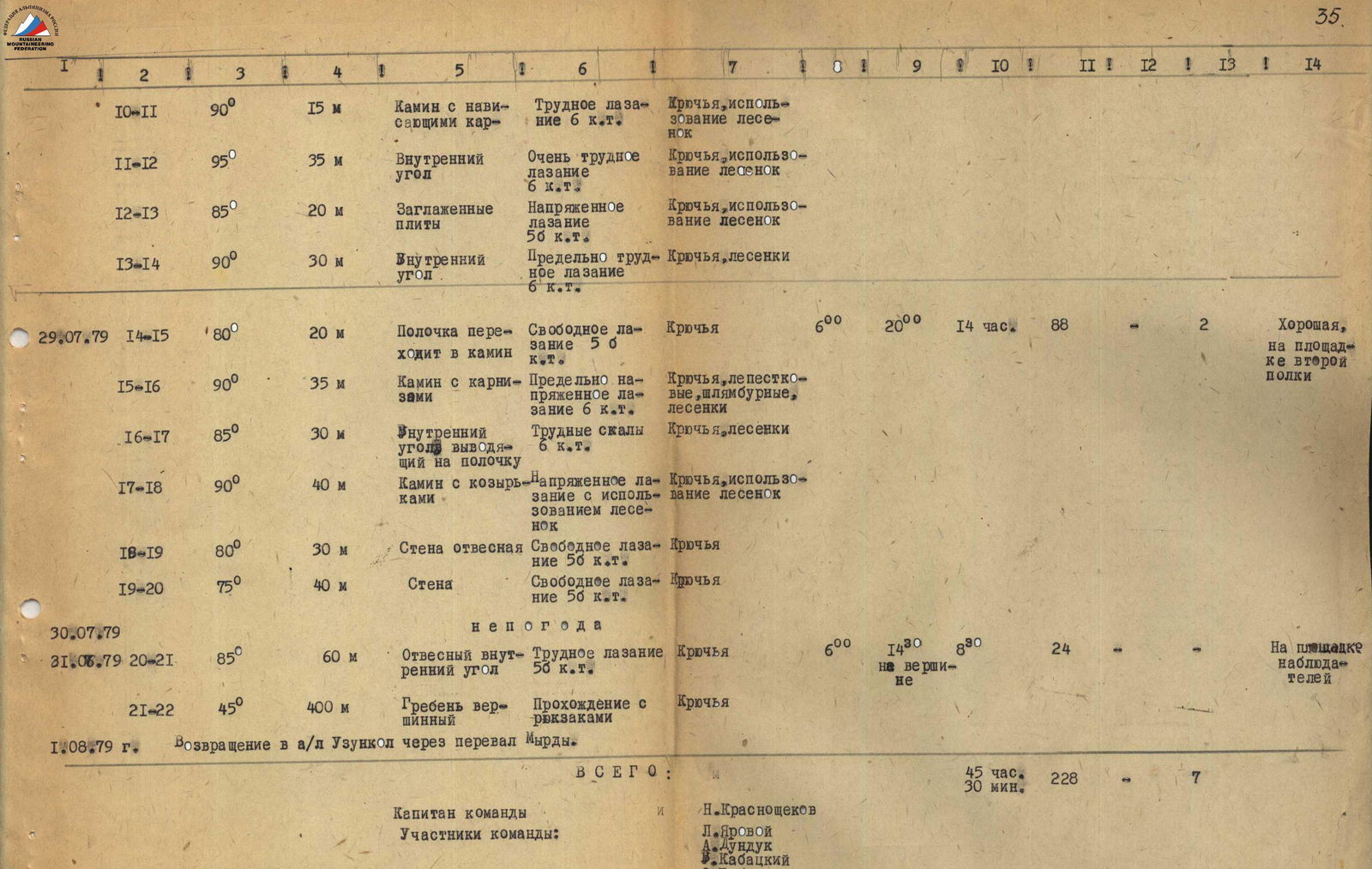
| Date | Passed sections | Average steepness in degrees | Length of section | Characteristics of the section and conditions of passage by relief character | Passage by technical insurance | Working hours | Rock pitons driven | Bolt pitons driven | Bivouac conditions, stop on bivouac |
|---|---|---|---|---|---|---|---|---|---|
| 27.07.79 | R0–R1 | 55° | 100 m | Steep snow slope | via ice axe | 7:00–14:00 | 30 | 1 | Good, on the assault group's site |
| R1–R2 | 90° | 15 m | Crevice, slab | Difficult rocks, 6 category | |||||
| R2–R3 | 80° | 30 m | Cornices | Difficult rocks, 5B category | |||||
| R3–R4 | up to 110° | 25 m | Overhanging internal corner, tense climbing | Difficult rocks, 6 category, use of ladders | |||||
| R4–R5 | 60° | 15 m | Inclined slab | Rocks of medium difficulty, 4 category, free climbing | |||||
| R5–R6 | 95° | 35 m | Vertical crevice, overhanging crevice | Difficult rocks, 6 category, use of ladders | |||||
| 28.07.79 | R6–R7 | 85° | 10 m | Wall | Difficult rocks, 5B category | 6:00–22:00 | 86 | 4 | Good, on the first shelf site |
| R7–R8 | 90° | 40 m | Internal corner | Difficult rocks, 6 category, use of ladders | |||||
| R8–R9 | 80° | 40 m | Wall | Difficult climbing, 5B category | |||||
| R9–R10 | 85° | 40 m | Cornices, internal corner | Difficult climbing, 5B category, use of ladders | |||||
| 29.07.79 | R10–R11 | 90° | 15 m | Chimney with overhanging cornices | Difficult climbing, 6 category | 6:00–20:00 | 88 | 2 | Good, on the second shelf site |
| R11–R12 | 95° | 35 m | Internal corner | Very difficult climbing, 6 category, use of ladders | |||||
| R12–R13 | 85° | 20 m | Smoothed slabs | Tense climbing, 5B category, use of ladders | |||||
| R13–R14 | 90° | 30 m | Internal corner | Extremely difficult climbing, 6 category, pitons, ladders | |||||
| R14–R15 | 80° | 20 m | Shelf turning into a chimney | Free climbing, 5B category, pitons | |||||
| R15–R16 | 90° | 35 m | Chimney with cornices | Extremely tense climbing, 6 category, pitons, petal, bolt, ladders | |||||
| R16–R17 | 85° | 30 m | Internal corner leading to a shelf | Difficult rocks, 6 category, pitons, ladders | |||||
| R17–R18 | 90° | 40 m | Chimney with cornets | Tense climbing using ladders, pitons | |||||
| R18–R19 | 80° | 30 m | Steep wall | Free climbing, 5B category, pitons | |||||
| R19–R20 | 75° | 40 m | Wall | Free climbing, 5B category, pitons | |||||
| 30.07.79 | Bad weather | ||||||||
| 31.07.79 | R20–R21 | 85° | 60 m | Steep internal corner | Difficult climbing, 5B category, pitons | 6:00–14:30 | 24 | — | On the observers' site |
| R21–R22 | 45° | 400 m | Summit ridge | Passage with backpacks, pitons | |||||
| 01.08.79 | Return to the Uzunkol alpine camp via the Myrdy pass. |
TOTAL:
| 45 h 30 min | 228 | 7 |
|---|---|---|
| Team captain: | Krasnoshchekov N.A. | |
| Team members: | Yarovoy L.Ya., Dunduk A.G., Kabatsky V.I., Babin O.F. |