
Sokol Mountain "Present set" marush (big walk) 2A
Author: Gennady Ivanov
In June 2012, my wife Anna and I visited Sudak and climbed Sokol Mountain via the "Present set" marush, rated 2A-2B.
Marush is simpler than Vilka or PK in Foros. So, most likely, its category is 2A.
My comments on the description (in italics)
R0–R1 35 m: 5c+
- Belay is organized using trees and, if necessary, personal anchors.
- Station is on a bolt and a tree, on a small ledge.
The length of the section is 45 m; the first bolt is encountered at 35 m, but the station is 10 m higher.
R1–R2: 25 m, 5b — simple climbing with easy belay organization using trees and personal anchors if needed.
Station is on a ledge on a tree.
R2–R3: 50 m, 5c — from the tree, climb left upwards through a small overhang, then move right onto convenient cracks for belay.
Station is on a huge ledge on a tree.
R3–R4: 50 m, easy traverse right along the ledge past trees. Station is on a tree.
There is a descent on this section. We proceeded with belay.
R4–R5: 50 m, 4c, traverse the ledge with a gradual ascent to the saddle. Station is on a tree on the left side of the saddle.
R5–R6: 50 m, 5c+
- Pass through a small "mirror" section
- Move to the crack above the destroyed rock section
- Reach the tree
Belay is organized easily. Station is on a tree. This rope coincides with the "Edinichka" route.
When passing the destroyed section, we tried not to load it. Overall, the section is easier than 5c; the rocks are gentle, and the rock formations are stable.
R6–R7: 25 m, 5a:
- Traverse right along the ledge
- Then climb up the crack to the plateau
Coincides with "Edinichka". Station is on the plateau on a small juniper.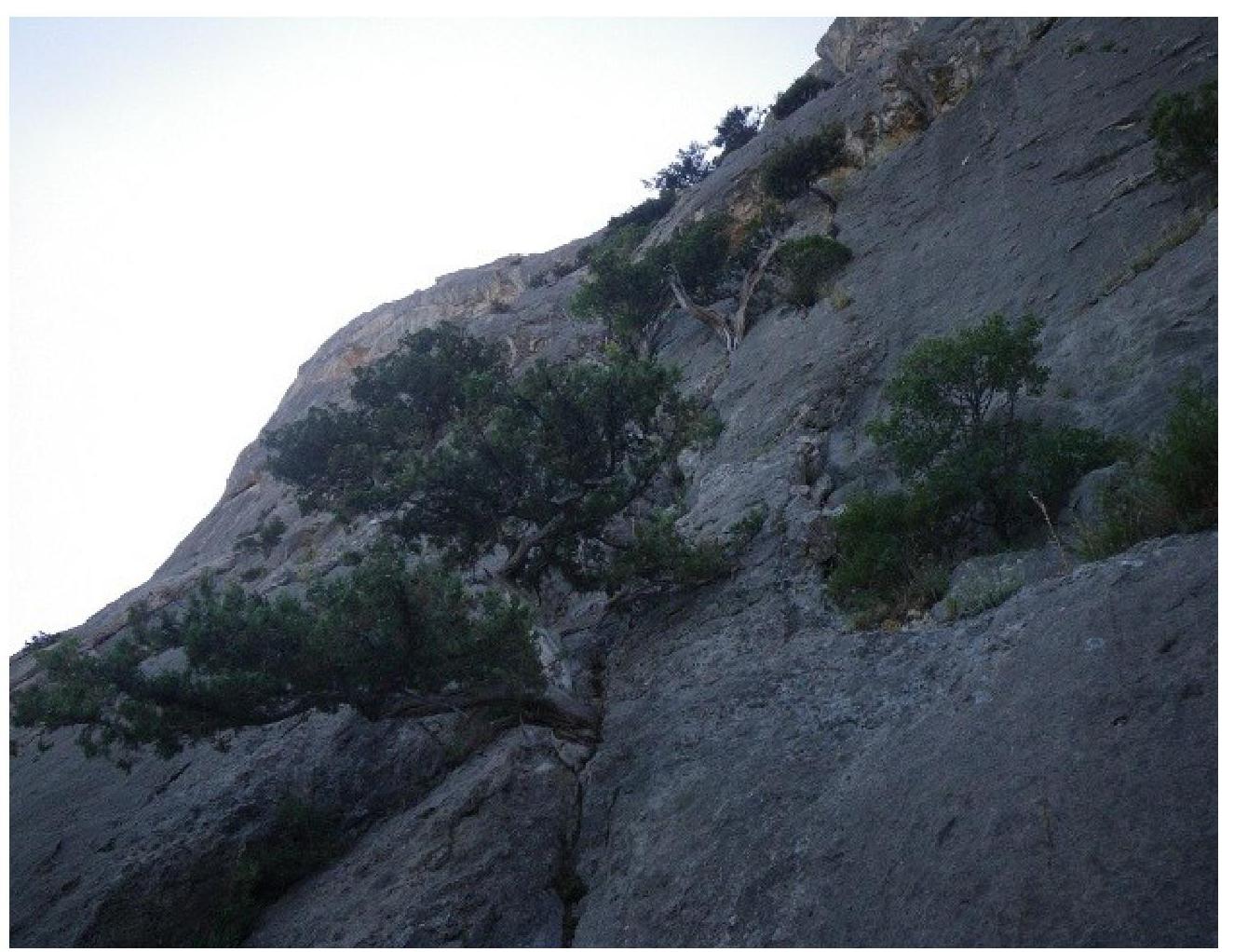
First rope of the route
1. Introduction
This document provides an overview of the key concepts and methodologies used in the study of quantum mechanics. It covers:
- Fundamental principles
- Mathematical formulations
- Practical applications
2. Fundamental Principles
2.1 Wave — Particle Duality
Quantum mechanics introduces the concept of wave — particle duality, where particles, such as electrons and photons, exhibit both wave-like and particle-like properties. This duality is central to understanding quantum behavior.
2.2 Superposition
The principle of superposition states that a quantum system can exist in multiple states simultaneously until it is measured. This is mathematically represented by a wave function, denoted as |ψ⟩.
2.3 Uncertainty Principle
The Heisenberg Uncertainty Principle states that it is impossible to simultaneously know the exact position and momentum of a particle. This is expressed as: Δx ⋅ Δp ≥ ℏ/2 where Δx is the uncertainty in position, Δp is the uncertainty in momentum, and ℏ is the reduced Planck constant.
3. Mathematical Formulations
3.1 Schrödinger Equation
The Schrödinger equation is a fundamental equation in quantum mechanics that describes how the quantum state of a physical system changes over time. It is given by: iℏ ∂/∂t Ψ(r, t) = Ĥ Ψ(r, t) where Ψ(r, t) is the wave function, Ĥ is the Hamiltonian operator, and Ĥ is the Hamiltonian operator.
3.2 Dirac Notation
Dirac notation is a convenient and concise way to represent quantum states and operators. It uses bra-ket notation, where a quantum state is described by a ket, and bra-ket notation is used to represent quantum states and operators.
4. Practical Applications
4.1 Quantum Computing
Quantum computing leverages the principles of superposition and entanglement to perform computations that are infeasible for classical computers. Quantum bits, or qubits, are the fundamental units of quantum information.
4.2 Quantum Cryptography
Quantum cryptography uses the principles of quantum mechanics to secure communication. Quantum key distribution (QKD) is a cornerstone of quantum computing, where key distribution (KDD) is a subset of classical computers.
5. Conclusion
Quantum mechanics is a cornerstone of modern physics, providing a framework for understanding the behavior of particles at the smallest scales. Its principles have led to groundbreaking technologies and continue to inspire new research and development.
6. References
- Griffiths, D. J. (2005). Introduction to Quantum Mechanics. Pearson.
- Shankar, R. (2012). Principles of Quantum Mechanics. Plenum Press.