
St. Petersburg Alpine Climbing Championship. Technical Climbing Category 2018
Report
on the ascent of Petit Dru (3733 m) via the "American Diretissima" route, 6A category (S. Timofeev, 1994) (west face, variant of the "American Direct" route, Royal Robbins and Gary Hemming, 1962)
by the "Polytechnic" climbing team from August 4, 2018, to August 10, 2018
Team coach: V.A. Molodozhen Team leader: A.O. Panov Team members:
- O.I. Lukashenko
- S.A. Seryanov
St. Petersburg 2018
Ascent Details
General Information
Team leader: A.O. Panov — 1st sports category Team members: O.I. Lukashenko — CMS, S.A. Seryanov — 1st sports category Coach: V.A. Molodozhen — Master of Sports Organization: "Polytechnic" Climbing Club (St. Petersburg)
Ascent Object Characteristics
Mountain region: Western Alps, France, Chamonix Route number according to the FAR classification table: 10.3.22 Route number according to the fasl.ru classification table: 10.3.12 Summit name: Petit Dru (3733 m)
Route Characteristics
Route name: "American Diretissima" Category: 6A Route type: rock climbing Height difference: 1050 m Route length: 1670 m Wall section length: 1260 m Section lengths:
- V category: 690 m
- VI category: 200 m
Average slope:
- main part of the route: 80°
- entire route: 70°
Descent via the south face to the Charpoua glacier Water is absent on sections R0–R29; snow patches are found on sections R29–R38.
Team Actions
Climbing hours to the summit:
| Day 1: | 5 hours; |
| Day 2: | 9.5 hours; |
| Day 3: | 11 hours; |
| Day 4: | 18 hours; |
| Day 5: | 4 hours; |
| Total: | 47.5 hours. |
All bivouacs were lying down on ledges.
Departure from base camp: August 4, 2018 Start of work on the route: August 5, 2018 Summit ascent: August 9, 2018 Return to base camp: August 10, 2018
Belay Points Used
No count was kept. The team did not leave any of their own belay points or bolts on the route.
Fig. 1: Area map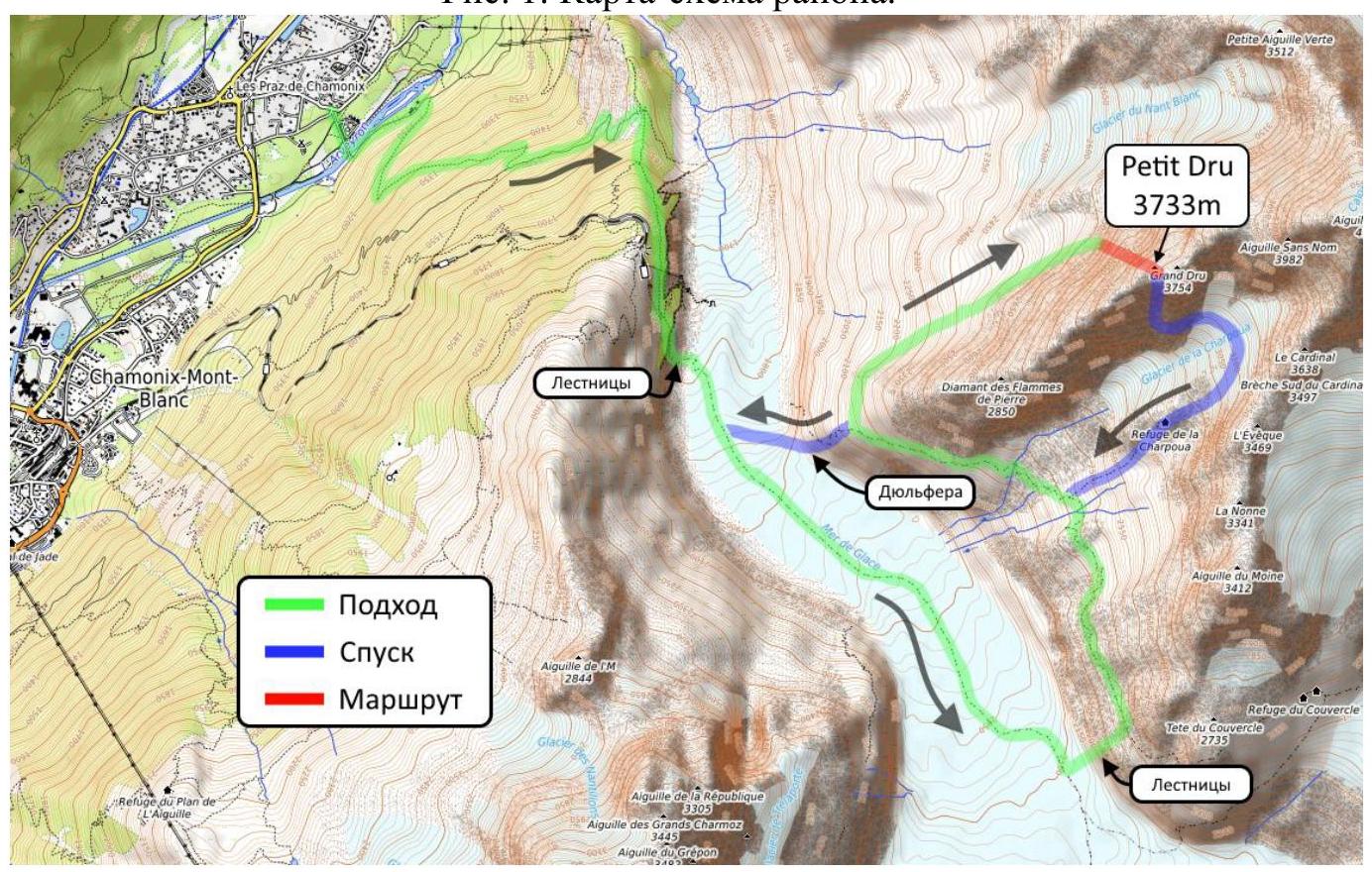
Fig. 2: Team's movement graph on the route
Fig. 3: Route description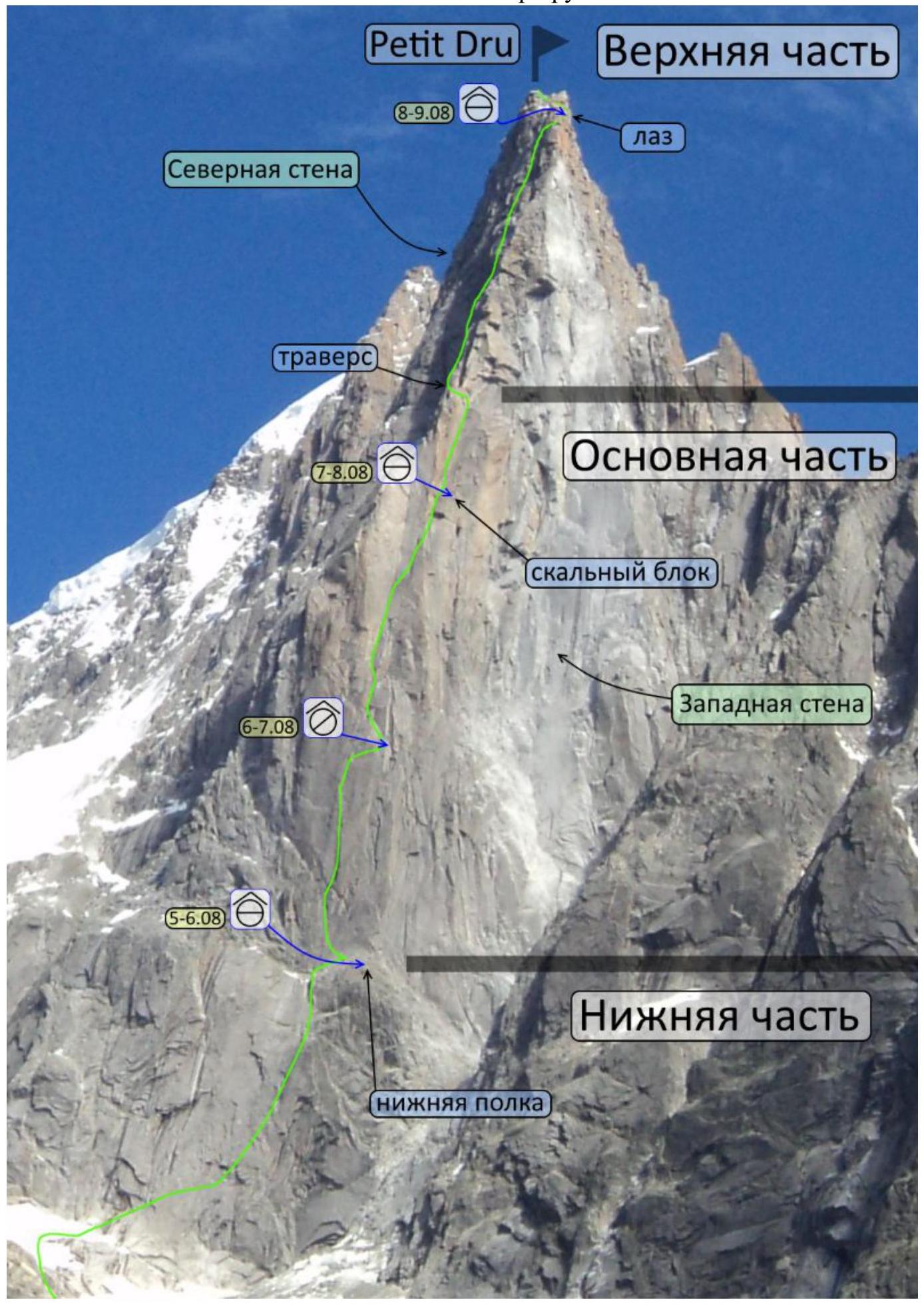
Description
Approach
From Chamonix, hike towards the Montenvers train station, then descend via ladders to the Mer de Glace glacier and move up it. Climb the ladders leading to the Charpoua hut and continue on the upper trail towards Petit Dru, ford a wide river flowing from the Charpoua glacier, and, bypassing the Dru massif, ascend to the west face of Petit Dru.
The route can be conditionally divided into three parts:
Lower Part (R0–R6)
The lower part is relatively gentle, with moderate climbing difficulty. Challenging sections are equipped with bolts. This part is rockfall-prone — most falling rocks hit this area. The terrain is quite monolithic, with few loose rocks.
The lower part ends at a large ledge that cuts through the west face. A convenient bivouac spot is located on the far right of the ledge, slightly off the route. At the time of the team's ascent (August 2018), there was almost no snow on the ledge.
Main Part (R6–R22)
This part of the route is steeper, with sections up to 6c (fr) and several 6b (fr) sections. The terrain is mostly monolithic, but there are large "semi-loose" blocks on the route that require extreme caution when navigating to avoid dropping them on the lower team members.
There are almost no suitable lying-down bivouac spots (the team managed to set up one spot at R11), but there are small ledges for sitting bivouacs. The next convenient bivouac is a rock block at the base of the key section (R19). The key section (R19–R22) is a 90 m internal corner at 6c (fr). From this point, the classic "American Direct" route was damaged by rockfalls in 2005 and 2011. Currently, a popular variation involves traversing onto the north face and continuing from there.
To reach the north face after the key section, one must traverse along an old bolted path (15 m A0, old bolts!). Immediately after the traverse, there's another very convenient bivouac spot (R22).
At the time of the team's ascent (August 2018), despite overcast weather and precipitation, there was no water throughout R6–R22.
Upper Part (R22–R38)
After reaching the north face, the route becomes gentler, but the climbing remains moderately difficult. There are many (not very comfortable) spots for lying-down bivouacs. As the route approaches the summit, the terrain becomes increasingly broken. In the upper part, there are:
- snow patches
- ice
One of the landmarks in the upper part is a quartz ledge that cuts through the face and stretches for hundreds of meters in both directions. On the right side of the ledge, there's a short passage (1–2 m) leading to the south face. The passage is narrow, requiring the team to pull their backpacks separately.
Immediately after the passage, on the south face, there are numerous bivouac spots. The route continues by traversing along the quartz ledge on the south side, almost reaching the couloir between Grand Dru and Petit Dru. A few more easy ropes lead to the summit of Petit Dru (3733 m).
Descent
Rappel starts from the end of the quartz ledge on the south face. Four rappels down, a distinctive flat-topped gendarme with bivouac spots comes into view. It's necessary to rappel slightly to the right of the gendarme. The descent couloir then curves left towards the Charpoua hut. Staying on the left side, continue rappelling down to easier terrain. Then, traverse across the easier terrain (simultaneous belay) towards the upper tier of the Charpoua glacier, located to the left behind the Grand Dru ridge. At the intersection of the traverse with the ridge, there's a bivouac spot under a large, leaning boulder. The traverse follows a faint "trail" with cairns. At the end of the "trail":
- climb a quartz dike for 30 m (IV);
- then traverse 80 m to the right (IV-) to reach the Charpoua glacier.
Then:
- traverse the closed glacier towards Le Cardinal (3638 m);
- descend via a trail to the Charpoua hut.
Fig. 4: Technical photo of the route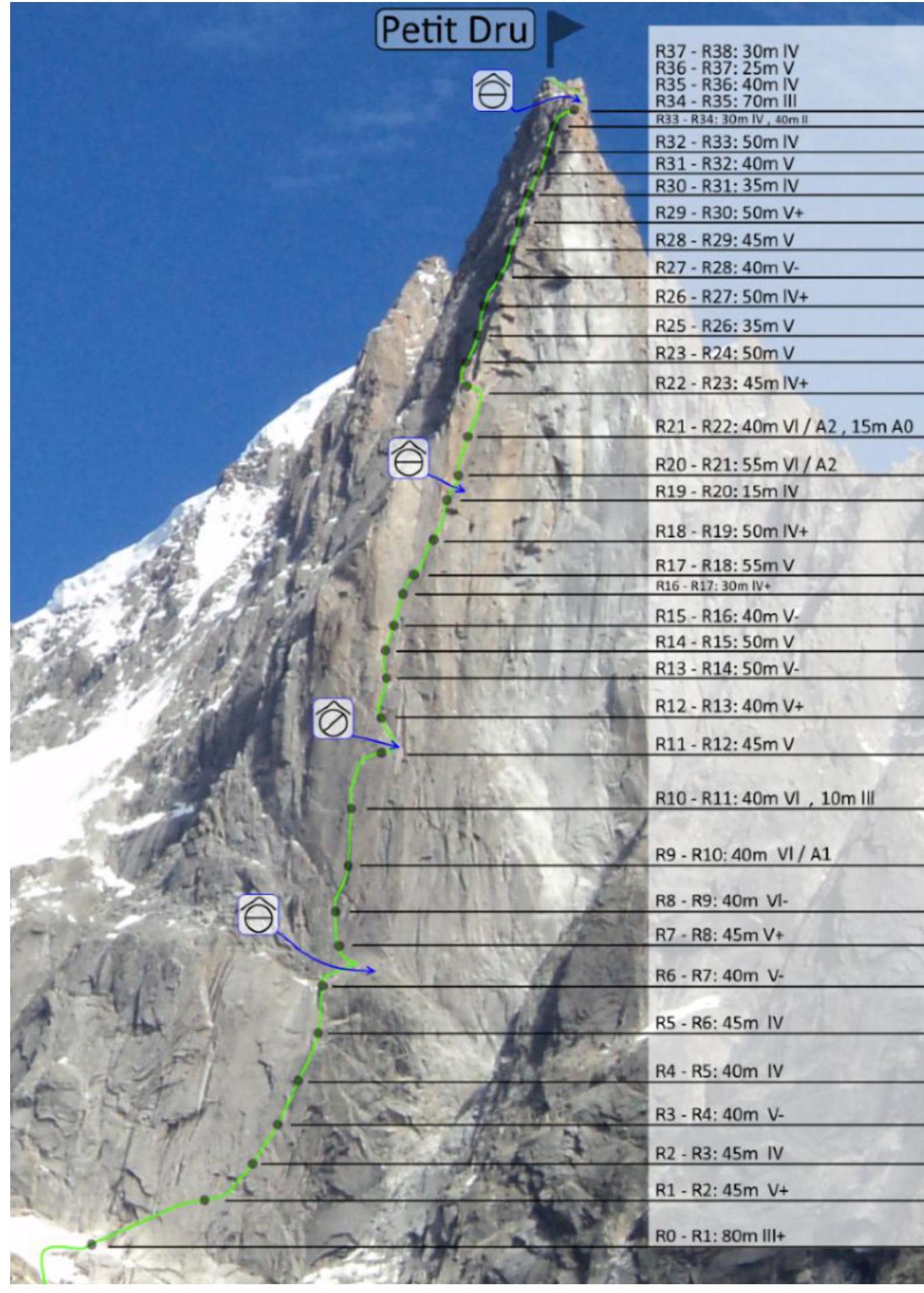
Technical Route Description
R0–R1: From the snow patch, traverse right along a series of ledges.
R1–R2: Aim for the bolts, climb through the overhang on the right side, and continue up the internal corner.
R2–R5: Continue up a series of internal corners.
R5–R6: Up a sloping internal corner to a large scree ledge.
R6–R7: Traverse right 15 m, then through a small wall and internal corner to a ledge.
R7–R8: Up a small corner-chimney, moving left, then up a series of walls and ledges to the base of a huge internal corner.
R8–R10: Up the internal corner; climbing is difficult, with some ITO.
R10–R11: Up a leaning slab and then 5 m up a broken corner, traverse right across a complex wall to a ledge, and continue right to a bivouac.
R11–R12: Up a sloping internal corner to under an overhang, and traverse 5 m under the overhang to the left.
R12–R13: Up 5 m via an internal corner, then left to bypass a giant block and back right, vertically above the previous station.
R13–R14: Up a series of internal corners.
R14–R15: Up a wall with a crack to the base of a huge internal corner.
R15–R17: Up the corner-chimney to a ledge in the middle of the internal corner.
R17–R18: Traverse right 10 m, then up an internal corner under overhanging blocks; bypass the blocks on the left.
R18–R19: Up through an overhang to a chimney formed by a huge rock block and the wall.
R19–R20: From the rock block, up simple rock 20 m to a ledge at the base of the key section.
R20–R21: Up an internal corner (6c (fr) A2).
R21–R22: Continue up the corner, then traverse 15 m on old bolts (40 m 6c (fr) A2; 15 m A0).
R22–R25: From the ledge on the north-west ridge, move up the north face, about 50 m from the ridge.
R25–R26: Continue up through a series of walls and cracks without moving left, to a ledge on the left.
R26–R27: From the ledge, up 15 m via a thin crack and then up an internal corner.
R27–R29: Up a series of internal corners and walls.
R29–R30: Through another chimney to a large scree ledge.
R30–R31: Along the scree ledge to the right to an internal corner.
R31–R34: Up a series of chimneys to a quartz ledge-dike, then through a passage to the south face.
R34–R35: On the south face, continue along the quartz ledge almost to the couloir between Grand Dru and Petit Dru.
R35–R36: Up a series of easy internal corners and walls to a ledge with a large cairn.
R36–R37: From the cairn, up through two internal corners to a ledge.
R37–R38: From here, traverse right along the ledge and then up a gentle couloir to the summit.
Fig. 5: Route diagram in UIAA symbols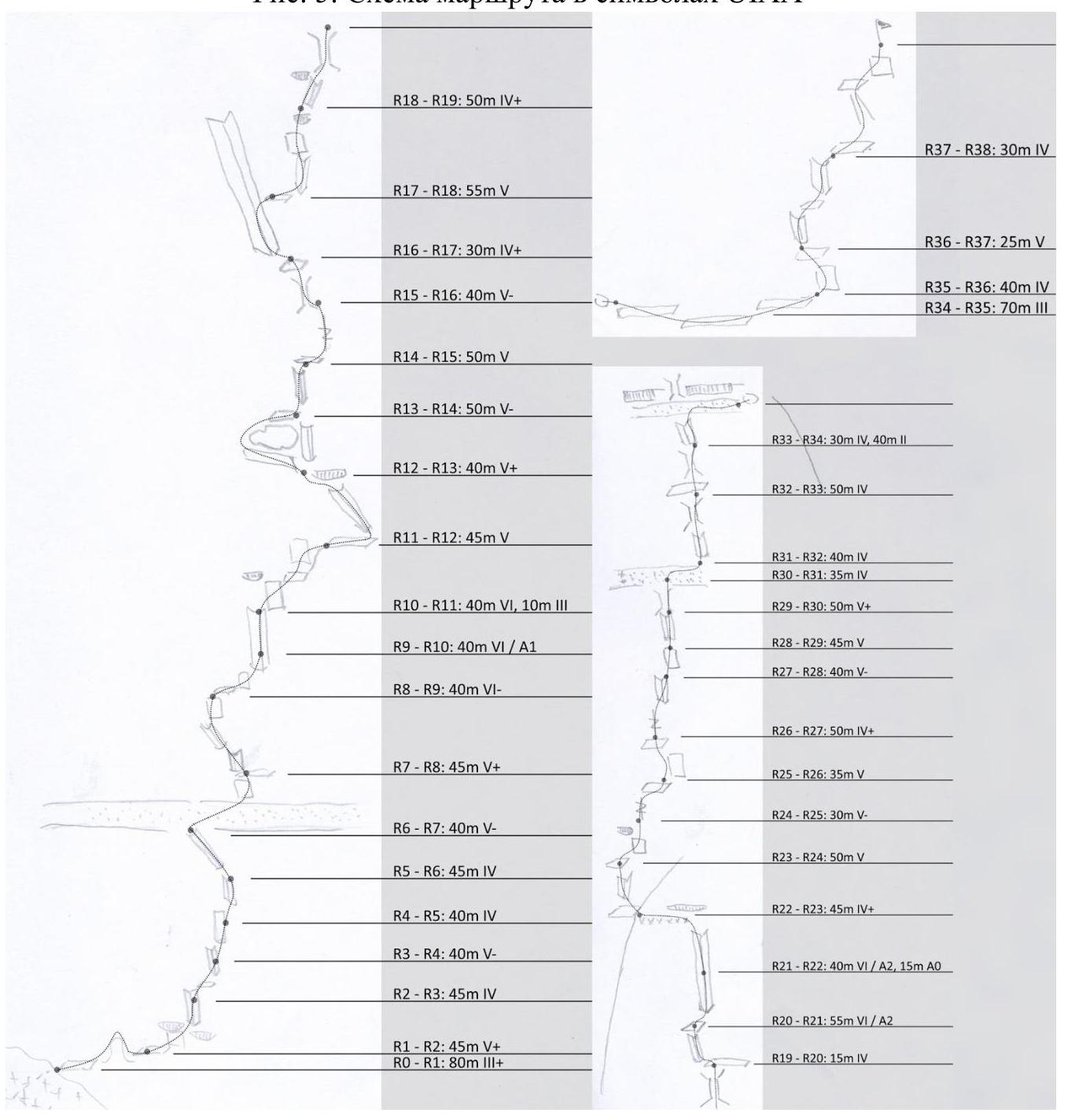
Tactical Team Actions
August 4, 2018
The team departed from Chamonix at 11:00, hiked towards Montenvers, and descended to the Mer de Glace glacier. They climbed the ladders to Charpoua hut and continued on the upper trail towards Petit Dru. At 18:00, they set up camp 100 m above the start of the descent rappels on Mer de Glace.
August 5, 2018
Departed at 8:00, reached the last snow patch before the route by 10:00, and collected water (1.5 L per person per day, totaling 15 L for 3 days). At 11:00, they began work on the route. The first six ropes had challenging sections equipped with bolts (approximately every 7–10 m), allowing for faster progression through the lower, rockfall-prone section.
At 15:30, they stopped for the night on the lower ledge (right part, section R6–R7).
- The Panov-Seryanov pair continued to process the next rope.
- Lukashenko set up the camp.
At 16:00, rain started, and the team was forced to halt work.
The leader worked on two ropes with a light backpacked (7 kg), while other team members moved:
- via free climbing on sections up to III category;
- via fixed ropes with top-rope belay on more challenging sections.
The R0–R6 section was climbed by the leader using free climbing.
August 6, 2018
Started work at 8:00. The wall was damp from the previous night's rain. From R7 onwards, the climbing became challenging, with some ITO. By 17:00, the weather deteriorated, and the team decided to bivouac at R11. The team set up a new bivouac spot for one tent (2–3 people) at R11.
Climbed alternately on double rope and via fixed ropes with top-rope belay.
The R9–R10 section was partially climbed using ITO; other sections from R6–R11 were climbed by the leader using free climbing.
August 7, 2018
Started at 7:00. Climbing remained challenging, with many wet internal corners and chimneys. Large "live" wedged blocks were encountered, requiring careful navigation to avoid dropping them on lower team members. By 18:00, they reached the rock block under the key section.
- Panov-Lukashenko began processing the next rope.
- Seryanov set up camp (R19).
Climbed alternately on double rope and via fixed ropes with top-rope belay.
The R11–R19 sections were climbed by the leader using free climbing.
August 8, 2018
Started early at 4:00. Lukashenko-Seryanov worked on the key section (R20–R21), while Panov packed up camp. By 10:00, the team overcame the key sections and reached the north face of Petit Dru (R22). By 22:00, they reached the quartz ledge-dike and the passage to the south face (R34). On the south face, immediately after the passage, they set up camp for the night.
The leader worked on two ropes with a light backpack (5 kg after the key section). Other team members moved:
- via free climbing on easier sections;
- via fixed ropes with top-rope belay on more challenging sections.
The R20–R22 sections were climbed using ITO. The R22–R34 sections were climbed by the leader using free climbing.
August 9, 2018
Started at 8:00. Most gear was left in camp. Climbed simultaneously (except for R36–R37, which was climbed alternately on one rope). Reached the summit at 13:00. Returned to camp, then began descending the south face. After four rappels, they stopped for the night on a gendarme's summit.
Climbed simultaneously on one rope (except for R36–R37). The R34–R36 and R37–R38 sections were climbed simultaneously using free climbing. The R36–R37 section was climbed alternately using free climbing.
August 10, 2018
Snow fell during the night. At 7:00, they continued descending via rappels and then traversed across easier terrain with simultaneous belay to reach the upper tier of the Charpoua glacier.
Due to glacier damage and seracs, the team had to:
- climb 30 m (IV);
- traverse 80 m (IV-) with simultaneous belay to reach a safer part of the glacier.
Then, they traversed the closed glacier under the slopes of Le Cardinal (3638 m) and descended to the trail to Charpoua hut. From there, they hiked past the hut to the upper trail along the Mer de Glace glacier.
By 18:00, the team retrieved their cache on the upper trail and rappelled down to the Mer de Glace glacier (three sections: 50 m, 50 m, and 25 m, with bolted stations and chained anchors). By 24:00, the group returned to Chamonix.
During the ascent, the team maintained regular radio contact with the base camp. There were no falls or injuries. The team was equipped with necessary gear for wall bivouacs, a first-aid kit, and supplies for the entire ascent period.
Photo Report
Fig. 6: View of the wall from the approach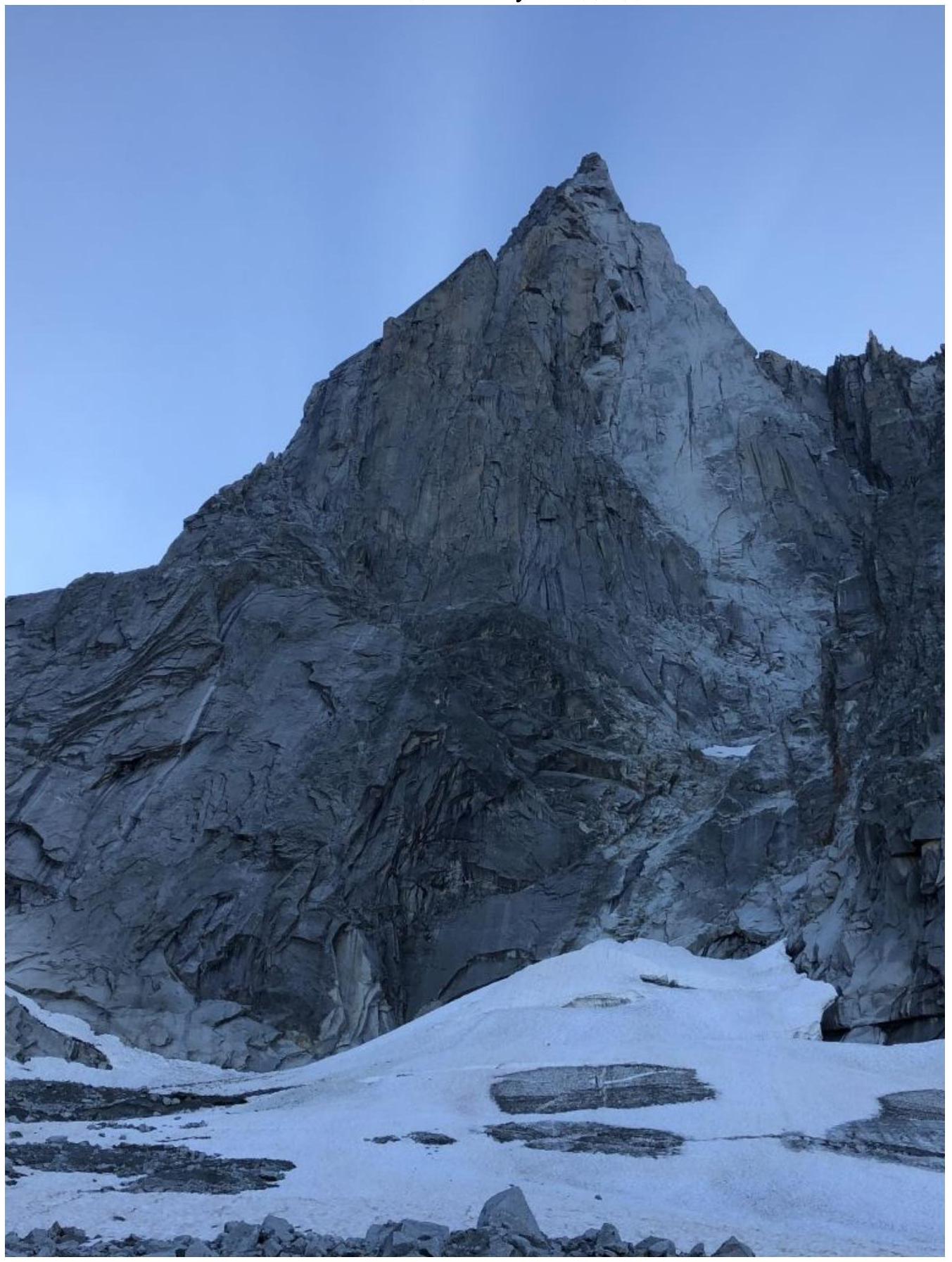 Fig. 7: Seryanov on section R9–R10
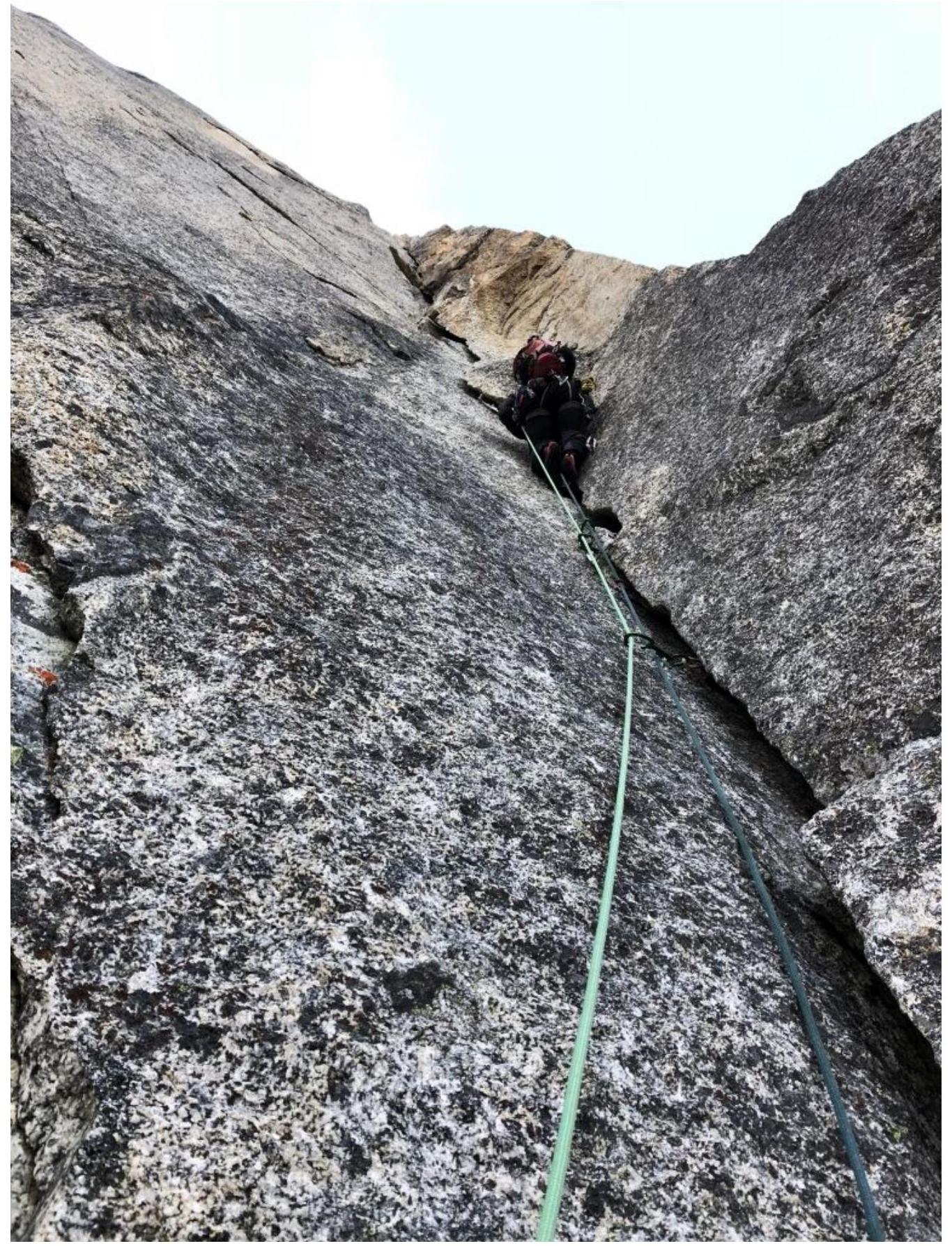 Fig. 8: View from station R14 (Panov)
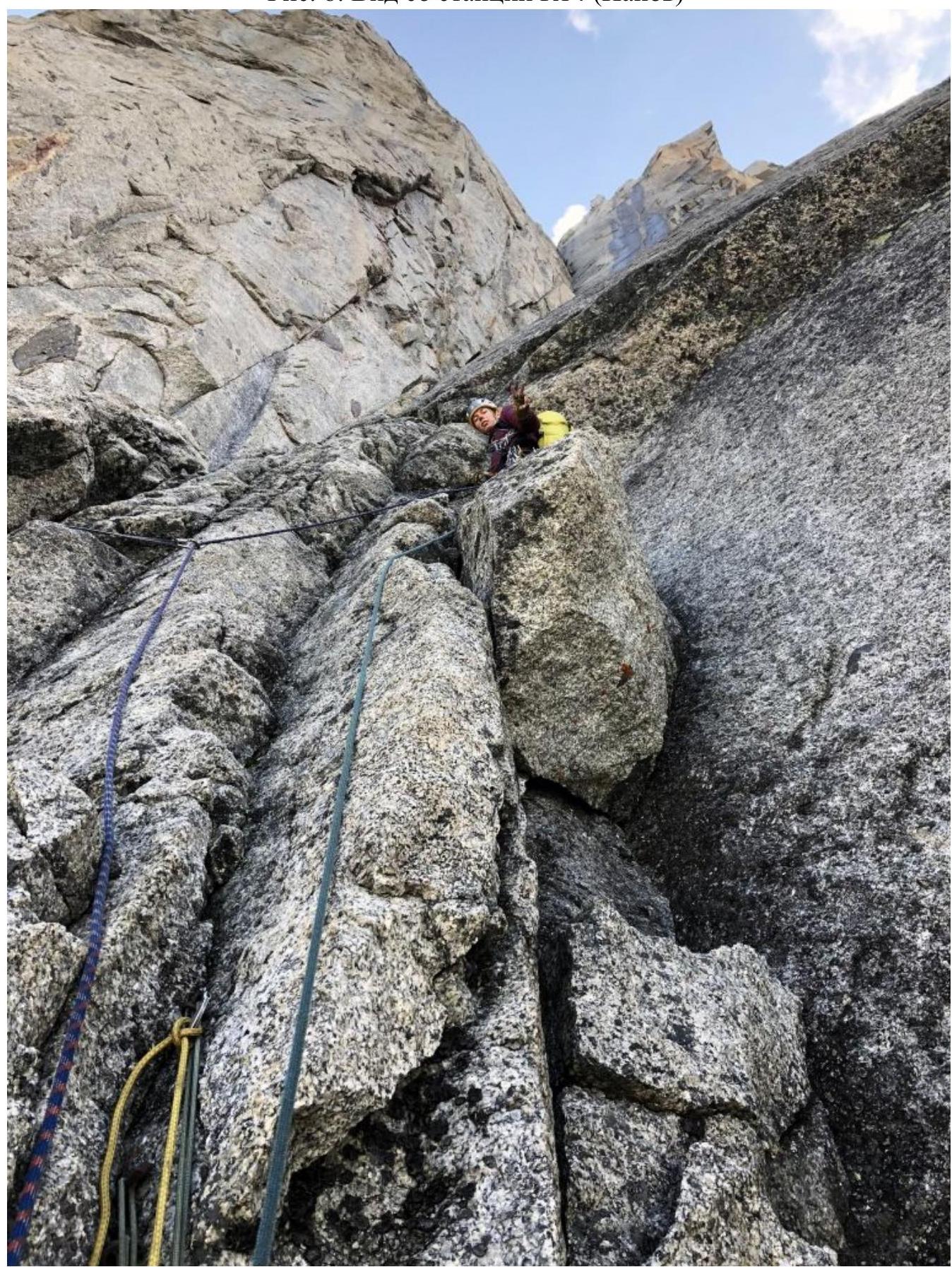 Fig. 9: View from bivouac (R19) to the key sections
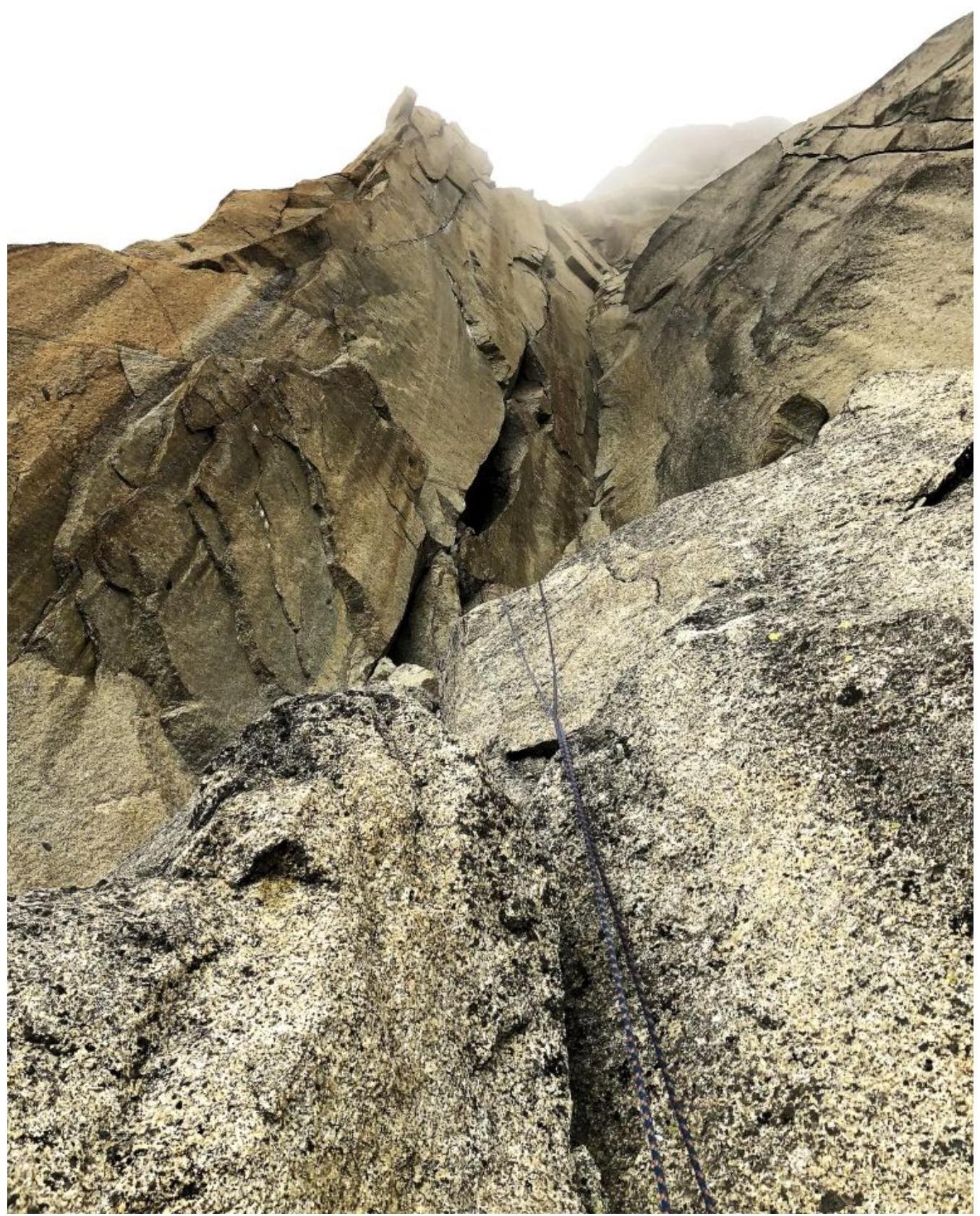 Fig. 10: View from station R22 down (to the rock block and key)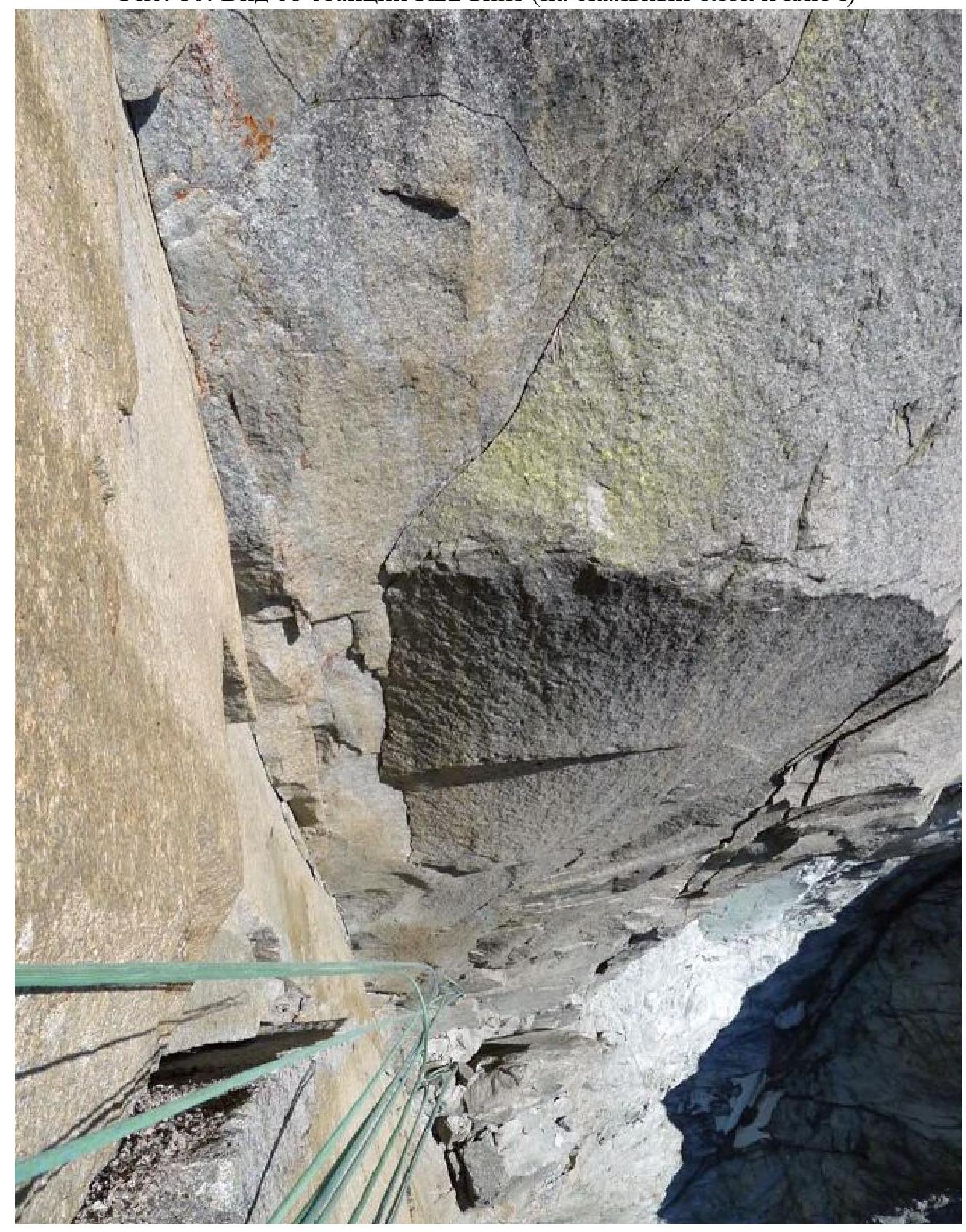
internet photo
Fig. 11: View from station R26 (Seryanov)
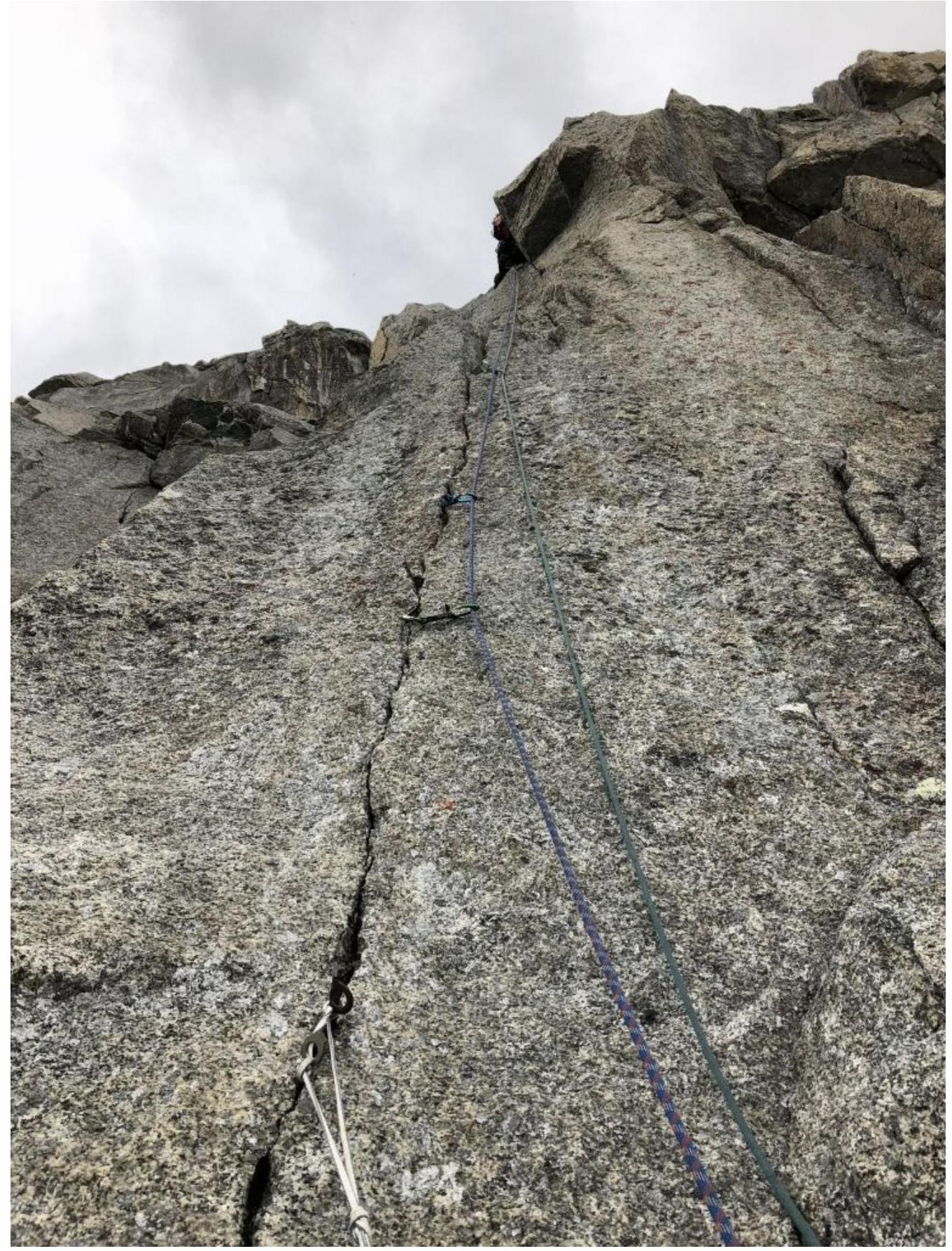
Fig. 12: Team on the summit


Comments
Sign in to leave a comment