
I. Class of Rock Climbing Ascent
- Pamir-Alay, Turkestan Range, Ak-Su river gorge.
- Peak 4240 (Slesova) via the North-West face.
- Proposed category: 6B, first ascent.
- Height difference: 810 m, route length: 986 m.
Section lengths:
- R5–R6 — 874 m
- R6 — 789 m. Average steepness of the main part of the route — 81° (3430–4210 m)
- Number of pitons used:
| Rock pitons | Nuts | Bolt pitons |
|---|---|---|
| 84 | 279 | 39 |
| 56 | 153 | 37 |
- Team's total climbing hours — 64, days on the route — 5.
Route preparation hours — 12.5, preparation days — 1.
- Overnights — 4, hanging bivouacs in a platform-tent.
- Team leader and coach: Pogorelov Alexander Grigorievich — Master of Sports of the USSR
Team members:
- Galagan Alexander Grigorievich — Master of Sports of the USSR
- Paevsky Oleg Yurievich — Candidate for Master of Sports
- Petyakshev Vasily Nikolaevich — Candidate for Master of Sports
- Selin Alexander Ivanovich — Candidate for Master of Sports
- Spiridonov Alexander Semenovich — Candidate for Master of Sports
- Route preparation:
- June 17, 1988 — Started the ascent
- June 18, 1988 — Reached the summit
- June 22, 1988 — Returned
- June 23, 1988
II. Organization
Alpinism Training and Sports Center "Planeta" under the sports club "Rostselmash".
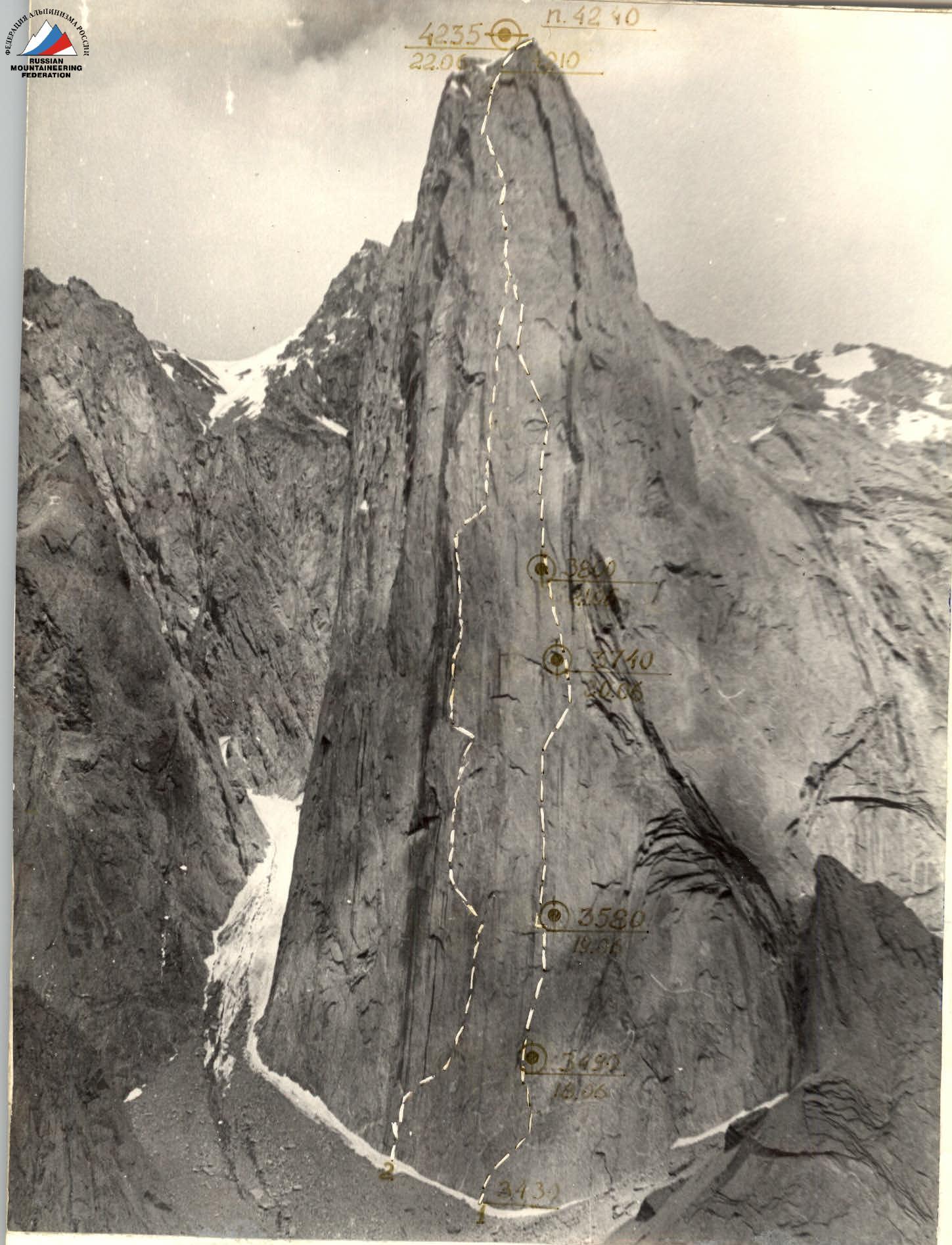
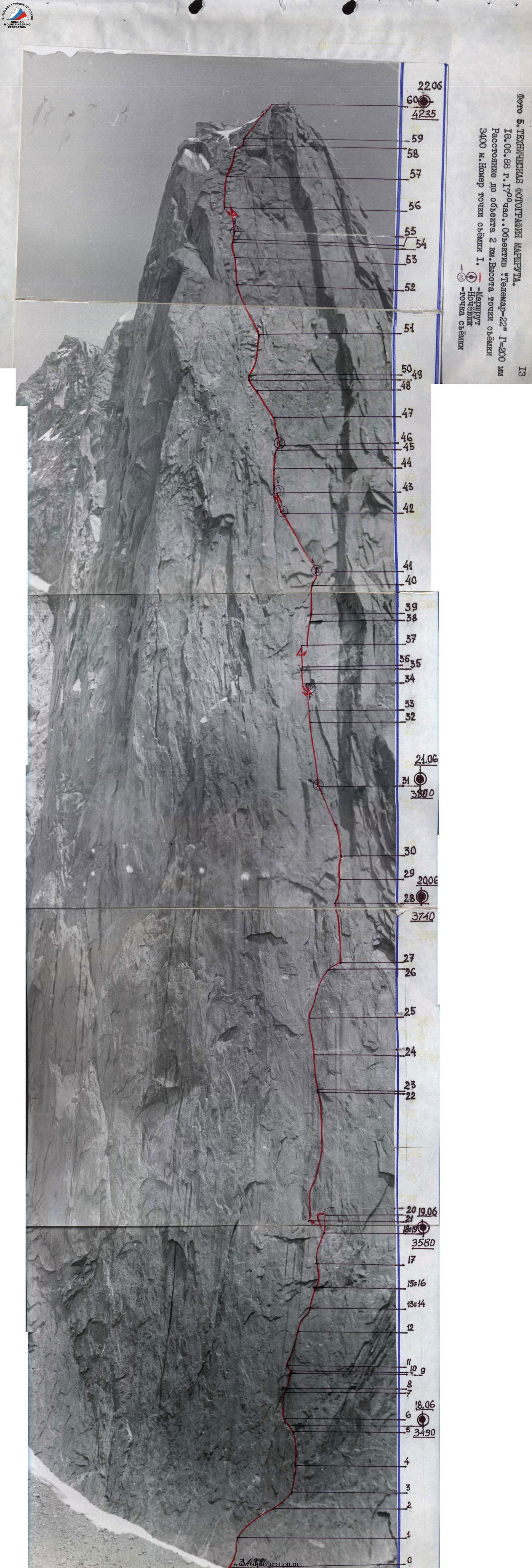
Photo 1. GENERAL PHOTO OF PEAK 4240 m (Slesova). August 16, 1988, 16:00. Lens "Helios-44", F=50 mm. Height of the shooting point 3450 m. Distance to the object — 2 km. Shooting point 1.
1 — team's route
2 — route of the team from "Dnepropetrovsk" (tentative).
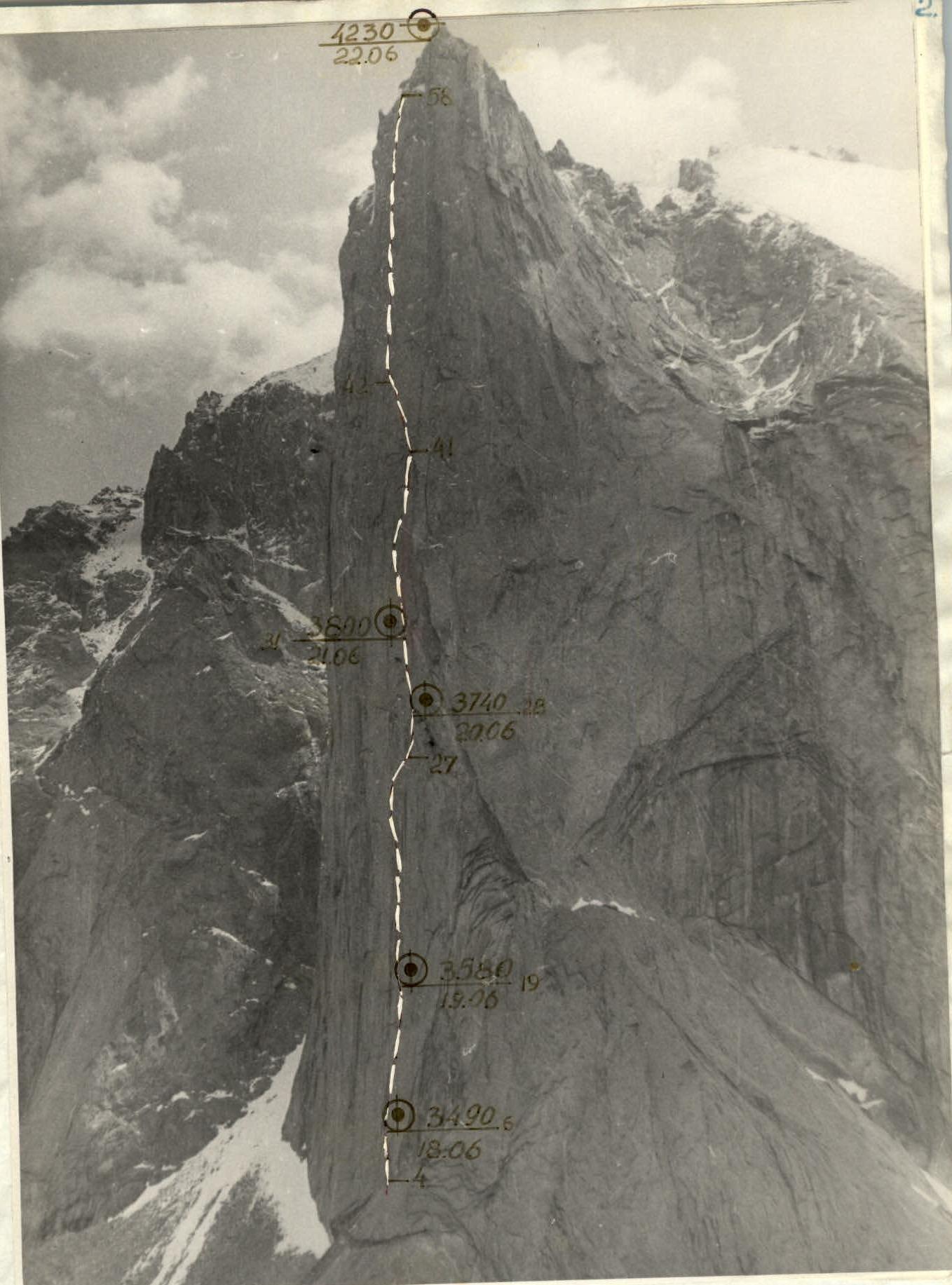
Photo 2. PROFILE OF THE WALL FROM THE RIGHT. August 17, 1988, 11:30. Lens "Helios-44", F=55 mm. Distance to the object 2.5 km. Height of the shooting point 3400 m. Shooting point № 2.
— team's route;
— overnight stays;
— section number
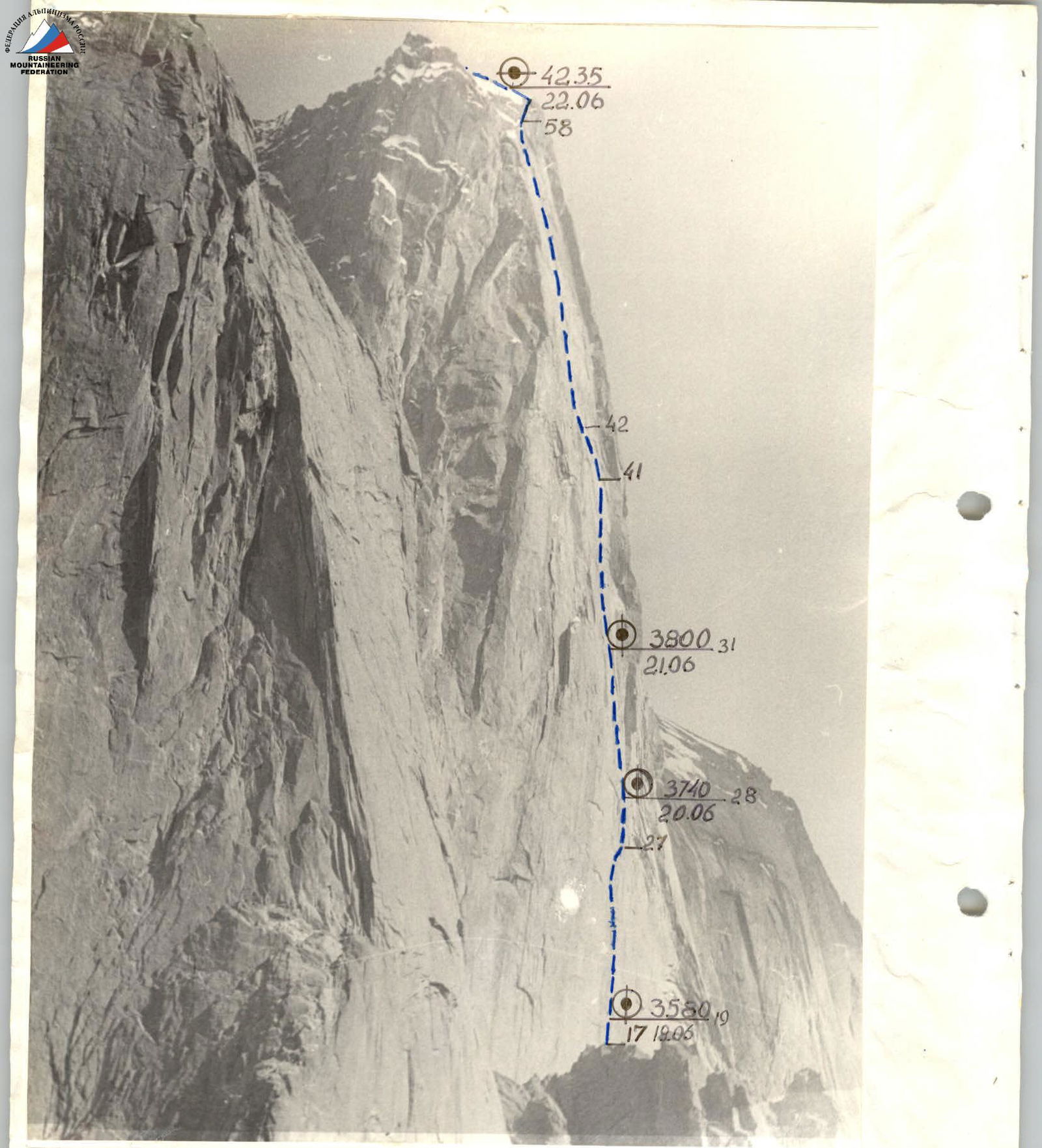
Photo 3. PROFILE OF THE WALL FROM THE LEFT. August 13, 1988, 15:00. 200 mm lens. Distance to the object 4 km. Height of the shooting point 2900 m. Shooting point № 3. — team's route; — overnight stays; — section number.
The ascent was carried out according to the tactical plan. A slight deviation occurred on June 19, 1988, when the team did not reach the planned overnight stop at point 5 due to some cracks being "dead ends" in the lower third of the route, which increased the amount of bolt work required. The next day, the team made up for the lost time, which was 7.5 hours out of 39 planned climbing hours, or less than 20%, which is within acceptable limits. On June 20, 1988, the bivouac was set up 35 m above the planned point 5 under an overhang, in a more convenient location for hanging the platform-tent. On June 22, 1988, the team reached the summit, although according to the tactical plan, the summit push was planned for June 23, 1988. The decision to summit earlier was influenced by the following factors:
- deteriorating weather conditions in the last two days (June 21–22);
- thanks to good preparation and recovery measures (mainly due to the presence of the platform-tent), the team was in good working condition, which made it possible to confidently reach the summit in daylight on the 22nd.
The organization of the rope teams was based on the principle of optimal distribution of forces. Two teams (Galagan-Pogorelov, Paevsky-Petyakshev) were formed to work ahead, with a plan to switch leaders mid-day and swap teams every other day. The third team (Selin-Spiridonov) supported the leading teams and organized bivouacs. This specialization proved to be fully justified. The work distribution among the leaders was as follows: Galagan — R24–R26; Pogorelov — R11–R19, R26–R32, R42–R60; Paevsky — R0–R6, R21–R24, R32–R34, R41–R42; Petyakshev — R6–R11, R19–R22, R34–R41. Most of the route was climbed using free climbing. Artificial Technical Climbing (ИТО) was used only where free climbing was impossible.
The first climber used a UIAA Ø12 mm rope, with belaying done through an improved "bug" by Koshevnick. The belay station was organized using three elements, balanced with a load-sharing loop. The rest of the team members moved on double ropes with two jumar ascenders and a "grigri" or with top-rope belay. Sometimes, they used single ropes on "Edelrid" Ø12 mm rope, which met UIAA requirements.
The main challenge was navigating the monolithic slabs in the lower part of the route. To overcome this, bolt climbing techniques were employed, mainly using removable bolt pitons and skyhooks under bolt holes (3–4 holes between pitons).
To organize belay stations, a platform was used (in ИТО sections), allowing for:
- piton placement or
- nut placement 1.2–1.4 m apart.
On the afternoon of August 15, 1953, a thunderstorm with heavy rain occurred. During this time, the leading team retreated to the tent, and after the storm passed, they continued their work. The metal equipment was hung 4 m away from the tent during the thunderstorm.
During the ascent, the team maintained constant radio contact with observers and the rescue team. The rescue team remained in the base camp below the route.
List of Products
| № | Product name | Quantity in grams taken | Note |
|---|---|---|---|
| 1. | Freeze-dried meat | 800 | |
| 2. | Freeze-dried milk | 500 | |
| 3. | Wheat crackers | 2500 | |
| 4. | Sugar | 2000 | |
| 5. | Buckwheat groats | 800 | |
| 6. | Semolina | 300 | |
| 7. | Oatmeal | 1000 | |
| 8. | Smoked sausage | 2000 | |
| 9. | Lard | 500 | |
| 10. | Butter | 800 | |
| 11. | Cheese | 1000 | |
| 12. | Salt, spices, adjika | 300 | |
| 13. | Freeze-dried soups | 2000 | |
| 14. | Bouillon cubes | 200 | |
| 15. | Candies | 1800 | |
| 16. | Raisins, prunes | 1500 | |
| 17. | Honey + walnuts | 800 | |
| 18. | Dried meat "surzhuk" | 2500 | |
| 19. | Vitamins, citric acid, ascorbic acid, salt tablets, sports drinks (Czechoslovakia) | 500 | |
| 20. | Freeze-dried cottage cheese | 1600 | |
| 21. | Canned meat | 1800 | |
| 22. | Tea | 600 | |
| TOTAL: | 25800 |
Calculation: 500 g × 6 people × 7 days = 21 kg Emergency supply: 400 g × 6 people × 2 days = 4 kg 800 g Water — 45 l + Juice — 4 l; total liquid — 49 l TOTAL: 74.8 kg
Total weight of backpacks — 151.95 kg
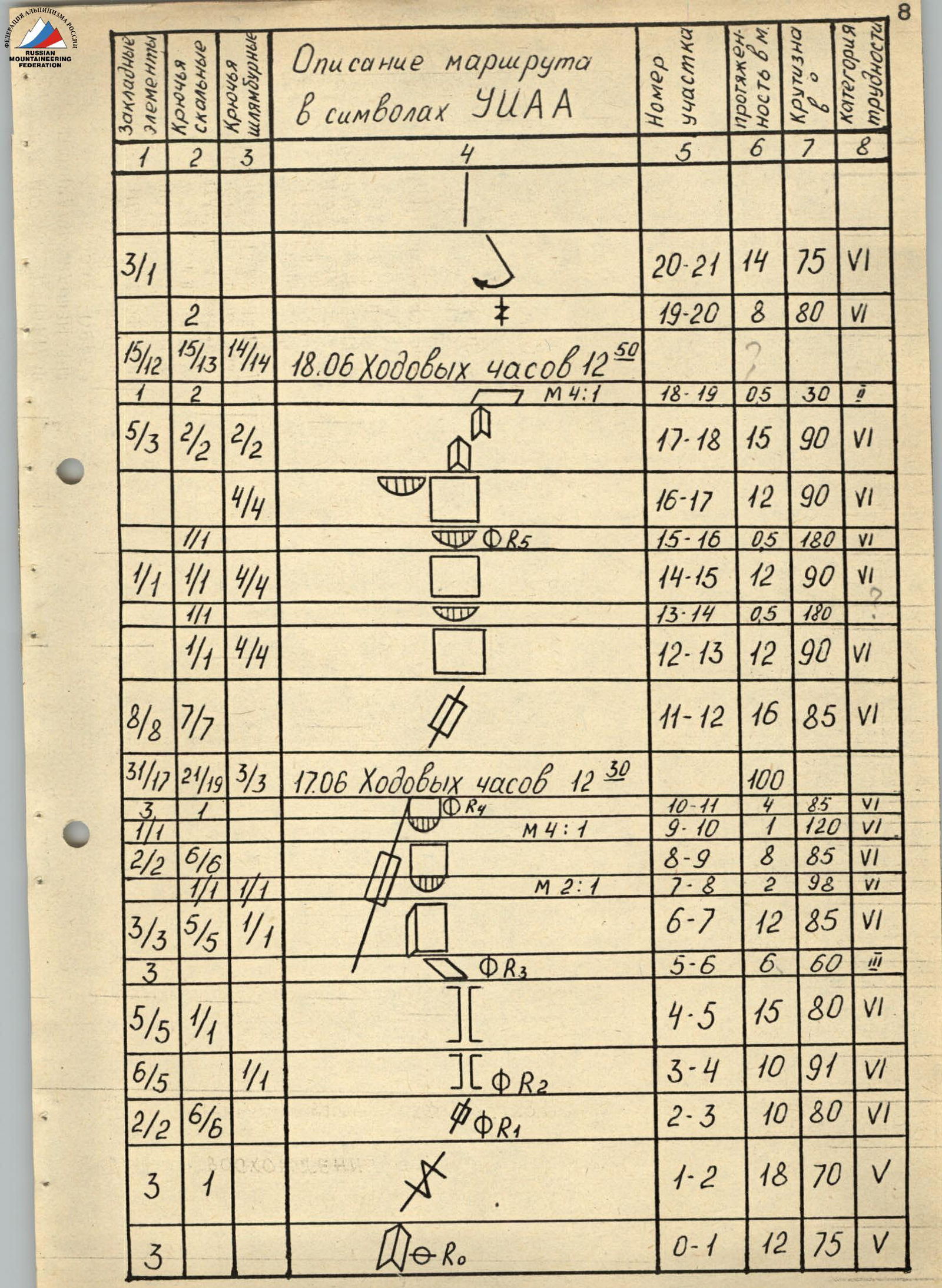
| 1 | 2 | 3 | 4 | 5 | 6 | 7 | 8 |
|---|---|---|---|---|---|---|---|
| 11 | R15 | R31–R32 | 42 | 80 | 6 | ||
| 11 | R14 | R30–R31 | 40 | 80 | 6 | ||
| 2 | R13 | R29–R30 | 10 | 75 | 6 | ||
| 1 | 2 | R12 | R28–R29 | 15 | 80 | 6 | |
| 8 | R11 | R27–R28 | 30 | 80 | 6 | ||
| 3 | R10 | R26–R27 | 5 | 70 | 4 | ||
| 8 | R25–R26 | 30 | 75 | 6 | |||
| 10/10 | R24–R25 | 22 | 90 | 6 | |||
| 43/41 | 8/6 | 10/10 | 19 June Climbing hours 13:35 | 97 | |||
| 10/10 | R23–R24 | 20 | 90 | 6 | |||
| R22–R23 | 0.5 | 180 | 6 | ||||
| 40/40 | 6/6 | R21–R22 | 55 | 87 | 6 | ||
| 4 | 2 | R22 | R47–R48 | 20 | 70 | 5 | |
| 4 | R21 | R46–R47 | 20 | 75 | 6 | ||
| 3 | R45–R46 | 5 | 15 | 6 | |||
| 2 | 2 | R44–R45 | 15 | 80 | 6 | ||
| 10/10 | 4/3 | R43–R44 | 20 | 80 | 6 | ||
| 9/8 | 1/1 | 1 | R20 | R42–R43 | 20 | 80 | 6 |
| 72/56 | 15/14 | 21 June Climbing hours 10:50 | 150 | ||||
| 10 | R19 | R41–R42 | 40 | 70 | 6 | ||
| 8/7 | 1/1 | R18 | R40–R41 | 8 | 92 | 6 | |
| 9/9 | 3/3 | R39–R40 | 15 | 85 | 6 | ||
| 3/3 | R38–R39 | 6 | 92 | 6 | |||
| 13/12 | 3/2 | R17 | R37–R38 | 20 | 85 | 6 | |
| 12/12 | 2/2 | R36–R37 | 20 | 85 | 6 | ||
| 1/1 | 1/1 | R35–R36 | 2 | 100 | 6 | ||
| 5/5 | 2/2 | R16 | R34–R35 | 9 | 85 | 6 | |
| 14/10 | R33–R34 | 22 | 85 | 6 | |||
| 2 | R32–R33 | 8 | 85 | 6 | |||
| 42 | 4 | 10/10 | 20 June Climbing hours 13:00 | 194 | |||
| 279/153 | 84/56 | 39/37 | Climbing hours 76:30 | 986 | |||
| 76/26 | 24/4 | 2 | 22 June Climbing hours 13:45 | 376 | |||
| R60–R61 | 50 | 20 | 1 | ||||
| 2 | 1 | R29 | R59–R60 | 50 | 65 | 4 | |
| 2 | R28 | R58–R59 | 5 | 65 | 6 | ||
| 10/7 | R27 | R57–R58 | 20 | 80 | 6 | ||
| 7 | R56–R57 | 25 | 75 | 6 | |||
| 4 | 2 | 1 | R26 | R55–R56 | 20 | 70 | 6 |
| 1 | R54–R55 | 3 | 92 | 6 | |||
| 3 | R53–R54 | 10 | 75 | 6 | |||
| 4 | R25 | R52–R53 | 18 | 70 | 6 | ||
| 5 | 4 | R24 | R51–R52 | 35 | 70 | 5 | |
| 6 | 1 | R50–R51 | 25 | 80 | 6 | ||
| 2/1 | R49–R50 | 5 | 85 | 6 | |||
| 2 | R48–R49 | 10 | 80 | 6 |
Description of the Route by Sections
R0–R1. Inner corner. Climbed using free climbing. Belaying through large nuts. The middle part has an overhang. R1–R2. Slab with a crack. Climbed using free climbing. R2–R3. Slab with a crack. ИТО on small stoppers and pitons. R3–R4. Narrow, overhanging chimney-split. Climbed mainly using ИТО. Large nuts were used. R4–R5. On this section, the chimney-split is not overhanging. Climbed using free climbing and partially using ИТО. R5–R6. Destroyed, inclined shelf. A platform-tent was hung above the shelf and an overnight stay was organized. R6–R7. Monolithic slab, bounded on the left by a wet, overhanging corner, and above by an overhang. Climbed using ИТО. Possibilities for organizing belays are limited. A bolt piton was placed. R7–R8. Overhanging section, wet from water seeping from a crack on the left. Climbed using ИТО. A removable bolt piton was placed. R8–R9. Monolithic slab. Climbed using ИТО. Belaying was mainly through pitons. R9–R10. Overhang with a crack. ИТО. R10–R11. Smooth slab with a slit. Strenuous climbing through the slit. Leads to a crack running from left to right, wet from water. Ends with a belay station. Belaying from ladders. R11–R12. Wet crack. ИТО using small nuts and pitons. R12–R13. Monolithic slab. Climbed using ИТО, with the use of bolt pitons and skyhooks. 1 piton, 3 holes for skyhooks (it's inconvenient to make holes for skyhooks due to the steepness and difficulty of placement). R13–R14. Overhang. Climbed using ИТО. A piton was used, hammered under the overhang. R14–R15. Section similar to R12–R13. Climbing technique is the same. R15–R16. Overhang. Below it, a belay station on nuts, sectors, and a removable bolt. Belaying from ladders. R16–R17. Slab with a "dead" crack. ИТО using removable bolt pitons and skyhooks (1 piton, 3–4 holes for skyhooks). R17–R18. Two inner corners, one after the other. Climbed mainly using free climbing. The slab between them has bolt pitons and a skyhook. R18–R19. Shelf 0.5 m wide. Above it, a tent was hung for the 2nd overnight stay. R19–R20. Monolithic wall with a vertical crack and limited relief for climbing. Strenuous climbing. Belaying through pitons. R20–R21. Climbing a slab to the left. Then, a pendulum move to the left to a crack going upwards. R21–R22. Smooth, monolithic wall with a continuous vertical crack. Climbed using ИТО. Small nuts and pitons were used. R22–R23. Overhang without cracks or relief. ИТО. R23–R25. Steep, smooth wall without cracks. ИТО using bolt pitons and skyhooks. R25–R26. Flake. Climbed using free climbing. Climbing is strenuous. Belaying through large nuts and sectors. R26–R27. Narrow shelf. R27–R28. Crack up to 5 cm wide. Limited holds on the sides. Climbed using free climbing. Climbing is strenuous. Belaying through large nuts. At the end of the section, a small ledge with an overhang. An overnight stay was organized here. R28–R29. Wide inner corner with limited holds. Climbed using free climbing. Climbing is strenuous. Relief for belaying is limited. R29–R30. Smooth slab. Relief for belaying and climbing is limited. Free climbing is strenuous. R30–R33. Wide vertical cracks.
- At the start of the section — a belay station on nuts.
- Belaying from ladders.
- Strenuous free climbing.
- Belaying through medium and large nuts.
- On the left, at the end of the section, a narrow ledge where the 4th overnight stay was organized.
- All belay stations are hanging, on ladders.
R33–R34. Inner corner with a crack, formed by the left side of a very wide (up to 2–3 m) chimney. Climbed using ИТО and free climbing at the beginning and top. Climbing is very strenuous. Belaying through medium and large nuts. (Photo 10). At the top, under an overhang — a belay station. Belaying from ladders. From the belay station, a pendulum move to the left.
R34–R35. Smooth wall with a vertical crack. ИТО. Small nuts.
R35–R36. Overhang with a flake. ИТО. Medium nuts.
R36–R37. Steep, monolithic, smooth wall with a vertical crack. ИТО. Belaying through small nuts and pitons. At the end of the section, a pendulum move to the left (4–5 m).
R37–R38. Section similar to R36–R37. Climbing technique is the same. At the beginning of the section — a belay station. Belaying without ladders.
R38–R39. Overhang with a crack and a flake at the top. ИТО. At the top, some free climbing. Climbing is very difficult.
R39–R40. Monolithic, smooth wall with a vertical crack leading under a cornice.
R40–R41. Cornice running from left to right. Climbed using ИТО. Medium nuts and sectors were used. At the exit from the cornice — a belay station. Belaying from ladders.
R41–R42. Inner corner with a crack inside and smooth, monolithic walls. Free climbing in an off-width position. Climbing is strenuous. Belaying through medium nuts.
R42–R43. Smooth wall with a crack. Climbed initially using free climbing, then ИТО. Belaying through small nuts and pitons. At the end of the section — a belay station. From here, a pendulum move to the left into an inner corner.
R43–R44. Inner corner with a crack inside and monolithic, smooth sides. ИТО. Small nuts and pitons.
R44–R45. Monolithic wall with limited relief ("miser"). At the top, a flake. Climbed using free climbing. Climbing is difficult. Relief for belaying in the lower part is limited.
R45–R46. Inner corner. Here — a belay station.
R46–R47. Inner corner running from right to left. At the top, strenuous climbing, with increasing steepness. (Photo 15).
R47–R48. Monolithic slabs with limited relief for belaying. Climbed using free climbing. At the end of the section — a belay station.
R48–R49. Monolithic wall with limited relief for belaying and climbing. Strenuous climbing.
R49–R50. Two overhangs, one after the other. Between them — a ledge. The first is climbed using ИТО, the second — free climbing.
R50–R51. Crack in the form of a flake. In some places, it overhangs. Strenuous climbing in an off-width position. At the end of the section — a belay station.
R51–R53. Smooth, monolithic slabs. At the end of the section — a belay station. Initially and at the end of the section — belaying through medium and small nuts, in the middle — pitons. At the end of section R51–R52 — a belay station.
R53–R54. Crescent-shaped chimney, narrowing inward. Strenuous climbing. Belaying through large and medium sectors.
R54–R55. Overhang. Climbed using free climbing.
R55–R56. Smooth, monolithic slabs with sharply limited relief for belaying and climbing. Climbing is strenuous. At the end of the section, a pendulum move to the left (6–7 m).
R56–R57. Flake with water running down it. Strenuous climbing.
R57–R58. Series of three cornices with water running down them. Climbing with ИТО.
R58–R59. Wet inner corner.
R59–R60. Easy ridge.
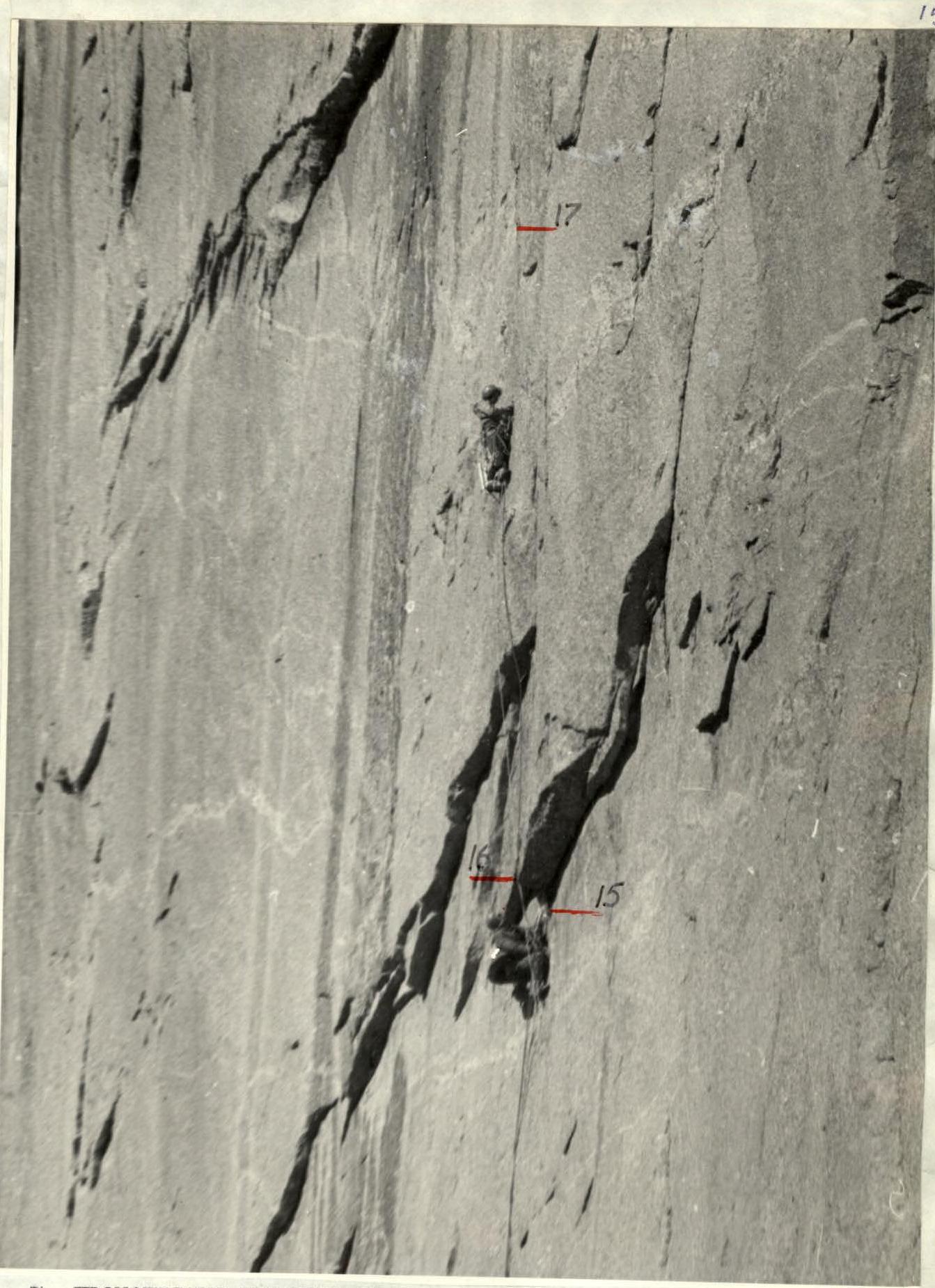
Photo 7. PASSAGE OF SECTION R16–R17. August 8, 1988, 8:00. 200 mm lens. Distance to the object 300 mm. Height of the shooting point 3100 m. Shooting point № 7.

Comments
Sign in to leave a comment