
PASSPORT
- Class: technical
- Region: Pamir-Alay, Lailak valley
- Summit: Pik Alexandra Bloka via West face
- Category: 6A
- Elevation difference:
- 680 m
- length 1250 m
- length of 6th category sections 580 m
- average steepness of the main part of the route 82°
- Used on the route:
- rock pitons 38/35
- bolt pitons 3/3
- chocks, including friends 376/320
- Climbing hours: 30 Days: 3
- Nights spent: in a tent on a rock ledge above the middle of the route
- Leader: Kokhanov Valery Petrovich, Master of Sports
Team members:
- Bekasov Alexander Vladimirovich, 1st sports category
- Kuznetsov Pyotr Valentinovich, Master of Sports
- Obednin Konstantin Alexandrovich, Master of Sports candidate
- Pushkarev Semyon Alekseevich, Master of Sports
- Sagan Sergey Anatolyevich, Master of Sports candidate
- Coach: Zakharov Nikolai Nikolaevich
- Route entry: July 29, 1995 Summit: July 31, 1995
- Organization: Krasnoyarsk Kraisportkomitet
 Photo of the summit. Taken on August 2, 1995. Nikon lens, F = 135 mm, distance 1 km, altitude 4400 m.
TACTICAL ACTIONS OF THE TEAM
The time schedule was followed strictly, and no adjustments were needed along the way. The rotation of lead climbers and the organization of rope team movement were carried out according to the tactical plan. On July 29, the rope team Pushkarev–Sagan–Obednin processed the route. Pushkarev worked the entire day as the lead climber. Sections R0–R5 were completed in 9 hours. On July 30, the rope team Kokhanov–Kuznetsov worked on the route first. Kokhanov worked the entire day as the lead climber. Sections R6–R8 were completed in 9 hours (the first 4 hours were spent on passing the fixed ropes and preparing for further route processing). On July 31, the rope team Kuznetsov–Pushkarev worked on the route first. Kuznetsov worked the entire day as the lead climber. Sections R9–R14 were completed in 8 hours. The physical and technical preparation of the team members and their experience allowed for a high workload, such as prolonged lead climbing, and the absence of unnecessary changes during the work saved a significant amount of ascent time. The belay for the lead climber was done using two ropes, one of which had UIAA marking through a UIAA knot. The movement of the remaining team members along the fixed ropes was done with top-rope belay, except for the third climber, who moved along the fixed ropes with bottom-rope belay. At the belay stations, opposition systems consisting of 3–5 blocked elements were used. The assortment and quantity of equipment corresponded to the route requirements. There were no falls or injuries. Despite the very good preparation of the team members and their desire to climb free, the route's high steepness and complexity often required the use of artificial technical aids (ITOs). The rescue team, authorized to tackle routes of 6th category difficulty, was stationed at the base camp, while the coach and observers were at the camp below the route. Radio communication was carried out according to the scheme: wall — observers; observers — base. There were no missed communication sessions.
UIAA SCHEME
| Difficulty category | Section | Length (m) | Steepness (deg.) |
|---|---|---|---|
| 3 | R0 | 60 | 40 |
| 5+ | R1 | 75 | 75–80 |
| 6 | R2 | 100 | 85 |
| 6 | R3 | 30 | |
| 6 | R4 | 120 | 95–100 |
| 6 | R5 | 30 | 75–90 |
| 6 | R6 | 65 | 80–85 |
| 6 | R7 | 50 | 70–80 |
| 6 | R8 | 100 | 70–80 |
| 5+ | R9 | 35 | 70 |
| 6 | R10 | 35 | 90 |
| 6 | R11 | 90 | 85 |
| 5+ | R12 | 50 | 70–75 |
| 5– | R13 | 150 | 40–45 |
| 4 | R14 | 120 | 15 |
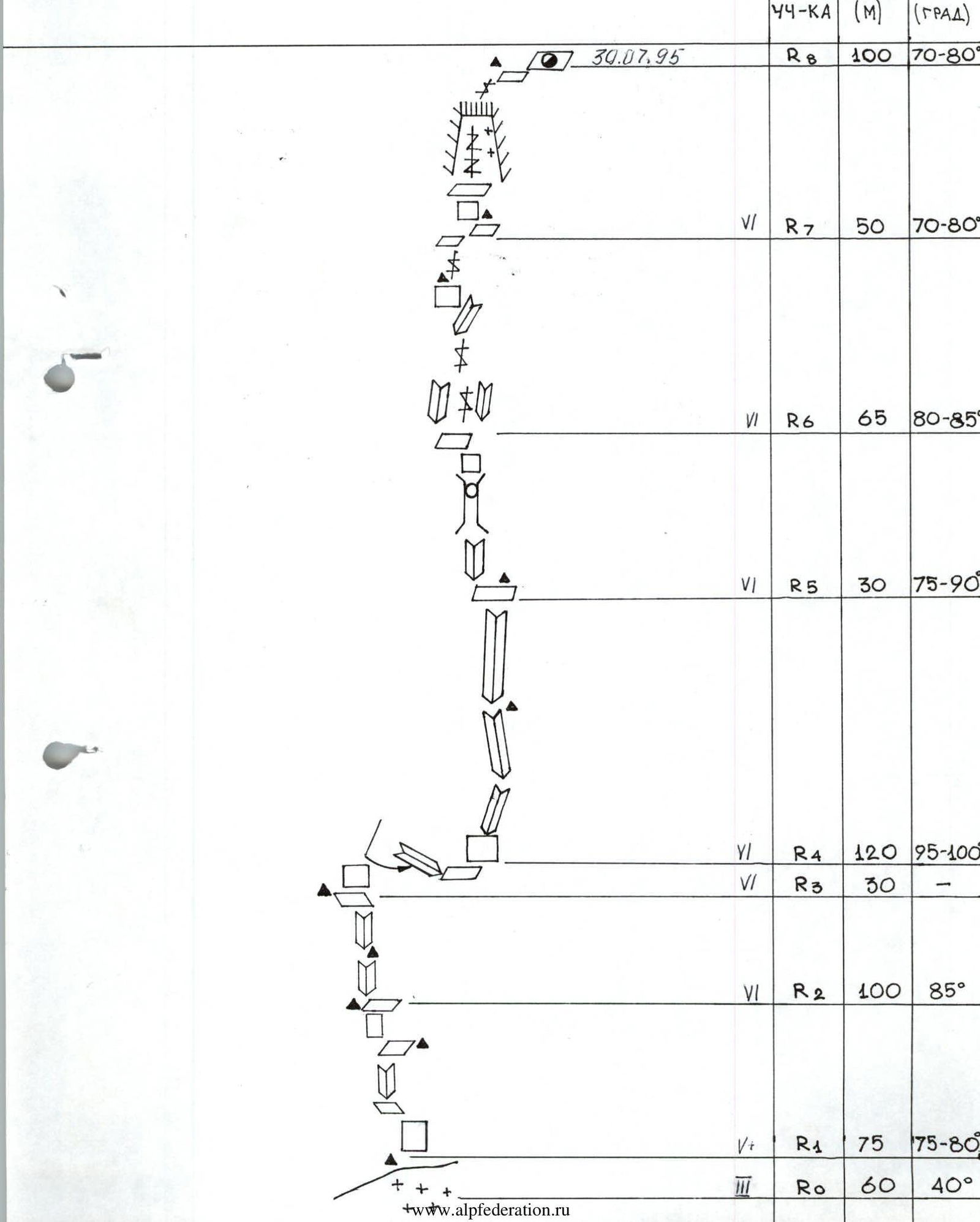
Route description by sections
R0 — The section starts from the bergschrund, which is overcome through a snow plug. This is 60 m of a steep snow slope, which leads 20 m to the left of a "patch" to the beginning of the wall.
R1 — Straight up to a small cornice, bypassed on the left (30 m, 3 pre-drilled bolt pitons), then 15 m up a small internal corner. Then straight up with a deviation to the left to the base of a large internal corner (30 m). Belay with chocks.
R2 — Up the steep internal corner 100 m to the level of the first control cairn. Belay with chocks and occasional use of friends for protection.
R3 — Along the wall with small smoothed holds and using three pre-drilled bolts 12 m up to the right. Using the last bolt as a pendulum, 20 m down to the right along a narrow sloping ledge to the first control cairn. Another 8 m to the right along the ledge to the next bolt.
R4 — 8 m straight up the completely smooth wall (using two more bolts and skyhooks) to a very thin initial crack. The wall becomes less steep, and the crack widens. Free climbing allows for 15 m of progress, then it becomes steep again (up to 100°), so we switch to artificial technical aids (ITOs) and continue on ITOs through this overhanging crack. All belay points are hanging. To the end of the crack and the appearance of the first ledges, which seem very convenient — 120 m.
R5 — 6 m up the internal corner, then 8 m up a wide crack to the left and up (through live rock!) to a small cornice. Through the cornice, up the crack to the base of a large internal corner. A convenient belay station. Belay with chocks and friends.
R6 — A 2-meter slab wedged between two walls 10 m from the belay is bypassed on the right along a small internal corner. Using two parallel vertical cracks (piton protection), we approach a bolt piton, from which we move left and up over a ridge, exit onto a slab with cracks, and another 10 m to the belay. 25 m up and slightly to the right, then 15 m to the right under a dark recess in the wall ending in a cornice. Belay.
R7 — 6 m up the wall, then, using the relief in the right part of the recess, ascent under the cornice and traverse to the left part of the cornice (snow, wet rocks!). The cornice is passed through a crack and further along the slab to the right and up another 15 m to the exit onto ledges. Belay. To the right, after a 4-meter internal corner, there are large — up to one and a half meters wide — ledges. A camping spot for sports groups, as well as for our group.
R8 — 100 m along a wide crack crossing the wall to the right and up leads to the lower part of an internal corner.
R9 — 20 m along a chimney filled with ice (ice screws, ice axes) leads to a cornice. After the cornice, we move left under a steep rock slab with a wide overhanging crack between the slab and the wall to the right and a narrow crack running diagonally across the slab from right to left.
R10 — 8 m up a thin, tapering crack to two bolt pitons, from which a small pendulum to the right and 5 m up to a diagonal crack. The crack is passed exclusively on ITOs (piton, hangers, small chocks). The length of the crack is about 15 m. Transition to free climbing, another 10 m, and we exit onto the top of the slab. Belay.
R11 — Free climbing up steep, broken rocks to the left and up 50 m to an internal corner to the left of the wall. 10 m to the right along the wall, 6 m up a wide crack in the internal corner, a 5-meter pendulum to the right to a rock "patch", 6 m to its top, and "point to point" along three bolt pitons. From the last bolt piton, a pendulum to the left into the upper part of the already familiar wide crack. Along it, 15 m to a good ledge. Belay.
R12 — 6 m to the left and through a small overhang, exit onto a gentle part of the wall. Another 40 m to the left and up to a gentle rock ridge. Belay. 4 m along the wall to the left and up leads to the ridge. Along "sheep's foreheads" 20 m, and we are on the "roof". Belay after 30 m at a convenient spot for reception.
R13 — 150 m along scree and gentle rocks to the ridge leading to the summit tower.
R14 — 120 m along the ridge (bypassing gendarmes on the left) under the summit tower. Onto the tower, 12 m of moderate complexity climbing. Summit!