
Ascent Logbook
- Category of Climbing Difficulty: First Ascent
- Location: Pamir-Alay, Turkestan Ridge
- Peak A. Blok, 5239 m, via the Northwest Counterfort and Northwest Wall.
- Proposed category of difficulty: 5B, combined, first ascent.
- Height difference: total, wall section (sections R17–R28)
| Total | Wall Section (R17–R28) | |
|---|---|---|
| Height Difference | 840 m | 430 m |
| Distance | 1040 m | 455 m |
| Average Slope | 62° | 75° |
| Distance of 5th Category Sections | 180 m | |
| Distance of 6th Category Sections | 340 m |
- Pitons driven:
- Rock pitons: 98/70
- Bolt pitons: 2/1
- Placements: 134/82
- Ice screws: 10/8
- Climbing hours — 69, days — 7
- Overnight stops:
- One person in a hammock, one lying on a ledge, four in a tent;
- One in a hammock, one lying on a ledge, four in a tent;
- Lying down, four in a tent, two in bivouac gear.
- Team Leader: Ginzburg S.A. — Candidate Master of Sports
Team Members:
- Vasiliev S.I. — Candidate Master of Sports
- Makhnovetsky A.B. — Candidate Master of Sports
- Melentiev V.I. — Master of Sports of the USSR
- Tsybanov V.V. — 1st sports category
- Shaginyan I.E. — Master of Sports of the USSR Coach: Kozlov Yu.E. — Master of Sports of the USSR
- Departure for the route — July 10, 1986, summit — July 16, 1986, return — July 16, 1986.
* The numerator shows the total number of pitons, the denominator shows the number used for artificial climbing.
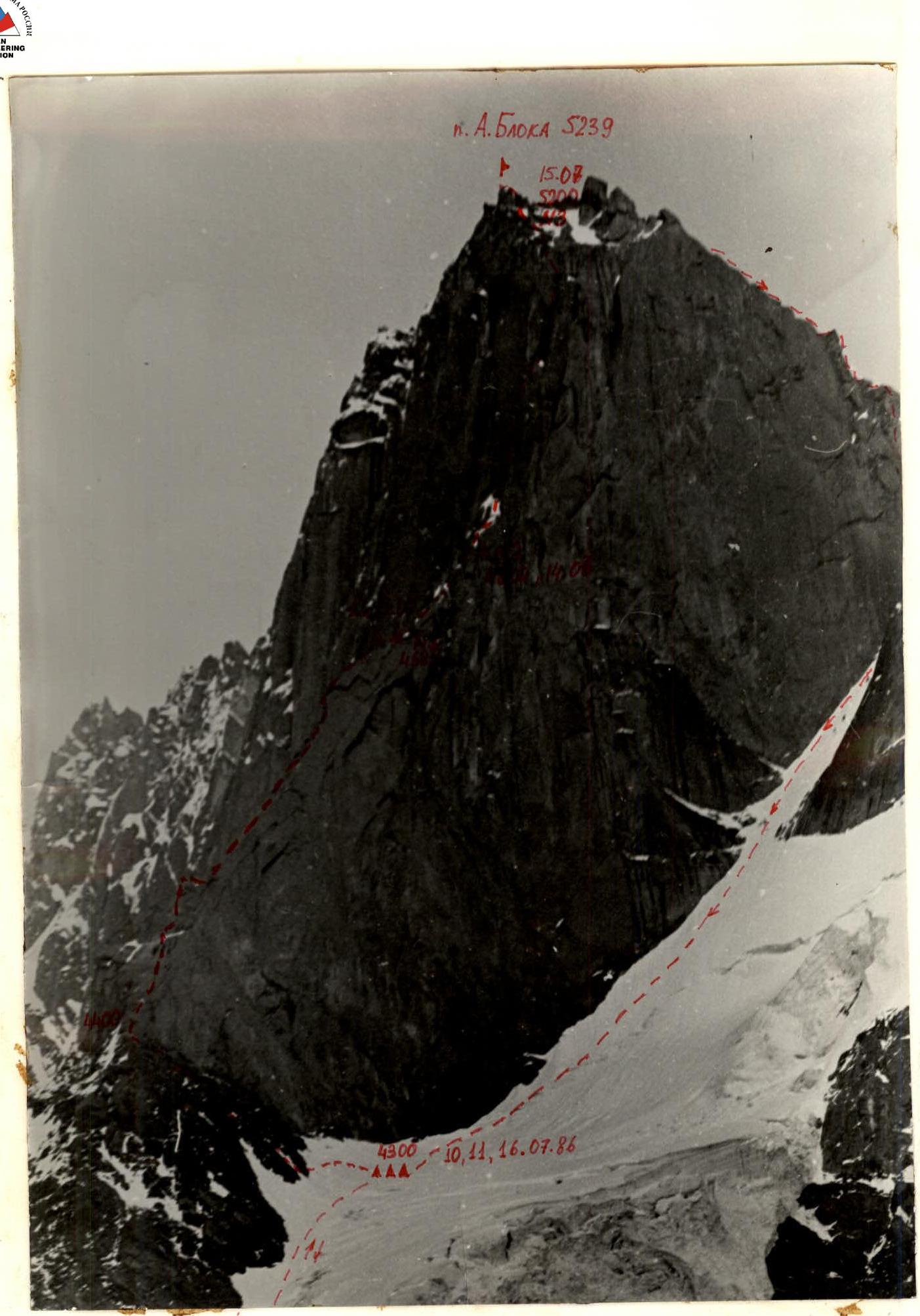
Fig. I. General view of the summit (photo I) taken on July 19, 1986, at 16:00 from the summit of Peak 4200, 2 km away, lens D-37A (F=135)
Tactical Actions of the Team
July 10. The Ginzburg–Makhnovetsky rope team departed from the bivouac on the ridge of Peak 4200 at 9:00, reached the snow mulde under the western wall of Peak A. Blok by 9:40, and, having taken all necessary gear, began processing the Northwest Counterfort. By 13:00, having climbed 4 ropes (section R0–R5), the team reached a gendarme, from which the previously unseen part of the route was visible. The upper part of the northwest counterfort, leading to the right part of the Central Bastion of Peak A. Blok, was carefully examined.
At 10:00, the rest of the group departed from the same bivouac and by 11:00 had fully relocated to the mulde under the western wall, where the initial bivouac was set up.
By 13:00, the transportation of gear along the processed part of the route began.
July 11. From 9:00, the Tsybanov–Melentiev rope team continued working on the northwest counterfort and by 18:00 had climbed another 6 ropes (section R5–R11). From 10:00 to 17:00, the rest of the group carried out the transportation of gear along the fixed ropes. Since there was no convenient place for a bivouac on the processed part of the route (except for a ledge two ropes from the start), it was decided to move the bivouac the next day.
July 12. At 9:00, the group completely left the initial bivouac. The Ginzburg–Makhnovetsky rope team, taking the ropes from below, moved forward for further processing. The Tsybanov–Shaginyan rope team carried the necessary gear for the leading team. The Melentiev–Vasiliev rope team was responsible for transporting all other gear.
By 13:00, the leading team reached a gentle slab, where it was decided to set up a bivouac (Overnight Stop No. 1). All gear was brought here by 15:00. The leading team continued processing the route and, having climbed another 3 ropes (section R11–R17), reached under the smooth slabs of the upper part of the counterfort. By 19:00, they had climbed about 15 meters of complex slab using skyhooks and micro-pitons. The rest of the group, having organized the bivouac, carried out gear to the start of section R17–R18.
July 13. From 9:00, the Tsybanov–Vasiliev rope team continued working ahead. The smooth, steep wall blocking access to the bastion was climbed using ice axes and ladders through cracks filled with ice. The ice was hard and glassy; protection was through ice screws and on rocks. Then, along moderate ice terrain, the team approached the base of the Central Bastion.
The beginning of the bastion is marked by a large, arched gap in the wall (section R20–R21) — the "gates." The right part of the "gates" is filled with flow ice. The "gates" were climbed on the left side, followed by a pendulum move to the right side.
Further movement was through a cornice on the "gates" along a narrow (averaging 3–4 cm) crack in a nearly vertical, smooth wall. The crack was climbed mainly using artificial climbing techniques.
The "gates" and the crack were climbed during a heavy snowfall that started around 15:00.
July 14. At 9:00, the Ginzburg–Melentiev rope team continued processing. By 20:00, they had completed the crack (section R21–R22) and a section of inclined slab (R22–R23), leading under the base of an internal corner. The crack ends on a small horizontal ledge where a semi-reclining overnight stop is possible.
At 13:00, the rest of the group, having gathered all gear, began ascending the fixed ropes and by 17:00 reached a small balcony 25 meters below the "gates." Here, they managed to clear a spot for one tent and organized Overnight Stop No. 2. It snowed again in the afternoon.
July 15. The Tsybanov–Makhnovetsky rope team started processing at 19:00. Using artificial climbing, they passed a steep 60-meter internal corner (key section of the route) with smooth walls (section R23–R24), a cornice closing the internal corner, and a chimney (R24–R26). From a small ledge at the end of the chimney, the path to the summit was visible.
Meanwhile, the rest of the group dropped gear to the initial bivouac and ascended to a ledge under the internal corner along the fixed ropes, where Overnight Stop No. 3 was planned. However, since the leading team had completed the most challenging part of the bastion by 17:30 and the further path to the summit was clear, it was decided to continue the ascent.
At 19:00, the entire group gathered on the ledge at the end of section R25–R26. The group then moved together, with the Vasiliev–Melentiev rope team leading. By 21:00, the group finished climbing the bastion and stopped on a snow shoulder under the summit at 22:00 (Overnight Stop No. 3).
July 16. Departing from the bivouac at 11:00 (it was very cold, -12 °C in the morning), the group reached the summit by 12:00 and began descending along the southwest ridge. By 22:00, everyone had descended to the initial bivouac in the snow mulde.
Thus, despite bad weather, the group fulfilled their tactical plan. The most challenging part was completed one day ahead of schedule, due to the absence of sections requiring the use of bolt pitons as initially planned.
The tactical scheme for the leading rope teams was as follows: the team departed from the overnight stop around 9:00, traversed the fixed ropes, and began processing when it became warmer. The leading teams worked on processing for an average of 8 hours, with a 30–45 minute break for a hot meal. If necessary, the first person in the leading team would change after the break.
The rest of the group was responsible for transporting gear along the fixed ropes and organizing overnight stops.
The adopted tactics allowed the group to rest maximally from processing. With the chosen tactics, going out for processing occurred no more than once every two days.
Communication with the Alay Rescue Team was regularly maintained three times a day via the "Karat" radio station. Additionally, twice a day, communication with the team coach and observers was carried out using the "Nedra" radio station.
Route Description by Sections
R0–R1. Smooth slab with good, convenient holds; water flows down in the afternoon. The upper part is covered with ice early in the morning.
R1–R3. Horizontal ledge under a steep wall. The wall is bypassed on the right via a vertical chimney.
R3–R5. Horizontal ledge turning into a ridge, ending in a gendarme. The ascent to the gendarme is via the left wall.
R5–R6. From the gendarme, a rappel down a нависающую стенку (overhanging wall).
R6–R7. Steep, smooth wall to the left of a sharp ridge.
R7–R8. Wall on the left side of a knife-edge ridge.
R8–R9. Steep, monolithic ridge with good holds.
R9–R10. Smooth, inclined slab under a cornice.
R10–R11. Very difficult, smooth internal corner to the right of the ridge. Climbed on the right wall.
R11–R12. Very sharp, knife-edge ridge.
R12–R13. Monolithic slab of medium steepness.
R13–R14. Gentle (about 5°), smooth slab. Overnight Stop No. 1 was organized here.
R14–R15. Snow ridge of medium steepness.
R15–R16. Difficult wall to the left of the ridge.
R16–R17. Chimney-couloir with a change to the right of the ridge.
R17–R18. Very difficult, completely smooth wall. Climbed using artificial climbing techniques.
R18–R19. Very difficult, completely smooth wall. Climbed using ice axes through a system of cracks with flow ice.
R19–R20. Steep ice couloir. To the right and below it, on a good platform, is Overnight Stop No. 2.
R20–R21. Arched gap in the wall — the "gates." The right side is filled with flow ice. Climbed using artificial climbing on the left part, followed by a pendulum move to the right.
R21–R22. Narrow (averaging 3–4 cm), long crack in a nearly vertical, completely smooth wall. Climbed mainly using artificial climbing. FRIENDS, medium placements, and channel pitons worked well. The section ends on a ledge suitable for a bivouac.
R22–R23. Smooth slab of medium steepness. Climbed on the left part.
R23–R24. Nearly vertical, very difficult internal corner with smooth walls. Climbed mainly using artificial climbing. Small and medium placements and channel pitons worked well. The cornice closing the internal corner is climbed on the right part using artificial climbing.
R24–R25. Very complex, nearly vertical chimney with smooth walls. Climbed mainly by free climbing on the right wall, with support on the left, overhanging wall. Channel pitons and small placements worked well. The section ends on a convenient ledge. A bolt piton was driven here to secure the ropes.
R25–R26. Chimney similar to R24–R25 but less steep.
R26–R27. Vertical, smooth wall. Climbed using artificial climbing.
R27–R28. Steep, smooth wall. Climbed by free climbing.
R28–R29. System of snow-covered ledges and broken rocks. Possible rockfall onto the wall.
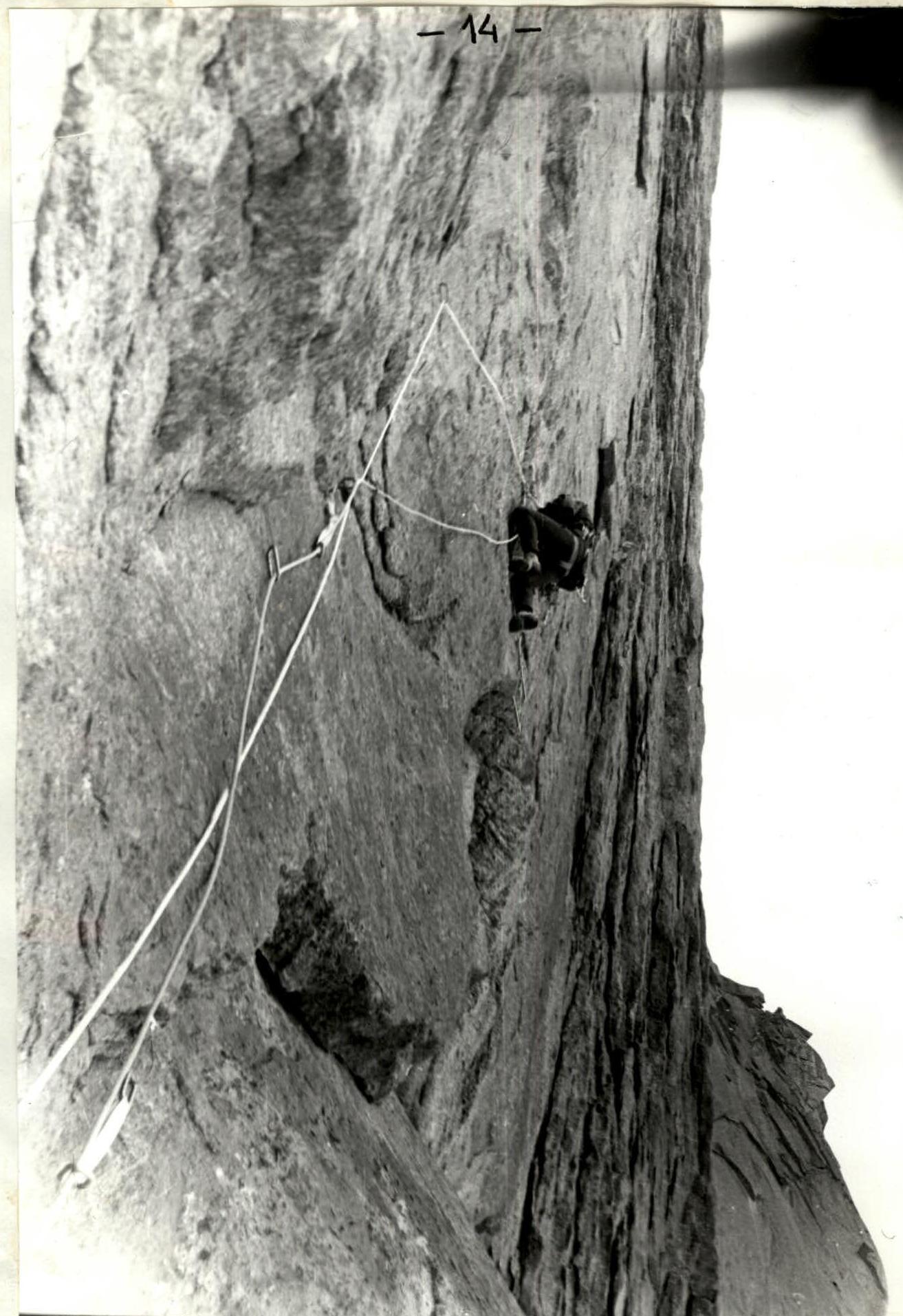
Photo No. 9. Climbing section R4–R5. Taken on August 28, 1986, at 17:00. "Smena" camera, T-43 lens, 10 m distance, shot from the end of section R3–R4
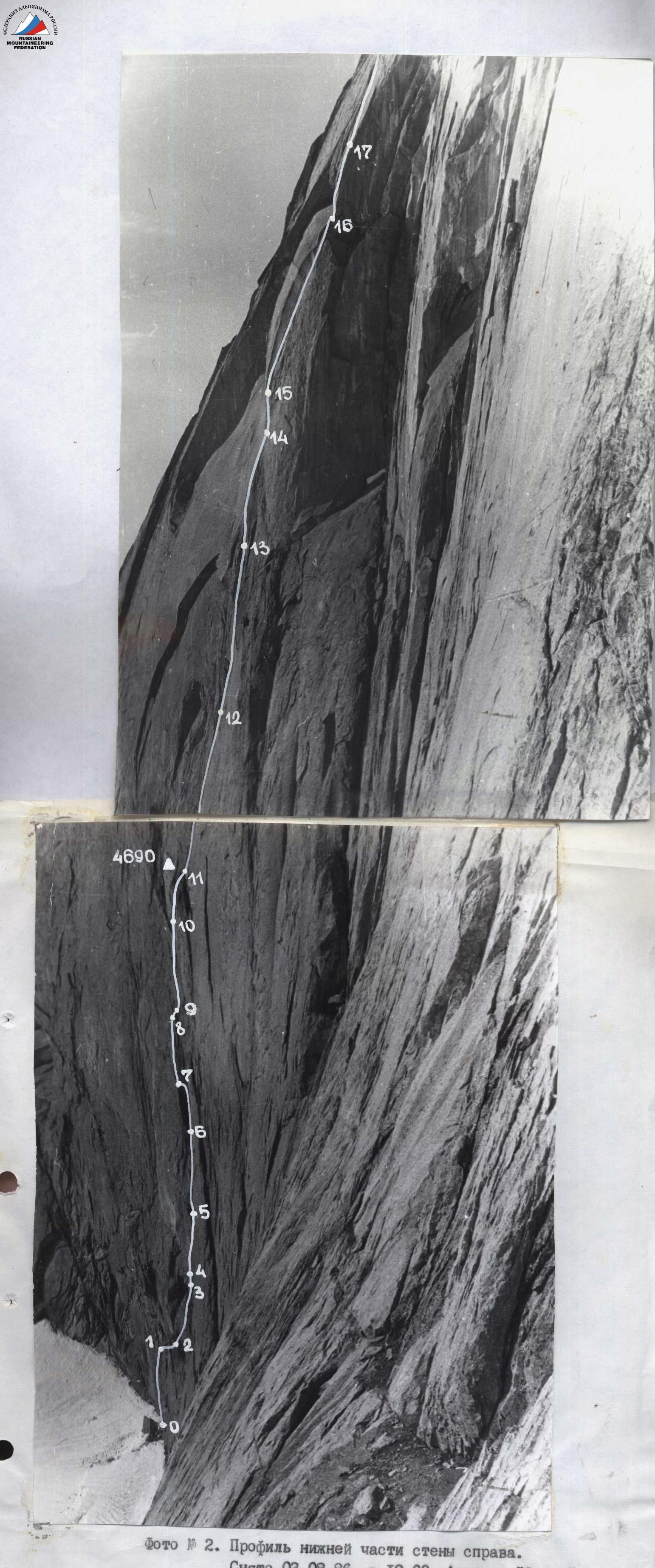
Photo No. 2. Profile of the lower part of the wall on the right. Taken on August 3, 1986, at 19:00. "Smena" camera, T-43 lens, 0.5 km distance, point R2 (4700 m)
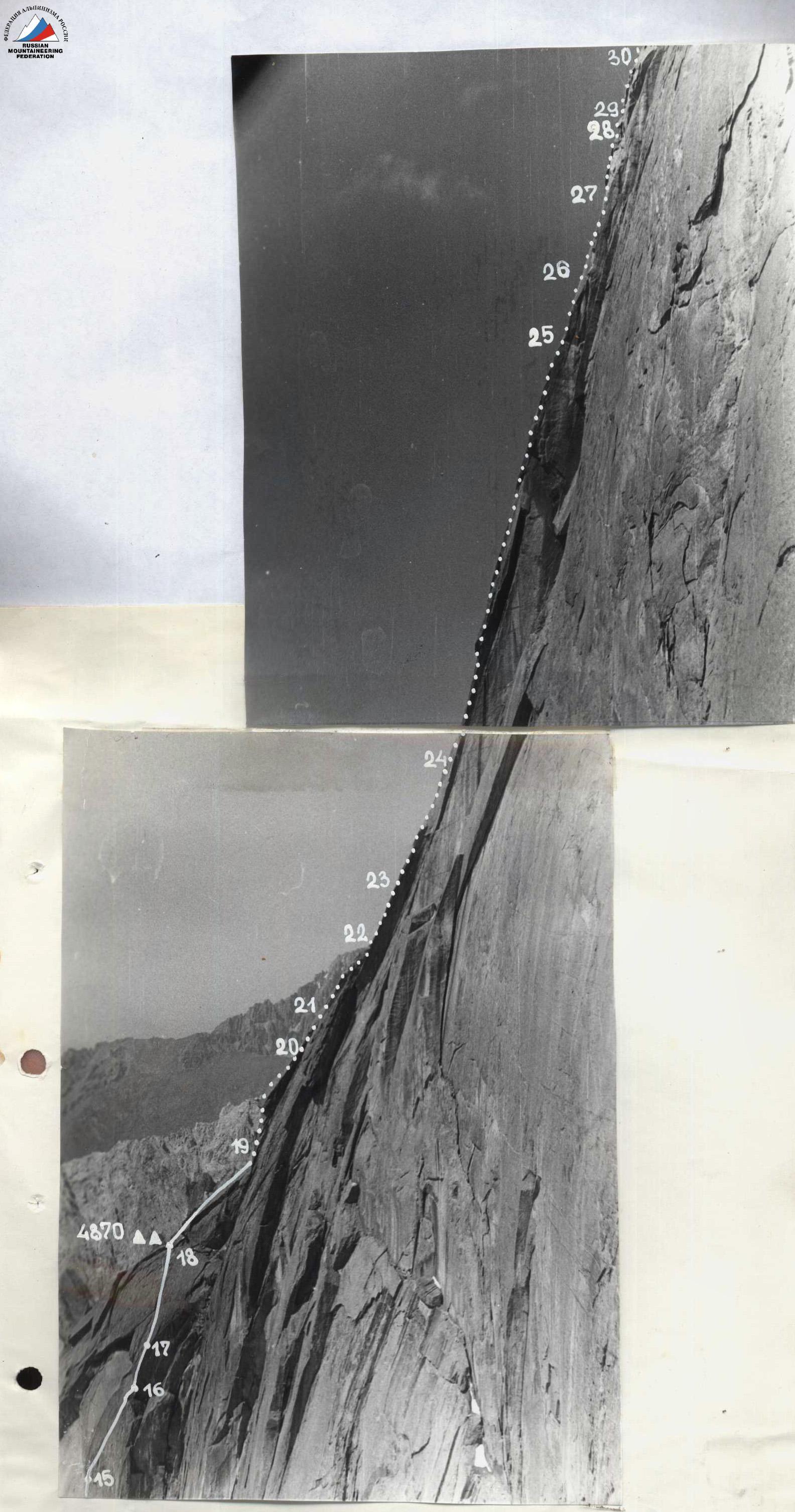
Photo No. 14. Climbing sections R22–R24, view of sections R24–R29. Taken on August 1, 1986, at 17:30. "Smena" camera, T-43 lens, 35 m distance, shot from the end of section R21–R22
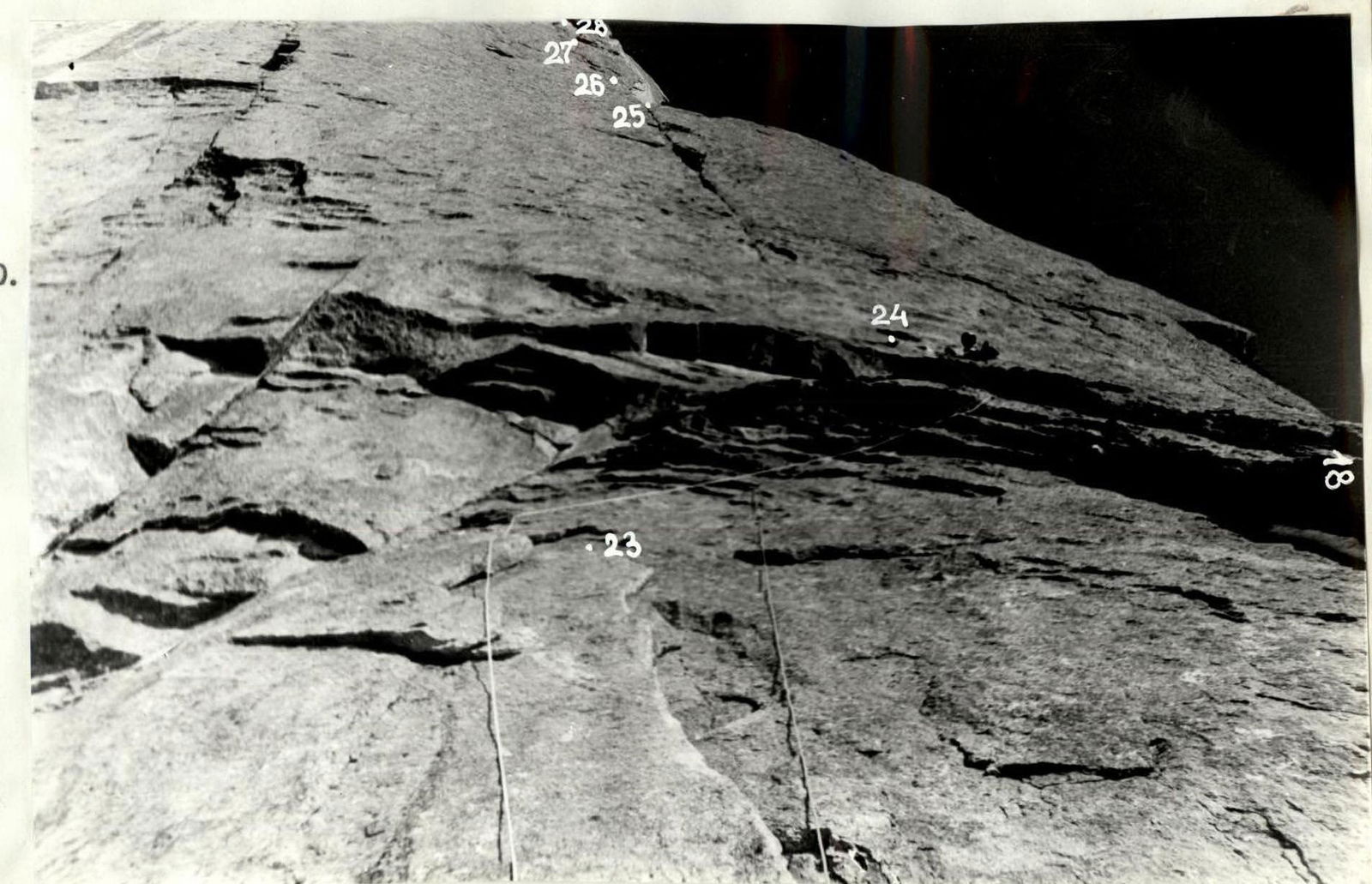
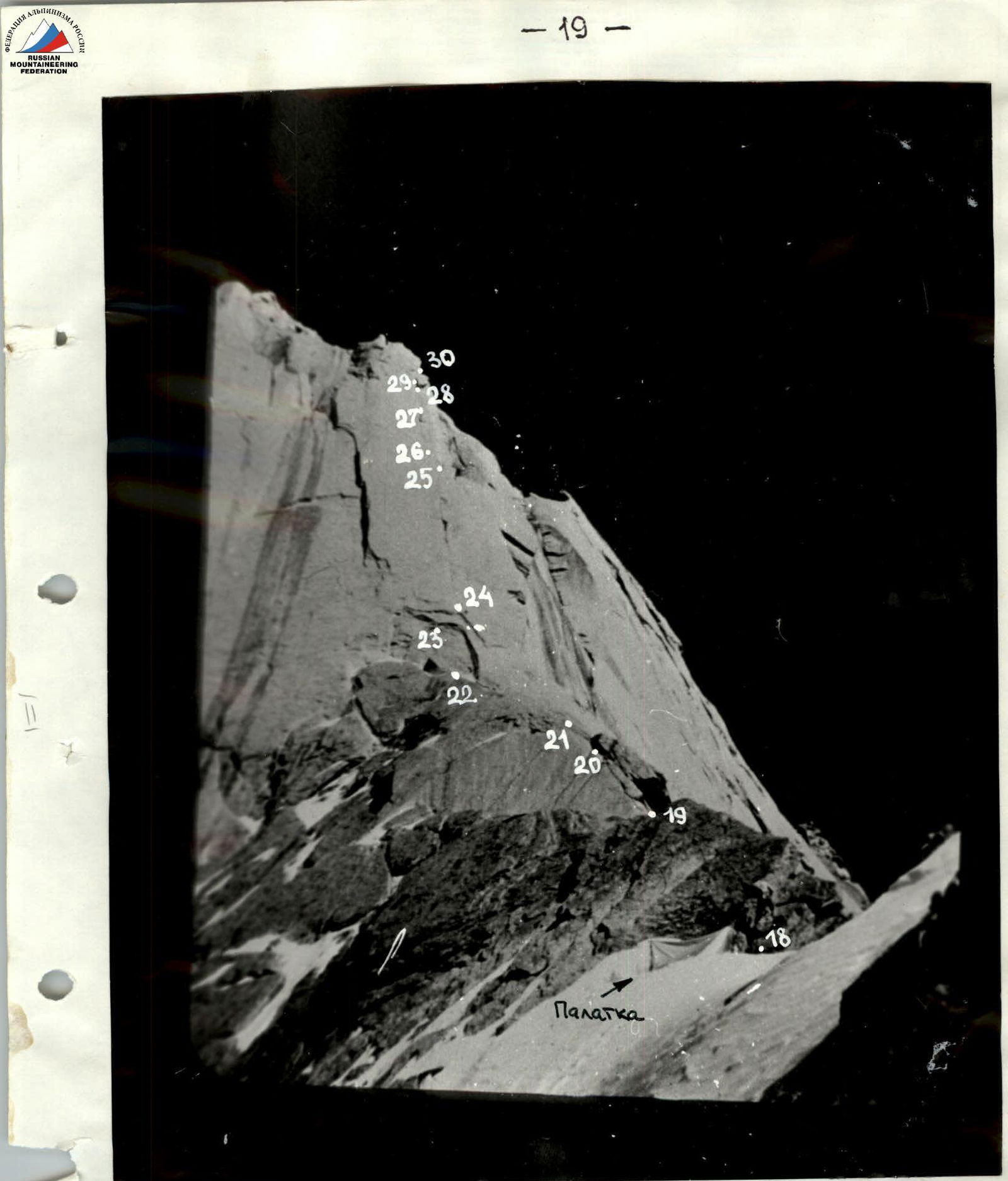
Photo No. 15. Overnight stop at point R18 on the Northwest Counterfort. Taken on August 1, 1986, at 12:00. "Smena" camera, T-43 lens, 20 m distance, shot from section R18–R19
Photo No. 17. Climbing section R28–R29. Taken on August 2, 1986, at 17:00. "Smena" camera, T-43 lens, 15 m distance, shot from the end of section R24–R25
