
Ascent Log
-
Ascent category — technical.
-
Ascent area: Pamir-Alay, Turkestan Range, Lailyak gorge.
-
Peak, route: p. Ak-Su (N), 5217 m, A. Antonova via the "cold corner".
-
Category of difficulty — 6A, 4th ascent.
-
Height difference: 1460 m.
Route length — 2040 m, length of sections with 5–6 category of difficulty — 1190 m.
Average slope: of the route — 65°, of its wall section — 70°.
-
Pitons hammered: rock — 76/41, chocks — 134/40, ice screws — 78/2, bolt pitons — 17/6. Left on the route: cams — 1, rock pitons — 6.
-
Team's travel hours: 73 h and 8 d.
-
Overnights: 1–6 — on a platform, 7th — on a ridge on a site, 8th — below the summit.
-
Participants:
Alexander Moachalov — Master of Sports Nikolai Rylov — Candidate for Master of Sports
-
Coach: self-coached.
-
Start of the route:
— August 16, 1999. Summit — August 23, 1999. Return to base camp — August 26, 1999.
-
Organization name: Perm Regional Sports Committee.
— Perm, K. Marx st., 1.
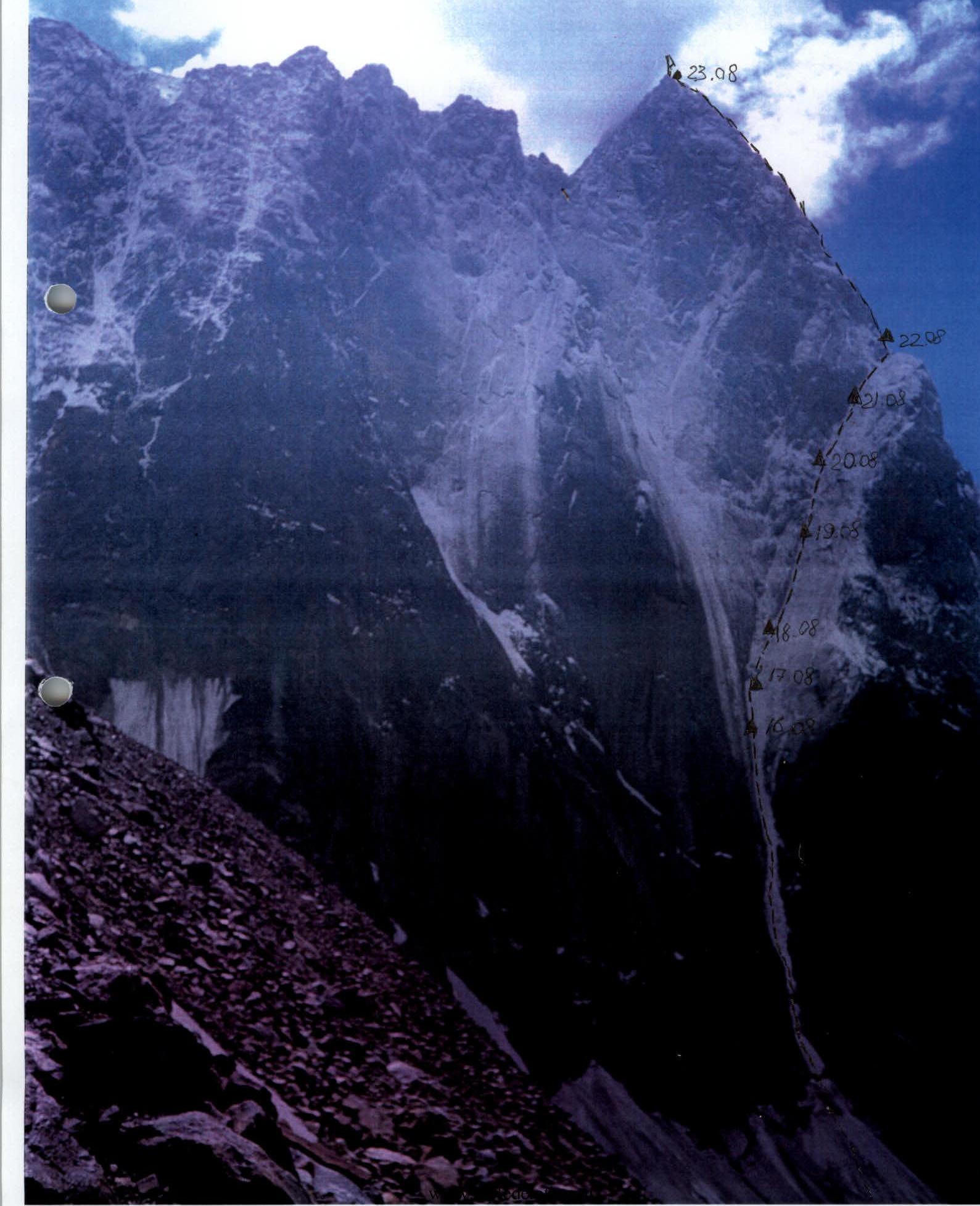
Team's Tactical Actions
The tactical plan for the ascent was made based on consultations with P. Shabalin and G. Kirievsky and personal observations of the wall in 1996–1998. To ensure a successful ascent, preparation was carried out corresponding to the complexity of the route and its features:
- A two-person tent-platform was manufactured.
- A gas reserve was prepared.
- A specialized menu of light, high-calorie products was compiled.
Hot meals were organized twice a day.
On the first day of ascent, the team left the bivouac at 3:00 AM. The early start was based on the need to climb as many pitches as possible, as this section is prone to rockfall after noon. A. Moachalov led. N. Rylov carried the platform and a large backpack. The second backpack was pulled up using a carabiner brake. The second's task was to remove intermediate protection points and transport the load.
On the next day, N. Rylov led first. Continuous rockfall and falling ice caused by an earthquake significantly complicated the work for this and the next two days. Bad weather conditions, compounded by the earthquake's aftermath, greatly shortened the working time on the route.
The team alternated leaders, allowing one to rest every other day. The weather allowed work only until noon, after 14:00 fog descended, and rain or wet snow fell.
Heavily iced, snow-covered rocks required more extensive use of artificial aids than planned, and ice-filled cracks slowed the ascent.
Crampons were not removed throughout the entire route.
On the pre-summit ridge, the team was caught in severe weather, with wet snow and electrical discharges. Therefore, they had to wait a day below the summit before descending.
When organizing protection, points were set up on at least three anchors. The platform for overnight stays was hung on two 10 mm diameter bolt pitons. For the first climber's protection, a double rope was used, one of which met all UIAA requirements. Protection was set up using " восьмёрка" (figure-eight descenders) and "VAUDE" extension slings.
Of all the equipment, the крюконоги (hook-nogs) and ladders produced by P. Shabalin were particularly notable. The set of cams was from "STREGOR".
There were no falls on the route. The accident-free ascent was also ensured by the team's appropriate psychological attitude and ability to work as a duo on a 6th category route in any weather conditions. Visual contact was maintained with the Magnitogorsk team for the second half of the route.
| Section # | Rock Pitons | Chocks | Bolt Pitons | Ice Screws | Diagram | Length in meters | Slope | Category of Difficulty |
|---|---|---|---|---|---|---|---|---|
| 1 | -- | 2 | -- | 6 | 80 | 50–60 | III–IV | |
| 2 | 4 | 5/3 | -- | 1 | 40 | 70 | V–VI | |
| 3 | 1 | 4 | 1 | -- | 20 | 70 | VI | |
| 4 | 1 | 3/1 | -- | 1 | 15 | 75 | V+ | |
| 5 | 2 | 1 | -- | 18 | 240 | 65 | V | |
| 6 | -- | -- | -- | 16 | 120 | 70–80 | V–VI | |
| 7 | 4/3 | 2/2 | -- | -- | 40 | 85–90 | VI A1 | |
| 8 | 3/3 | 7/3 | -- | -- | 30 | 95 | VI A2 | |
| 9 | 3/3 | 4/2 | -- | -- | 35 | 80 | V–VI A1 | |
| 10 | 3/2 | 5/3 | -- | -- | 30 | 75 | VI A1 | |
| 11 | 3/1 | 4/2 | -- | 2/2 | 40 | 70 | VI A1 | |
| 12 | 2 | 3/1 | 1+2 | 1 | 30 | 75 | V–VI | |
| 13 | 4/3 | 2/2 | 1 | 1 | 40 | 75 | VI A1 | |
| 14 | 3/2 | 5/2 | -- | -- | 50 | 70 | VI A1 | |
| 15 | 5/3 | 3/1 | 2 | 3 | 45 | 90 | VI A1 | |
| 16 | 3/2 | 4 | 1 | -- | 20 | 80 | V A1 | |
| 17 | 5/4 | 2 | 1 | -- | 20 | 85 | VI A2 | |
| 18 | 3/1 | 5/2 | -- | 1 | 50 | 70 | VI A1 | |
| 19 | -- | 3 | -- | 5 | 50 | 70 | V | |
| 20 | 3/1 | 4/2 | -- | 1 | 40 | 75 | VI A1 | |
| 21 | 2/1 | 4 | -- | -- | 70 | 80 | VI A1 | |
| 22 | 6/4 | 4/2 | 1 | 2 | 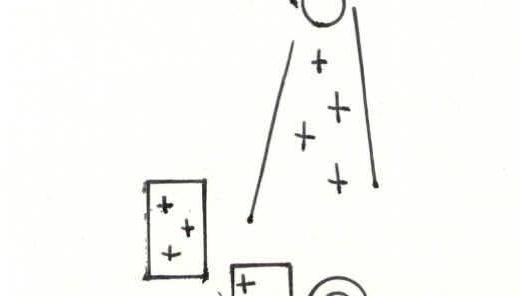 | 50 | 75 | VI A1 |
| 23 | -- | -- | 3/3 | 6 | 40 | 50 | IV | |
| 24 | 1/1 | 3/2 | -- | 4 | 10 | 95 | VI A2 | |
| 25 | 1 | 2 | -- | 3 | 50 | 90 | VI A1 | |
| 26 | 1 | 3 | -- | 1 | 30 | 30 | III | |
| 27 | 1 | 2 | 1 | -- | 50 | 50 | IV | |
| 28 | 5/5 | 8/7 | 3/3 | 2 | 55 | 85–90 | V–VI A1 | |
| 29 | 7/2 | 8/3 | -- | 4 | 500 | 40–50 | IV–V | |
| 30 | -- | 2 | -- | -- | 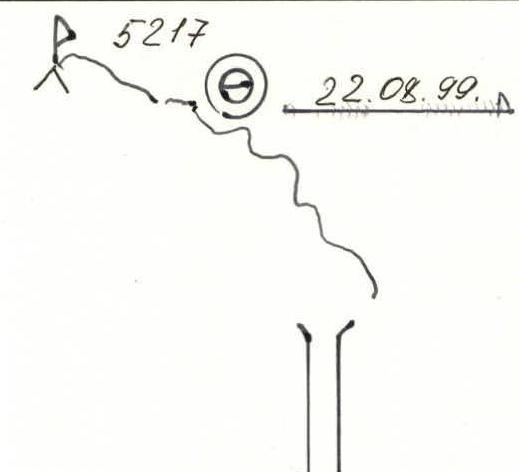 | 150 | 30 | IV |
Route Description by Sections
- A snow-ice slope with a bergschrund at the top leads to the start of the route.
- Heavily broken rocks, iced over, with snow-filled cracks, lead to an ice "river". 3–4. Ice climbing along the rocks, exiting to a wall with an oblique crack. Difficult rock climbing on the wall, then through a chimney leads to the start of the ice "river". 5–6. Ice "river" 240–260 m long, with a slope of 65°. Climbed from the right side; left side is dangerous due to potential icefall. There are rock walls 2–3 m high. 7–9. The ice slope meets an overhanging wall. Then traverse right, along the wall, to an internal corner. Problems with protection organization. Rocks are iced over. 10–13. Steep walls with small overhangs are climbed using artificial aids. Difficulties with setting protection points. Cracks are filled with ice. Climbing in crampons.
- The wall's lower section is overhanging, with loose rocks everywhere. Climbed via a crack running through the center. Rocks are semi-destroyed. 15–16. Then, a sloping ledge covered in snow. From it, an internal corner iced over leads right. Problems with protection organization. The corner leads to a cornice, which is bypassed on the right. Climbing in crampons due to ice covering the rocks. 17–18. A chimney is climbed using artificial aids. To the right are overhanging walls with cornices. To the left is a rockfall hazard.
- An ice slope with a 70° slope leads to an internal corner filled with ice. Difficult climbing in crampons. 20–22. Up steep, iced-over walls. Climbing is difficult, using artificial aids. To the right are iced-over "ram's heads". Leftward bypass is impossible due to rockfall danger. The slope eases slightly. Rocks are snow-covered, with ice underneath. Walls and corners alternate with snowy couloirs. 23–25. A snow-ice couloir is climbed through a rock "plug". The couloir leads to an internal corner, climbed using large cams. Difficult climbing. Artificial aids. 26–27. A sloping ledge covered in snow. Problems with protection organization. Climbing on relatively easy, broken rocks. Loose rocks. Ice everywhere.
- A 55–60 m wall, with a chimney-like feature in the center. All cracks are filled with ice. Climbing is 5–6 category, in crampons, with artificial aids. The chimney leads to a ridge.
- Climbing is 5–6 category. The entire ridge is snowy, making climbing difficult. The ridge ends with a rappel loop.
- From the rappel loop, rightward along the ridge towards the summit, a rock tower is bypassed on the left, then to a saddle and a transition to the right side of the ridge. On snow and easy rocks to the summit — 150 m, category 4.
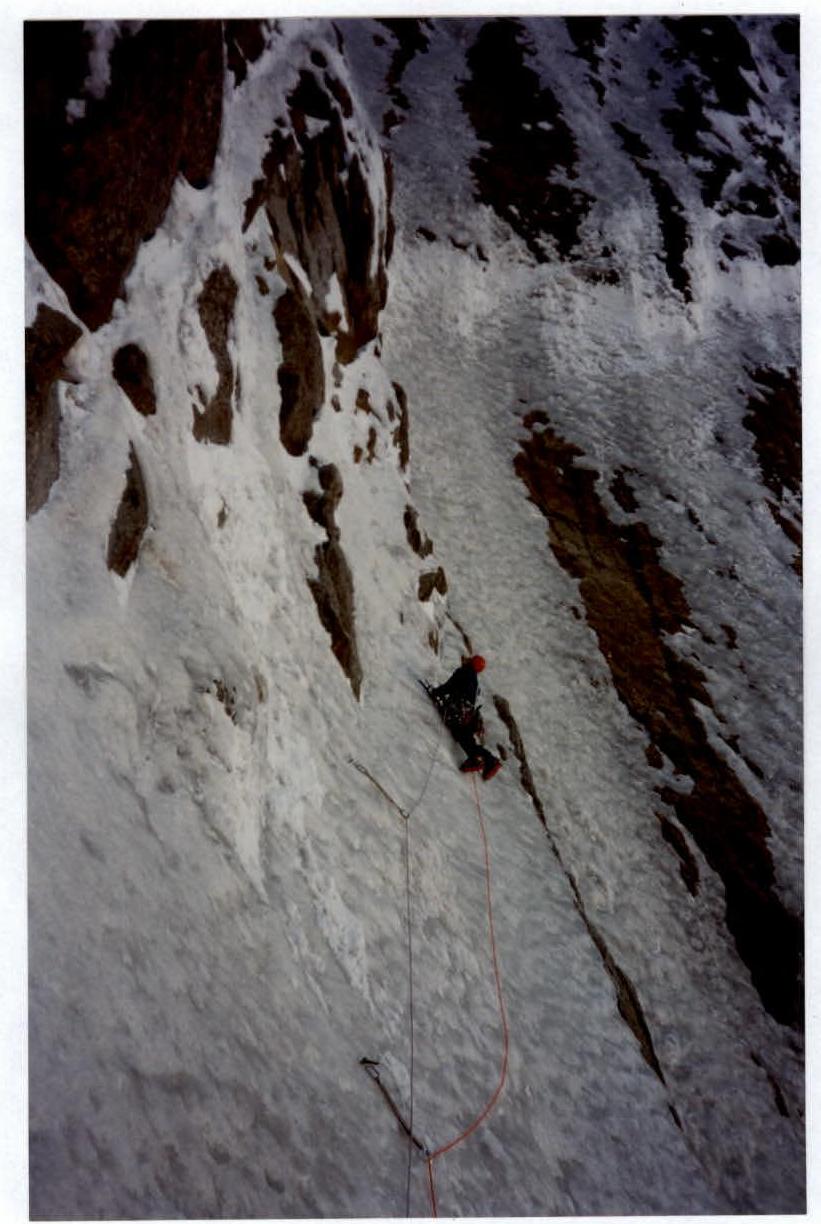 Section 7–9.
 Section 14.