

- Climbing category — technical
- Climbing area —
- Summit — Zamin-Karor, height 4303 m
- Difficulty category — 6B category of difficulty
- Route characteristics: height difference — 1350 m length of 5–6 sections — 1270 m average steepness — 85–87°
- Pitons driven: for belaying: rock 313, ice —, bolt 8 for ITO: rock 58, ice —, bolt 17
- Total climbing hours — 60 h
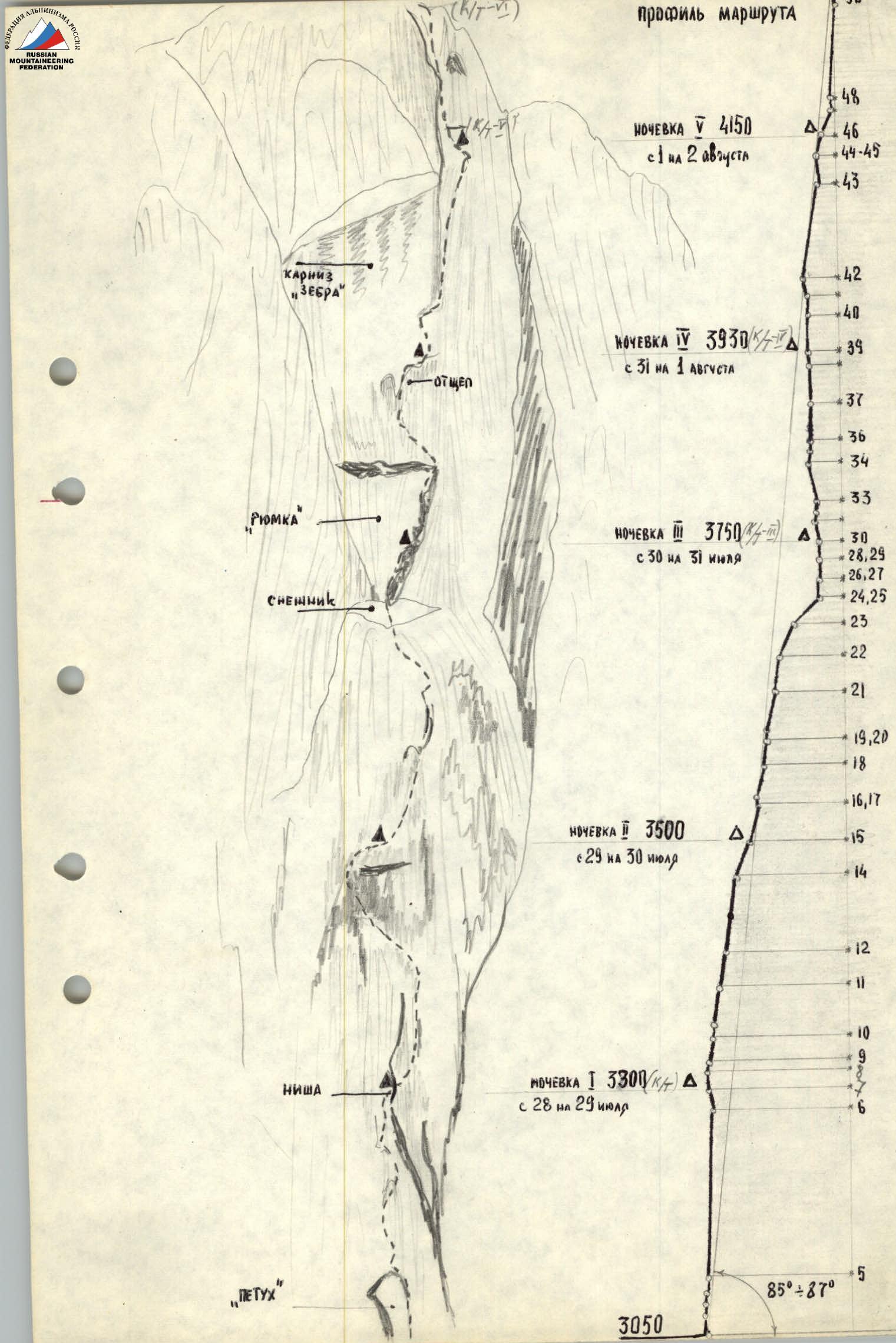
- Number of bivouacs and their characteristics: I. In hammocks, lack of platforms, water seepage. II. Platform for three people, three in hammocks, water seepage. III. Platform for two people, snow present. IV. Bivouac in hammocks, water dripping from the upper cornice. V. Platform for one person, 5 people in hammocks, water seeping down the rock face.
- Team leader: Efimov Sergey Borisovich — MS Team members: Abedikhin Aleksey Veniaminovich — MS Samoylin Mikhail Alekseyevich — MS Vinogradsky Yevgeny Mikhailovich — MS Abramov Sergey Semyonovich — CMS Yakovlev Gennady Semyonovich — CMS
- Team coach: Efimov Sergey Borisovich
- Climbing dates: Departure on July 28, return on August 2, 1979.
Zamin-Karor
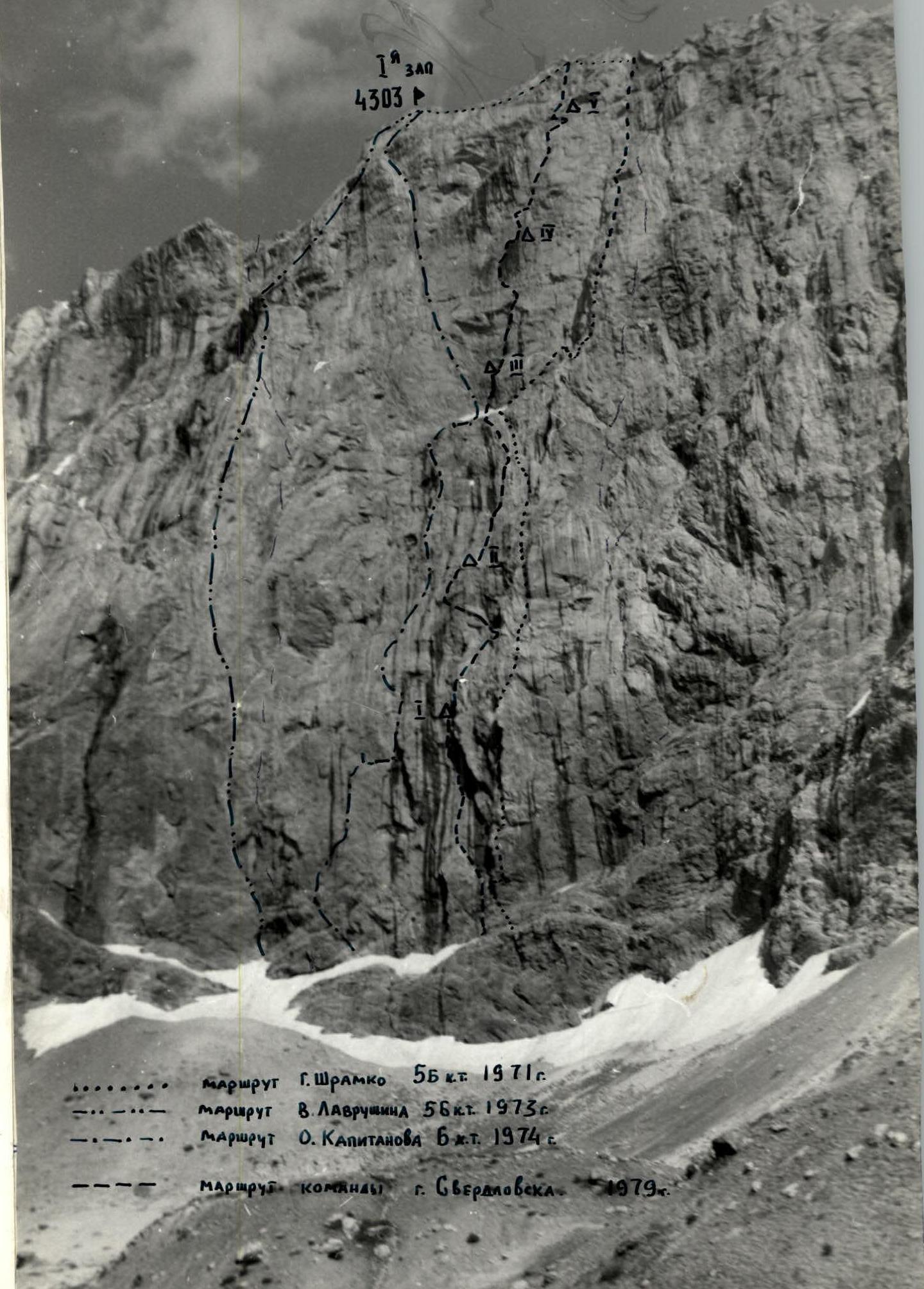
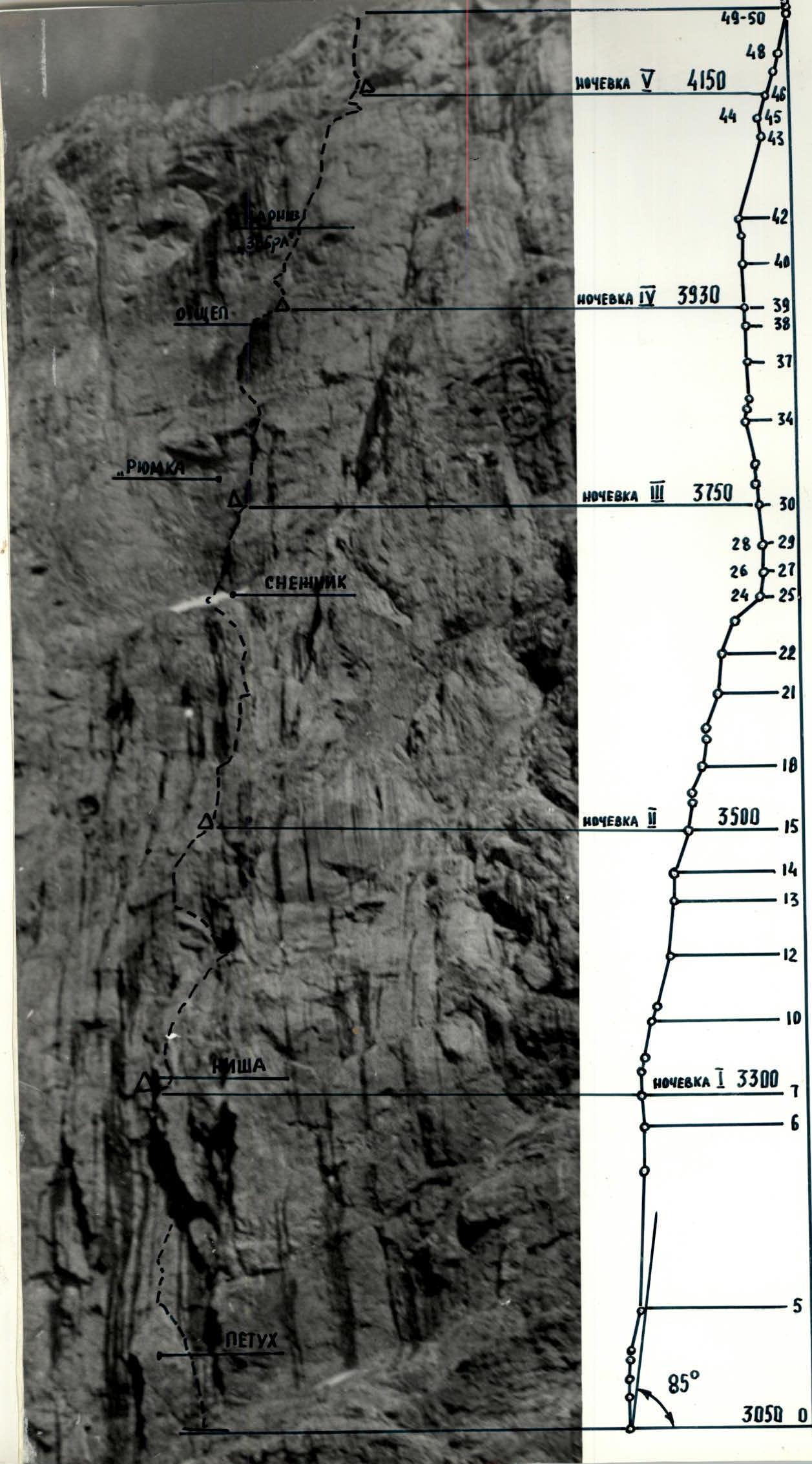
CLIMBING TACTICS
The tactical plan for the ascent was developed taking into account the technical characteristics of the route (length, steepness, complexity, etc.), weather conditions in the area, availability of bivouac sites and water on the route, physical and technical preparation of the team, equipment supply, and the experience of previous climbers on the wall.
The team's capabilities were tested through over 15 years of serious joint ascents, as well as during a training ascent on the Western wall of Bodhona peak via V. Vladarчик's route (6B category of difficulty), which received bronze medals at the 1972 USSR Championship. The route was successfully completed by the team with two bivouacs (the first ascenders had five). This allowed the team to test not only their preparation and various tactical schemes on the route but also food products and equipment, some of which were manufactured before the season and required testing:
- protection gear
- pitons
- bolts
- hammers
- ladders to ladders
- carabiners
- harnesses
- backpacks
- hammocks
- new stove design
- "autoclave" pot
- down gear
- and more.
After the ascent, adjustments were made to both the team's equipment and the interaction scheme among team members during work on the route. During preparation, the team manufactured:
- lightweight down gear
- a stove with a new lightweight design, allowing for a 1.5–2 liter fuel tank and, together with the "autoclave," significantly saving fuel and time for cooking.
A hammock-cape set allowed the team to forego a tent and solved the problem of finding platforms for bivouacs on the route, enabling team members to rest well and recover before the next working day. All this allowed the team to:
- reduce the starting backpack weight to 7.5 kg
- ease the workload on team members on the route
- reduce the number of times backpacks were pulled
- save time on route passage.
The tactical plan included a daily change of the leading pair and, within the pair, a change of the lead climber after each rope (the lead worked without a backpack) to recover and evenly distribute the load among all team members. A fairly even composition of participants with high rock climbing qualification and significant experience in wall ascents facilitated this.
To solve the "water" problem:
- Each team member carried a 1-liter flask in their backpack
- A small snack was kept in a pouch on the belt
No lunch was planned during the day.
Based on studying reports from other teams, a realistic assessment of the route's difficulty, and their own capabilities, the team concluded that they could complete the route with 5 bivouacs, i.e., climb an average of 250–300 m per day. This was also in line with the fact that small platforms were visible near the предполагаемых мест ночёвок on the wall.
ASCENT DESCRIPTION
(explanation to table № 1)
July 28 — day one
The team left the base camp at 6:00 and began working on the route at 8:00. The route started between large black streaks, 10 meters to the left of G. Shramko's route to the 1st Western peak. Movement was left and upwards, with a gray chip as an orientation point. The Efimov–Lebedikhin pair worked ahead. After passing two ropes and reaching the top of the chip (sections R0–R5), they began working on a 180-meter, virtually sheer section (R5–R6) of smooth slabs. This was one of the key sections with a limited number of holds, requiring high rock climbing technique:
- sky hooks
- ladders
- artificial holds
- bolt pitons, etc.
Each step and body position were carefully planned to utilize the smallest relief irregularities for climbing. Still, some areas lacked even these minimal features, necessitating the use of bolt pitons. On this section, over a 30-meter stretch, backpacks were pulled. The next section (R6–R7) was a 20-meter negative internal angle leading to a niche in the wall with an overhanging cornice. Backpacks were pulled again. Lebedikhin reached the niche at 21:30. Bivouac. As it turned out, the first day was one of the most intense. The expected platform in the niche was not found. Everyone slept in hammocks. Water was available, dripping from under the cornice. A control cairn was left at the bivouac site.
July 29 — day two
Due to the intense work on the route on the first day, rest was needed, so the team started working at 11:00. The leading pair was Abramov–Vinogradsky. The cornice was bypassed on the right via a 20-meter sheer wall (R7–R8), transitioning into a slightly gentler 10-meter internal angle (R8–R9). Further work was intense. The wall did not "let go" or allow relaxation. Movement was straight up. A 25-meter 80° wall (R9–R10) gave way to a 15-meter overhang (R10–R11), leading to a 40-meter wall (R11–R12) with a 80° crack. Further movement was left and upwards along a 40-meter 80° wall towards smooth slabs with a black wide streak, where water flowed. Limited holds and wet rocks created significant difficulties for this section (R13–R14). Artificial holds were necessary. Despite this, the 80-meter section with a steepness of 80° was successfully overcome, leading to a 40-meter 70° internal angle (R14–R15), which brought the team to the planned bivouac site. The pair continued processing the route while the rest set up the bivouac. At 20:00, water and two platforms were available. One platform was for two people, and one was for one. Others slept in hammocks. A control cairn was left.
July 30 — day three
The team departed at 8:30. The Samoylin–Efimov pair worked ahead. Movement initially followed an 80-meter 75° internal angle (R15–R18), interrupted in the middle by a sheer wall (R16–R17). Further, the internal angle became steeper. Over 30 meters (R18–R19), its steepness reached 80°. After that, a 10-meter overhanging section (R19–R20) led to smoothed slabs (75–80°), (R20–R22), which, after 80 meters, transitioned into gentler (65°) "ram's foreheads." From there, the team ascended a 40-meter snow slope with a 45° steepness (R23–R24). From the snow, the so-called "glass" began — a giant chip at the sheer wall in the shape of a glass with a side face 150–170 meters long. The path lay along the right face of the "glass" to its "roof." After the snow, movement proceeded right along a platform and, after overcoming three 20-meter sheer walls interrupted by platforms (R25–R30), the team reached the bivouac site. The pair continued processing the further path while the rest set up the bivouac. Snow was present on the platform. By melting snow in capes and hanging them on rocks like bags, the team obtained sufficient water. They settled in for the night at 20:00. Two people slept on one platform, and one on another. Others slept in hammocks. Control cairn.
July 31 — day four
Departure at 8:00. The Efimov–Lebedikhin pair led. The day began with overcoming a 20-meter overhanging wall (R30–R31). Difficult climbing. Use of ladders and artificial holds. Backpacks were pulled. Ascent up a 10-meter wall (75°), (R31–R32), followed by a traverse along a narrow 10-meter platform (R32–R33) on a sheer wall, leading to a 40-meter internal angle (R33–R34) with an overhang, transitioning into a 15-meter sheer wall (R34–R35). Further movement was left and upwards along a 10-meter platform and towards a 40-meter sheer wall (R36–R37) with an overhang in the middle, featuring wet rocks and moss. Limited holds. Exceptionally difficult climbing, artificial holds, and bolt pitons were used. The wall transitioned into a vertical internal angle (R37–R38), requiring the same level of tension and high technique as the previous rope. Backpacks were pulled on the last two ropes. After overcoming this section, a narrow 15-meter platform on a sheer wall led to a small, large, narrow ledge — the site for the next bivouac.
As on the previous day, the pair continued processing the next section of the route while other participants:
- hung hammocks
- attempted to collect water droplets from the "rain" blown from the waterfall in the upper part of the wall using capes.
Eventually, everyone got wet. The situation was interesting — the sun was shining, "rain" was pouring from above, and team members were wet, yet the team was without water. Very little water was collected. At 20:00, work on the route ceased. Everyone slept in hammocks, covered with capes from the "rain." The rest was quite normal. Control cairn.
August 1 — day five
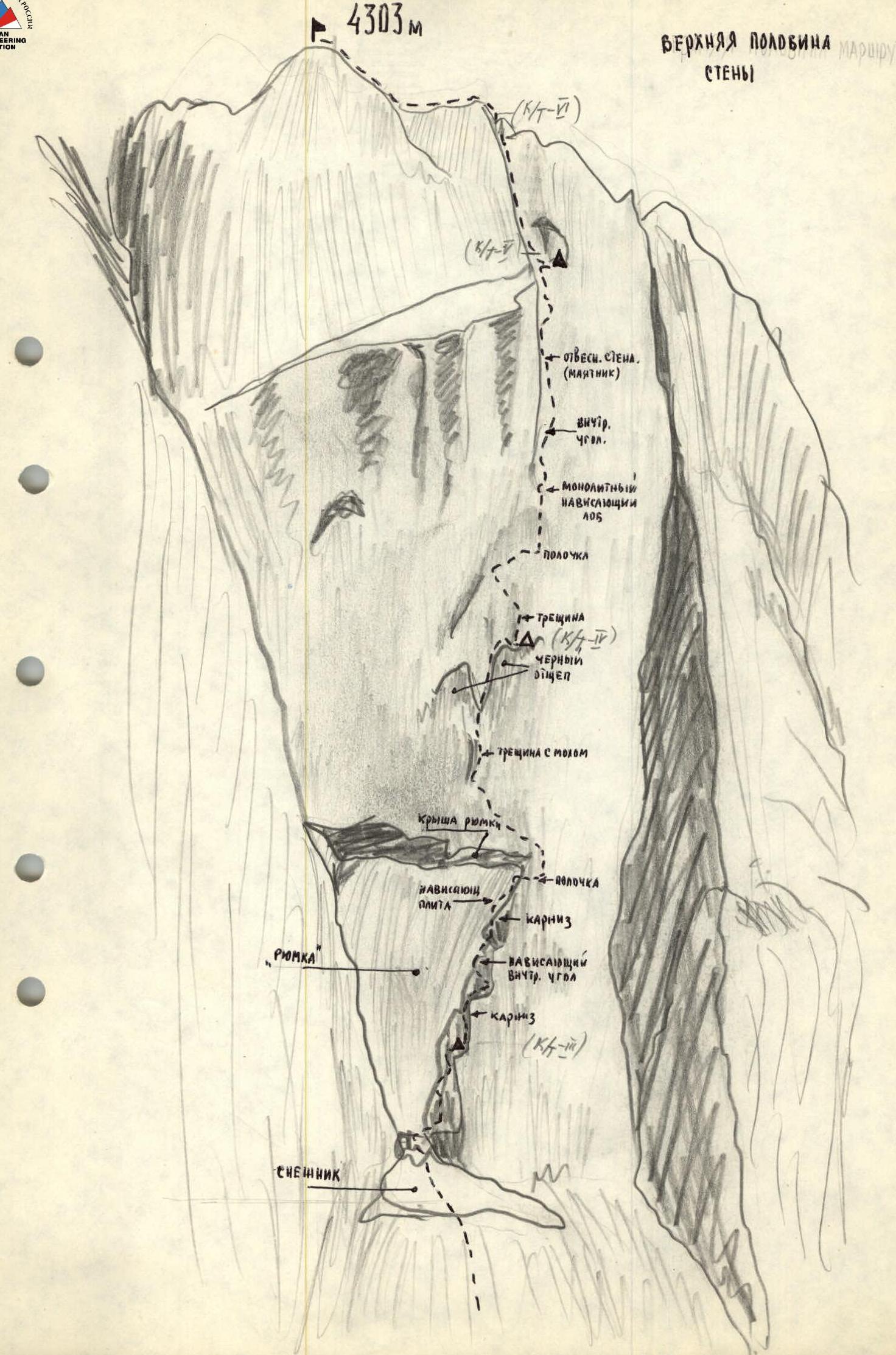
Departure at 8:00. Efimov, Lebedikhin, and Samoylin worked ahead in turn. Movement was directly upwards along a 40-meter sheer wall (R39–R40) with destroyed rocks. Holds were scarce. High rock climbing technique and artificial holds were applied. The same was necessary on the next section (R40–R41), a 20-meter traverse right and upwards along a sheer wall towards a black cornice (R41–R42). The next pair, Samoylin–Vinogradsky, removed the rope, which zigzagged, and the rest ascended the rope directly upwards from the bivouac to a platform under the cornice, not touching the rock in the middle, and ascending 1.5 meters away from it. The 20-meter black cornice was passed using bolt pitons "from ladder to ladder." Backpacks were pulled on the last three sections. The black cornice led to a large yellow cornice, bypassed on the right on a 100-meter 80° wall (R42–R43), overcome by a 20-meter pendulum from the left, rusty side. Exit to a platform. Movement left and upwards along the platform led to a wide 30-meter internal angle 70° with a smooth, slab-like structure (R45–R46). In the upper part of the angle, a fairly wide but inclined platform was found, with water present. Bivouac at 20:00. One person slept on the platform, the rest in hammocks.
August 2 — day six, final day
Departure at 8:00. Samoylin led. Movement was left and upwards. A 10-meter sheer wall (R47–R48) led to a small platform. Control cairn.
Further movement was right and upwards along a 100-meter internal 85° angle (R48–R49), and after overcoming a 10-meter 105° cornice (R49–R50), the team reached the ridge of the peak at 11:00. Control cairn.
At 12:30, the team reached the 1st Western peak. At 19:00, the team descended to the base camp.
CONCLUSION
The route via the center of the S-3 wall of Zamin-Karor peak (1st Western) through the "glass" is logical and safe. Throughout the route, rocks with seeping water are encountered.
Recommended equipment:
- large-sized channel pitons
- universal rock pitons of large and medium size
- protection gear: stoppers, eccentrics, sectors of various sizes
- sky hooks
- replaceable bolt pitons with a diameter of 8 mm (used in three sections of the route, leaving holes 20 mm deep after use)
It is recommended to bring hammocks if the group consists of more than two people.
TABLE OF MAIN ROUTE CHARACTERISTICS
| Date | Designation | Average steepness in degrees | Length in meters | Relief character | Difficulty | Condition | Weather conditions | Rock | Ice | Bolt |
|---|---|---|---|---|---|---|---|---|---|---|
| 28.07 | R0–R1 | 90 | 40 | Smooth slabs | U | Monolith | Clear | 10 | - | - |
| R1–R2 | - | 5 | Platform | - | - | - | - | - | - | |
| R2–R3 | 85 | 10 | Wall | U | Monolith | - | 2 | - | - | |
| R3–R4 | 90 | 15 | Crack with a plug | U I | Monolith | - | 3 | - | - | |
| R4–R5 | 75 | 15 | Internal angle | U | Monolith | - | 2 | - | - | |
| R5–R6 | 85–90 | 180 | Smooth slabs | U I | Monolith | - | 30+U I | - | 3+U I | |
| R6–R7 | 100 | 20 | Internal angle | U I | Monolith | - | 8+U I | - | - | |
| July 28, departure on the route at 8:00, stop for bivouac at 21:30. | ||||||||||
| Total climbing hours — 13 h 30 min. | ||||||||||
| Bivouac in hammocks (complete lack of platforms). | ||||||||||
| 29.07 | R7–R8 | 90 | 20 | Wall | U | Monolith | Clear | 5 | - | - |
| R8–R9 | 75 | 10 | Internal angle | U | Monolith | - | 5+U I | - | - | |
| R9–R10 | 80 | 25 | Wall | U | Monolith | - | 5 | - | - | |
| R10–R11 | 90 | 15 | Wall | U I | Monolith | - | 4 | - | - | |
| R11–R12 | 80 | 40 | Wall with a crack | U | Monolith | - | 5+U I | - | - | |
| R12–R13 | 80 | 40 | Wall | U | Monolith | - | 8 | - | - | |
| R13–R14 | 80 | 80 | Smoothed rocks | U I | Monolith, wet | - | 17+U | - | 2+U I | |
| R14–R15 | 70 | 40 | Internal angle | U I | Destroyed rocks | - | 7 | - | - | |
| July 29, departure on the route at 11:00, stop for bivouac at 20:00. | ||||||||||
| Total climbing hours — 9 h. | ||||||||||
| Bivouac conditions: one platform for two people, one for one person, others in hammocks. Water present. | ||||||||||
| ... | ... | ... | ... | ... | ... | ... | ... | ... | ... | ... |
| 02.08 | R47–R48 | 90 | 10 | Wall | U I | Monolith | Clear | 3 | - | - |
| R48–R49 | 85 | 100 | Internal angle | U I | Monolith | - | 23 | - | - | |
| R49–R50 | 100 | 10 | Cornice | U I | Monolith | - | 3 | - | - | |
| August 2, departure on the route at 8:00, reached the western ridge of the peak at 11:00. | ||||||||||
| Total climbing hours — 3 h. | ||||||||||
| At 12:30, the team reached the first Western peak. |
Team leader: S. Efimov
SCHEME OF WALL PASSAGE
 Section 4–6
Section 4–6
 Section 4–6
