
Passport
I. Technical Class
- Pamir-Alay, Gaumysh valley
- Peak 5200 (Gaumysh)
- 5B category of difficulty
- Elevation gain — 1100 m
Length of sections with 5–6 category of difficulty — 990 m, including 580 m of 6 category. Average steepness 75–80°.
- Pitons driven: rock — 55 + XXXI, ice — 88 + XXI, bolt — V, chockstones — 20 + III.
- Travel time: 46.5 hours
- Overnights: 1st and 2nd on a platform carved in the snow-ice ridge, sitting. 3rd on a platform carved in the snow-ice slope – sitting. 4th on a carved platform. Sitting. 5th on a snow cornice. Lying.
- Leader: Boyko V.V. MS Participants: Shchegolev Yu.K. CMS Kukushkin A.F. CMS Kolobaev S.P. CMS Lapin V.A. CMS
- Coach: Zhurzdin V.I.
- Departure on the route 26 July 1982, return — 2 August 1982.
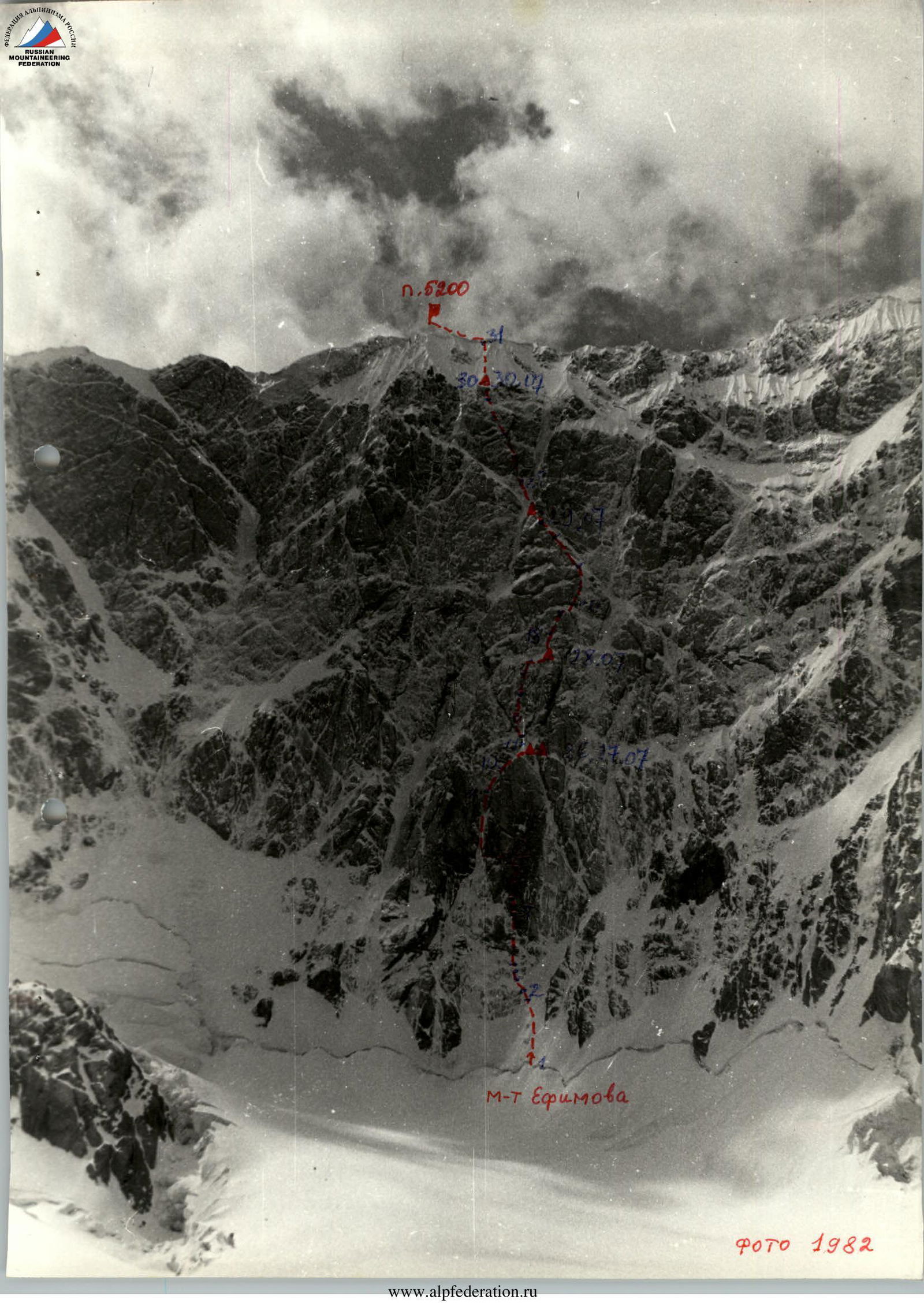 PHOTO 1982
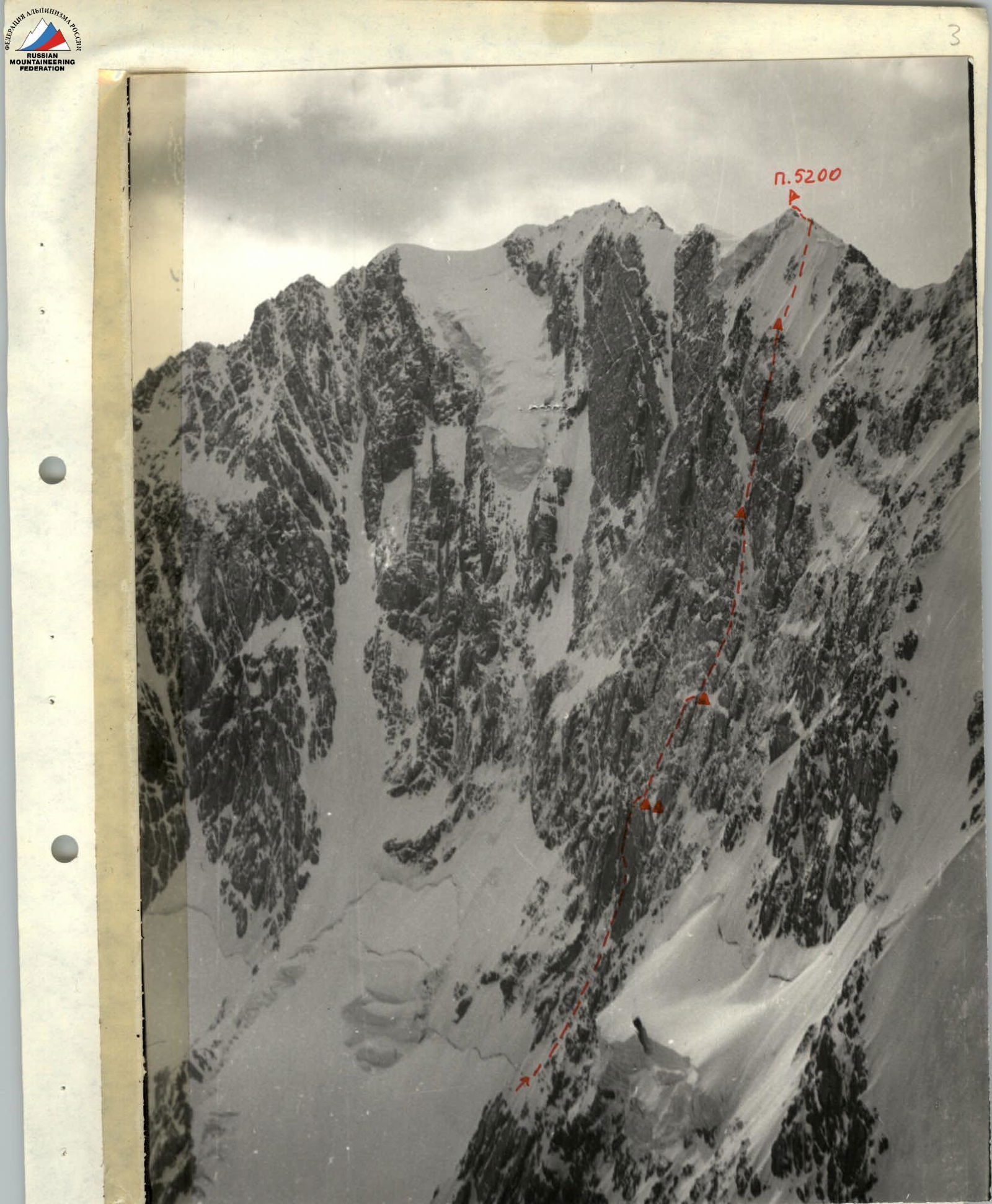 Route profile
Route Description
On 26 July 1982 at 7:00, linked together, we began to cross the bergschrund near two rock islands. Using an ice axe and ice hammer as artificial points of support, we climbed onto an ice slope with a steepness of 60°, increasing to 65° at the top. After 40 m of straightforward climbing, we encountered ice-covered rocks (sections R1–R2). There were no actual rocks, everything was covered in ice. The climbing was very unpleasant (section R3). We followed a simple snow-ice ridge (section R4) to the base of a rock wall known as the "iron" (a characteristic rock formation at the lower part of the wall). Progress along the route seemed impossible due to the extensive icing of the wall. It should be noted that during our ascent, the overall icing of the route was significantly greater than it was in 1980 when the team led by S. Efimov climbed it. This substantially complicated the route on certain sections. The wall at the base of the "iron" is a vivid example. We ascended 60 m to the right via an inner corner that was less icy (section R5). The climbing was very challenging. A traverse to the left (section R6) presented significant difficulties due to the smooth, icy rocks with few cracks. We had to drive two bolt pitons and use pendulum movements several times to overcome icy sections. The final pendulum (10–15 m) allowed us to hook onto a small crack 15 m below the cornice on the second attempt. The cornice (with up to 3 m overhang) was traversed on the left using ladders. There were places to drive pitons (section R8). Directly from the ladders, with crampons on, we stepped onto the ice. The ice gully was initially very steep, up to 80°, then it widened and became less steep (down to 65°), traversed on the front points of crampons with a hammer and ice axe, partially using them as artificial points of support (section R9). Then we entered an ice chimney. The ice was flowed, thin, and broke off in lenses. The steepness of individual sections reached 90°. As evening approached, water dripped and ice fragments fell, complicating the ascent. Ice screws did not go in fully (only halfway or even a third, placed in areas with the thickest ice layer); each piton required a semi-stirrup runner to reduce the leverage of the pulling force. We traversed this challenging section R10 partially on ladders and on the front points of crampons. The chimney then turned into a couloir, became less steep, the ice was soft, and crampons did not hold well. We then followed a snow-ice slope leading to the top of the "iron". On the ridge, we carved a small platform and, already in the dark, settled into the tent in a sitting position.
On the morning of 27 July, the weather was cloudy, and it snowed. The pair Lapin–Kukushkin went ahead to prepare the route. Initially, they traversed a snow-ice slope with rock outcrops, then an ice wall led to an inner corner (sections R12–R13). The right part of the corner overhung (95–100°), forming a kind of roof (section R14). The corner was climbed using ladders. After advancing a few more meters along an icy chimney, the pair had to return due to worsening weather. It snowed heavily throughout the night. By morning, the snow had stopped, and the weather was good, although it was cold and everything was covered in snow. We had great difficulty traversing the icy and frozen fixed ropes because carabiners and jammers did not hold well on the icy rope. Then followed a chimney turning into a couloir. The familiar steep ice was climbed on the front points of crampons. The technique for climbing such sections was well-practiced, and we no longer felt significant anxiety. A slight easing of the slope and another chimney went upwards to the right, again icy and overhanging at the top. At the top, we had to remove crampons and, partially using ladders and partially through difficult climbing, we reached the top (section R16). To the right, a characteristic snow patch resembling a "bird" was visible. We traversed a snow-ice slope with a steepness of up to 65° and reached the overnight camp. Here was a control point. While the others carved out a platform, the pair Boyko–Kolobaev started to prepare the wall. The wall was up to 85° steep with several overhangs and was completely icy. Free climbing was impossible. We had to chip away at the ice centimeter by centimeter, searching for the slightest opportunities to create artificial points of support. In 2.5 hours, we managed to climb only 30 m. The next day (29 July), another 25–30 m of such progress, and we reached beneath a chimney filled with ice. In it, we felt at home. Again, ice screws, a hammer, and an ice axe were used, and on the front points of crampons, we climbed to the top (section R19). A short traverse to the right along an ice wall with rock outcrops and another chimney followed. It was climbed similarly (section R21). Then came an ice wall with rock and stone outcrops. The wall turned into a chimney or even a giant icicle filled with ice, with a steepness of up to 90° (section R23). Straight up the icicle, and we entered a snow-ice couloir (the lower right part of the "X" formed by two giant snow-ice couloirs crossing the entire wall). We moved directly up the couloir. Initially, we used ice screws for protection, then ice axes. We fairly quickly reached the intersection of the "X". Here, contrary to all our hopes, we had to spend another night in a suspended tent.
On the morning of 30 July, we departed the bivouac at 10:00. Section R25 presented an ice wall (80 m) with a steepness of up to 75° at the top. The ice was hard. Further, straight up the chimney of the wall. The overall steepness of the wall was 80°. The first 40 m were a chimney filled with ice. Using the practiced technique, partially on ladders, we climbed it (section R26). Then an inner corner was climbed at a gallop. There were few places to drive pitons. The next 40 m (section R28) were a wall with an overhang in the middle part. The overhang was climbed on the right. The climbing was very challenging. Further, the wall became less steep but more broken, creating additional difficulties during the ascent. At the beginning of a snow-ice slope leading to the pre-summit ridge, on a snow cornice, we had an excellent lying overnight stay.
On 31 July — departure at 9:00. Across ice with a steepness of up to 65°, covered with a layer of dry, loose snow up to 60 cm thick, with great difficulty, mainly of a physical nature, we reached the ridge. Here, we left our backpacks and, lightly loaded, reached the summit by 11:30. The weather was excellent. We enjoyed a beautiful panorama. Took photos. Then we traversed Peak 5100 and from the ridge, down a snow couloir (with ice and one rappel at the bottom), quickly descended into the Dzhili-Su valley. By 19:00, unhurriedly, with a stop at a spring, we arrived at the hot springs, where we spent the evening and half of the next day.
Table of Main Route Characteristics
| № | Steepness, ° | Length, m | Section Characteristics | Difficulty | Condition | Weather | Rock | Ice | Bolt | Chockstones |
|---|---|---|---|---|---|---|---|---|---|---|
| R1 | 90 | 10 | Bergschrund | 5 | Hard ice | good | 2 | |||
| R2 | 65 | 140 | Ice slope | 5 | Hard clean ice | good | 10 | |||
| R3 | 65 | 40 | Rocks with ice | 5 | Rocks smooth, ice hard | good | 3 | 1+1 | 1 | |
| R4 | 50 | 25 | Snow-ice slope | 3 | Ice under snow | good | 3 | |||
| R5 | 85 | 60 | Rock wall | 6 | Monolith with cracks | good | 9 | 4 | ||
| R6 | 80 | 40 | Rock wall | 6 | Rocks without holds | good | 5+3 | +2 | 2 | |
| R7 | 85 | 15 | Rock wall | 6 | Monolith | good | 3 | |||
| R8 | 100 | 10 | Cornice | 6 | Monolith with cracks | good | 1+2 | |||
| R9 | 70 | 60 | Ice gully | 5 | Clean ice | cloudy | 5 | |||
| R10 | 80 | 45 | Chimney with ice | 6 | Thin flaking ice | cloudy, wet | 3+5 | |||
| R11 | 60 | 70 | Ice-snow slope | 4 | Ice, then firn and soft snow | snowing | 5 | |||
| 26 July 1982. Start — 7:00. End — 21:30. Overnight sitting on a carved platform. | ||||||||||
| R12 | 60 | 20 | Snow slope | 4 | Firn | cloudy | 2 | |||
| R13 | 75 | 40 | Ice wall | 5 | Hard ice with rock outcrops | cloudy | 5 | |||
| R14 | 95 | 15 | Inner corner | 6 | Monolith without holds | snow started | 1+1 | +2 | ||
| 27 July 1982. Overnight at the same place. | ||||||||||
| R15 | 80 | 60 | Chimney with ice | 6 | Thin ice, rocks smooth | clear, cold | 2 | 8 | ||
| R16 | 80 | 40 | Chimney with ice | 6 | Thin ice, overhanging at the end | good | 4+1 | 4+2 | ||
| R17 | 65 | 60 | Snow-ice slope | 4 | Ice under snow, traverse right | cloudy | 4 | 3 | ||
| 28 July 1982. Start — 9:30. End — 19:30. Overnight sitting on a carved platform. | ||||||||||
| R18 | 85 | 60 | Rock wall | 6 | Rocks covered with flow ice, few holds | good | +2I | +2 | +1 | +3 |
| R19 | 85 | 20 | Chimney with ice | 6 | Hard ice | good | 3 | 3+3 | ||
| R20 | 75 | 15 | Ice slope | 5 | Hard ice with rock outcrops | good | 3 | |||
| R21 | 80 | 20 | Chimney with ice | 5 | Hard ice, rocks smooth | good | 4+2 | |||
| R22 | 75 | 30 | Ice wall | 5 | Thin, flaking ice | cloudy | 3 | 5 | 2 | |
| R23 | 80 | 30 | Chimney with ice | 5 | Clean hard ice | cloudy | 5+2 | |||
| R24 | 60 | 180 | Snow-ice couloir | 4 | Ice and soft snow | cloudy | 7 | |||
| 29 July 1982. Start — 9:30. End — 19:00. Overnight sitting on a carved platform. | ||||||||||
| R25 | 75 | 80 | Ice wall | 5 | Hard ice | good | 7 | |||
| R26 | 80 | 40 | Chimney | 6 | Filled with ice | good | 2+1 | +3 | ||
| R27 | 75 | 40 | Inner corner | 6 | Smooth rocks | good | 2+2 | 1+1 | ||
| R28 | 80 | 40 | Rock wall | 6 | Rocks partly broken | good | 2 | |||
| R29 | 75 | 40 | Wall | 6 | Smooth slab | good | 4 | |||
| R30 | 70 | 30 | Rock wall | 4 | Broken rocks | good | 1 | 2 | ||
| 30 July 1982. Start — 10:30. End — 20:00. Overnight lying on a snow cornice. | ||||||||||
| R31 | 60 | 140 | Snow-ice slope | 4 | Ice under loose, powdery snow | good | 4 | |||
| 31 July 1982. Start — 9:30. End — 11:30. Summit. |
Total: Total travel time — 46.5 hours. Total pitons: rock — 55+31, ice — 88+21, bolt — +5, chockstones — 20+3.
Captain: V.V. Boyko Coach: V.I. Zhurzdin
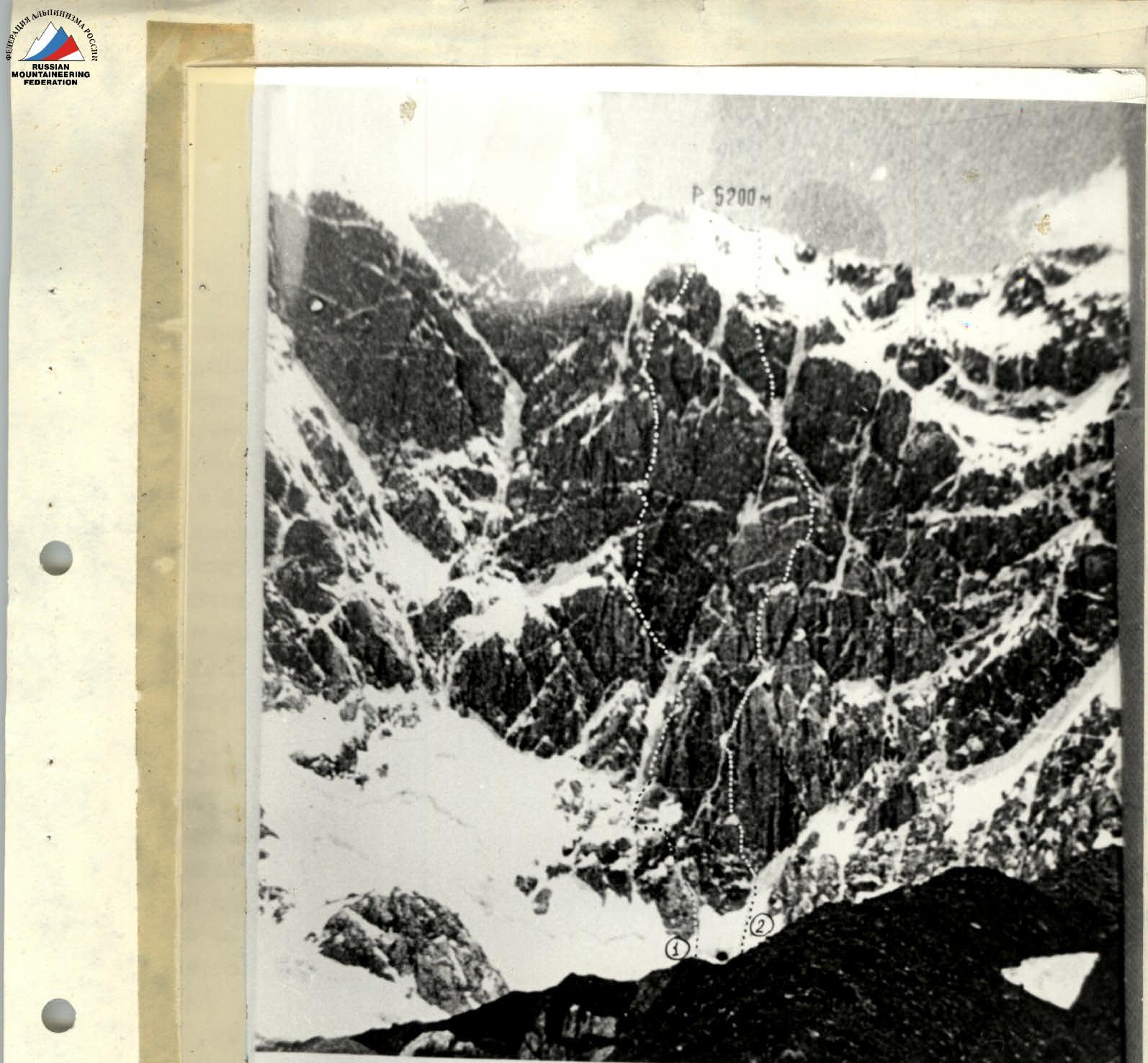
(1) Gorenchuk's route, 1977, 6A category of difficulty (1st place in the 1977 Championship) (2) 1980 route, team from Sverdlovsk (1st place in the 1980 Championship) PHOTO 1980