
Passport
of the ascent made in the 1983 Leningrad City Alpine Championship
- Ascent category — technical
- Ascent area — Pamir-Alai. Alai Ridge
- Ascent route — Gamuysh West peak (5200 m), North face, 6B category of difficulty (Yu. Gorenchuk's route)
- Ascent characteristics: route length — 1433 m height difference — 1150 m average steepness — 65°–70° length of the most difficult sections (V–VI category of difficulty) — 1133 m
- Pitons hammered: total incl. for r.p.e. rock — 99 26 camming devices — 77 25 ice — 76 8 bolt — 10 3 + 2 used others'
- Number of climbing days — 8
- Number of climbing hours — 75.5 h
- Number of bivouacs and their characteristics — 8, all sitting
- Team name — Combined team of LOS DSO "Burevestnik"
- Full name of the team captain, coach, participants and their qualification: Vasiliev Boris Petrovich, MSMS, coach and captain Barulin Boris Alexandrovich, MS Beilin Yuri Iosifovich, CMS Novogrudsky Arkady Lvovich, CMS Savin Boris Nilovich, CMS Novikov Evgeny Davidovich, CMS Karol Andrey Igorevich, CMS
- Ascent date: July 15–23, 1983 (July 19 — bad weather day)
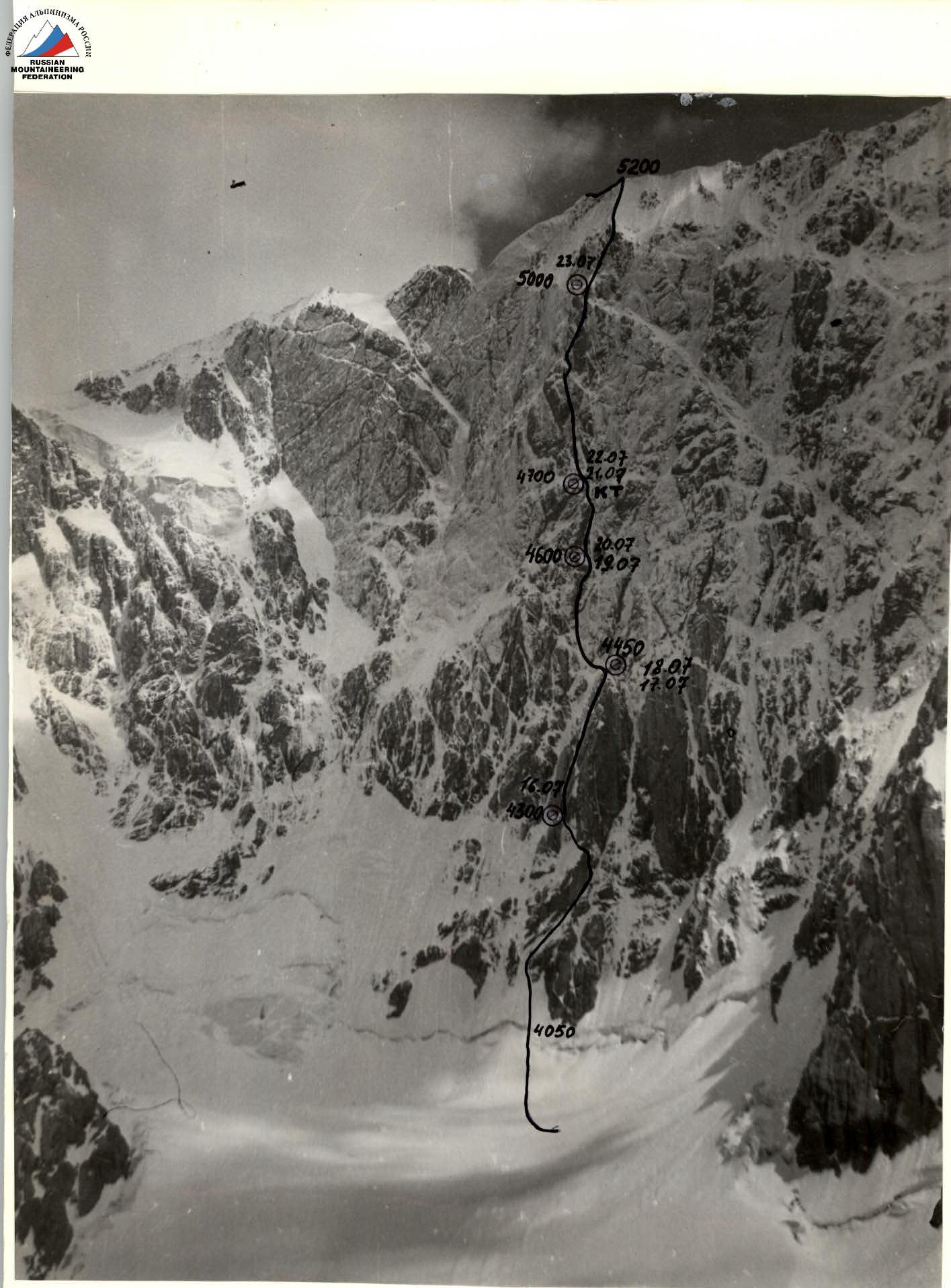
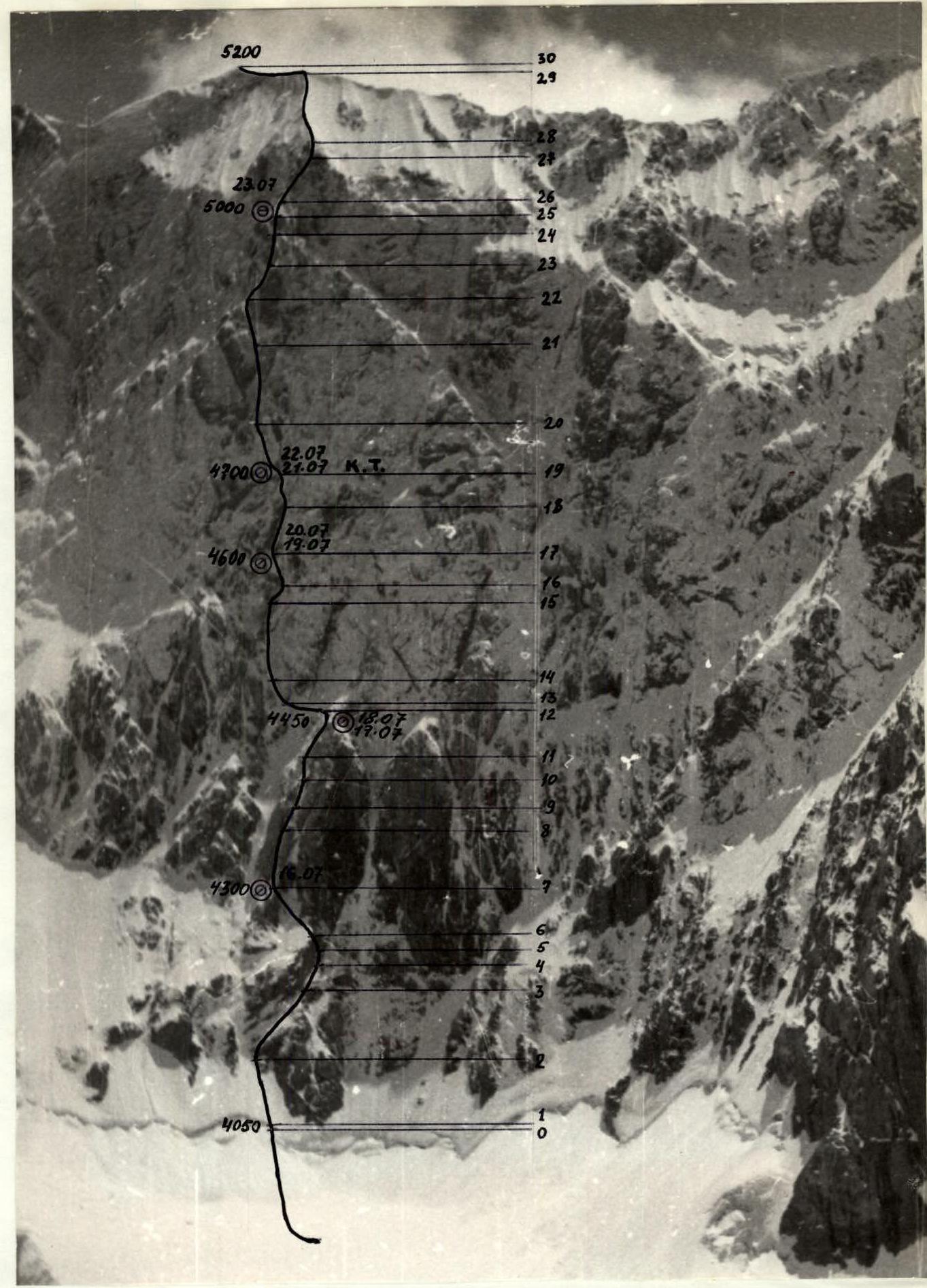
Photo of the general view of the route
Table of the main characteristics of the ascent route
Ascent route — Gamuysh peak (5200 m) via the North face, 6B category of difficulty Route length — 1433 m Height difference — 1200 m Length of the most difficult sections (V–VI category of difficulty) — 1133 m Route steepness — 70°–75°
| Date | Section | Avg. steep. deg. | Length, m | Terrain characteristics | Difficulty | Condition | Weather conditions | Rock pitons | Camming devices | Ice pitons | Bolt pitons | Daily ration weight |
|---|---|---|---|---|---|---|---|---|---|---|---|---|
| 1 | 2 | 3 | 4 | 5 | 6 | 7 | 8 | 9 | 10 | 11 | 12 | 13 |
| 15.07 | R0–R1 | 90 | 3 | Ice wall of the bergschrund | V | Flow ice | Clear | - | 2(II) | - | - | 350 g/person |
| R1–R2 | 45 | 80 | Ice slope | IV | Thin snow on ice | Clear | - | 4 | - | - | ||
| R2–R3 | 65 | 60 | Slabs | V | Frozen with ice | Clear | 4 | 2 | 4 | - | ||
| R3–R4 | 50 | 60 | Inclined shelf, ice groove | V | Destroyed rocks, snow | Clear | 4 | I | 3 | - | ||
| R4–R5 | 60 | 15 | Wall | V | Rocks destroyed | Cloudy | 3 | 2 | - | - | ||
| R5–R6 | 70 | 15 | Inner corner | VI | Frozen with ice, destroyed | Cloudy | 4 | 2 | I | - | ||
| rocks | ||||||||||||
| R6–R7 | 50 | 30 | Ice wall (traverse) | V | Flow ice | Cloudy, wind | - | - | 4 | - | ||
| R7–R8 | 85 | 40 | Inner corner, chimney | VI,A2 | Frozen with ice | Light snowstorm | 6(IV) | 8(VI) | 3(II) | I | ||
| Start — 6:30, bivouac — 20:00, climbing hours — 13, sitting bivouac for 3 people, ice-cut | ||||||||||||
| 16.07 | R8–R9 | 60 | 20 | Ice groove | V | Snow on ice | Clear | 2 | - | 2 | I | 350 g/person |
| R9–R10 | 75 | 30 | Rock wall | V | Heavily destroyed | Cloudy | 3 | 3 | - | - | ||
| R10–R11 | 65 | 69 | Ice chimney, groove | V | Snow-covered | Cloudy | 3 | I | 8 | - | ||
| R11–R12 | 60 | 50 | Ice slope | IV | Snow on ice | Thunderstorm, snow | 2 | I | 4 | - | ||
| Start — 8:30, bivouac — 16:00, climbing hours — 7.5, sitting bivouac — two platforms, ice-cut, 40 m apart | 27 | |||||||||||
| 17.07 | R12–R13 | 60 | 90 | Ice slope (traverse) | VI | Flow ice | Cloudy, no precip. | 2 | 6 | 2 | - | 350 g/person |
| R13–R14 | 65 | 50 | Ice groove | V | Snow-covered | Cloudy | I | 2 | 3 | - | ||
| Start — 10:00, finish — 16:00, climbing hours — 6, bivouac — on the same places | ||||||||||||
| 18.07 | R14–R15 | 85 | 60 | Inner corner with overhangs | VI,A2 | Frozen with ice | Clear, strong wind | 8(VI) | 12(X) | - | I(I) | 350 g/person |
| R15–R16 | 90 | 20 | Slab (traverse under eaves) | VI,A1 | Monolith, frozen with ice | Snowfall | 5(IV) | I(I) | I | I(I) | ||
| R16–R17 | 65 | 60 | Ice groove | V | Snow-covered | Heavy snowstorm, | 2 | 4 | - | I | ||
| powder avalanches | ||||||||||||
| from the wall | ||||||||||||
| Start — 9:00, bivouac — 18:00, climbing hours — 9, separate sitting bivouac, 4 people — on the snow overhang under the "black corner", 3 people — 3 ropes lower on the ice-cut platform | ||||||||||||
| 19.07 | Heavy snowstorm, avalanches going down the wall, visibility 20 m, forced sit-out day, bivouac at the same places | 280 g/person | ||||||||||
| 20.07 | R17–R18 | 100 | 60 | Inner corner with overhanging | VI,A2 | Frozen with ice | Clear | 10(X) | 8(V) | - | I(I) | 350 g/person |
| left wall | ||||||||||||
| R18–R19 | 70 | 40 | Ice groove | V | Snow-covered, water flow | Clear | 5 | 2 | 5 | - | 350 g/person | |
| Start — 9:00, bivouac — 20:00, climbing hours — 11, separate sitting bivouac — 3 people on the ice-cut platform, 4 people on the snow overhang under the "black corner" | ||||||||||||
| 21.07 | R19–R20 | 75 | 80 | Wall | V | Ice-covered rocks | Clear | 6 | 6 | 3 | - | 350 g/person |
| R20–R21 | 85 | 100 | Chimney | VI,A2 | Frozen with ice | Clear | 4(II) | 6 | 8(V) | 2 (used others') | ||
| Start — 9:00, finish — 21:00, climbing hours — 12, sitting bivouac, ice-cut | ||||||||||||
| 22.07 | R21–R22 | 60 | 60 | Ice groove | V | Layer of snow on ice | Clear | 3 | I | 4 | - | 350 g/person |
| R22–R23 | 70 | 40 | Rock wall | V | Heavily destroyed | Clear | 5 | 2 | - | - | ||
| R23–R24 | 85 | 40 | System of inner corners | VI,A2 | Frozen with ice | Clear | 5 | 5(III) | 2(I) | - | ||
| R24–R25 | 70 | 20 | Rock wall | V | Heavily destroyed | Clear | 4 | I | I | - | ||
| R25–R26 | 50 | 30 | Ice slope | IV | Snow on ice | Clear | 2 | - | 2 | - | ||
| Start — 9:00, bivouac — 22:00, climbing hours — 13, sitting bivouac, ice-cut on the ice ridge | ||||||||||||
| 23.07 | R26–R27 | 80 | 60 | Rock wall | V | Destroyed, ice-covered | Clear | 5 | 5 | - | - | 350 g/person |
| R27–R28 | 60 | 20 | Ice groove, eave | V | Layer of snow on ice | Clear | I | - | 2 | - | ||
| R28–R29 | 60 | 100 | Ice "knife" | IV | Layer of snow on ice | Clear | - | - | 4 | - | ||
| R29–R30 | 15 | 40 | Snow ridge | II | Eaves | Clear | - | - | - | - | 320 g/person | |
| Start — 9:00, summit — 13:30, climbing hours — 4.5 |
Descent via the West ridge through the South. Kara-Ganda peak, return to the base camp — July 24, 1983 at 16:00.
Team captain and coach
B. Vasiliev
Route description
Section R0–R2. The team is led by the rope team Barulin–Beilin–Karol. Steep ice wall of the bergschrund, followed by a calm ice slope with a thin layer of snow. Cold. Crampons hold well. As we ascend, the layer of snow on the ice thickens. By the end of the second rope, the slope steepness increases, and the ice is only partially covered with snow. It's difficult to find a place to secure the rope — the ice layer on the slabs is too thin.
Section R2–R3. Further movement is directed right-upwards along the sheer edge of the rock bastion. Slabs of varying steepness are frozen with ice. In some places, smoothed rocks protrude from the ice, and small vertical rock walls — "thresholds" — are encountered.
Section R3–R4. The next threshold leads to an ice groove under the rocks. There's quite a lot of snow. Movement becomes somewhat easier, but organizing protection is challenging: the rock on the left is monolithic and completely crack-free, and under the thick layer of snow in the groove, there's soft, porous ice.
Section R4–R5. The slope steepness gradually increases, and an almost vertical ice "river" leads under a destroyed rock wall heavily covered with snow. Many loose rocks.
Section R5–R6. After the wall, movement continues through a steep inner corner. The walls are smooth, and the junction is frozen with ice. The entrance to the corner is very difficult. The corner leads to a ledge under the main bastion massif. Upwards, vertical, absolutely smooth gray slabs ascend. It's necessary to traverse left to the point where the "body" of the bastion is cut by an inner corner.
Section R6–R7. The difficult traverse starts with a descent and then continues left-upwards, just below the boundary between the rocks and ice (see photo). The ice is flow ice, very heavy. The exit is onto a small snow-ice saddle slightly left of an unexpressed inner corner. 16:00, 7 ropes passed. We take a short break. We leave a "cleaner" to set up a bivouac and start working again at 17:00.
Section R7–R8. The weather deteriorates, wet snow falls, and a gusty wind blows. The corner is steep, heavily frozen with ice, with loose rocks in the ice. It's not suitable for free climbing; many ladders are needed, and progress is slow. At one point, it's necessary to remove and put on crampons several times on a single rope. At the top, the corner gradually turns into a chimney with an overhanging left wall, frozen with ice. Before entering the chimney, a bolt piton is hammered. 20:00. The rope is secured on the bolt piton, and the rope team descends for the night.
Section R8–R9. Second working day. We finish the bastion. Above, the chimney "collapses" and turns into an ice groove. Movement on crampons. The ice layer is too thin for pitons; at the end of the groove, it's necessary to hammer a bolt piton.
Section R9–R10. The groove leads to a steep rock wall. It's necessary to climb very carefully — many loose blocks. The wall is climbed using free climbing.
Section R10–R11. The wall leads to an ice slope, which quickly narrows and turns first into a groove and then into a steep ice chimney. The chimney is diagonal and very inconvenient for climbing.
Section R11–R12. After the chimney, the ice slope widens and after 50 m leads to steep rock walls. From here, it's necessary to move left and cross a large couloir. 5 ropes passed, 16:00. We take a break. The weather sharply deteriorates. The team stops ascending. Double ropes are organized, and the entire team is busy finding possible bivouac sites. Suitable platforms are not available. It's necessary to cut into the flow ice, and by 20:30, two small platforms are cut: one under the rock wall, the other 30 m below. Gorenchuk's team reached this point on the third working day. We gain one day. At night, there's a heavy snowfall, tents are covered with snow, but the morning is clear.
Section R12–R14. Third working day. Crossing the couloir is a complex technical and tactical task. The couloir is very steep, the ice is heavy, and rockfall and stonefall are possible from above. The rope team Novogrudsky–Savin goes out lightly, wearing crampons. Vasiliev observes the couloir and keeps in touch with the pair. The first rope team works excellently. For 6 hours, using a "pendulum" and then with the help of "ice screws" and ice axes, the pair crosses the large couloir and ascends the ice groove to the opposite side (see photo). Crossing the couloir in the second half of the day with a load is too dangerous, and the captain gives the pair a command to return to the previous bivouac.
Section R14–R15. The morning is clear, but strong wind and frost hinder movement. The rope team Novogrudsky–Vasiliev–Savin goes out. After five ropes of protection directly upwards, a very difficult inner corner leads to an overhang. The only way out is to traverse right along smooth slabs, bypassing the eaves.
Section R15–R16. The slabs are heavily snow-covered, and the weather deteriorates again. Almost the entire traverse is done on r.p.e.
Section R16–R17. After bypassing the eaves, we enter a steep ice groove. Further, the groove slightly flattens and leads under the base of the "black corner" — one of the key points of the route. The weather has worsened significantly. Powder avalanches start going down the groove and corner (see photo). Movement becomes dangerous. 17:00. Only the first four people manage to reach under the "black corner". Here, on a hanging snow overhang, they start organizing a bivouac. The remaining three people cut a platform 3 ropes lower.
The next day, the snowfall does not stop. During moments of clearing, the team observes avalanches going down the entire wall. We use the forced sit-out day to repair equipment and rest. Tents are pitched in safe locations, although it's cramped and very damp.
Section R17–R18. The "black corner" is one of the most interesting places on the route. The right wall is a steep, smooth slab, also covered with snow. The left wall overhangs with several eaves (see photo). The gap between the walls is 20–30 cm — too wide for our camming devices. The rope team Novogrudsky–Novikov starts working. The entire team gathers on the snow overhang; it creaks but still holds. The first climber attempts to climb using free climbing, hammering a bolt piton for protection. Hands get heavily loaded, and it's necessary to switch to r.p.e. Some others' pitons are encountered, including bolt ones. After passing slightly more than half of the corner, the first climber asks to be replaced — hands are too heavily loaded. The rope team Barulin–Beilin takes over. Further, the corner becomes slightly easier and gradually turns into a slab (the left wall ends), frozen with ice. On the vertical wall, crampons are put on while hanging, and "ice screws" and ice axes are used.
Section R18–R19. The vertical ice wall turns into an ice groove. In the middle part, it's slightly easier, and then it becomes steeper again. The rock sides of the groove are destroyed — rock pitons and camming devices are used. Afternoon. It becomes warm, and water flows through the groove; in the upper part, it's like a shower. Water streams interfere with looking upwards. Ropes and clothing become much heavier. From a narrow chimney at the end of the groove, it's very difficult to exit left onto a steep ice shelf. At this moment, a waterfall starts in the groove. Four people manage to climb here; everyone gets soaked. 20:00. We decide to stop climbing. The remaining three people spend the night at the previous location. Four people cut a platform in the ice.
Section R19–R20. The rope team Barulin–Beilin continues working upwards. The path lies along a steep rock wall towards a giant eave (see photo). Here, the rocks are much cleaner, but the cracks are still frozen with ice. By 14:00, two ropes are passed, and the start of the chimneys is reached. The rope team descends to the bivouac for a break. They're replaced by the rope team Novogrudsky–Savin–Karol.
Section R20–R21. The key point of the route. The chimneys are 2–2.5 m wide, with an ice-covered bottom, sheer walls with almost no holds, and very few cracks (see photo). Several others' rock and bolt pitons are encountered here, more frequently than in the lower half of the route. Using the entire arsenal of the team's equipment, the rope team manages to climb 100 m of chimneys by the end of the day. It's too late for the entire team to climb. We decide to spend the night at the old location. A second platform is cut near the first one.
Section R21–R23. Beilin–Barulin go out. The chimney ends with a small destroyed wall. Further, it's easier. First, an ice groove, then a destroyed rock wall, and again we face overhangs.
Section R23–R24. The proximity of the "roof" is felt. These are the last overhangs on the wall. They're overcome using a crack and a system of inner corners (see photo). Ice is a significant hindrance; it's necessary to climb on r.p.e. The section ends with a small vertical chimney frozen with giant icicles.
Section R24–R26. One rope of steep ice and then 80 m of the last rocks of the wall stand as a bastion. The ridge is close, but we feel that we won't make it to the ridge today. We have tea. Beilin–Vasiliev go out to finish the rocks. The rest build the last bivouac on the wall.
Section R26–R29. From the last rocks, there's an unpleasant exit via an ice groove onto the "roof". Karol–Barulin lead. The ice "knife" is very treacherous. We pass it with alternate protection on ice screws. 40 m of a simple ridge remain to the summit.
Descent via the South. Kara-Ganda peak along the West ridge. The route via the North face of Gamuysh peak (5200 m) is considered by the team to undoubtedly correspond to the highest 6B category of difficulty. The abundance of flow ice covering almost the entire wall and the snow-covered route significantly increase its complexity.
Some participants had several 6B category routes in their experience, such as:
- "Moskovskaya Pravda"
- "Svobodnaya Koreya"
- "Chapdara" and others. Everyone agrees that Gorenchuk's route is not less complex, and in terms of the length of ice sections of 6B category, it surpasses them.
The team believes that bypassing the lower part of the route on the left simplifies and shortens the ascent by 2–3 days, although even in the variant of bypassing on the left along the shelves with an exit under the base of the "Black corner" or under the base of the giant eave "Kon'", these routes were accepted by other teams as 6B category.
However, it's necessary to distinguish these routes, as the complexity and laboriousness of passing the lower half of Gorenchuk's route is not less than the second half.
The team is satisfied that they were able to fully repeat the route of the first ascenders.
Route diagram in conventional symbols
Sections R12–R14