
Ascent Passport
I. Ascent class — technically challenging 2. Ascent area — Alaysky ridge 3. Unnamed peak about 5200 m above sea level in the center of the northern wall 4. Difficulty category — 6B 5. Route characteristics:
height difference — 1200 m, average steepness — 74°, length of I, II, III, IV, V, VI sections 0, 40, 65, 80, 700, 545
-
Pitons driven: for belaying, for I.T.O. Rock 136, 34; Ice 51, 34; Bolt 14—; Cam 16, 44
-
Number of climbing hours — 76
-
Overnight stays on the route — 6, of which: sitting — 4, semi-hanging — 1, hanging — 1.
-
Gorenchuk Yuri Feodosievich MSMS — team leader Troschinenko Leonid Andreevich CMS — deputy leader Zakhodyzhiy Mikhail Mikhailovich MS — participant Larionov Sergey Anatolyevich CMS — participant Lipchinsky Alexander Grigorievich MS — participant Logachev Yuri Alexandrovich MS — participant Sapozhkov Lev Konstantinovich CMS — participant Shchedrin Georgy Sergeyevich CMS — participant
-
Team coach — Zakhodyzhiy M. M.
II. The team, after two days of processing, started the ascent on August 9, 1977, and returned to base camp on August 16, 1977.
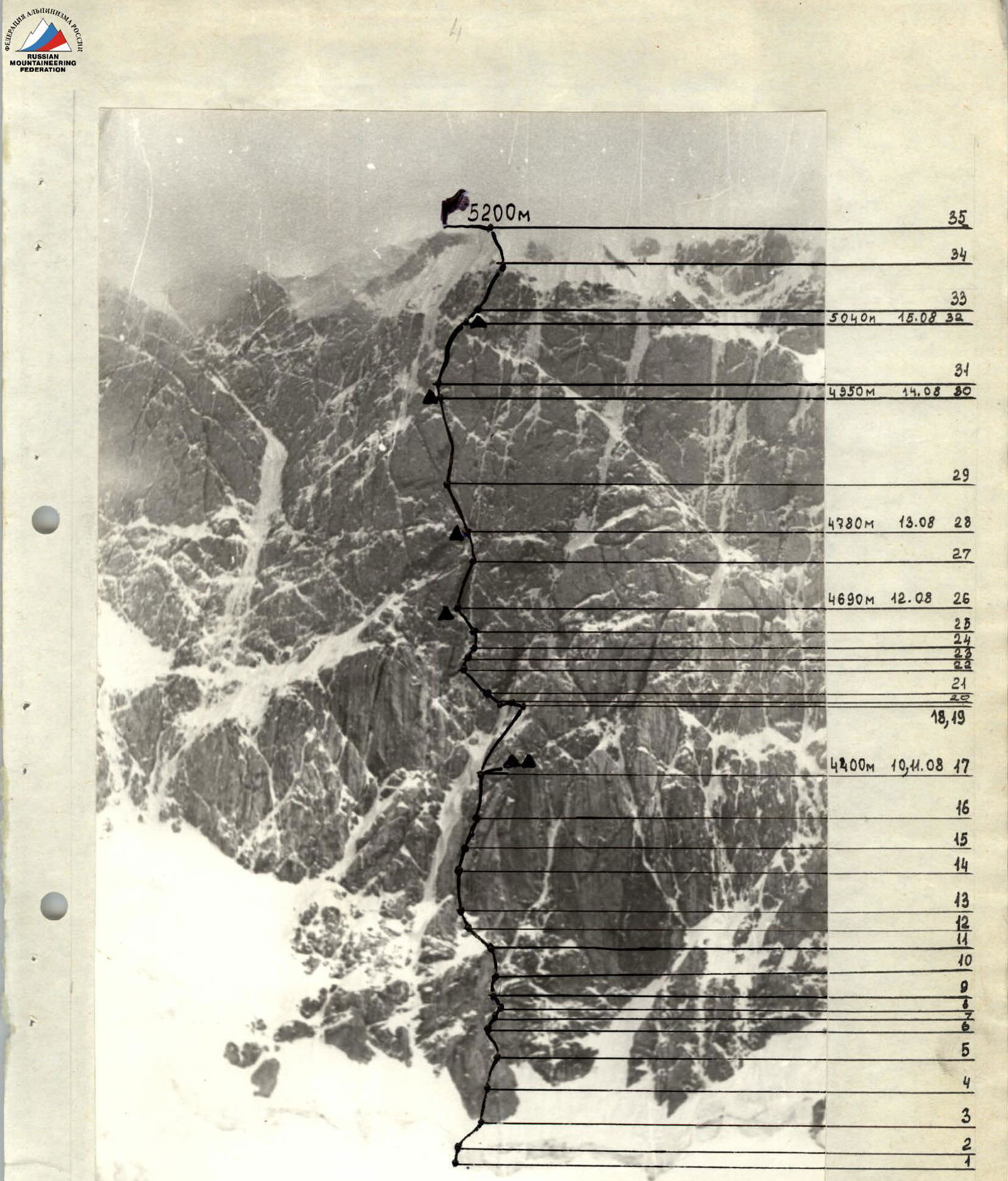
Photo 1. Route taken by the team.

Photo 2. Route profile.
Ascent Chronicle
August 7
At 7:00, the trio: Larionov, Lipchinsky, Shchedrin sets out from base camp. We approach the start of the route by 8:00 with light packs. Very difficult bergschrund wall, then easier, and now rocks. After recent bad weather, there's a lot of snow. The first rope goes through a cleft and snow doesn't get in the way much. Further on, it's worse. Smooth slab, few holds and a lot of snow. But the rocks are solid. Then a destroyed wall, from which you can pull out a "brick" of any size. Inner corner. It becomes clear what awaits us further:
- Corner walls can only be climbed with bolts
- There's ice in the corner
But for now, after hammering for a bit, you can drive a piton and climb.
August 8
The trio: Troshchenko, Sapozhkov, Logachev, who spent the night in the assault camp, continues processing. Yesterday, nothing resembling an overnight stay was found. We have to leave the corner and move to the wall. Initially monolithic, then I crushed the rock, forcing us to return to the inner corner. The rope ends, and further along the corner there are continuous overhangs. The only option is to move left along the ice:
- 30 m traverse,
- wall,
- next rope is along a chimney.
Very difficult, rocks are "rubble", it's hard to climb. Lots of ladders. Above, the chimney "disintegrates", turns into a groove, then into a wall. But that's tomorrow. And there's still no sign of an overnight stay.
August 9
Yesterday, after discussion, we decided that further processing didn't make sense. So, the duo Zakhodyzhiy–Lipchinsky is "pushed out" of base camp at 6:00. They need to lead us to the overnight stay. The rest set out at 8:00. We go to the tent on the glacier with light packs, then pick up the load and continue. The processors are already approaching the end of the belays. For now, they're passing through the sections discussed yesterday. The lower ones:
- remove the belays,
- link up with the observers who have approached the wall,
- throw excess load down.
And ahead, there are serious problems:
- Slab is steep, smooth, very few cracks.
- Then — ice.
- Rocks stick out here and there.
- Very steep.
For reliability, Lipchinsky drives a bolt at the end of the belays. To the right, options for an overnight stay are visible, and while Sasha is hacking through the ice, the lower ones traverse the rope to the right and prepare a bivouac. Sitting, but on this wall, we can't be too fussy.
TABLE OF MAIN ROUTE CHARACTERISTICS
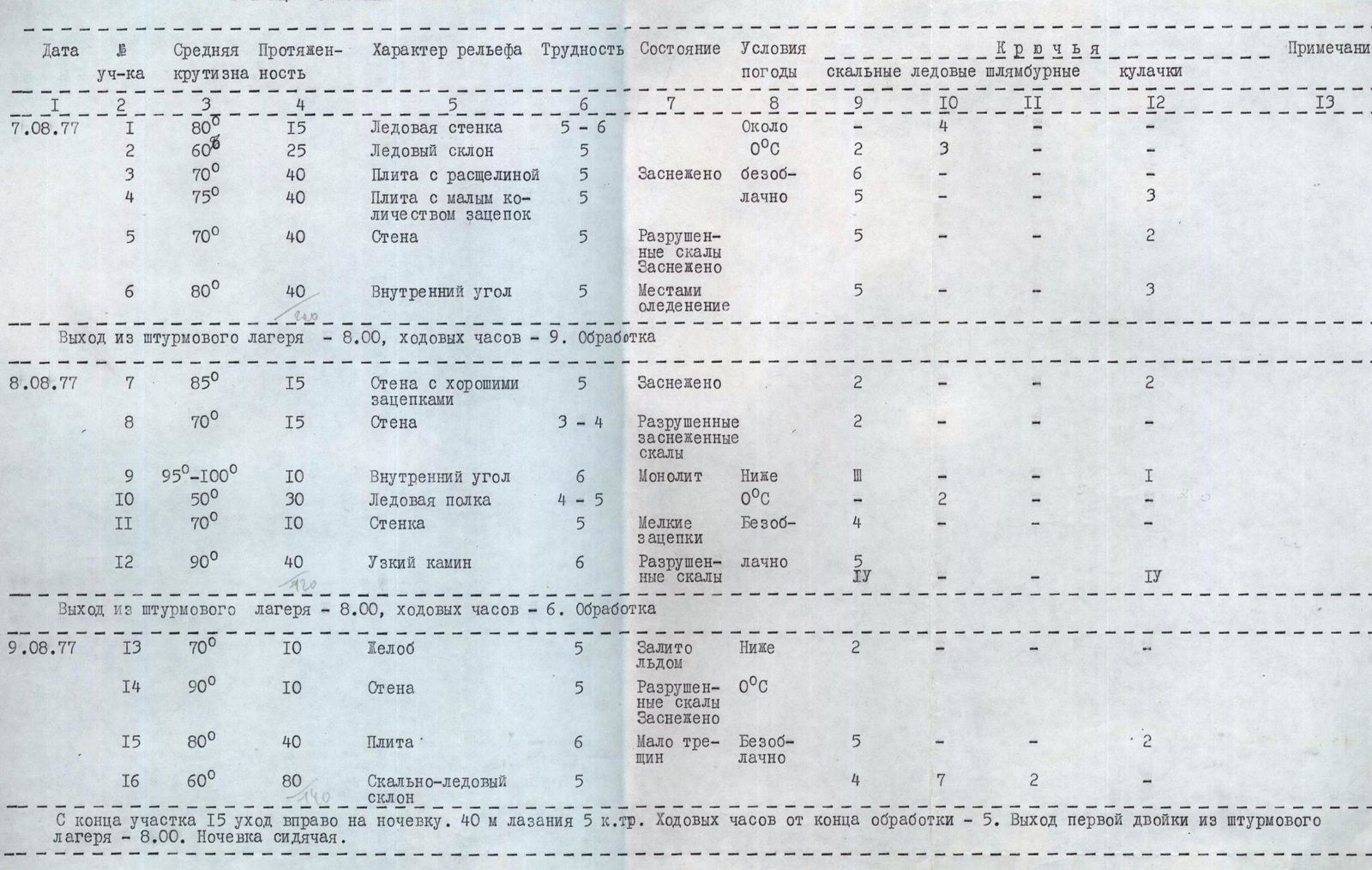
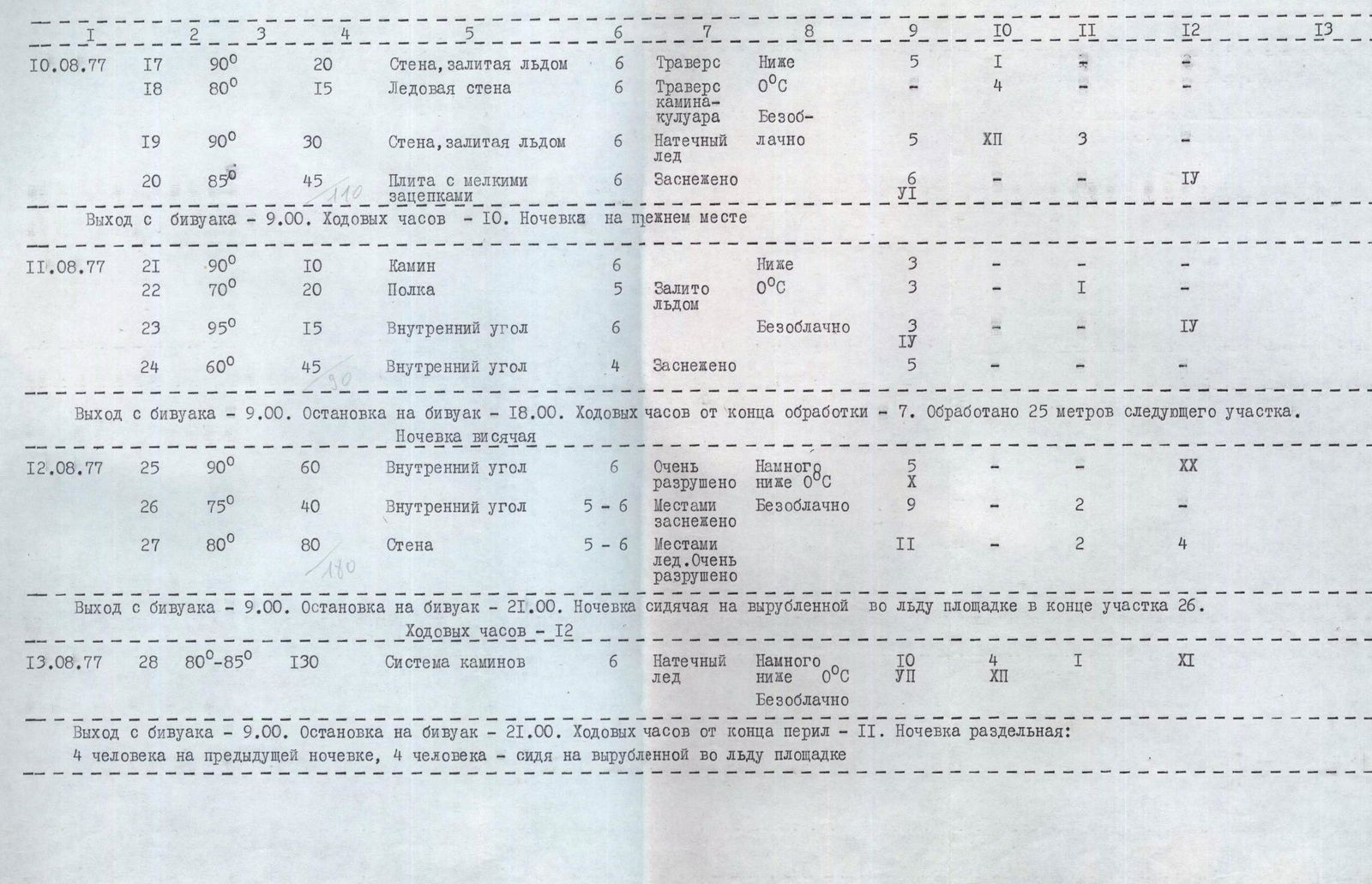
| Date | Section № | Average steepness | Length | Terrain characteristics | Difficulty | Condition | Weather conditions | Pitons: rock | Pitons: ice | Pitons: bolt | Pitons: cam | Note |
|---|---|---|---|---|---|---|---|---|---|---|---|---|
| August 7, 1977 | R1 | 80° | 15 m | Ice wall | 5–6 | Around 0 °C | 4 | |||||
| R2 | 60° | 25 m | Ice slope | 5 | 2 | 3 | ||||||
| R3 | 70° | 40 m | Slab with cleft | 5 | Snow-covered | Clear | 6 | |||||
| R4 | 75° | 40 m | Slab with few holds | 5 | 5 | 3 | ||||||
| R5 | 70° | 40 m | Wall | 5 | Crumbly rocks | 5 | 2 | |||||
| R6 | 80° | 40 m | Inner corner | 5 | Partially icy | 5 | 3 | |||||
| Exit from assault camp — 8:00, climbing hours — 9. Processing | ||||||||||||
| August 8, 1977 | R7 | 85° | 15 m | Wall with good holds | 5 | Snow-covered | 2 | 2 | ||||
| R8 | 70° | 15 m | Wall | 3–4 | Crumbly, snow-covered rocks | 2 | ||||||
| R9 | 95–100° | 10 m | Inner corner | 6 | Monolithic | Below 0 °C | 3 | |||||
| R10 | 50° | 30 m | Ice shelf | 4–5 | 2 | 1 | ||||||
| R11 | 70° | 10 m | Wall | 5 | Small holds | Clear | 4 | 1 | ||||
| R12 | 90° | 40 m | Narrow chimney | 6 | Crumbly rocks | 5 | 4 | |||||
| Exit from assault camp — 8:00, climbing hours — 6. Processing | ||||||||||||
| August 9, 1977 | R13 | 70° | 10 m | Groove | 5 | Icy | Below 0 °C | 2 | ||||
| R14 | 90° | 10 m | Wall | 5 | Crumbly rocks | |||||||
| R15 | 80° | 40 m | Slab | 6 | Few cracks | Clear | 5 | 2 | ||||
| R16 | 60° | 80 m | Rock-ice slope | 5 | 4 | 7 | 1 | 2 | ||||
| Exit from R15 section to the right for overnight stay. 40 m of 5th category difficulty climbing. Climbing hours from end of processing — 5. First duo's exit from assault camp — 8:00. Overnight stay is sitting. | ||||||||||||
| August 10, 1977 | R17 | 90° | 20 m | Wall, icy | 6 | Traverse | Below 0 °C | 5 | 1 | |||
| R18 | 80° | 15 m | Ice wall | 6 | Traverse of chimney-culoir | Clear | 4 | |||||
| R19 | 90° | 30 m | Wall, icy | 6 | Rime ice | 5 | 12 | 3 | ||||
| R20 | 85° | 45 m | Slab with small holds | 6 | Snow-covered | 6 | 4 | 6 | ||||
| Exit from bivouac — 9:00. Climbing hours — 10. Overnight stay at the same place | ||||||||||||
| August 11, 1977 | R21 | 90° | 10 m | Chimney | 6 | Icy | Below 0 °C | 3 | ||||
| R22 | 70° | 20 m | Shelf | 5 | 3 | 1 | ||||||
| R23 | 95° | 15 m | Inner corner | 6 | Clear | 3 | 4 | |||||
| R24 | 60° | 45 m | Inner corner | 4 | Snow-covered | 5 | ||||||
| Exit from bivouac — 9:00. Stop for bivouac — 18:00. Climbing hours from end of processing — 7. 25 m of the next section processed. Overnight stay is hanging. | ||||||||||||
| August 12, 1977 | R25 | 90° | 60 m | Inner corner | 6 | Very crumbly | Well below 0 °C | 5 | 10 | 10 | ||
| R26 | 75° | 40 m | Inner corner | 5–6 | Partially snow-covered | Clear | 9 | 2 | ||||
| R27 | 80° | 80 m | Wall | 5–6 | Partially icy, very crumbly | 11 | 2 | 4 | ||||
| Exit from bivouac — 9:00. Stop for bivouac — 21:00. Overnight stay is sitting on ice platform carved at the end of R26 section. Climbing hours — 12. | ||||||||||||
| August 13, 1977 | R28 | 80–85° | 130 m | System of chimneys | 6 | Rime ice | Well below 0 °C, clear | 10 | 7 | 4 | 11 | |
| Exit from bivouac — 9:00. Stop for bivouac — 21:00. Climbing hours from end of belays — 11. Overnight stay is split: 4 people at previous overnight stay, 4 people — sitting on ice platform carved. | ||||||||||||
| August 14, 1977 | R29 | 60° | 20 m | Ice ridge | 5 | Very cold | 1 | 3 | ||||
| R30 | 80° | 120 m | System of inner corners | 5–6 | Rime ice | 12 | 5 | 1 | ||||
| R31 | 50° | 20 m | Ice slope | 4–5 | 2 | 2 | ||||||
| Exit from bivouac — 10:00. Stop for bivouac — 21:00. Climbing hours — 11. Overnight stay is semi-hanging | ||||||||||||
| August 15, 1977 | R32 | 75° | 80 m | Wall | 5 | Partially icy | Very cold | 9 | ||||
| R33 | 50° | 200 m | Ice ridge | 5 | 1 | 6 | ||||||
| R34 | 80° | 80 m | Ridge | 2–3 | Simultaneous | |||||||
| Exit from bivouac — 9:00. Summit — 14:00. Climbing hours — 5. |
August 10, 1977
It became clear yesterday that we'll have to repeat the overnight stay at the same place. Today, we need to cross the giant chimney filled with ice and process the approach to the "Black" corner, which looks very harsh. It's visible from below with the naked eye and makes you think. Very similar to the corner on Koreya, but longer. But we need to get to it first. Another rope of ice, a traverse along sheer and partially overhanging rocks — and the bottom of the chimney. The ice is like glass and almost sheer. We need to cut steps. Then there's a problem. The rocks are sheer, and ice streams flow down them. The movement includes:
- Bolt for belaying
- Pendulum onto ice
- Up the ice on ladders
- Right onto a little rib
- Another pendulum
- More ladders
And at the end of the rope, we have to drive two bolt pitons. There are no cracks. On this day, another rope is passed through a slab, very difficult, filled with ice.
August 11, 1977
From below, it seemed that after the slab, there would be no problems before the "Black" corner. But we had to do some serious climbing. Chimney, shelf, rather wall, and overhangs in the corner. Then easier. The "Black" corner is very good. The left wall overhangs — steepness about 110° and crumbly. The right wall is a sheer, smooth wall made of "tiles". Everything is creaking. In the remaining three hours, we passed 30 m of the corner. The overnight stay is hanging. We spend the night on the entire length of the rope under the corner.
August 12, 1977
Lyonya Troshchenko, who started the corner yesterday, wants to finish it. Another 4 hours — and another corner begins. It's less steep, but again ice. We're exiting onto an ice-filled shelf. We'll spend the night here. While Yura Logachev climbs two ropes of a very crumbly wall, leading to the start of chimneys, the lower ones carve out a sitting overnight stay in the ice for the whole group in 3 hours — for the first time in 3 days, we gather together on a bivouac. Yura describes the further path:
- Chimney.
- Bottom filled with ice.
- Width about 2 m.
- Walls without holds and sheer.
Lipchinsky and Zakhodyzhiy, who go first tomorrow, are pondering.
August 13, 1977
We rise at 6:30, and at 9:00, the first duo sets off upwards. We climb 3 ropes today. Again, ice on ladders and lots of artificial aids. We spend the night apart again. Four people on the previous overnight stay, four at the end of the climbed section — overnight stays are similar — on a shelf carved in the ice. The view above is not encouraging — even more ice, but slightly less steep — not chimneys, but inner corners.
August 14, 1977
From the overnight stay, we climb along an ice ridge, and then along corners. Mainly on ice. Like the whole route, this section is good because there's no way to deviate from the route. We climb the easiest option, and it's still very difficult. The abundance of ice suggests we're close to the summit ridge. After a system of corners, half a rope of ice slope, and we need to spend the night. Four people sleep sitting, four hanging.
August 15, 1977
Two ropes of rocks, for some reason, almost without ice, and we emerge under the ice ridge. 3 hours of work, several "buckets" — and we're on the ridge. It's wide and even, you can unclip the rope and walk around. We ran to the summit and back along the ridge, leaving our backpacks behind. The descent will be long.
Observation Group Diary
August 9, 1977
At 6:00, the duo Lipchinsky–Zakhodyzhiy sets out on the route. At 7:30, the rest of the group follows. At 10:30, Lipchinsky reaches the last rope processed the day before. 12:00 — radio contact with LОС-I (bottom). The last ones start dropping ropes. The first ones reach the end of the belays. 13:00 — observations through a telescope: a 90 m rope and a 45 m rope are dropped. Lipchinsky is one rope away from the end of the big ice groove (at point I). 20:00 — radio contact with LОС-II. The group is setting up a bivouac. After processing, they passed 3 ropes, another 2 are being processed, trying to traverse the ice couloir to the left. 21:00. The whole group is on the bivouac. The tent is set up to the right of the couloir, slightly below the level of a large stone in the couloir (at a point on the photograph above and to the right of the numeral I). About 11 ropes have been climbed from the bivouac.
August 10, 1977
10:00. The tent is still in the same place. Some people who spent the night below the tent (5 m away) on a shelf are climbing up. 12:00 — radio contact. The overnight stay was normal. The lead pair, Gorenchuk–Larionov, is working ahead. They're not removing the overnight stay yet. 13:00. Two ropes were processed in the evening above the tent. Today, they're processing the second one. From the tent, the rope goes along a snowy board to a rock bastion between the snowy board on the right and the ice couloir on the left (people are climbing up the rope). The top person is in the upper part of the ice couloir, on the border between rocks and snow (ice). 14:00. The first person (Larionov) has crossed the ice couloir. 16:00 — listening to the airwaves. Question about a dropped rope that got stuck at the bergschrund. 16:30. The first person (Gorenchuk) has climbed up the rope, moved left from the couloir. The others are sitting in the tent. 18:15. Larionov started climbing the second rope from the couloir (up and to the left). The tent is still in the same place. 19:30. Larionov is climbing the same rope. There are two tents at the overnight stay (5 m apart). 20:00 — radio contact. They reported: they crossed the ice couloir and another 1.5 ropes (total 4–5 ropes from the tent). Everything is normal. Overnight stay is in the same place.
August 11, 1977
10:00. The first pair leaves the tent and starts moving up the belays. 11:20. The first pair reaches the upper end of the belays. The others below are dismantling the bivouac. The third participant starts climbing up the belays. 12:00 — radio contact: everything is normal, they're starting to process the route, planning to climb 3 ropes. 12:15. The top person in the first pair starts processing the route further than yesterday's belays. 14:00. The first person (Troshchenko) has climbed a rope. 16:00. The others are climbing up the belays. 16:30 — listening to the airwaves, no radio contact. 16:30 — Troshchenko has reached a snowy shelf (in its middle). 1.5 ropes today. Gosha is approaching him. A rope below, Logachev and Sapozhkov. A rope below — Lipchinsky, Zakhodyzhiy. Gorenchuk and Larionov are climbing last. 17:30 — Troshchenko has passed the snowy shelf and approached the inner corner (about 2.5 ropes from the start of processing). 18:00 — Troshchenko and Shchedrin are at the upper end of the snowy shelf (at the base of the inner corner), a rope below, Sapozhkov and Logachev are in the middle of the shelf, a rope below — Lipchinsky, Zakhodyzhiy. Gorenchuk and Larionov are climbing up. 19:00 — Troshchenko starts climbing up the inner corner. Sapozhkov and Logachev are preparing an overnight stay (here too). 19:15 — Larionov (last) has passed all the belays from the previous day. 20:00 — radio contact. They reported: they climbed 2.5 ropes. Troshchenko is climbing up the inner corner (climbed about 30 m). Almost everyone (except Larionov) has gathered at the overnight stay. Total 7 ropes from the tent.
August 12, 1977
10:00 — the first person starts climbing up the belays above the overnight stays. 10:30 — the first person starts climbing up the inner corner above the belay point (19th rope from the start of the route). 12:00 — radio contact: everything is normal. The first person (Troshchenko) is working in the inner corner. 16:00 — listening to the airwaves. 17:00 — Troshchenko has reached a snowy shelf to the left and above the center of the "broken mirror" (about 20 ropes from the start). The others are climbing up the inner corner. 18:00 Logachev and Sapozhkov are a rope above the snowy shelf, three people are on the shelf, the rest are climbing up to it. 19:30 — the whole team is on the snowy shelf, preparing an overnight stay. 20:00 — radio contact. They processed 1.5 ropes from the overnight stay, approached a ledge, everything is normal.
August 13, 1977
8:30 — Lipchinsky and Zakhodyzhiy start climbing up the belays. 10:00 — the pair is at the end of the belays, Lipchinsky starts moving up (about 23 ropes from the start of the route). 12:45 — Sasha is in the upper part of the ice couloir (groove). They're not dismantling the tents, Lipchinsky descended to Zakhodyzhiy twice. 15:00 Lipchinsky climbed 20 m in the chimney, 15:40 the pair is at the base of the chimney. 16:00 — listening to the airwaves. 16:50–17:00 the duo Larionov–Gorenchuk climbs up the belays from the tent. 18:00 Lipchinsky continues climbing up the chimney. 19:05 Lipchinsky has passed the chimney, climbed onto a snowy shelf, Larionov is at the start of the chimney. 20:00 — radio contact: Lipchinsky and Zakhodyzhiy are at the end of the 25th rope, Larionov is in the upper part of the chimney. They reported: everything is normal, spending the night in two places. 20:30 — Lipchinsky is at the snowy ridge, about 5 ropes from the overnight stay.
August 14, 1977
8:45. The first person starts climbing from the lower overnight stay up the belays. 9:45 — everyone from the lower overnight stay has moved to the belays. 12:00 — radio contact — Larionov is climbing up, the group is gathering at the upper overnight stay. 16:00 — radio contact — everything is normal, they climbed 2 ropes from the upper overnight stay along an ice couloir. 18:00 — Larionov is climbing the 3rd rope, the couloir is starting to ease up. 19:10 — Larionov is on a snowy ridge, 2 ropes below the "roof". 20:00 — radio contact — everything is in order. The duo Larionov–Gorenchuk starts processing rocks. The other participants are setting up an overnight stay in the lower part of the ridge.
August 15, 1977
9:15 — the first person approaches the base of the ice blade. 11:10 — the first person (Sapozhkov) has climbed about 90 m of the ice blade. The group has gathered on the rocks before the ice. 12:00 — radio contact — everything is normal. 13:45 — Sapozhkov disappears behind the summit ridge. 14:30 — the last participant reaches the summit. 16:00 — listening to the airwaves. A storm is brewing. 20:00 — radio contact. The group stops for an overnight stay on the ridge near the saddle between the main peak and peak 5000 (approx.). Then they'll descend through peak 4850, 4700, and along the northern ridge of peak 4700.
August 16, 1977
12:00 — radio contact — the group is on peak 4850. Everything is normal. 16:00 — listening to the airwaves. 17:00 — the group is in camp. The deputy head of the observation group was appointed Kockin A.A. — 1st sports category. The participants of the observation group changed, and radio contact with the team was maintained regularly using "Vitalka" radios, of which the team had two on the route.
Communication times:
- 12:00 and 20:00 — working hours
- 16:00 — emergency hours
The team was observed through a 60x telescope, which allowed observers to identify participants on the route. In the lower third of the route, observation was conducted from the assault camp, after which it was dismantled, and observation was conducted from the base camp.
Conclusion about the Route and Participants
The route along the northern wall of the unnamed peak 5200 m, according to the team members, is the most challenging of the routes they've taken. In terms of the complexity of the rock terrain and the volume of extremely difficult sections, it surpasses known rock routes along the walls of Bodkhona and Yagnob. The rime ice covering almost the entire wall significantly increases the route's difficulty.
On the routes taken by the participants along the combined northern walls of Svobodnaya Koreya and Cha-Tyn-Tau:
- technically difficult sections are significantly fewer;
- glaciation is less severe.
The team completed the route in ideal weather conditions between long periods of bad weather and believes that completing the route in worse weather conditions is problematic. This is exacerbated by the fact that it's very difficult to deviate from the route after passing the "black" corner. For successful completion, high-quality ice equipment is necessary:
- modern crampons;
- ice screws;
- hammers.
The team participants had a large volume of technical training in the 1976–1977 seasons, completing an average of 6 ascents of 5th–6th difficulty categories.
All participants:
- approached preparation and the ascent very responsibly;
- despite the large volume of work, maintained high efficiency;
- throughout the ascent, maintained a good mood, mutual understanding, and friendliness.
Team coach Zakhodyzhiy M. M.
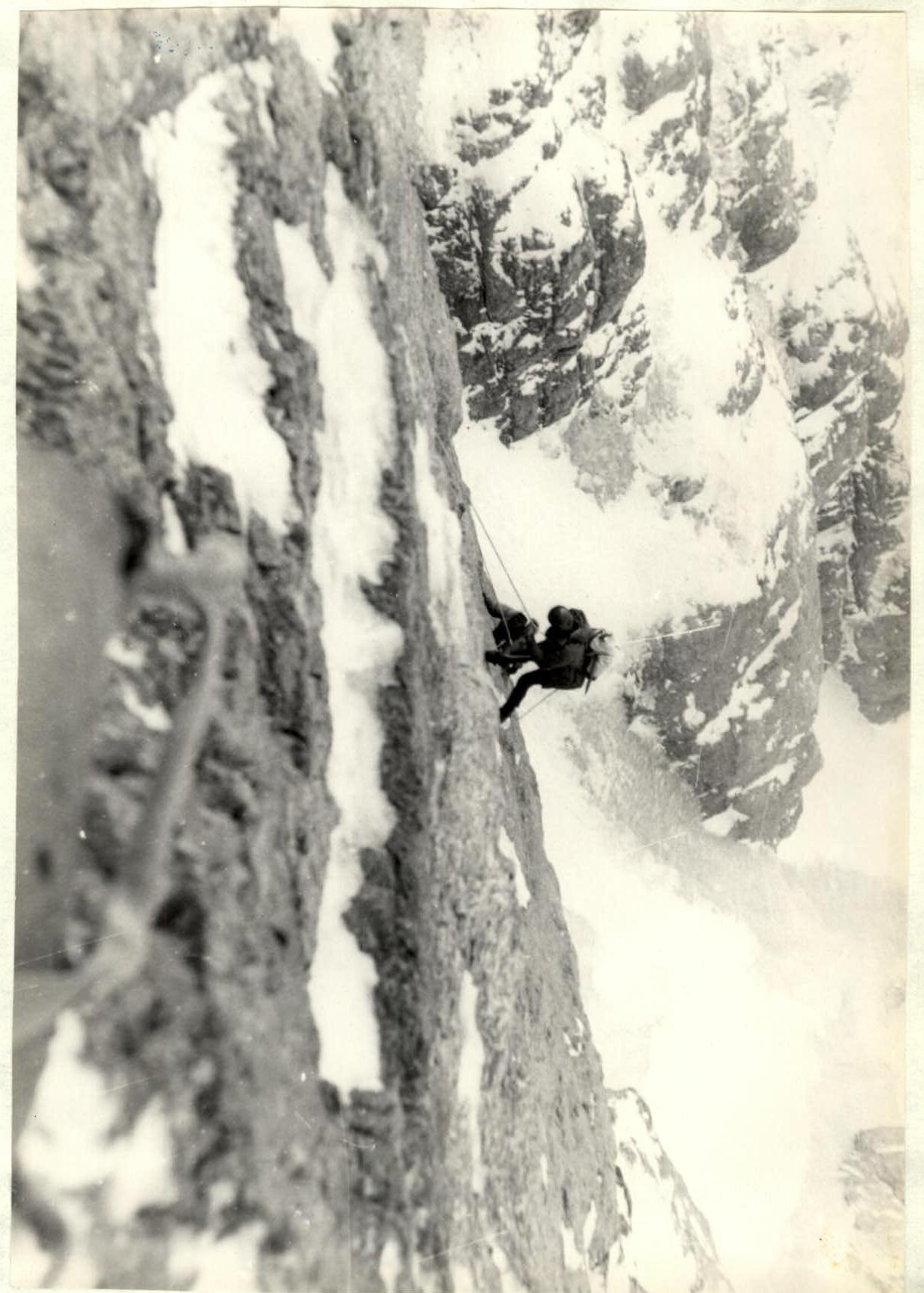
Photo 10. Section R21.
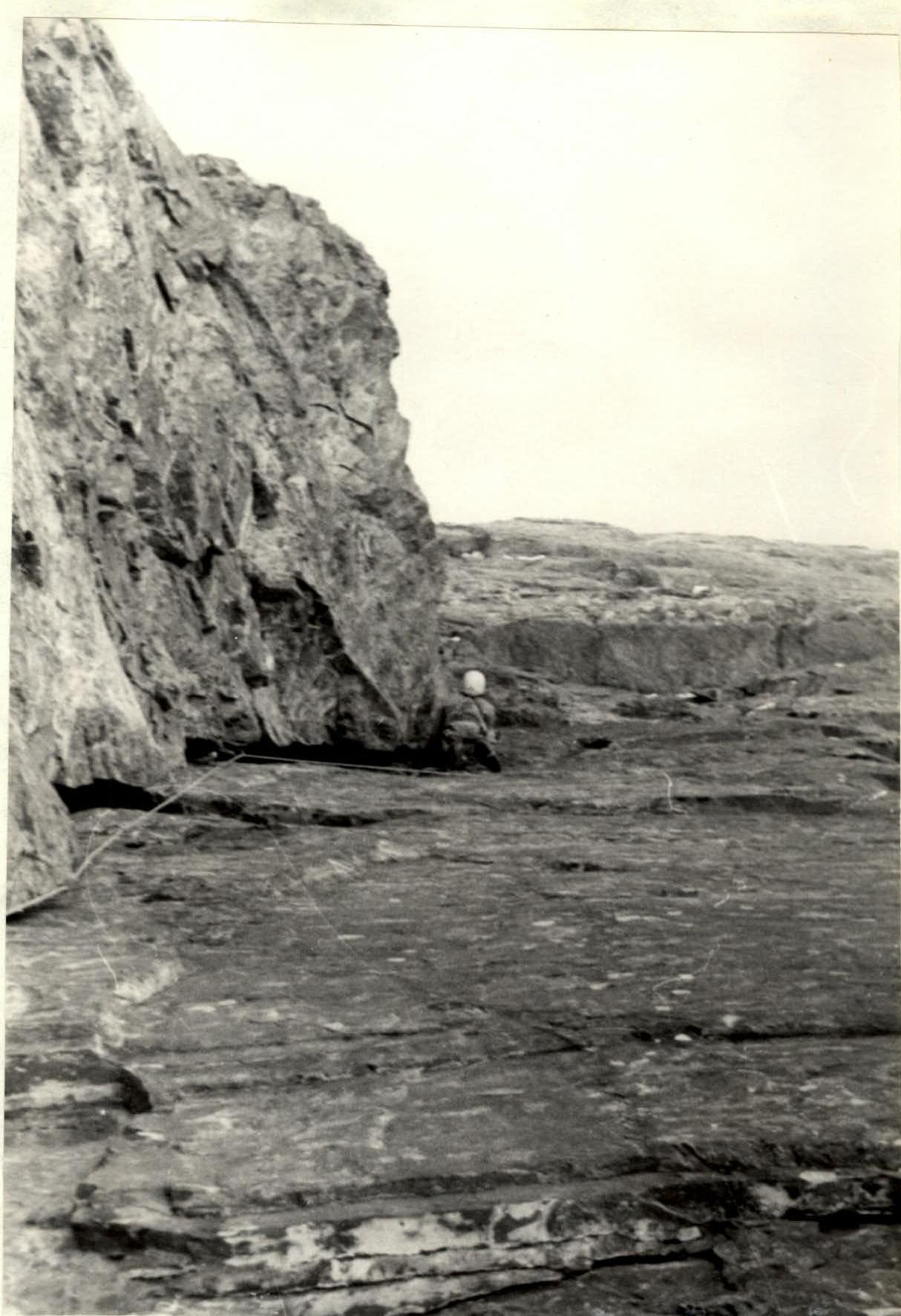
Photo 11. "Black" inner corner. Section R26.
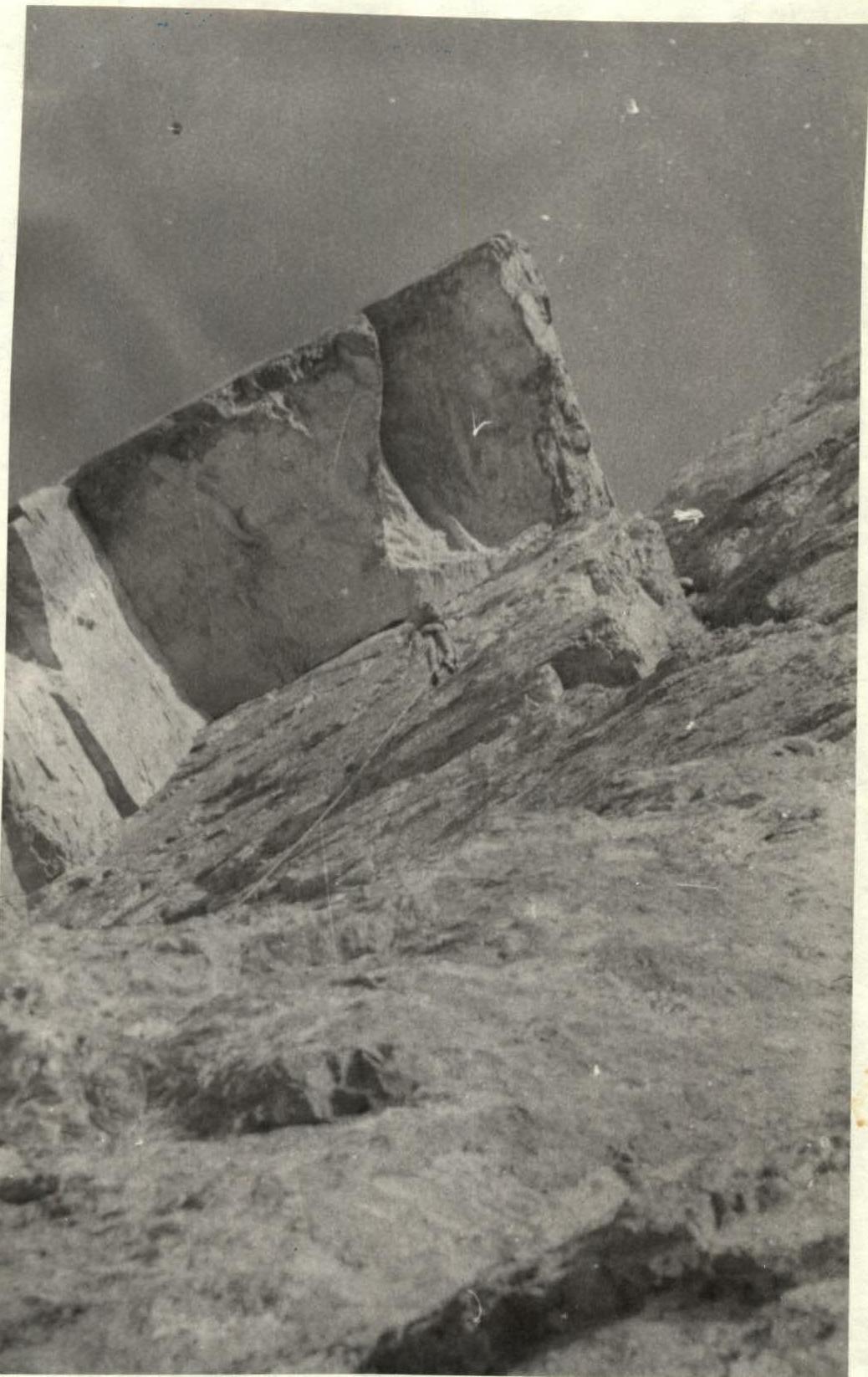
Photo 14. Movement along belays to section R28.