
D.B. Sharashenidze
Center of the big triangle of the North wall
(Report on the first ascent)
Team captain MS USSR Sharashenidze D.B. Team coach MS USSR Kartvelishvili G.I.
Tbilisi – 1976
Tactical plan of the ascent
The tactical plan was made taking into account the specifics of the area, characterized by complex meteorological conditions. Reconnaissance confirmed that the route is a monolithic wall of great steepness, and there are practically no places for overnight stays in a tent. Therefore, the tactics of passing this route had to be fundamentally different, since hanging overnight stays during a long ascent period greatly exhaust the climber's strength.
The main difficulties presented by the wall were as follows:
- Transportation of cargo on the route.
- Organization of reliable and safe overnight stays without a tent.
- Completing a set of equipment and gear for participants.
- Choosing the optimal amount of food and equipment.
- Communication between rope teams.
A winch with a 120 m cable was designed for transportation, which proved itself. The advantage over manual pulling was especially noticeable on long sections of the route (100–110 m).
A rich set of pitons, hammocks, platforms, and "zdarki" ensured the organization of reliable and safe overnight stays.
From the experience of previous ascents of a similar nature, we knew that success largely depends on the correct selection of equipment and food. Particular attention was paid to determining their optimal quantity, which would allow the ascent to be carried out at a high pace, contributing to success, especially in areas with unstable meteorological conditions.
Team composition
| № | Surname, name, patronymic | Year of birth | Nationality | Sport rank | Instructor's title | Best ascents of previous seasons |
|---|---|---|---|---|---|---|
| 1. | SHARASHENIDZE Dmitry Borisovich | 1937 | Georgian | MS | instructor | Bodkhona on the Western wall — 6B category of difficulty and 15 ascents of 5A category of difficulty |
| 2. | KARTVELISHVILI Givi Irakliyevich | 1936 | Georgian | MS | instructor | South Ushba on the North-Western wall — 6B category of difficulty, Bodkhona on the Western wall — 6B category of difficulty and 10 ascents of 5A category of difficulty |
| 3. | BAKANIDZE Durmishkhan Grigoryevich | 1937 | Georgian | MS | instructor | Chatyn on the "diamond" — 6B category of difficulty, South Ushba on the North-Western wall — 6B category of difficulty, Bodkhona on the Western wall — 6B category of difficulty and 26 ascents of 5A category of difficulty |
| 4. | CHICHINADZE Murad Grigoryevich | 1948 | Georgian | MS | – | Peak of the Communist Academy — 6B category of difficulty, South Ushba on the North-Western wall — 6B category of difficulty and 11 ascents of 5A category of difficulty |
| 5. | LUKASHVILI Tariel Shalvovich | 1942 | Georgian | CMS | instructor | Chatyn on the "diamond" — 6B category of difficulty, South Ushba on the North-Western wall — 6B category of difficulty, Bodkhona on the Western wall — 6B category of difficulty and 16 ascents of 5A category of difficulty |
| 6. | ZUMBADZE Georgy Shalvovich | 1940 | Georgian | CMS | instructor | Bodkhona on the Western wall — 6B category of difficulty and 9 ascents of 5A category of difficulty |
Passage of the route by days
Day one. July 24, 1976
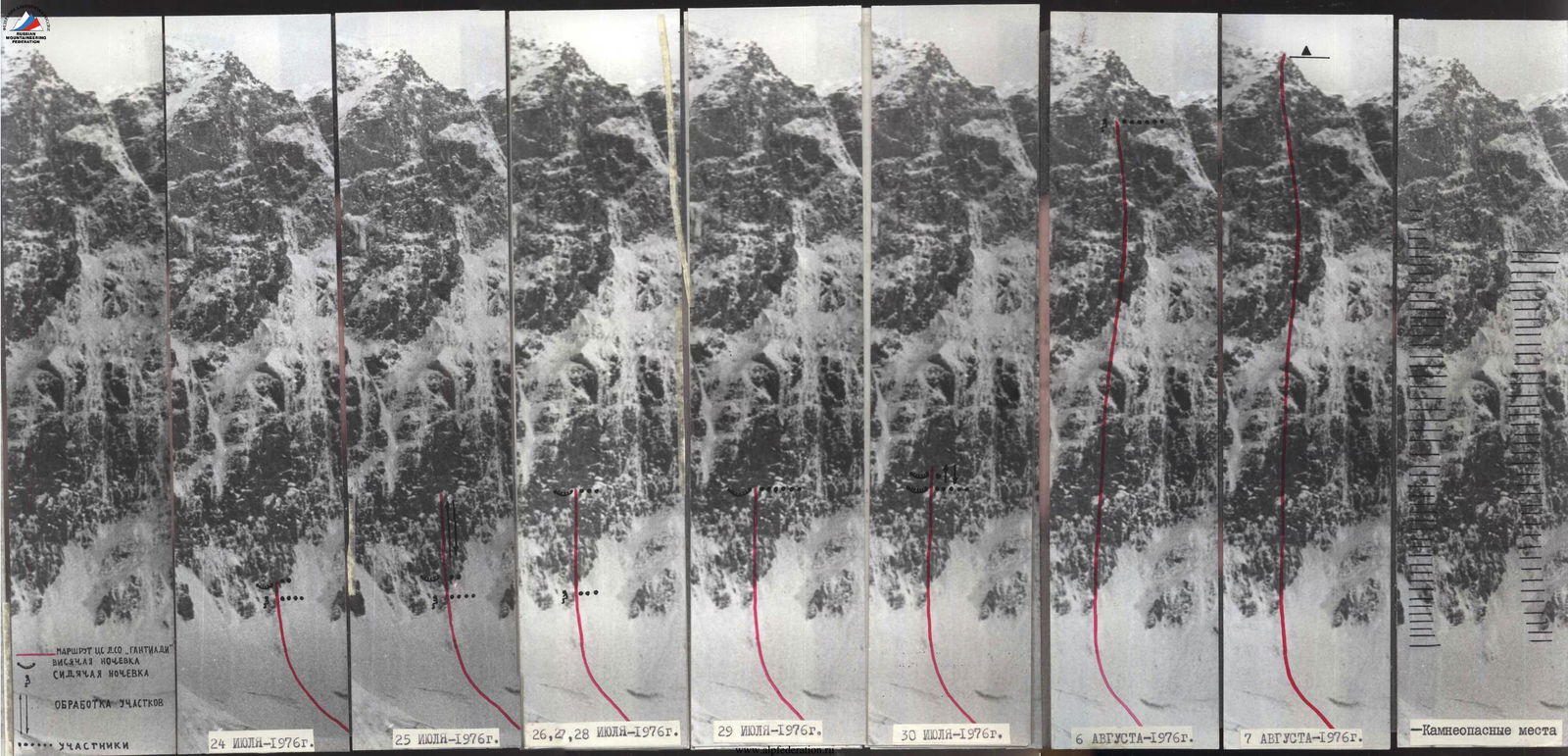
The weather is good. At 3:00, the team leaves the upper base camp located on the left (orographic) moraine of the Dzhigit glacier. Crossing the glacier, we begin the ascent along a snow-ice slope cut by crevasses. In 2 h 45 min, we arrive at the assault camp, where our tent, food, and equipment for the ascent are located. We take part of the load and head upwards. Ahead is an ice wall, which is bypassed on the right. Having passed 60 m, we approach the lower bergschrund. Having overcome it relatively easily, we reach a snow-ice slope with a steepness of about 35°. (According to the terminology of previous climbers, the "second barrier" of the glacier). The slope is traversed simultaneously. 150 m, and we are at the upper bergschrund bordering the ice wall. The path is blocked by an ice wall 7 m high (R0–R1). Here, the trio of Sharashenidze, Lukashvili, and Zumbadze leave their load and return down to the tent location (assault camp) for the remaining food and equipment. The trio of Kartvelishvili, Bakanidze, and Chichinadze process the ice wall. Bakanidze works at the front. By 11:00, the weather worsens. Sleet. Bakanidze reaches an ice slope 120 m long and 65° steep (R0–R2). Backpacks are pulled up using a rope. At 18:00, the whole group is under the first bastion. The first meters indicate the nature of the ascent. Monolithic rocks with a steepness of 80°. There is nowhere to put a tent. We hang the tent on the belay and with difficulty squeeze into hammocks four at a time. Two, Zumbadze and Chichinadze, due to lack of space, spend the night in hammocks 15 m higher. Sleet. Wind. Time 18:00.
(2)
Day two. July 25, 1976
Sleet falls throughout the night. Wind. In the morning, the wind dies down, but the snowfall is heavy. Visibility is poor. Snowfall stops by 12:00. Clears up. Below, on the snow slope, we see a group of Zenith climbers, led by V. Zhurdzin, following the route of A. Ryabukhin, 1965. The duo of Zumbadze and Chichinadze heads onto the wall. Zumbadze leads. The rocks are smooth and solid. We use platforms and ladders. The first 50 m of the wall are smooth. Then, a 7 m wall with a negative slope (105°) follows, transitioning into a vertical section (15 m). Vertical sections alternate with sections of 80–85° steepness. Zumbadze is an excellent rock climber, but even in crampons, it's not easy for him. In seven and a half hours, they cover 125 m (R2–R10). The weather worsens towards the evening. The lead climber secures the rope, and the duo rappels down to the previous bivouac. Time 19:00, snow, sleet.
Day three. July 26, 1976
The weather is calm at night, but worsens again in the morning. At 15:00, it clears up. Three climbers, Sharashenidze, Kartvelishvili, and Zumbadze, ascend using the fixed ropes. It's not possible to process the section with the whole group today. The last of this trio reaches the end of the rope at 21:00. By the light of headlamps, under a cornice and in bad weather, we organize a hanging bivouac. Three of us sit on hanging backpacks, pressed tightly together. Legs are in a hammock. Time 20:00, wind. The second trio spends the night below, at the previous bivouac.
Day four. July 27, 1976
Heavy weather. We communicate with the lower trio by radio. Continuing the ascent is impossible.
Day five. July 28, 1976
Heavy weather. A lot of snow has fallen.
Day six. July 29, 1976
The weather continues to be bad. Wind. Snow. Even for Tian Shan conditions, the weather is unusual. We communicate with the lower trio by radio. Everyone is fine. The mood in the group is cheerful and combat-ready. Occasionally, the wind dies down. Through the scattered fog, we see the "Zenith" group on the snow slope below. They are descending from the route. At 12:00, we contact the observers. They relay a telegram text dated July 28, 1976, signed by the authorized Sports Committee V.I. Volchenko and deputy judge of the competition V.G. Lazebny, suggesting that we descend from the route due to heavy weather, with the option to retry later. An unusual precedent! After the ascent, we learned that the reason for this was the unusually severe weather and a poor weather forecast for the coming week. We express gratitude to V.I. Volchenko and V.G. Lazebny for the offer, but after assessing our capabilities, we decide not to descend from the route. At 16:00, the wind dies down. The lower trio leaves the first control point at the bivouac and begins the ascent. The upper team helps pull up the backpacks. At 21:00, the whole group gathers together. The bivouac is hanging.
Day seven. July 30, 1976
The weather is bad. Snow. Sleet. It's clear that we've hit a strong, prolonged period of bad weather. We decide to use any short period of improvement for the ascent. An hour, half an hour... It doesn't matter, as a tent bivouac is not in sight. We'll sleep in shifts, just to keep moving upwards. Therefore, everyone is ready to go out in the morning.
At 13:00, the wind dies down. Snowfall. The duo of Bakanidze and Lukashvili sets out. Ahead is Bakanidze. Directly from the bivouac, there's an 8 m high cornice with a steepness of 115°. It's climbed using ladders and a platform. Then, a 20 m wall follows with a steepness of 85°. Above the wall, a traverse to the left (5 m) leads to a 7 m vertical section. Then, a small inclined ledge (30°) measuring 1.5×0.4 m. Bakanidze takes Lukashvili in belay. Above the ledge, a 5 m wall hangs with a steepness of ~100°. At this point, the vertical wall meets the left end of a large horseshoe-shaped cornice. Lukashvili leads. He passes the negative wall. Time 20:20. In seven hours, they've covered 40 m (R10–R14). Lukashvili secures the rope and descends to the ledge. Bakanidze returns to the previous bivouac, and Lukashvili organizes a solo hanging bivouac in a hammock above the ledge.
Day eight. July 31, 1976
In the morning, the weather is variable. By 7:30, the wind dies down, and the snowfall stops. Overcast. Bakanidze and Chichinadze ascend using the fixed ropes. Chichinadze leads. He passes a 22 m slab with a steepness of 85°. This section is climbed using free climbing. The climbing is very difficult. The slab ends with a 5 m negative wall (105°). We use platforms and ladders. Then, a wall follows with a steepness of 80° and a length of 25 m. Chichinadze asks to send up crampons and pitons. Our dispatchers, Kartvelishvili and Lukashvili, prepare the necessary set of pitons and attach them to a rope along with crampons. Chichinadze pulls everything up to him. Despite the cold, he's forced to change his Tricouni boots for crampons because the Tricouni grips poorly on the smooth granite. The high steepness ensures the absence of snow and sleet accumulation from these days. The cracks are wide and partly filled with ice. We have to carefully search for places to place pitons, although a large set of them somewhat eases the task. Further, the steepness increases to 85°. The holds are small but strong enough. Therefore, Chichinadze passes the 15 m wall relatively quickly (1 h). Then, an 8 m vertical wall follows, and 15 m with a steepness of 85°. The wall ends with a 2 m negative section (95°), leading to an inclined ledge covered with a thin layer of ice (45°). After the ledge, a wall follows with a length of 15 m and a steepness of 75°. Then, a 12 m vertical section. It adjoins ice-filled rocky outcrops. The ice greatly complicates the passage of this section, despite its relatively low steepness (70°) (R14–R24). At 20:00, four climbers — Chichinadze, Bakanidze, Kartvelishvili, and Lukashvili — organize a sitting bivouac. Two, Sharashenidze and Zumbadze, manage to reach only the ledge and organize a hanging bivouac. The second control point is left at the previous bivouac. The weather worsens. Strong wind. Sleet.
Day nine. August 1, 1976
The past night was very difficult. The bad weather didn't allow us to sleep. By morning, the wind's strength decreases, although it continues to snow until 11:00. At 11:30, two climbers, Sharashenidze and Zumbadze, dismantle the lower bivouac and ascend using the fixed ropes to join the first four. During this time, Kartvelishvili and Chichinadze process the path further. The route first passes along a snow-ice slope (60°) for 10 m, then along a steep groove (80°). The groove is clogged in the middle with a huge rock boulder, which is bypassed on the right. After the groove, a 20 m long ice slope follows. Then, a 5 m vertical wall leads to an ice slope under a red rock resembling a tent in shape (R24–R27). This was the only place where we thought we could set up a tent. However, the first blows with an ice axe disappoint us. Under the thin layer of ice, we find monolithic, inclined granite slabs. There's nowhere to set up a tent. Time 15:00. Kartvelishvili and Chichinadze descend to the previous bivouac. The bivouac is sitting for four, and two are in hammocks. The weather is good at night. For the first time in these 9 days, we see Issyk-Kul and, lit by lanterns, Prjevalsk.
Day ten. August 2, 1976
The weather is bad. Wind. Snow. By 11:20, it clears up. Chichinadze ascends using the fixed ropes. From the red rock, an ice slope follows with a steepness of 65°. The ice often alternates with rocky outcrops covered with a thin ice crust, making movement in crampons difficult. Therefore, this section, except for the first part, is climbed using ladders on the fixed ropes. At 20:00, the four — Kartvelishvili, Chichinadze, Zumbadze, and Lukashvili — organize a hanging bivouac on the rocks (R27–R28). Two, Sharashenidze and Bakanidze, remain at the previous bivouac. For the day, 14 m of path are covered. The weather starts to worsen. At night, a strong wind.
Day eleven. August 3, 1976
By morning, the weather improves. At 9:00, two climbers, Sharashenidze and Bakanidze, ascend to join the first four. At 11:00, they catch up with the others. During this time, Zumbadze and Lukashvili lay the path upwards. Along icy rocks, they reach the base of the wall. The steepness of the first wall is 85°, with a length of 25 m. Above the wall, there's a place for a sitting bivouac. Zumbadze and Lukashvili continue processing the route. Time 17:00. The others begin to organize the bivouac. By 20:00, Zumbadze and Lukashvili descend to the others, and for the first time in the last 4 days, the whole group gathers together. The bivouac is sitting (R29–R30).
Day twelve. August 4, 1976
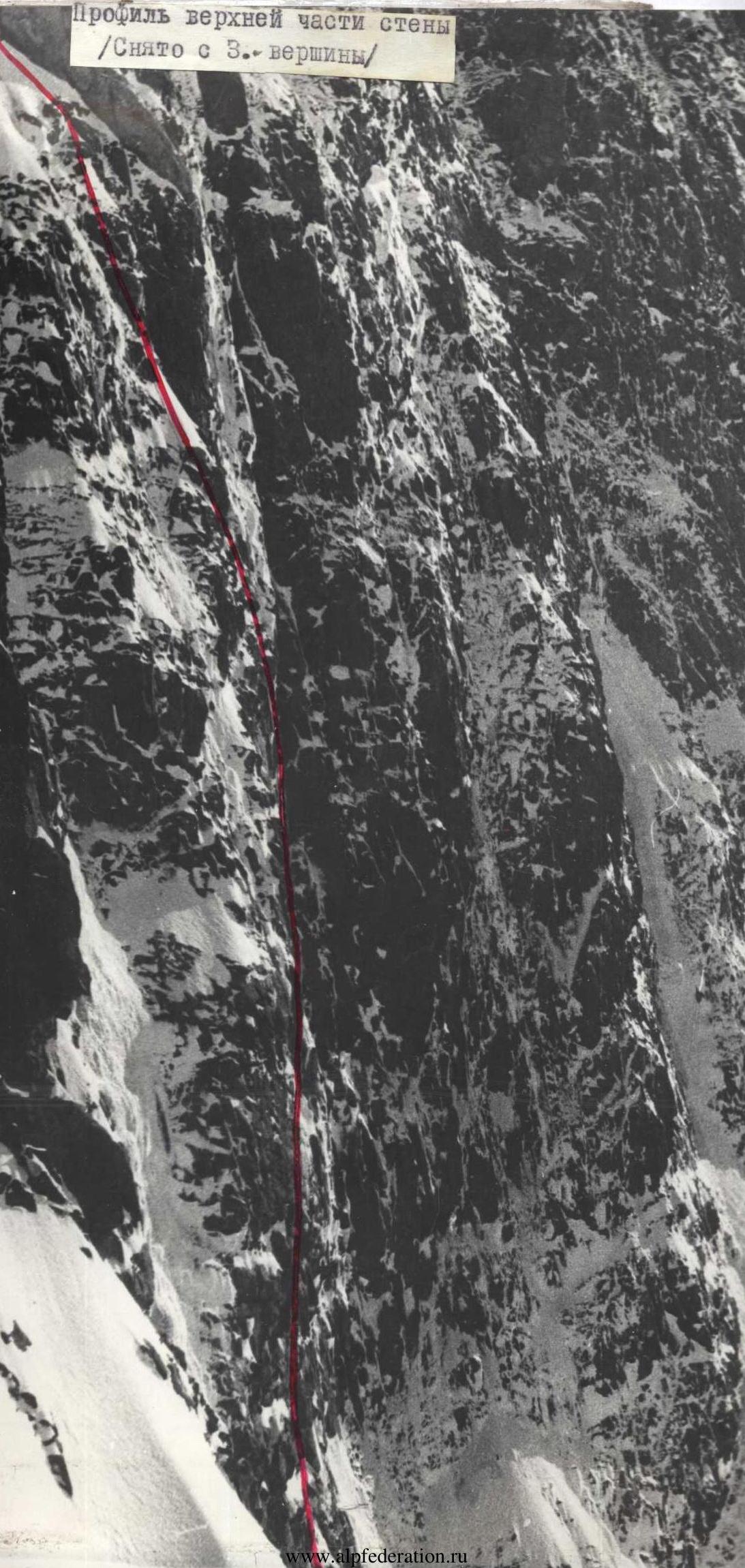
The weather is good in the morning. At 8:00, Zumbadze and Sharashenidze ascend using the fixed ropes. The wall immediately after the bivouac is vertical (20 m). Further, monolithic rocks follow with a steepness of 80° and a length of 85 m. Sometimes, there are snow patches on this wall. Gradually, the steepness increases, and the wall ends with a negative section. The steepness of this section is ~110°; the length is 15 m. The weather gradually starts to worsen. The cornice transitions into a 50 m vertical wall. To the right, an ice groove is visible, where falling stones whistle from time to time (R30–R34). Zumbadze leads. Chichinadze and Sharashenidze follow using the fixed ropes. Time 19:00. The weather sharply worsens. A hanging bivouac can be organized above the wall, but there's not enough time to pull up three backpacks. The sharp deterioration in weather forces the upper trio to descend immediately. 65 m of height gained with great difficulty are lost! Below, under the cornice, which provides some protection from the sleet, four organize a hanging bivouac. Two spend the night 10 m below. Strong wind. Cold. Time 19:30 (R32–R33).
Day thirteen. August 5, 1976
Throughout the night, sleet falls. Wind. By 12:00 in the morning, the wind dies down, but it continues to snow. Waiting out the bad weather means wasting time, as a sitting bivouac 65 m higher is guaranteed. Therefore, in the snowfall, the whole group ascends using the fixed ropes. Movement is greatly hindered by a thin layer of ice on the belay rope. We have to constantly break the ice off the rope. The rope catch gets stuck during movement. We cross the start of the ice groove to the right and reach a snow-ice ridge (R33–R34). For the first time in 13 days, we can set up a tent, although preparing the site takes a lot of time and energy. It's decided to spend the night in a "Pamirka" tent, which is very cramped but warm. The tent is very tight, and this bivouac turns out to be sitting. The weather worsens. The wind reaches a colossal strength and around 4:00 am tears our tent. Snow falls directly on us (R33–R34).
Day fourteen. August 6, 1976
In the morning, the wind dies down. At 7:30, the duo of Lukashvili and Kartvelishvili sets out. A snow-ice ridge with a steepness of 45° and a length of 25 m leads to a 25 m vertical wall. Further, a 70° rocky counterfort follows, gradually increasing in steepness and eventually reaching 75–80°. Then, a snow-ice slope leads to an overhanging wall. Along the edge of the ice slope and wall, a 10 m traverse to the left follows, and we ascend a 50 m vertical wall to a narrow inclined ledge. Further, the steepness decreases to 75°. After another 45 m, we reach a vertical wall and organize a hanging bivouac below it (R34–R41). Time 20:00. Overcast.
Day fifteen. August 7, 1976
The weather is good in the morning. Clear. Finally, we can enjoy the beauty of the Issyk-Kul landscape. The proximity of the end of the wall is encouraging. We admit that the continuous bad weather of the previous days was tiring. With good weather, we hope to reach the ridge today. At 8:30, Kartvelishvili and Lukashvili lead. Kartvelishvili passes a 20 m vertical wall. Then, the steepness slightly decreases (80°). Despite the high steepness, the rock texture allows for relatively fast movement. The relief on this section is more diverse than below. There are small ledges (unsuitable for tents), snow patches, narrow crevices, and fissures. Overall, the section is similar in difficulty to the upper part of G. Khergianni's route on South Ushba. After about three rope lengths, we reach a rocky ridge. Another 40 m of climbing, and we're on the ridge. The wall is passed! The ridge is snowy and even. We repair the tent torn on the night of August 5 and settle in for the night at 21:30. For the first time in 15 days, we sleep in a tent, not tied to safety ropes (R41–R44).
Day sixteen. August 8, 1976
The weather is good. We set out at 8:30. Bypassing snow-ice cornices to the right and left along the ridge, we move towards the summit (R44–R45). Belay is through an ice axe and ice screws. At 12:50, we reach the Western summit. We retrieve a note left by Lithuanian climbers and begin our descent at 13:15, first to the south, and then along the western snowy ridge (Route 4A category of difficulty). We descend to the glacier at 18:00. There, we meet the observation group waiting for us with supplies.
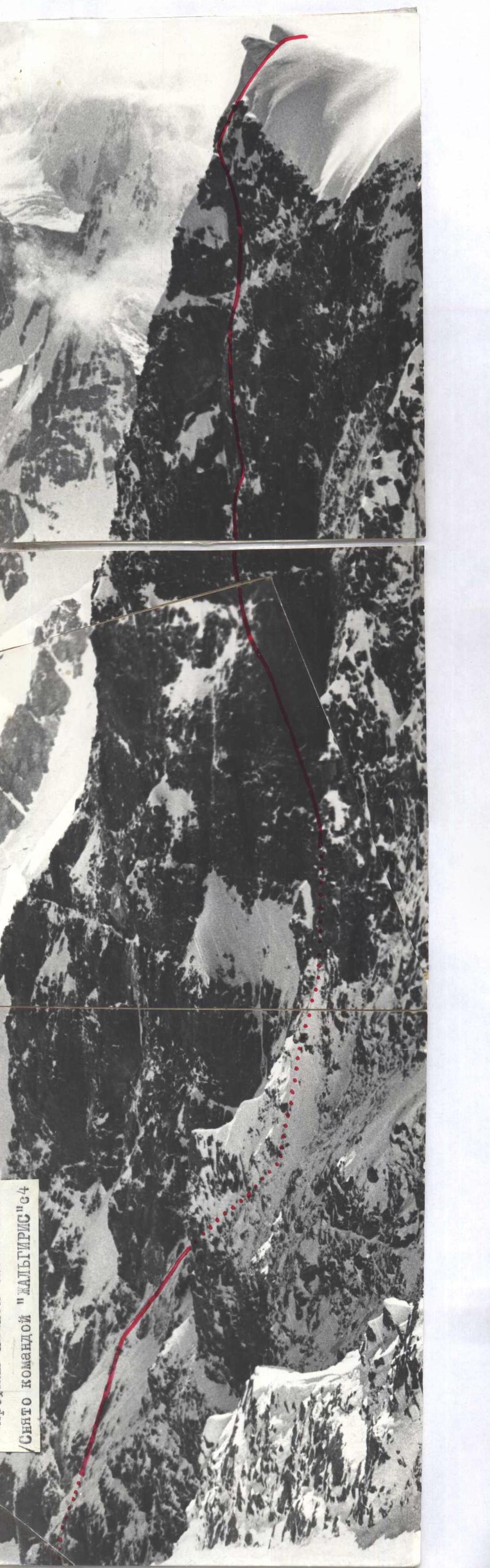
After two hours, we descend to the base camp. Table of main characteristics of the ascent route: Center of the big triangle of the North wall of Dzhigit peak. Height difference: 1320 m, including complex sections: 1220 m, average steepness: 79°.
| Date | Passed sections | Average steepness | Length of section (by length) | Characteristics of the section and passage conditions by relief | Category of difficulty of the section | By method of overcoming and belay | By weather conditions | Departure time | End time | Working hours | Rock pitons | Ice pitons | Bolts | Bivouac conditions |
|---|---|---|---|---|---|---|---|---|---|---|---|---|---|---|
| 24.07.1976 г. | R0–R1 | 90° | 7 | Ice wall | 6 | Platform, ladders, pitons | Good | 3:00 | 18:00 | 15 | – | 7 | – | Hanging bivouac |
| R1–R2 | 65° | 120 | Ice wall | 5A | Crampons, pitons | Snowfall | – | 12 | – | |||||
| 25.07.1976 г. | R2–R3 | 80° | 50 | Solid rocks, limited holds | 5Б | Difficult climbing | Overcast | 12:00 | 19:00 | 7 | 10 | – | – | Hanging bivouac |
| R3–R4 | 105° | 7 | Cornice, smooth rocks | 6 | On a platform, pitons | Overcast | 11 | – | – | |||||
| R4–R5 | 90° | 15 | Solid rocks, limited holds | 6 | Very difficult climbing. On one spot on a platform, pitons | Overcast | 7 | – | – | Processing | ||||
| R5–R6 | 85° | 25 | Solid monolithic rocks, limited holds | 6 | Difficult climbing, ladder on one spot | Overcast | 12 | – | – | |||||
| R6–R7 | 90° | 20 | Solid, monolithic rocks. Few holds | 6 | Very difficult climbing. Using a platform and ladder | Overcast | 14 | – | – | |||||
| R7–R8 | 80° | 15 | Inner corner | 5Б | Difficult climbing | Fog. Weather starts to worsen | 3 | – | – | |||||
| R8–R9 | 95° | 10 | Overhanging wall, few holds | 6 | Very difficult climbing, ladders, platforms | Fog, weather worsens | 7 | – | – | |||||
| R9–R10 | 80° | 5 | Monolithic smooth wall, limited holds | 5Б | Very difficult climbing | Weather has worsened | 1 | – | – | |||||
| 26–28.07.1976 г. | Bad weather | 15:00 | 21:00 | 6 | Hanging bivouac | |||||||||
| 29.07.1976 г. | Bad weather, clearing by 16:00 | 16:00 | 21:00 | 5 | Hanging bivouac | |||||||||
| 30.07.1976 г. | R10–R11 | 115° | 8 | Cornice, smooth surface, thin cracks | 6 | Climbing using artificial holds | Overcast weather | 13:00 | 20:00 | 7 ч | 11 | – | – | Hanging bivouac |
| R11–R12 | 85° | 20 | Wall monolithic, wide cracks | 6 | Very difficult climbing, pitons | Overcast | 6 | – | – | |||||
| R12–R13 | 90° | 7 | Monolithic rocks, limited holds | 6 | Very difficult climbing | Overcast | 3 | – | – | |||||
| R13–R14 | 100° | 5 | Monolithic smooth rock above a ledge | 6 | Platform, ladders | Overcast | 6 | – | – | |||||
| 31.07.1976 г. | R14–R15 | 85° | 22 | Smooth slabs, cracks filled with ice | 6 | Very difficult climbing forward | Overcast, wind | 7:30 | 20:00 | 12,5 | 6 | – | – | For four - sitting bivouac. Two reached section R10–R11 and organized a hanging bivouac |
| R15–R16 | 105° | 5 | Smooth wall, few cracks for pitons | 6 | Platform, ladders | Variable weather, wind | 7 | – | 1 | |||||
| R16–R17 | 80° | 25 | Smooth slabs, very few holds | 6 | Very difficult climbing, ladders | Bad weather | 7 | – | – | |||||
| R17–R18 | 85° | 15 | Slab with small holds | 5Б | Difficult climbing | Overcast | 4 | – | – | |||||
| R18–R19 | 90° | 8 | Smooth slabs | 6 | Very difficult climbing, ladders | Overcast | 4 | – | – | |||||
| R19–R20 | 85° | 15 | Smooth slabs | 6 | Very difficult climbing, ladders | Weather worsens, wind | 6 | – | – | |||||
| R20–R21 | 100° | 6 | Monolithic rocks | 6 | Ladder, platform | Wind is intensifying | 9 | – | – | |||||
| R21–R22 | 85° | 15 | Solid, monolithic rocks, limited holds | 5Б | Medium climbing | Wind, overcast | 4 | – | 1 | |||||
| R22–R23 | 45° | 5 | Ledge covered with ice | 4А | Difficult climbing | Wind, overcast | 1 | – | – | |||||
| R23–R24 | 70° | 15 | Rocks with holds | 5Б | Difficult climbing | Wind, clearing up | 3 | – | – | |||||
| 01.08.1976 г. | R24–R25 | 90° | 12 | Rocks covered with thin ice | 5Б | Difficult climbing, ladders | Wind, overcast | 11:30 | 15:00 | 3,5 | 8 | – | – | For four - sitting bivouac, for two - hanging |
| R25–R26 | 75° | 15 | Rocky wall with holds | 5Б | Difficult climbing | Wind, clearing up | 3 | – | – | |||||
| R26–R27 | 90° | 5 | Rocky icy wall | 5Б | Difficult climbing | Wind, overcast | 2 | – | – | |||||
| 02.08.1976 г. | R27–R28 | 65° | 120 | Ice slope with rocky outcrops | 5Б | Crampons, ladders | Weather clear, light wind | 11:00 | 20:00 | 9 | 7 | 14 | – | For four - hanging bivouac, for two - sitting |
| 03.08.1976 г. | R28–R29 | 70° | 40 | Icing, rocky islands on the ice slope | 5Б | Crampons | Overcast, wind | 9:00 | 20:00 | 11 | 3 | 5 | – | Sitting bivouac |
| R29–R30 | 85° | 25 | Monolithic rocks. Few holds | 6 | Very difficult climbing, ladders | Overcast, wind | 7 | – | – | |||||
| 04.08.1976 г. | R30–R31 | 90° | 20 | Rocks with limited holds | 6 | Very difficult climbing, ladders | Good weather, light wind | 8:00 | 19:30 | 11 ч 30 мин | 8 | – | – | Hanging bivouac |
| R31–R32 | 80° | 90 | Monolithic rocks. Below is a crevice | 5Б | Difficult climbing | Overcast, wind | 16 | – | – | |||||
| R32–R33 | 110° | 15 | Smooth slab with cracks | 6 | Platform, ladders | Overcast, wind | 18 | – | – | |||||
| R33–R34 | 90° | 50 | Monolithic rocks. Few holds | 6 | Very difficult climbing, platform, ladders | Sleet, wind | 11 | – | – | |||||
| 05.08.1976 г. | Passing the processed section. Reaching the snowy ridge. | Sitting bivouac | ||||||||||||
| 06.08.1976 г. | R34–R35 | 45° | 25 | Snow-ice ridge | 4А | Cutting steps, through an ice axe | Clear weather | 7:30 | 20:00 | 12,5 | – | – | – | Hanging bivouac |
| R35–R36 | 90° | 20 | Solid rocks with cracks | 5Б | Difficult climbing | Clear weather | 5 | – | – | |||||
| R36–R37 | 70° | 15 | Solid rocks with cracks | 5А | Difficult climbing | Overcast | 2 | – | – | |||||
| R37–R38 | 80° | 20 | Solid rocks with cracks | 5Б | Difficult climbing | Overcast | 4 | – | – | |||||
| R38–R39 | 65° | 20 | Snow-ice slope | 5Б | Cutting and kicking steps | Overcast, weather worsens | – | 2 | – | |||||
| R39–R40 | 90° | 50 | Monolithic rocks, few holds | 6 | Very difficult climbing | Overcast, wind | 14 | – | – | |||||
| R40–R41 | 75° | 45 | Monolithic rocks, few holds | 5Б | Difficult climbing | Overcast, wind | 6 | – | – | |||||
| 07.08 |