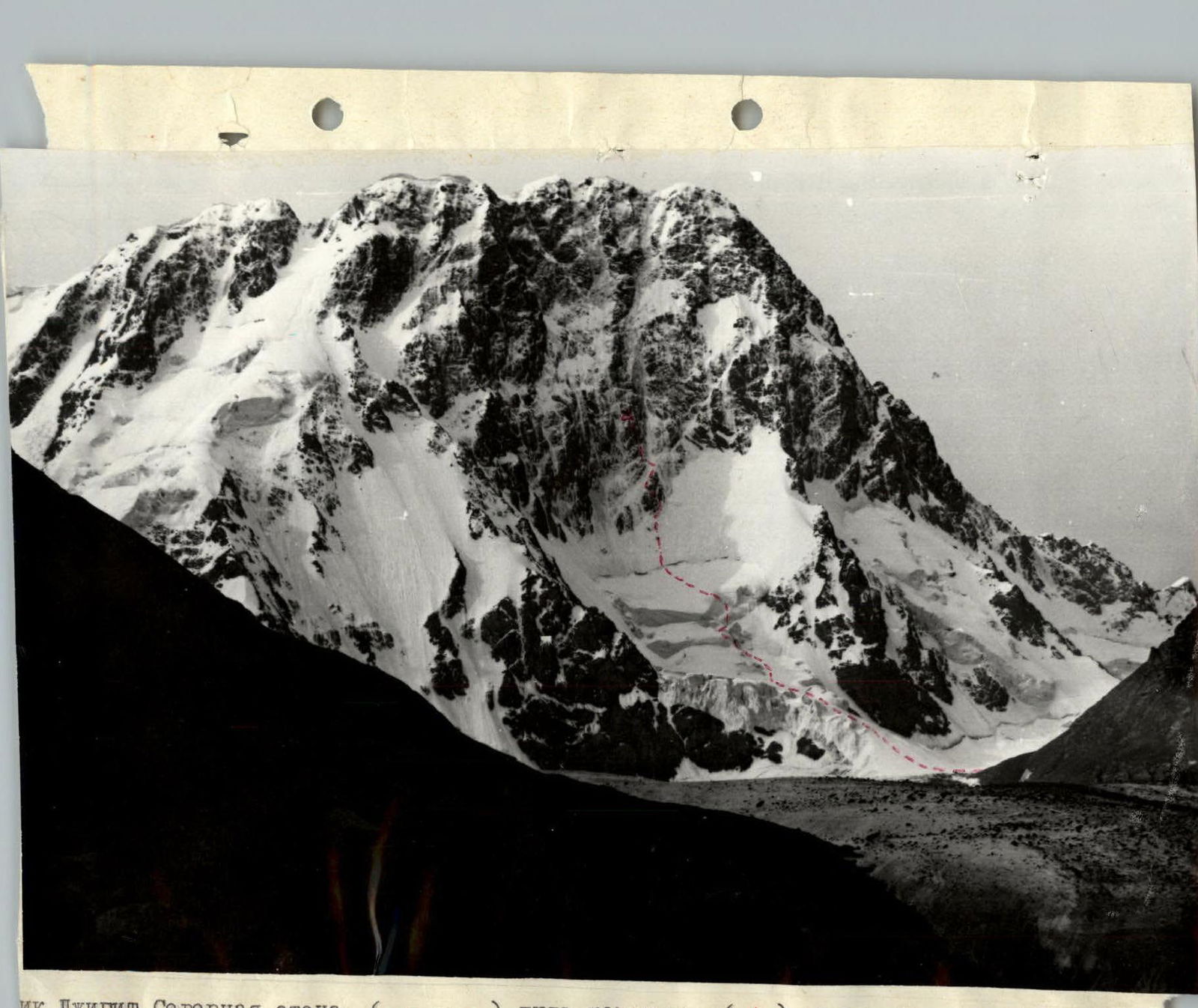
REPORT ON THE PARTICIPATION OF THE CS DSO “LOKOMOTIV” TEAM IN THE USSR CHAMPIONSHIP IN ALPINISM IN THE 1974 SEASON
The composition of the team that actually participated in the championship:
- Manshin Yu.P. — team captain,
- Volkov R.P. — deputy captain,
- Repin V.D.,
- Vodolazhsky V.K.,
- Svitov V.M.
The team was supported by a rescue team and a communications group consisting of:
- Marfin V.M.,
- Shmuylovich S.G.,
- Slavin A.V.,
- Gorodetsky E.V.,
- Makulov A.V.,
- Nagorsky A.S.
According to the plan developed and approved by the CS, the entire team participated in a gathering at the Adyl-Su tourist center from June 26 to July 31, where the team performed training ascents, and the rescue team members fulfilled the standards for the Candidate for Master of Sports.
On July 28, the team captain flew to Frunze to organize the procurement of food and transportation to the area of Peak Jigit. On August 1, the team and support staff arrived there. On August 3, the entire team departed from Frunze and on August 4, they were at the Ala-Too tourist center. On that day, a base camp was set up next to Ala-Too, and documents were presented to the championship judge S. Savvon and the head of the Central Tian Shan CSP A. Kholodnyak.
On August 5, the team and support staff went to the Jigit Glacier with the aim of organizing an intermediate camp to observe the route and establish communication with the base camp and CSP. On that day, the weather was normal: clear from night until 11:00, rain from 12:00 to 18:00 with snow on the glacier, and clear from 18:00 to night.
On the night of August 6, a snowfall began, which continued throughout the day and the night of August 7. After a short break in the morning, the snowfall resumed, and by mid-day, there was about 30 cm of fresh snow on the moraine. Observation and communication were not possible, so to avoid consuming supplies in the intermediate camp (7 hours walk from the base camp), the team descended to Ala-Too.
On August 8, the work on organizing the base camp was completed. By evening, signs of improving weather appeared.
On August 9, the weather was good throughout the day. The team, with a load of equipment and supplies, went to the intermediate camp on the moraine.
On August 10, the weather was good throughout the day. Stable radio communication was established with the base camp. Observations were made of the wall. Avalanches descended from the sides of the wall facing east and west onto the cirque glacier from 12:00. The center of the wall was thawing much more slowly as it was lit:
- at the very top until 10:00,
- from 18:00 to 19:30 — a large part of the wall, but not intensely and not for long.
On August 11, the weather was good again. They observed the regime of avalanches and rockfalls from the wall. The observation was conducted by going out onto the cirque glacier plateau for a closer acquaintance with the state of the center of the North wall. It was still heavily snowed up. The side of the wall facing west (to the left of the center) was very quickly clearing of snow. From 11:00, it was lit by the sun until sunset, and avalanches and rockfalls were intense on it. By the evening of August 11, this side was entirely black. Rockfalls and large avalanches were not observed on the center of the wall.
On the morning of August 12, the weather began to deteriorate. Since the team did not have a lot of time for observation, it was decided to limit it to two days. They concluded that the route was steep throughout, from 70 to 90°. The rocks were snow-covered and icy and, therefore, very difficult.
They roughly determined:
- the places for overnight stays
- the duration of the ascent — 8–10 days
They did not detect any avalanche or rockfall danger, except for the transition from the lower rock triangle to the main ridge leading to the crest of Jigit. On August 12, the team descended to the base camp. It rained from 18:00 until morning.
On August 13, preparations were made for the exit to the route, the route sheet was filled out, and permission to exit was obtained from the deputy authorized by the Federation, V. Samokhvalov, and the exit was registered with the CSP. The weather was unstable.
On August 14, the team left Ala-Too and spent the night on the moraine. It snowed from 15:00 to 23:00.
On August 15, the team went out onto the cirque glacier plateau. The pair Volkov — Vodolazhsky processed a section of the route from the bergschrund to the top of the lower rock triangle. Overnight stay on the moraine. Snowfall began at 16:00 and continued all night, ending only late in the morning on August 16. On this day, they waited out the bad weather. From the second half of the day, the sun was shining, and avalanches came down from the cirque glacier. On August 17, the team went out onto the route in full strength. Working with a change of rope team shifts and pulling up backpacks, the team crossed the couloir between the lower rock triangle and the main ridge along the center of the North wall and went up to a 70-meter sheer chimney to a snow patch — the intended overnight location. There were no places for a platform. Due to the lack of daylight, they hacked out a platform for a standing bivouac. It was planned to organize a good sitting bivouac in a rope hammock the next day and, after resting, move further. Snowfall began at 19:00 and continued all night. The bivouac was covered with snow flowing in a continuous stream down the entire wall. The temperature was relatively high, and the snow at their altitude was sticky. They spent the night covered with a tent with the entrance facing downwards. The psychological state of the team was calm and optimistic.
On the morning of August 18, the snowfall stopped, but there were signs of worsening weather. The nearest section, 100–150 m long and with a steepness of 80–85°, was completely covered with a thick layer of snow, making it impossible to move along it for the next two days. With the continuation of bad weather, the avalanche danger increased, especially in the couloir between the ridge and the lower rock triangle, as snow accumulated at the top under the crest. The team decided to descend and wait out the bad weather in the camp on the moraine. The snowfall resumed at 10:00 and did not stop until the middle of the next day, August 19. The bad weather with constant snowstorms continued on August 20 and 21. The temperature dropped to –15°.
On August 21, the team decided to abandon the route, as its condition did not allow them to proceed earlier than in a week of good weather. About 50 cm of snow had fallen on the moraine. An attempt was made to retrieve the equipment from under the route, and the team went to the base camp, dismantling the camp on the moraine. In addition to the weather, this decision was influenced by the fact that the stay on Tian Shan, as stipulated by the budget, was coming to an end, and accordingly, the supplies were running out.
On August 22, a debriefing was conducted in the presence of a federation representative. On August 23, the team departed to Frunze, and on August 25, they arrived at the Adylsu tourist center. After a financial report and the return of equipment, on August 27, the team finished its work, and the participants dispersed.
The team's withdrawal from the route is explained by the harsh weather conditions in the 1974 season, which was confirmed by the head of CSP A. Kholodnyak, the lack of time to wait out the bad weather, as the budget provided for the team's stay on Tian Shan for only 20 days, from August 4 to 24, and the impossibility of entering the route immediately upon arrival, as the participants of the championship were in the area of Peak Jigit for the first time and were not sufficiently familiar with the route, its conditions, and local circumstances.
Entering the second declared route was not provided for in the budget.
Team Captain (Yu. Manshin, Honored Master of Sports of the USSR)