
-
Ice class
-
Teskey Ala-Too, Jety-Oguz gorge
-
Peak Oguz-bashi 2nd West along the northern wall
-
Peak Oguz-bashi, cat. dif. 5B, second ascent
-
Height difference: 800 m, length — 1060 m, length of sections 5–6 cat. dif. — 700 m, average steepness of the entire route ~ 55° (4200–5000 m), of which: 50° (4200–4500 m), 80° (4500–4700 m), 70° (4700–4950 m)
-
Pitons driven (approximately):
- rock 60, ice 90, chocks 6
-
Team's climbing hours to the summit — 14.5 hours
-
Convenient overnight stay on the summit ridge.
-
Team leader Khilko Vladimir Pavlovich — CMS (unofficial)
Team members:
- Shapovalov Vladimir Alexandrovich — CMS
- Bikineev Shamil Ilyich — CMS
- Afanasyev Alekseyevich Georgiyevich — CMS (unofficial)
- Coach: Dyachenko Nikolai Nikolayevich — MS
- Departure to the route: July 18, 1986
Summit: July 18, 1986
Return: July 19, 1986

- ----- route taken by the team
- Δ — overnight stay
- ..... descent path from the summit
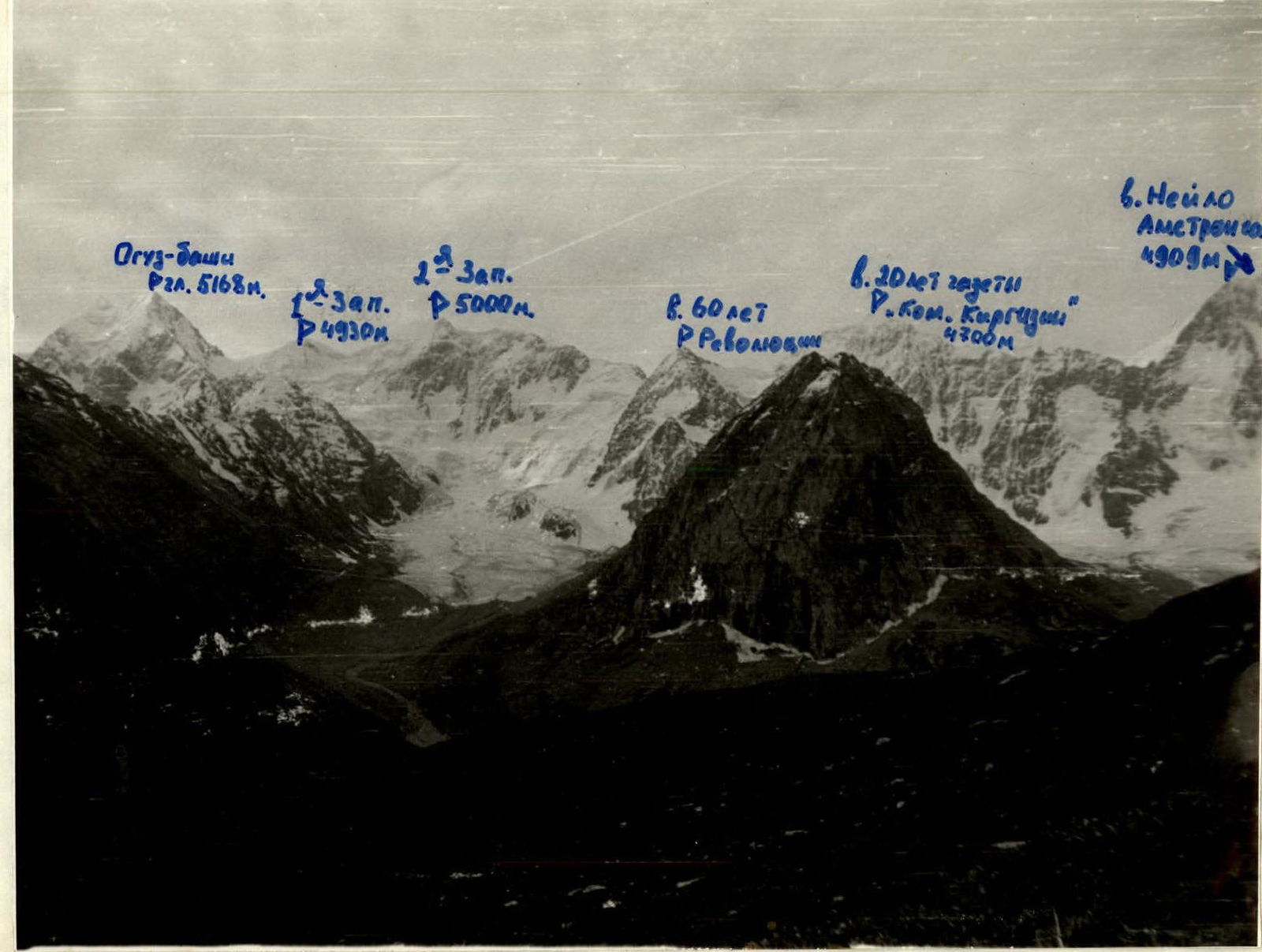
Photopanorama
Tactical actions of the team. The route can be conditionally divided into three sections:
-
Section I (R0–R2) — ice slab with a length of 450 m, average steepness 50°, passable in individual pairs. All participants were in crampons, each had ice axes and ice hammers. Each rope team had its own set of pitons.
-
Section II (R3–R2) — rock wall with a length of 400 m, average steepness 75°. The lower part of the wall is very steep, местами up to 90°. The rocks are very difficult to pass due to being covered with flow ice. The ice layer is thin, making it impossible to use ice screws, so the team had to constantly clear the rocks of ice. The first 200 m of the wall were worked on by the pair Shapovalov — Afanasyev, taking turns. The rope team Khilko — Bikineev climbed using rope ascenders and a "chest-leg" system. The second part of the wall is less steep, composed of large blocks, but covered with a thick layer of ice. The use of rock pitons was practically excluded. Ice screws were used for belaying, which required great attention — it was necessary to choose areas with winter ice, as fresh ice lay in layers — 20 cm of ice, then firn, then ice again. This section was first climbed by Khilko — Bikineev, while the rope team Shapovalov — Afanasyev followed using rope ascenders.
A very unpleasant section is the transition from the wall to the "roof" — wide gullies, polished by descending snow and covered in ice at the time of ascent.
- Section III (R5–R10) — "roof", height difference 150 m and average steepness 35–40°, does not present particular technical difficulty, but is psychologically challenging. Very deep wet snow ( местами above waist level), requiring the creation of a trench. Belaying was done from one rocky outcrop to another, with at least three pitons being driven. Here, both the rope teams and the leaders within the teams constantly changed.